A seminar on,
CONCEPT OF REGULATED AND NON-REGULATED MARKET
Submitted to
Savitribai Phule ,Pune University
In Partial fulfilment of Requirements for the Award of
Degree of
MASTER OF PHARMACY
IN
PHARMACEUTICAL QUALITY ASSURANCE TECHNIQUES
Bhujbal Knowledge City,
MET’S Institute of Pharmacy,
Adgaon, Nashik.
2018-2019
Presented by-
Mr. Sanket D. Pawar.
M.Pharm (PQAT) Sem I
Guided By-
Dr. G. S. Deokar
(M.Pharm, PhD)
1
CONTENTS
 Introduction :
 Types of Markets :
 Regulated Market :
 Non- Regulated Market :
2
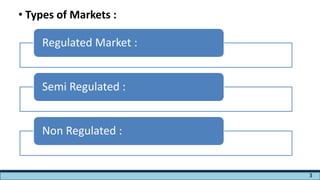
Regulated Market :
Semi Regulated :
Non Regulated :
• Types of Markets :
3
 Introduction :
Regulatory process by which a person/organization/sponsor/innovator
gets authorization to launch a drug in the market is known as drug
approval process. In general, a drug approval process comprises of
various stages: application to conduct clinical trials, conducting clinical
trials, application to marketing authorization of drug and post-marketing
studies. Every country has its own regulatory authority, having an overall
objective of a stringent drug approval system is to ensure that medicinal
products of acceptable quality and efficacy are manufactured.
4
 Regulated Market :
These countries have well-defined procedures for marketing and
distribution of pharmaceuticals both for human and veterinary use.
MAHs should file applications to market their drugs with all the
supportive and required data.
Eg : Major big countries with specific authorities / monitoring bodies to
look after health of its citizens - US, JAPAN, AUSTRALIA, CANADA, INDIA,
Etc.
Regulated pharma markets require submission of dossier in CTD format
which has to provide clinical trial and bioequivalence studies.
5
The Common Technical Document (CTD) is a set of
specification for application dossier for the registration of
Medicines. It is an internationally agreed format for the
preparation of applications regarding new drugs intended
to be submitted to regional regulatory authorities in
participating countries. It was developed by the European
Medicines Agency (EMA, Europe), the Food and Drug
Administration (FDA, US) and the Ministry of Health,
Labour and Welfare (Japan). The CTD is maintained by
the International Conference on Harmonisation of
Technical Requirements for Registration of
Pharmaceuticals for Human Use (ICH).
What is CTD ?
6
Various Applications :
• INDA (Investigational New Drug Application) : Program is
the means by which a pharmaceutical company obtains
permission to start human clinical trials and to ship an
experimental drug across state lines (usually to clinical
investigators) before a marketing application for the drug has
been approved.
The content of an IND is prescribed in the Code of federal
regulation and it submitted under cover sheet (Form FDA-1571)
7
• NDA (New Drug Application) : The Food and Drug Administration
New Drug Application (NDA) is the vehicle in the United States through
which drug sponsors formally propose that the FDA approve a new
pharmaceutical for sale and marketing. Some 30% or less of initial drug
candidates proceed through the entire multi-year process of drug
development, concluding with an approved NDA, if successful.
An application for a new chemiacal entity form FDA 356h.
8
 Non- Regulated Market :
Non-regulated: Small to very countries which do
not have any specific authorities which controls
the supply of medicine. One can consider newly
formed countries, small population countries and
under developed countries. AFRICAN countries,
Asian countries. Being said since these countries
do not have specific monitoring authorities, they
depend on other regulated countries.
9
•Products falls in Non-Regulated Market:
Unregulated products, however, are not required to meet any of the
standards and are not subjected by law to any evaluation or follow-up in
the marketplace. As long as they do not claim to cure any particular
disease or ailment, they are not subjected to the rigorous clinical
processes described. In order to prove that they cure, they would have
had to undergo the clinical trial process to prove their effectiveness and
safety. Hence their labels will not make any specific claim of benefit, but
instead use general terms like 'may be helpful in', health aid, or 'has been
used in', and may list a number of general health conditions.
Example : All OT
10
11

Regulated and Non-Regulated marked

  • 1.
    A seminar on, CONCEPTOF REGULATED AND NON-REGULATED MARKET Submitted to Savitribai Phule ,Pune University In Partial fulfilment of Requirements for the Award of Degree of MASTER OF PHARMACY IN PHARMACEUTICAL QUALITY ASSURANCE TECHNIQUES Bhujbal Knowledge City, MET’S Institute of Pharmacy, Adgaon, Nashik. 2018-2019 Presented by- Mr. Sanket D. Pawar. M.Pharm (PQAT) Sem I Guided By- Dr. G. S. Deokar (M.Pharm, PhD) 1
  • 2.
    CONTENTS  Introduction : Types of Markets :  Regulated Market :  Non- Regulated Market : 2
  • 3.
    Regulated Market : SemiRegulated : Non Regulated : • Types of Markets : 3
  • 4.
     Introduction : Regulatoryprocess by which a person/organization/sponsor/innovator gets authorization to launch a drug in the market is known as drug approval process. In general, a drug approval process comprises of various stages: application to conduct clinical trials, conducting clinical trials, application to marketing authorization of drug and post-marketing studies. Every country has its own regulatory authority, having an overall objective of a stringent drug approval system is to ensure that medicinal products of acceptable quality and efficacy are manufactured. 4
  • 5.
     Regulated Market: These countries have well-defined procedures for marketing and distribution of pharmaceuticals both for human and veterinary use. MAHs should file applications to market their drugs with all the supportive and required data. Eg : Major big countries with specific authorities / monitoring bodies to look after health of its citizens - US, JAPAN, AUSTRALIA, CANADA, INDIA, Etc. Regulated pharma markets require submission of dossier in CTD format which has to provide clinical trial and bioequivalence studies. 5
  • 6.
    The Common TechnicalDocument (CTD) is a set of specification for application dossier for the registration of Medicines. It is an internationally agreed format for the preparation of applications regarding new drugs intended to be submitted to regional regulatory authorities in participating countries. It was developed by the European Medicines Agency (EMA, Europe), the Food and Drug Administration (FDA, US) and the Ministry of Health, Labour and Welfare (Japan). The CTD is maintained by the International Conference on Harmonisation of Technical Requirements for Registration of Pharmaceuticals for Human Use (ICH). What is CTD ? 6
  • 7.
    Various Applications : •INDA (Investigational New Drug Application) : Program is the means by which a pharmaceutical company obtains permission to start human clinical trials and to ship an experimental drug across state lines (usually to clinical investigators) before a marketing application for the drug has been approved. The content of an IND is prescribed in the Code of federal regulation and it submitted under cover sheet (Form FDA-1571) 7
  • 8.
    • NDA (NewDrug Application) : The Food and Drug Administration New Drug Application (NDA) is the vehicle in the United States through which drug sponsors formally propose that the FDA approve a new pharmaceutical for sale and marketing. Some 30% or less of initial drug candidates proceed through the entire multi-year process of drug development, concluding with an approved NDA, if successful. An application for a new chemiacal entity form FDA 356h. 8
  • 9.
     Non- RegulatedMarket : Non-regulated: Small to very countries which do not have any specific authorities which controls the supply of medicine. One can consider newly formed countries, small population countries and under developed countries. AFRICAN countries, Asian countries. Being said since these countries do not have specific monitoring authorities, they depend on other regulated countries. 9
  • 10.
    •Products falls inNon-Regulated Market: Unregulated products, however, are not required to meet any of the standards and are not subjected by law to any evaluation or follow-up in the marketplace. As long as they do not claim to cure any particular disease or ailment, they are not subjected to the rigorous clinical processes described. In order to prove that they cure, they would have had to undergo the clinical trial process to prove their effectiveness and safety. Hence their labels will not make any specific claim of benefit, but instead use general terms like 'may be helpful in', health aid, or 'has been used in', and may list a number of general health conditions. Example : All OT 10
  • 11.