Dr. Chamendra Ranasinghe
Senior Superintendent of Police
MBBS, MSc ( Med. Admin), PGD in Health Development &
Dip. In Occupational health
Mail: chamendra1009@gmail.com
3/3/2020 1
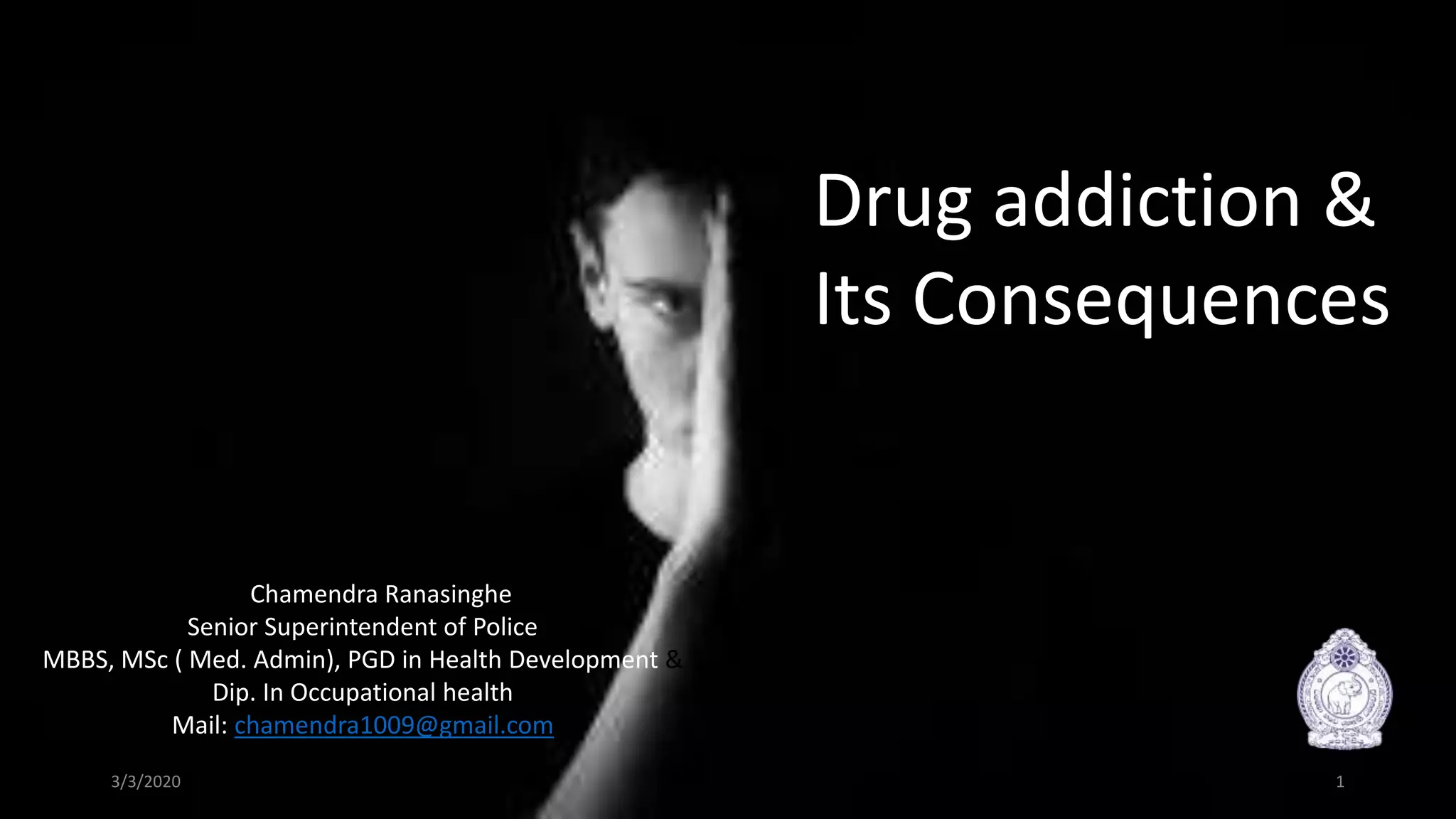
Drug addiction &
Its Consequences
3/3/2020 2
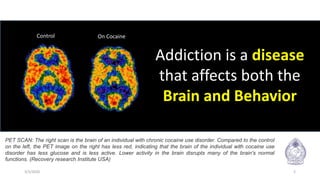
PET SCAN: The right scan is the brain of an individual with chronic cocaine use disorder. Compared to the control
on the left, the PET image on the right has less red, indicating that the brain of the individual with cocaine use
disorder has less glucose and is less active. Lower activity in the brain disrupts many of the brain's normal
functions. (Recovery research Institute USA)
Control On Cocaine
Addiction is a disease
that affects both the
Brain and Behavior
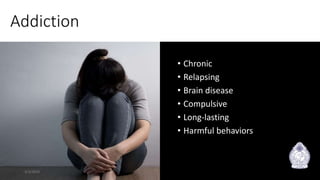
Addiction
3/3/2020 3
• Chronic
• Relapsing
• Brain disease
• Compulsive
• Long-lasting
• Harmful behaviors
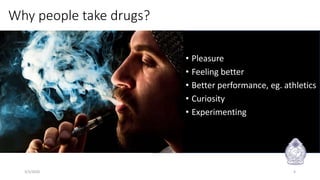
Why people take drugs?
• Pleasure
• Feeling better
• Better performance, eg. athletics
• Curiosity
• Experimenting
3/3/2020 4
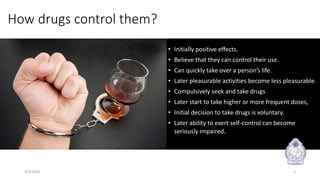
How drugs control them?
• Initially positive effects.
• Believe that they can control their use.
• Can quickly take over a person’s life.
• Later pleasurable activities become less pleasurable.
• Compulsively seek and take drugs
• Later start to take higher or more frequent doses,
• Initial decision to take drugs is voluntary.
• Later ability to exert self-control can become
seriously impaired.
3/3/2020 5
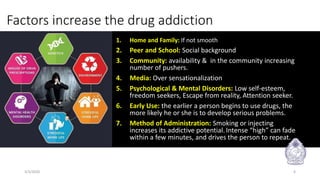
Factors increase the drug addiction
1. Home and Family: If not smooth
2. Peer and School: Social background
3. Community: availability & in the community increasing
number of pushers.
4. Media: Over sensationalization
5. Psychological & Mental Disorders: Low self-esteem,
freedom seekers, Escape from reality, Attention seeker.
6. Early Use: the earlier a person begins to use drugs, the
more likely he or she is to develop serious problems.
7. Method of Administration: Smoking or injecting
increases its addictive potential. Intense “high” can fade
within a few minutes, and drives the person to repeat.
3/3/2020 6
Phases of drug addiction
1. Experimentation phase - A new user tries to
use drug once and often produces a negative
result which makes the user not to try again.
2. Occasional use - The user only uses drugs when
he is with his friends so he wont be out of place.
3. Regular use - In this stage, the user is actively
seeks the drug of abuse of his choice. He always
carves for drugs. He uses drugs often time.
Obviously, can’t live without using drug.
73/3/2020
Sign & Symptoms
• Secretive
• Wants to be alone
• Change in dress and appearance
• Change in interests and activities
• Losing or gaining of weight
• Physically hurting people
• Rebellious or offensive behavior
• Absent-minded
• Avoiding the issue of drug abuse when
asked about it.
• Possession of illegal drugs in his room
• Needle marks on his arms
• Spending time with known drug users
• Defending teen use of drugs
• Suicide attempt
• Repeatedly having bloodshot eyes
• Puffy or droopy eyelids
3/3/2020 8
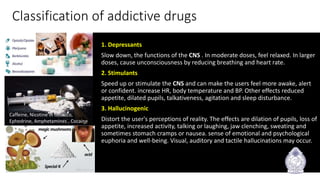
Caffeine, Nicotine in tobacco,
Ephedrine, Amphetamines , Cocaine
Classification of addictive drugs
1. Depressants
Slow down, the functions of the CNS . In moderate doses, feel relaxed. In larger
doses, cause unconsciousness by reducing breathing and heart rate.
2. Stimulants
Speed up or stimulate the CNS and can make the users feel more awake, alert
or confident. increase HR, body temperature and BP. Other effects reduced
appetite, dilated pupils, talkativeness, agitation and sleep disturbance.
3. Hallucinogenic
Distort the user's perceptions of reality. The effects are dilation of pupils, loss of
appetite, increased activity, talking or laughing, jaw clenching, sweating and
sometimes stomach cramps or nausea. sense of emotional and psychological
euphoria and well-being. Visual, auditory and tactile hallucinations may occur.
3/3/2020
9
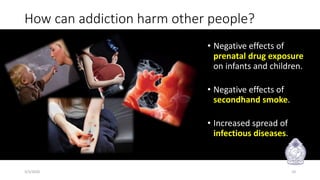
How can addiction harm other people?
• Negative effects of
prenatal drug exposure
on infants and children.
• Negative effects of
secondhand smoke.
• Increased spread of
infectious diseases.
3/3/2020 10
Medical consequences of drug addiction
• Increase risk of cardiovascular disease, stroke, cancer,
HIV/ AIDS, Hepatitis B and mental disorders.
• Tobacco smoke causes cancer of the mouth, throat,
larynx, blood, lungs, stomach, pancreas, kidney, bladder,
and cervix.
• Toxic to nerve cells
• Mental illness often co-exist. In some cases, mental
disorders such as anxiety, depression, or schizophrenia
may precede addiction; in other cases, drug abuse may
trigger or exacerbate those mental disorders,
particularly in people with specific vulnerabilities.
3/3/2020 11
Effects to the Family
• Intense feeling of humiliation and
guilt are felt by family members.
• Self-esteem in generally low among
the members of the family.
• The spirit of togetherness or unity
is broken.
• Occurrence of domestic violence.
• Loss of money or valuables.
3/3/2020 12
Effects to the Community
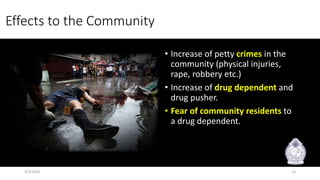
• Increase of petty crimes in the
community (physical injuries,
rape, robbery etc.)
• Increase of drug dependent and
drug pusher.
• Fear of community residents to
a drug dependent.
3/3/2020 13
Effects to Economy
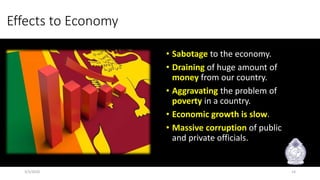
• Sabotage to the economy.
• Draining of huge amount of
money from our country.
• Aggravating the problem of
poverty in a country.
• Economic growth is slow.
• Massive corruption of public
and private officials.
3/3/2020 14
Effects to Law Enforcement
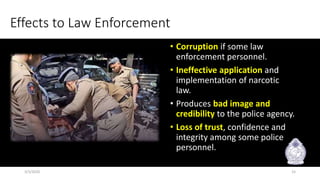
• Corruption if some law
enforcement personnel.
• Ineffective application and
implementation of narcotic
law.
• Produces bad image and
credibility to the police agency.
• Loss of trust, confidence and
integrity among some police
personnel.
3/3/2020 15
Myth Busting
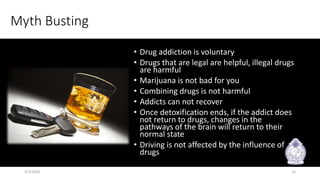
• Drug addiction is voluntary
• Drugs that are legal are helpful, illegal drugs
are harmful
• Marijuana is not bad for you
• Combining drugs is not harmful
• Addicts can not recover
• Once detoxification ends, if the addict does
not return to drugs, changes in the
pathways of the brain will return to their
normal state
• Driving is not affected by the influence of
drugs
3/3/2020 16
Anti-drug war is as important as the
fight against terrorism
3/3/2020 17
Why is adolescence a critical time for
preventing drug addiction?
• Challenging social and academic situations.
• Increase availability of drugs.
• Experimental behavior.
• Sharing experience.
• Weaker assessment.
• Using abusable substances at this age can
disrupt brain function in areas critical to
motivation, memory, learning, judgment,
and behavior control.
3/3/2020 18
Family & religious values are the answer for
many of these problems.
• Family support.
• Share patient experience.
• Problem identification.
• Spending time.
• Emotionally strengthen.
• Stay alert.
• Religious teachings
3/3/2020 19
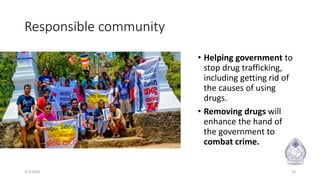
Responsible community
• Helping government to
stop drug trafficking,
including getting rid of
the causes of using
drugs.
• Removing drugs will
enhance the hand of
the government to
combat crime.
3/3/2020 20
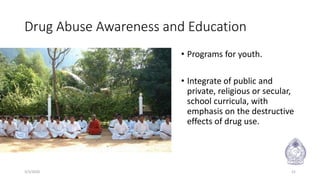
Drug Abuse Awareness and Education
• Programs for youth.
• Integrate of public and
private, religious or secular,
school curricula, with
emphasis on the destructive
effects of drug use.
3/3/2020 21
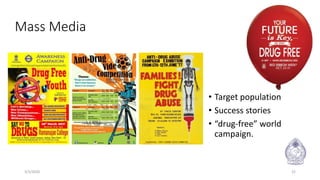
Mass Media
• Target population
• Success stories
• “drug-free” world
campaign.
3/3/2020 22
3/3/2020 23
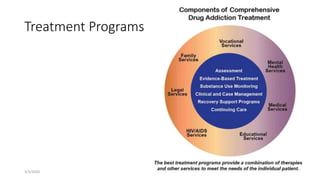
Treatment Programs
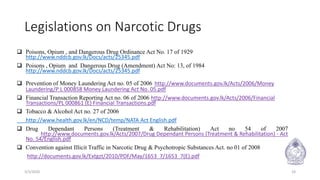
Legislations on Narcotic Drugs
 Poisons, Opium , and Dangerous Drug Ordinance Act No. 17 of 1929
http://www.nddcb.gov.lk/Docs/acts/25345.pdf
 Poisons , Opium and Dangerous Drug (Amendment) Act No: 13, of 1984
http://www.nddcb.gov.lk/Docs/acts/25345.pdf
 Prevention of Money Laundering Act no. 05 of 2006 http://www.documents.gov.lk/Acts/2006/Money
Laundering/P L 000858 Money Laundering Act No. 05.pdf
 Financial Transaction Reporting Act no. 06 of 2006 http://www.documents.gov.lk/Acts/2006/Financial
Transactions/PL 000861 (E) Financial Transactions.pdf
 Tobacco & Alcohol Act no. 27 of 2006
http://www.health.gov.lk/en/NCD/temp/NATA Act English.pdf
 Drug Dependant Persons (Treatment & Rehabilitation) Act no 54 of 2007
http://www.documents.gov.lk/Acts/2007/Drug Dependant Persons (Treatment & Rehabilitation) - Act
No. 54/English.pdf
 Convention against Illicit Traffic in Narcotic Drug & Psychotropic Substances Act. no 01 of 2008
http://documents.gov.lk/Extgzt/2010/PDF/May/1653_7/1653_7(E).pdf
3/3/2020 24
3/3/2020 25

Drug addiction and its consequences

  • 1.
    Dr. Chamendra Ranasinghe SeniorSuperintendent of Police MBBS, MSc ( Med. Admin), PGD in Health Development & Dip. In Occupational health Mail: chamendra1009@gmail.com 3/3/2020 1 Drug addiction & Its Consequences
  • 2.
    3/3/2020 2 PET SCAN:The right scan is the brain of an individual with chronic cocaine use disorder. Compared to the control on the left, the PET image on the right has less red, indicating that the brain of the individual with cocaine use disorder has less glucose and is less active. Lower activity in the brain disrupts many of the brain's normal functions. (Recovery research Institute USA) Control On Cocaine Addiction is a disease that affects both the Brain and Behavior
  • 3.
    Addiction 3/3/2020 3 • Chronic •Relapsing • Brain disease • Compulsive • Long-lasting • Harmful behaviors
  • 4.
    Why people takedrugs? • Pleasure • Feeling better • Better performance, eg. athletics • Curiosity • Experimenting 3/3/2020 4
  • 5.
    How drugs controlthem? • Initially positive effects. • Believe that they can control their use. • Can quickly take over a person’s life. • Later pleasurable activities become less pleasurable. • Compulsively seek and take drugs • Later start to take higher or more frequent doses, • Initial decision to take drugs is voluntary. • Later ability to exert self-control can become seriously impaired. 3/3/2020 5
  • 6.
    Factors increase thedrug addiction 1. Home and Family: If not smooth 2. Peer and School: Social background 3. Community: availability & in the community increasing number of pushers. 4. Media: Over sensationalization 5. Psychological & Mental Disorders: Low self-esteem, freedom seekers, Escape from reality, Attention seeker. 6. Early Use: the earlier a person begins to use drugs, the more likely he or she is to develop serious problems. 7. Method of Administration: Smoking or injecting increases its addictive potential. Intense “high” can fade within a few minutes, and drives the person to repeat. 3/3/2020 6
  • 7.
    Phases of drugaddiction 1. Experimentation phase - A new user tries to use drug once and often produces a negative result which makes the user not to try again. 2. Occasional use - The user only uses drugs when he is with his friends so he wont be out of place. 3. Regular use - In this stage, the user is actively seeks the drug of abuse of his choice. He always carves for drugs. He uses drugs often time. Obviously, can’t live without using drug. 73/3/2020
  • 8.
    Sign & Symptoms •Secretive • Wants to be alone • Change in dress and appearance • Change in interests and activities • Losing or gaining of weight • Physically hurting people • Rebellious or offensive behavior • Absent-minded • Avoiding the issue of drug abuse when asked about it. • Possession of illegal drugs in his room • Needle marks on his arms • Spending time with known drug users • Defending teen use of drugs • Suicide attempt • Repeatedly having bloodshot eyes • Puffy or droopy eyelids 3/3/2020 8
  • 9.
    Caffeine, Nicotine intobacco, Ephedrine, Amphetamines , Cocaine Classification of addictive drugs 1. Depressants Slow down, the functions of the CNS . In moderate doses, feel relaxed. In larger doses, cause unconsciousness by reducing breathing and heart rate. 2. Stimulants Speed up or stimulate the CNS and can make the users feel more awake, alert or confident. increase HR, body temperature and BP. Other effects reduced appetite, dilated pupils, talkativeness, agitation and sleep disturbance. 3. Hallucinogenic Distort the user's perceptions of reality. The effects are dilation of pupils, loss of appetite, increased activity, talking or laughing, jaw clenching, sweating and sometimes stomach cramps or nausea. sense of emotional and psychological euphoria and well-being. Visual, auditory and tactile hallucinations may occur. 3/3/2020 9
  • 10.
    How can addictionharm other people? • Negative effects of prenatal drug exposure on infants and children. • Negative effects of secondhand smoke. • Increased spread of infectious diseases. 3/3/2020 10
  • 11.
    Medical consequences ofdrug addiction • Increase risk of cardiovascular disease, stroke, cancer, HIV/ AIDS, Hepatitis B and mental disorders. • Tobacco smoke causes cancer of the mouth, throat, larynx, blood, lungs, stomach, pancreas, kidney, bladder, and cervix. • Toxic to nerve cells • Mental illness often co-exist. In some cases, mental disorders such as anxiety, depression, or schizophrenia may precede addiction; in other cases, drug abuse may trigger or exacerbate those mental disorders, particularly in people with specific vulnerabilities. 3/3/2020 11
  • 12.
    Effects to theFamily • Intense feeling of humiliation and guilt are felt by family members. • Self-esteem in generally low among the members of the family. • The spirit of togetherness or unity is broken. • Occurrence of domestic violence. • Loss of money or valuables. 3/3/2020 12
  • 13.
    Effects to theCommunity • Increase of petty crimes in the community (physical injuries, rape, robbery etc.) • Increase of drug dependent and drug pusher. • Fear of community residents to a drug dependent. 3/3/2020 13
  • 14.
    Effects to Economy •Sabotage to the economy. • Draining of huge amount of money from our country. • Aggravating the problem of poverty in a country. • Economic growth is slow. • Massive corruption of public and private officials. 3/3/2020 14
  • 15.
    Effects to LawEnforcement • Corruption if some law enforcement personnel. • Ineffective application and implementation of narcotic law. • Produces bad image and credibility to the police agency. • Loss of trust, confidence and integrity among some police personnel. 3/3/2020 15
  • 16.
    Myth Busting • Drugaddiction is voluntary • Drugs that are legal are helpful, illegal drugs are harmful • Marijuana is not bad for you • Combining drugs is not harmful • Addicts can not recover • Once detoxification ends, if the addict does not return to drugs, changes in the pathways of the brain will return to their normal state • Driving is not affected by the influence of drugs 3/3/2020 16
  • 17.
    Anti-drug war isas important as the fight against terrorism 3/3/2020 17
  • 18.
    Why is adolescencea critical time for preventing drug addiction? • Challenging social and academic situations. • Increase availability of drugs. • Experimental behavior. • Sharing experience. • Weaker assessment. • Using abusable substances at this age can disrupt brain function in areas critical to motivation, memory, learning, judgment, and behavior control. 3/3/2020 18
  • 19.
    Family & religiousvalues are the answer for many of these problems. • Family support. • Share patient experience. • Problem identification. • Spending time. • Emotionally strengthen. • Stay alert. • Religious teachings 3/3/2020 19
  • 20.
    Responsible community • Helpinggovernment to stop drug trafficking, including getting rid of the causes of using drugs. • Removing drugs will enhance the hand of the government to combat crime. 3/3/2020 20
  • 21.
    Drug Abuse Awarenessand Education • Programs for youth. • Integrate of public and private, religious or secular, school curricula, with emphasis on the destructive effects of drug use. 3/3/2020 21
  • 22.
    Mass Media • Targetpopulation • Success stories • “drug-free” world campaign. 3/3/2020 22
  • 23.
  • 24.
    Legislations on NarcoticDrugs  Poisons, Opium , and Dangerous Drug Ordinance Act No. 17 of 1929 http://www.nddcb.gov.lk/Docs/acts/25345.pdf  Poisons , Opium and Dangerous Drug (Amendment) Act No: 13, of 1984 http://www.nddcb.gov.lk/Docs/acts/25345.pdf  Prevention of Money Laundering Act no. 05 of 2006 http://www.documents.gov.lk/Acts/2006/Money Laundering/P L 000858 Money Laundering Act No. 05.pdf  Financial Transaction Reporting Act no. 06 of 2006 http://www.documents.gov.lk/Acts/2006/Financial Transactions/PL 000861 (E) Financial Transactions.pdf  Tobacco & Alcohol Act no. 27 of 2006 http://www.health.gov.lk/en/NCD/temp/NATA Act English.pdf  Drug Dependant Persons (Treatment & Rehabilitation) Act no 54 of 2007 http://www.documents.gov.lk/Acts/2007/Drug Dependant Persons (Treatment & Rehabilitation) - Act No. 54/English.pdf  Convention against Illicit Traffic in Narcotic Drug & Psychotropic Substances Act. no 01 of 2008 http://documents.gov.lk/Extgzt/2010/PDF/May/1653_7/1653_7(E).pdf 3/3/2020 24
  • 25.