Drug Addiction
Survey Method
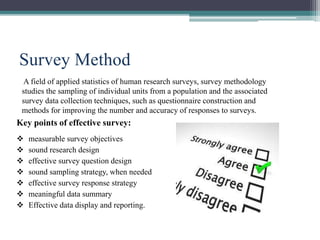
A field of applied statistics of human research surveys, survey methodology
studies the sampling of individual units from a population and the associated
survey data collection techniques, such as questionnaire construction and
methods for improving the number and accuracy of responses to surveys.
Key points of effective survey:
 measurable survey objectives
 sound research design
 effective survey question design
 sound sampling strategy, when needed
 effective survey response strategy
 meaningful data summary
 Effective data display and reporting.
Steps in survey Method:
1. Selection of the problem
2. Questionnaire about the problem:.
Two types of questions are asked in a questionnaire:
• Open ended questions: person respond in an elaborative way.
• Close ended questions: Answer in “yes” or “no”.
3. Sampling and population
• Population
• Sample
4. Method of Measurement
5. Analysis of data
6. Results or Reports Writing
Advantages:
 Relatively easy to administer
 Can be developed in less time (compared to other data-collection methods)
 Cost-effective, but cost depends on survey mode
 Can be administered remotely via online, mobile devices, mail, email, kiosk, or telephone.
 Conducted remotely can reduce or prevent geographical dependence
 Capable of collecting data from a large number of respondents
 Numerous questions can be asked about a subject, giving extensive flexibility in data
analysis
 With survey software, advanced statistical techniques can be utilized to analyze survey
data to determine validity, reliability, and statistical significance, including the ability to
analyze multiple variables
 A broad range of data can be collected (e.g., attitudes, opinions, beliefs, values, behavior,
factual).
Standardized surveys are relatively free from several types of errors
Disadvantages:
 Respondents may not feel encouraged to provide accurate, honest answers
 Respondents may not feel comfortable providing answers that present themselves in an
unfavorable manner.
 Respondents may not be fully aware of their reasons for any given answer because of
lack of memory on the subject, or even boredom.
 Surveys with closed-ended questions may have a lower validity rate than other question
types.
 Data errors due to question non-responses may exist. The number of respondents who
choose to respond to a survey question may be different from those who chose not to
respond, thus creating bias.
 Survey question answer options could lead to unclear data because certain answer options
may be interpreted differently by respondents. For example, the answer option
“somewhat agree” may represent different things to different subjects, and have its own
meaning to each individual respondent. ‘Yes’ or ‘no’ answer options can also be
problematic. Respondents may answer “no” if the option “only once” is not available.
 Customized surveys can run the risk of containing certain types of errors.
Research Methodology
Research:-
The systematic investigation into and study of materials and sources in order
to establish facts and reach new conclusions, is called research.
Methodology:-
A set of methods, rules, or ideas that are important in a science or art, is
called methodology.
Research Methodology:-
Research Methodology is a way to find out the result of a given
problem on a specific matter or problem that is also referred as research problem.
Characteristics of research
Characteristics of Research.
1. Empirical - based on observations and experimentation on theories.
2. Systematic - follows orderly and sequential procedure.
3. Controlled - all variables except those that are tested/experimented upon are kept constant.
4. Employs hypothesis - guides the investigation process
5. Analytical - There is critical analysis of all data used so that there is no error in their interpretation
6. Objective, Unbiased, & Logical - all findings are logically based on empirical
7. Employs quantitative or statistical methods - data are transformed into numerical measures and are
treated statistically
8. Original work
9. Done by an expert - the researcher uses valid and carefully designed procedures, valid data gather
for
10. Must be patient and unhurried activity - to ensure accuracy
11. Require effort-making capacity
12. Requires courage
13. Has logical roots that help to establish facts or principles
14. Answers all type of questions
15. Question sharing
16. problem set
17. thesis
Types of research methods
1. Observational method:-
Observational Methods in psychological research entail the observation and
description of a subject's behavior. Researchers utilizing the observational
method can exert varying amounts of control over the environment in which the
observation takes place.
2. Clinical method:-
The clinical method is the scientific method applied to the care of a patient. Dear
Editor: We carefully read the interesting Richard Smith editorial “Doctors.
3. Survey method:-
A field of applied statistics of human research surveys, survey methodology
studies the sampling of individual units from a population and the associated
survey data collection techniques, such as questionnaire construction and
methods for improving the number and accuracy of responses to surveys.
4. Experimental method:-
It is a collection of research designs which use manipulation and controlled
testing to understand causal processes. Generally, one or more variables are
manipulated to determine their effect on a dependent variable.
5. Interview method:-
Interview is the verbal conversation between two people with the objective of
collecting relevant information for the purpose of research.
Hypothesis
“Drug addiction is more common in upper class than lower class”
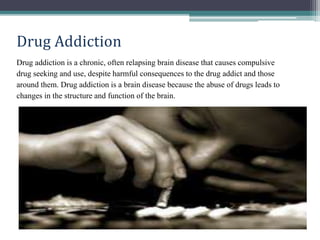
Drug Addiction
Drug addiction is a chronic, often relapsing brain disease that causes compulsive
drug seeking and use, despite harmful consequences to the drug addict and those
around them. Drug addiction is a brain disease because the abuse of drugs leads to
changes in the structure and function of the brain.
Causes of drug addiction:
1. Psychological Causes of Drug Addiction
A mental illness such as depression
Inability to connect with others, lack of friends
Poor performance at work or school
Poor stress coping skills
2. Environmental Causes of Drug Addiction
Participation in a sport where performance-enhancing drugs are encouraged
A peer group that uses or promotes drug use
People of lower socioeconomic status are at greater risk of drug addiction
Gender and ethnicity contribute to addiction of some drugs
Genetic Causes of Drug Addiction
Drug addiction tends to run in families, indicating genetics may have a role in causing drug
addiction. In fact, in studies of twins it appears half of someone's risk of becoming addicted to
drugs is genetic.2 Genetic causes of drug addiction appear to involve multiple gene sequences
and science has not yet been able to pinpoint all the genes involved. However, it is known some
genes, like those involved in brain receptors of nicotine, contribute to the cause of drug addiction.
Disadvantages of drugs
Drugs are designed to alter normal body chemistry. As such, they are likely to cause side effects
that range from annoying to downright serious. In an Africa safari, introducing tourists into the
habitat of animals alter their behavior ever so slightly disturbing what is normal and
commonplace. Drugs work in much the same way; side effects that arise from drug use can lead
to other conditions that may also give rise to other serious conditions so moderation and
sticking to a prescription is key. Common examples include nausea, vomiting, an upset
stomach, skin irritation and the likes.
In many cases, clinical strength drugs are made from synthetic chemicals which are otherwise
not present in the body. It’s like finding a jackleg drill in the toolkit of an architect; it’s out of
place and unwanted despite its usefulness. Clinical strength artificial chemicals in the body can
upset body chemistry, alter the way the body functions, and introduce foreign substances that
may not only lead to adverse reactions but may also cause mutations which can give rise to
other diseases.
Drugs create a certain level of dependency. If one earns from a mogl scam, he is likely to come
back to it despite its known negative effects. Drugs work in much the same way. An acquired
dependency can lead to a vicious cycle of drug use that may become unregulated over time.
Even substances like coffee and soda, which are the most ubiquitous of consumer products,
have caffeine that can lead to substance dependency. In the case of drugs which are clinical
strength, the dependency can develop much faster. Limiting the dosage on all levels, and unless
otherwise prescribed, is paramount to responsible drug use.
Demographic variable
Gender Male Female
Occupation Student, Teacher and
Doctor
Student
Age 19 to 47 17 to 20
Frequency 15 5
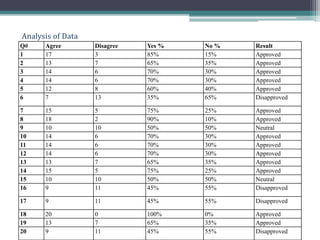
Analysis of Data
Q# Agree Disagree Yes % No % Result
1 17 3 85% 15% Approved
2 13 7 65% 35% Approved
3 14 6 70% 30% Approved
4 14 6 70% 30% Approved
5 12 8 60% 40% Approved
6 7 13 35% 65% Disapproved
7 15 5 75% 25% Approved
8 18 2 90% 10% Approved
9 10 10 50% 50% Neutral
10 14 6 70% 30% Approved
11 14 6 70% 30% Approved
12 14 6 70% 30% Approved
13 13 7 65% 35% Approved
14 15 5 75% 25% Approved
15 10 10 50% 50% Neutral
16 9 11 45% 55% Disapproved
17 9 11 45% 55% Disapproved
18 20 0 100% 0% Approved
19 13 7 65% 35% Approved
20 9 11 45% 55% Disapproved
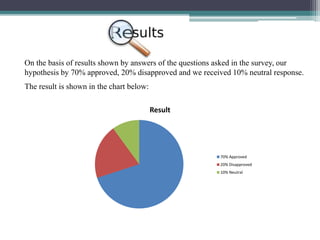
On the basis of results shown by answers of the questions asked in the survey, our
hypothesis by 70% approved, 20% disapproved and we received 10% neutral response.
The result is shown in the chart below:
Result
70% Approved
20% Disapproved
10% Neutral
we conducted a surveu to prove whether or not our hypothesis is correct,we took a
questionnaire of 20 questions and asked 20 different people to answer those questions.the
whole purpose of this process was to take their opinion on the matter of drug addiction so
we can check if our hypothesis is correct or not.After this process we analyzed the data
and came to know that people agree 70% with us , disagree 20% and 10% gave us
neutral results.
Seeing that rate of agreement(70%) is greater than the rate of disagreement(20%) and
rate of neutral results(10%), we have come to the conclusion that our hypothesis is
“correct”.
Suggestions
Following are some suggestions that we would like to make:
1. Parents should keep an eye on their children to stop them from going to the wrong
path.
2. Parents should try that their relationship must never affect their child.
3. Parents must never ignore their children
4. People should try to adopt healthy methods to tackle the problem of depression.eg
help of a psychological expert.
5. Parents must check what type of friends their children have.
6. Parents must not insult their children in a way that it breaks their heart and lead them
to addiction.
7. Education must be provided to every person in order to tackle drug addiction
8. Government must take some necessary step to stop drug addiction.

Drug addiction pptx

  • 1.
  • 2.
    Survey Method A fieldof applied statistics of human research surveys, survey methodology studies the sampling of individual units from a population and the associated survey data collection techniques, such as questionnaire construction and methods for improving the number and accuracy of responses to surveys. Key points of effective survey:  measurable survey objectives  sound research design  effective survey question design  sound sampling strategy, when needed  effective survey response strategy  meaningful data summary  Effective data display and reporting.
  • 3.
    Steps in surveyMethod: 1. Selection of the problem 2. Questionnaire about the problem:. Two types of questions are asked in a questionnaire: • Open ended questions: person respond in an elaborative way. • Close ended questions: Answer in “yes” or “no”. 3. Sampling and population • Population • Sample 4. Method of Measurement 5. Analysis of data 6. Results or Reports Writing
  • 4.
    Advantages:  Relatively easyto administer  Can be developed in less time (compared to other data-collection methods)  Cost-effective, but cost depends on survey mode  Can be administered remotely via online, mobile devices, mail, email, kiosk, or telephone.  Conducted remotely can reduce or prevent geographical dependence  Capable of collecting data from a large number of respondents  Numerous questions can be asked about a subject, giving extensive flexibility in data analysis  With survey software, advanced statistical techniques can be utilized to analyze survey data to determine validity, reliability, and statistical significance, including the ability to analyze multiple variables  A broad range of data can be collected (e.g., attitudes, opinions, beliefs, values, behavior, factual). Standardized surveys are relatively free from several types of errors
  • 5.
    Disadvantages:  Respondents maynot feel encouraged to provide accurate, honest answers  Respondents may not feel comfortable providing answers that present themselves in an unfavorable manner.  Respondents may not be fully aware of their reasons for any given answer because of lack of memory on the subject, or even boredom.  Surveys with closed-ended questions may have a lower validity rate than other question types.  Data errors due to question non-responses may exist. The number of respondents who choose to respond to a survey question may be different from those who chose not to respond, thus creating bias.  Survey question answer options could lead to unclear data because certain answer options may be interpreted differently by respondents. For example, the answer option “somewhat agree” may represent different things to different subjects, and have its own meaning to each individual respondent. ‘Yes’ or ‘no’ answer options can also be problematic. Respondents may answer “no” if the option “only once” is not available.  Customized surveys can run the risk of containing certain types of errors.
  • 6.
    Research Methodology Research:- The systematicinvestigation into and study of materials and sources in order to establish facts and reach new conclusions, is called research. Methodology:- A set of methods, rules, or ideas that are important in a science or art, is called methodology. Research Methodology:- Research Methodology is a way to find out the result of a given problem on a specific matter or problem that is also referred as research problem.
  • 7.
    Characteristics of research Characteristicsof Research. 1. Empirical - based on observations and experimentation on theories. 2. Systematic - follows orderly and sequential procedure. 3. Controlled - all variables except those that are tested/experimented upon are kept constant. 4. Employs hypothesis - guides the investigation process 5. Analytical - There is critical analysis of all data used so that there is no error in their interpretation 6. Objective, Unbiased, & Logical - all findings are logically based on empirical 7. Employs quantitative or statistical methods - data are transformed into numerical measures and are treated statistically 8. Original work 9. Done by an expert - the researcher uses valid and carefully designed procedures, valid data gather for 10. Must be patient and unhurried activity - to ensure accuracy 11. Require effort-making capacity 12. Requires courage 13. Has logical roots that help to establish facts or principles 14. Answers all type of questions 15. Question sharing 16. problem set 17. thesis
  • 8.
    Types of researchmethods 1. Observational method:- Observational Methods in psychological research entail the observation and description of a subject's behavior. Researchers utilizing the observational method can exert varying amounts of control over the environment in which the observation takes place. 2. Clinical method:- The clinical method is the scientific method applied to the care of a patient. Dear Editor: We carefully read the interesting Richard Smith editorial “Doctors. 3. Survey method:- A field of applied statistics of human research surveys, survey methodology studies the sampling of individual units from a population and the associated survey data collection techniques, such as questionnaire construction and methods for improving the number and accuracy of responses to surveys. 4. Experimental method:- It is a collection of research designs which use manipulation and controlled testing to understand causal processes. Generally, one or more variables are manipulated to determine their effect on a dependent variable. 5. Interview method:- Interview is the verbal conversation between two people with the objective of collecting relevant information for the purpose of research.
  • 9.
    Hypothesis “Drug addiction ismore common in upper class than lower class”
  • 10.
    Drug Addiction Drug addictionis a chronic, often relapsing brain disease that causes compulsive drug seeking and use, despite harmful consequences to the drug addict and those around them. Drug addiction is a brain disease because the abuse of drugs leads to changes in the structure and function of the brain.
  • 11.
    Causes of drugaddiction: 1. Psychological Causes of Drug Addiction A mental illness such as depression Inability to connect with others, lack of friends Poor performance at work or school Poor stress coping skills 2. Environmental Causes of Drug Addiction Participation in a sport where performance-enhancing drugs are encouraged A peer group that uses or promotes drug use People of lower socioeconomic status are at greater risk of drug addiction Gender and ethnicity contribute to addiction of some drugs Genetic Causes of Drug Addiction Drug addiction tends to run in families, indicating genetics may have a role in causing drug addiction. In fact, in studies of twins it appears half of someone's risk of becoming addicted to drugs is genetic.2 Genetic causes of drug addiction appear to involve multiple gene sequences and science has not yet been able to pinpoint all the genes involved. However, it is known some genes, like those involved in brain receptors of nicotine, contribute to the cause of drug addiction.
  • 12.
    Disadvantages of drugs Drugsare designed to alter normal body chemistry. As such, they are likely to cause side effects that range from annoying to downright serious. In an Africa safari, introducing tourists into the habitat of animals alter their behavior ever so slightly disturbing what is normal and commonplace. Drugs work in much the same way; side effects that arise from drug use can lead to other conditions that may also give rise to other serious conditions so moderation and sticking to a prescription is key. Common examples include nausea, vomiting, an upset stomach, skin irritation and the likes. In many cases, clinical strength drugs are made from synthetic chemicals which are otherwise not present in the body. It’s like finding a jackleg drill in the toolkit of an architect; it’s out of place and unwanted despite its usefulness. Clinical strength artificial chemicals in the body can upset body chemistry, alter the way the body functions, and introduce foreign substances that may not only lead to adverse reactions but may also cause mutations which can give rise to other diseases. Drugs create a certain level of dependency. If one earns from a mogl scam, he is likely to come back to it despite its known negative effects. Drugs work in much the same way. An acquired dependency can lead to a vicious cycle of drug use that may become unregulated over time. Even substances like coffee and soda, which are the most ubiquitous of consumer products, have caffeine that can lead to substance dependency. In the case of drugs which are clinical strength, the dependency can develop much faster. Limiting the dosage on all levels, and unless otherwise prescribed, is paramount to responsible drug use.
  • 13.
    Demographic variable Gender MaleFemale Occupation Student, Teacher and Doctor Student Age 19 to 47 17 to 20 Frequency 15 5
  • 14.
    Analysis of Data Q#Agree Disagree Yes % No % Result 1 17 3 85% 15% Approved 2 13 7 65% 35% Approved 3 14 6 70% 30% Approved 4 14 6 70% 30% Approved 5 12 8 60% 40% Approved 6 7 13 35% 65% Disapproved 7 15 5 75% 25% Approved 8 18 2 90% 10% Approved 9 10 10 50% 50% Neutral 10 14 6 70% 30% Approved 11 14 6 70% 30% Approved 12 14 6 70% 30% Approved 13 13 7 65% 35% Approved 14 15 5 75% 25% Approved 15 10 10 50% 50% Neutral 16 9 11 45% 55% Disapproved 17 9 11 45% 55% Disapproved 18 20 0 100% 0% Approved 19 13 7 65% 35% Approved 20 9 11 45% 55% Disapproved
  • 15.
    On the basisof results shown by answers of the questions asked in the survey, our hypothesis by 70% approved, 20% disapproved and we received 10% neutral response. The result is shown in the chart below: Result 70% Approved 20% Disapproved 10% Neutral
  • 16.
    we conducted asurveu to prove whether or not our hypothesis is correct,we took a questionnaire of 20 questions and asked 20 different people to answer those questions.the whole purpose of this process was to take their opinion on the matter of drug addiction so we can check if our hypothesis is correct or not.After this process we analyzed the data and came to know that people agree 70% with us , disagree 20% and 10% gave us neutral results. Seeing that rate of agreement(70%) is greater than the rate of disagreement(20%) and rate of neutral results(10%), we have come to the conclusion that our hypothesis is “correct”.
  • 17.
    Suggestions Following are somesuggestions that we would like to make: 1. Parents should keep an eye on their children to stop them from going to the wrong path. 2. Parents should try that their relationship must never affect their child. 3. Parents must never ignore their children 4. People should try to adopt healthy methods to tackle the problem of depression.eg help of a psychological expert. 5. Parents must check what type of friends their children have. 6. Parents must not insult their children in a way that it breaks their heart and lead them to addiction. 7. Education must be provided to every person in order to tackle drug addiction 8. Government must take some necessary step to stop drug addiction.