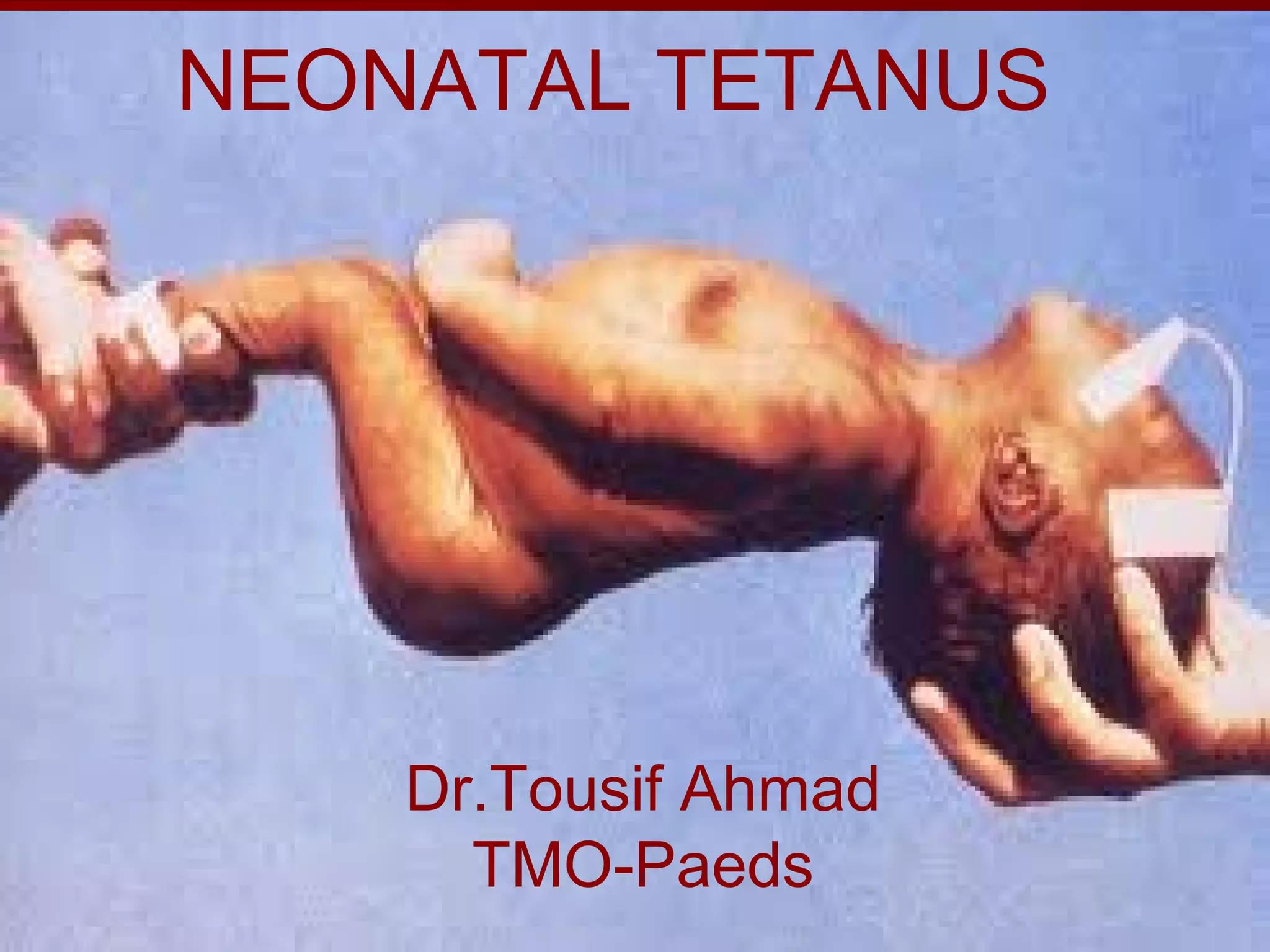
NEONATAL TETANUS
Dr.Tousif Ahmad
TMO-Paeds
Case presentationCase presentation
A 5 days old newborn presented to nurseryA 5 days old newborn presented to nursery
with complaints of:with complaints of:
1.1. Generalized body stiffness.Generalized body stiffness.
2.2. Unable to suck.Unable to suck.
3.3. FeverFever
Case presentationCase presentation
 The baby was delivered through NVD inThe baby was delivered through NVD in
home by a dai ,and the umbilicus was cuthome by a dai ,and the umbilicus was cut
by some instrument present in the home.by some instrument present in the home.
Some medicine & ghee was applied to itSome medicine & ghee was applied to it
after cutting.after cutting.
 The mother was not vaccinated againstThe mother was not vaccinated against
any disease during pregnancy.any disease during pregnancy.
Case presentationCase presentation
 On Examination:On Examination:
1.1. Generalized body spasms, precipitatedGeneralized body spasms, precipitated
by sound, touch, light & procedures suchby sound, touch, light & procedures such
as IV cannulation.as IV cannulation.
2.2. Lock jaw.Lock jaw.
3.3. Tense abdomenTense abdomen
4.4. Umbilicus contaminated with soil & bloodUmbilicus contaminated with soil & blood
Case presentationCase presentation
 All the investigations are normalAll the investigations are normal
DiagnosisDiagnosis
 NEONATAL TETANUSNEONATAL TETANUS
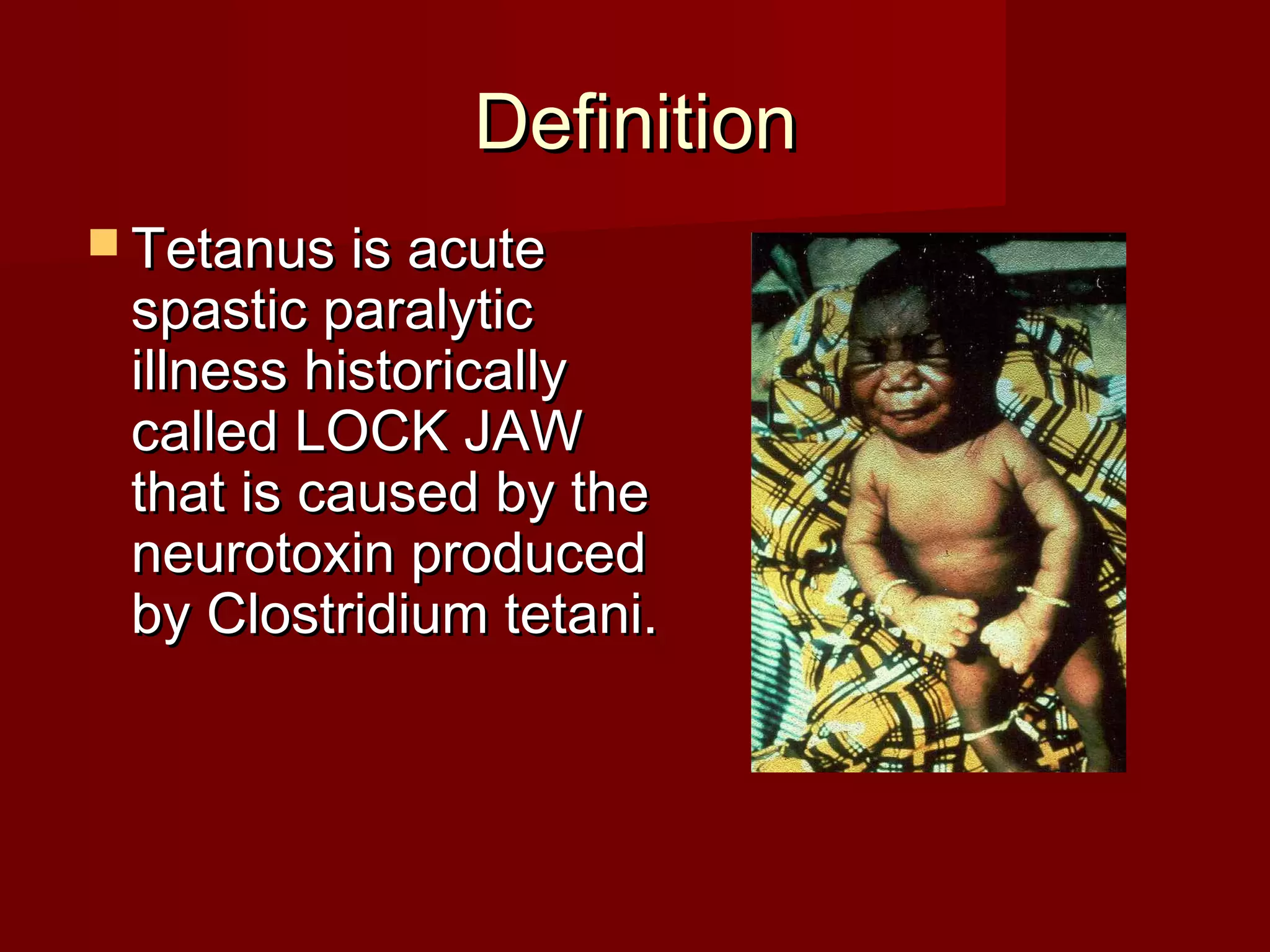
DefinitionDefinition
 Tetanus is acuteTetanus is acute
spastic paralyticspastic paralytic
illness historicallyillness historically
called LOCK JAWcalled LOCK JAW
that is caused by thethat is caused by the
neurotoxin producedneurotoxin produced
by Clostridium tetani.by Clostridium tetani.
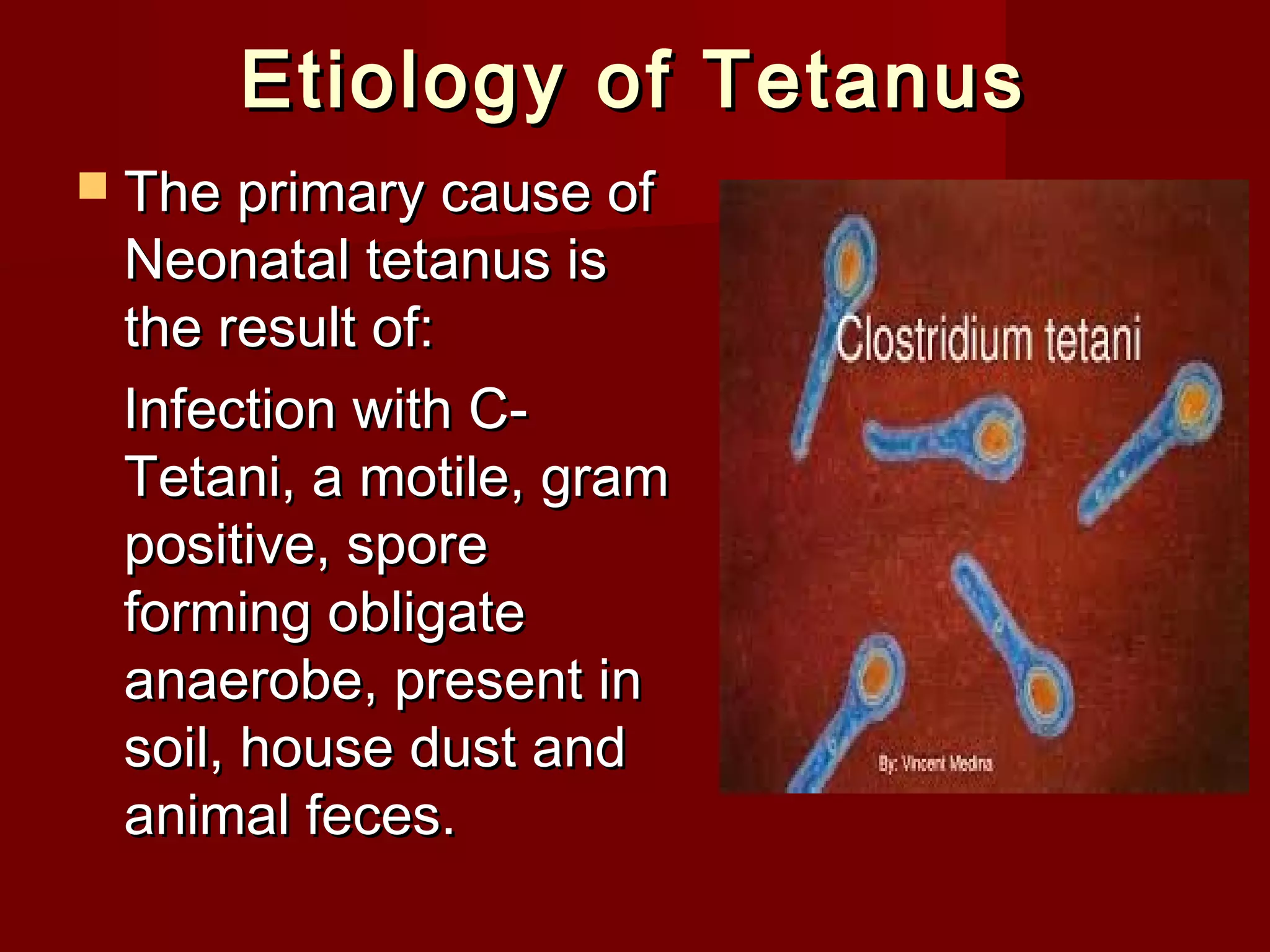
Etiology of TetanusEtiology of Tetanus
 The primary cause ofThe primary cause of
Neonatal tetanus isNeonatal tetanus is
the result of:the result of:
Infection with C-Infection with C-
Tetani, a motile, gramTetani, a motile, gram
positive, sporepositive, spore
forming obligateforming obligate
anaerobe, present inanaerobe, present in
soil, house dust andsoil, house dust and
animal feces.animal feces.
Etiology of TetanusEtiology of Tetanus
 Tetanus occurs after introduced sporesTetanus occurs after introduced spores
germinate, multiply, and produce tetanusgerminate, multiply, and produce tetanus
toxin at the infected injury site.toxin at the infected injury site.
 The incubation period is usually 2-14The incubation period is usually 2-14
days.days.
 Tetanus toxin binds at the neuromuscularTetanus toxin binds at the neuromuscular
junction and enters the motor nerve byjunction and enters the motor nerve by
endocytosis after which it undergoesendocytosis after which it undergoes
retrograde axonal transport to theretrograde axonal transport to the
cytoplasm of motoneurons.cytoplasm of motoneurons.
Etiology of TetanusEtiology of Tetanus
 The toxin exits the motoneurons in theThe toxin exits the motoneurons in the
spinal cord and next enters adjacentspinal cord and next enters adjacent
spinal inhibitory interneurons.spinal inhibitory interneurons.
 It prevents release of the inhibitoryIt prevents release of the inhibitory
neurotransmitters glycine and GABA.neurotransmitters glycine and GABA.
 The autonomic nervous system is alsoThe autonomic nervous system is also
rendered unstable in tetanus.rendered unstable in tetanus.
TypesTypes
 The disease can show 4 possible types:The disease can show 4 possible types:
-Generalized tetanus can affect all skeletal muscles. It is-Generalized tetanus can affect all skeletal muscles. It is
the most common as well as the most severe form of thethe most common as well as the most severe form of the
four types.four types.
- Local tetanus manifests with muscle spasms at or near- Local tetanus manifests with muscle spasms at or near
the wound that has been infected with the bacteria.the wound that has been infected with the bacteria.
-Cephalic tetanus primarily affects one or several-Cephalic tetanus primarily affects one or several
muscles in the face rapidly (in one to two days) aftermuscles in the face rapidly (in one to two days) after
a head injury or ear infection. Trismus ("lockjaw") maya head injury or ear infection. Trismus ("lockjaw") may
occur. The disease can easily progress to generalizedoccur. The disease can easily progress to generalized
tetanus.tetanus.
-Neonatal tetanus is similar to generalized tetanus-Neonatal tetanus is similar to generalized tetanus
except that it affects a baby that is less than 1 month oldexcept that it affects a baby that is less than 1 month old
(called a neonate).(called a neonate).
1212
Neonatal tetanusNeonatal tetanus
 is a form of generalized tetanus that occurs inis a form of generalized tetanus that occurs in
newborn babies. Neonatal tetanus occurs innewborn babies. Neonatal tetanus occurs in
infants born without protective passive immunity,infants born without protective passive immunity,
because the mother is not immune.because the mother is not immune.
 It usually occurs through infection of theIt usually occurs through infection of the
unhealed umbilical stump, particularly when theunhealed umbilical stump, particularly when the
stump is cut with an unsterile instrument.stump is cut with an unsterile instrument.
 Neonatal tetanus is common in some developingNeonatal tetanus is common in some developing
countries (estimated >270,000 deaths worldwidecountries (estimated >270,000 deaths worldwide
per year)per year)
Neonatal tetanusNeonatal tetanus
 In 2012, in our department of Pediatrics,In 2012, in our department of Pediatrics,
Total 38 neonates were admitted withTotal 38 neonates were admitted with
tetanus neonatorum.tetanus neonatorum.
 Out of them, 24 died and 14 survived.Out of them, 24 died and 14 survived.
 Mortality rate was 63%.Mortality rate was 63%.
1414
Neonatal tetanusNeonatal tetanus
 Neonatal tetanus presents most oftenNeonatal tetanus presents most often
about the seventh day of life with a shortabout the seventh day of life with a short
history of failure to feed. Spasms arehistory of failure to feed. Spasms are
typical but the diagnosis can be mistakentypical but the diagnosis can be mistaken
for meningitis or sepsis .for meningitis or sepsis .
Clinical feaClinical fea tures of neonataltures of neonatal
tetanustetanus
 Muscles rigidityMuscles rigidity
 IrritabilityIrritability
 DysphagiaDysphagia
 RestlessnessRestlessness
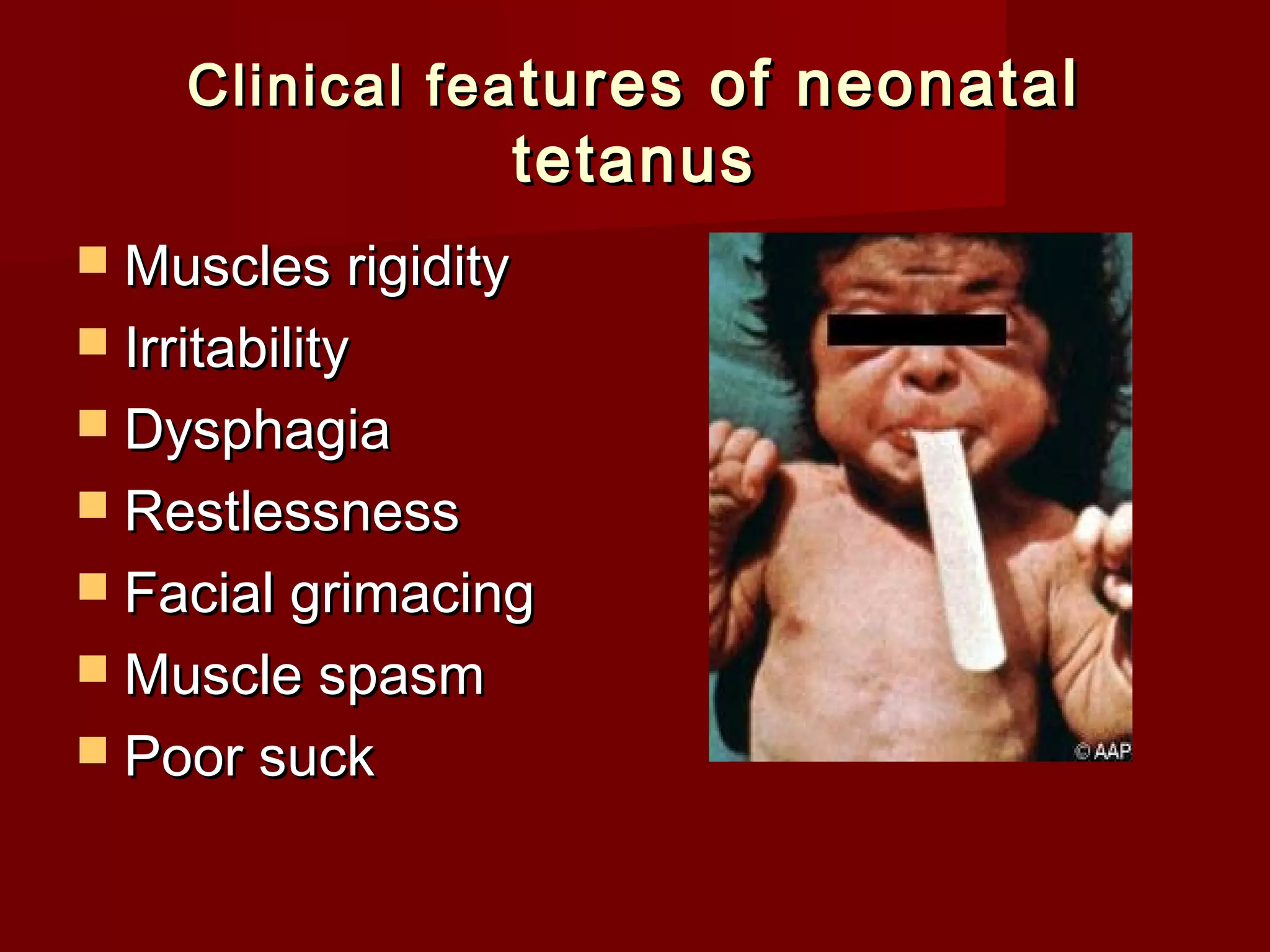
 Facial grimacingFacial grimacing
 Muscle spasmMuscle spasm
 Poor suckPoor suck
Clinical feaClinical fea tures of neonataltures of neonatal
tetanustetanus
 Usually symptoms begins 3-10 days afterUsually symptoms begins 3-10 days after
birth and pattern is generalized.birth and pattern is generalized.
 Initial symptom is failure to suck andInitial symptom is failure to suck and
inability to open the mouth known asinability to open the mouth known as
trismus or lockjaw.trismus or lockjaw.
 Spasm of the facial muscles immobilizesSpasm of the facial muscles immobilizes
the jaw and produces a fixed sardonic grinthe jaw and produces a fixed sardonic grin
called risus sardonicuscalled risus sardonicus
Clinical feaClinical fea tures of neonataltures of neonatal
tetanustetanus
 With in 12-24 hours after the 1With in 12-24 hours after the 1stst
symptom,symptom,
generalized tonic muscular convulsionsgeneralized tonic muscular convulsions
occur producing flexion & adduction of theoccur producing flexion & adduction of the
arms, clenching of fists & extension of thearms, clenching of fists & extension of the
lower extremities.lower extremities.
 Initially spasms are mild but later becomeInitially spasms are mild but later become
severe with spasms of the glottis &severe with spasms of the glottis &
respiratory muscles.respiratory muscles.
Clinical feaClinical fea tures of neonataltures of neonatal
tetanustetanus
 Abdominal muscles become rigid andAbdominal muscles become rigid and
spasms of the muscles of the back mayspasms of the muscles of the back may
result in opisthotonus.result in opisthotonus.
 Spasms may be precipitated by touch,Spasms may be precipitated by touch,
noise or bright light.noise or bright light.
 Baby remains conscious and allert.Baby remains conscious and allert.
ManagementManagement
The aims of treatment are:The aims of treatment are:
 Remove the source of exotoxinRemove the source of exotoxin
 Neutralize the remaining circulating toxinsNeutralize the remaining circulating toxins
 Provide supportive care until toxin isProvide supportive care until toxin is
metabolized.metabolized.
ManagementManagement
Specific measures:Specific measures:
 Washing and debridment of the infectedWashing and debridment of the infected
site, and administeration of antibioticssite, and administeration of antibiotics
such as Benzyl penicillin or Metronidazole.such as Benzyl penicillin or Metronidazole.
 Anti-toxinAnti-toxin
1)Anti-tetanus serum -(50,000-100,000 U)1)Anti-tetanus serum -(50,000-100,000 U)
2)Human tetanus immunoglobulin (3000-2)Human tetanus immunoglobulin (3000-
6000 u)6000 u)
ManagementManagement
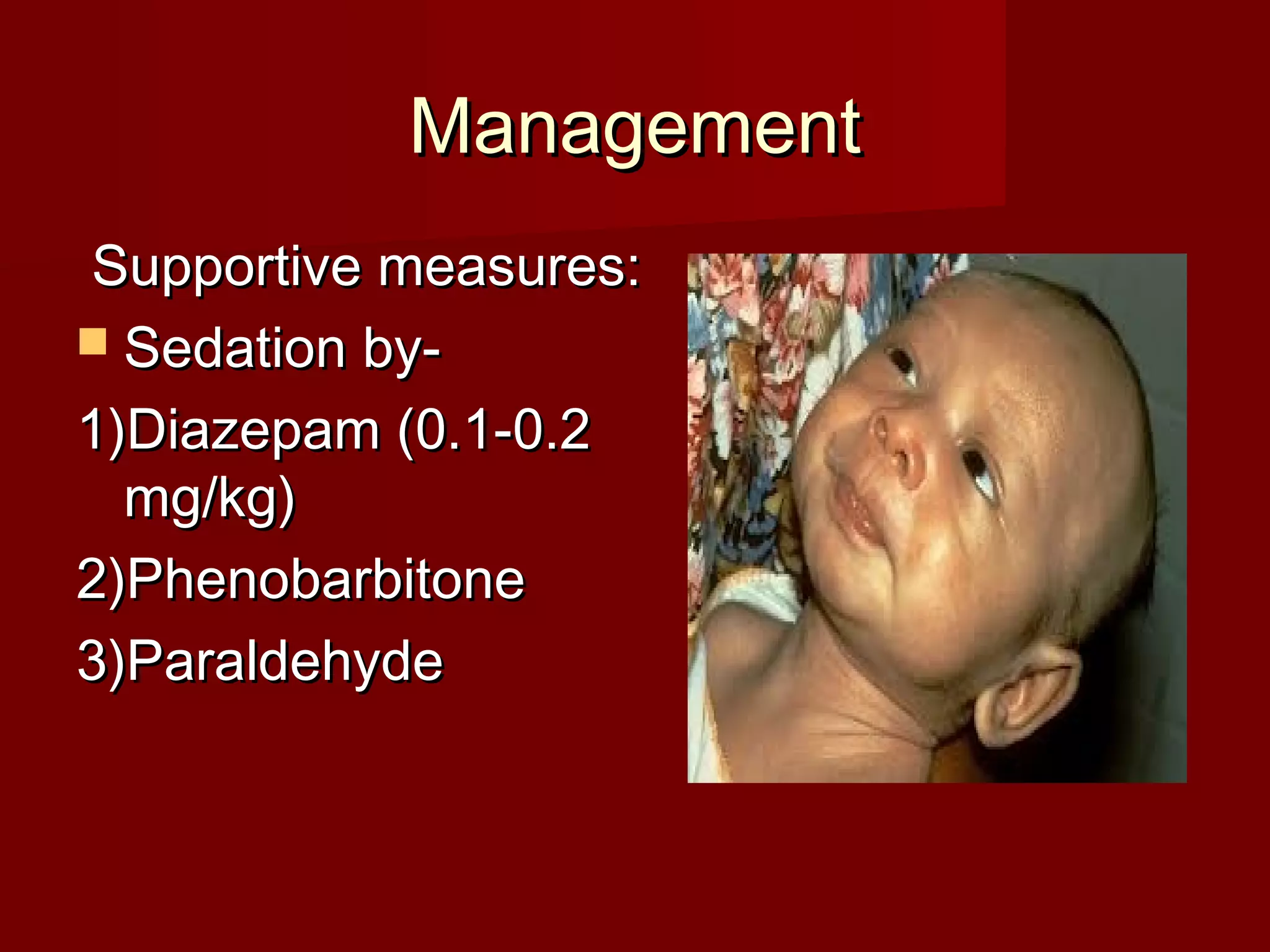
Supportive measures:Supportive measures:
 Sedation by-Sedation by-
1)Diazepam (0.1-0.21)Diazepam (0.1-0.2
mg/kg)mg/kg)
2)Phenobarbitone2)Phenobarbitone
3)Paraldehyde3)Paraldehyde
ManagementManagement
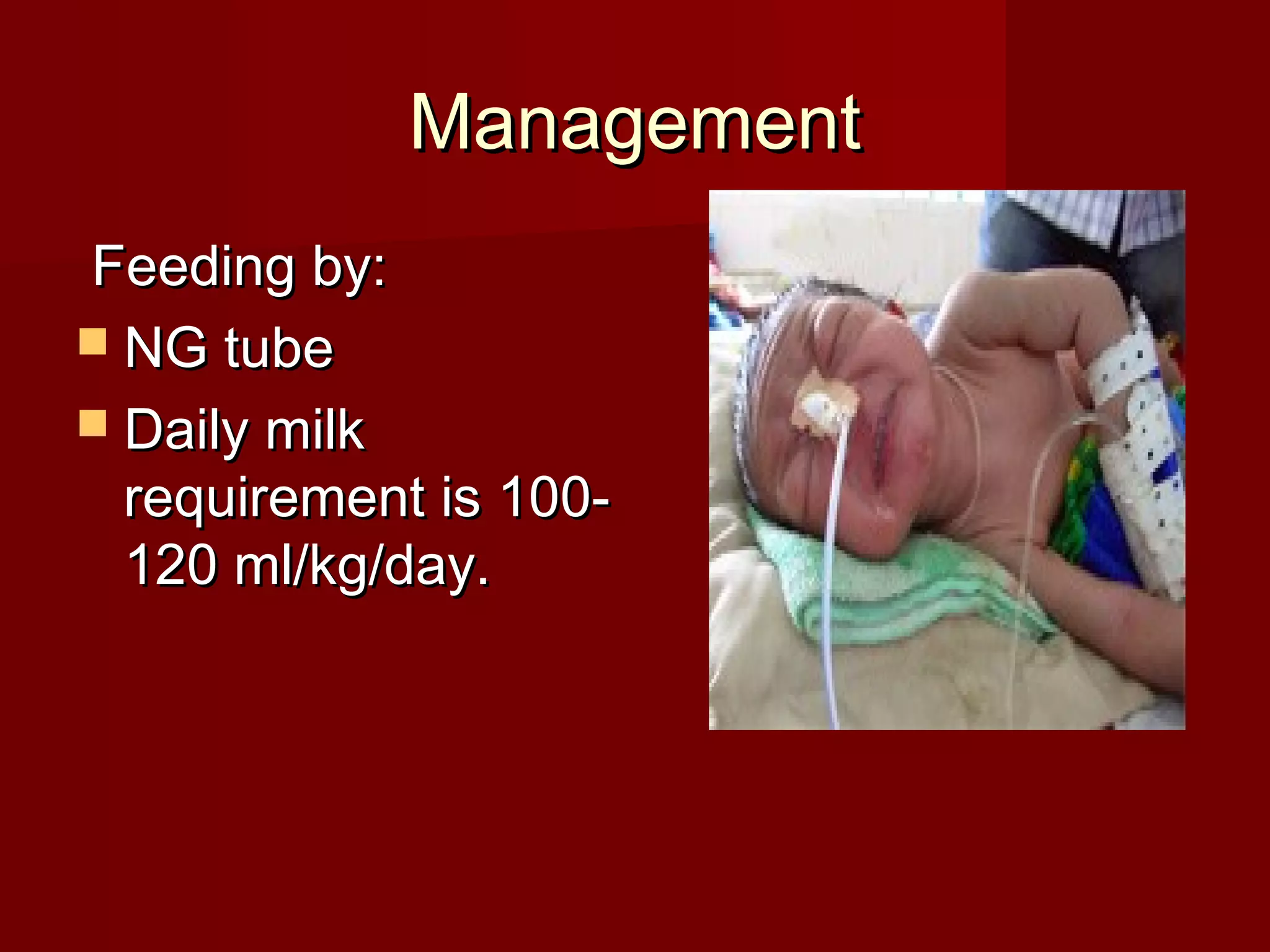
Feeding by:Feeding by:
 NG tubeNG tube
 Daily milkDaily milk
requirement is 100-requirement is 100-
120 ml/kg/day.120 ml/kg/day.
ManagementManagement
Nursing care:Nursing care:
 Clean the umbilicus/woundClean the umbilicus/wound
 Isolate the baby in dark silent roomIsolate the baby in dark silent room
 Change the postureChange the posture
 Cardiorespiratory monitoringCardiorespiratory monitoring
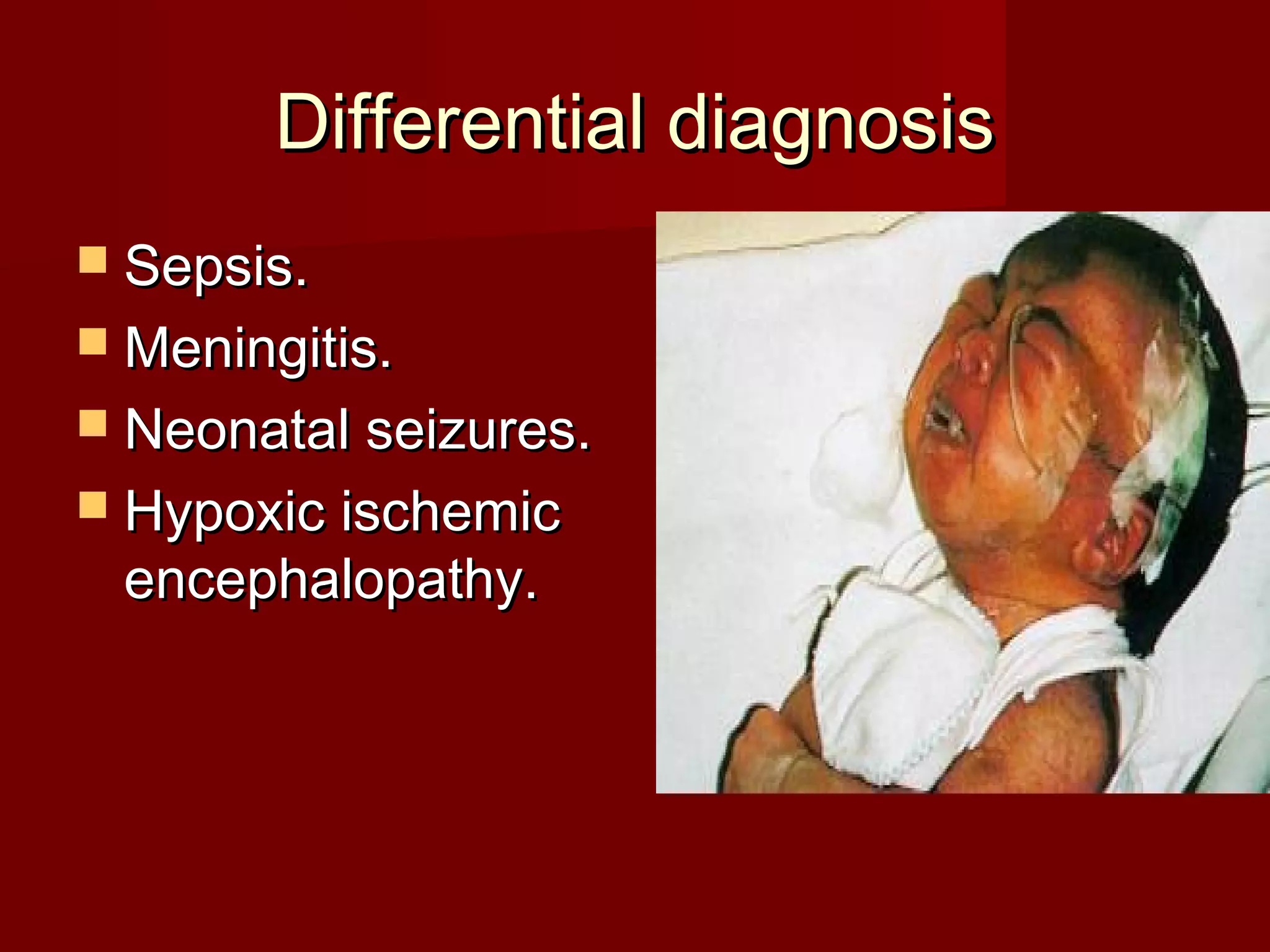
Differential diagnosisDifferential diagnosis
 Sepsis.Sepsis.
 Meningitis.Meningitis.
 Neonatal seizures.Neonatal seizures.
 Hypoxic ischemicHypoxic ischemic
encephalopathy.encephalopathy.
ComplicationsComplications
 Aspiration pneumoniaAspiration pneumonia
 Lacerations of mouth & tongueLacerations of mouth & tongue
 Intramuscular hematomas orIntramuscular hematomas or
rhabdomyolysis leading to hemoglobinuriarhabdomyolysis leading to hemoglobinuria
& renal failure.& renal failure.
 Vertebral fractures.Vertebral fractures.
 Decubitus ulcerations.Decubitus ulcerations.
 Autonomic disturbances.Autonomic disturbances.
PreventionPrevention
 Immunize the mother during pregnancyImmunize the mother during pregnancy
 Clean & safe deliveryClean & safe delivery
 Care of umbilical cordCare of umbilical cord
 Avoid early circumcission in male babies.Avoid early circumcission in male babies.
 Immunize the baby after disease.Immunize the baby after disease.
 Training of daisTraining of dais
PrognosisPrognosis
 Fatality rate mainly depends upon qualityFatality rate mainly depends upon quality
of supportive care.of supportive care.
 Main causes of death are respiratoryMain causes of death are respiratory
failure and pneumonia.failure and pneumonia.
 MR is 60% or more for neonatal tetanus &MR is 60% or more for neonatal tetanus &
20-50% in children.20-50% in children.
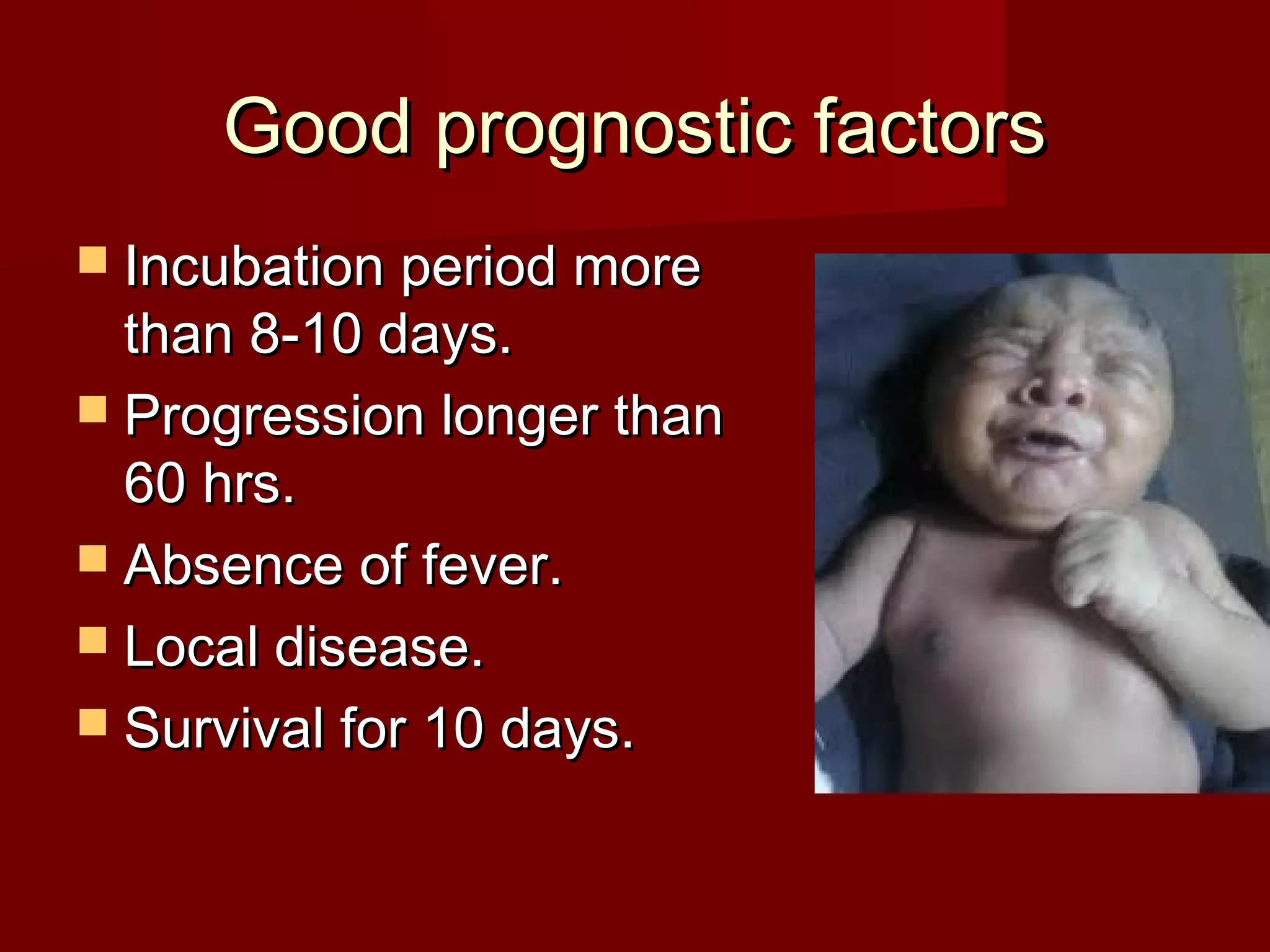
Good prognostic factorsGood prognostic factors
 Incubation period moreIncubation period more
than 8-10 days.than 8-10 days.
 Progression longer thanProgression longer than
60 hrs.60 hrs.
 Absence of fever.Absence of fever.
 Local disease.Local disease.
 Survival for 10 days.Survival for 10 days.
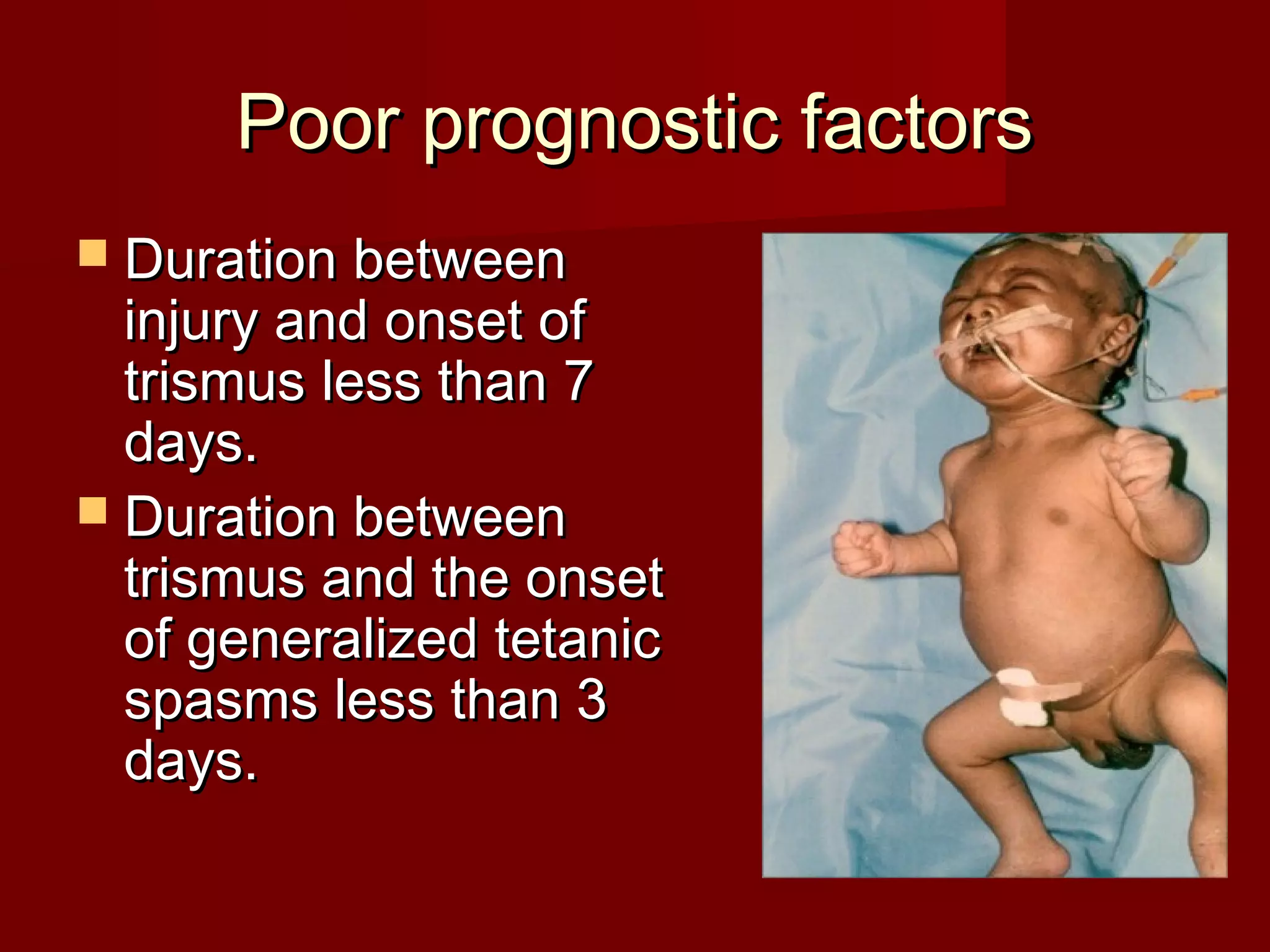
Poor prognostic factorsPoor prognostic factors
 Duration betweenDuration between
injury and onset ofinjury and onset of
trismus less than 7trismus less than 7
days.days.
 Duration betweenDuration between
trismus and the onsettrismus and the onset
of generalized tetanicof generalized tetanic
spasms less than 3spasms less than 3
days.days.
THANK YOU

Dr.tosif tetanus in the new born

  • 1.
  • 2.
    Case presentationCase presentation A5 days old newborn presented to nurseryA 5 days old newborn presented to nursery with complaints of:with complaints of: 1.1. Generalized body stiffness.Generalized body stiffness. 2.2. Unable to suck.Unable to suck. 3.3. FeverFever
  • 3.
    Case presentationCase presentation The baby was delivered through NVD inThe baby was delivered through NVD in home by a dai ,and the umbilicus was cuthome by a dai ,and the umbilicus was cut by some instrument present in the home.by some instrument present in the home. Some medicine & ghee was applied to itSome medicine & ghee was applied to it after cutting.after cutting.  The mother was not vaccinated againstThe mother was not vaccinated against any disease during pregnancy.any disease during pregnancy.
  • 4.
    Case presentationCase presentation On Examination:On Examination: 1.1. Generalized body spasms, precipitatedGeneralized body spasms, precipitated by sound, touch, light & procedures suchby sound, touch, light & procedures such as IV cannulation.as IV cannulation. 2.2. Lock jaw.Lock jaw. 3.3. Tense abdomenTense abdomen 4.4. Umbilicus contaminated with soil & bloodUmbilicus contaminated with soil & blood
  • 5.
    Case presentationCase presentation All the investigations are normalAll the investigations are normal
  • 6.
  • 7.
    DefinitionDefinition  Tetanus isacuteTetanus is acute spastic paralyticspastic paralytic illness historicallyillness historically called LOCK JAWcalled LOCK JAW that is caused by thethat is caused by the neurotoxin producedneurotoxin produced by Clostridium tetani.by Clostridium tetani.
  • 8.
    Etiology of TetanusEtiologyof Tetanus  The primary cause ofThe primary cause of Neonatal tetanus isNeonatal tetanus is the result of:the result of: Infection with C-Infection with C- Tetani, a motile, gramTetani, a motile, gram positive, sporepositive, spore forming obligateforming obligate anaerobe, present inanaerobe, present in soil, house dust andsoil, house dust and animal feces.animal feces.
  • 9.
    Etiology of TetanusEtiologyof Tetanus  Tetanus occurs after introduced sporesTetanus occurs after introduced spores germinate, multiply, and produce tetanusgerminate, multiply, and produce tetanus toxin at the infected injury site.toxin at the infected injury site.  The incubation period is usually 2-14The incubation period is usually 2-14 days.days.  Tetanus toxin binds at the neuromuscularTetanus toxin binds at the neuromuscular junction and enters the motor nerve byjunction and enters the motor nerve by endocytosis after which it undergoesendocytosis after which it undergoes retrograde axonal transport to theretrograde axonal transport to the cytoplasm of motoneurons.cytoplasm of motoneurons.
  • 10.
    Etiology of TetanusEtiologyof Tetanus  The toxin exits the motoneurons in theThe toxin exits the motoneurons in the spinal cord and next enters adjacentspinal cord and next enters adjacent spinal inhibitory interneurons.spinal inhibitory interneurons.  It prevents release of the inhibitoryIt prevents release of the inhibitory neurotransmitters glycine and GABA.neurotransmitters glycine and GABA.  The autonomic nervous system is alsoThe autonomic nervous system is also rendered unstable in tetanus.rendered unstable in tetanus.
  • 11.
    TypesTypes  The diseasecan show 4 possible types:The disease can show 4 possible types: -Generalized tetanus can affect all skeletal muscles. It is-Generalized tetanus can affect all skeletal muscles. It is the most common as well as the most severe form of thethe most common as well as the most severe form of the four types.four types. - Local tetanus manifests with muscle spasms at or near- Local tetanus manifests with muscle spasms at or near the wound that has been infected with the bacteria.the wound that has been infected with the bacteria. -Cephalic tetanus primarily affects one or several-Cephalic tetanus primarily affects one or several muscles in the face rapidly (in one to two days) aftermuscles in the face rapidly (in one to two days) after a head injury or ear infection. Trismus ("lockjaw") maya head injury or ear infection. Trismus ("lockjaw") may occur. The disease can easily progress to generalizedoccur. The disease can easily progress to generalized tetanus.tetanus. -Neonatal tetanus is similar to generalized tetanus-Neonatal tetanus is similar to generalized tetanus except that it affects a baby that is less than 1 month oldexcept that it affects a baby that is less than 1 month old (called a neonate).(called a neonate).
  • 12.
    1212 Neonatal tetanusNeonatal tetanus is a form of generalized tetanus that occurs inis a form of generalized tetanus that occurs in newborn babies. Neonatal tetanus occurs innewborn babies. Neonatal tetanus occurs in infants born without protective passive immunity,infants born without protective passive immunity, because the mother is not immune.because the mother is not immune.  It usually occurs through infection of theIt usually occurs through infection of the unhealed umbilical stump, particularly when theunhealed umbilical stump, particularly when the stump is cut with an unsterile instrument.stump is cut with an unsterile instrument.  Neonatal tetanus is common in some developingNeonatal tetanus is common in some developing countries (estimated >270,000 deaths worldwidecountries (estimated >270,000 deaths worldwide per year)per year)
  • 13.
    Neonatal tetanusNeonatal tetanus In 2012, in our department of Pediatrics,In 2012, in our department of Pediatrics, Total 38 neonates were admitted withTotal 38 neonates were admitted with tetanus neonatorum.tetanus neonatorum.  Out of them, 24 died and 14 survived.Out of them, 24 died and 14 survived.  Mortality rate was 63%.Mortality rate was 63%.
  • 14.
    1414 Neonatal tetanusNeonatal tetanus Neonatal tetanus presents most oftenNeonatal tetanus presents most often about the seventh day of life with a shortabout the seventh day of life with a short history of failure to feed. Spasms arehistory of failure to feed. Spasms are typical but the diagnosis can be mistakentypical but the diagnosis can be mistaken for meningitis or sepsis .for meningitis or sepsis .
  • 15.
    Clinical feaClinical features of neonataltures of neonatal tetanustetanus  Muscles rigidityMuscles rigidity  IrritabilityIrritability  DysphagiaDysphagia  RestlessnessRestlessness  Facial grimacingFacial grimacing  Muscle spasmMuscle spasm  Poor suckPoor suck
  • 16.
    Clinical feaClinical features of neonataltures of neonatal tetanustetanus  Usually symptoms begins 3-10 days afterUsually symptoms begins 3-10 days after birth and pattern is generalized.birth and pattern is generalized.  Initial symptom is failure to suck andInitial symptom is failure to suck and inability to open the mouth known asinability to open the mouth known as trismus or lockjaw.trismus or lockjaw.  Spasm of the facial muscles immobilizesSpasm of the facial muscles immobilizes the jaw and produces a fixed sardonic grinthe jaw and produces a fixed sardonic grin called risus sardonicuscalled risus sardonicus
  • 17.
    Clinical feaClinical features of neonataltures of neonatal tetanustetanus  With in 12-24 hours after the 1With in 12-24 hours after the 1stst symptom,symptom, generalized tonic muscular convulsionsgeneralized tonic muscular convulsions occur producing flexion & adduction of theoccur producing flexion & adduction of the arms, clenching of fists & extension of thearms, clenching of fists & extension of the lower extremities.lower extremities.  Initially spasms are mild but later becomeInitially spasms are mild but later become severe with spasms of the glottis &severe with spasms of the glottis & respiratory muscles.respiratory muscles.
  • 18.
    Clinical feaClinical features of neonataltures of neonatal tetanustetanus  Abdominal muscles become rigid andAbdominal muscles become rigid and spasms of the muscles of the back mayspasms of the muscles of the back may result in opisthotonus.result in opisthotonus.  Spasms may be precipitated by touch,Spasms may be precipitated by touch, noise or bright light.noise or bright light.  Baby remains conscious and allert.Baby remains conscious and allert.
  • 19.
    ManagementManagement The aims oftreatment are:The aims of treatment are:  Remove the source of exotoxinRemove the source of exotoxin  Neutralize the remaining circulating toxinsNeutralize the remaining circulating toxins  Provide supportive care until toxin isProvide supportive care until toxin is metabolized.metabolized.
  • 20.
    ManagementManagement Specific measures:Specific measures: Washing and debridment of the infectedWashing and debridment of the infected site, and administeration of antibioticssite, and administeration of antibiotics such as Benzyl penicillin or Metronidazole.such as Benzyl penicillin or Metronidazole.  Anti-toxinAnti-toxin 1)Anti-tetanus serum -(50,000-100,000 U)1)Anti-tetanus serum -(50,000-100,000 U) 2)Human tetanus immunoglobulin (3000-2)Human tetanus immunoglobulin (3000- 6000 u)6000 u)
  • 21.
    ManagementManagement Supportive measures:Supportive measures: Sedation by-Sedation by- 1)Diazepam (0.1-0.21)Diazepam (0.1-0.2 mg/kg)mg/kg) 2)Phenobarbitone2)Phenobarbitone 3)Paraldehyde3)Paraldehyde
  • 22.
    ManagementManagement Feeding by:Feeding by: NG tubeNG tube  Daily milkDaily milk requirement is 100-requirement is 100- 120 ml/kg/day.120 ml/kg/day.
  • 23.
    ManagementManagement Nursing care:Nursing care: Clean the umbilicus/woundClean the umbilicus/wound  Isolate the baby in dark silent roomIsolate the baby in dark silent room  Change the postureChange the posture  Cardiorespiratory monitoringCardiorespiratory monitoring
  • 24.
    Differential diagnosisDifferential diagnosis Sepsis.Sepsis.  Meningitis.Meningitis.  Neonatal seizures.Neonatal seizures.  Hypoxic ischemicHypoxic ischemic encephalopathy.encephalopathy.
  • 25.
    ComplicationsComplications  Aspiration pneumoniaAspirationpneumonia  Lacerations of mouth & tongueLacerations of mouth & tongue  Intramuscular hematomas orIntramuscular hematomas or rhabdomyolysis leading to hemoglobinuriarhabdomyolysis leading to hemoglobinuria & renal failure.& renal failure.  Vertebral fractures.Vertebral fractures.  Decubitus ulcerations.Decubitus ulcerations.  Autonomic disturbances.Autonomic disturbances.
  • 26.
    PreventionPrevention  Immunize themother during pregnancyImmunize the mother during pregnancy  Clean & safe deliveryClean & safe delivery  Care of umbilical cordCare of umbilical cord  Avoid early circumcission in male babies.Avoid early circumcission in male babies.  Immunize the baby after disease.Immunize the baby after disease.  Training of daisTraining of dais
  • 27.
    PrognosisPrognosis  Fatality ratemainly depends upon qualityFatality rate mainly depends upon quality of supportive care.of supportive care.  Main causes of death are respiratoryMain causes of death are respiratory failure and pneumonia.failure and pneumonia.  MR is 60% or more for neonatal tetanus &MR is 60% or more for neonatal tetanus & 20-50% in children.20-50% in children.
  • 28.
    Good prognostic factorsGoodprognostic factors  Incubation period moreIncubation period more than 8-10 days.than 8-10 days.  Progression longer thanProgression longer than 60 hrs.60 hrs.  Absence of fever.Absence of fever.  Local disease.Local disease.  Survival for 10 days.Survival for 10 days.
  • 29.
    Poor prognostic factorsPoorprognostic factors  Duration betweenDuration between injury and onset ofinjury and onset of trismus less than 7trismus less than 7 days.days.  Duration betweenDuration between trismus and the onsettrismus and the onset of generalized tetanicof generalized tetanic spasms less than 3spasms less than 3 days.days.
  • 30.