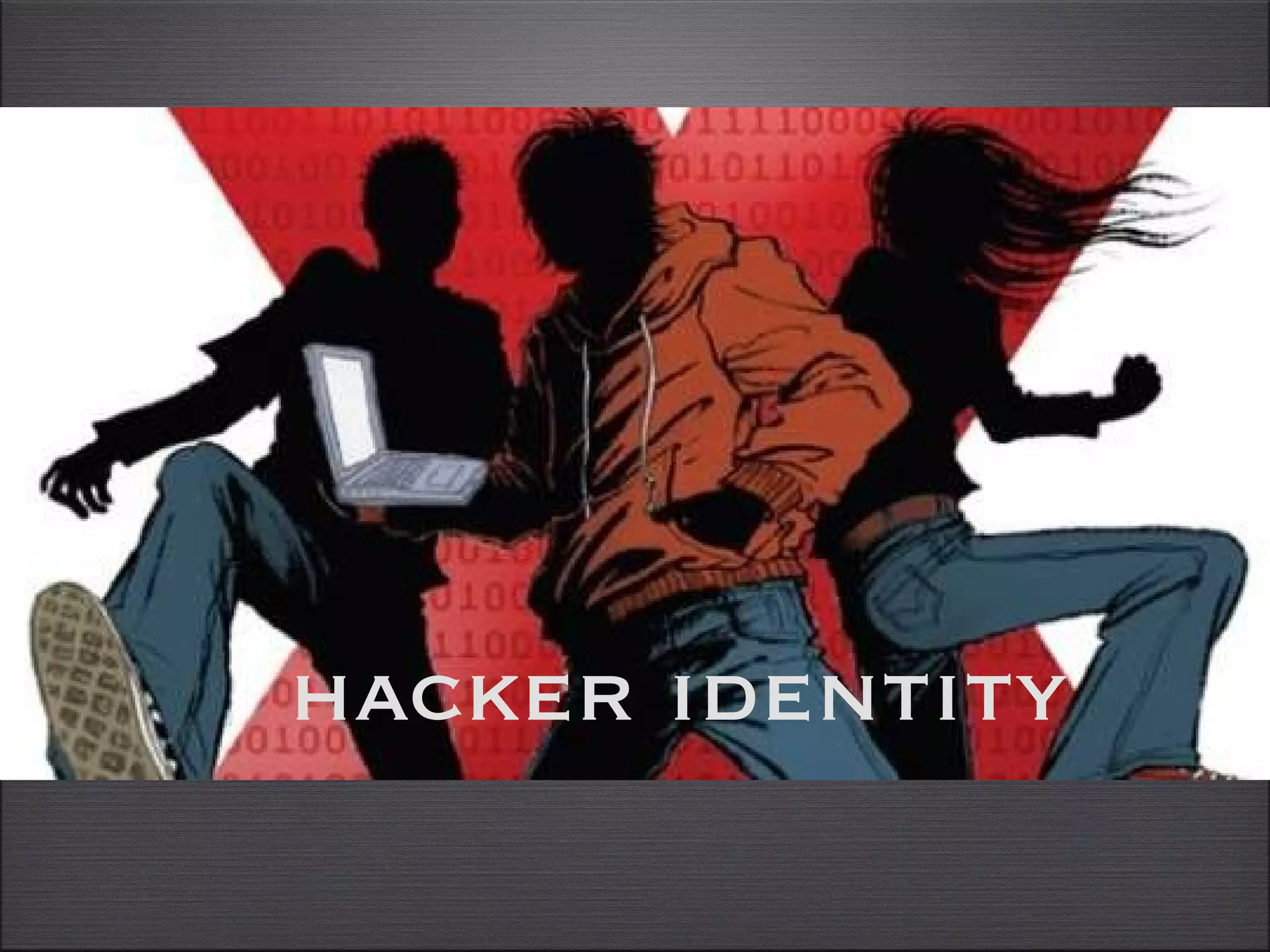
hacker identity
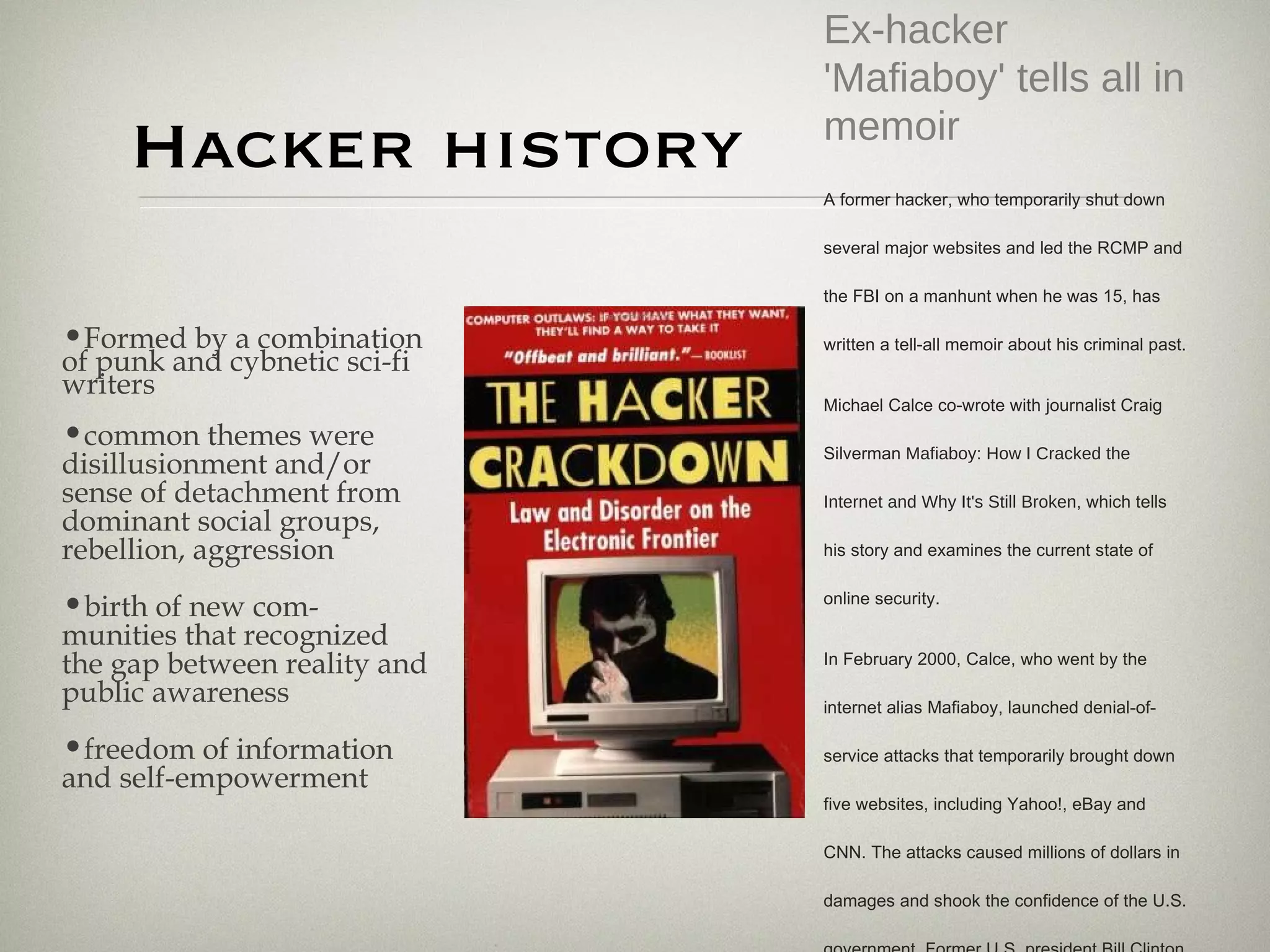
Hacker history Ex-hacker 'Mafiaboy' tells all in memoir A former hacker, who temporarily shut down several major websites and led the RCMP and the FBI on a manhunt when he was 15, has written a tell-all memoir about his criminal past. Michael Calce co-wrote with journalist Craig Silverman  Mafiaboy: How I Cracked the Internet and Why It's Still Broken , which tells his story and examines the current state of online security. In February 2000, Calce, who went by the internet alias Mafiaboy, launched denial-of-service attacks that temporarily brought down five websites, including Yahoo!, eBay and CNN. The attacks caused millions of dollars in damages and shook the confidence of the U.S. government. Former U.S. president Bill Clinton even convened a special Cybersecurity Summit in the days after the attacks. http://www.cbc.ca/canada/story/2008/10/11/mafiaboy-book.html Formed by a combination of punk and cybnetic sci-fi writers  common themes were disillusionment and/or sense of detachment from dominant social groups, rebellion, aggression birth of new com-munities that recognized the gap between reality and public awareness  freedom of information and self-empowerment
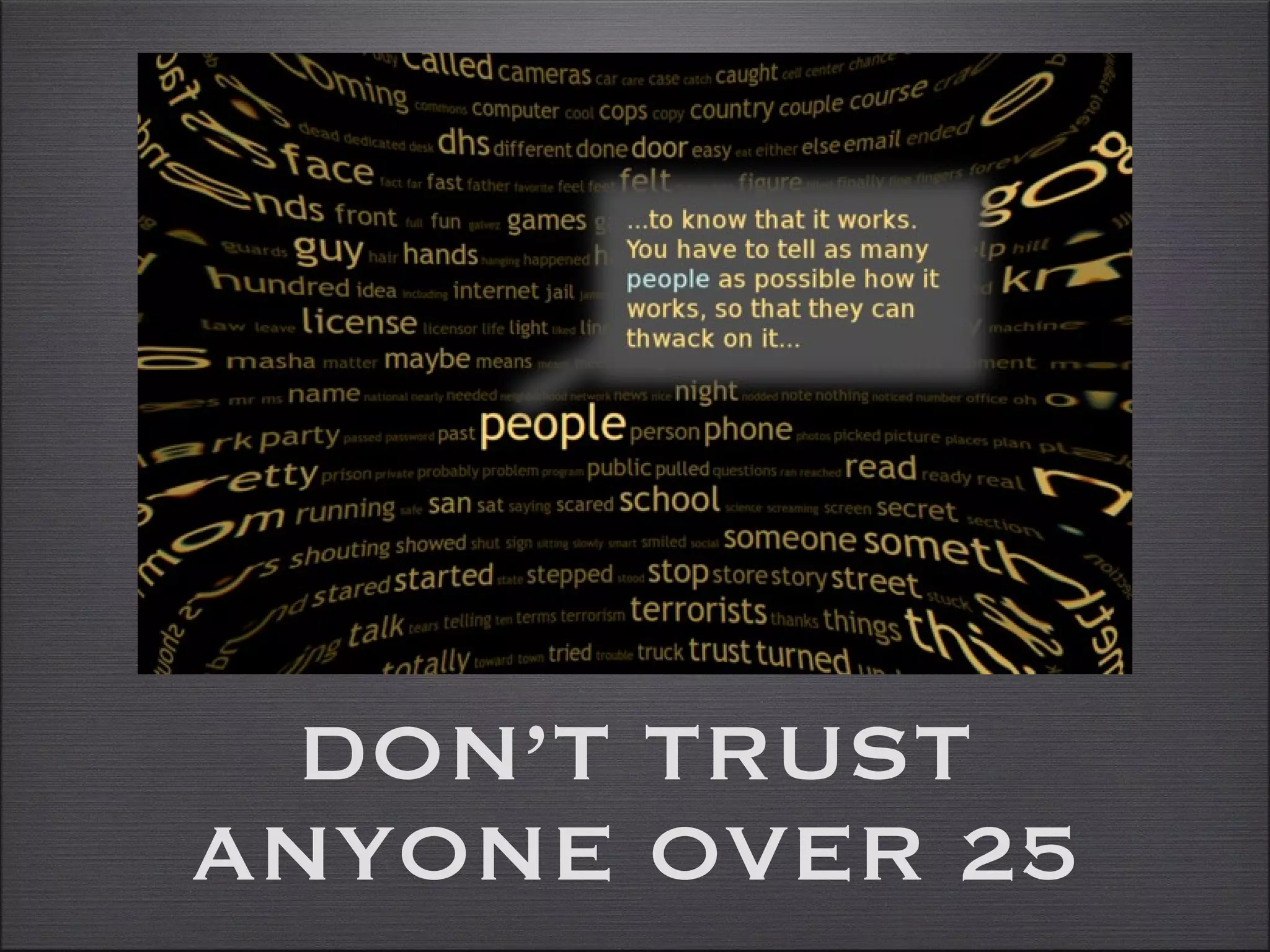
DON’T TRUST ANYONE OVER 25
I believe that we live in an era where anything that can be expressed as bits will be. I believe that bits exist to be copied [. . .]. Me, I’m looking to find ways to use copying to make more money and it’s working: enlisting my readers as evangelists for my work and giving them free ebooks to distribute sells more books. As Tim O’Reilly says, my problem isn’t piracy, it’s obscurity. — Cory Doctorow (“About”) —  Cory Doctorow (“About”)
The exposure culture reflects the philosophy of the Web, in which getting noticed is everything. Web authors link to each other, quote liberally, and sometimes annotate entire articles. E-mailing links to favourite articles and jokes has become as much a part of American work culture as the water cooler. The big sin in exposure culture is not copying, but, instead, failure to properly attribute authorship. And at the centre of this exposure culture is the almighty search engine. If your site is easy to find on Google, you don't sue --- you celebrate. Tim Wu  is a professor at  Columbia Law School , the chair of media reform group  Free Press , and a writer for  Slate Magazine . . .
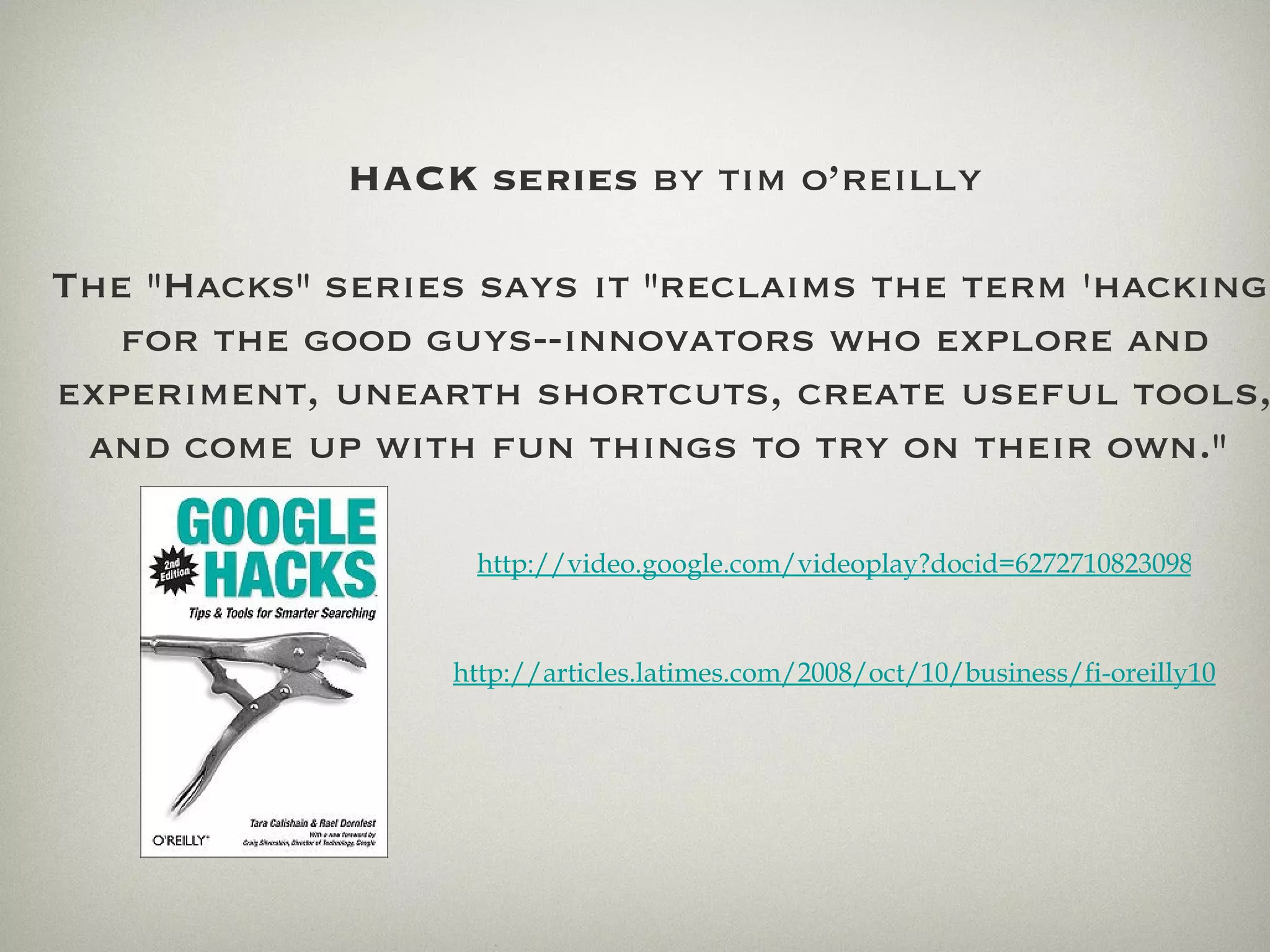
HACK   series  by tim o’reilly The "Hacks" series says it "reclaims the term 'hacking' for the good guys--innovators who explore and experiment, unearth shortcuts, create useful tools, and come up with fun things to try on their own."  http://articles.latimes.com/2008/oct/10/business/fi-oreilly10 http://video.google.com/videoplay?docid=6272710823098922710#
The most alarming aspect of the DCMA for hackers is that it embodies the fallacy that the only sources of innovation of the benefit to society lie within the halls of research institutions or corporations. Suddenly, it is a crime to explore, in the comfort of your own home.  Freedom of speech should not require a lawyer, and free thought should not involve letters of authorization for research.  Andrew “bunnie” Huang, Hacking the Xbox
For every copyright protection scheme that is defeated by a hacker, there is someone who learned an important lesson about how to make a better protection scheme. Andrew “bunnie” Huang, Hacking the Xbox
The keys to decrypt a DVD are controlled by an org called DVD-CCA, and they have a bunch of licensing requirements for anyone who gets a key from them. Among these is something called region-coding: if you buy a DVD in France, it'll have a flag set that says, "I am a European DVD." Bring that DVD to America and your DVD player will compare the flag to its list of permitted regions, and if they don't match, it will tell you that it's not allowed to play your disc. Remember: there is no copyright that says that an author gets to do this. When we wrote the copyright statutes and granted authors the right to control display, performance, duplication,derivative works, and so forth, we didn't leave out "geography"by accident. That was on-purpose.
So when your French DVD won't play in America, that's not because it'd be illegal to do so: it's because the studios have invented a business-model and then invented a copyright law to prop it up. The DVD is your property and so is the DVD player, but if you break the region-coding on your disc, you're going to run afoul of anticircumvention. That's what happened to Jon Johansen, a Norwegian teenager who wanted to watch French DVDs on his Norwegian DVD player. He and some pals wrote some code to break the CSS so that he could do so. He's a wanted man here in America; in Norway the studios put the local fuzz up to bringing him up on charges of “unlawfully trespassing upon a computer system.” When his defence asked,"Which computer has Jon trespassed upon?" the answer was: "His own." (Microsoft Research DRM talk.)
This is the overweening characteristic of every single successful new medium: it is true to itself. The Luther Bible didn't succeed on the axes that made a hand-copied monk Bible valuable: they were ugly, they weren't in Church Latin, they weren't read aloud by someone who could interpret it for his lay audience, they didn't represent years of devoted-with-a-capital-D labor by someone who had given his life over to God. The thing that made the Luther Bible a success was its scalability: it was more popular because it was more proliferate: all success factors for a new medium pale beside its profligacy. The most successful organisms on earth are those that reproduce the most: bugs and bacteria, nematodes and virii. Reproduction is the best of all survival strategies. http://craphound.com/msftdrm.txt
digital rights Management Doctorow’s  Microsoft Research DRM Talk is his most famous position paper on DRM. http://craphound.com/msftdrm.txt Here's how anticircumvention works: if you put a lock -- an access control -- around a copyrighted work, it is illegal to break that lock. It's illegal to make a tool that breaks that lock. It's illegal to tell someone how to make that tool. One court even held it illegal to tell someone where she can find out how to make that tool.
Here are the two most important things to know about computers and the Internet: 1. A computer is a machine for rearranging bits  2. The Internet is a machine for moving bits from one place to another very cheaply and quickly.  Any new medium that takes hold on the Internet and with computers will embrace these two facts, not regret them. A newspaper press is a machine for spitting out cheap and smeary newsprint at speed: if you try to make it output fine art lithos, you'll get junk. If you try to make it output newspapers, you'll get the basis for a free society. And so it is with the Internet. At the heyday of Napster, record execs used to show up at conferences and tell everyone that Napster was doomed because no one wanted loosely compressed MP3s with no liner notes and truncated files and misspelled metadata. (http://craphound.com/msftdrm.txt)
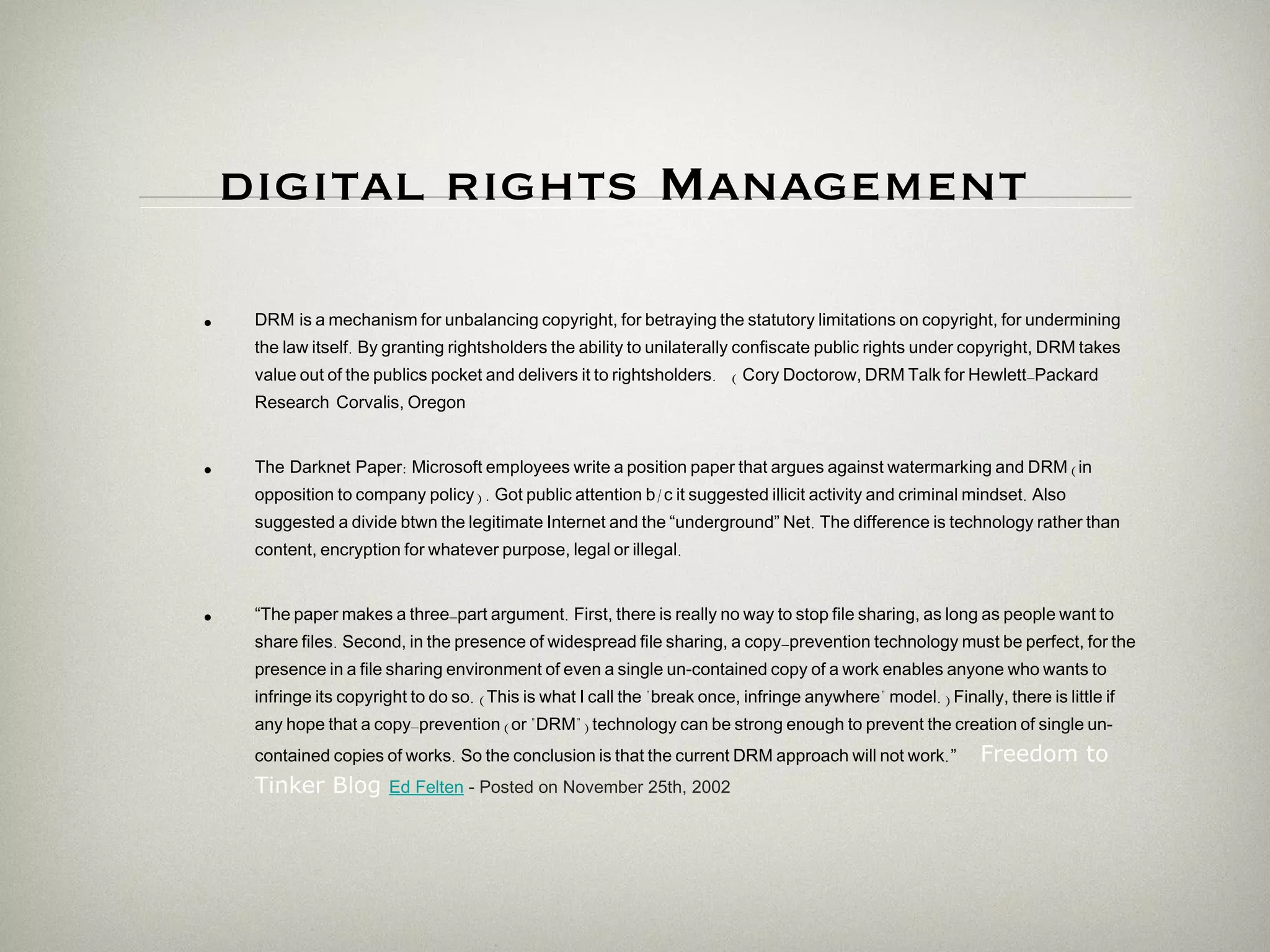
digital rights Management   DRM  is   a   mechanism   for   unbalancing   copyright,   for   betraying   the   statutory   limitations   on   copyright,   for   undermining   the   law   itself .  By   granting   rightsholders   the   ability   to   unilaterally   confiscate   public   rights   under   copyright,   DRM   takes   value   out   of   the   public ' s   pocket   and   delivers   it   to   rightsholders .  (  Cory   Doctorow,   DRM   Talk   for   Hewlett - Packard   Research   Corvalis,   Oregon The Darknet Paper :  Microsoft   employees   write   a   position   paper   that   argues   against   watermarking   and   DRM  ( in   opposition   to   company   policy ) .  Got   public   attention   b / c   it   suggested   illicit   activity   and   criminal   mindset .  Also   suggested   a   divide   btwn   the   legitimate   Internet   and   the   “underground”   Net .  The   difference   is   technology   rather   than   content,   encryption   for   whatever   purpose,   legal   or   illegal . “ The   paper   makes   a   three - part   argument .  First,   there   is   really   no   way   to   stop   file   sharing,   as   long   as   people   want   to   share   files .  Second,   in   the   presence   of   widespread   file   sharing,   a   copy - prevention   technology   must   be   perfect,   for   the   presence   in   a   file   sharing   environment   of   even   a   single   un-contained   copy   of   a   work   enables   anyone   who   wants   to   infringe   its   copyright   to   do   so . ( This   is   what   I   call   the  " break   once,   infringe   anywhere "  model .)  Finally,   there   is   little   if   any   hope   that   a   copy - prevention  ( or  " DRM ")  technology   can   be   strong   enough   to   prevent   the   creation   of   single   un-contained   copies   of   works .  So   the   conclusion   is   that   the   current   DRM   approach   will   not   work . ”   Freedom to Tinker Blog  Ed Felten  - Posted on November 25th, 2002
Doctorow’s Xnet is taken from the Darknet concept Darknet is any closed private network of computers used for file sharing don’t learn to hack - hack to learn
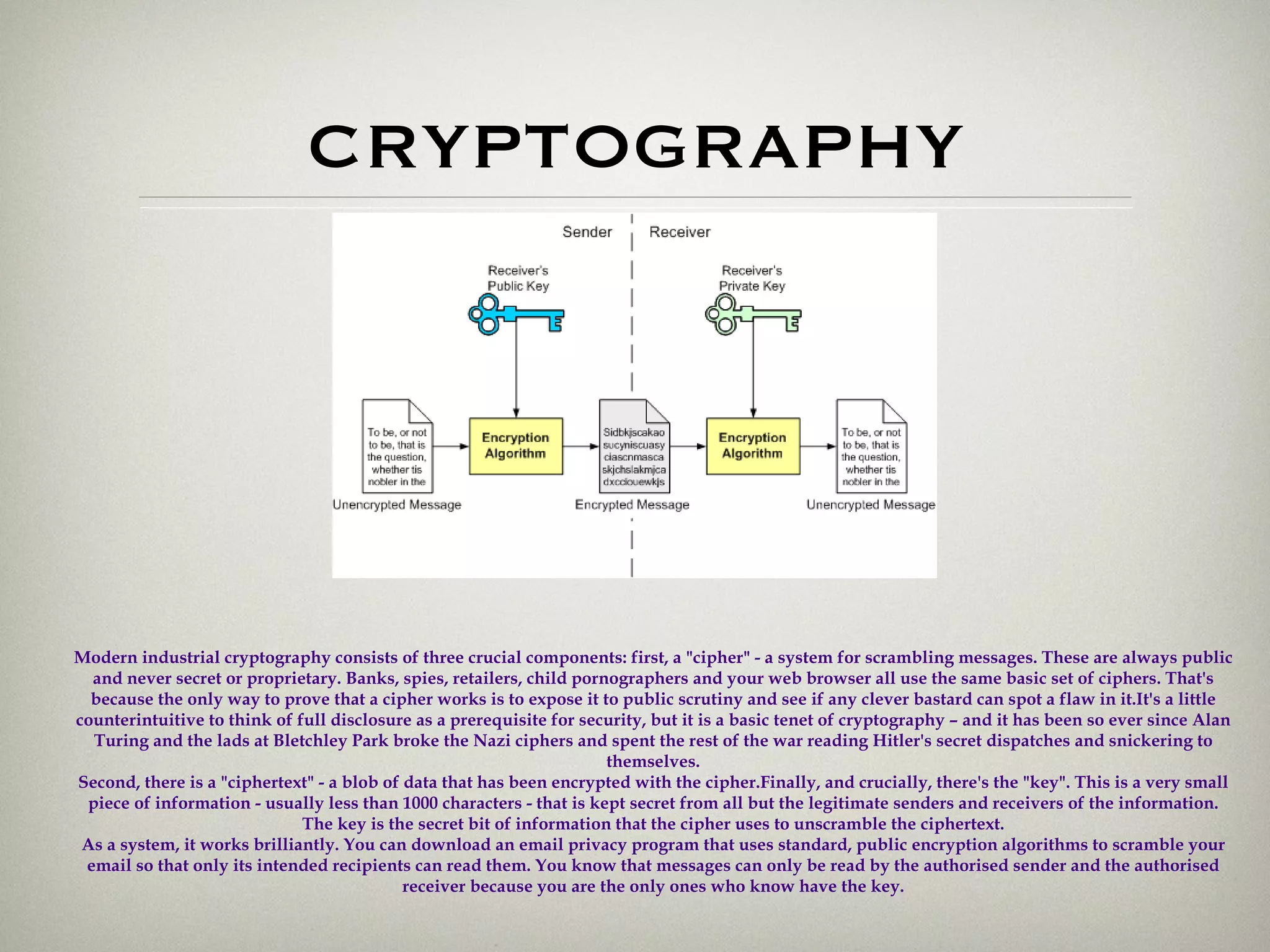
CRYPTOGRAPHY Modern industrial cryptography consists of three crucial components: first, a "cipher" - a system for scrambling messages. These are always public and never secret or proprietary. Banks, spies, retailers, child pornographers and your web browser all use the same basic set of ciphers. That's because the only way to prove that a cipher works is to expose it to public scrutiny and see if any clever bastard can spot a flaw in it.It's a little counterintuitive to think of full disclosure as a prerequisite for security, but it is a basic tenet of cryptography – and it has been so ever since Alan Turing and the lads at Bletchley Park broke the Nazi ciphers and spent the rest of the war reading Hitler's secret dispatches and snickering to themselves. Second, there is a "ciphertext" - a blob of data that has been encrypted with the cipher.Finally, and crucially, there's the "key". This is a very small piece of information - usually less than 1000 characters - that is kept secret from all but the legitimate senders and receivers of the information. The key is the secret bit of information that the cipher uses to unscramble the ciphertext. As a system, it works brilliantly. You can download an email privacy program that uses standard, public encryption algorithms to scramble your email so that only its intended recipients can read them. You know that messages can only be read by the authorised sender and the authorised receiver because you are the only ones who know have the key.
Privacy almost always includes an element of personal/political power. Children want privacy from their parents.  Employees want privacy from their bosses.  Political dissidents want privacy from the Chinese secret police.  DRM Talk for Hewlett-Packard Research  Corvalis, OregonCory Doctorow European Affairs Coordinator, Electronic Frontier Foundation
where digital rights Management and cryptography meet In DRM use-restriction scenarios, there is only a sender and an attacker,  who is also the intended recipient of the message . I transmit a song to you so that you can listen to it, but try to stop you from copying it. This requires that your terminal obey my commands, even when you want it to obey  your  commands. Understood this way, use-restriction and privacy are antithetical. As is often the case in security, increasing the security on one axis weakens the security on another. A terminal that is capable of being remotely controlled by a third party who is adversarial to its owner is a terminal that is capable of betraying its owner's privacy in numerous ways without the owner's consent or knowledge. A terminal that can  never  be used to override its owner's wishes is by definition a terminal that is better at protecting its owner's privacy. FOR EXAMPLE: Amazon's new movie download service is called Unbox and it outlines what DRM implies. The user agreement requires that you allow Unbox DRM software to monitor your hard drive and to report activity to Amazon. These reports would thus include a list of: all the software installed; all the music and video you have; all your computer's interaction with other devices. You will surrender your freedom to such an extent that you will only be able to regain control by removing the software. But if you do remove the software you will also remove all your movies along with it. You are restricted even geographically, and you lose your movies if you ever move out of the USA. You of course have to agree that they can change these terms at any time. Microsoft's newly upgraded Windows Media Player 11 (WMP11) user agreement has a similar set of terms. ( http://www.defectivebydesign.org/what_is_drm )
doctorow on crypto In DRM, the attacker  is also the recipient . It's not Alice andBob and Carol, it's just Alice and Bob. Alice sells Bob a DVD. She sells Bob a DVD player. The DVD has a movie on it -- say,Pirates of the Caribbean -- and it's enciphered with an algorithm called CSS -- Content Scrambling System. The DVD player has a CSS un-scrambler.Now, let's take stock of what's a secret here: the cipher is well-known. The cipher-text is most assuredly in enemy hands, arrr...So what? As long as the key is secret from the attacker, we're golden. But there's the rub. Alice wants Bob to buy Pirates of the Caribbean from her. Bob will only buy Pirates of the Caribbean if he can descramble the CSS-encrypted VOB -- video object -- on his DVD player. Otherwise, the disc is only useful to Bob as a drinks-coaster. So Alice has to provide Bob -- the attacker -- with the key, the cipher and the cipher-text. DRM systems are usually broken in minutes, sometimes days. Rarely, months. It's not because the people who think them up are stupid. It's not because the people who break them are smart. It's not because there's a flaw in the algorithms. At the end of the day, all DRM systems share a common vulnerability: they provide their attackers with cipher-text, the cipher and the key. At this point, the secret isn't a secret anymore.
What type of info/work/code can be copyright? Where is it freedom and where is it protection?  InterNet new medium - must change business model Cryptography - how do we catch the bad guys?
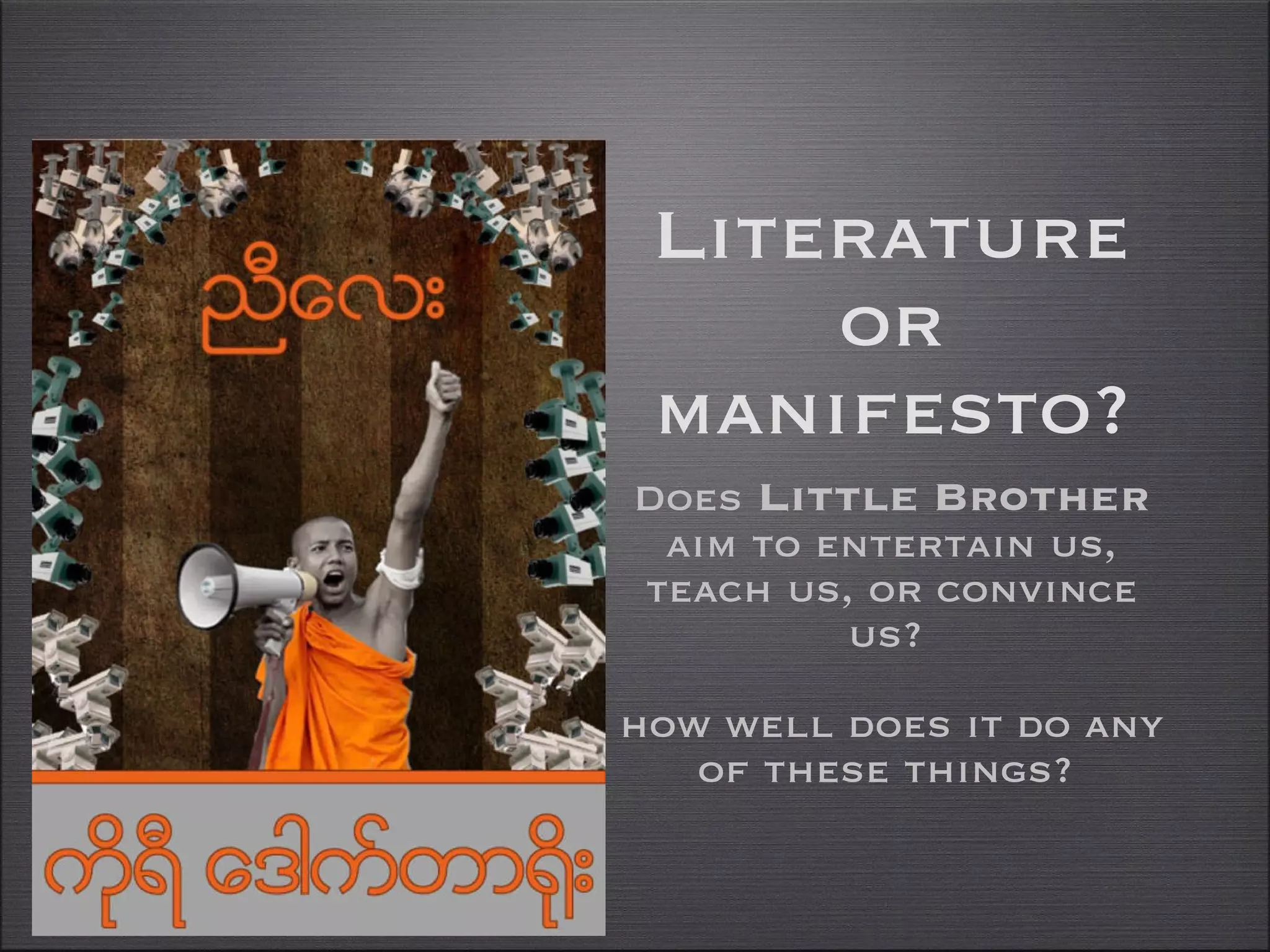
Literature or manifesto? Does  Little   Brother  aim to entertain us, teach us, or convince us?  how well does it do any of these things?
If you love freedom, if you think the human condition is dignified by privacy, by the right to be left alone, by the right to explore your weird ideas provided you don't hurt others, then you have common cause with the kids whose web-browsers and cellphones are being used to lock them up and follow them around. If you believe that the answer to bad speech is more speech not censorship then you have a dog in the fight. If you believe in a society of laws, a land where our rulers have to tell us the rules, and have to follow them too, then you're part of the same struggle that kids fight when they argue for the right to live under the same Bill of Rights that adults have. This book is meant to be part of the conversation about what an information society means: does it mean total control, or unheardof liberty? It's not just a noun, it's a verb, it's something you do. liberty? It's not just a noun, it's a verb, it's something you do. liberty? It's not just a noun, it's a verb, it's something you do. liberty? It's not just a noun, it's a verb, it's something you do. liberty? It's not just a noun, it's a verb, it's something you do. liberty? It's not just a noun, it's a verb, it's something you do.
DO SOMETHING This book is meant to be something you do, not just something you read. The technology in this book is either real or nearly real. You can build a lot of it. You can share it and remix it . You can use the ideas to spark important discussions with your friends and family. You can use those ideas to defeat censorship and get onto the free Internet, even if your government, employer or school doesn't want you to. You can build a lot of it. You can share it and remix it . You can use the ideas to spark important discussions with your friends and family. You can use those ideas to defeat censorship and get onto the free Internet, even if your government, employer or school doesn't want you to. You can build a lot of it. You can share it and remix it . You can use the ideas to spark important discussions with your friends and family. You can use those ideas to defeat censorship and get onto the free Internet, even if your government, employer or school doesn't want you to. You can build a lot of it. You can share it and remix it . You can use the ideas to spark important discussions with your friends and family. You can use those ideas to defeat censorship and get onto the free Internet, even if your government, employer or school doesn't want you to.
“… nationalism, religious bigotry, and feudal loyalty are far more powerful forces than sanity.”  (Orwell, Wells, Hitler, and the World State) (Orwell, Wells, Hitler, and the World State) “ I believe that totalitarian ideas have taken root in the minds of intellectuals everywhere, and I have tried to draw these ideas out to their logical consequences.”  (Orwell, The Collected Essays, Journalism, and Letters of George Orwell)
The scene of the book is laid in Britain in order to emphasize that the English-speaking races are not innately better than anyone else and that totalitarianism, if not fought against, could triumph anywhere. (Orwell,  Collected Essays, Journalism, and Letters of George Orwell ) )
I do not believe that the kind of society I describe will arrive, (the book is a satire), but that something resembling it could arrive.
http://craphound.com/littlebrother/2010/07/10/iranian-activists-release-free-persian-little-brother/
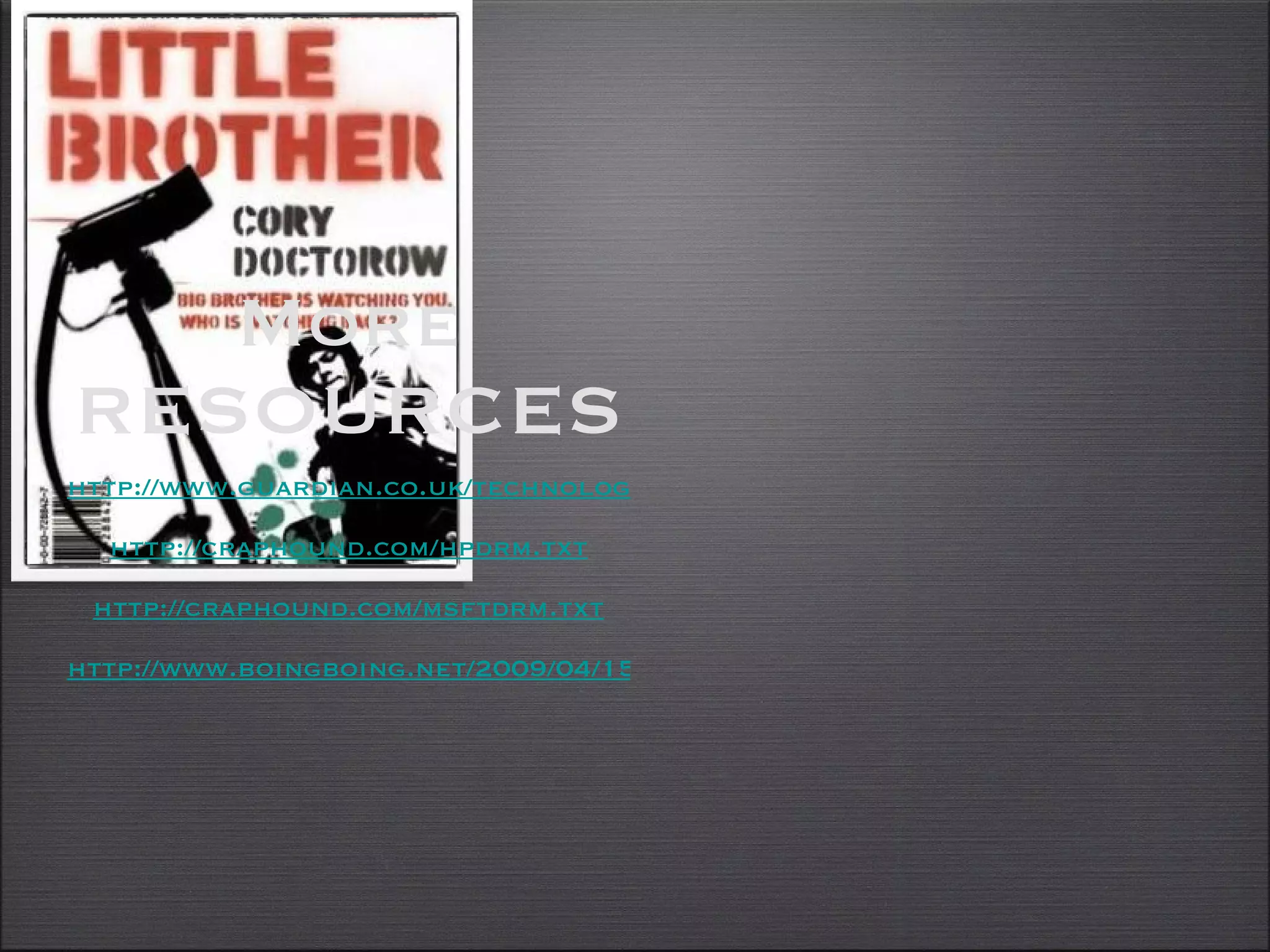
More RESOURCES http://www.guardian.co.uk/technology/2007/sep/04/lightspeed http://craphound.com/hpdrm.txt http://craphound.com/msftdrm.txt http://www.boingboing.net/2009/04/15/my-drm-and-ebooks-ta.html

Drm and crypto

  • 1.
  • 2.
    Hacker history Ex-hacker'Mafiaboy' tells all in memoir A former hacker, who temporarily shut down several major websites and led the RCMP and the FBI on a manhunt when he was 15, has written a tell-all memoir about his criminal past. Michael Calce co-wrote with journalist Craig Silverman Mafiaboy: How I Cracked the Internet and Why It's Still Broken , which tells his story and examines the current state of online security. In February 2000, Calce, who went by the internet alias Mafiaboy, launched denial-of-service attacks that temporarily brought down five websites, including Yahoo!, eBay and CNN. The attacks caused millions of dollars in damages and shook the confidence of the U.S. government. Former U.S. president Bill Clinton even convened a special Cybersecurity Summit in the days after the attacks. http://www.cbc.ca/canada/story/2008/10/11/mafiaboy-book.html Formed by a combination of punk and cybnetic sci-fi writers common themes were disillusionment and/or sense of detachment from dominant social groups, rebellion, aggression birth of new com-munities that recognized the gap between reality and public awareness freedom of information and self-empowerment
  • 3.
  • 4.
    I believe thatwe live in an era where anything that can be expressed as bits will be. I believe that bits exist to be copied [. . .]. Me, I’m looking to find ways to use copying to make more money and it’s working: enlisting my readers as evangelists for my work and giving them free ebooks to distribute sells more books. As Tim O’Reilly says, my problem isn’t piracy, it’s obscurity. — Cory Doctorow (“About”) — Cory Doctorow (“About”)
  • 5.
    The exposure culturereflects the philosophy of the Web, in which getting noticed is everything. Web authors link to each other, quote liberally, and sometimes annotate entire articles. E-mailing links to favourite articles and jokes has become as much a part of American work culture as the water cooler. The big sin in exposure culture is not copying, but, instead, failure to properly attribute authorship. And at the centre of this exposure culture is the almighty search engine. If your site is easy to find on Google, you don't sue --- you celebrate. Tim Wu is a professor at Columbia Law School , the chair of media reform group Free Press , and a writer for Slate Magazine . . .
  • 6.
    HACK series by tim o’reilly The "Hacks" series says it "reclaims the term 'hacking' for the good guys--innovators who explore and experiment, unearth shortcuts, create useful tools, and come up with fun things to try on their own." http://articles.latimes.com/2008/oct/10/business/fi-oreilly10 http://video.google.com/videoplay?docid=6272710823098922710#
  • 7.
    The most alarmingaspect of the DCMA for hackers is that it embodies the fallacy that the only sources of innovation of the benefit to society lie within the halls of research institutions or corporations. Suddenly, it is a crime to explore, in the comfort of your own home. Freedom of speech should not require a lawyer, and free thought should not involve letters of authorization for research. Andrew “bunnie” Huang, Hacking the Xbox
  • 8.
    For every copyrightprotection scheme that is defeated by a hacker, there is someone who learned an important lesson about how to make a better protection scheme. Andrew “bunnie” Huang, Hacking the Xbox
  • 9.
    The keys todecrypt a DVD are controlled by an org called DVD-CCA, and they have a bunch of licensing requirements for anyone who gets a key from them. Among these is something called region-coding: if you buy a DVD in France, it'll have a flag set that says, "I am a European DVD." Bring that DVD to America and your DVD player will compare the flag to its list of permitted regions, and if they don't match, it will tell you that it's not allowed to play your disc. Remember: there is no copyright that says that an author gets to do this. When we wrote the copyright statutes and granted authors the right to control display, performance, duplication,derivative works, and so forth, we didn't leave out "geography"by accident. That was on-purpose.
  • 10.
    So when yourFrench DVD won't play in America, that's not because it'd be illegal to do so: it's because the studios have invented a business-model and then invented a copyright law to prop it up. The DVD is your property and so is the DVD player, but if you break the region-coding on your disc, you're going to run afoul of anticircumvention. That's what happened to Jon Johansen, a Norwegian teenager who wanted to watch French DVDs on his Norwegian DVD player. He and some pals wrote some code to break the CSS so that he could do so. He's a wanted man here in America; in Norway the studios put the local fuzz up to bringing him up on charges of “unlawfully trespassing upon a computer system.” When his defence asked,"Which computer has Jon trespassed upon?" the answer was: "His own." (Microsoft Research DRM talk.)
  • 11.
    This is theoverweening characteristic of every single successful new medium: it is true to itself. The Luther Bible didn't succeed on the axes that made a hand-copied monk Bible valuable: they were ugly, they weren't in Church Latin, they weren't read aloud by someone who could interpret it for his lay audience, they didn't represent years of devoted-with-a-capital-D labor by someone who had given his life over to God. The thing that made the Luther Bible a success was its scalability: it was more popular because it was more proliferate: all success factors for a new medium pale beside its profligacy. The most successful organisms on earth are those that reproduce the most: bugs and bacteria, nematodes and virii. Reproduction is the best of all survival strategies. http://craphound.com/msftdrm.txt
  • 12.
    digital rights ManagementDoctorow’s Microsoft Research DRM Talk is his most famous position paper on DRM. http://craphound.com/msftdrm.txt Here's how anticircumvention works: if you put a lock -- an access control -- around a copyrighted work, it is illegal to break that lock. It's illegal to make a tool that breaks that lock. It's illegal to tell someone how to make that tool. One court even held it illegal to tell someone where she can find out how to make that tool.
  • 13.
    Here are thetwo most important things to know about computers and the Internet: 1. A computer is a machine for rearranging bits 2. The Internet is a machine for moving bits from one place to another very cheaply and quickly. Any new medium that takes hold on the Internet and with computers will embrace these two facts, not regret them. A newspaper press is a machine for spitting out cheap and smeary newsprint at speed: if you try to make it output fine art lithos, you'll get junk. If you try to make it output newspapers, you'll get the basis for a free society. And so it is with the Internet. At the heyday of Napster, record execs used to show up at conferences and tell everyone that Napster was doomed because no one wanted loosely compressed MP3s with no liner notes and truncated files and misspelled metadata. (http://craphound.com/msftdrm.txt)
  • 14.
    digital rights Management DRM is a mechanism for unbalancing copyright, for betraying the statutory limitations on copyright, for undermining the law itself . By granting rightsholders the ability to unilaterally confiscate public rights under copyright, DRM takes value out of the public ' s pocket and delivers it to rightsholders . ( Cory Doctorow, DRM Talk for Hewlett - Packard Research Corvalis, Oregon The Darknet Paper : Microsoft employees write a position paper that argues against watermarking and DRM ( in opposition to company policy ) . Got public attention b / c it suggested illicit activity and criminal mindset . Also suggested a divide btwn the legitimate Internet and the “underground” Net . The difference is technology rather than content, encryption for whatever purpose, legal or illegal . “ The paper makes a three - part argument . First, there is really no way to stop file sharing, as long as people want to share files . Second, in the presence of widespread file sharing, a copy - prevention technology must be perfect, for the presence in a file sharing environment of even a single un-contained copy of a work enables anyone who wants to infringe its copyright to do so . ( This is what I call the " break once, infringe anywhere " model .) Finally, there is little if any hope that a copy - prevention ( or " DRM ") technology can be strong enough to prevent the creation of single un-contained copies of works . So the conclusion is that the current DRM approach will not work . ” Freedom to Tinker Blog Ed Felten - Posted on November 25th, 2002
  • 15.
    Doctorow’s Xnet istaken from the Darknet concept Darknet is any closed private network of computers used for file sharing don’t learn to hack - hack to learn
  • 16.
    CRYPTOGRAPHY Modern industrialcryptography consists of three crucial components: first, a "cipher" - a system for scrambling messages. These are always public and never secret or proprietary. Banks, spies, retailers, child pornographers and your web browser all use the same basic set of ciphers. That's because the only way to prove that a cipher works is to expose it to public scrutiny and see if any clever bastard can spot a flaw in it.It's a little counterintuitive to think of full disclosure as a prerequisite for security, but it is a basic tenet of cryptography – and it has been so ever since Alan Turing and the lads at Bletchley Park broke the Nazi ciphers and spent the rest of the war reading Hitler's secret dispatches and snickering to themselves. Second, there is a "ciphertext" - a blob of data that has been encrypted with the cipher.Finally, and crucially, there's the "key". This is a very small piece of information - usually less than 1000 characters - that is kept secret from all but the legitimate senders and receivers of the information. The key is the secret bit of information that the cipher uses to unscramble the ciphertext. As a system, it works brilliantly. You can download an email privacy program that uses standard, public encryption algorithms to scramble your email so that only its intended recipients can read them. You know that messages can only be read by the authorised sender and the authorised receiver because you are the only ones who know have the key.
  • 17.
    Privacy almost alwaysincludes an element of personal/political power. Children want privacy from their parents. Employees want privacy from their bosses. Political dissidents want privacy from the Chinese secret police. DRM Talk for Hewlett-Packard Research Corvalis, OregonCory Doctorow European Affairs Coordinator, Electronic Frontier Foundation
  • 18.
    where digital rightsManagement and cryptography meet In DRM use-restriction scenarios, there is only a sender and an attacker, who is also the intended recipient of the message . I transmit a song to you so that you can listen to it, but try to stop you from copying it. This requires that your terminal obey my commands, even when you want it to obey your commands. Understood this way, use-restriction and privacy are antithetical. As is often the case in security, increasing the security on one axis weakens the security on another. A terminal that is capable of being remotely controlled by a third party who is adversarial to its owner is a terminal that is capable of betraying its owner's privacy in numerous ways without the owner's consent or knowledge. A terminal that can never be used to override its owner's wishes is by definition a terminal that is better at protecting its owner's privacy. FOR EXAMPLE: Amazon's new movie download service is called Unbox and it outlines what DRM implies. The user agreement requires that you allow Unbox DRM software to monitor your hard drive and to report activity to Amazon. These reports would thus include a list of: all the software installed; all the music and video you have; all your computer's interaction with other devices. You will surrender your freedom to such an extent that you will only be able to regain control by removing the software. But if you do remove the software you will also remove all your movies along with it. You are restricted even geographically, and you lose your movies if you ever move out of the USA. You of course have to agree that they can change these terms at any time. Microsoft's newly upgraded Windows Media Player 11 (WMP11) user agreement has a similar set of terms. ( http://www.defectivebydesign.org/what_is_drm )
  • 19.
    doctorow on cryptoIn DRM, the attacker is also the recipient . It's not Alice andBob and Carol, it's just Alice and Bob. Alice sells Bob a DVD. She sells Bob a DVD player. The DVD has a movie on it -- say,Pirates of the Caribbean -- and it's enciphered with an algorithm called CSS -- Content Scrambling System. The DVD player has a CSS un-scrambler.Now, let's take stock of what's a secret here: the cipher is well-known. The cipher-text is most assuredly in enemy hands, arrr...So what? As long as the key is secret from the attacker, we're golden. But there's the rub. Alice wants Bob to buy Pirates of the Caribbean from her. Bob will only buy Pirates of the Caribbean if he can descramble the CSS-encrypted VOB -- video object -- on his DVD player. Otherwise, the disc is only useful to Bob as a drinks-coaster. So Alice has to provide Bob -- the attacker -- with the key, the cipher and the cipher-text. DRM systems are usually broken in minutes, sometimes days. Rarely, months. It's not because the people who think them up are stupid. It's not because the people who break them are smart. It's not because there's a flaw in the algorithms. At the end of the day, all DRM systems share a common vulnerability: they provide their attackers with cipher-text, the cipher and the key. At this point, the secret isn't a secret anymore.
  • 20.
    What type ofinfo/work/code can be copyright? Where is it freedom and where is it protection? InterNet new medium - must change business model Cryptography - how do we catch the bad guys?
  • 21.
    Literature or manifesto?Does Little Brother aim to entertain us, teach us, or convince us? how well does it do any of these things?
  • 22.
    If you lovefreedom, if you think the human condition is dignified by privacy, by the right to be left alone, by the right to explore your weird ideas provided you don't hurt others, then you have common cause with the kids whose web-browsers and cellphones are being used to lock them up and follow them around. If you believe that the answer to bad speech is more speech not censorship then you have a dog in the fight. If you believe in a society of laws, a land where our rulers have to tell us the rules, and have to follow them too, then you're part of the same struggle that kids fight when they argue for the right to live under the same Bill of Rights that adults have. This book is meant to be part of the conversation about what an information society means: does it mean total control, or unheardof liberty? It's not just a noun, it's a verb, it's something you do. liberty? It's not just a noun, it's a verb, it's something you do. liberty? It's not just a noun, it's a verb, it's something you do. liberty? It's not just a noun, it's a verb, it's something you do. liberty? It's not just a noun, it's a verb, it's something you do. liberty? It's not just a noun, it's a verb, it's something you do.
  • 23.
    DO SOMETHING Thisbook is meant to be something you do, not just something you read. The technology in this book is either real or nearly real. You can build a lot of it. You can share it and remix it . You can use the ideas to spark important discussions with your friends and family. You can use those ideas to defeat censorship and get onto the free Internet, even if your government, employer or school doesn't want you to. You can build a lot of it. You can share it and remix it . You can use the ideas to spark important discussions with your friends and family. You can use those ideas to defeat censorship and get onto the free Internet, even if your government, employer or school doesn't want you to. You can build a lot of it. You can share it and remix it . You can use the ideas to spark important discussions with your friends and family. You can use those ideas to defeat censorship and get onto the free Internet, even if your government, employer or school doesn't want you to. You can build a lot of it. You can share it and remix it . You can use the ideas to spark important discussions with your friends and family. You can use those ideas to defeat censorship and get onto the free Internet, even if your government, employer or school doesn't want you to.
  • 24.
    “… nationalism, religiousbigotry, and feudal loyalty are far more powerful forces than sanity.” (Orwell, Wells, Hitler, and the World State) (Orwell, Wells, Hitler, and the World State) “ I believe that totalitarian ideas have taken root in the minds of intellectuals everywhere, and I have tried to draw these ideas out to their logical consequences.” (Orwell, The Collected Essays, Journalism, and Letters of George Orwell)
  • 25.
    The scene ofthe book is laid in Britain in order to emphasize that the English-speaking races are not innately better than anyone else and that totalitarianism, if not fought against, could triumph anywhere. (Orwell, Collected Essays, Journalism, and Letters of George Orwell ) )
  • 26.
    I do notbelieve that the kind of society I describe will arrive, (the book is a satire), but that something resembling it could arrive.
  • 27.
  • 28.
    More RESOURCES http://www.guardian.co.uk/technology/2007/sep/04/lightspeedhttp://craphound.com/hpdrm.txt http://craphound.com/msftdrm.txt http://www.boingboing.net/2009/04/15/my-drm-and-ebooks-ta.html

Editor's Notes

  • #2 What kind of person do you think of when you picture a hacker? Does anyone here describe themselves as a hacker? What is the stereotype? How do hackers see themselves? What do you think?
  • #5 How does Doctorow see hackers? How does he want US to see them?