Whose Immaterial Economy? Jyrki J.J. Kasvi
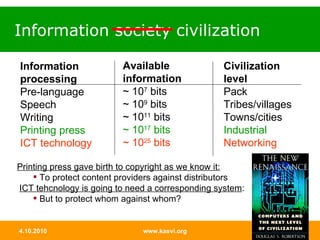
Information society civilization Information processing Pre-language Speech Writing Printing press ICT technology Available information ~ 10 7  bits ~ 10 9  bits ~ 10 11  bits ~ 10 17  bits ~ 10 25  bits Printing press gave birth to copyright as we know it: To protect content providers against distributors ICT tehcnology is going to need a corresponding system : But to protect whom against whom? Civilization level Pack Tribes/villages Towns/cities Industrial  Networking
Anne’s act 1709 In 1709 the first actual copyright law was enacted in United Kingdom  Defined the three interest groups whose relationships copyright laws still governs: content provider, publisher and consumer  Publishers had no right to limit the way consumers use the content they purchase, DRM would have been illegal in 1709.  It took 300 years from Gutenberg’s invention to get a law  The principles of Anne’s act worked for almost 300 years! Requires small copying costs and centralised control In digital world the copying costs are zero and each and every computer is a potential printing press Now the change happens much faster than 300-400 years ago.
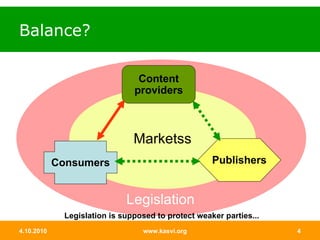
Balance? Marketss Content providers Publishers Consumers Legislation Legislation is supposed to protect weaker parties...
Challenge and opportunity Printing press created the basis for copyright system Making of new copies of content is cheap It is possible to centrally supervise and control copying Newspapers and popular culture were born as a result But the profession of scribes was wiped out Digital technology requires new rules It costs nothing to copy, edit and distribute content It is impossible to centrally supervise or control copying What new cultural phenomena digital technology makes possible? Social media, crowdsourcing, … Rip-n-mix & mash-up ???
Goals for a new copyright system Of these we probably have a wide consensus To maximise production and use of content – the expansion of culture E.g. the original goal of the patent system was to maximise the distribution and use of new innovations – expansion of economy To secure livelihood of content makers What about benefits of media industry shareholders? Production and marketing services used by content makers are also under threat To facilitate new forms of content, expression and culture Crowdsourcing, mash-ups etc. vs. copyright Of means to achieve these goals we still need to discuss
Problematic details Copyrights of public information Have been used to limit publication and usage of public information How to use content created by public cultural institutions and broadcasting companies? Copyrights in developing countries Research and education institutions of developing countries cannot afford the prices of scientific and educational materials Disabled people’s equal access to information Content should be transferable to formats accessible to disabled people DRM should allow blind people’s screen readers to work Copyrights of software have been forgotten Economically the most important sector of copyright economy in Finland The intimate relationship of media industry and law makers The secrecy of ACTA negotiations have not stopped media industry lobbyists from being informed (better than politicians or NGO’s)‏ Consumer and civil rights have been secondary to economic interests
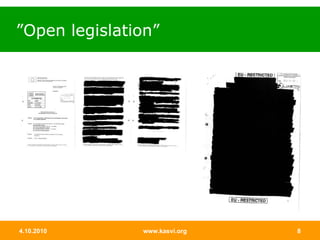
” Open legislation”
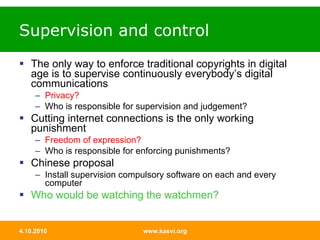
Supervision and control The only way to enforce traditional copyrights in digital age is to supervise continuously everybody’s digital communications Privacy? Who is responsible for supervision and judgement? Cutting internet connections is the only working punishment  Freedom of expression? Who is responsible for enforcing punishments? Chinese proposal Install supervision compulsory software on each and every computer Who would be watching the watchmen?
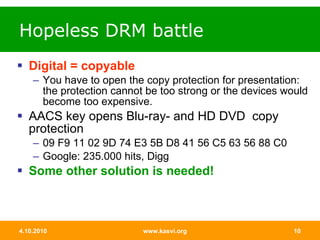
Hopeless DRM battle Digital = copyable You have to open the copy protection for presentation: the protection cannot be too strong or the devices would become too expensive.  AACS key opens Blu-ray- and HD DVD  copy protection 09 F9 11 02 9D 74 E3 5B D8 41 56 C5 63 56 88 C0  Google: 235.000 hits, Digg Some other solution is needed!
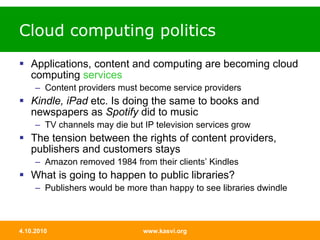
Cloud computing politics Applications, content and computing are becoming cloud computing  services Content providers must become service providers Kindle, iPad  etc. Is doing the same to books and newspapers as  Spotify  did to music TV channels may die but IP television services grow The tension between the rights of content providers, publishers and customers stays Amazon removed 1984 from their clients’ Kindles What is going to happen to public libraries? Publishers would be more than happy to see libraries dwindle
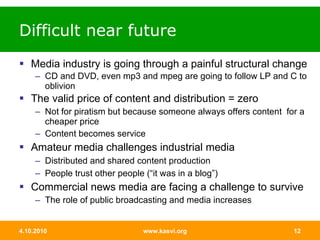
Difficult near future Media industry is going through a painful structural change CD and DVD, even mp3 and mpeg are going to follow LP and C to oblivion The valid price of content and distribution = zero Not for piratism but because someone always offers content  for a cheaper price Content becomes service Amateur media challenges industrial media Distributed and shared content production People trust other people (“it was in a blog”)‏ Commercial news media are facing a challenge to survive The role of public broadcasting and media increases
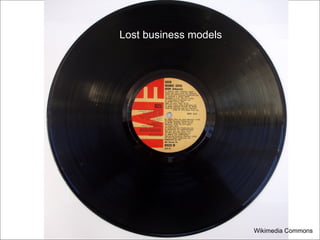
Wikimedia Commons Lost business models
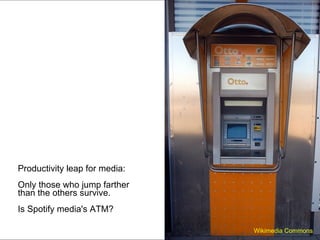
Productivity leap for media: Only those who jump farther  than the others survive. Is Spotify media's ATM? Wikimedia Commons
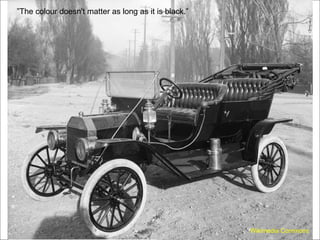
Wikimedia Commons ” The colour doesn't matter as long as it is black.”
Possibilities for survival Tailoring Media are still model T Fords When do I get Helsingin Sanomat for Laajalahti to my mail bos with extra politics and without sports?  Service Media consumers still have to search for their own content and news and entertainment from various sources  Why can I have a list of T shirt web stores but not my news?  Open public data Utilising and mashing up of public data to create new content and services.  Reliability In the web, reliability is your most valuable asset and  ” In the web no-one knows you are a dog.”  The New Yorker, page 61 of July 5, 1993
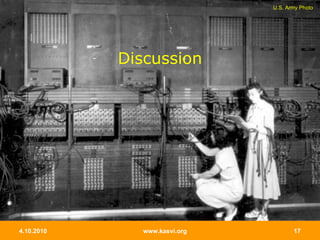
Sukupuolten välinen digikuilu? Discussion U.S. Army Photo

Copyright economy updated

  • 1.
    Whose Immaterial Economy?Jyrki J.J. Kasvi
  • 2.
    Information society civilizationInformation processing Pre-language Speech Writing Printing press ICT technology Available information ~ 10 7 bits ~ 10 9 bits ~ 10 11 bits ~ 10 17 bits ~ 10 25 bits Printing press gave birth to copyright as we know it: To protect content providers against distributors ICT tehcnology is going to need a corresponding system : But to protect whom against whom? Civilization level Pack Tribes/villages Towns/cities Industrial Networking
  • 3.
    Anne’s act 1709In 1709 the first actual copyright law was enacted in United Kingdom Defined the three interest groups whose relationships copyright laws still governs: content provider, publisher and consumer Publishers had no right to limit the way consumers use the content they purchase, DRM would have been illegal in 1709. It took 300 years from Gutenberg’s invention to get a law The principles of Anne’s act worked for almost 300 years! Requires small copying costs and centralised control In digital world the copying costs are zero and each and every computer is a potential printing press Now the change happens much faster than 300-400 years ago.
  • 4.
    Balance? Marketss Contentproviders Publishers Consumers Legislation Legislation is supposed to protect weaker parties...
  • 5.
    Challenge and opportunityPrinting press created the basis for copyright system Making of new copies of content is cheap It is possible to centrally supervise and control copying Newspapers and popular culture were born as a result But the profession of scribes was wiped out Digital technology requires new rules It costs nothing to copy, edit and distribute content It is impossible to centrally supervise or control copying What new cultural phenomena digital technology makes possible? Social media, crowdsourcing, … Rip-n-mix & mash-up ???
  • 6.
    Goals for anew copyright system Of these we probably have a wide consensus To maximise production and use of content – the expansion of culture E.g. the original goal of the patent system was to maximise the distribution and use of new innovations – expansion of economy To secure livelihood of content makers What about benefits of media industry shareholders? Production and marketing services used by content makers are also under threat To facilitate new forms of content, expression and culture Crowdsourcing, mash-ups etc. vs. copyright Of means to achieve these goals we still need to discuss
  • 7.
    Problematic details Copyrightsof public information Have been used to limit publication and usage of public information How to use content created by public cultural institutions and broadcasting companies? Copyrights in developing countries Research and education institutions of developing countries cannot afford the prices of scientific and educational materials Disabled people’s equal access to information Content should be transferable to formats accessible to disabled people DRM should allow blind people’s screen readers to work Copyrights of software have been forgotten Economically the most important sector of copyright economy in Finland The intimate relationship of media industry and law makers The secrecy of ACTA negotiations have not stopped media industry lobbyists from being informed (better than politicians or NGO’s)‏ Consumer and civil rights have been secondary to economic interests
  • 8.
  • 9.
    Supervision and controlThe only way to enforce traditional copyrights in digital age is to supervise continuously everybody’s digital communications Privacy? Who is responsible for supervision and judgement? Cutting internet connections is the only working punishment Freedom of expression? Who is responsible for enforcing punishments? Chinese proposal Install supervision compulsory software on each and every computer Who would be watching the watchmen?
  • 10.
    Hopeless DRM battleDigital = copyable You have to open the copy protection for presentation: the protection cannot be too strong or the devices would become too expensive. AACS key opens Blu-ray- and HD DVD copy protection 09 F9 11 02 9D 74 E3 5B D8 41 56 C5 63 56 88 C0 Google: 235.000 hits, Digg Some other solution is needed!
  • 11.
    Cloud computing politicsApplications, content and computing are becoming cloud computing services Content providers must become service providers Kindle, iPad etc. Is doing the same to books and newspapers as Spotify did to music TV channels may die but IP television services grow The tension between the rights of content providers, publishers and customers stays Amazon removed 1984 from their clients’ Kindles What is going to happen to public libraries? Publishers would be more than happy to see libraries dwindle
  • 12.
    Difficult near futureMedia industry is going through a painful structural change CD and DVD, even mp3 and mpeg are going to follow LP and C to oblivion The valid price of content and distribution = zero Not for piratism but because someone always offers content for a cheaper price Content becomes service Amateur media challenges industrial media Distributed and shared content production People trust other people (“it was in a blog”)‏ Commercial news media are facing a challenge to survive The role of public broadcasting and media increases
  • 13.
    Wikimedia Commons Lostbusiness models
  • 14.
    Productivity leap formedia: Only those who jump farther than the others survive. Is Spotify media's ATM? Wikimedia Commons
  • 15.
    Wikimedia Commons ”The colour doesn't matter as long as it is black.”
  • 16.
    Possibilities for survivalTailoring Media are still model T Fords When do I get Helsingin Sanomat for Laajalahti to my mail bos with extra politics and without sports? Service Media consumers still have to search for their own content and news and entertainment from various sources Why can I have a list of T shirt web stores but not my news? Open public data Utilising and mashing up of public data to create new content and services. Reliability In the web, reliability is your most valuable asset and ” In the web no-one knows you are a dog.” The New Yorker, page 61 of July 5, 1993
  • 17.
    Sukupuolten välinen digikuilu?Discussion U.S. Army Photo