Institute of InformationTechnology
Report: One Day visit of Drip Irrigation System
Subject: IrrigationEngineering
Submitted To: Ms. Shahzadi Irum
Submitted By:
Fahad Amin (084)
M.Fahad Khan (077)
Ahsan Naveed (080)
Ahtesham Bhatti (005)
Abdullah Bin Abbasi (001)
Date of Submission: 08-May-2018
Department of Civil Engineering
Event Name: One day visit to drip irrigation site in Dhok Khurram & near Khanpur Dam.
Date of visit: Tuesday, 17th
April 2018
Location/Venue: Dhok Khurram & near Khanpur Dam
Organiser: Ms. Shahzadi Irum
Other Faculty Members: Ms. Sandeerah Choudry & Sir Mujeeb-ur-Rehman
Sponsorship/Funding agency: Comsats University Wah Cantt
Brief description It is a basically educational visit. Its purpose is to see the drip
irrigation system and how this method is better from other
methods.
Category  Industrial Visit  Seminar  Conference
Training activity  Workshop  Visit
Number of
participants
Male: 65 Female: 3
INTRODUCTION:
On 17th
April 2018 we student of civil engineering from comsats wah
went on two drip irrigation sites to practically see the drip irrigation system which we
were studying in our subject “Irrigation Engineering”.
There were different elements to be learned in this visit that our teacher showed us and
explained its details and fundamentals. We learned many things and we saw everything
practically. Actually we visited two sites 1st
was at Dhok Khurram, where we saw drip
irrigation system used for cucumber and loquat trees farm.
This system was installed by the help of government. Government gave 80% subsidy on
solar panels which are used to run the pump directly from sunlight. They do not give
batteries to save the current for night use if farmer needs to run the pump on night than
he has to purchase the batteries or have another power source. Government also give
60% subsidy on the whole system expenses e.g. pump, construction of storage tank,
filters, pipes etc. But the owner should sign the bond which says that owner should run
this system at least 5 years otherwise no subsidy will be given to the owner or farmer.
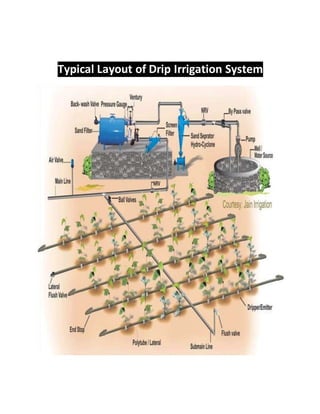
Typical Layout of Drip Irrigation System
Equipment Used:
1) Solar panels
2) Water Source/ Pump
3) Head Unit
4) Filters (Sand Filter) & (Disc Filter)
5) Pressuregauges
6) Flush lines
7) Control valves
8) Venturefor Fertilizers
9) Main linepipes
10) Sub main pipes / Laterals
11) Tunnels
Solar panels
Water Tank
Water
Source or
Pump
Explanation:
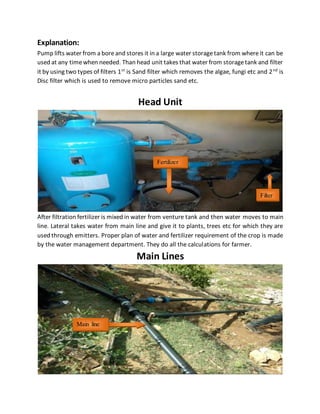
Pump lifts water from a boreand stores it in a large water storagetank from whereit can be
used at any timewhen needed. Than head unit takes that water from storagetank and filter
it by using two types of filters 1st
is Sand filter which removes the algae, fungi etc and 2nd
is
Disc filter which is used to remove micro particles sand etc.
Head Unit
After filtration fertilizer is mixed in water from venture tank and then water moves to main
line. Lateral takes water from main line and give it to plants, trees etc for which they are
used through emitters. Proper plan of water and fertilizer requirement of the crop is made
by the water management department. They do all the calculations for farmer.
Main Lines
Fertilizer
Main line
Filter
Laterals
Flush Pipes & Valves
Flow of water is controlled by using flow control valves and when a pipe is blocked its
blockage is removed by using air pressure through flush valves. After harvesting the crop
farmer does not have to give any money to the water management department because
government supportsthis irrigation systemand they takesalaries from government for their
work.
Semi portable drip irrigation system was used there, some pipes were underground and
somewere shown and can be moved to another site. Wesaw farm of loquats and tunnels of
cucumber both were using drip irrigation system. Emitters were used to control the water
flow near the plant.
2nd
sitewas near Khanpur Dam which was using thesameirrigation system butit was on the
top of hill and from top they used thegravity flow to irrigatethepalm plants. Each plant has
theemitter controlled by a valve. Remaining system was the same as previous site system.
Lateral
Flush valve
Flush Pipe
Cucumber Loquat Trees
Head Unit of 2nd
Site

Drip Irrigation

  • 1.
    Institute of InformationTechnology Report:One Day visit of Drip Irrigation System Subject: IrrigationEngineering Submitted To: Ms. Shahzadi Irum Submitted By: Fahad Amin (084) M.Fahad Khan (077) Ahsan Naveed (080) Ahtesham Bhatti (005) Abdullah Bin Abbasi (001) Date of Submission: 08-May-2018 Department of Civil Engineering
  • 2.
    Event Name: Oneday visit to drip irrigation site in Dhok Khurram & near Khanpur Dam. Date of visit: Tuesday, 17th April 2018 Location/Venue: Dhok Khurram & near Khanpur Dam Organiser: Ms. Shahzadi Irum Other Faculty Members: Ms. Sandeerah Choudry & Sir Mujeeb-ur-Rehman Sponsorship/Funding agency: Comsats University Wah Cantt Brief description It is a basically educational visit. Its purpose is to see the drip irrigation system and how this method is better from other methods. Category  Industrial Visit  Seminar  Conference Training activity  Workshop  Visit Number of participants Male: 65 Female: 3 INTRODUCTION: On 17th April 2018 we student of civil engineering from comsats wah went on two drip irrigation sites to practically see the drip irrigation system which we were studying in our subject “Irrigation Engineering”. There were different elements to be learned in this visit that our teacher showed us and explained its details and fundamentals. We learned many things and we saw everything practically. Actually we visited two sites 1st was at Dhok Khurram, where we saw drip irrigation system used for cucumber and loquat trees farm. This system was installed by the help of government. Government gave 80% subsidy on solar panels which are used to run the pump directly from sunlight. They do not give batteries to save the current for night use if farmer needs to run the pump on night than he has to purchase the batteries or have another power source. Government also give 60% subsidy on the whole system expenses e.g. pump, construction of storage tank, filters, pipes etc. But the owner should sign the bond which says that owner should run this system at least 5 years otherwise no subsidy will be given to the owner or farmer.
  • 3.
    Typical Layout ofDrip Irrigation System
  • 4.
    Equipment Used: 1) Solarpanels 2) Water Source/ Pump 3) Head Unit 4) Filters (Sand Filter) & (Disc Filter) 5) Pressuregauges 6) Flush lines 7) Control valves 8) Venturefor Fertilizers 9) Main linepipes 10) Sub main pipes / Laterals 11) Tunnels Solar panels Water Tank Water Source or Pump
  • 5.
    Explanation: Pump lifts waterfrom a boreand stores it in a large water storagetank from whereit can be used at any timewhen needed. Than head unit takes that water from storagetank and filter it by using two types of filters 1st is Sand filter which removes the algae, fungi etc and 2nd is Disc filter which is used to remove micro particles sand etc. Head Unit After filtration fertilizer is mixed in water from venture tank and then water moves to main line. Lateral takes water from main line and give it to plants, trees etc for which they are used through emitters. Proper plan of water and fertilizer requirement of the crop is made by the water management department. They do all the calculations for farmer. Main Lines Fertilizer Main line Filter
  • 6.
    Laterals Flush Pipes &Valves Flow of water is controlled by using flow control valves and when a pipe is blocked its blockage is removed by using air pressure through flush valves. After harvesting the crop farmer does not have to give any money to the water management department because government supportsthis irrigation systemand they takesalaries from government for their work. Semi portable drip irrigation system was used there, some pipes were underground and somewere shown and can be moved to another site. Wesaw farm of loquats and tunnels of cucumber both were using drip irrigation system. Emitters were used to control the water flow near the plant. 2nd sitewas near Khanpur Dam which was using thesameirrigation system butit was on the top of hill and from top they used thegravity flow to irrigatethepalm plants. Each plant has theemitter controlled by a valve. Remaining system was the same as previous site system. Lateral Flush valve Flush Pipe
  • 7.