THEATER ARTS
An Overview
The History of
Drama
TABLE OF CONTENTS
Theater as an Art
Elements of
Drama
Theater as a
Socializing
Activity
Role of Drama
and Theater
Theater as a Way
of Learning
ACTIVIT
Y TIME!!!
THE HISTORY
OF DRAMA
01
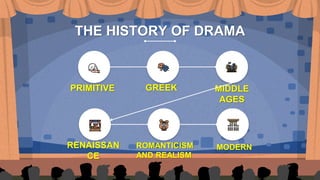
THE HISTORY OF DRAMA
PRIMITIVE GREEK
RENAISSAN
CE
MIDDLE
AGES
ROMANTICISM
AND REALISM
MODERN
ELEMENTS OF DRAMA
02
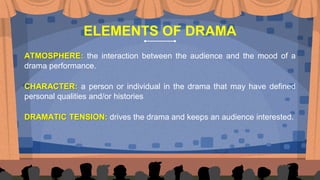
ELEMENTS OF DRAMA
ATMOSPHERE: the interaction between the audience and the mood of a
drama performance.
CHARACTER: a person or individual in the drama that may have defined
personal qualities and/or histories
DRAMATIC TENSION: drives the drama and keeps an audience interested.
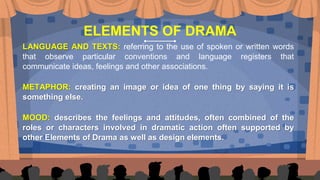
ELEMENTS OF DRAMA
LANGUAGE AND TEXTS: referring to the use of spoken or written words
that observe particular conventions and language registers that
communicate ideas, feelings and other associations.
METAPHOR: creating an image or idea of one thing by saying it is
something else.
MOOD: describes the feelings and attitudes, often combined of the
roles or characters involved in dramatic action often supported by
other Elements of Drama as well as design elements.
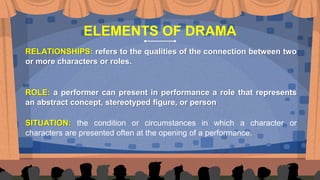
ELEMENTS OF DRAMA
RELATIONSHIPS: refers to the qualities of the connection between two
or more characters or roles.
ROLE: a performer can present in performance a role that represents
an abstract concept, stereotyped figure, or person
SITUATION: the condition or circumstances in which a character or
characters are presented often at the opening of a performance.
ELEMENTS OF DRAMA
SPACE: the place where dramatic action is situated and the qualities of that
place
SYMBOL: symbolic parts of the scenography or design represent and add
further meaning to themes, narrative, emotion, mood and atmosphere.
TIME: both the time of day, time of the year and time in history or the future.
Time also reflects changes in time within a scene or drama event.
ROLE OF DRAMA AND
THEATER
03
ROLE OF DRAMA AND THEATER
 THEATRE AND DRAMA HELP US TO SEE A DIFFERENT
PERSPECTIVE FROM OUR OWN.
 THEATRE AND DRAMA REMIND US THAT WE ARE NOT ALONE.
 THEATRE AND DRAMA ARE IMMEDIATE, EVOLVING AND
ALWAYS DIFFERENT.
 LIVE THEATRE AND DRAMA HELP TO PROMOTE SOCIAL
DISCOURSE, DIALOGUE AND POTENTIAL SOCIAL CHANGE.
 THEATRE AND DRAMA PROMOTE EDUCATION AND LITERACY.
THEATE
R AS AN
ART
04
THEATER AS AN ART
Theatre is a collaborative art form which combines words,
voice, movement and visual elements to express meaning. The
field of theatre encompasses not only live improvised and scripted
work, but also dramatic forms such as film, television and other
electronic media. Due to the increasingly pervasive influence of
contemporary theatrical media, theatre has enormous importance
in citizens’ lives. It is not possible for students to achieve media
literacy without understanding and having hands-on experience
with theatre. Theatre is about the examination and resolution of
fundamental human issues, and is built on understanding and
presenting interactions between people.
THEATER AS A
SOCIALIZING
ACTIVITY
05
THEATER AS A SOCIALIZING ACTIVITY
Theatre work provides a vehicle for students to reflect on
important aspects of life, in the process developing their sensitivity to
and deepening their understandings of others’ points of view. The
broad, worldwide base of theatrical literature or repertoire ranges from
classical forms such as Japanese Kabuki and Shakespeare, to folk
forms such as traditional puppetry, to contemporary forms such as
animated cartoons and movies. Quality theatre education is similarly
broad-based, extending beyond the teaching of acting to develop
students’ abilities in areas ranging from technical theatre to directing,
and from researching the cultural and historical context of repertoire to
creating their own improvised or scripted works.
THEATER AS A WAY
OF LEARNING
06
THEATER AS A WAY OF LEARNING
Theatre is an integral part of English language arts as well as the
performing arts, so the foundation for theatre begins at birth as
children develop personal communication skills. Parents and
preschool and elementary teachers should encourage imaginative play
and role-playing, both for their own sake and as important components
of the learning process across the curriculum. All students should
study creative writing, improvising and writing scripts; expressive
public speaking, media literacy, theatrical production and
interpretation; and other key communication skills as part of their
basic K-12 language arts curriculum, and should deepen and apply
these skills in formal theatre experiences under the guidance of expert
theatre teachers.

GROUP-1-SPEECH-AND-STAGE-ARTS-Autosaved-Copy.pptx

  • 1.
  • 2.
    The History of Drama TABLEOF CONTENTS Theater as an Art Elements of Drama Theater as a Socializing Activity Role of Drama and Theater Theater as a Way of Learning
  • 3.
  • 4.
  • 5.
    THE HISTORY OFDRAMA PRIMITIVE GREEK RENAISSAN CE MIDDLE AGES ROMANTICISM AND REALISM MODERN
  • 6.
  • 7.
    ELEMENTS OF DRAMA ATMOSPHERE:the interaction between the audience and the mood of a drama performance. CHARACTER: a person or individual in the drama that may have defined personal qualities and/or histories DRAMATIC TENSION: drives the drama and keeps an audience interested.
  • 8.
    ELEMENTS OF DRAMA LANGUAGEAND TEXTS: referring to the use of spoken or written words that observe particular conventions and language registers that communicate ideas, feelings and other associations. METAPHOR: creating an image or idea of one thing by saying it is something else. MOOD: describes the feelings and attitudes, often combined of the roles or characters involved in dramatic action often supported by other Elements of Drama as well as design elements.
  • 9.
    ELEMENTS OF DRAMA RELATIONSHIPS:refers to the qualities of the connection between two or more characters or roles. ROLE: a performer can present in performance a role that represents an abstract concept, stereotyped figure, or person SITUATION: the condition or circumstances in which a character or characters are presented often at the opening of a performance.
  • 10.
    ELEMENTS OF DRAMA SPACE:the place where dramatic action is situated and the qualities of that place SYMBOL: symbolic parts of the scenography or design represent and add further meaning to themes, narrative, emotion, mood and atmosphere. TIME: both the time of day, time of the year and time in history or the future. Time also reflects changes in time within a scene or drama event.
  • 11.
    ROLE OF DRAMAAND THEATER 03
  • 12.
    ROLE OF DRAMAAND THEATER  THEATRE AND DRAMA HELP US TO SEE A DIFFERENT PERSPECTIVE FROM OUR OWN.  THEATRE AND DRAMA REMIND US THAT WE ARE NOT ALONE.  THEATRE AND DRAMA ARE IMMEDIATE, EVOLVING AND ALWAYS DIFFERENT.  LIVE THEATRE AND DRAMA HELP TO PROMOTE SOCIAL DISCOURSE, DIALOGUE AND POTENTIAL SOCIAL CHANGE.  THEATRE AND DRAMA PROMOTE EDUCATION AND LITERACY.
  • 13.
  • 14.
    THEATER AS ANART Theatre is a collaborative art form which combines words, voice, movement and visual elements to express meaning. The field of theatre encompasses not only live improvised and scripted work, but also dramatic forms such as film, television and other electronic media. Due to the increasingly pervasive influence of contemporary theatrical media, theatre has enormous importance in citizens’ lives. It is not possible for students to achieve media literacy without understanding and having hands-on experience with theatre. Theatre is about the examination and resolution of fundamental human issues, and is built on understanding and presenting interactions between people.
  • 15.
  • 16.
    THEATER AS ASOCIALIZING ACTIVITY Theatre work provides a vehicle for students to reflect on important aspects of life, in the process developing their sensitivity to and deepening their understandings of others’ points of view. The broad, worldwide base of theatrical literature or repertoire ranges from classical forms such as Japanese Kabuki and Shakespeare, to folk forms such as traditional puppetry, to contemporary forms such as animated cartoons and movies. Quality theatre education is similarly broad-based, extending beyond the teaching of acting to develop students’ abilities in areas ranging from technical theatre to directing, and from researching the cultural and historical context of repertoire to creating their own improvised or scripted works.
  • 17.
    THEATER AS AWAY OF LEARNING 06
  • 18.
    THEATER AS AWAY OF LEARNING Theatre is an integral part of English language arts as well as the performing arts, so the foundation for theatre begins at birth as children develop personal communication skills. Parents and preschool and elementary teachers should encourage imaginative play and role-playing, both for their own sake and as important components of the learning process across the curriculum. All students should study creative writing, improvising and writing scripts; expressive public speaking, media literacy, theatrical production and interpretation; and other key communication skills as part of their basic K-12 language arts curriculum, and should deepen and apply these skills in formal theatre experiences under the guidance of expert theatre teachers.