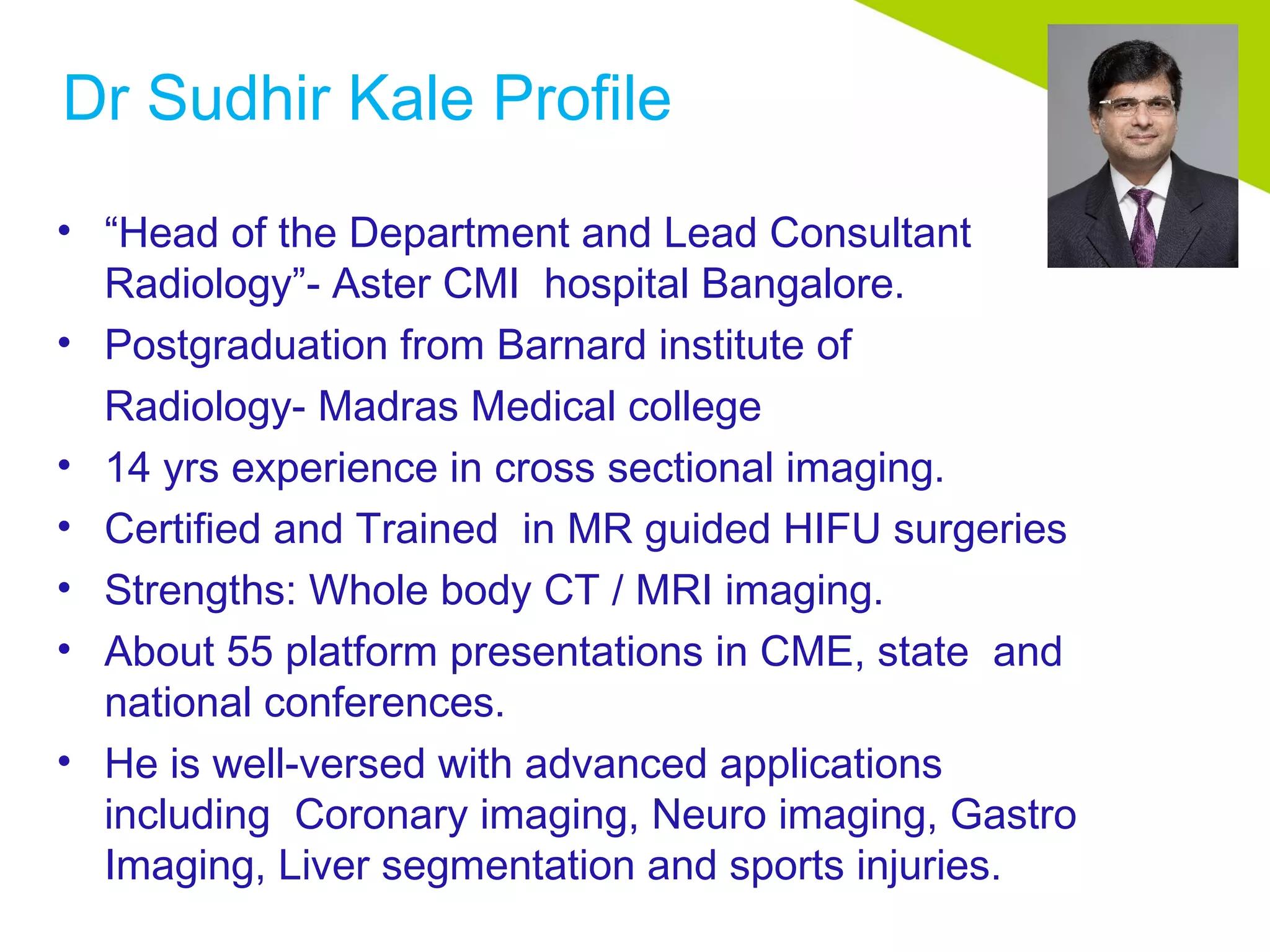
Dr Sudhir Kale Profile
• “Head of the Department and Lead Consultant
Radiology”- Aster CMI hospital Bangalore.
• Postgraduation from Barnard institute of
Radiology- Madras Medical college
• 14 yrs experience in cross sectional imaging.
• Certified and Trained in MR guided HIFU surgeries
• Strengths: Whole body CT / MRI imaging.
• About 55 platform presentations in CME, state and
national conferences.  
• He is well-versed with advanced applications
including Coronary imaging, Neuro imaging, Gastro
Imaging, Liver segmentation and sports injuries.
• Author of MR HIFU chapter in book on Text book
and Atlas of fibroids, already in press probable
release June 2016.
• He has been associated in Research Projects in
Neuro Radiology (Multiple Sclerosis, Peripheral
Vascular Disease, Fibroids and Cartilage Mapping).
• Life member IRIA, ICRI and IACI.
• Has reported cross sectional imaging for NCA
(national cricket academy) and KSCA. Many Indian,
international and IPL players.
Contrast Media and Prevention of
Contrast Induced Nephropathy
Dr Sudhir Kale
Chief Radiologist
Aster CMI hospital Bangalore
Objectives
 Patient selection strategies
 Contrast Media in Renal Impaired patients
 Prevention of contrast induced nephropathy (CIN).
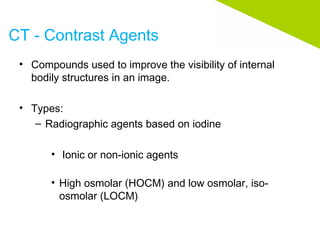
CT - Contrast Agents
• Compounds used to improve the visibility of internal
bodily structures in an image.
• Types:
– Radiographic agents based on iodine
• Ionic or non-ionic agents
• High osmolar (HOCM) and low osmolar, iso-
osmolar (LOCM)
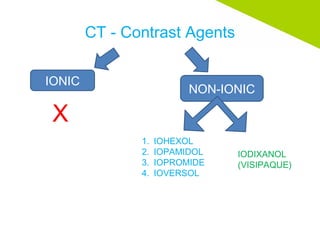
CT - Contrast Agents
IONIC
NON-IONIC
1. IOHEXOL
2. IOPAMIDOL
3. IOPROMIDE
4. IOVERSOL
IODIXANOL
(VISIPAQUE)
X
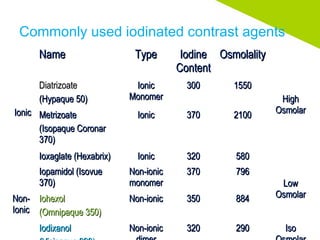
Commonly used iodinated contrast agents
NameName TypeType IodineIodine
ContentContent
OsmolalityOsmolality
IonicIonic
DiatrizoateDiatrizoate
(Hypaque 50)(Hypaque 50)
IonicIonic
MonomerMonomer
300300 15501550
HighHigh
OsmolarOsmolar
MetrizoateMetrizoate
(Isopaque Coronar(Isopaque Coronar
370)370)
IonicIonic 370370 21002100
Ioxaglate (Hexabrix)Ioxaglate (Hexabrix) IonicIonic 320320 580580
LowLow
OsmolarOsmolarNon-Non-
IonicIonic
Iopamidol (IsovueIopamidol (Isovue
370)370)
Non-ionicNon-ionic
monomermonomer
370370 796796
IohexolIohexol
(Omnipaque 350)(Omnipaque 350)
Non-ionicNon-ionic 350350 884884
IodixanolIodixanol Non-ionicNon-ionic 320320 290290 IsoIso
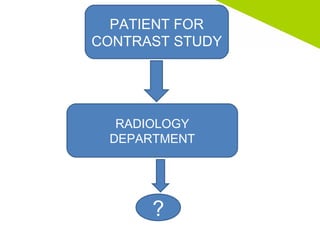
PATIENT FOR
CONTRAST STUDY
RADIOLOGY
DEPARTMENT
?
Patient selection and Preparation strategies
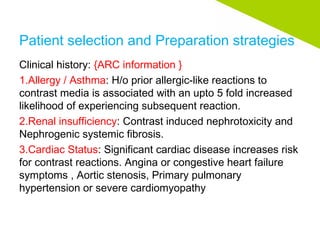
Clinical history: {ARC information }
1.Allergy / Asthma: H/o prior allergic-like reactions to
contrast media is associated with an upto 5 fold increased
likelihood of experiencing subsequent reaction.
2.Renal insufficiency: Contrast induced nephrotoxicity and
Nephrogenic systemic fibrosis.
3.Cardiac Status: Significant cardiac disease increases risk
for contrast reactions. Angina or congestive heart failure
symptoms , Aortic stenosis, Primary pulmonary
hypertension or severe cardiomyopathy
Patient selection and Preparation strategies
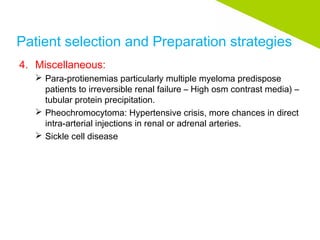
4. Miscellaneous:
 Para-protienemias particularly multiple myeloma predispose
patients to irreversible renal failure – High osm contrast media) –
tubular protein precipitation.
 Pheochromocytoma: Hypertensive crisis, more chances in direct
intra-arterial injections in renal or adrenal arteries.
 Sickle cell disease
Patient Care Forum
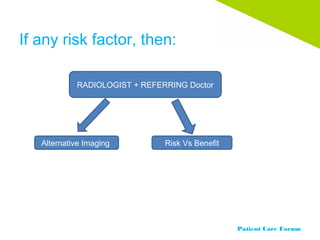
If any risk factor, then:
RADIOLOGIST + REFERRING Doctor
Risk Vs BenefitAlternative Imaging
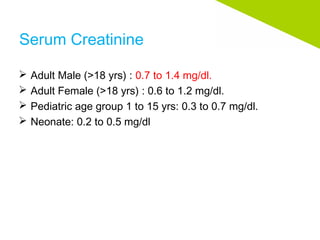
Serum Creatinine
 Adult Male (>18 yrs) : 0.7 to 1.4 mg/dl.
 Adult Female (>18 yrs) : 0.6 to 1.2 mg/dl.
 Pediatric age group 1 to 15 yrs: 0.3 to 0.7 mg/dl.
 Neonate: 0.2 to 0.5 mg/dl
eGFR Calculation is preferred in
the present guidelines
Estimated GFR
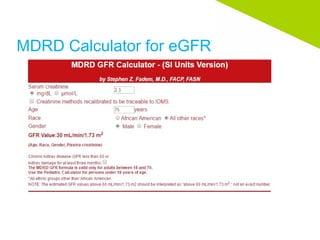
MDRD Calculator for eGFR
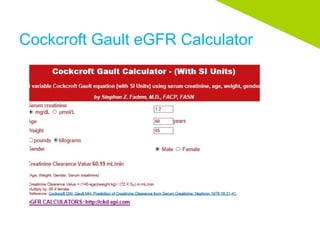
Cockcroft Gault eGFR Calculator
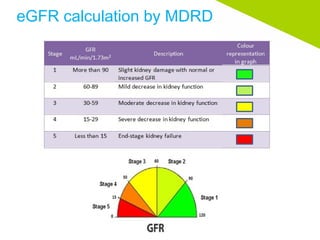
eGFR calculation by MDRD
Renal Toxicity
Risk Factors
– 5 - 10 fold increase with pre-existing renal
insufficiency (increased creatinine)
– Dehydration
– CHF
– Age > 70
– Taking nephrotoxic drugs (nonsteroidal inflammatory
agents, gentomycin etc.)
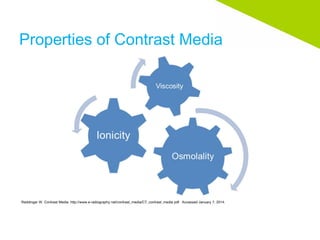
Reddinger W. Contrast Media. http://www.e-radiography net/contrast_media/CT_contrast_media pdf. Accessed January 7, 2014.
Properties of Contrast Media
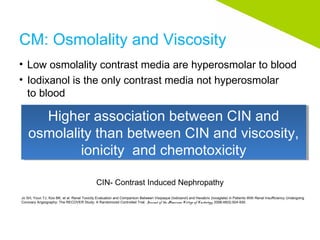
CM: Osmolality and Viscosity
• Low osmolality contrast media are hyperosmolar to blood
• Iodixanol is the only contrast media not hyperosmolar
to blood
Jo SH, Youn TJ, Koo BK, et al. Renal Toxicity Evaluation and Comparison Between Visipaque (Iodixanol) and Hexabrix (Ioxaglate) in Patients With Renal Insufficiency Undergoing
Coronary Angiography: The RECOVER Study: A Randomized Controlled Trial. Journal of the American College of Cardiology. 2006;48(5):924-930.
CIN- Contrast Induced Nephropathy
Higher association between CIN and
osmolality than between CIN and viscosity,
ionicity and chemotoxicity
Higher association between CIN and
osmolality than between CIN and viscosity,
ionicity and chemotoxicity
Currently VISPAQUE (IODIXANOL) is the
contrast media with least incidence of CIN
Jo SH, Youn TJ, Koo BK, et al. Renal Toxicity Evaluation and Comparison Between Visipaque (Iodixanol) and Hexabrix (Ioxaglate) in Patients With Renal Insufficiency Undergoing
Coronary Angiography: The RECOVER Study: A Randomized Controlled Trial. Journal of the American College of Cardiology. 2006;48(5):924-930.
CIN- Contrast Induced Nephropathy
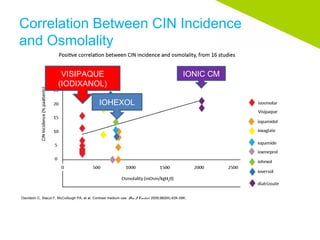
Correlation Between CIN Incidence
and Osmolality
Davidson C, Stacul F, McCullough PA, et al. Contrast medium use. Am J Cardiol. 2006;98(6A):42K-58K.
VISIPAQUE
(IODIXANOL)
IOHEXOL
IONIC CM
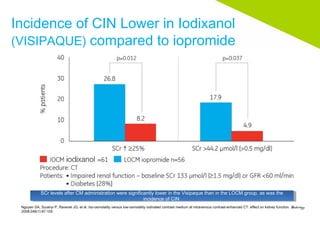
Incidence of CIN Lower in Iodixanol
(VISIPAQUE) compared to iopromide
Nguyen SA, Suranyi P, Ravenel JG, et al. Iso-osmolality versus low-osmolality iodinated contrast medium at intravenous contrast-enhanced CT: effect on kidney function. Radiology.
2008;248(1):97-105.
SCr levels after CM administration were significantly lower in the Visipaque than in the LOCM group, as was the
incidence of CIN
SCr levels after CM administration were significantly lower in the Visipaque than in the LOCM group, as was the
incidence of CIN
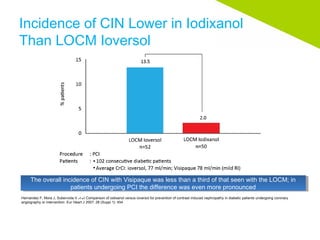
Incidence of CIN Lower in Iodixanol
Than LOCM Ioversol
The overall incidence of CIN with Visipaque was less than a third of that seen with the LOCM; in
patients undergoing PCI the difference was even more pronounced
The overall incidence of CIN with Visipaque was less than a third of that seen with the LOCM; in
patients undergoing PCI the difference was even more pronounced
Hernandez F, Mora J, Suberviola V et al. Comparison of iodixanol versus ioversol for prevention of contrast induced nephropathy in diabetic patients undergoing coronary
angiography or intervention. Eur Heart J 2007; 28 (Suppl 1): 454
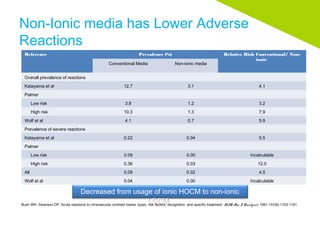
Decreased from usage of ionic HOCM to non-ionic
LOCM.
Reference Prevalence (%) Relative Risk Conventional/ Non-
ionic
Conventional Media Non-ionic media
Overall prevalence of reactions
Katayama et al 12.7 3.1 4.1
Palmer
Low risk 3.8 1.2 3.2
High risk 10.3 1.3 7.9
Wolf et al 4.1 0.7 5.9
Prevalence of severe reactions
Katayama et al 0.22 0.04 5.5
Palmer
Low risk 0.09 0.00 Incalculable
High risk 0.36 0.03 12.0
All 0.09 0.02 4.5
Wolf et al 0.04 0.00 Incalculable
Bush WH, Swanson DP. Acute reactions to intravascular contrast media: types, risk factors, recognition, and specific treatment. AJR Am J Roentgenol. 1991;157(6):1153-1161.
Non-Ionic media has Lower Adverse
Reactions
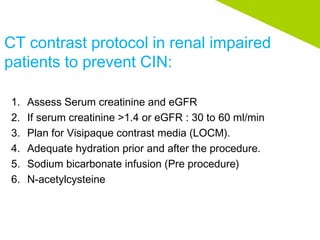
CT contrast protocol in renal impaired
patients to prevent CIN:
1. Assess Serum creatinine and eGFR
2. If serum creatinine >1.4 or eGFR : 30 to 60 ml/min
3. Plan for Visipaque contrast media (LOCM).
4. Adequate hydration prior and after the procedure.
5. Sodium bicarbonate infusion (Pre procedure)
6. N-acetylcysteine
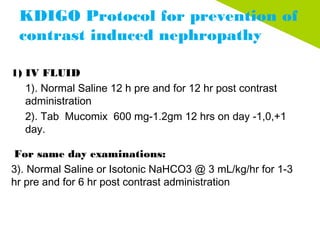
KDIGO Protocol for prevention of
contrast induced nephropathy
1) IV FLUID
1). Normal Saline 12 h pre and for 12 hr post contrast
administration
2). Tab  Mucomix  600 mg-1.2gm 12 hrs on day -1,0,+1
day.
 For same day examinations:
3). Normal Saline or Isotonic NaHCO3 @ 3 mL/kg/hr for 1-3
hr pre and for 6 hr post contrast administration
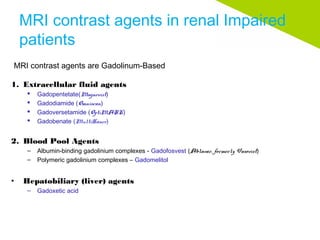
MRI contrast agents in renal Impaired
patients
1. Extracellular fluid agents
 Gadopentetate(Magnevist)
 Gadodiamide (Omniscan)
 Gadoversetamide (OptiMARK)
 Gadobenate (MultiHance)
2. Blood Pool Agents
– Albumin-binding gadolinium complexes - Gadofosvest (Ablavar, formerly Vasovist)
– Polymeric gadolinium complexes – Gadomelitol
• Hepatobiliary (liver) agents
– Gadoxetic acid
MRI contrast agents are Gadolinum-Based
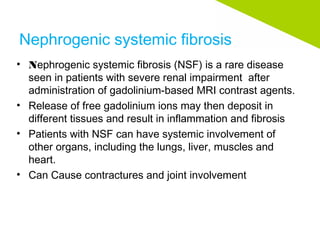
Nephrogenic systemic fibrosis
• Nephrogenic systemic fibrosis (NSF) is a rare disease
seen in patients with severe renal impairment after
administration of gadolinium-based MRI contrast agents.
• Release of free gadolinium ions may then deposit in
different tissues and result in inflammation and fibrosis
• Patients with NSF can have systemic involvement of
other organs, including the lungs, liver, muscles and
heart.
• Can Cause contractures and joint involvement
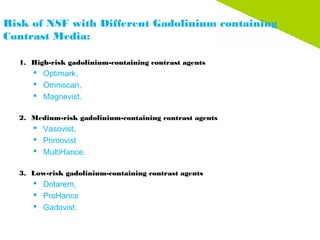
Risk of NSF with Different Gadolinium containing
Contrast Media:
1. High-risk gadolinium-containing contrast agents
 Optimark,
 Omniscan,
 Magnevist.
 
2. Medium-risk gadolinium-containing contrast agents
 Vasovist,
 Primovist
 MultiHance.
 
3. Low-risk gadolinium-containing contrast agents
 Dotarem,
 ProHance
 Gadovist.
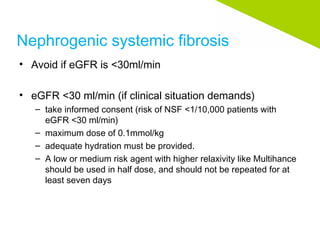
Nephrogenic systemic fibrosis
• Avoid if eGFR is <30ml/min
• eGFR <30 ml/min (if clinical situation demands)
– take informed consent (risk of NSF <1/10,000 patients with
eGFR <30 ml/min)
– maximum dose of 0.1mmol/kg
– adequate hydration must be provided.
– A low or medium risk agent with higher relaxivity like Multihance
should be used in half dose, and should not be repeated for at
least seven days
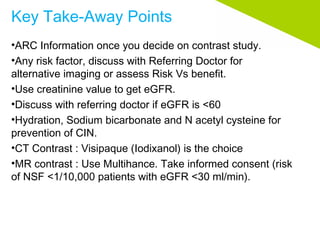
Key Take-Away Points
•ARC Information once you decide on contrast study.
•Any risk factor, discuss with Referring Doctor for
alternative imaging or assess Risk Vs benefit.
•Use creatinine value to get eGFR.
•Discuss with referring doctor if eGFR is <60
•Hydration, Sodium bicarbonate and N acetyl cysteine for
prevention of CIN.
•CT Contrast : Visipaque (Iodixanol) is the choice
•MR contrast : Use Multihance. Take informed consent (risk
of NSF <1/10,000 patients with eGFR <30 ml/min).
THANK YOU

Dr sudhir vydehi final

  • 1.
    Dr Sudhir KaleProfile • “Head of the Department and Lead Consultant Radiology”- Aster CMI hospital Bangalore. • Postgraduation from Barnard institute of Radiology- Madras Medical college • 14 yrs experience in cross sectional imaging. • Certified and Trained in MR guided HIFU surgeries • Strengths: Whole body CT / MRI imaging. • About 55 platform presentations in CME, state and national conferences.   • He is well-versed with advanced applications including Coronary imaging, Neuro imaging, Gastro Imaging, Liver segmentation and sports injuries.
  • 2.
    • Author ofMR HIFU chapter in book on Text book and Atlas of fibroids, already in press probable release June 2016. • He has been associated in Research Projects in Neuro Radiology (Multiple Sclerosis, Peripheral Vascular Disease, Fibroids and Cartilage Mapping). • Life member IRIA, ICRI and IACI. • Has reported cross sectional imaging for NCA (national cricket academy) and KSCA. Many Indian, international and IPL players.
  • 3.
    Contrast Media andPrevention of Contrast Induced Nephropathy Dr Sudhir Kale Chief Radiologist Aster CMI hospital Bangalore
  • 4.
    Objectives  Patient selectionstrategies  Contrast Media in Renal Impaired patients  Prevention of contrast induced nephropathy (CIN).
  • 5.
    CT - ContrastAgents • Compounds used to improve the visibility of internal bodily structures in an image. • Types: – Radiographic agents based on iodine • Ionic or non-ionic agents • High osmolar (HOCM) and low osmolar, iso- osmolar (LOCM)
  • 6.
    CT - ContrastAgents IONIC NON-IONIC 1. IOHEXOL 2. IOPAMIDOL 3. IOPROMIDE 4. IOVERSOL IODIXANOL (VISIPAQUE) X
  • 7.
    Commonly used iodinatedcontrast agents NameName TypeType IodineIodine ContentContent OsmolalityOsmolality IonicIonic DiatrizoateDiatrizoate (Hypaque 50)(Hypaque 50) IonicIonic MonomerMonomer 300300 15501550 HighHigh OsmolarOsmolar MetrizoateMetrizoate (Isopaque Coronar(Isopaque Coronar 370)370) IonicIonic 370370 21002100 Ioxaglate (Hexabrix)Ioxaglate (Hexabrix) IonicIonic 320320 580580 LowLow OsmolarOsmolarNon-Non- IonicIonic Iopamidol (IsovueIopamidol (Isovue 370)370) Non-ionicNon-ionic monomermonomer 370370 796796 IohexolIohexol (Omnipaque 350)(Omnipaque 350) Non-ionicNon-ionic 350350 884884 IodixanolIodixanol Non-ionicNon-ionic 320320 290290 IsoIso
  • 8.
  • 9.
    Patient selection andPreparation strategies Clinical history: {ARC information } 1.Allergy / Asthma: H/o prior allergic-like reactions to contrast media is associated with an upto 5 fold increased likelihood of experiencing subsequent reaction. 2.Renal insufficiency: Contrast induced nephrotoxicity and Nephrogenic systemic fibrosis. 3.Cardiac Status: Significant cardiac disease increases risk for contrast reactions. Angina or congestive heart failure symptoms , Aortic stenosis, Primary pulmonary hypertension or severe cardiomyopathy
  • 10.
    Patient selection andPreparation strategies 4. Miscellaneous:  Para-protienemias particularly multiple myeloma predispose patients to irreversible renal failure – High osm contrast media) – tubular protein precipitation.  Pheochromocytoma: Hypertensive crisis, more chances in direct intra-arterial injections in renal or adrenal arteries.  Sickle cell disease
  • 11.
    Patient Care Forum Ifany risk factor, then: RADIOLOGIST + REFERRING Doctor Risk Vs BenefitAlternative Imaging
  • 12.
    Serum Creatinine  AdultMale (>18 yrs) : 0.7 to 1.4 mg/dl.  Adult Female (>18 yrs) : 0.6 to 1.2 mg/dl.  Pediatric age group 1 to 15 yrs: 0.3 to 0.7 mg/dl.  Neonate: 0.2 to 0.5 mg/dl
  • 13.
    eGFR Calculation ispreferred in the present guidelines Estimated GFR
  • 14.
  • 15.
  • 16.
  • 17.
    Renal Toxicity Risk Factors –5 - 10 fold increase with pre-existing renal insufficiency (increased creatinine) – Dehydration – CHF – Age > 70 – Taking nephrotoxic drugs (nonsteroidal inflammatory agents, gentomycin etc.)
  • 18.
    Reddinger W. ContrastMedia. http://www.e-radiography net/contrast_media/CT_contrast_media pdf. Accessed January 7, 2014. Properties of Contrast Media
  • 19.
    CM: Osmolality andViscosity • Low osmolality contrast media are hyperosmolar to blood • Iodixanol is the only contrast media not hyperosmolar to blood Jo SH, Youn TJ, Koo BK, et al. Renal Toxicity Evaluation and Comparison Between Visipaque (Iodixanol) and Hexabrix (Ioxaglate) in Patients With Renal Insufficiency Undergoing Coronary Angiography: The RECOVER Study: A Randomized Controlled Trial. Journal of the American College of Cardiology. 2006;48(5):924-930. CIN- Contrast Induced Nephropathy Higher association between CIN and osmolality than between CIN and viscosity, ionicity and chemotoxicity Higher association between CIN and osmolality than between CIN and viscosity, ionicity and chemotoxicity
  • 20.
    Currently VISPAQUE (IODIXANOL)is the contrast media with least incidence of CIN Jo SH, Youn TJ, Koo BK, et al. Renal Toxicity Evaluation and Comparison Between Visipaque (Iodixanol) and Hexabrix (Ioxaglate) in Patients With Renal Insufficiency Undergoing Coronary Angiography: The RECOVER Study: A Randomized Controlled Trial. Journal of the American College of Cardiology. 2006;48(5):924-930. CIN- Contrast Induced Nephropathy
  • 21.
    Correlation Between CINIncidence and Osmolality Davidson C, Stacul F, McCullough PA, et al. Contrast medium use. Am J Cardiol. 2006;98(6A):42K-58K. VISIPAQUE (IODIXANOL) IOHEXOL IONIC CM
  • 22.
    Incidence of CINLower in Iodixanol (VISIPAQUE) compared to iopromide Nguyen SA, Suranyi P, Ravenel JG, et al. Iso-osmolality versus low-osmolality iodinated contrast medium at intravenous contrast-enhanced CT: effect on kidney function. Radiology. 2008;248(1):97-105. SCr levels after CM administration were significantly lower in the Visipaque than in the LOCM group, as was the incidence of CIN SCr levels after CM administration were significantly lower in the Visipaque than in the LOCM group, as was the incidence of CIN
  • 23.
    Incidence of CINLower in Iodixanol Than LOCM Ioversol The overall incidence of CIN with Visipaque was less than a third of that seen with the LOCM; in patients undergoing PCI the difference was even more pronounced The overall incidence of CIN with Visipaque was less than a third of that seen with the LOCM; in patients undergoing PCI the difference was even more pronounced Hernandez F, Mora J, Suberviola V et al. Comparison of iodixanol versus ioversol for prevention of contrast induced nephropathy in diabetic patients undergoing coronary angiography or intervention. Eur Heart J 2007; 28 (Suppl 1): 454
  • 24.
    Decreased from usageof ionic HOCM to non-ionic LOCM. Reference Prevalence (%) Relative Risk Conventional/ Non- ionic Conventional Media Non-ionic media Overall prevalence of reactions Katayama et al 12.7 3.1 4.1 Palmer Low risk 3.8 1.2 3.2 High risk 10.3 1.3 7.9 Wolf et al 4.1 0.7 5.9 Prevalence of severe reactions Katayama et al 0.22 0.04 5.5 Palmer Low risk 0.09 0.00 Incalculable High risk 0.36 0.03 12.0 All 0.09 0.02 4.5 Wolf et al 0.04 0.00 Incalculable Bush WH, Swanson DP. Acute reactions to intravascular contrast media: types, risk factors, recognition, and specific treatment. AJR Am J Roentgenol. 1991;157(6):1153-1161. Non-Ionic media has Lower Adverse Reactions
  • 25.
    CT contrast protocolin renal impaired patients to prevent CIN: 1. Assess Serum creatinine and eGFR 2. If serum creatinine >1.4 or eGFR : 30 to 60 ml/min 3. Plan for Visipaque contrast media (LOCM). 4. Adequate hydration prior and after the procedure. 5. Sodium bicarbonate infusion (Pre procedure) 6. N-acetylcysteine
  • 26.
    KDIGO Protocol forprevention of contrast induced nephropathy 1) IV FLUID 1). Normal Saline 12 h pre and for 12 hr post contrast administration 2). Tab  Mucomix  600 mg-1.2gm 12 hrs on day -1,0,+1 day.  For same day examinations: 3). Normal Saline or Isotonic NaHCO3 @ 3 mL/kg/hr for 1-3 hr pre and for 6 hr post contrast administration
  • 27.
    MRI contrast agentsin renal Impaired patients 1. Extracellular fluid agents  Gadopentetate(Magnevist)  Gadodiamide (Omniscan)  Gadoversetamide (OptiMARK)  Gadobenate (MultiHance) 2. Blood Pool Agents – Albumin-binding gadolinium complexes - Gadofosvest (Ablavar, formerly Vasovist) – Polymeric gadolinium complexes – Gadomelitol • Hepatobiliary (liver) agents – Gadoxetic acid MRI contrast agents are Gadolinum-Based
  • 28.
    Nephrogenic systemic fibrosis •Nephrogenic systemic fibrosis (NSF) is a rare disease seen in patients with severe renal impairment after administration of gadolinium-based MRI contrast agents. • Release of free gadolinium ions may then deposit in different tissues and result in inflammation and fibrosis • Patients with NSF can have systemic involvement of other organs, including the lungs, liver, muscles and heart. • Can Cause contractures and joint involvement
  • 29.
    Risk of NSFwith Different Gadolinium containing Contrast Media: 1. High-risk gadolinium-containing contrast agents  Optimark,  Omniscan,  Magnevist.   2. Medium-risk gadolinium-containing contrast agents  Vasovist,  Primovist  MultiHance.   3. Low-risk gadolinium-containing contrast agents  Dotarem,  ProHance  Gadovist.
  • 30.
    Nephrogenic systemic fibrosis •Avoid if eGFR is <30ml/min • eGFR <30 ml/min (if clinical situation demands) – take informed consent (risk of NSF <1/10,000 patients with eGFR <30 ml/min) – maximum dose of 0.1mmol/kg – adequate hydration must be provided. – A low or medium risk agent with higher relaxivity like Multihance should be used in half dose, and should not be repeated for at least seven days
  • 31.
    Key Take-Away Points •ARCInformation once you decide on contrast study. •Any risk factor, discuss with Referring Doctor for alternative imaging or assess Risk Vs benefit. •Use creatinine value to get eGFR. •Discuss with referring doctor if eGFR is <60 •Hydration, Sodium bicarbonate and N acetyl cysteine for prevention of CIN. •CT Contrast : Visipaque (Iodixanol) is the choice •MR contrast : Use Multihance. Take informed consent (risk of NSF <1/10,000 patients with eGFR <30 ml/min).
  • 32.

Editor's Notes

  • #19 The osmolality of a solution is the measurement of the number of molecules and particles in a solution per kilogram of water. Osmolality can be described as a measurement of the number of molecules that can crowd out or displace water molecules in a kilogram of water. The radiographic significance of the osmolality value of contrast media is that it is higher than the osmolality value of blood plasma. Any solution that has an osmolality value greater than blood plasma is said to be a hyperosmolar solution. Therefore, ionic and non-ionic contrast media are hyperosmolar solutions when compared to blood plasma. The following are examples of approximate average osmolality values of blood plasma, cerebrospinal fluid, non-ionic contrast media, and ionic contrast media. Contrast media is primarily divided into two categories, high osmolar contrast media (HOCM) and low osmolar contrast media (LOCM) References: Reddinger W. Contrast Media. http://www.e-radiography.net/contrast_media/CT_contrast_media pdf. Accessed January 7, 2014.
  • #20 Low contrasting contrast media is hyperosmolar to blood Iodixanol is only contrast not hyperosmolar to blood Higher association between CIN and osmolality than between CIN and viscosity, ionicity and chemotoxicity References: Jo SH, Youn TJ, Koo BK, et al. Renal Toxicity Evaluation and Comparison Between Visipaque (Iodixanol) and Hexabrix (Ioxaglate) in Patients With Renal Insufficiency Undergoing Coronary Angiography: The RECOVER Study: A Randomized Controlled Trial. Journal of the American College of Cardiology. 2006;48(5):924-930.
  • #21 Low contrasting contrast media is hyperosmolar to blood Iodixanol is only contrast not hyperosmolar to blood Higher association between CIN and osmolality than between CIN and viscosity, ionicity and chemotoxicity References: Jo SH, Youn TJ, Koo BK, et al. Renal Toxicity Evaluation and Comparison Between Visipaque (Iodixanol) and Hexabrix (Ioxaglate) in Patients With Renal Insufficiency Undergoing Coronary Angiography: The RECOVER Study: A Randomized Controlled Trial. Journal of the American College of Cardiology. 2006;48(5):924-930.
  • #22 As seen in the studies, there is a correlation between CIN incidence and osmolality. This was significant with a p value of 0.046. Reference: Davidson C, Stacul F, McCullough PA, et al. Contrast medium use. Am J Cardiol. 2006;98(6A):42K-58K.
  • #23 Nguyen et al compared the effects of Visipaque and the LOCM iopromide in 117 patients with impaired kidney function undergoing CT examination in a prospective, single-centre, randomised, double-blind study. SCr levels after CM administration were significantly lower in the Visipaque than in the LOCM group, as was the incidence of CIN in this high-risk patient group undergoing contrast-enhanced CT. References: Nguyen SA, Suranyi P, Ravenel JG, et al. Iso-osmolality versus low-osmolality iodinated contrast medium at intravenous contrast-enhanced CT: effect on kidney function. Radiology. 2008;248(1):97-105.
  • #24 Visipaque and the LOCM ioversol were also compared in a double-blind, prospective trial in 337 patients with stable Chronic Kidney Disease undergoing coronary angiography (the VALOR trial)The primary end-points were the mean peak percentage change in SCr and the incidence of CIN (SCr rise &amp;gt;44.2 μmol/l [0.5 mg/dL]) within 72 hours post-contrast. This percentage was significantly lower in the Visipaque group: 12.9% versus 22.4%, p=0.01. The CIN rate was not significantly different, but again was lower in the Visipaque group: 21.9% versus 26.4%; p=0.57. Reference: Hernandez F, Mora J, Suberviola V et al. Comparison of iodixanol versus ioversol for prevention of contrast induced nephropathy in diabetic patients undergoing coronary angiography or intervention. Eur Heart J 2007; 28 (Suppl 1): 454
  • #25 This table shows the prevalence adverse reactions amongst patients receiving conventional media and patients receiving non-ionic media. As seen in the table in the slide, there is a lower prevalence of adverse reactions in patients receiving non-ionic media. This is seen in all the studies. References: Bush WH, Swanson DP. Acute reactions to intravascular contrast media: types, risk factors, recognition, and specific treatment. AJR Am J Roentgenol. 1991;157(6):1153-1161.