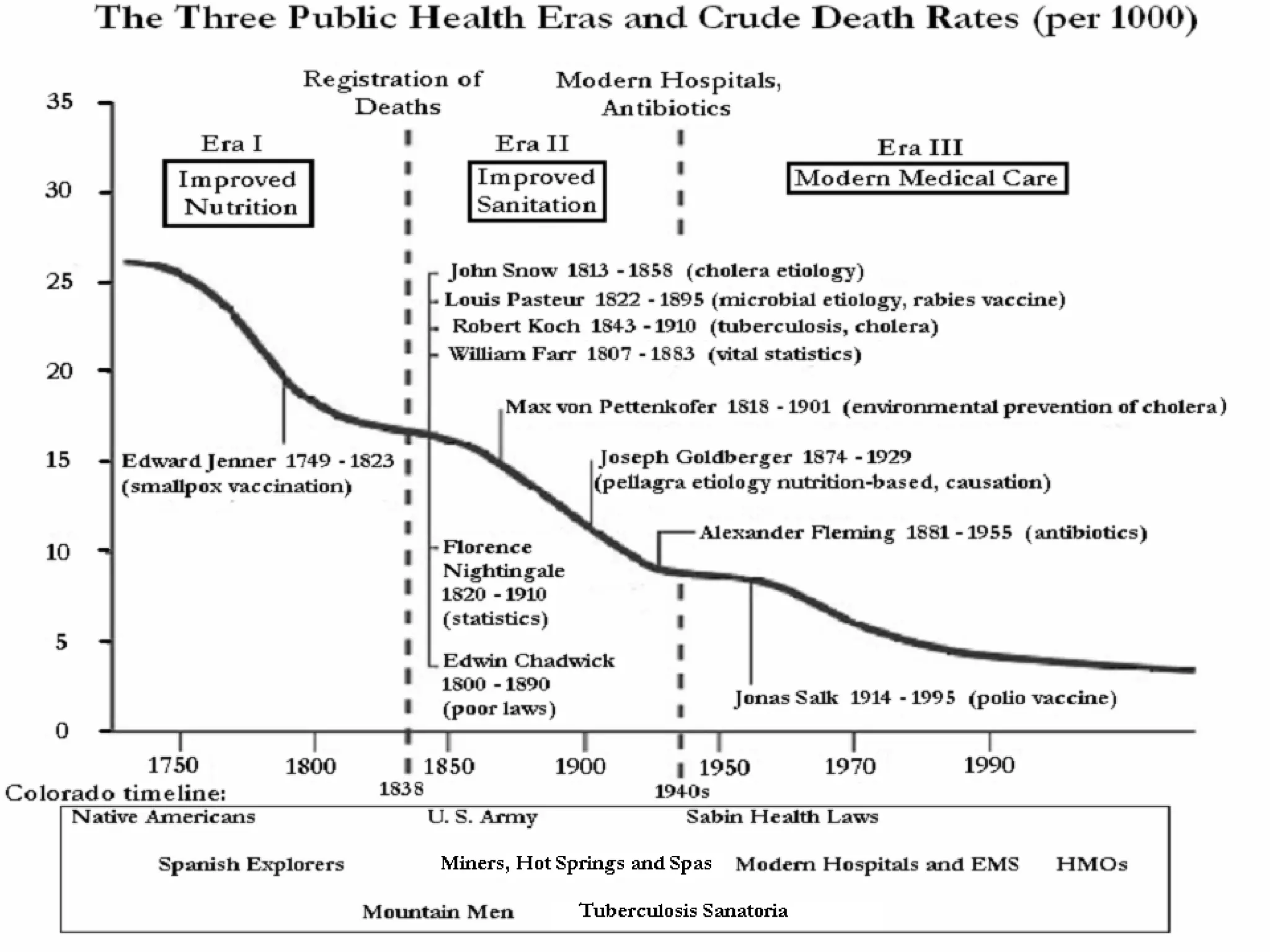
Public Health inPublic Health in
Jefferson CountyJefferson County
September 8, 2010September 8, 2010
Dr. Mark B. Johnson, MD, MPHDr. Mark B. Johnson, MD, MPH
Executive DirectorExecutive Director
Jefferson County Public HealthJefferson County Public Health
What if...What if...
...there was no health care system ?...there was no health care system ?
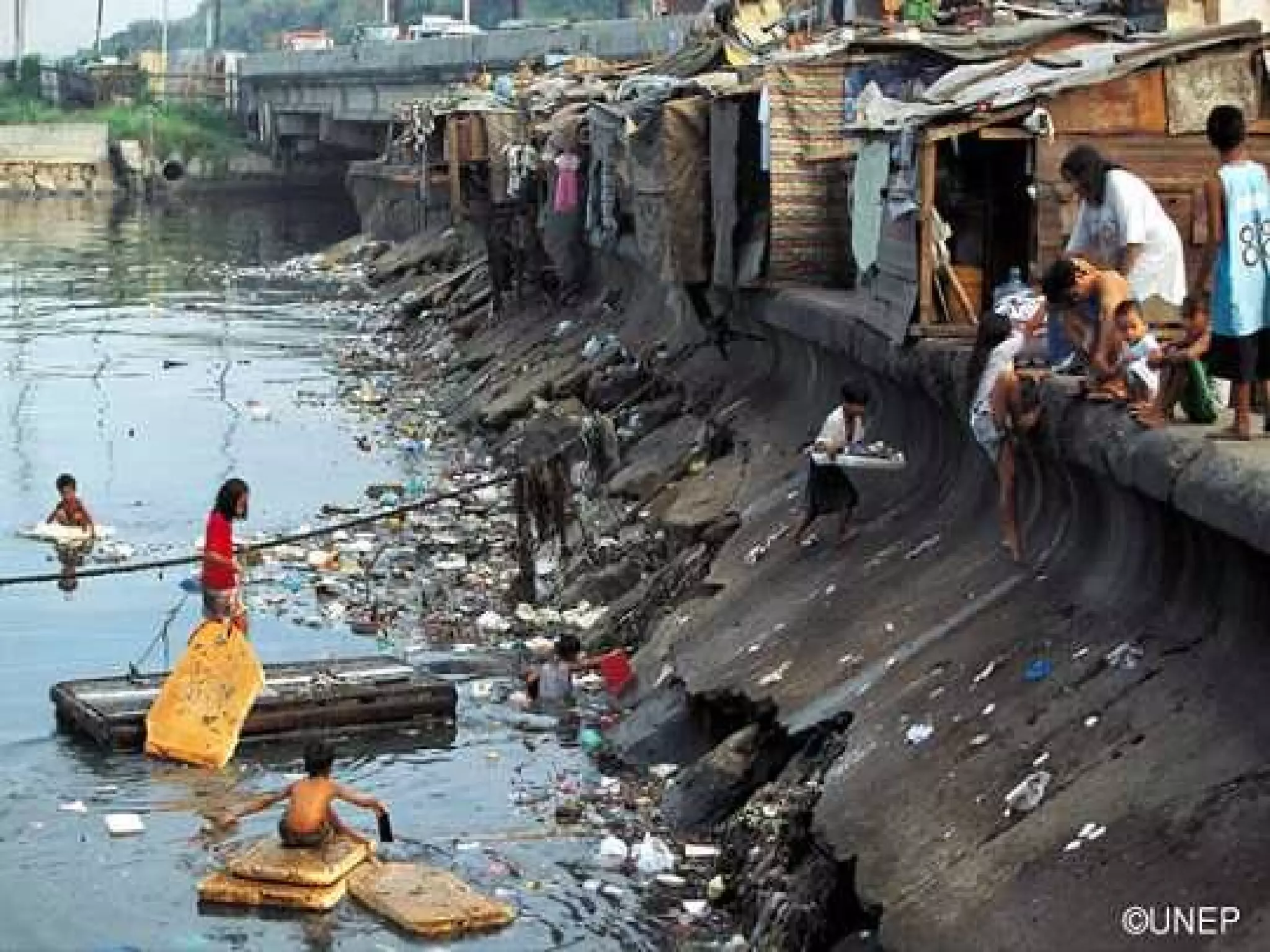
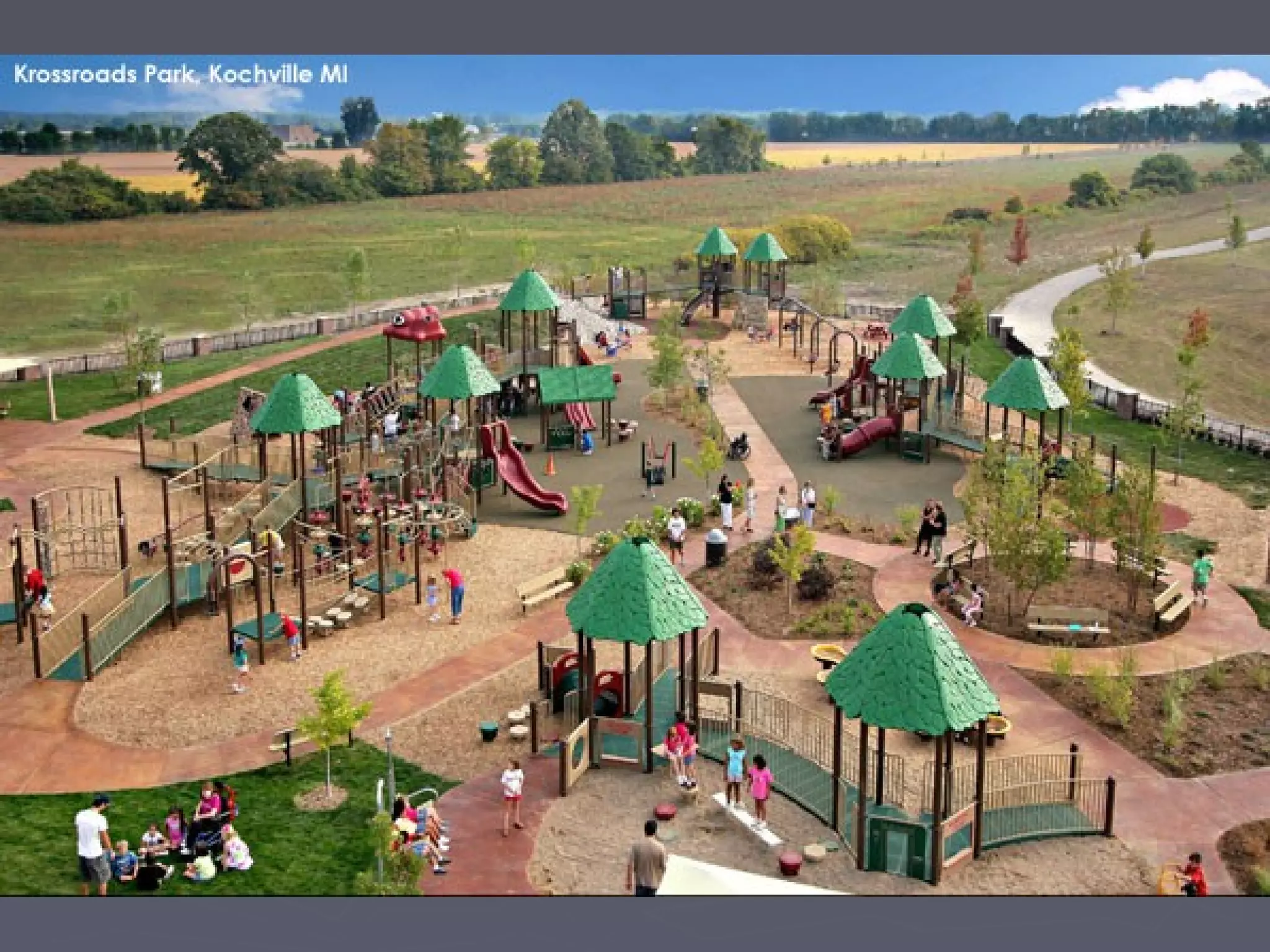
Would it make anyWould it make any
difference where youdifference where you
lived?lived?
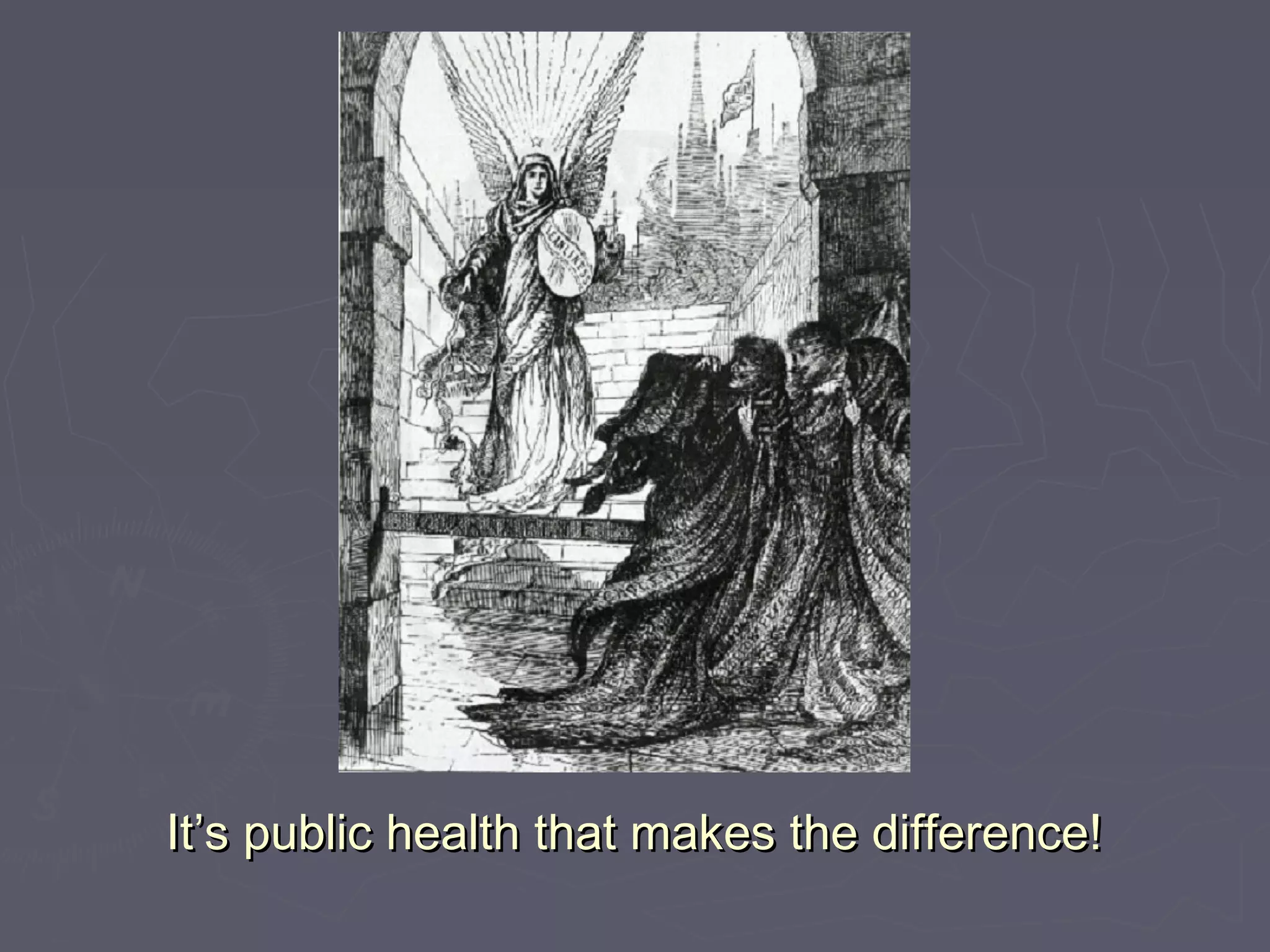
It’s public health that makes the difference!It’s public health that makes the difference!
So... what is publicSo... what is public
health, and how does ithealth, and how does it
differ from medical care?differ from medical care?
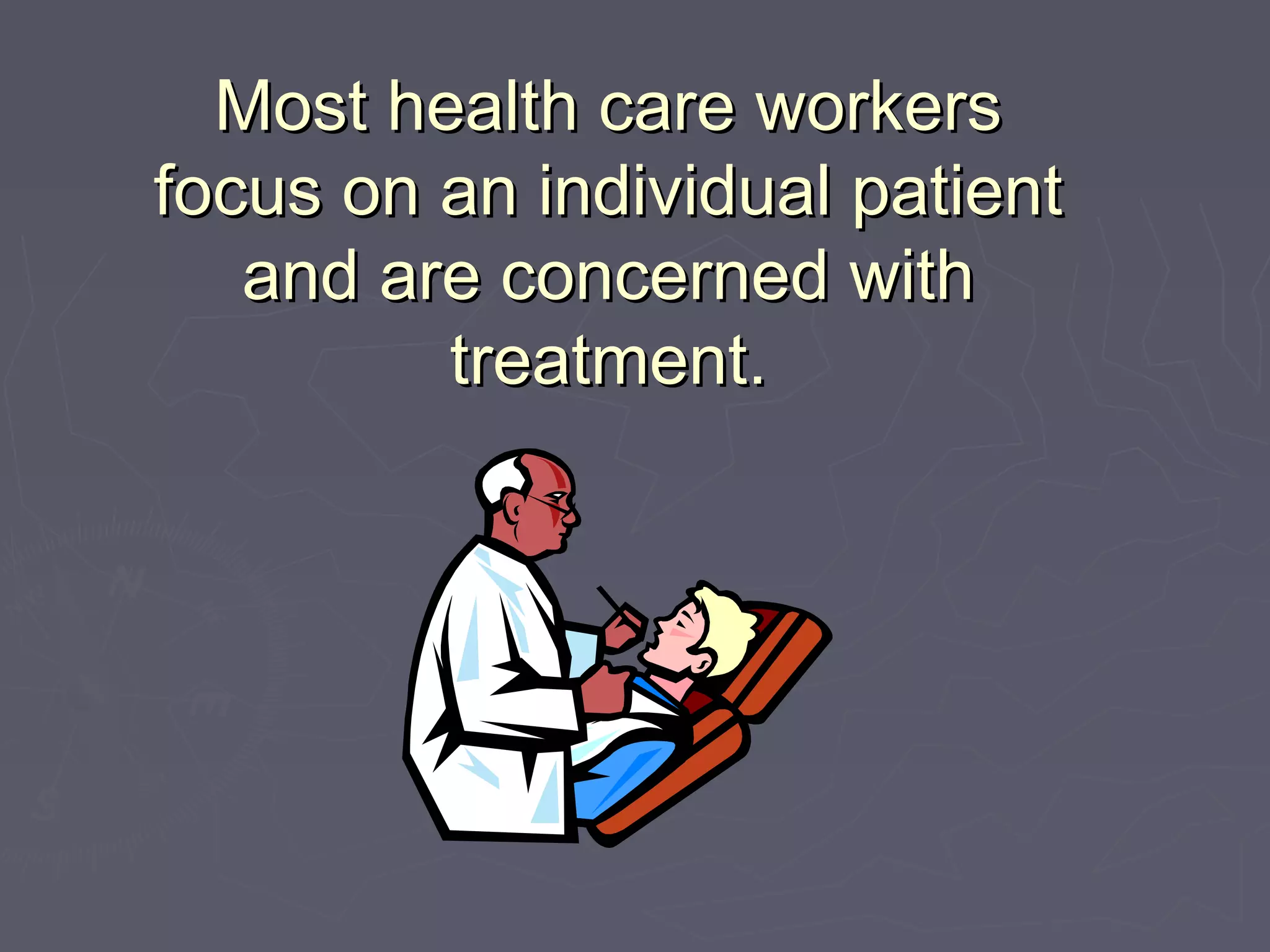
Most health care workersMost health care workers
focus on an individual patientfocus on an individual patient
and are concerned withand are concerned with
treatment.treatment.
Public Health focuses on aPublic Health focuses on a
community and is concernedcommunity and is concerned
with prevention.with prevention.
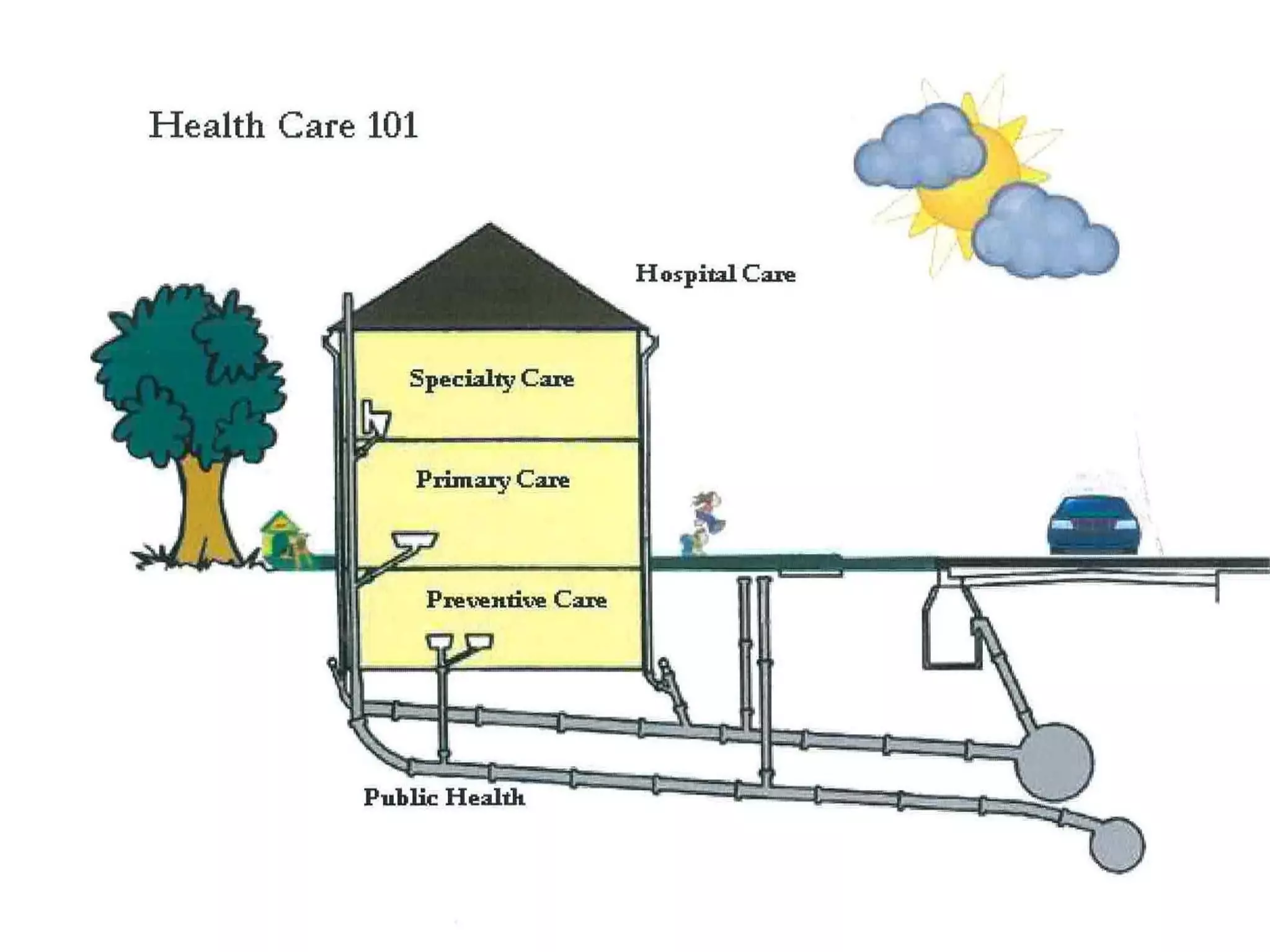
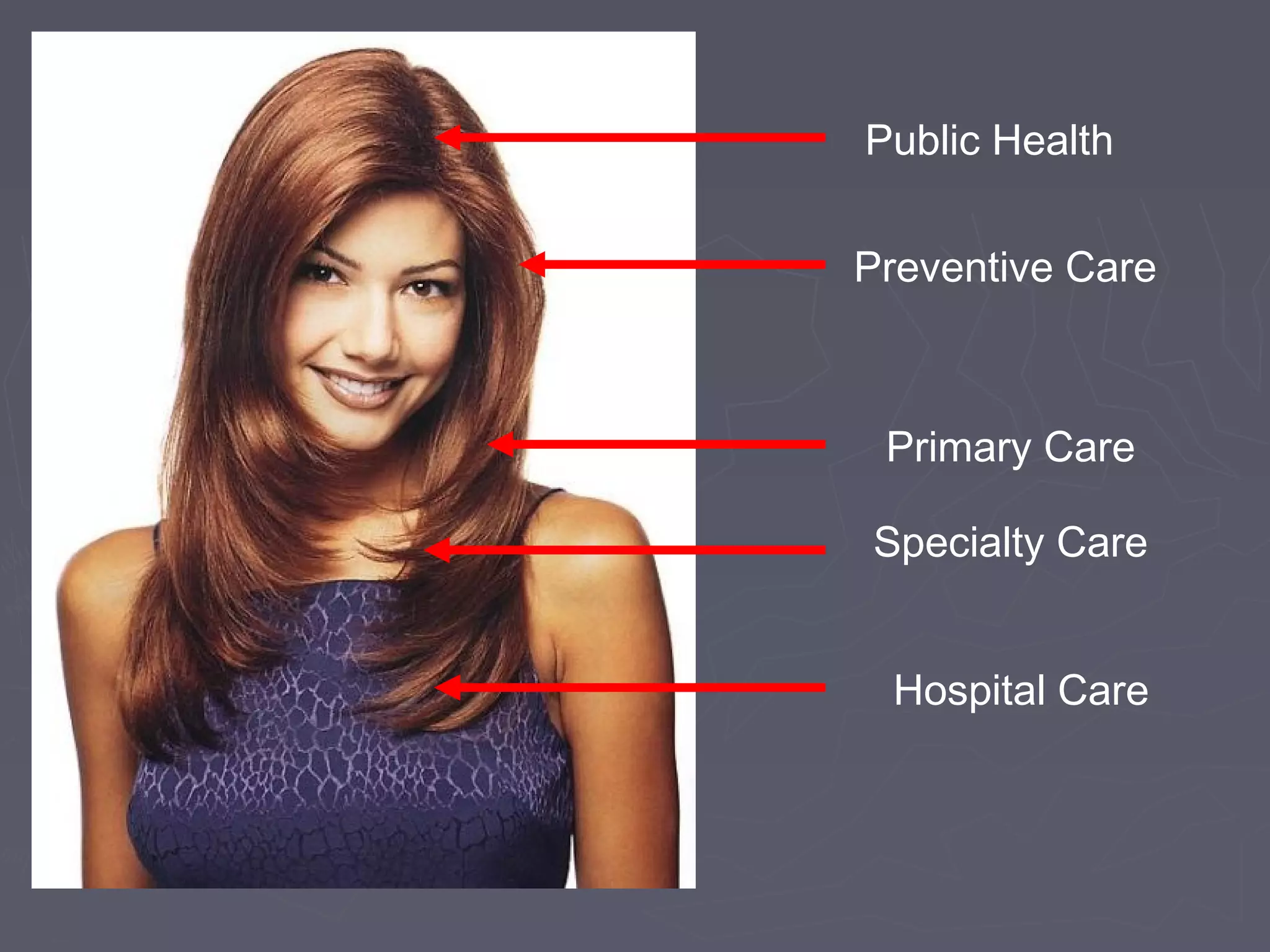
Public Health
Preventive Care
Primary Care
Specialty Care
Hospital Care
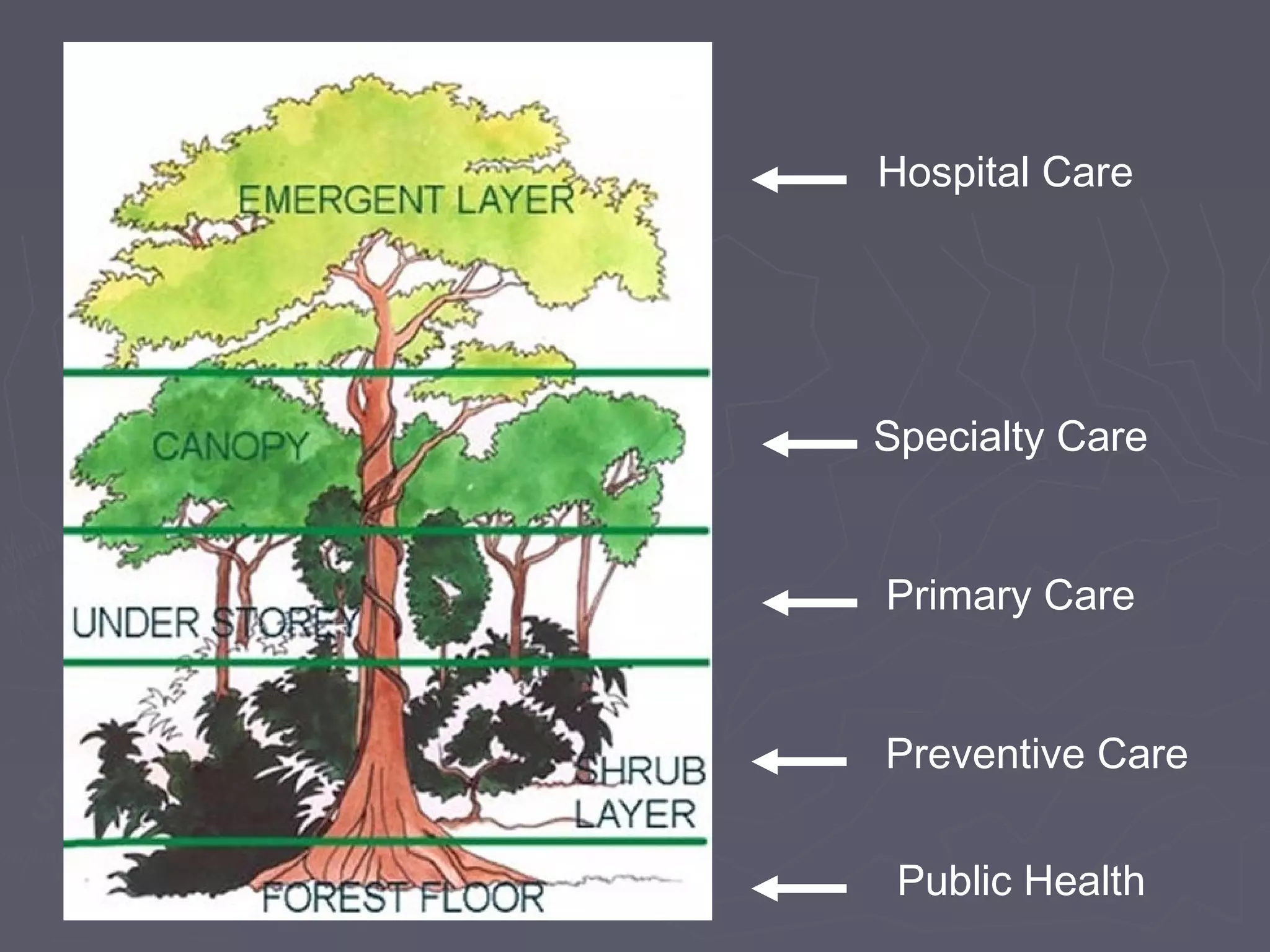
Public Health
Preventive Care
Primary Care
Specialty Care
Hospital Care
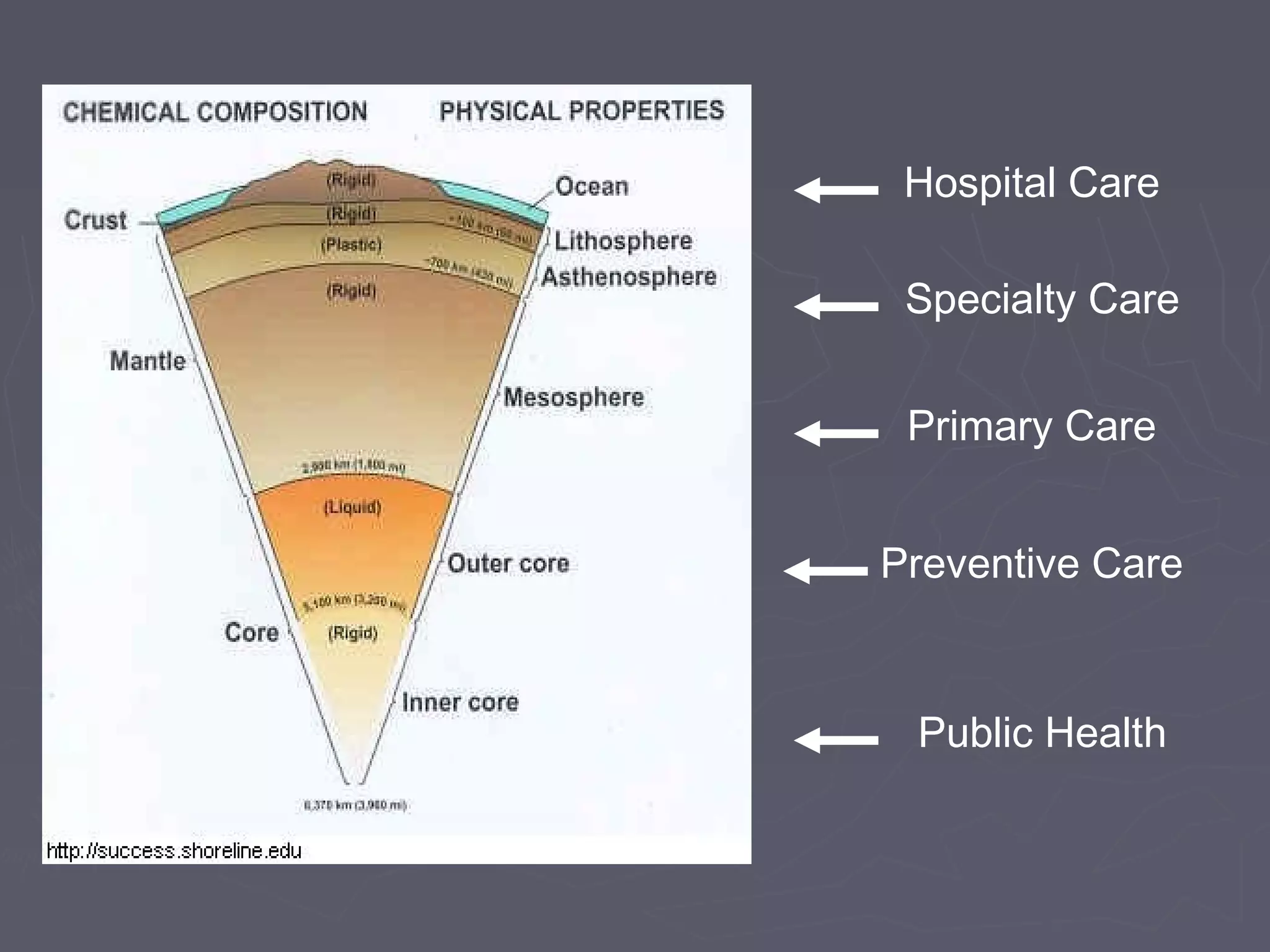
Public Health
Preventive Care
Primary Care
Specialty Care
Hospital Care
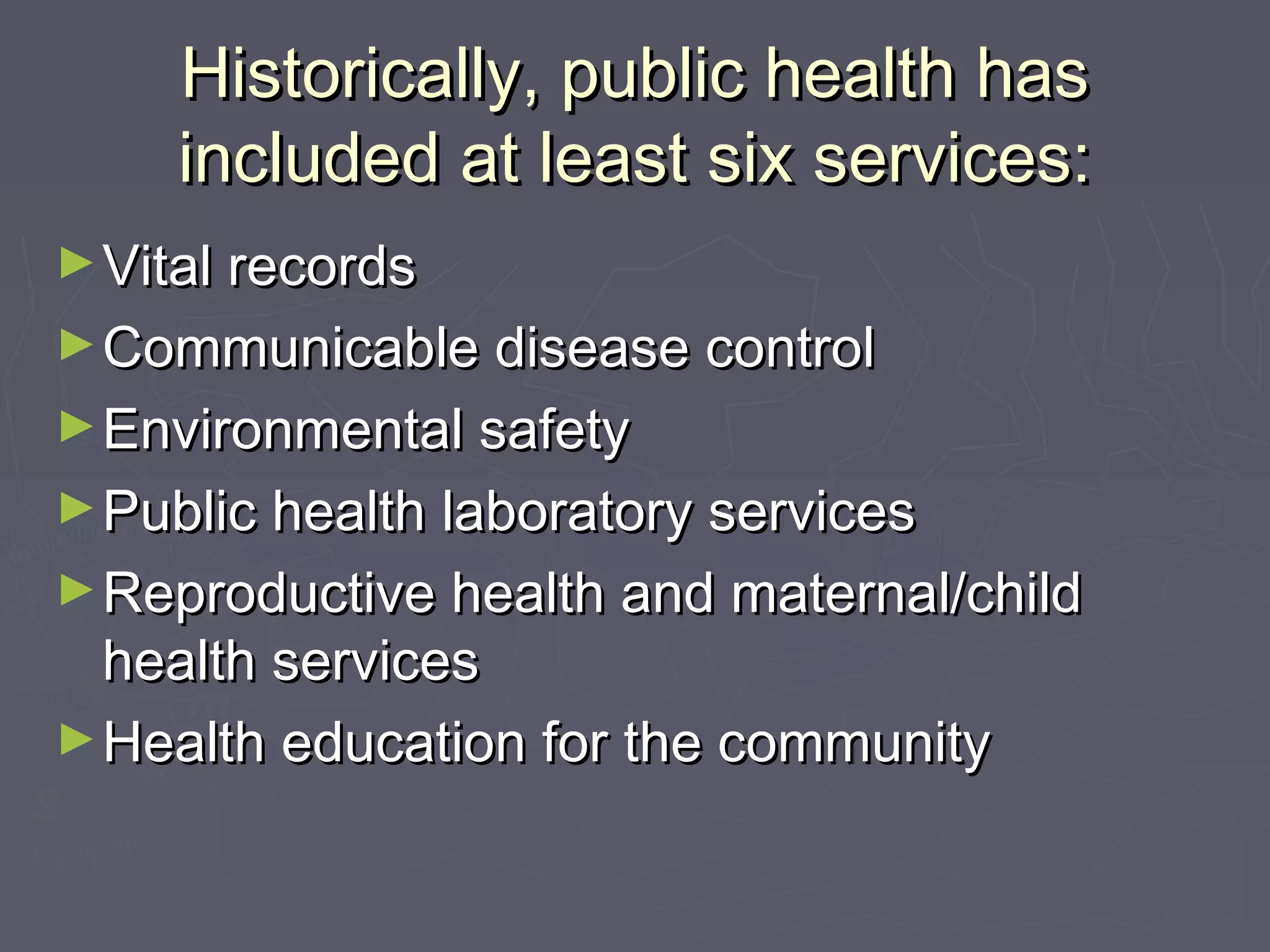
Historically, public health hasHistorically, public health has
included at least six services:included at least six services:
►Vital recordsVital records
►Communicable disease controlCommunicable disease control
►Environmental safetyEnvironmental safety
►Public health laboratory servicesPublic health laboratory services
►Reproductive health and maternal/childReproductive health and maternal/child
health serviceshealth services
►Health education for the communityHealth education for the community
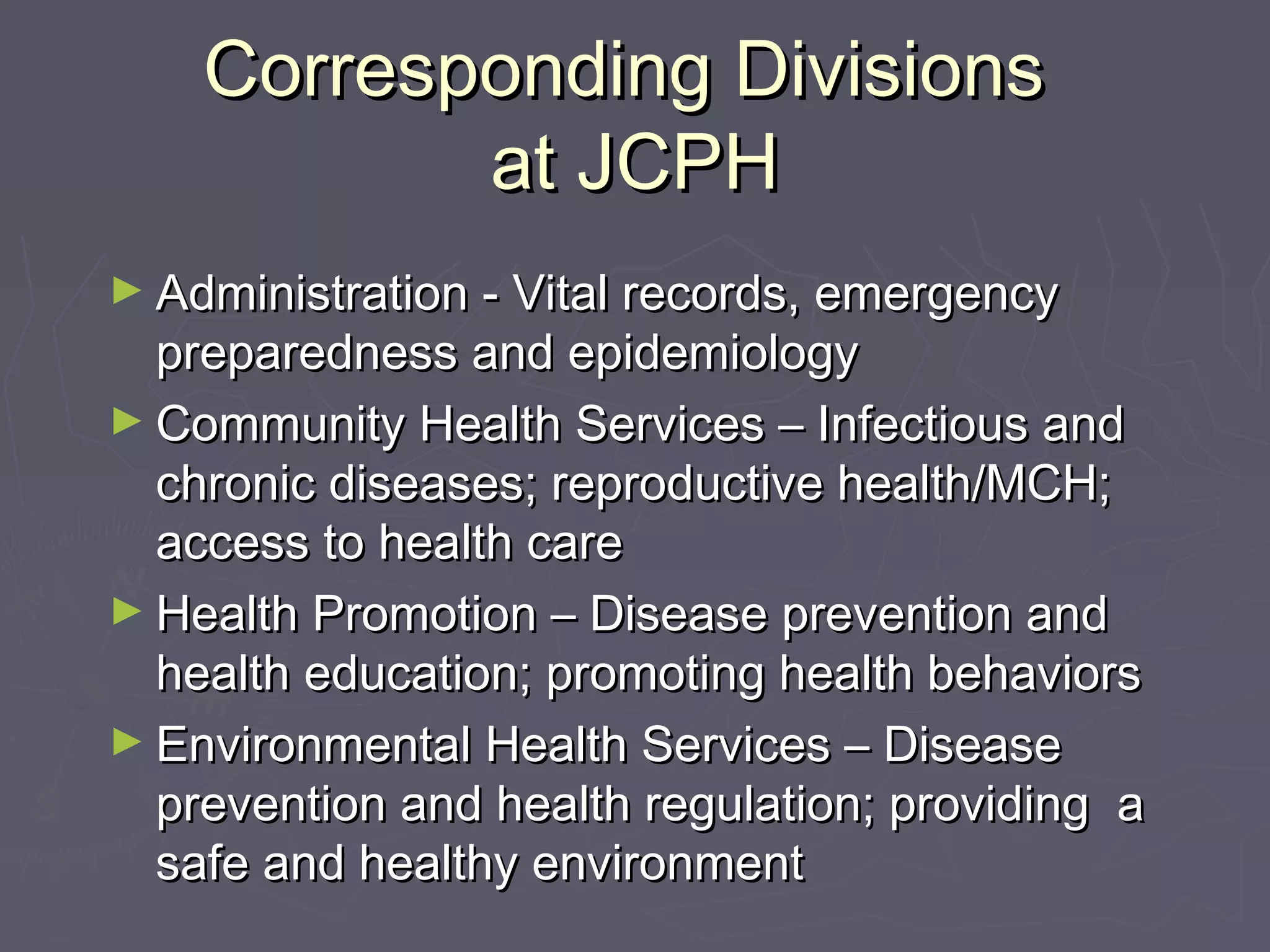
Corresponding DivisionsCorresponding Divisions
at JCPHat JCPH
► Administration - Vital records, emergencyAdministration - Vital records, emergency
preparedness and epidemiologypreparedness and epidemiology
► Community Health Services – Infectious andCommunity Health Services – Infectious and
chronic diseases; reproductive health/MCH;chronic diseases; reproductive health/MCH;
access to health careaccess to health care
► Health Promotion – Disease prevention andHealth Promotion – Disease prevention and
health education; promoting health behaviorshealth education; promoting health behaviors
► Environmental Health Services – DiseaseEnvironmental Health Services – Disease
prevention and health regulation; providing aprevention and health regulation; providing a
safe and healthy environmentsafe and healthy environment
The primary rule ofThe primary rule of
public health:public health:
Never put a barrier betweenNever put a barrier between
an individual and the public’san individual and the public’s
good.good.
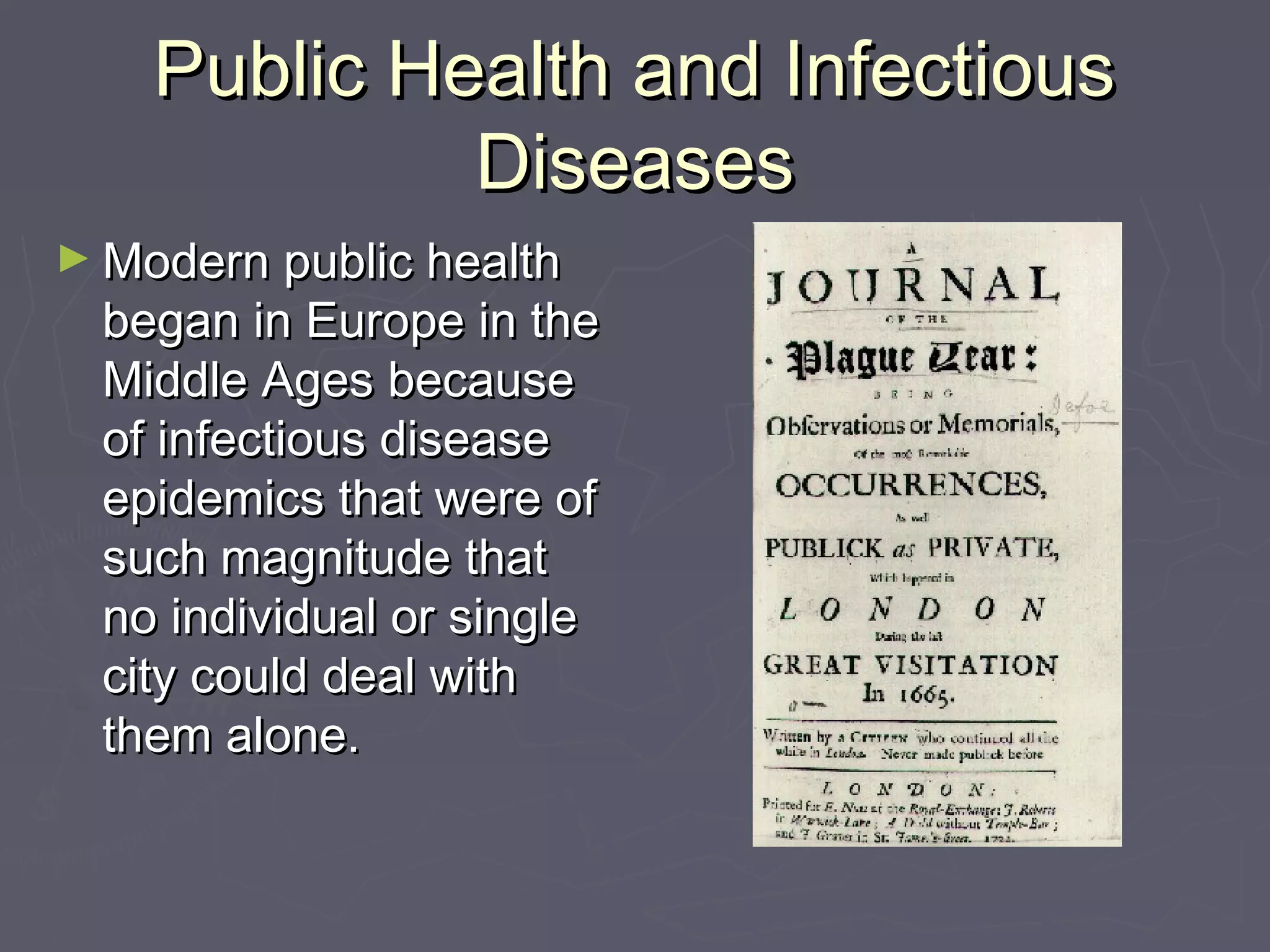
Public Health and InfectiousPublic Health and Infectious
DiseasesDiseases
► Modern public healthModern public health
began in Europe in thebegan in Europe in the
Middle Ages becauseMiddle Ages because
of infectious diseaseof infectious disease
epidemics that were ofepidemics that were of
such magnitude thatsuch magnitude that
no individual or singleno individual or single
city could deal withcity could deal with
them alone.them alone.
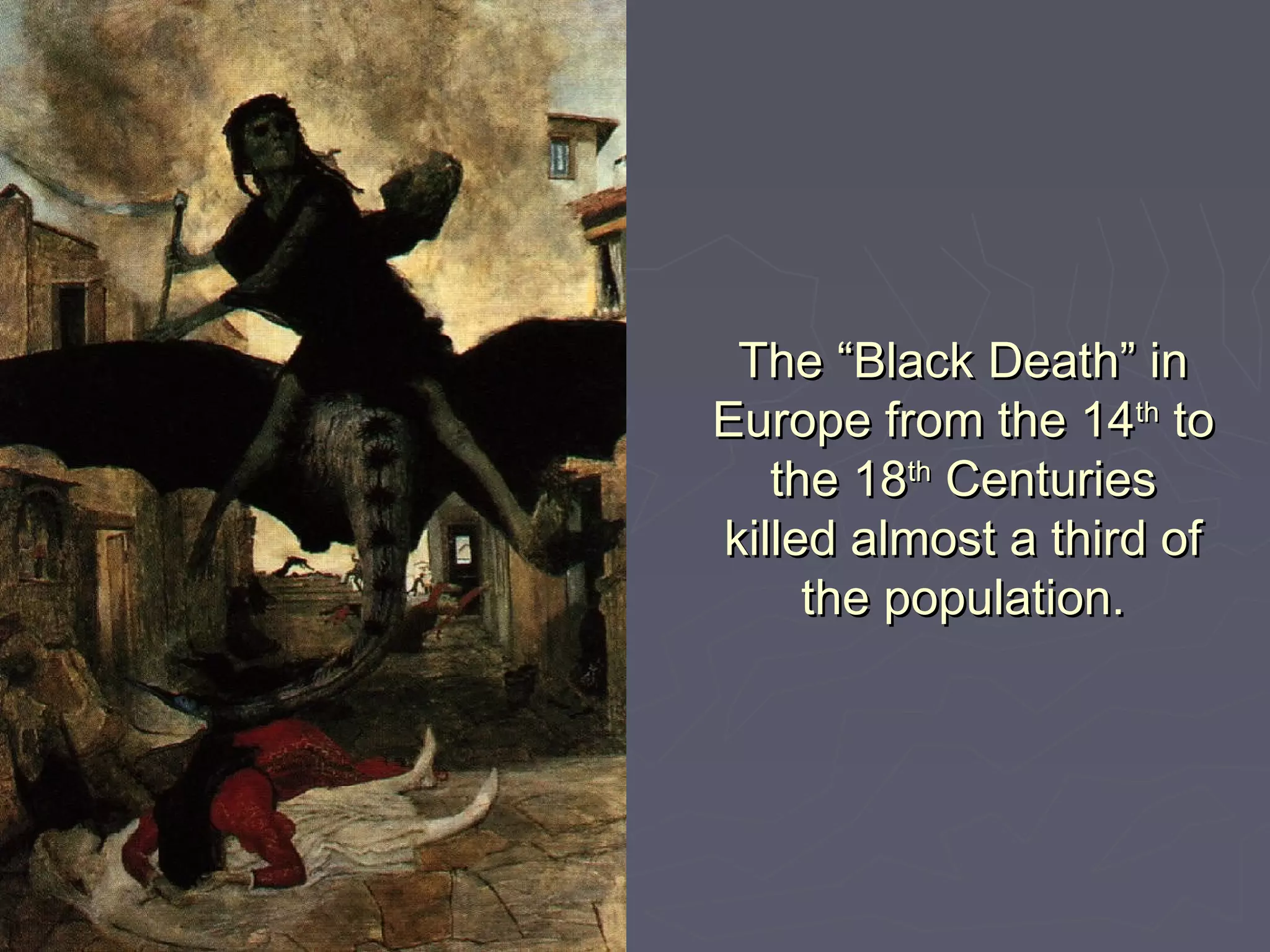
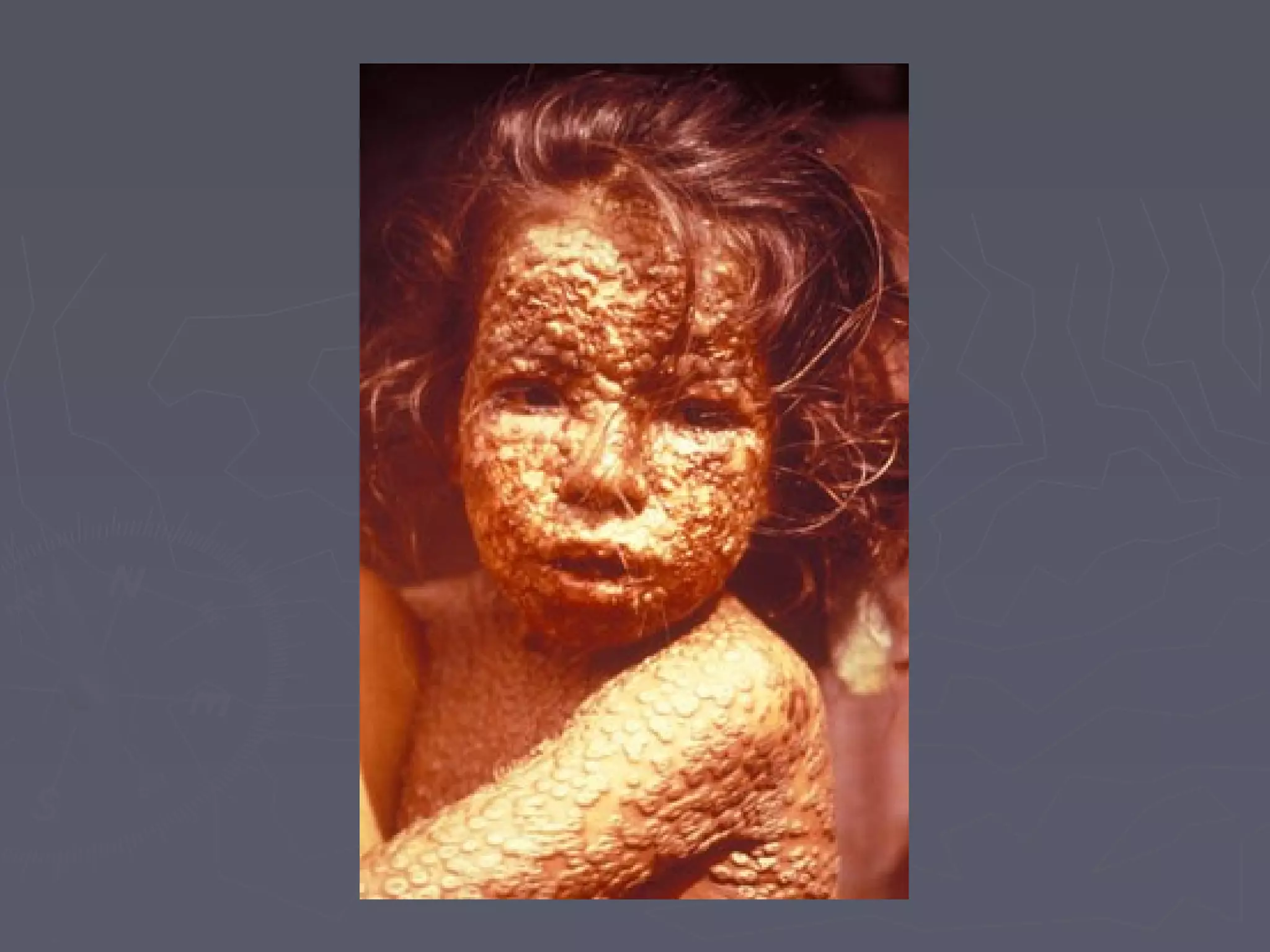
The “Black Death” inThe “Black Death” in
Europe from the 14Europe from the 14thth
toto
the 18the 18thth
CenturiesCenturies
killed almost a third ofkilled almost a third of
the population.the population.
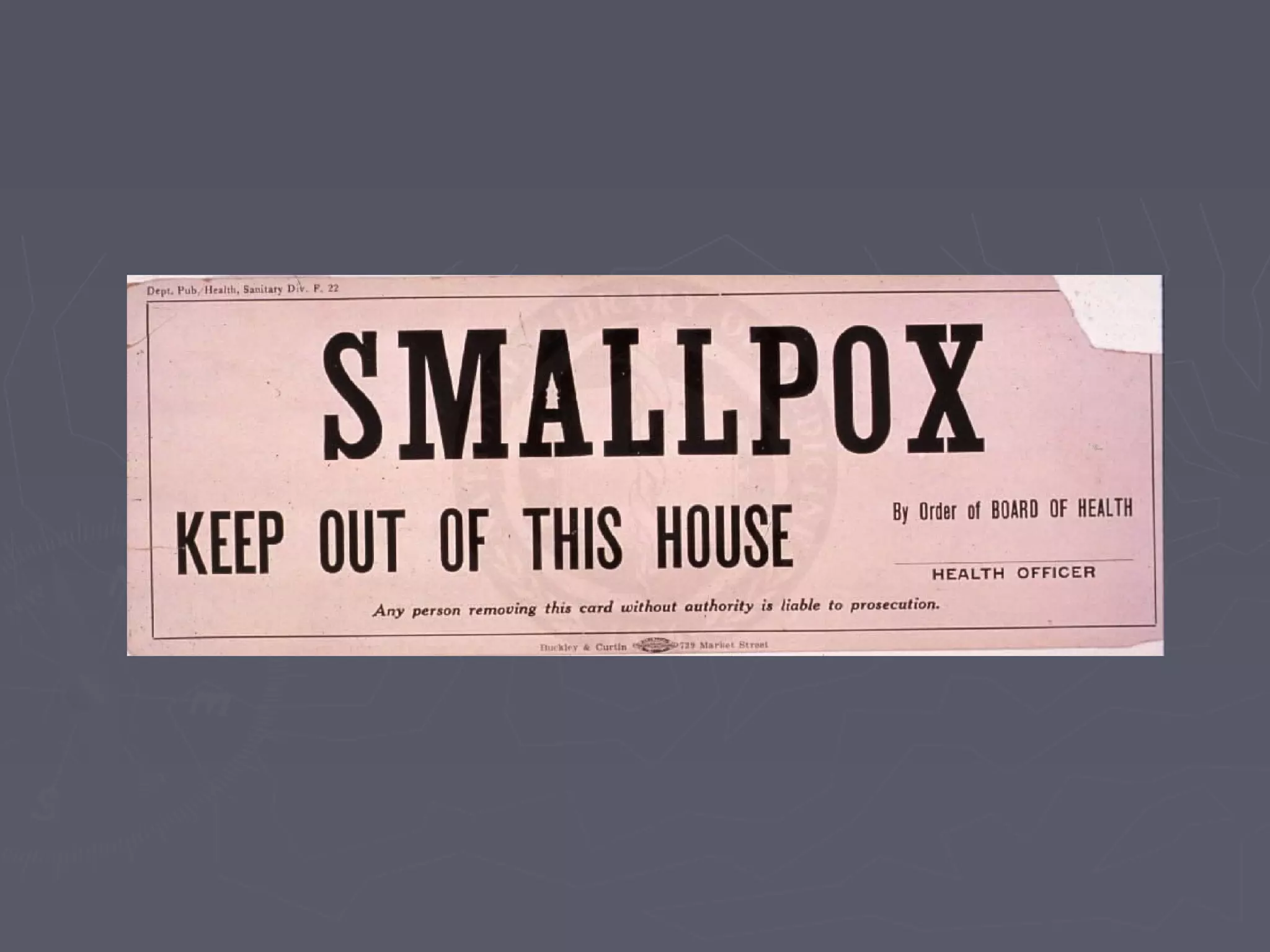
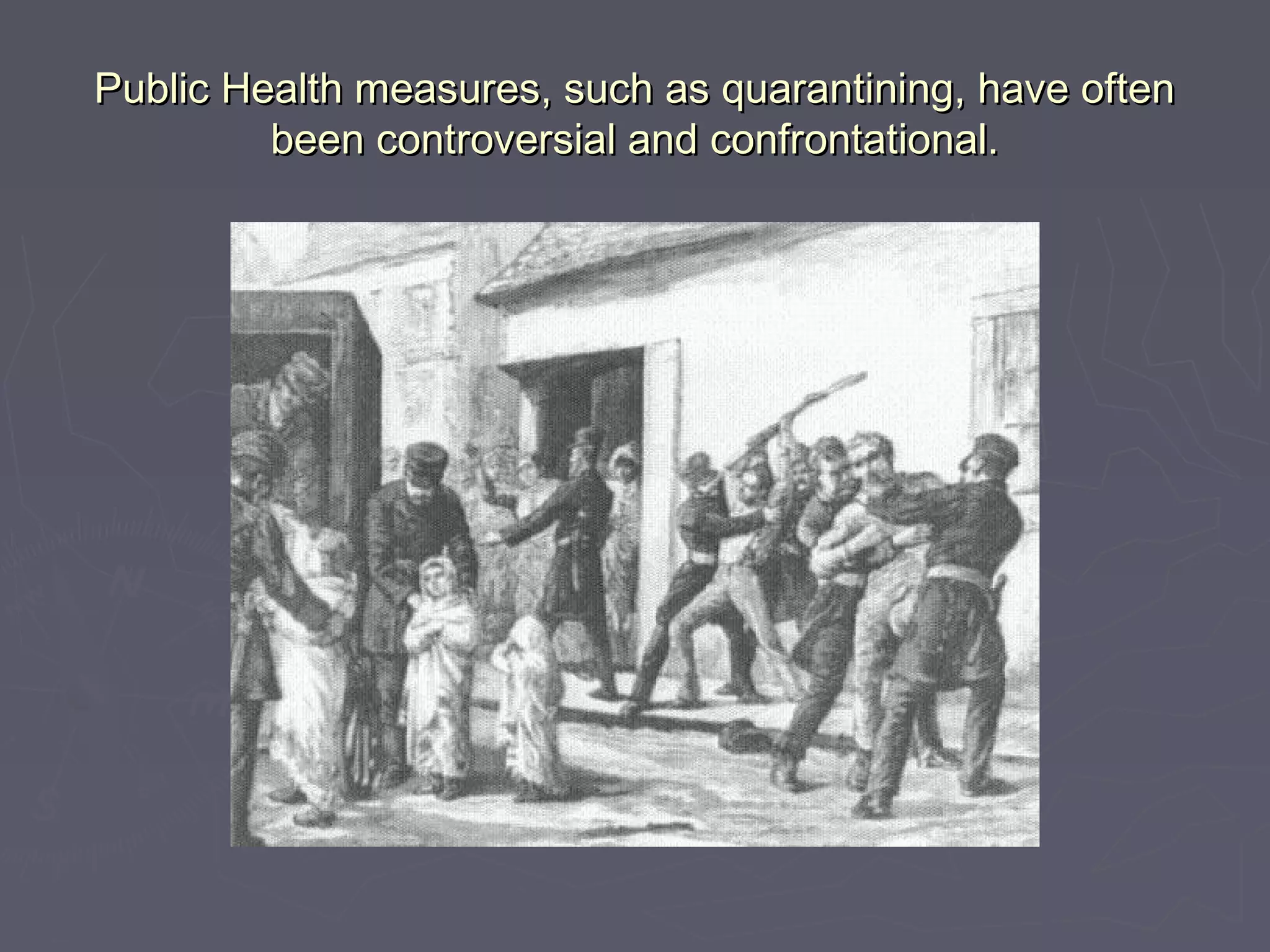
Public Health measures, such as quarantining, have oftenPublic Health measures, such as quarantining, have often
been controversial and confrontational.been controversial and confrontational.
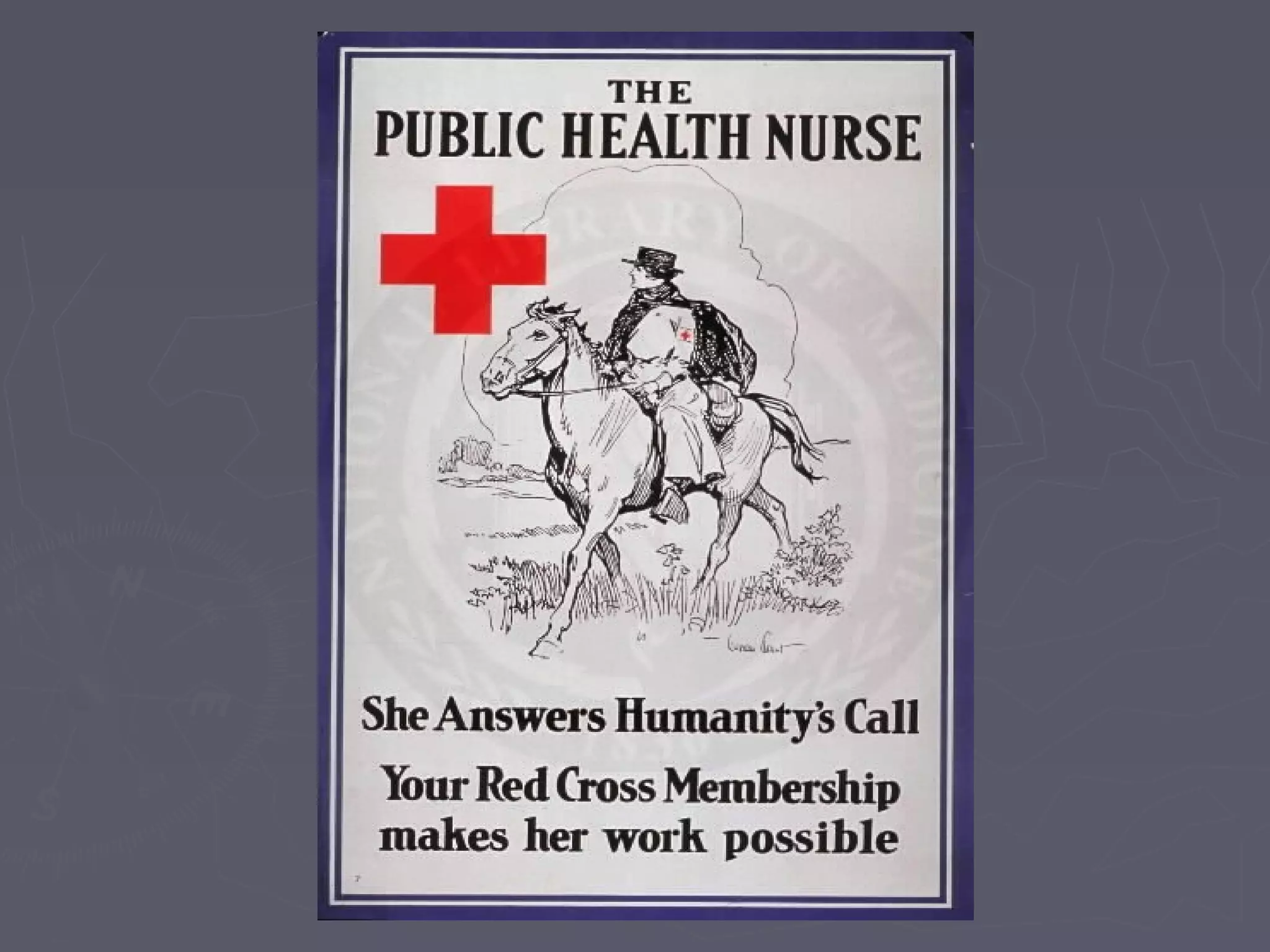
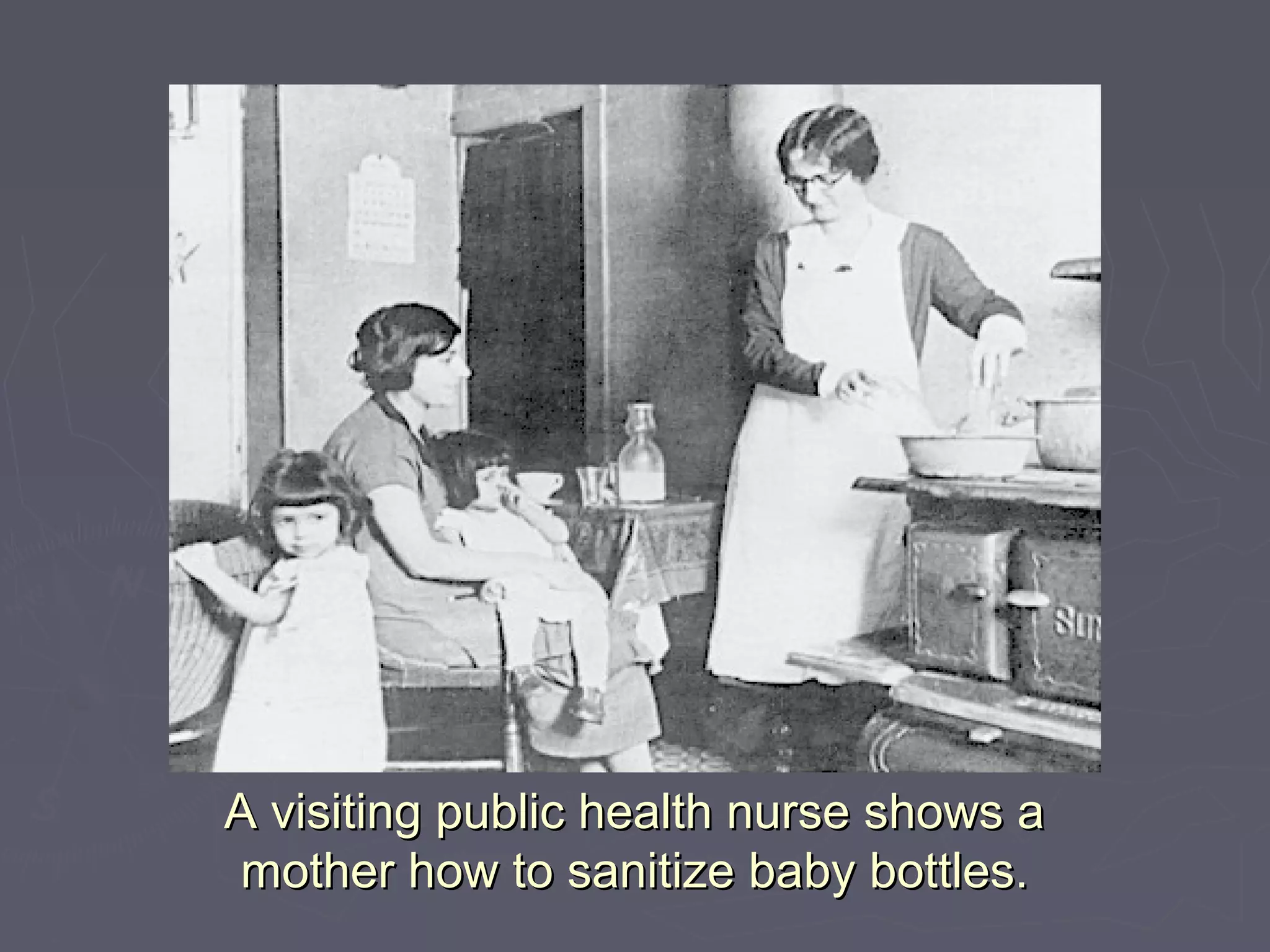
A visiting public health nurse shows aA visiting public health nurse shows a
mother how to sanitize baby bottles.mother how to sanitize baby bottles.
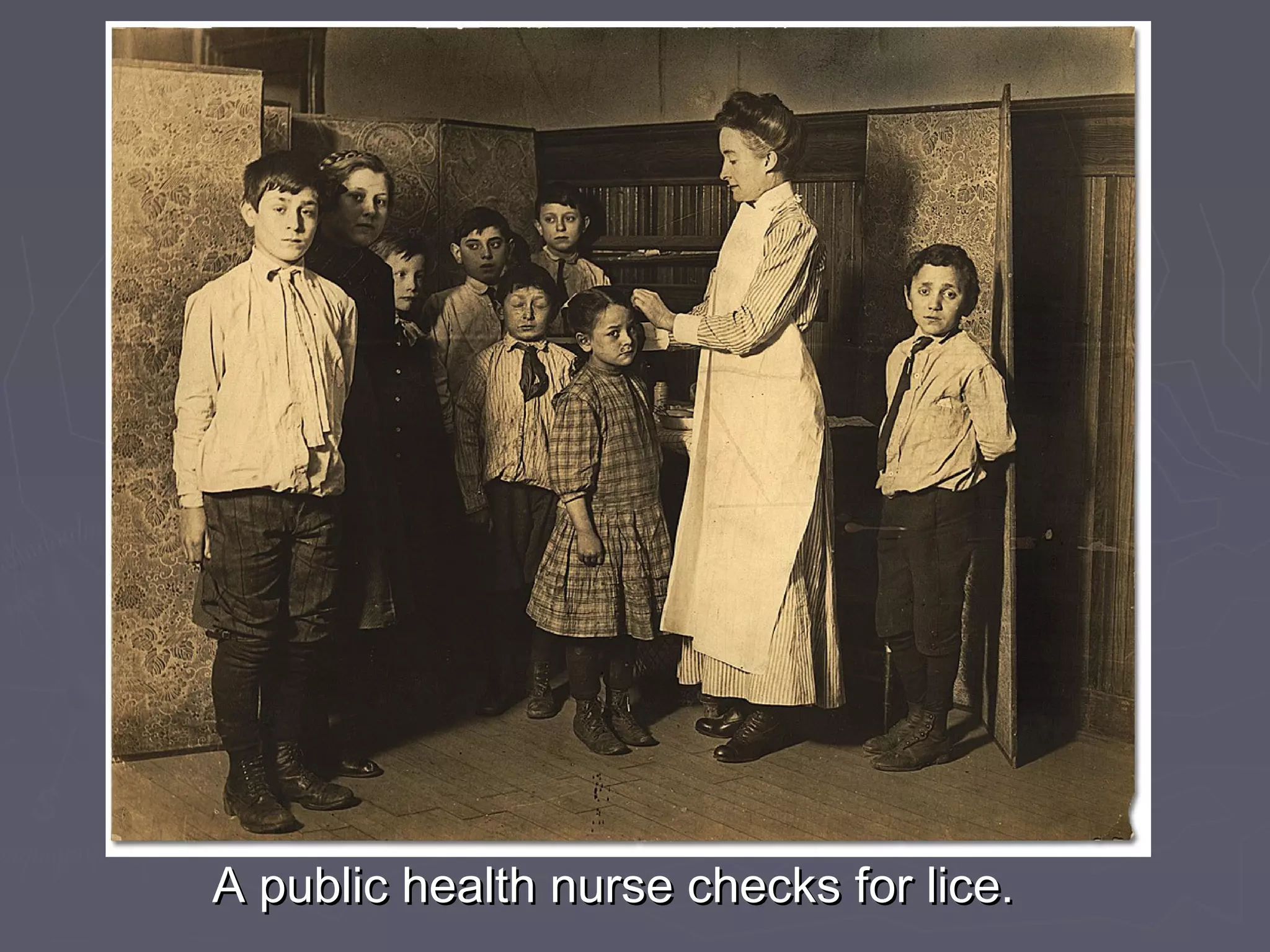
A public health nurse checks for lice.A public health nurse checks for lice.
Major public health issues inMajor public health issues in
infectious diseases.infectious diseases.
►Antibiotic resistanceAntibiotic resistance
►Emerging infectionsEmerging infections
►Bioterrorism and altered agentsBioterrorism and altered agents
►Re-emerging diseasesRe-emerging diseases
►Influenza pandemicsInfluenza pandemics
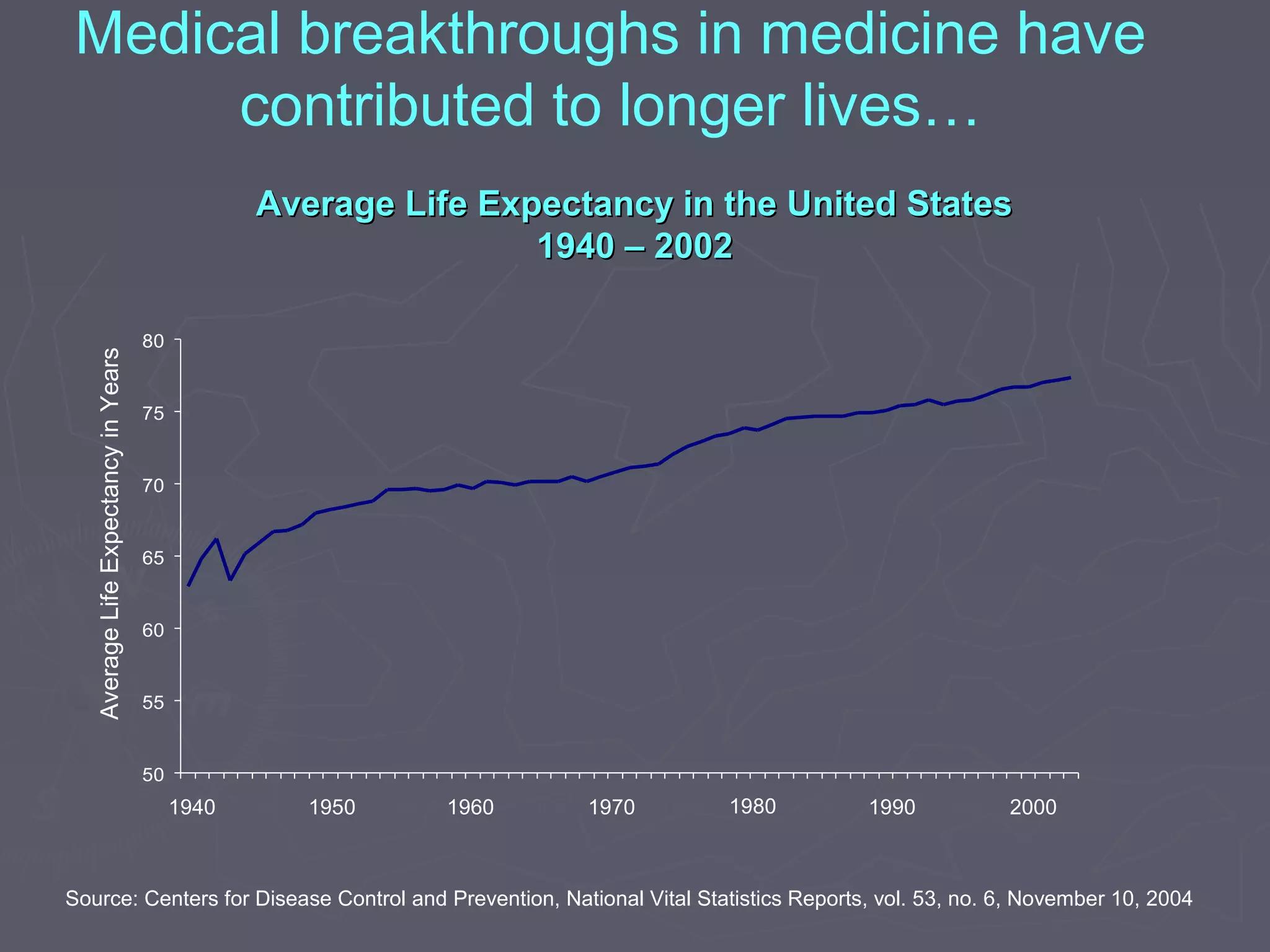
Medical breakthroughs in medicine have
contributed to longer lives…
50
55
60
65
70
75
80
Source: Centers for Disease Control and Prevention, National Vital Statistics Reports, vol. 53, no. 6, November 10, 2004
Average Life Expectancy in the United StatesAverage Life Expectancy in the United States
1940 – 20021940 – 2002
AverageLifeExpectancyinYears
20001940 1945 1950 1955 1960 1965 1970 1975 1980 198
5
1990 1995
Major Accomplishment: Life
Expectancy
►In the 20th
Century life expectancy
increased by 0.3 years each year = 3
years per decade.
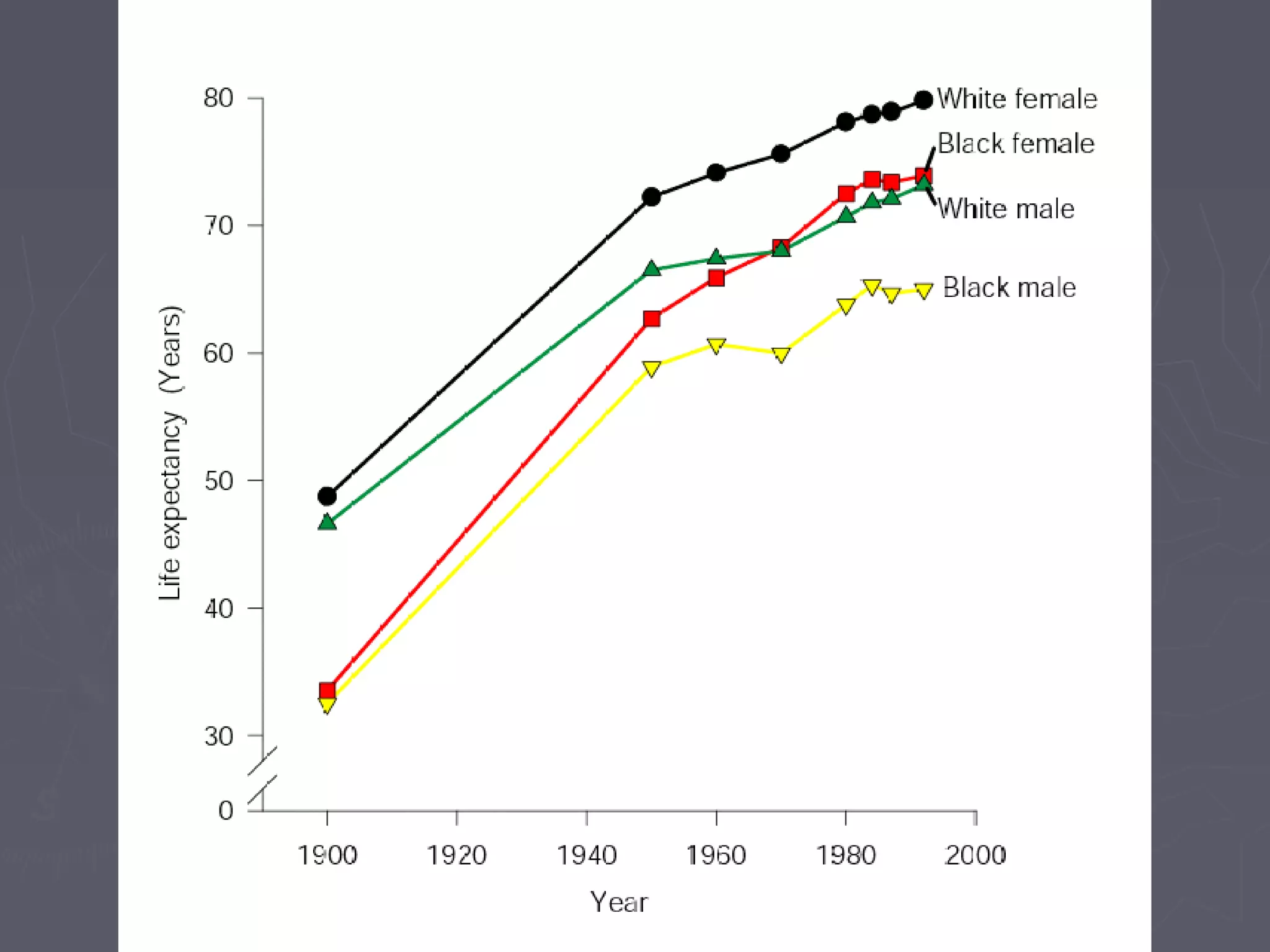
►Two-thirds of the increase in life
expectancy at birth occurred before 1950.
►Two-thirds of the increase in life
expectancy at age 65 occurred after 1950.
Chronic Disease ControlChronic Disease Control
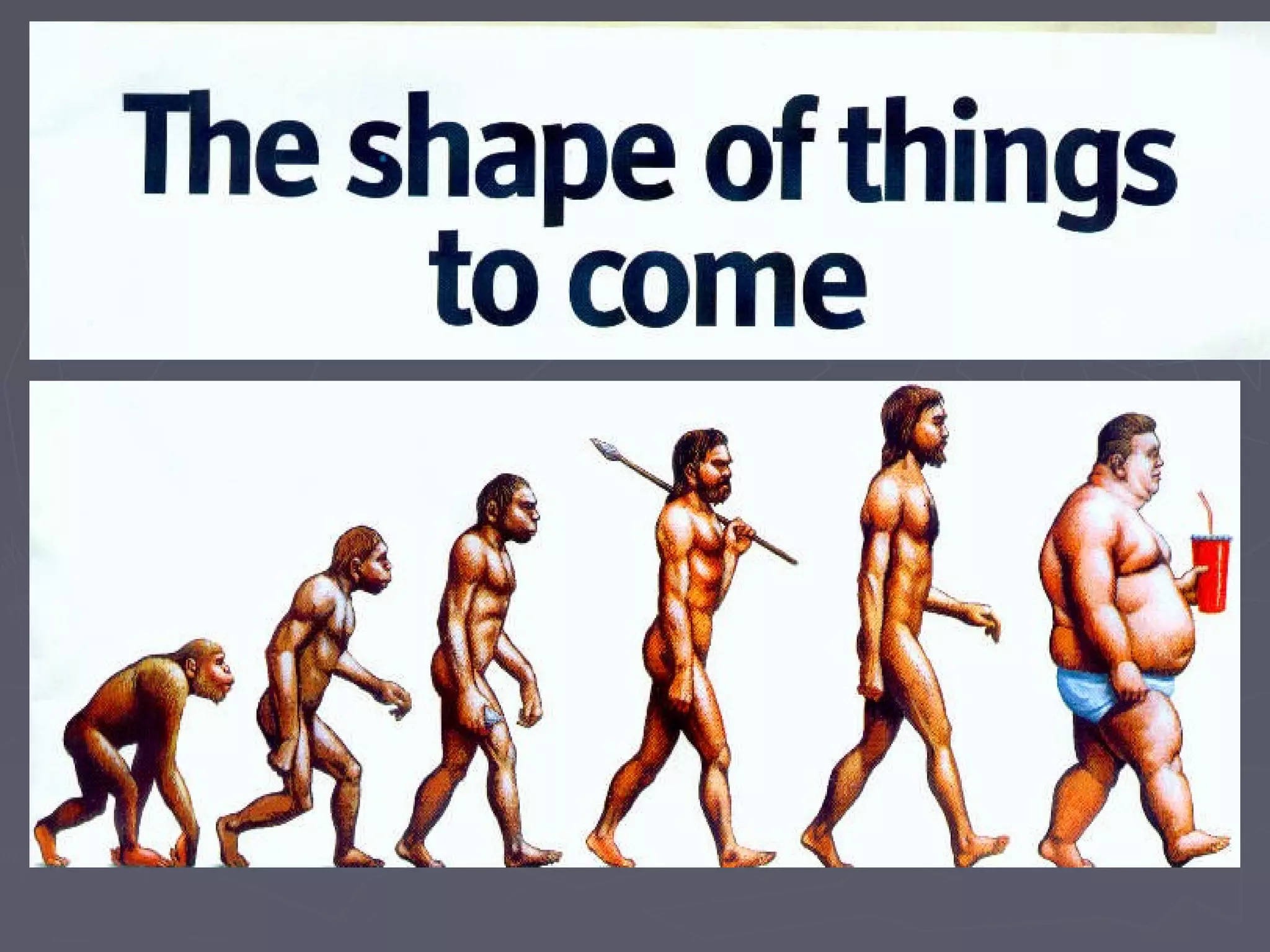
The epidemics of lifestyle.The epidemics of lifestyle.
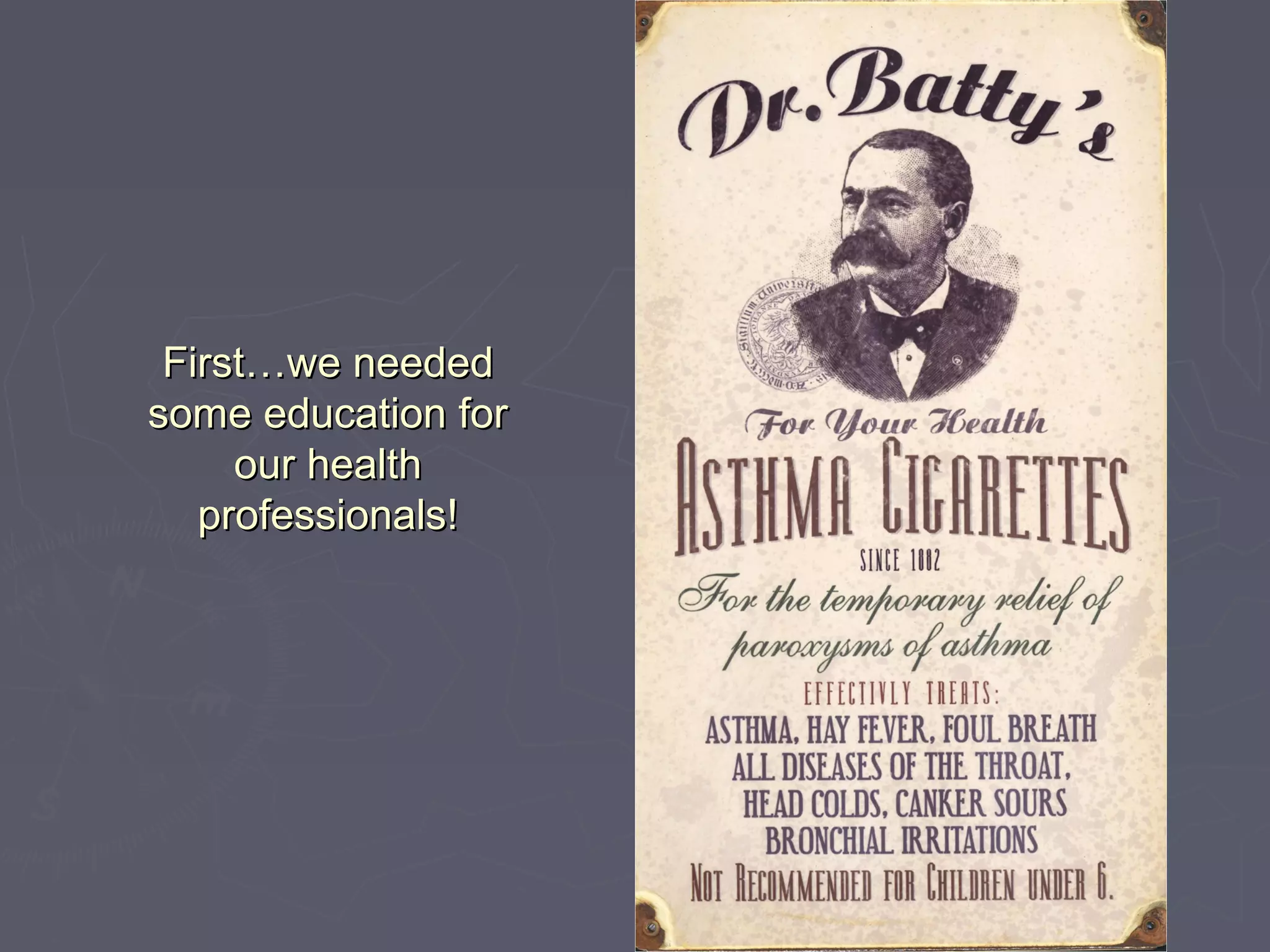
First…we neededFirst…we needed
some education forsome education for
our healthour health
professionals!professionals!
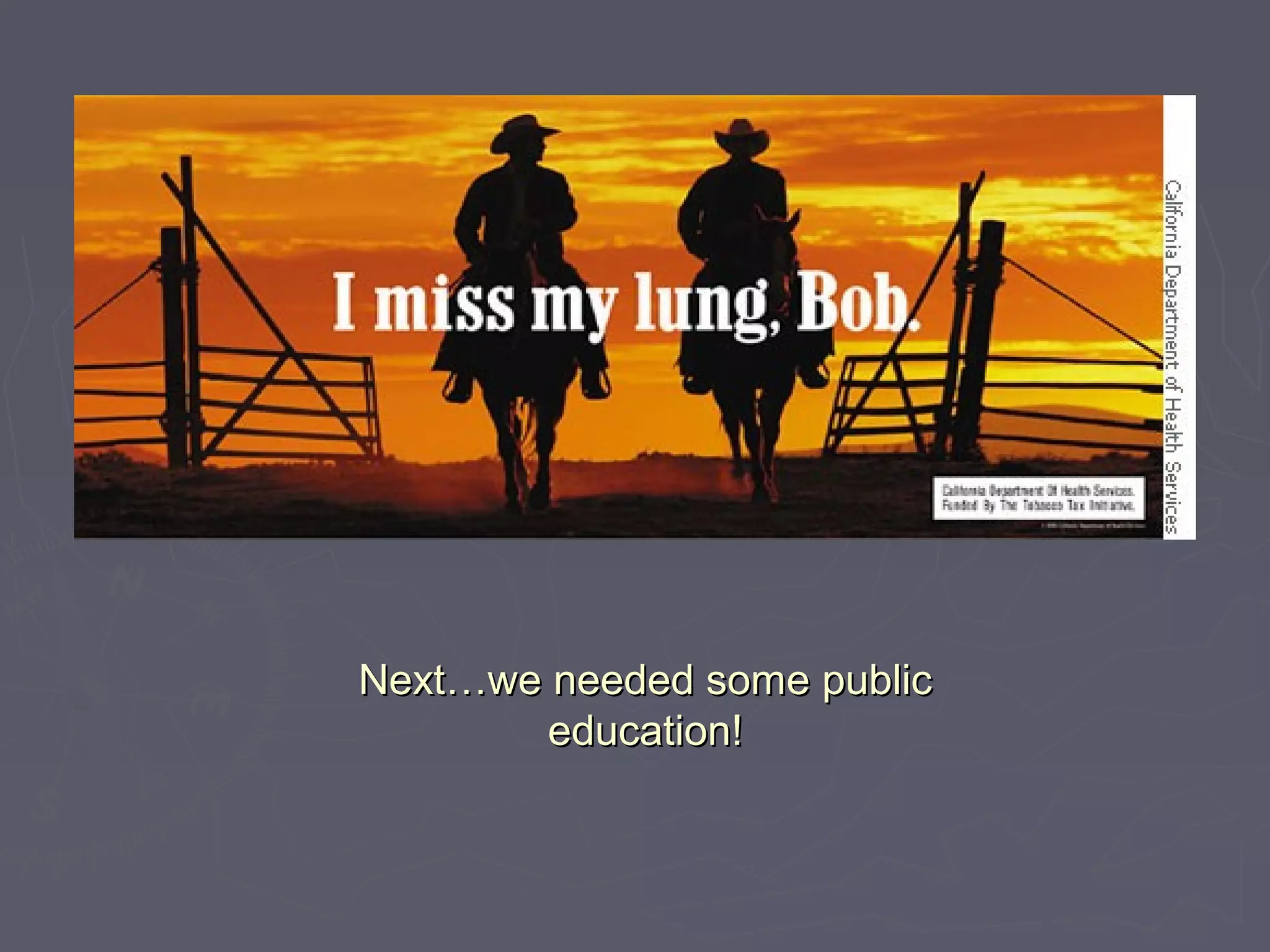
Next…we needed some publicNext…we needed some public
education!education!
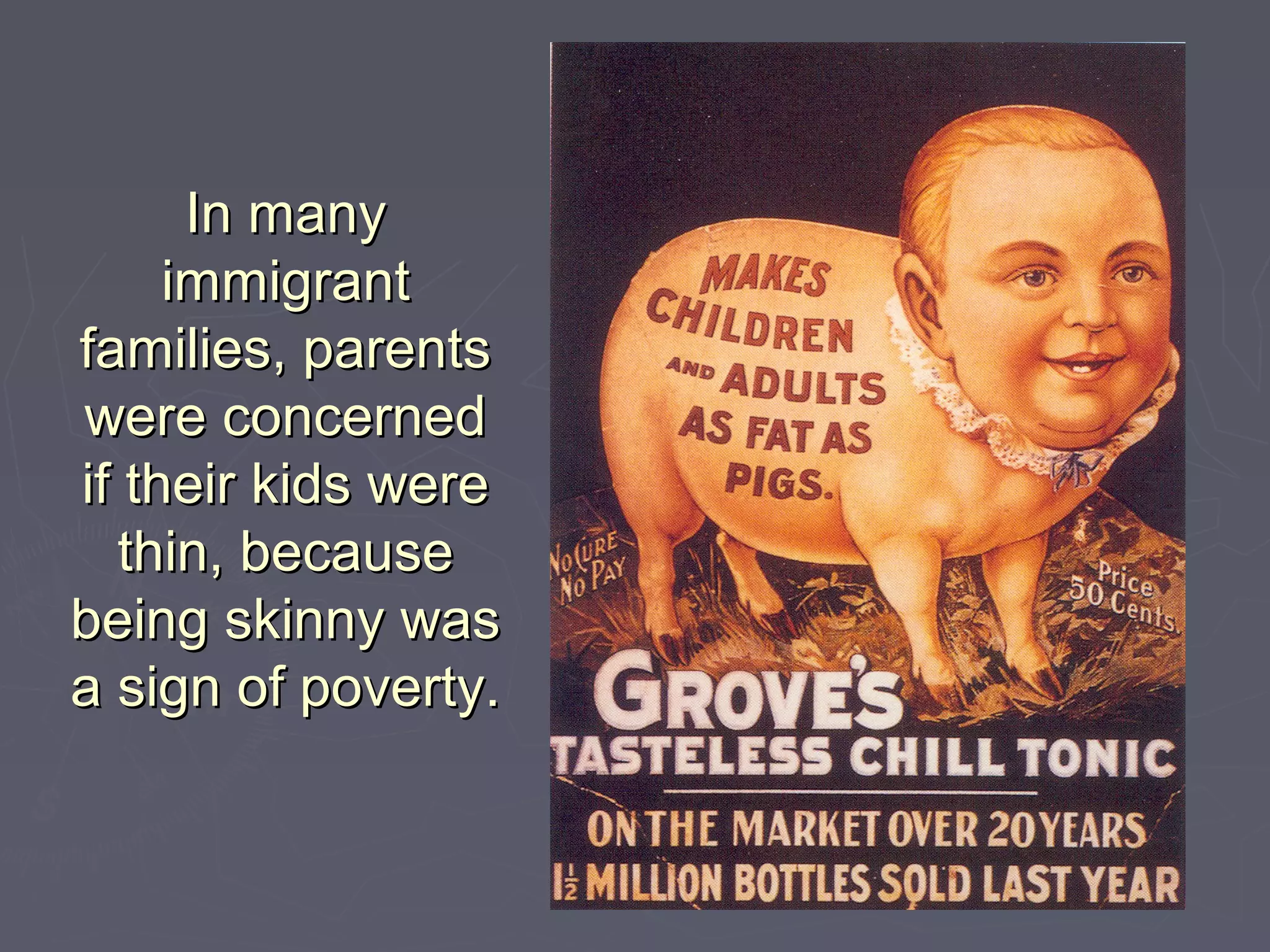
In manyIn many
immigrantimmigrant
families, parentsfamilies, parents
were concernedwere concerned
if their kids wereif their kids were
thin, becausethin, because
being skinny wasbeing skinny was
a sign of poverty.a sign of poverty.
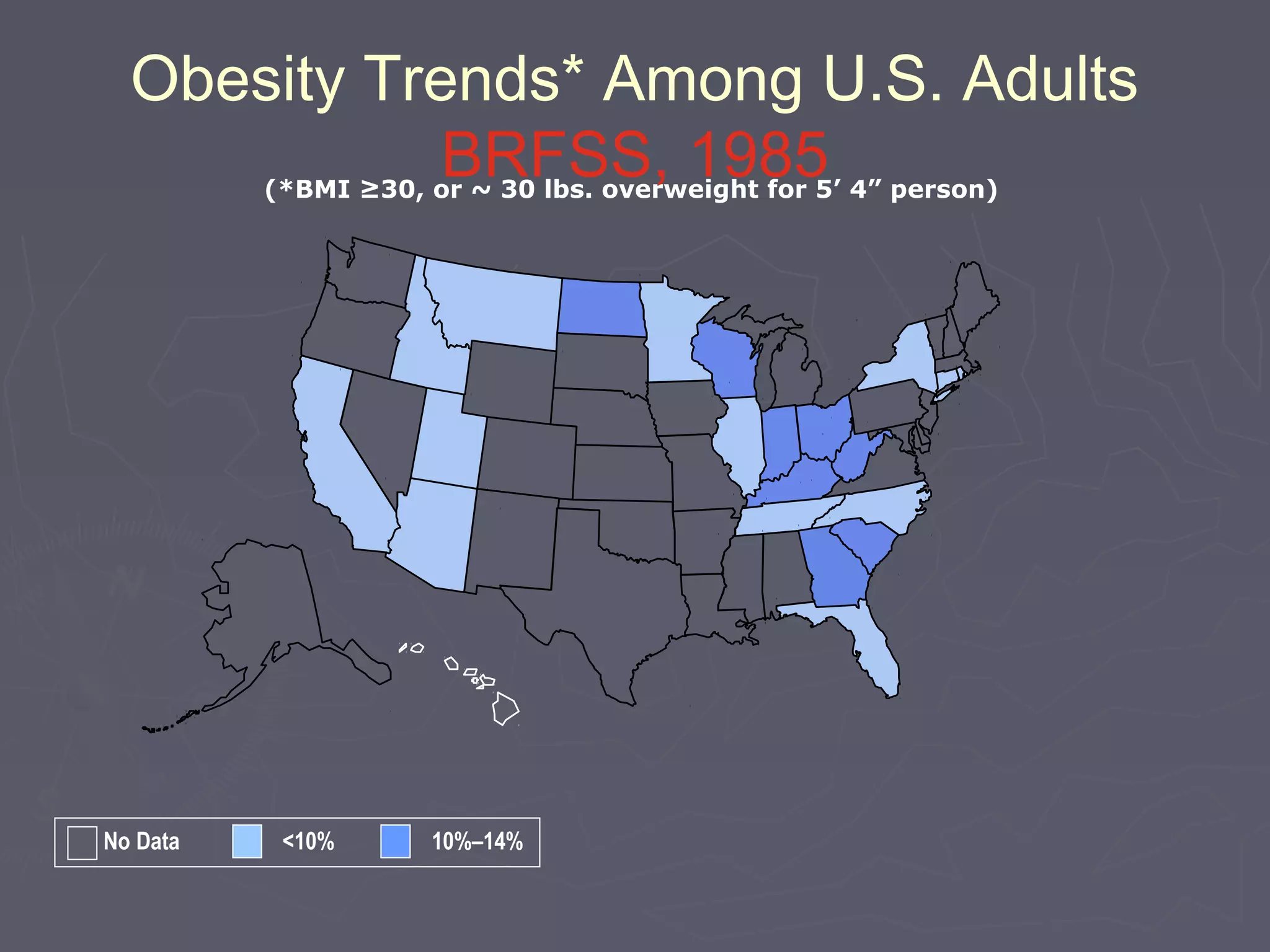
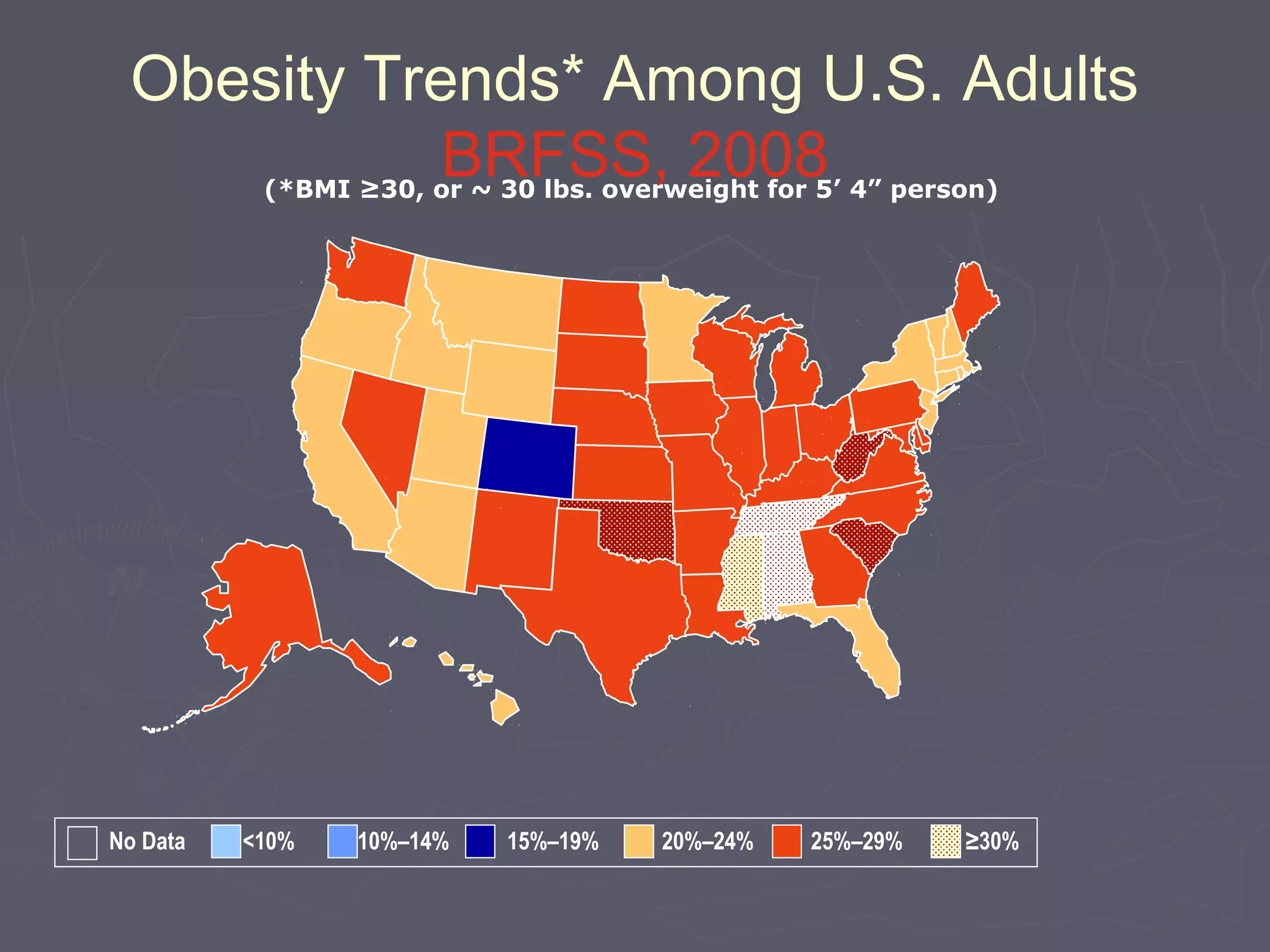
Obesity Trends* Among U.S. Adults
BRFSS, 1985(*BMI ≥30, or ~ 30 lbs. overweight for 5’ 4” person)
No Data <10% 10%–14%
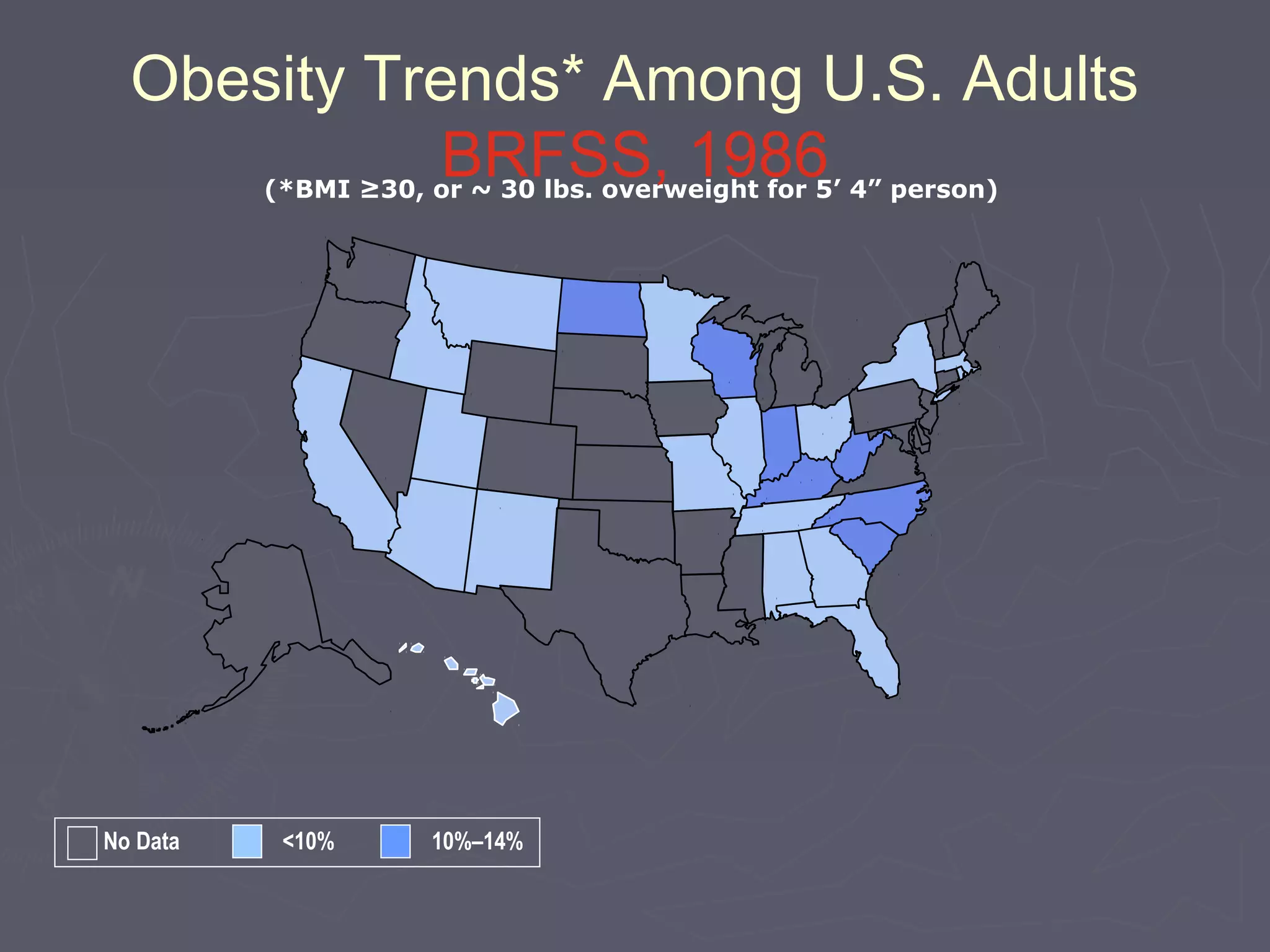
Obesity Trends* Among U.S. Adults
BRFSS, 1986(*BMI ≥30, or ~ 30 lbs. overweight for 5’ 4” person)
No Data <10% 10%–14%
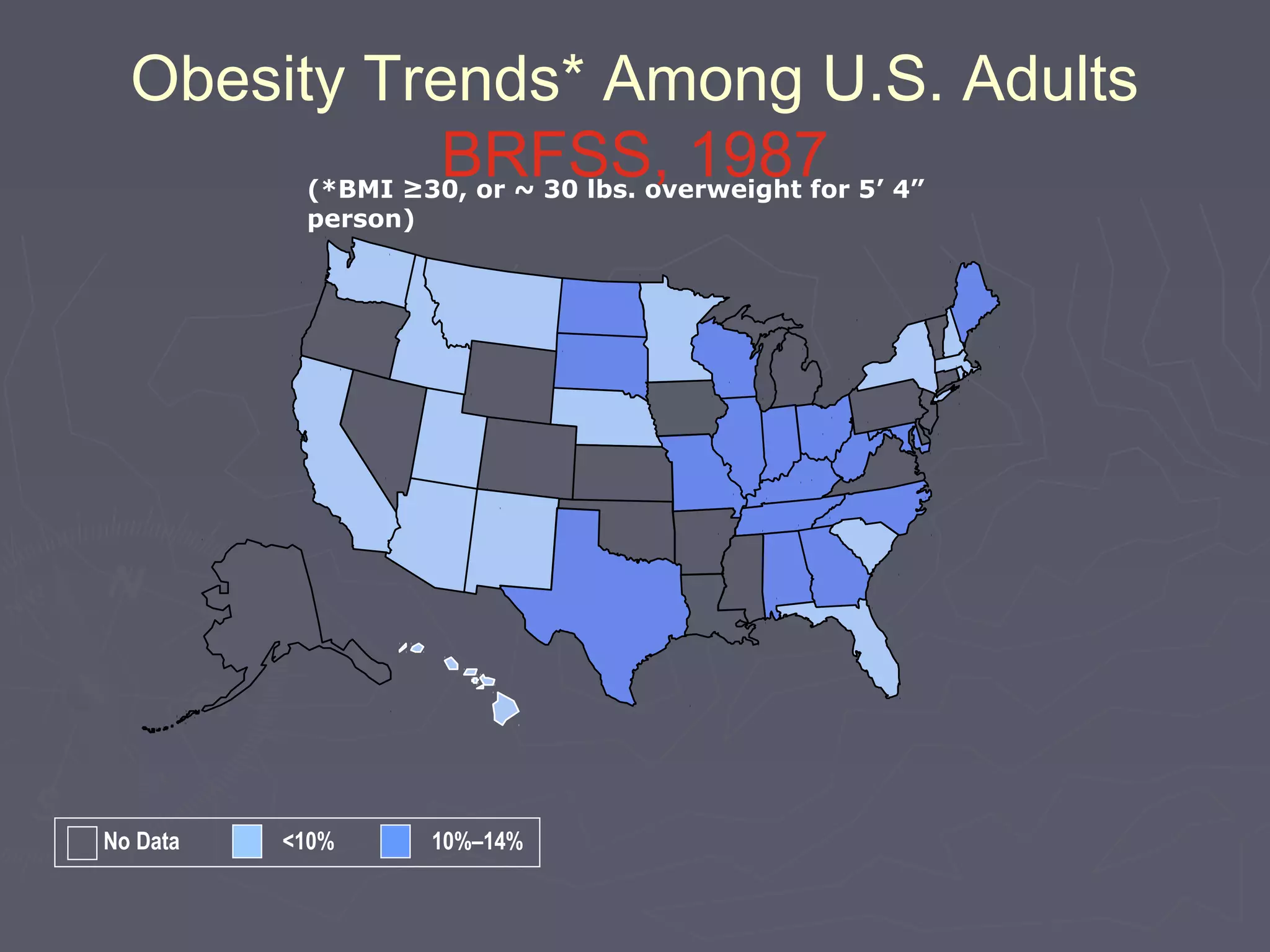
Obesity Trends* Among U.S. Adults
BRFSS, 1987(*BMI ≥30, or ~ 30 lbs. overweight for 5’ 4”
person)
No Data <10% 10%–14%
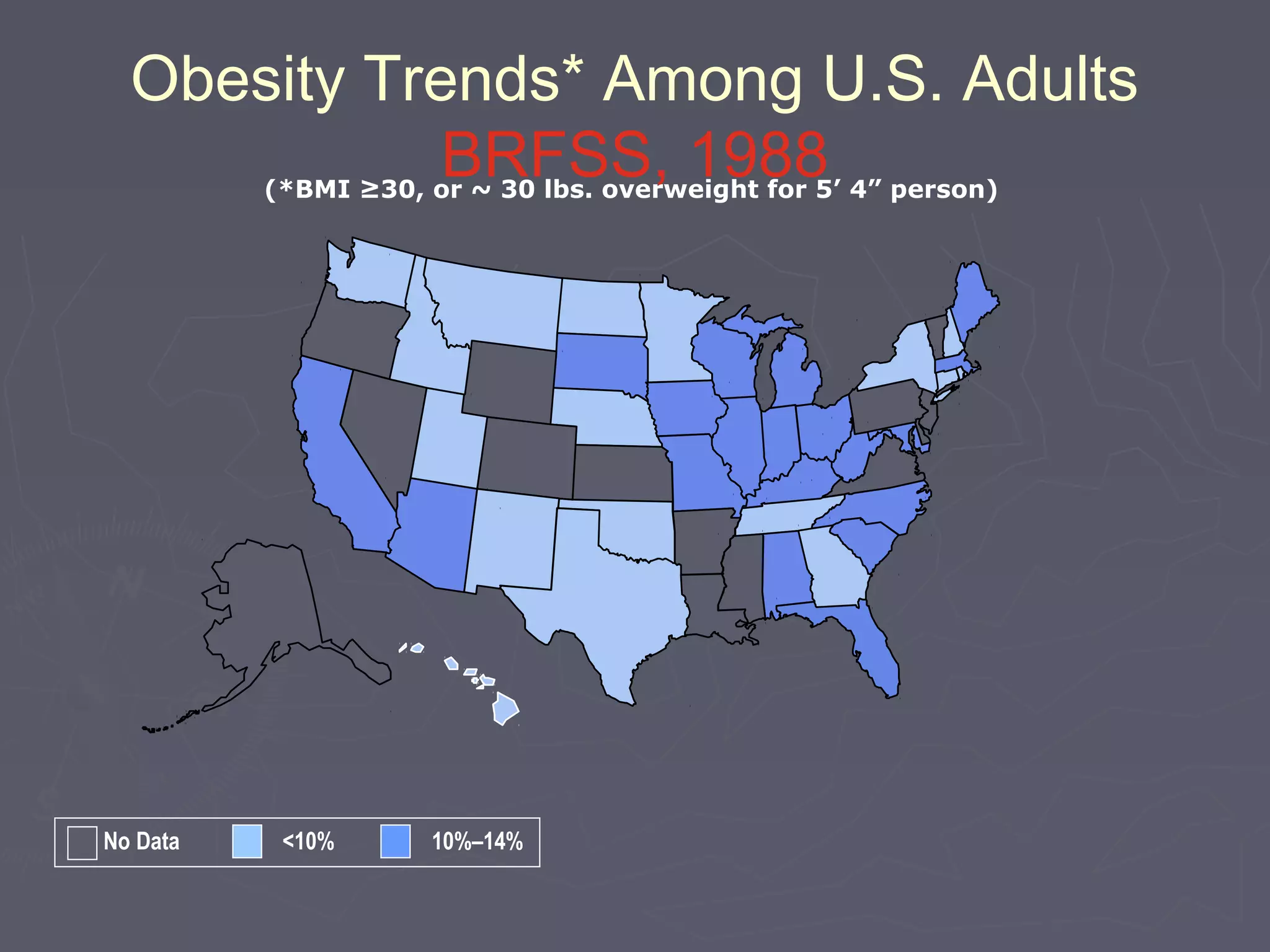
Obesity Trends* Among U.S. Adults
BRFSS, 1988(*BMI ≥30, or ~ 30 lbs. overweight for 5’ 4” person)
No Data <10% 10%–14%
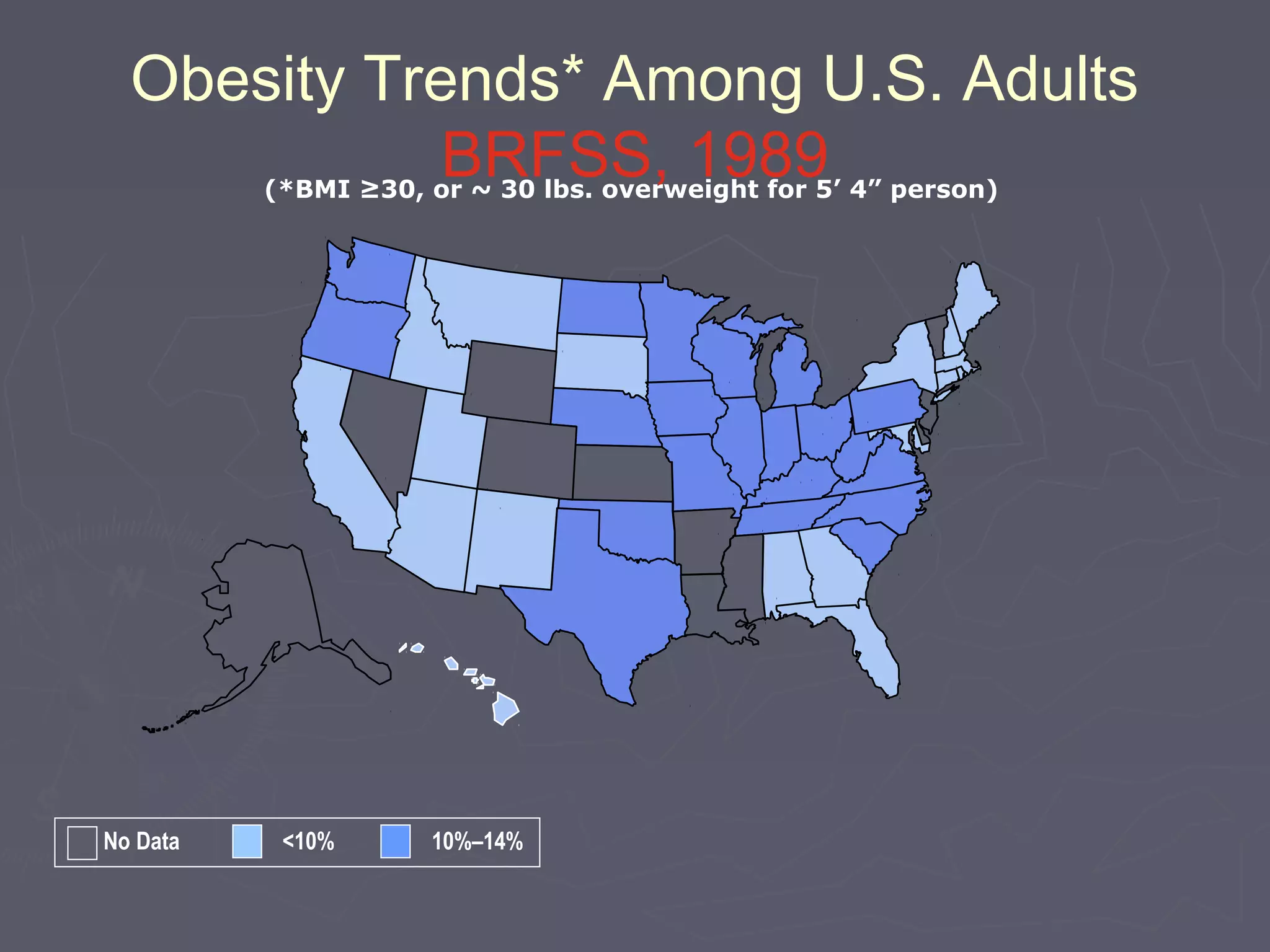
Obesity Trends* Among U.S. Adults
BRFSS, 1989(*BMI ≥30, or ~ 30 lbs. overweight for 5’ 4” person)
No Data <10% 10%–14%
Obesity Trends* Among U.S. Adults
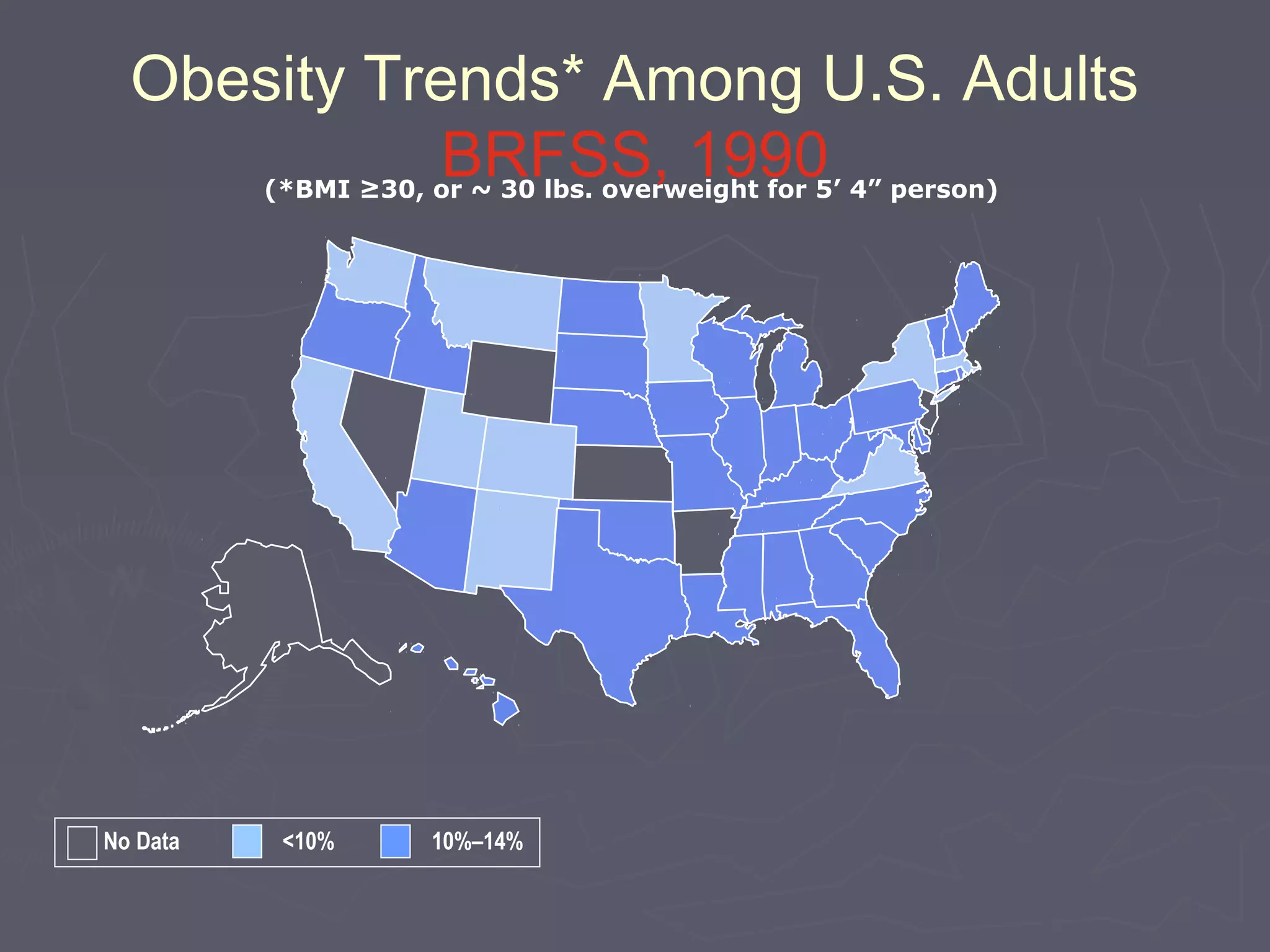
BRFSS, 1990(*BMI ≥30, or ~ 30 lbs. overweight for 5’ 4” person)
No Data <10% 10%–14%
Obesity Trends* Among U.S. Adults
BRFSS, 1991(*BMI ≥30, or ~ 30 lbs. overweight for 5’ 4” person)
No Data <10% 10%–14% 15%–19%
Obesity Trends* Among U.S. Adults
BRFSS, 1992(*BMI ≥30, or ~ 30 lbs. overweight for 5’ 4” person)
No Data <10% 10%–14% 15%–19%
Obesity Trends* Among U.S. Adults
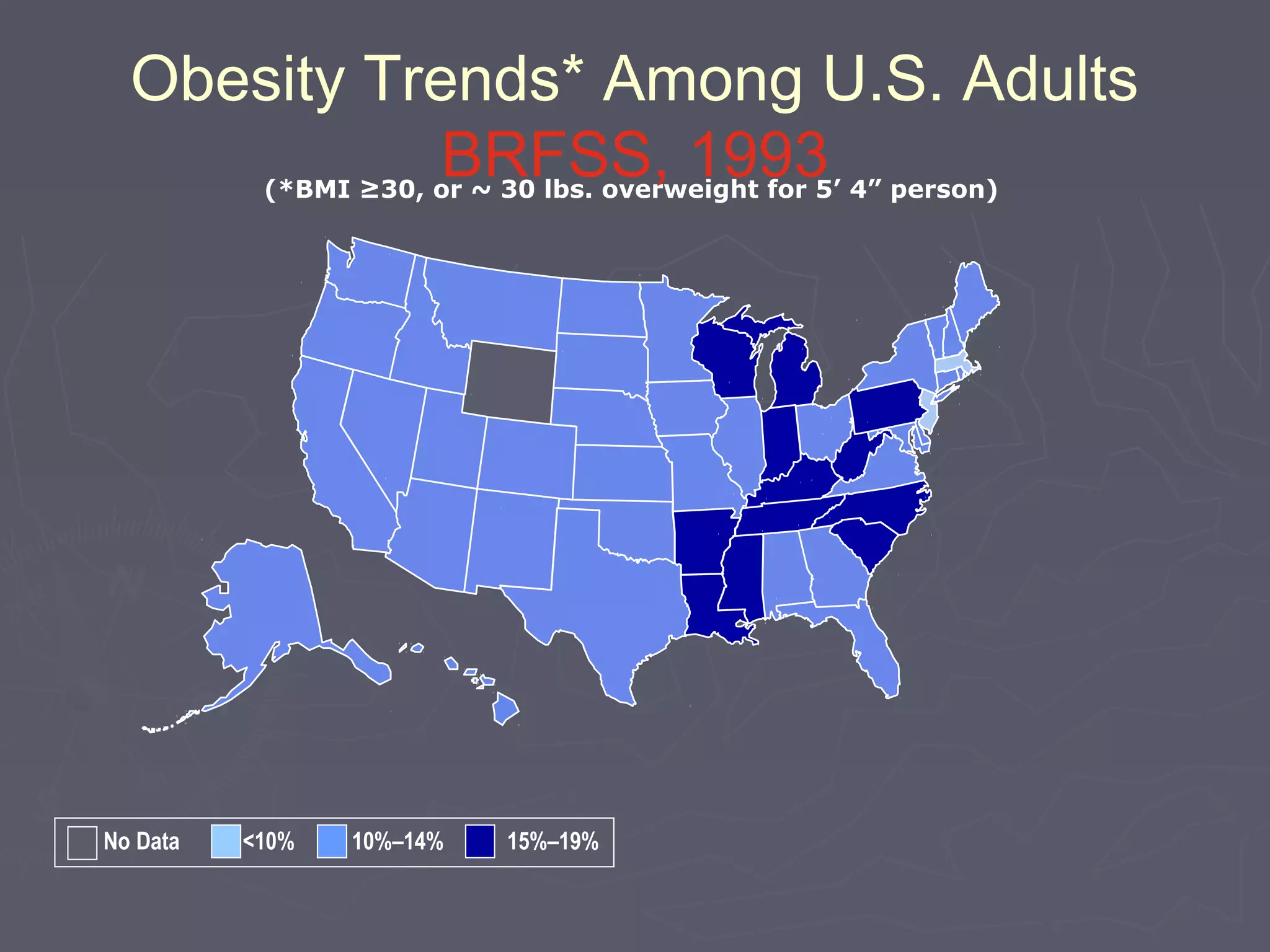
BRFSS, 1993(*BMI ≥30, or ~ 30 lbs. overweight for 5’ 4” person)
No Data <10% 10%–14% 15%–19%
Obesity Trends* Among U.S. Adults
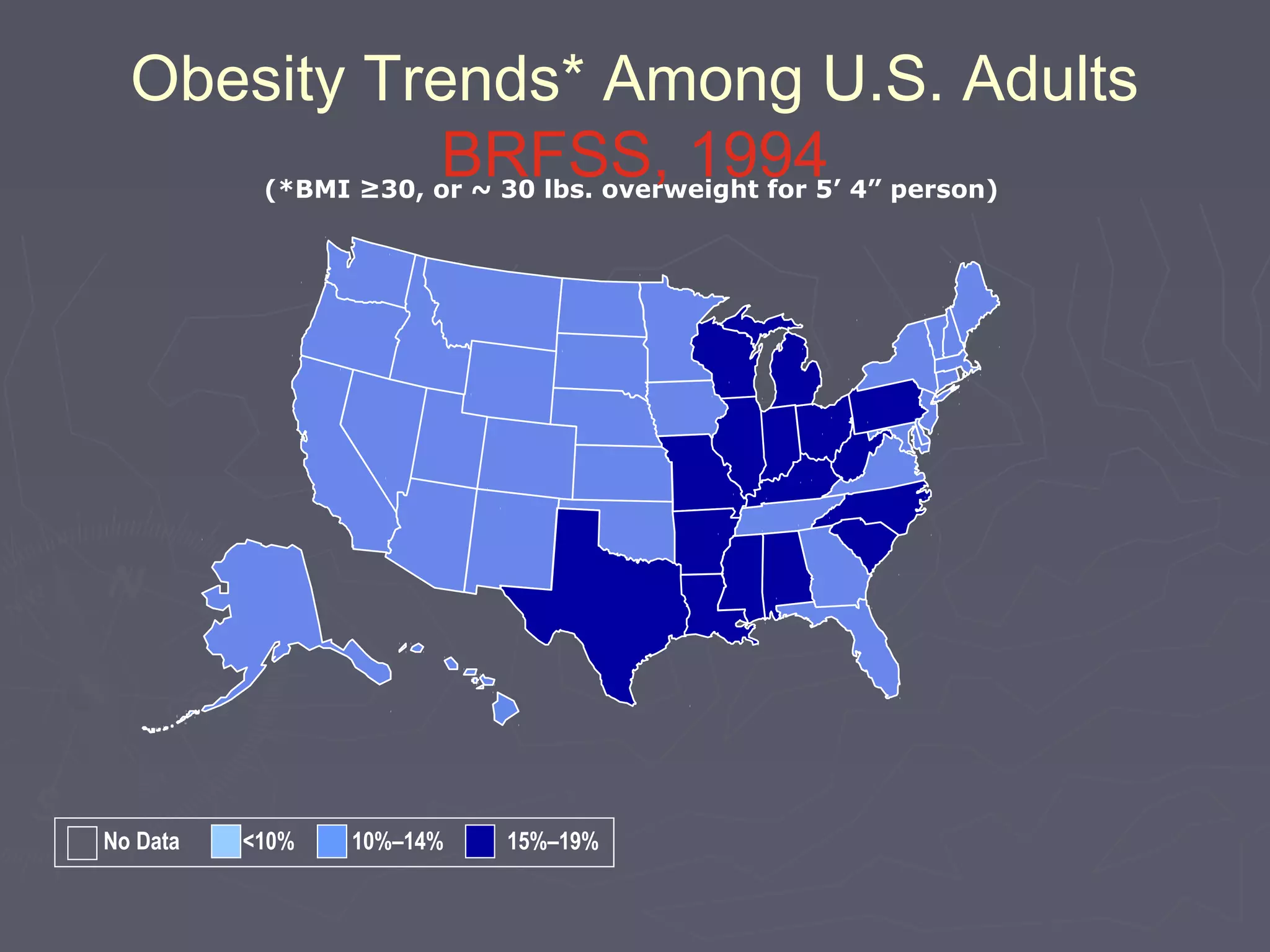
BRFSS, 1994(*BMI ≥30, or ~ 30 lbs. overweight for 5’ 4” person)
No Data <10% 10%–14% 15%–19%
Obesity Trends* Among U.S. Adults
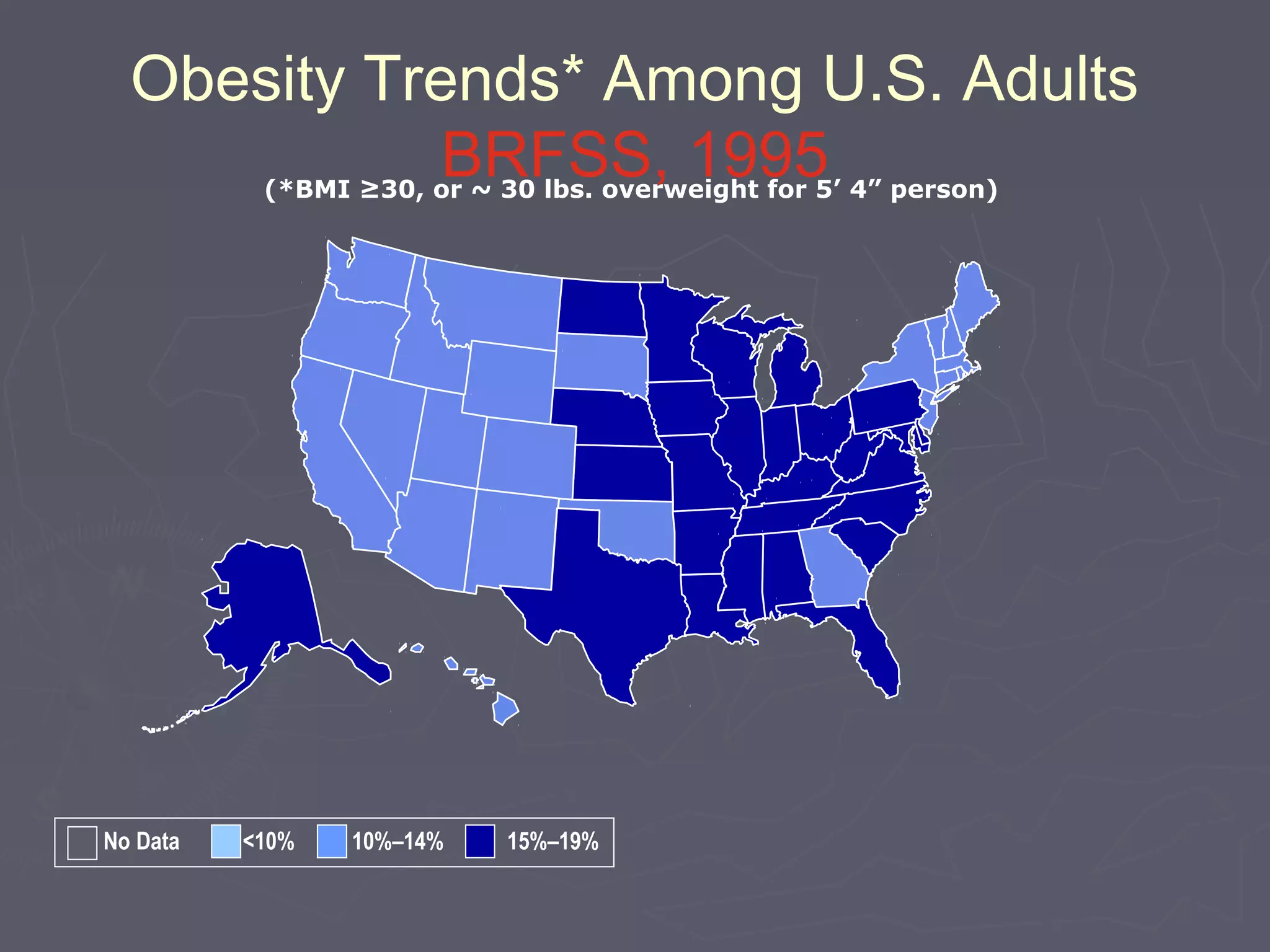
BRFSS, 1995(*BMI ≥30, or ~ 30 lbs. overweight for 5’ 4” person)
No Data <10% 10%–14% 15%–19%
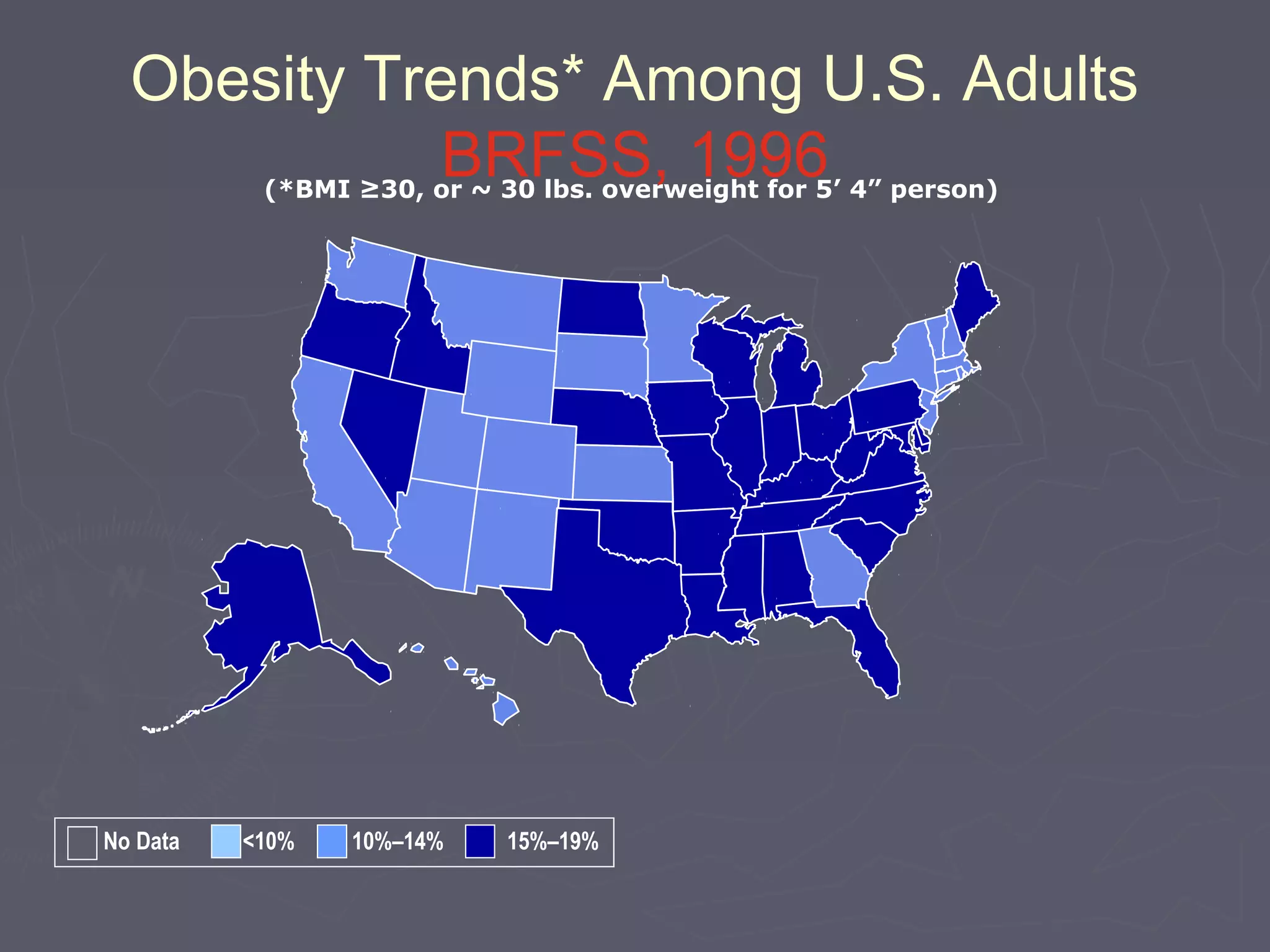
Obesity Trends* Among U.S. Adults
BRFSS, 1996(*BMI ≥30, or ~ 30 lbs. overweight for 5’ 4” person)
No Data <10% 10%–14% 15%–19%
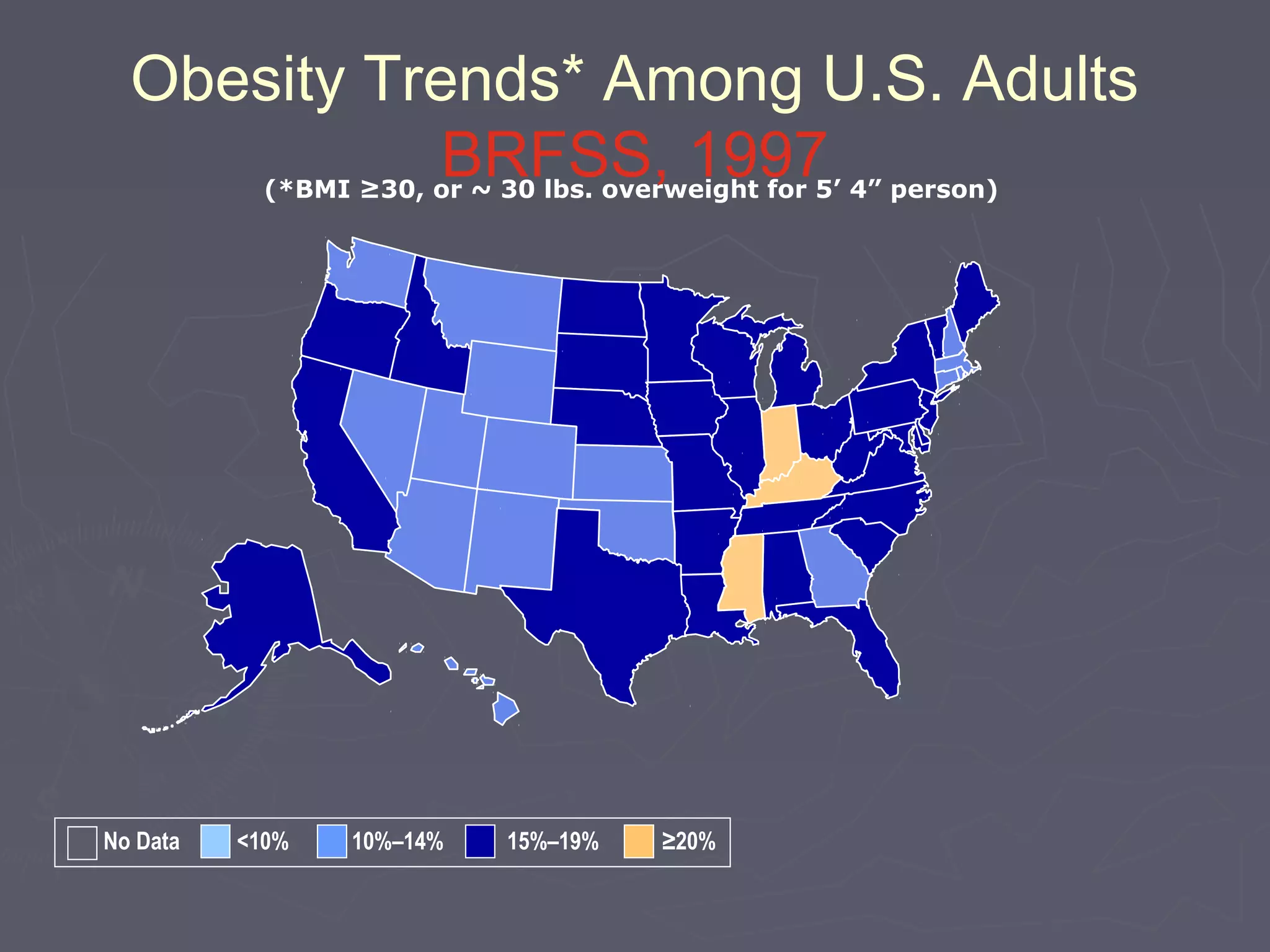
Obesity Trends* Among U.S. Adults
BRFSS, 1997(*BMI ≥30, or ~ 30 lbs. overweight for 5’ 4” person)
No Data <10% 10%–14% 15%–19% ≥20%
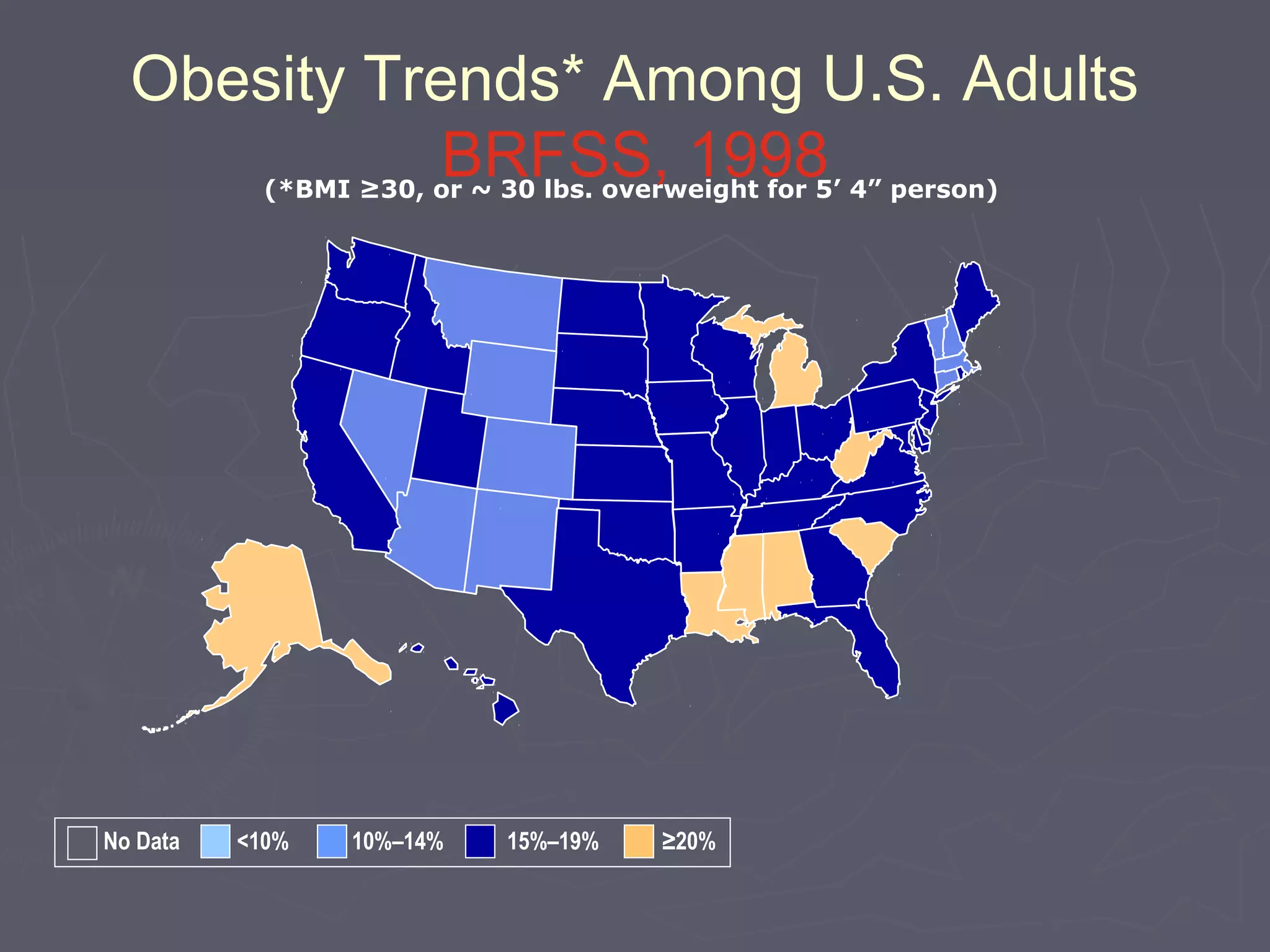
Obesity Trends* Among U.S. Adults
BRFSS, 1998(*BMI ≥30, or ~ 30 lbs. overweight for 5’ 4” person)
No Data <10% 10%–14% 15%–19% ≥20%
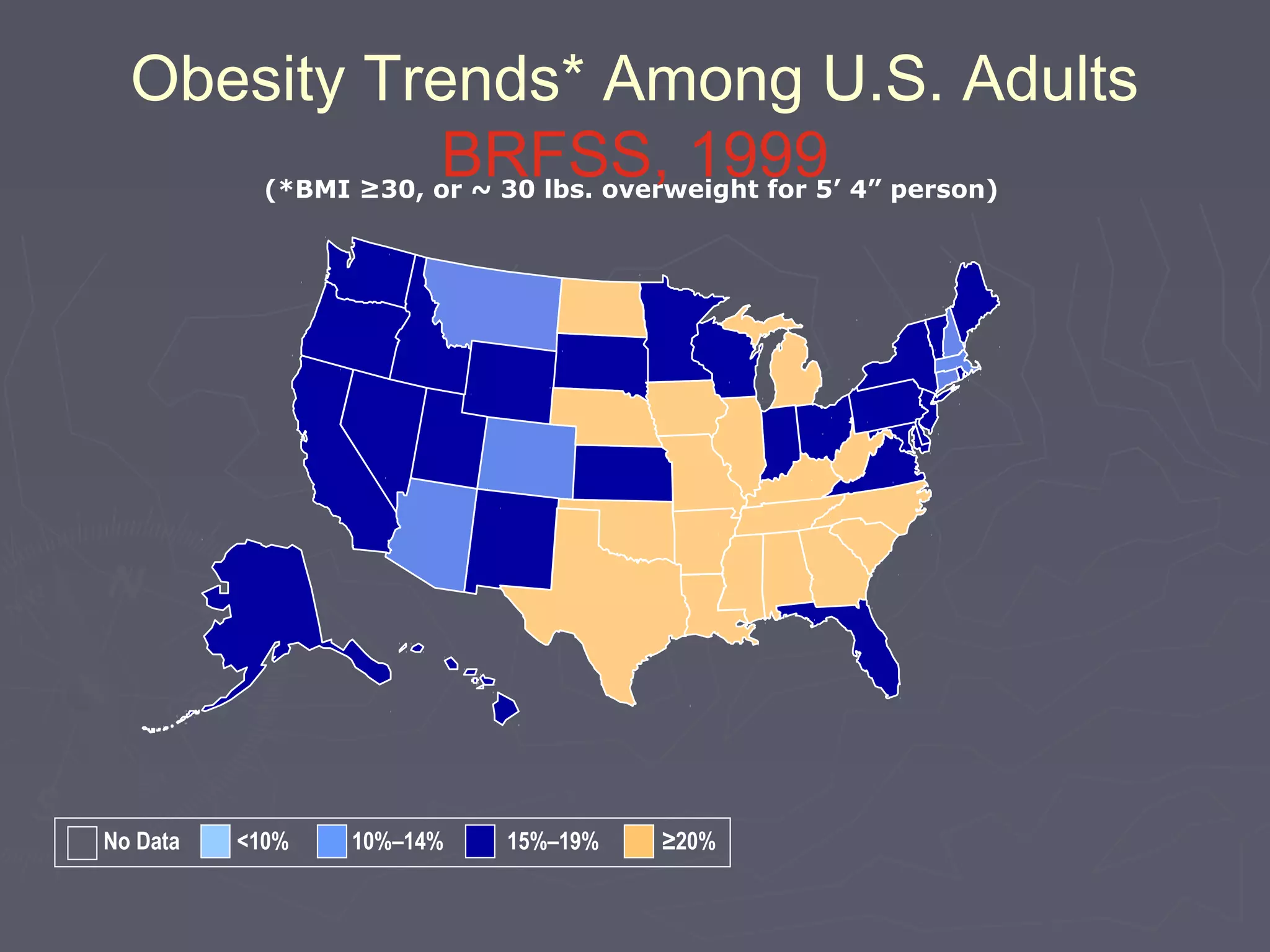
Obesity Trends* Among U.S. Adults
BRFSS, 1999(*BMI ≥30, or ~ 30 lbs. overweight for 5’ 4” person)
No Data <10% 10%–14% 15%–19% ≥20%
Obesity Trends* Among U.S. Adults
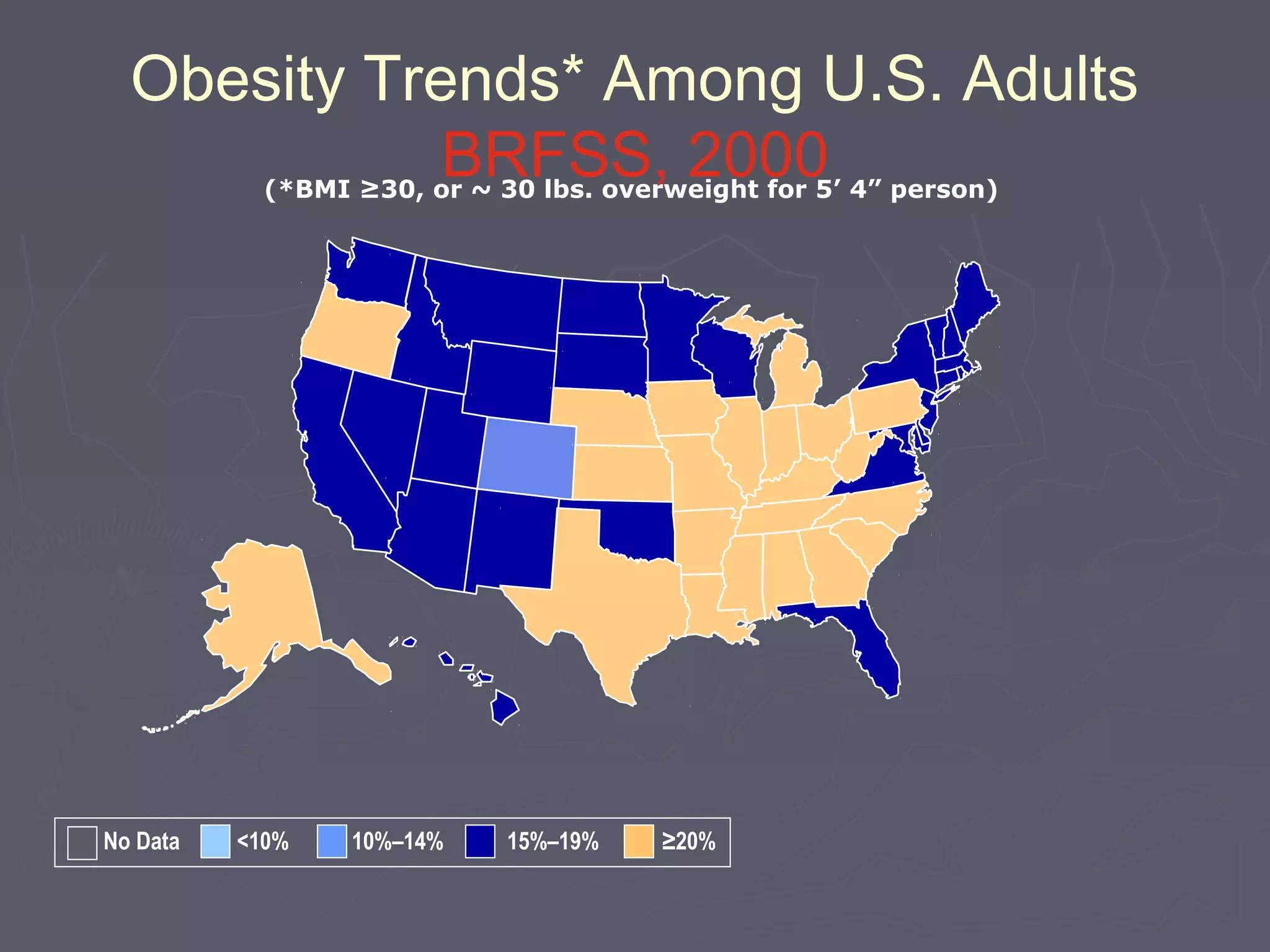
BRFSS, 2000(*BMI ≥30, or ~ 30 lbs. overweight for 5’ 4” person)
No Data <10% 10%–14% 15%–19% ≥20%
Obesity Trends* Among U.S. Adults
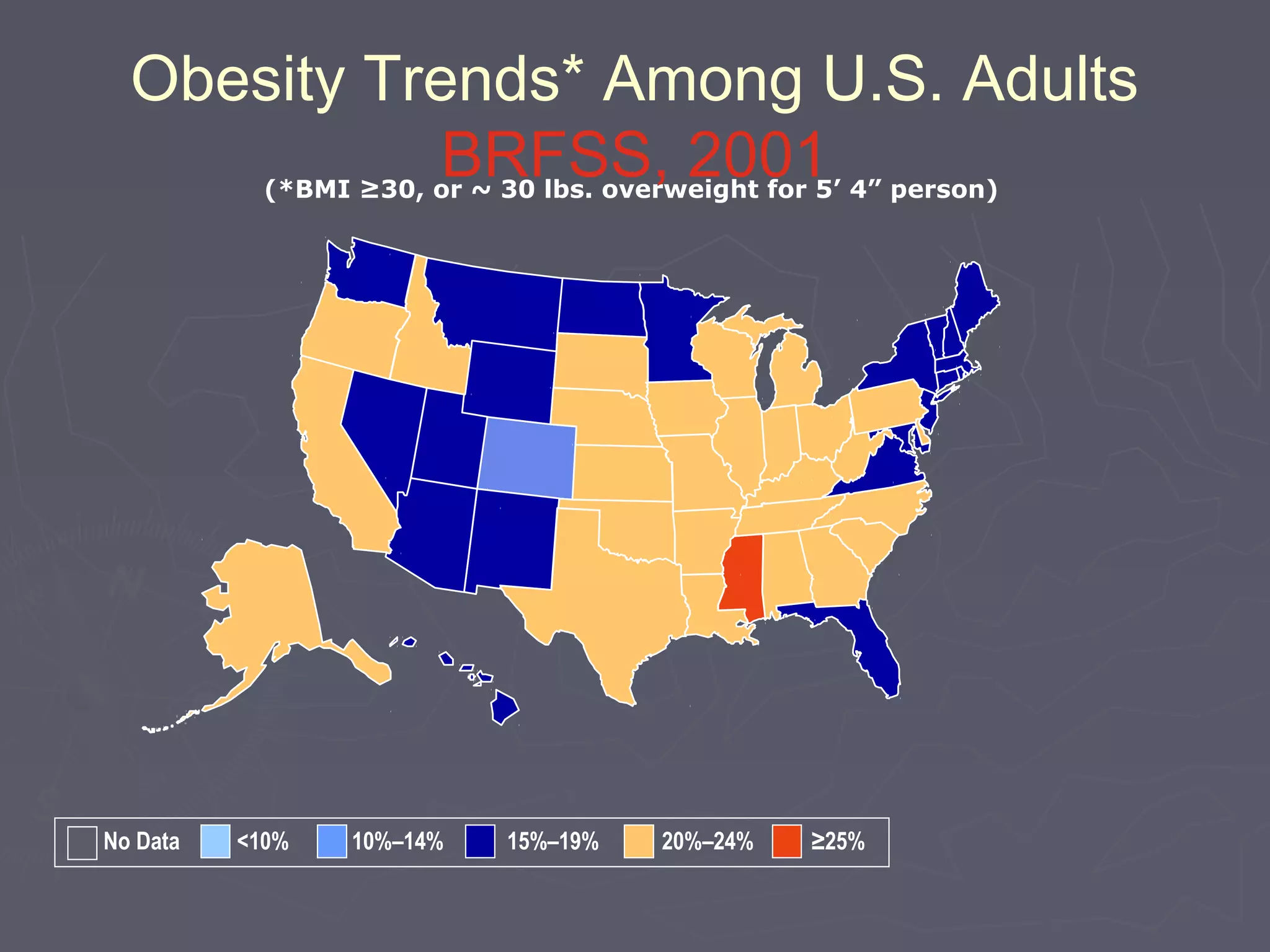
BRFSS, 2001(*BMI ≥30, or ~ 30 lbs. overweight for 5’ 4” person)
No Data <10% 10%–14% 15%–19% 20%–24% ≥25%
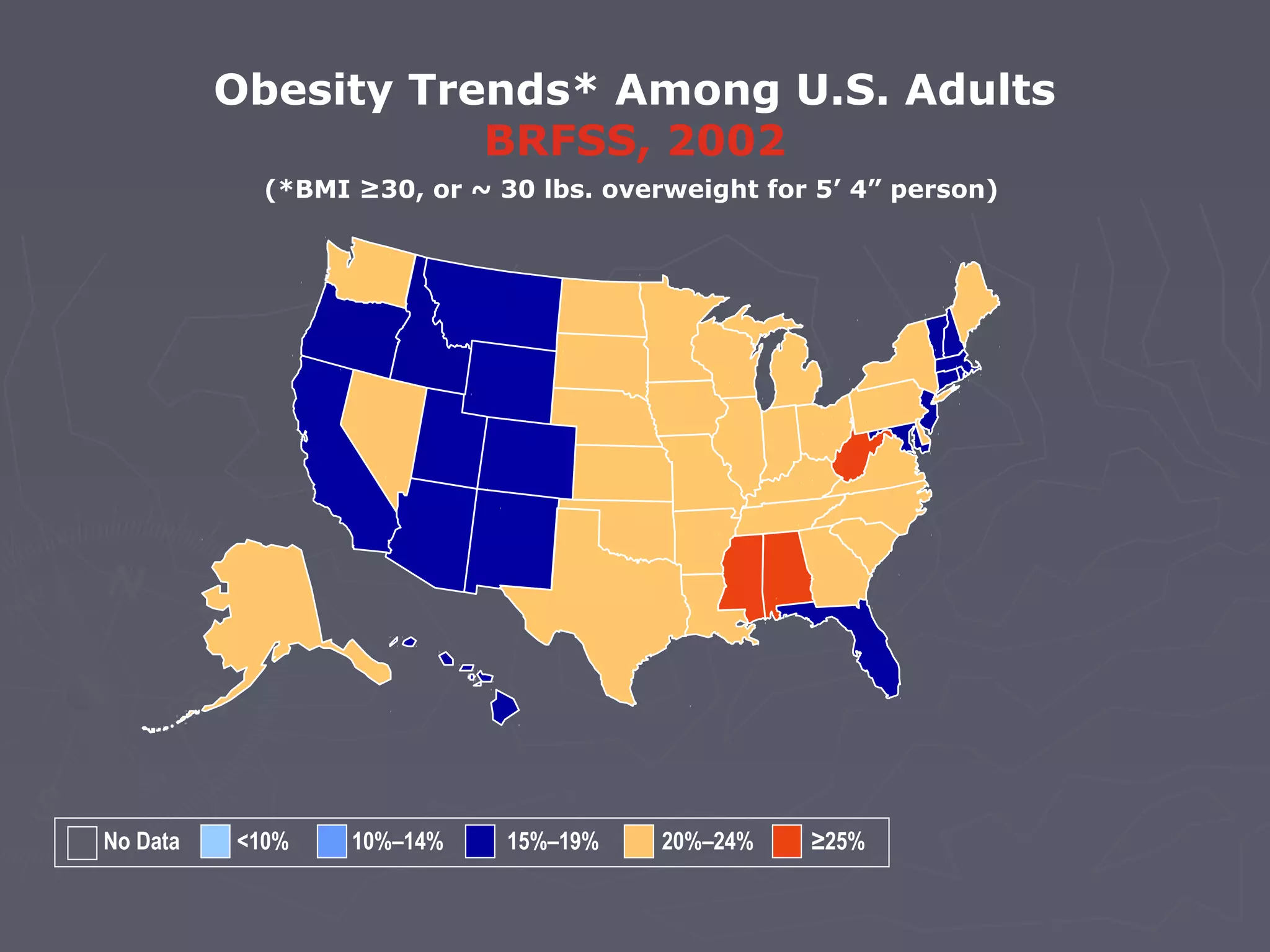
(*BMI ≥30, or ~ 30 lbs. overweight for 5’ 4” person)
Obesity Trends* Among U.S. Adults
BRFSS, 2002
No Data <10% 10%–14% 15%–19% 20%–24% ≥25%
Obesity Trends* Among U.S. Adults
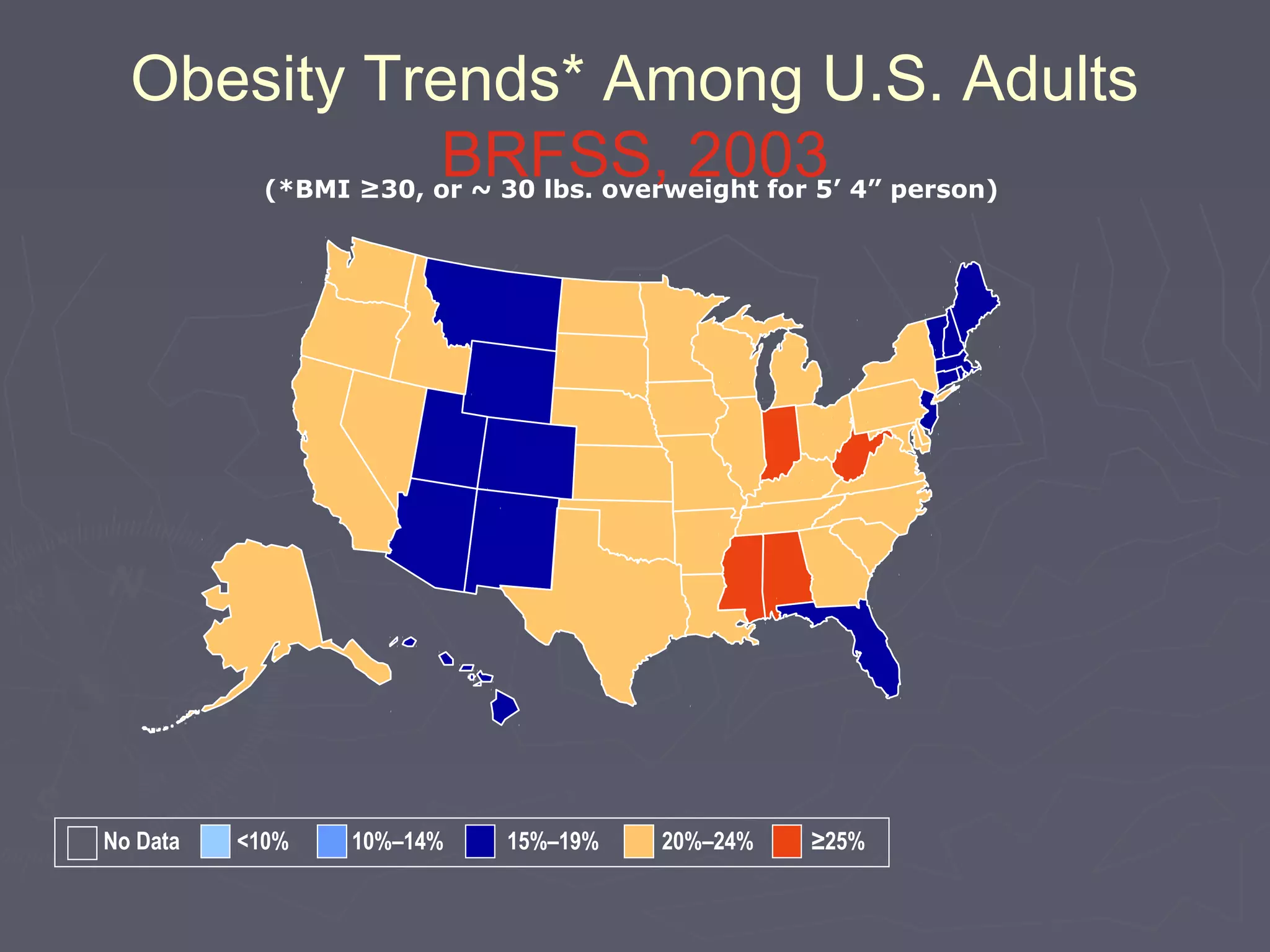
BRFSS, 2003(*BMI ≥30, or ~ 30 lbs. overweight for 5’ 4” person)
No Data <10% 10%–14% 15%–19% 20%–24% ≥25%
Obesity Trends* Among U.S. Adults
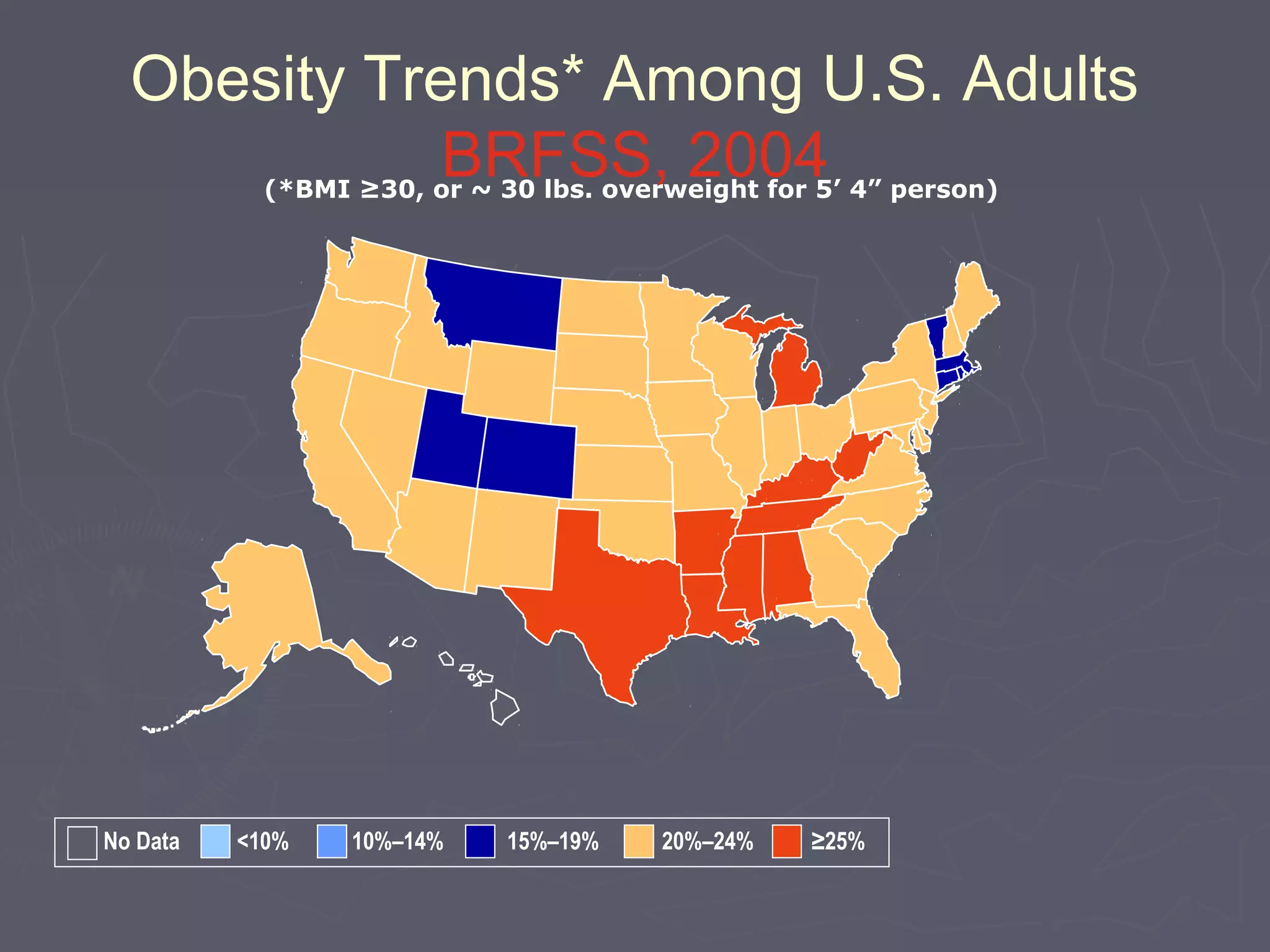
BRFSS, 2004(*BMI ≥30, or ~ 30 lbs. overweight for 5’ 4” person)
No Data <10% 10%–14% 15%–19% 20%–24% ≥25%
Obesity Trends* Among U.S. Adults
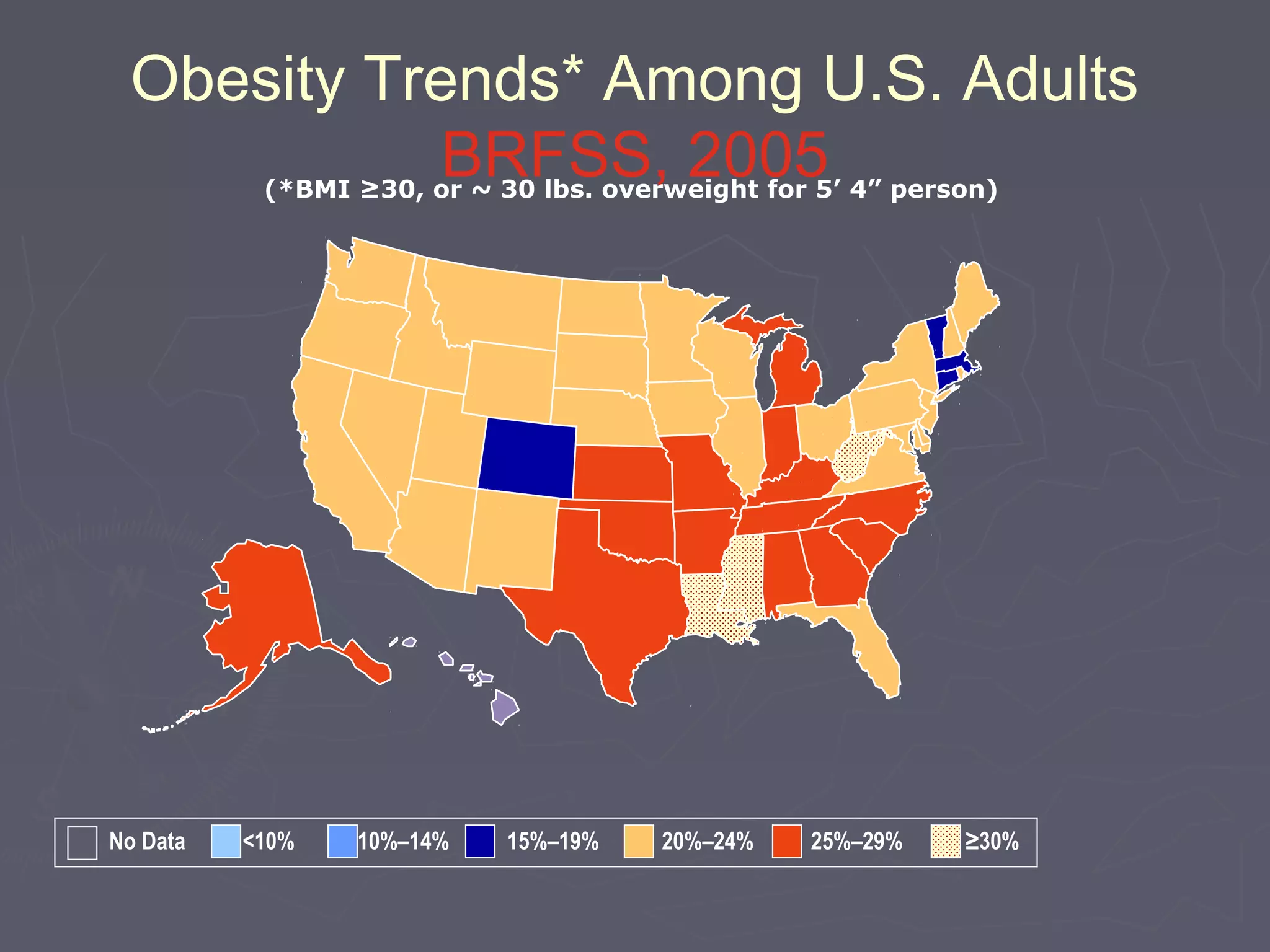
BRFSS, 2005(*BMI ≥30, or ~ 30 lbs. overweight for 5’ 4” person)
No Data <10% 10%–14% 15%–19% 20%–24% 25%–29% ≥30%
Obesity Trends* Among U.S. Adults
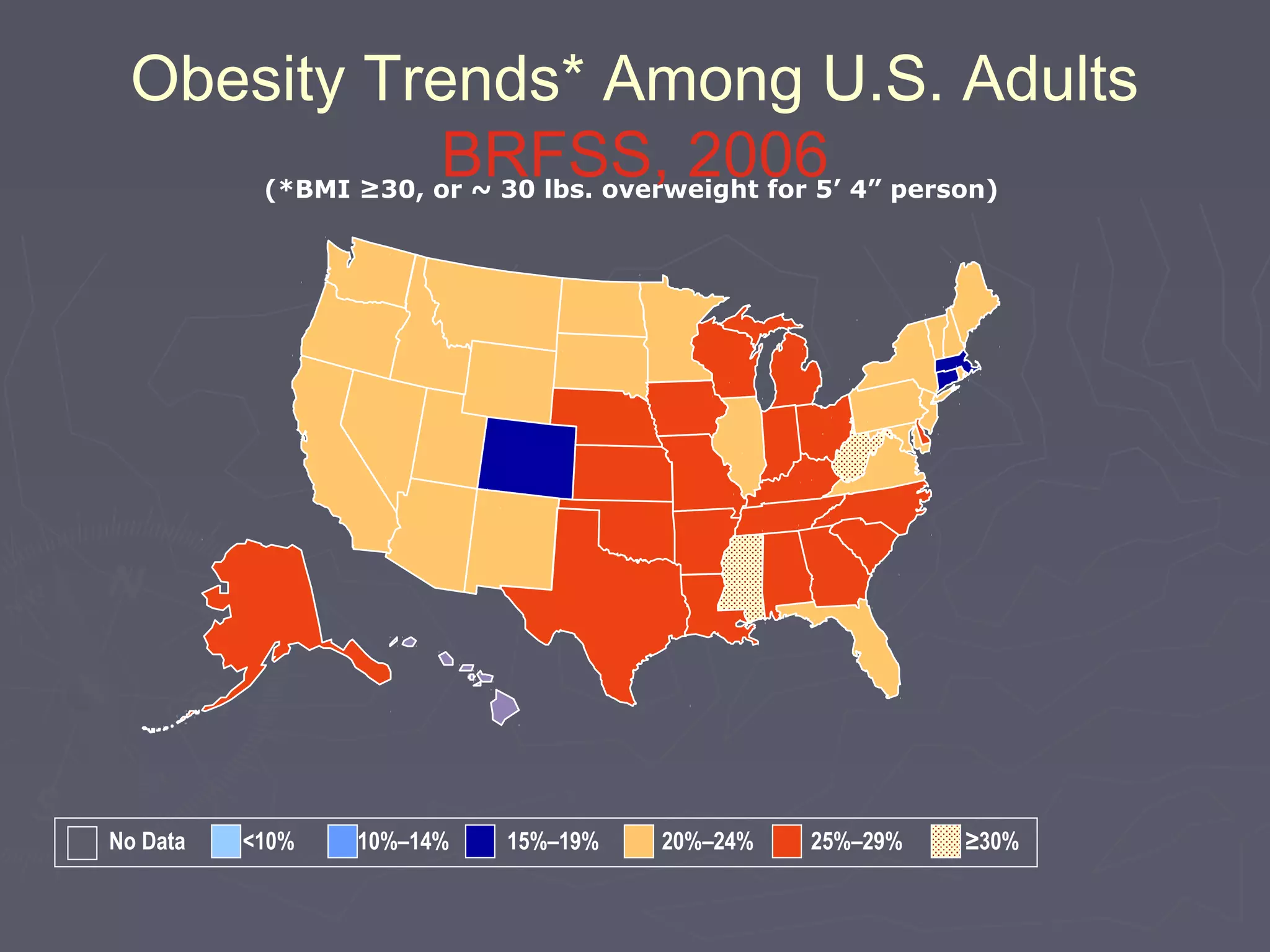
BRFSS, 2006(*BMI ≥30, or ~ 30 lbs. overweight for 5’ 4” person)
No Data <10% 10%–14% 15%–19% 20%–24% 25%–29% ≥30%
Obesity Trends* Among U.S. Adults
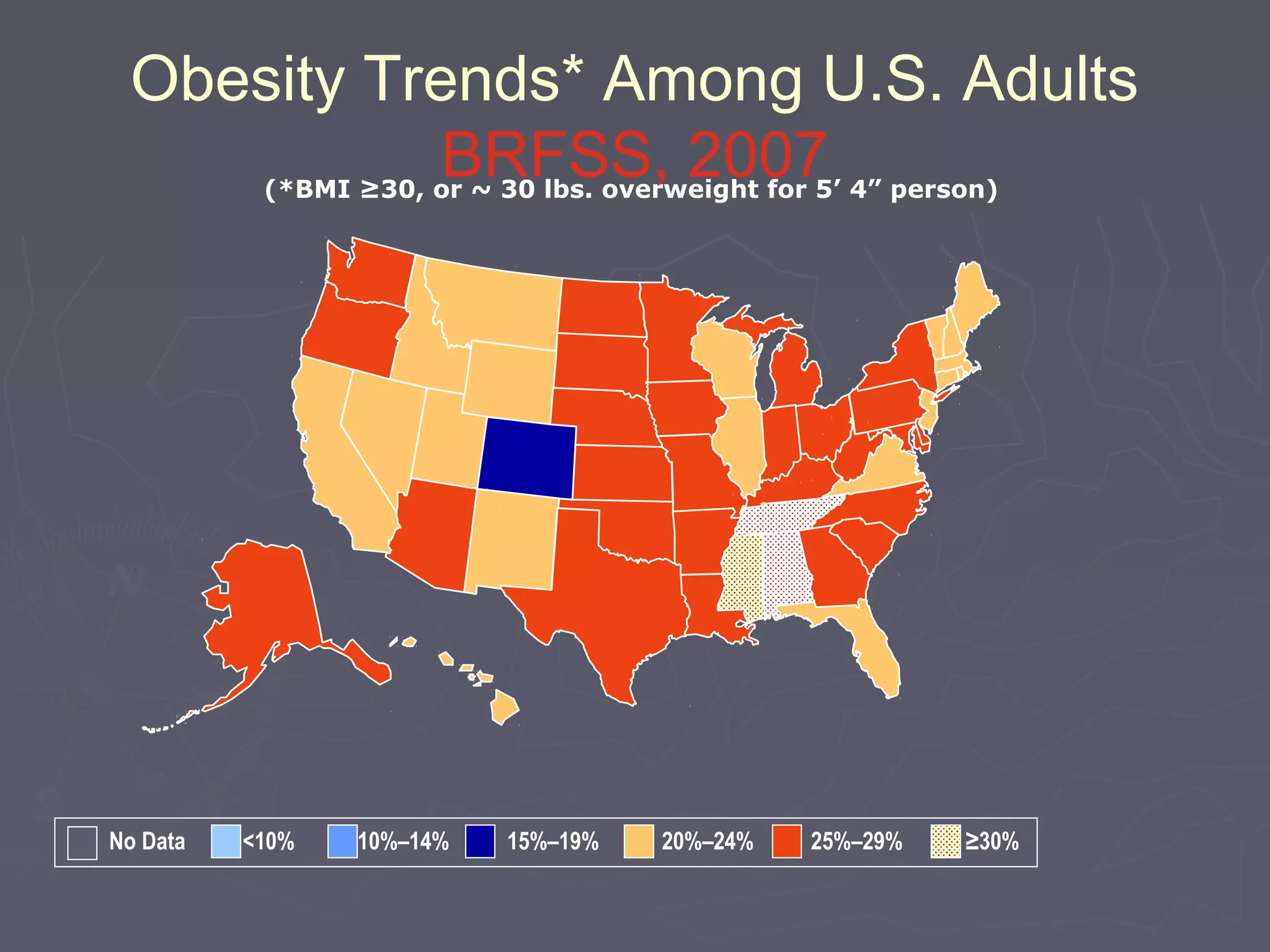
BRFSS, 2007(*BMI ≥30, or ~ 30 lbs. overweight for 5’ 4” person)
No Data <10% 10%–14% 15%–19% 20%–24% 25%–29% ≥30%
Obesity Trends* Among U.S. Adults
BRFSS, 2008(*BMI ≥30, or ~ 30 lbs. overweight for 5’ 4” person)
No Data <10% 10%–14% 15%–19% 20%–24% 25%–29% ≥30%
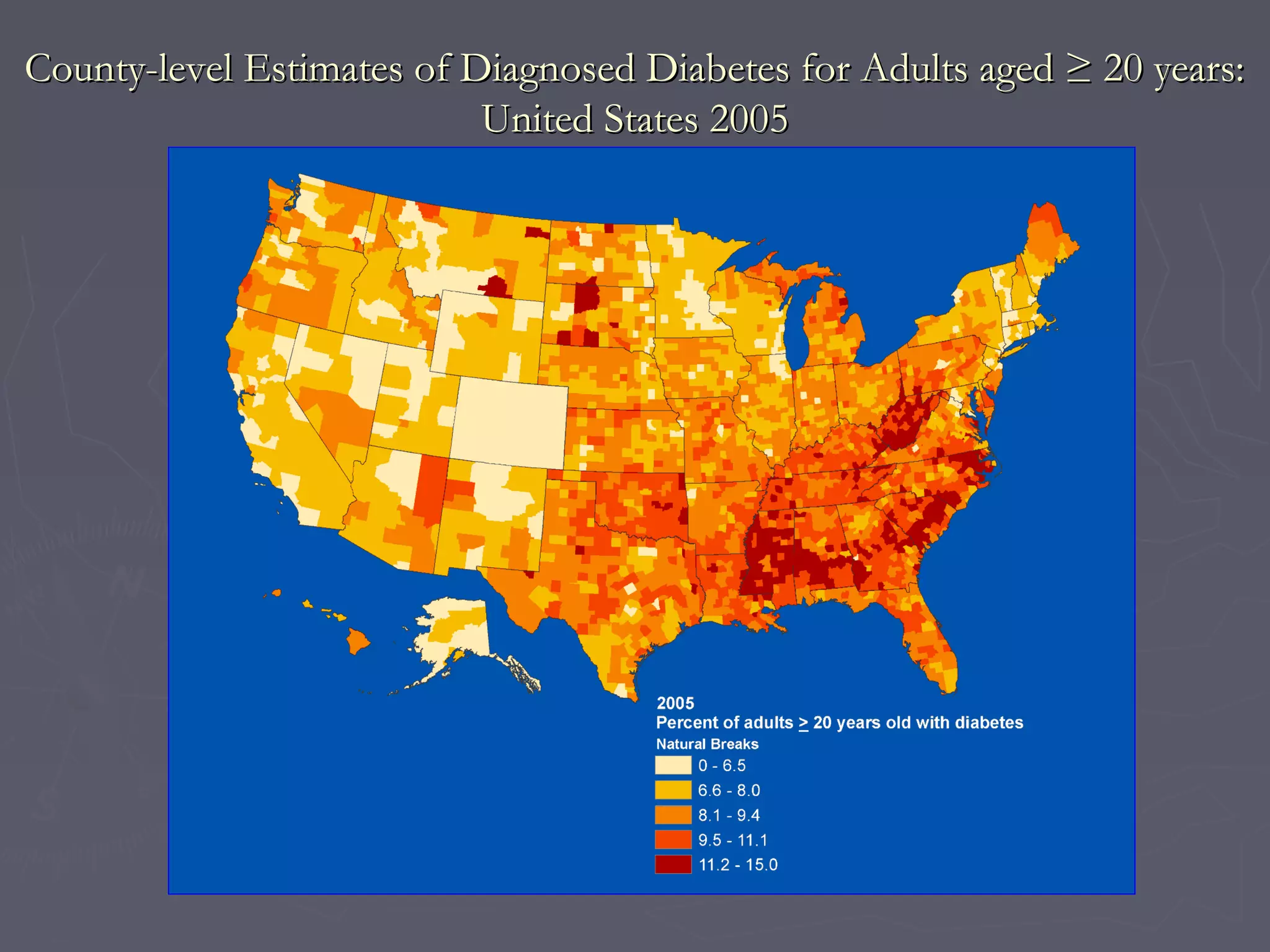
County-level Estimates of Diagnosed Diabetes for Adults aged ≥ 20 years:County-level Estimates of Diagnosed Diabetes for Adults aged ≥ 20 years:
United States 2005United States 2005
Environmental HealthEnvironmental Health
IssuesIssues
Our impact on the environment,Our impact on the environment,
and the environment’s impact onand the environment’s impact on
us.us.
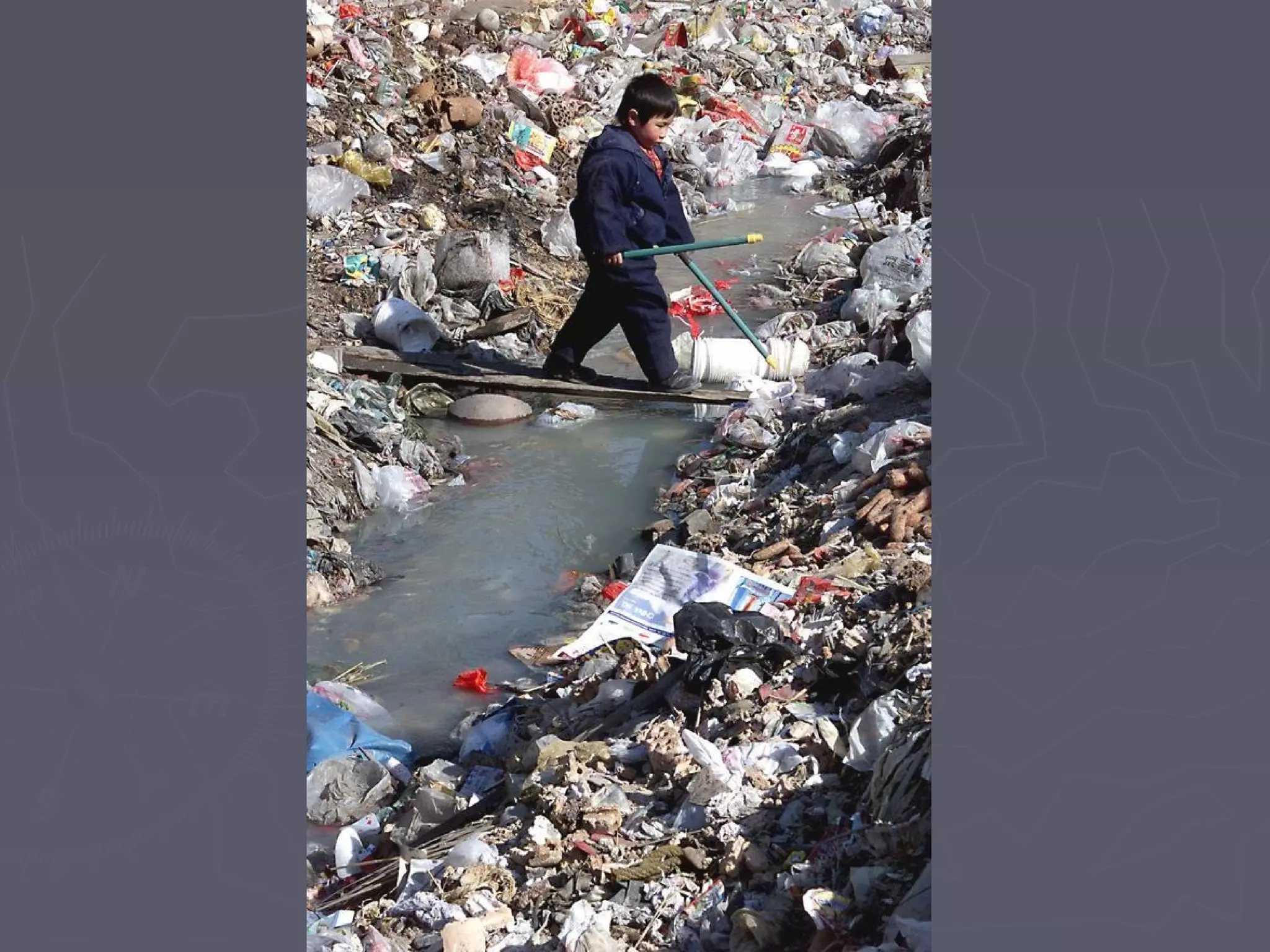
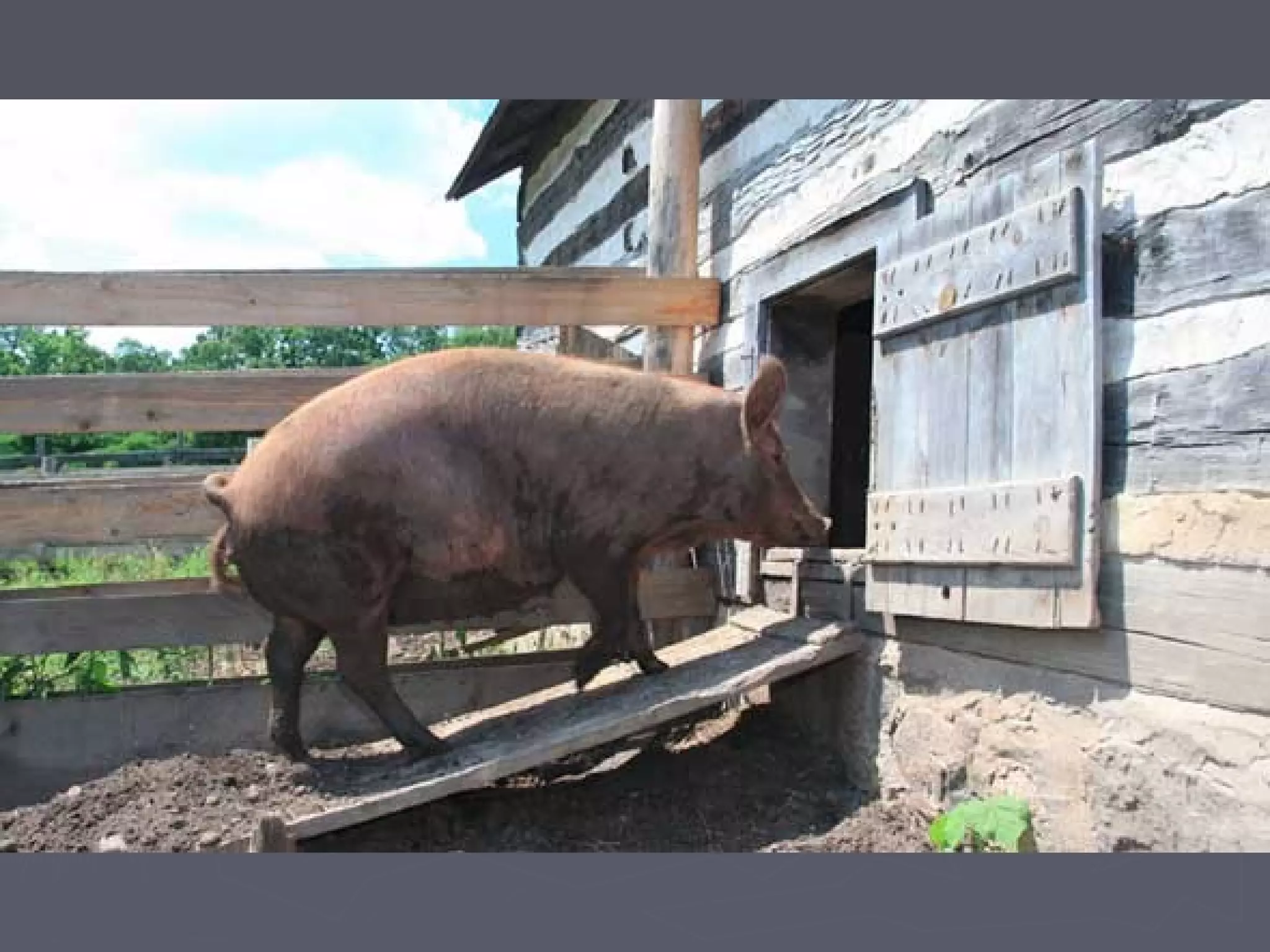
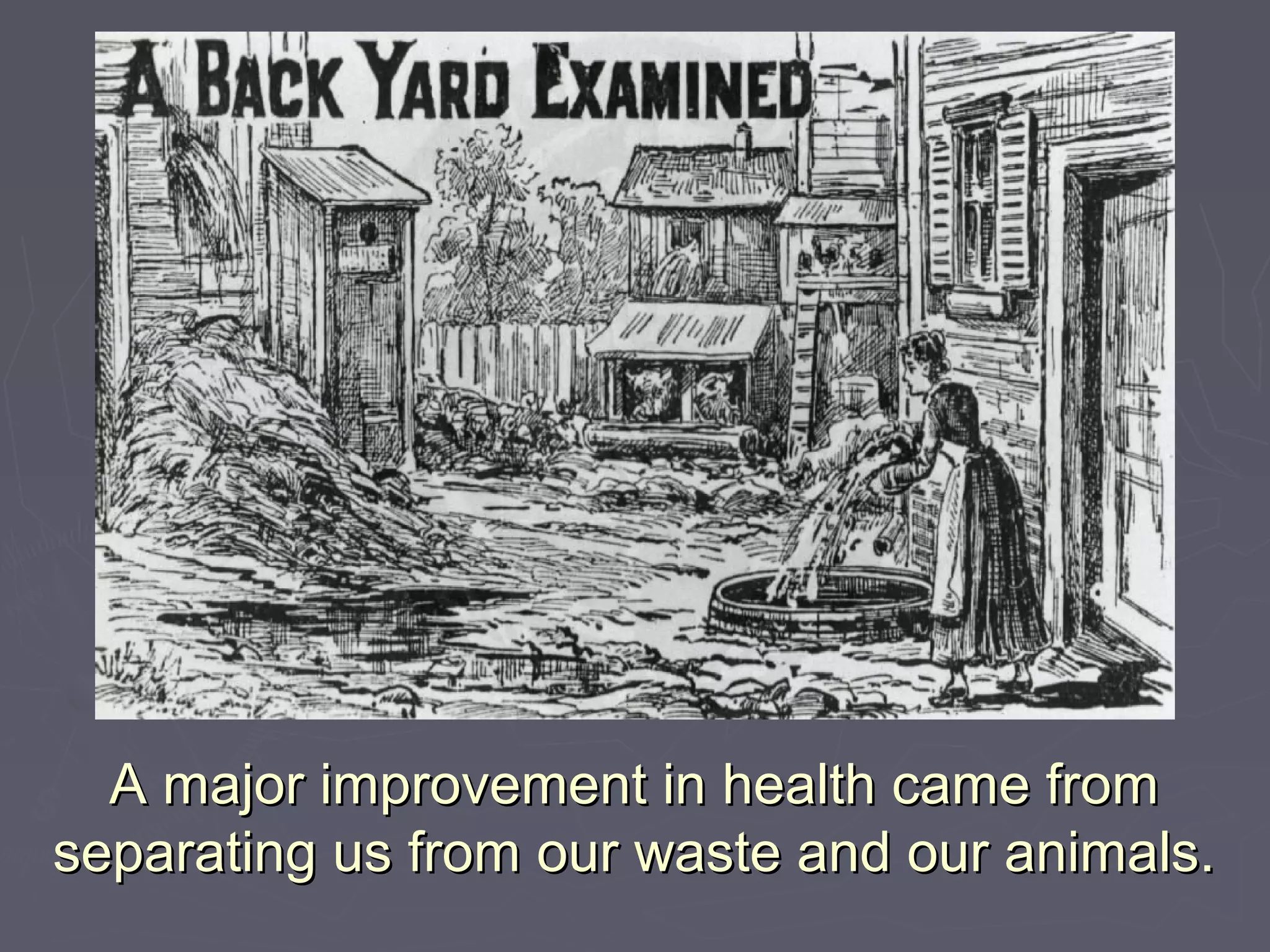
A major improvement in health came fromA major improvement in health came from
separating us from our waste and our animals.separating us from our waste and our animals.
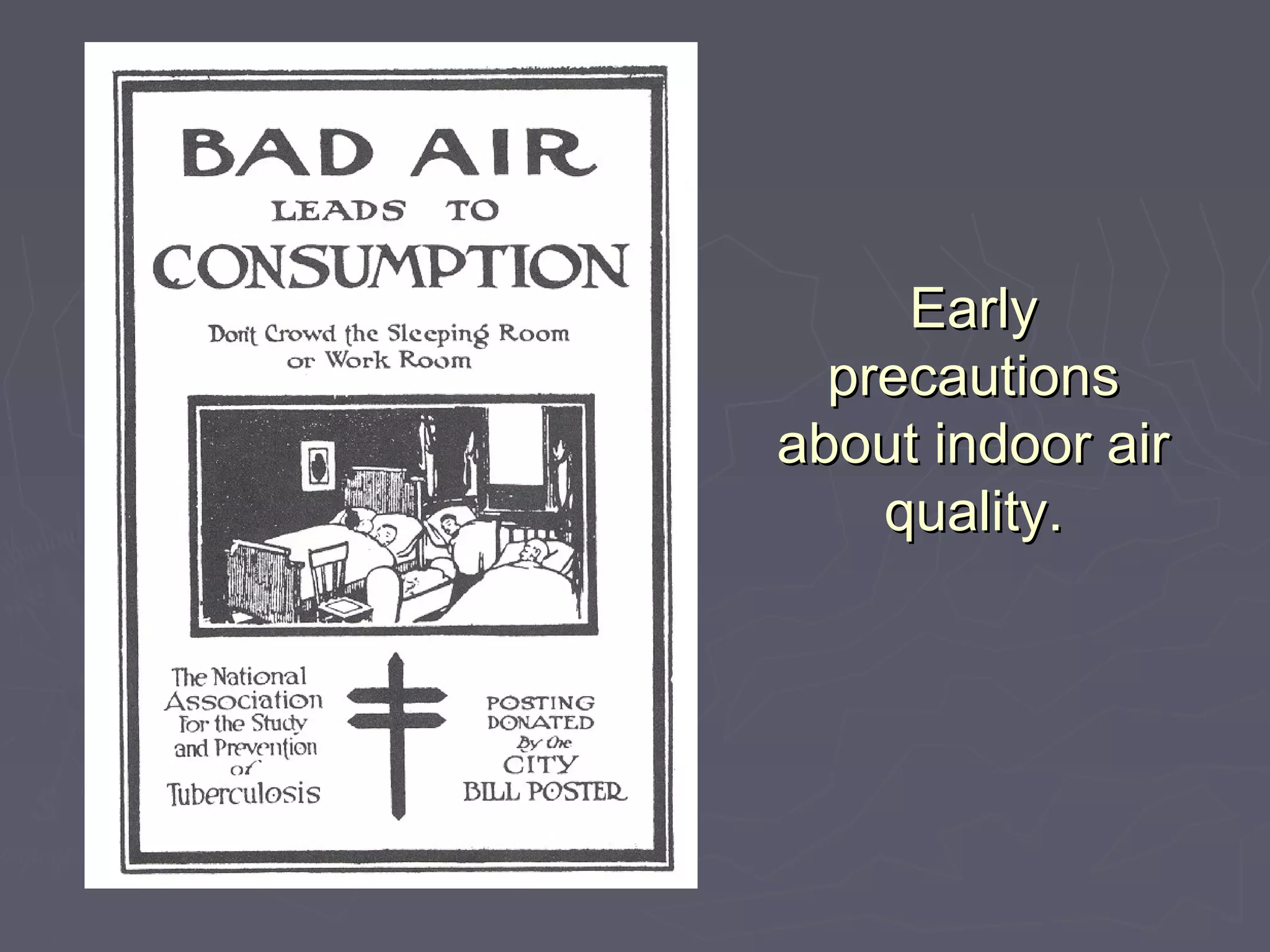
EarlyEarly
precautionsprecautions
about indoor airabout indoor air
quality.quality.
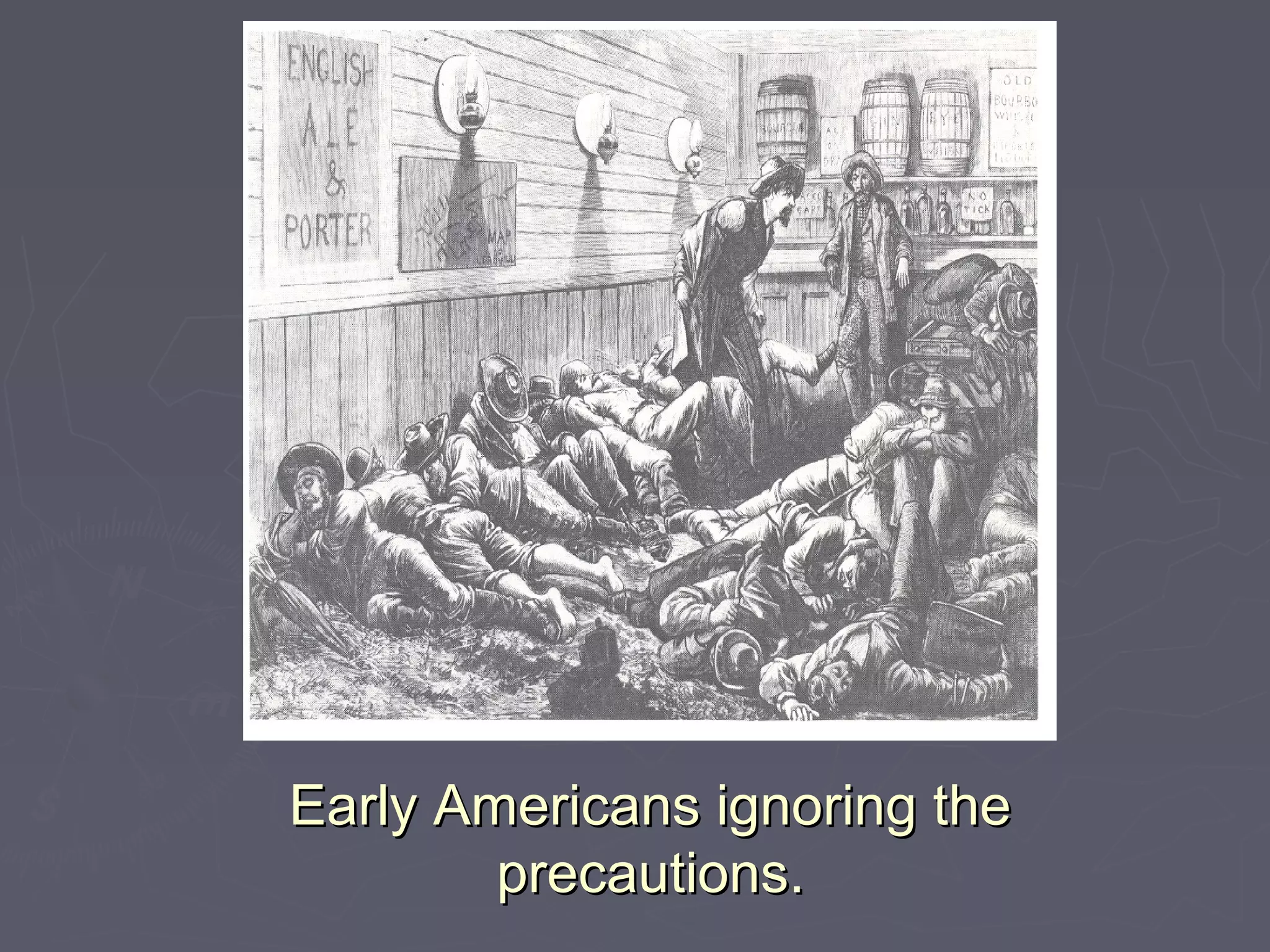
Early Americans ignoring theEarly Americans ignoring the
precautions.precautions.
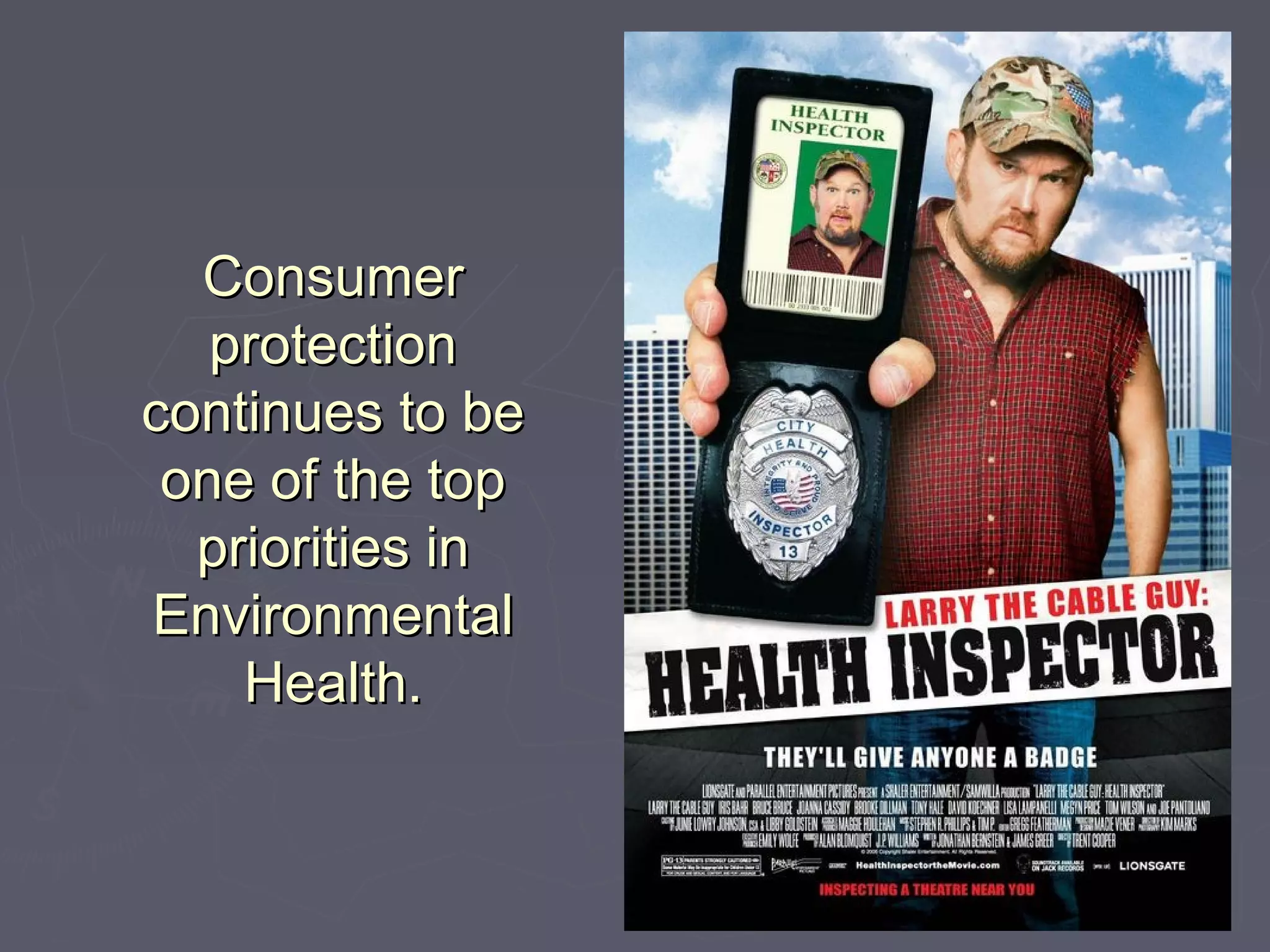
ConsumerConsumer
protectionprotection
continues to becontinues to be
one of the topone of the top
priorities inpriorities in
EnvironmentalEnvironmental
Health.Health.
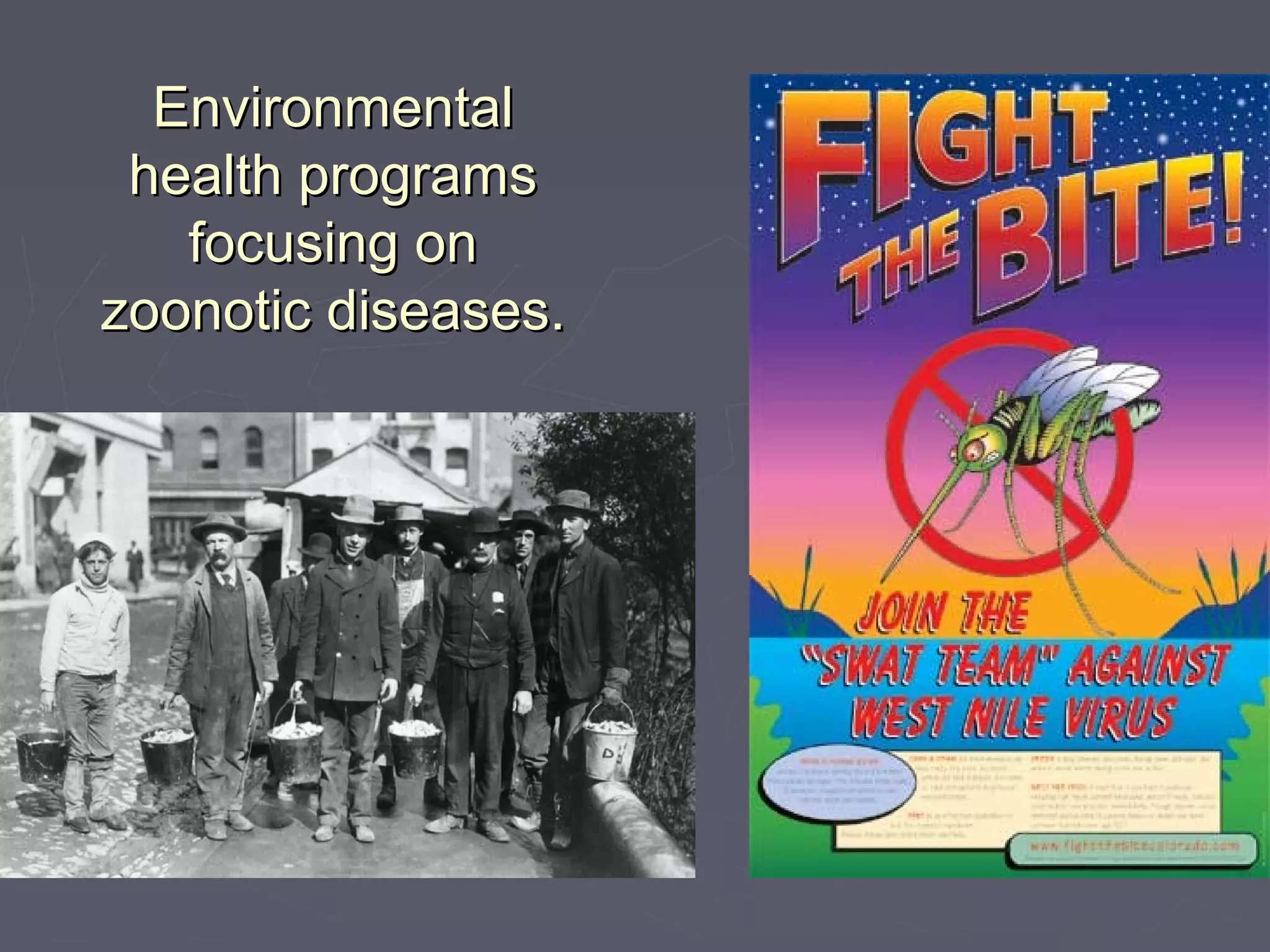
EnvironmentalEnvironmental
health programshealth programs
focusing onfocusing on
zoonotic diseases.zoonotic diseases.
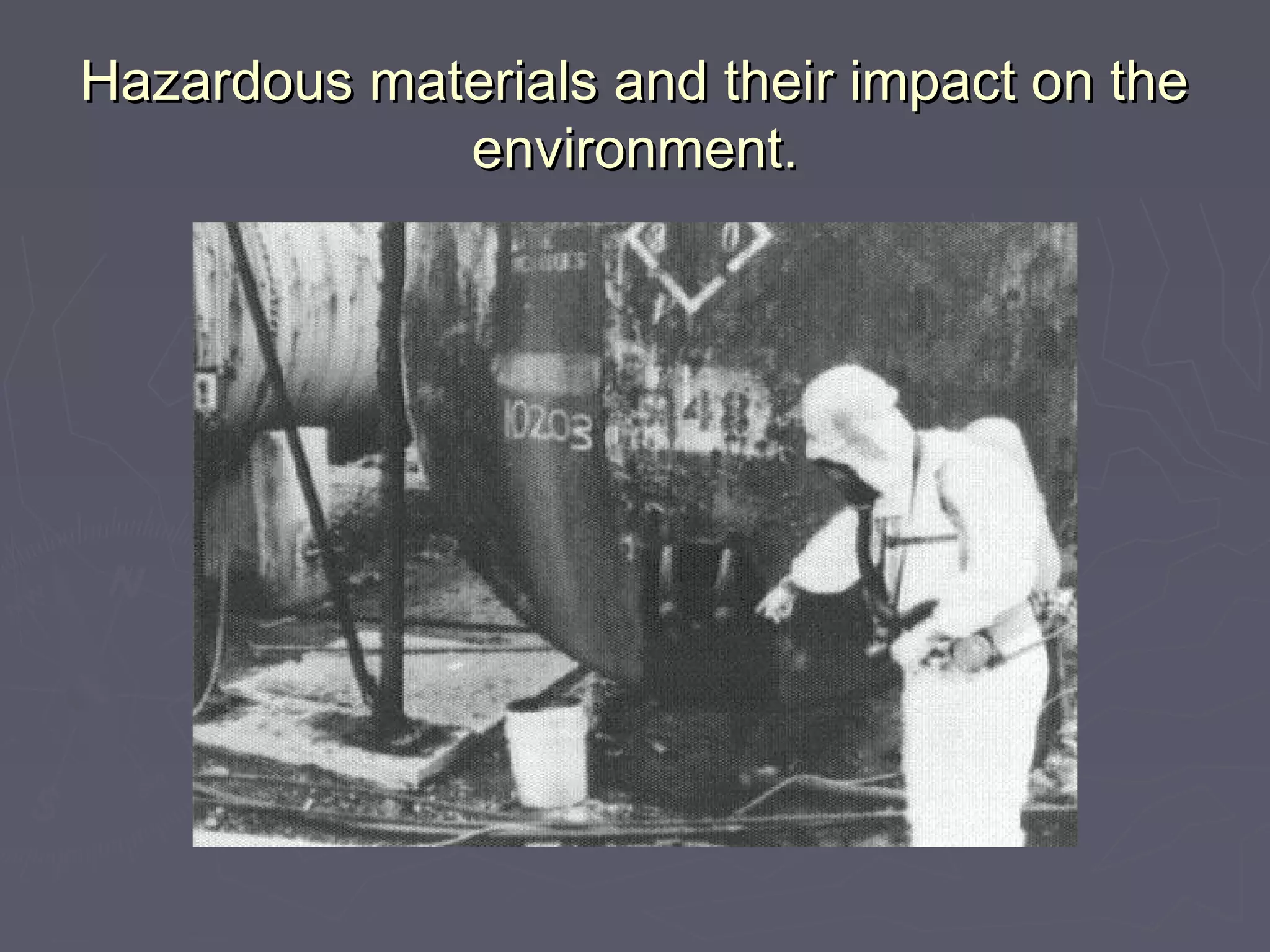
Hazardous materials and their impact on theHazardous materials and their impact on the
environment.environment.
The Medically UninsuredThe Medically Uninsured
and Underinsuredand Underinsured
Have we made progress inHave we made progress in
providing care to the “poor?”providing care to the “poor?”
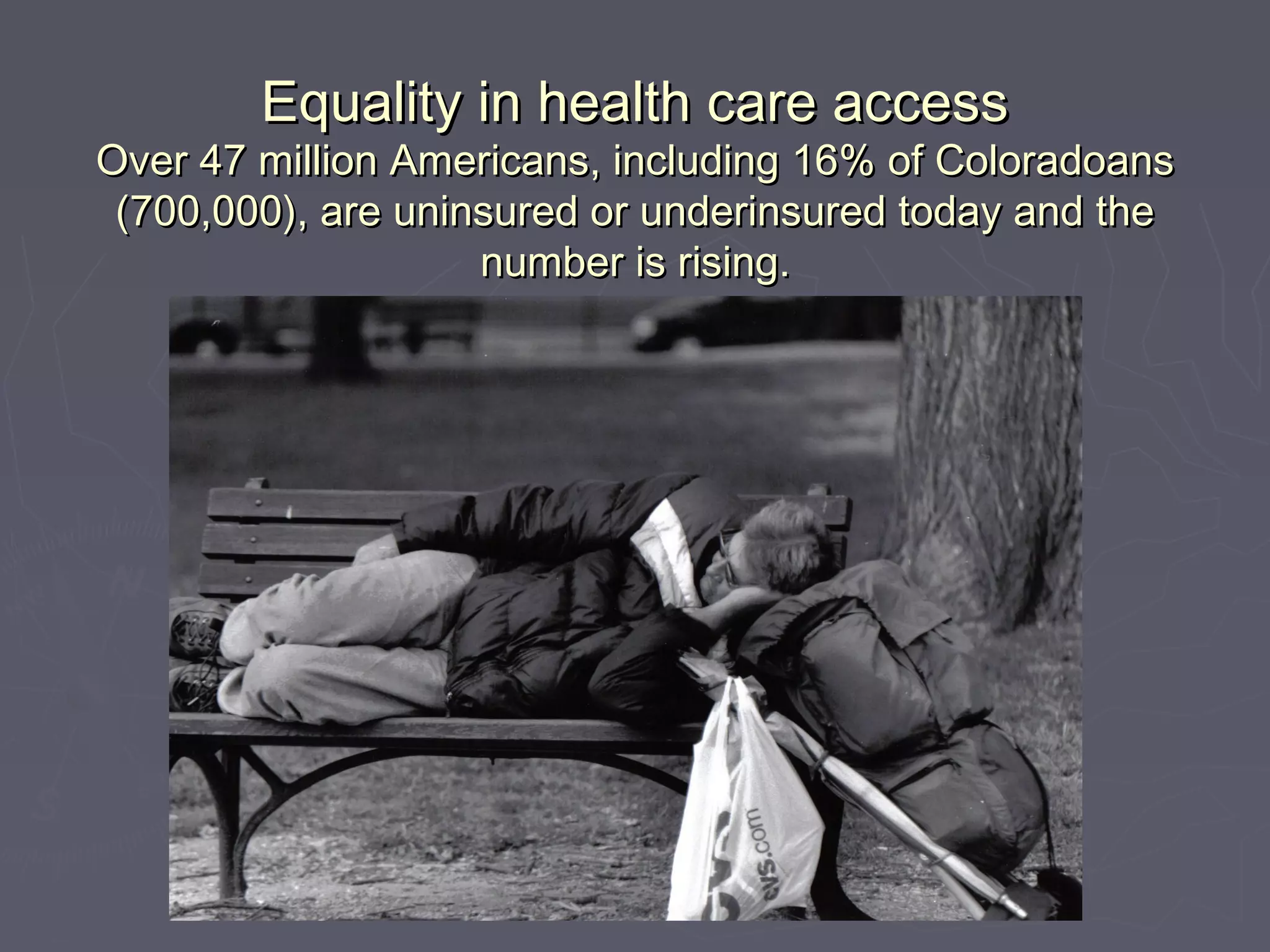
Equality in health care accessEquality in health care access
Over 47 million Americans, including 16% of ColoradoansOver 47 million Americans, including 16% of Coloradoans
(700,000), are uninsured or underinsured today and the(700,000), are uninsured or underinsured today and the
number is rising.number is rising.
Welcome to JCPH!Welcome to JCPH!

Dr. j's orientation_september_2010

  • 1.
    Public Health inPublicHealth in Jefferson CountyJefferson County September 8, 2010September 8, 2010 Dr. Mark B. Johnson, MD, MPHDr. Mark B. Johnson, MD, MPH Executive DirectorExecutive Director Jefferson County Public HealthJefferson County Public Health
  • 2.
    What if...What if... ...therewas no health care system ?...there was no health care system ?
  • 3.
    Would it makeanyWould it make any difference where youdifference where you lived?lived?
  • 18.
    It’s public healththat makes the difference!It’s public health that makes the difference!
  • 19.
    So... what ispublicSo... what is public health, and how does ithealth, and how does it differ from medical care?differ from medical care?
  • 20.
    Most health careworkersMost health care workers focus on an individual patientfocus on an individual patient and are concerned withand are concerned with treatment.treatment.
  • 21.
    Public Health focuseson aPublic Health focuses on a community and is concernedcommunity and is concerned with prevention.with prevention.
  • 24.
    Public Health Preventive Care PrimaryCare Specialty Care Hospital Care
  • 25.
    Public Health Preventive Care PrimaryCare Specialty Care Hospital Care
  • 26.
    Public Health Preventive Care PrimaryCare Specialty Care Hospital Care
  • 27.
    Historically, public healthhasHistorically, public health has included at least six services:included at least six services: ►Vital recordsVital records ►Communicable disease controlCommunicable disease control ►Environmental safetyEnvironmental safety ►Public health laboratory servicesPublic health laboratory services ►Reproductive health and maternal/childReproductive health and maternal/child health serviceshealth services ►Health education for the communityHealth education for the community
  • 28.
    Corresponding DivisionsCorresponding Divisions atJCPHat JCPH ► Administration - Vital records, emergencyAdministration - Vital records, emergency preparedness and epidemiologypreparedness and epidemiology ► Community Health Services – Infectious andCommunity Health Services – Infectious and chronic diseases; reproductive health/MCH;chronic diseases; reproductive health/MCH; access to health careaccess to health care ► Health Promotion – Disease prevention andHealth Promotion – Disease prevention and health education; promoting health behaviorshealth education; promoting health behaviors ► Environmental Health Services – DiseaseEnvironmental Health Services – Disease prevention and health regulation; providing aprevention and health regulation; providing a safe and healthy environmentsafe and healthy environment
  • 29.
    The primary ruleofThe primary rule of public health:public health: Never put a barrier betweenNever put a barrier between an individual and the public’san individual and the public’s good.good.
  • 31.
    Public Health andInfectiousPublic Health and Infectious DiseasesDiseases ► Modern public healthModern public health began in Europe in thebegan in Europe in the Middle Ages becauseMiddle Ages because of infectious diseaseof infectious disease epidemics that were ofepidemics that were of such magnitude thatsuch magnitude that no individual or singleno individual or single city could deal withcity could deal with them alone.them alone.
  • 32.
    The “Black Death”inThe “Black Death” in Europe from the 14Europe from the 14thth toto the 18the 18thth CenturiesCenturies killed almost a third ofkilled almost a third of the population.the population.
  • 35.
    Public Health measures,such as quarantining, have oftenPublic Health measures, such as quarantining, have often been controversial and confrontational.been controversial and confrontational.
  • 37.
    A visiting publichealth nurse shows aA visiting public health nurse shows a mother how to sanitize baby bottles.mother how to sanitize baby bottles.
  • 38.
    A public healthnurse checks for lice.A public health nurse checks for lice.
  • 39.
    Major public healthissues inMajor public health issues in infectious diseases.infectious diseases. ►Antibiotic resistanceAntibiotic resistance ►Emerging infectionsEmerging infections ►Bioterrorism and altered agentsBioterrorism and altered agents ►Re-emerging diseasesRe-emerging diseases ►Influenza pandemicsInfluenza pandemics
  • 41.
    Medical breakthroughs inmedicine have contributed to longer lives… 50 55 60 65 70 75 80 Source: Centers for Disease Control and Prevention, National Vital Statistics Reports, vol. 53, no. 6, November 10, 2004 Average Life Expectancy in the United StatesAverage Life Expectancy in the United States 1940 – 20021940 – 2002 AverageLifeExpectancyinYears 20001940 1945 1950 1955 1960 1965 1970 1975 1980 198 5 1990 1995
  • 42.
    Major Accomplishment: Life Expectancy ►Inthe 20th Century life expectancy increased by 0.3 years each year = 3 years per decade. ►Two-thirds of the increase in life expectancy at birth occurred before 1950. ►Two-thirds of the increase in life expectancy at age 65 occurred after 1950.
  • 45.
    Chronic Disease ControlChronicDisease Control The epidemics of lifestyle.The epidemics of lifestyle.
  • 46.
    First…we neededFirst…we needed someeducation forsome education for our healthour health professionals!professionals!
  • 48.
    Next…we needed somepublicNext…we needed some public education!education!
  • 49.
    In manyIn many immigrantimmigrant families,parentsfamilies, parents were concernedwere concerned if their kids wereif their kids were thin, becausethin, because being skinny wasbeing skinny was a sign of poverty.a sign of poverty.
  • 52.
    Obesity Trends* AmongU.S. Adults BRFSS, 1985(*BMI ≥30, or ~ 30 lbs. overweight for 5’ 4” person) No Data <10% 10%–14%
  • 53.
    Obesity Trends* AmongU.S. Adults BRFSS, 1986(*BMI ≥30, or ~ 30 lbs. overweight for 5’ 4” person) No Data <10% 10%–14%
  • 54.
    Obesity Trends* AmongU.S. Adults BRFSS, 1987(*BMI ≥30, or ~ 30 lbs. overweight for 5’ 4” person) No Data <10% 10%–14%
  • 55.
    Obesity Trends* AmongU.S. Adults BRFSS, 1988(*BMI ≥30, or ~ 30 lbs. overweight for 5’ 4” person) No Data <10% 10%–14%
  • 56.
    Obesity Trends* AmongU.S. Adults BRFSS, 1989(*BMI ≥30, or ~ 30 lbs. overweight for 5’ 4” person) No Data <10% 10%–14%
  • 57.
    Obesity Trends* AmongU.S. Adults BRFSS, 1990(*BMI ≥30, or ~ 30 lbs. overweight for 5’ 4” person) No Data <10% 10%–14%
  • 58.
    Obesity Trends* AmongU.S. Adults BRFSS, 1991(*BMI ≥30, or ~ 30 lbs. overweight for 5’ 4” person) No Data <10% 10%–14% 15%–19%
  • 59.
    Obesity Trends* AmongU.S. Adults BRFSS, 1992(*BMI ≥30, or ~ 30 lbs. overweight for 5’ 4” person) No Data <10% 10%–14% 15%–19%
  • 60.
    Obesity Trends* AmongU.S. Adults BRFSS, 1993(*BMI ≥30, or ~ 30 lbs. overweight for 5’ 4” person) No Data <10% 10%–14% 15%–19%
  • 61.
    Obesity Trends* AmongU.S. Adults BRFSS, 1994(*BMI ≥30, or ~ 30 lbs. overweight for 5’ 4” person) No Data <10% 10%–14% 15%–19%
  • 62.
    Obesity Trends* AmongU.S. Adults BRFSS, 1995(*BMI ≥30, or ~ 30 lbs. overweight for 5’ 4” person) No Data <10% 10%–14% 15%–19%
  • 63.
    Obesity Trends* AmongU.S. Adults BRFSS, 1996(*BMI ≥30, or ~ 30 lbs. overweight for 5’ 4” person) No Data <10% 10%–14% 15%–19%
  • 64.
    Obesity Trends* AmongU.S. Adults BRFSS, 1997(*BMI ≥30, or ~ 30 lbs. overweight for 5’ 4” person) No Data <10% 10%–14% 15%–19% ≥20%
  • 65.
    Obesity Trends* AmongU.S. Adults BRFSS, 1998(*BMI ≥30, or ~ 30 lbs. overweight for 5’ 4” person) No Data <10% 10%–14% 15%–19% ≥20%
  • 66.
    Obesity Trends* AmongU.S. Adults BRFSS, 1999(*BMI ≥30, or ~ 30 lbs. overweight for 5’ 4” person) No Data <10% 10%–14% 15%–19% ≥20%
  • 67.
    Obesity Trends* AmongU.S. Adults BRFSS, 2000(*BMI ≥30, or ~ 30 lbs. overweight for 5’ 4” person) No Data <10% 10%–14% 15%–19% ≥20%
  • 68.
    Obesity Trends* AmongU.S. Adults BRFSS, 2001(*BMI ≥30, or ~ 30 lbs. overweight for 5’ 4” person) No Data <10% 10%–14% 15%–19% 20%–24% ≥25%
  • 69.
    (*BMI ≥30, or~ 30 lbs. overweight for 5’ 4” person) Obesity Trends* Among U.S. Adults BRFSS, 2002 No Data <10% 10%–14% 15%–19% 20%–24% ≥25%
  • 70.
    Obesity Trends* AmongU.S. Adults BRFSS, 2003(*BMI ≥30, or ~ 30 lbs. overweight for 5’ 4” person) No Data <10% 10%–14% 15%–19% 20%–24% ≥25%
  • 71.
    Obesity Trends* AmongU.S. Adults BRFSS, 2004(*BMI ≥30, or ~ 30 lbs. overweight for 5’ 4” person) No Data <10% 10%–14% 15%–19% 20%–24% ≥25%
  • 72.
    Obesity Trends* AmongU.S. Adults BRFSS, 2005(*BMI ≥30, or ~ 30 lbs. overweight for 5’ 4” person) No Data <10% 10%–14% 15%–19% 20%–24% 25%–29% ≥30%
  • 73.
    Obesity Trends* AmongU.S. Adults BRFSS, 2006(*BMI ≥30, or ~ 30 lbs. overweight for 5’ 4” person) No Data <10% 10%–14% 15%–19% 20%–24% 25%–29% ≥30%
  • 74.
    Obesity Trends* AmongU.S. Adults BRFSS, 2007(*BMI ≥30, or ~ 30 lbs. overweight for 5’ 4” person) No Data <10% 10%–14% 15%–19% 20%–24% 25%–29% ≥30%
  • 75.
    Obesity Trends* AmongU.S. Adults BRFSS, 2008(*BMI ≥30, or ~ 30 lbs. overweight for 5’ 4” person) No Data <10% 10%–14% 15%–19% 20%–24% 25%–29% ≥30%
  • 76.
    County-level Estimates ofDiagnosed Diabetes for Adults aged ≥ 20 years:County-level Estimates of Diagnosed Diabetes for Adults aged ≥ 20 years: United States 2005United States 2005
  • 77.
    Environmental HealthEnvironmental Health IssuesIssues Ourimpact on the environment,Our impact on the environment, and the environment’s impact onand the environment’s impact on us.us.
  • 78.
    A major improvementin health came fromA major improvement in health came from separating us from our waste and our animals.separating us from our waste and our animals.
  • 79.
  • 80.
    Early Americans ignoringtheEarly Americans ignoring the precautions.precautions.
  • 81.
    ConsumerConsumer protectionprotection continues to becontinuesto be one of the topone of the top priorities inpriorities in EnvironmentalEnvironmental Health.Health.
  • 82.
    EnvironmentalEnvironmental health programshealth programs focusingonfocusing on zoonotic diseases.zoonotic diseases.
  • 83.
    Hazardous materials andtheir impact on theHazardous materials and their impact on the environment.environment.
  • 84.
    The Medically UninsuredTheMedically Uninsured and Underinsuredand Underinsured Have we made progress inHave we made progress in providing care to the “poor?”providing care to the “poor?”
  • 85.
    Equality in healthcare accessEquality in health care access Over 47 million Americans, including 16% of ColoradoansOver 47 million Americans, including 16% of Coloradoans (700,000), are uninsured or underinsured today and the(700,000), are uninsured or underinsured today and the number is rising.number is rising.
  • 86.

Editor's Notes

  • #19 Cleanliness guards the kingdom behind the quarantine gate, with cholera, yellow fever and smallpox threatening. At the Gates—our safety depends upon official vigilance
  • #80 Don’t crowd the sleeping room or work room.