Improving Dairy Cattle Fertility
Using Translational Genomics
AFRI 2013-68004-20365
T. Spencer, H. Neibergs, J. Dalton,
M. Chahine, D. Moore, P. Hansen, J. Cole,
and A. De Vries
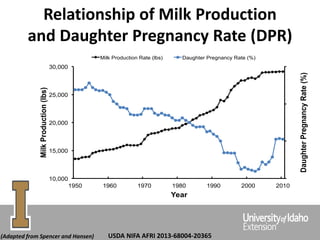
Relationship of Milk Production
and Daughter Pregnancy Rate (DPR)
20
24
28
32
10,000
15,000
20,000
25,000
30,000
1950 1960 1970 1980 1990 2000 2010
DaughterPregnancyRate(%)
MilkProduction(lbs)
Year
Milk Production Rate (lbs) Daughter Pregnancy Rate (%)
(Adapted from Spencer and Hansen) USDA NIFA AFRI 2013-68004-20365
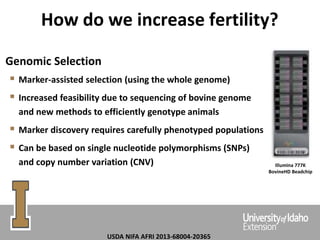
Genomic Selection
 Marker-assisted selection (using the whole genome)
 Increased feasibility due to sequencing of bovine genome
and new methods to efficiently genotype animals
 Marker discovery requires carefully phenotyped populations
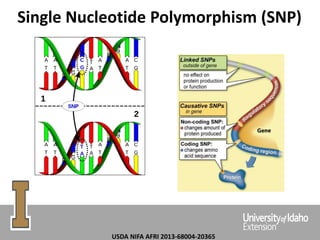
 Can be based on single nucleotide polymorphisms (SNPs)
and copy number variation (CNV) Illumina 777K
BovineHD Beadchip
How do we increase fertility?
USDA NIFA AFRI 2013-68004-20365
Single Nucleotide Polymorphism (SNP)
USDA NIFA AFRI 2013-68004-20365
 Long-term goal: Increase fertility of dairy cattle
 Research approach:
• Develop novel genetic markers of fertility in heifers and lactating cows
• Determine effects of specific SNPs on daughter pregnancy rate (DPR) and
embryo development
 Extension approach:
• Disseminate, demonstrate, evaluate and document the impact of using genetic
selection tools to increase fertility on herd management and profitability
Integrated Research-Extension Project
 Approach: Using records, Holstein heifers and primiparous cows
will be fertility classified based on pregnancy outcome to AI.
• Heifers: normal reproductive tract, no record of diseases, and
display standing estrus before AI.
• Cows: normal reproductive tract, uncomplicated pregnancy, no
record of diseases before or after AI, and display standing
estrus before AI.
 Fertility phenotypes:
• Highly fertile (pregnant on first AI)
• Subfertile (pregnant after 4th AI)
• Infertile (never pregnant to AI and culled)
Objective 1: Develop Novel Markers Of Fertility
USDA NIFA AFRI 2013-68004-20365
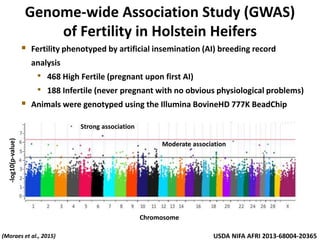
Genome-wide Association Study (GWAS)
of Fertility in Holstein Heifers
 Fertility phenotyped by artificial insemination (AI) breeding record
analysis
• 468 High Fertile (pregnant upon first AI)
• 188 Infertile (never pregnant with no obvious physiological problems)
 Animals were genotyped using the Illumina BovineHD 777K BeadChip
Chromosome
-log10(p-value)
(Moraes et al., 2015)
Strong association
Moderate association
USDA NIFA AFRI 2013-68004-20365
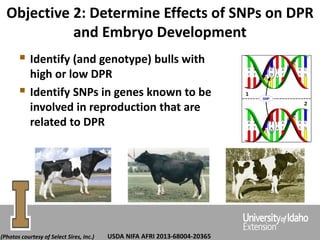
Objective 2: Determine Effects of SNPs on DPR
and Embryo Development
 Identify (and genotype) bulls with
high or low DPR
 Identify SNPs in genes known to be
involved in reproduction that are
related to DPR
USDA NIFA AFRI 2013-68004-20365(Photos courtesy of Select Sires, Inc.)
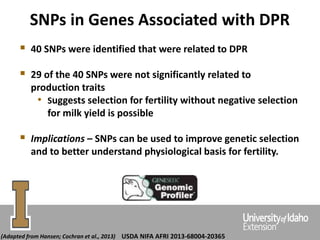
SNPs in Genes Associated with DPR
 40 SNPs were identified that were related to DPR
 29 of the 40 SNPs were not significantly related to
production traits
• Suggests selection for fertility without negative selection
for milk yield is possible
 Implications – SNPs can be used to improve genetic selection
and to better understand physiological basis for fertility.
(Adapted from Hansen; Cochran et al., 2013) USDA NIFA AFRI 2013-68004-20365
 Objective 3: Evaluate the efficiency and profitability of
increasing fertility in dairy cattle using genetic selection tools.
(Computer modeling; Web-based decision support tool).
 Objective 4: Transfer science-based information to dairy
producers, managers, and allied industry personnel, with
strategies to improve fertility using novel genomic information
and tools.
Objectives 3 and 4
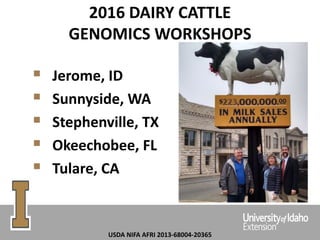
2016 DAIRY CATTLE
GENOMICS WORKSHOPS
 Jerome, ID
 Sunnyside, WA
 Stephenville, TX
 Okeechobee, FL
 Tulare, CA
USDA NIFA AFRI 2013-68004-20365
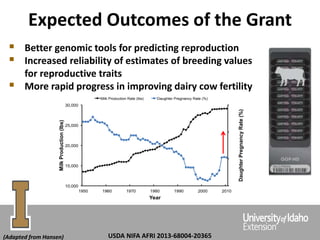
Expected Outcomes of the Grant
 Better genomic tools for predicting reproduction
 Increased reliability of estimates of breeding values
for reproductive traits
 More rapid progress in improving dairy cow fertility
20
24
28
32
10,000
15,000
20,000
25,000
30,000
1950 1960 1970 1980 1990 2000 2010
DaughterPregnancyRate(%)
MilkProduction(lbs)
Year
Milk Production Rate (lbs) Daughter Pregnancy Rate (%)
(Adapted from Hansen) USDA NIFA AFRI 2013-68004-20365
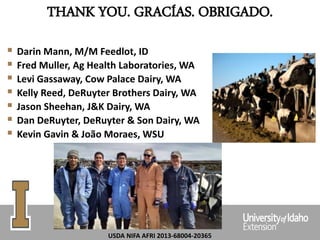
THANK YOU. GRACÍAS. OBRIGADO.
 Darin Mann, M/M Feedlot, ID
 Fred Muller, Ag Health Laboratories, WA
 Levi Gassaway, Cow Palace Dairy, WA
 Kelly Reed, DeRuyter Brothers Dairy, WA
 Jason Sheehan, J&K Dairy, WA
 Dan DeRuyter, DeRuyter & Son Dairy, WA
 Kevin Gavin & João Moraes, WSU
USDA NIFA AFRI 2013-68004-20365

Current Research in Genomic Selection- Dr. Joe Dalton

  • 1.
    Improving Dairy CattleFertility Using Translational Genomics AFRI 2013-68004-20365 T. Spencer, H. Neibergs, J. Dalton, M. Chahine, D. Moore, P. Hansen, J. Cole, and A. De Vries
  • 2.
    Relationship of MilkProduction and Daughter Pregnancy Rate (DPR) 20 24 28 32 10,000 15,000 20,000 25,000 30,000 1950 1960 1970 1980 1990 2000 2010 DaughterPregnancyRate(%) MilkProduction(lbs) Year Milk Production Rate (lbs) Daughter Pregnancy Rate (%) (Adapted from Spencer and Hansen) USDA NIFA AFRI 2013-68004-20365
  • 3.
    Genomic Selection  Marker-assistedselection (using the whole genome)  Increased feasibility due to sequencing of bovine genome and new methods to efficiently genotype animals  Marker discovery requires carefully phenotyped populations  Can be based on single nucleotide polymorphisms (SNPs) and copy number variation (CNV) Illumina 777K BovineHD Beadchip How do we increase fertility? USDA NIFA AFRI 2013-68004-20365
  • 4.
    Single Nucleotide Polymorphism(SNP) USDA NIFA AFRI 2013-68004-20365
  • 5.
     Long-term goal:Increase fertility of dairy cattle  Research approach: • Develop novel genetic markers of fertility in heifers and lactating cows • Determine effects of specific SNPs on daughter pregnancy rate (DPR) and embryo development  Extension approach: • Disseminate, demonstrate, evaluate and document the impact of using genetic selection tools to increase fertility on herd management and profitability Integrated Research-Extension Project
  • 6.
     Approach: Usingrecords, Holstein heifers and primiparous cows will be fertility classified based on pregnancy outcome to AI. • Heifers: normal reproductive tract, no record of diseases, and display standing estrus before AI. • Cows: normal reproductive tract, uncomplicated pregnancy, no record of diseases before or after AI, and display standing estrus before AI.  Fertility phenotypes: • Highly fertile (pregnant on first AI) • Subfertile (pregnant after 4th AI) • Infertile (never pregnant to AI and culled) Objective 1: Develop Novel Markers Of Fertility USDA NIFA AFRI 2013-68004-20365
  • 7.
    Genome-wide Association Study(GWAS) of Fertility in Holstein Heifers  Fertility phenotyped by artificial insemination (AI) breeding record analysis • 468 High Fertile (pregnant upon first AI) • 188 Infertile (never pregnant with no obvious physiological problems)  Animals were genotyped using the Illumina BovineHD 777K BeadChip Chromosome -log10(p-value) (Moraes et al., 2015) Strong association Moderate association USDA NIFA AFRI 2013-68004-20365
  • 8.
    Objective 2: DetermineEffects of SNPs on DPR and Embryo Development  Identify (and genotype) bulls with high or low DPR  Identify SNPs in genes known to be involved in reproduction that are related to DPR USDA NIFA AFRI 2013-68004-20365(Photos courtesy of Select Sires, Inc.)
  • 9.
    SNPs in GenesAssociated with DPR  40 SNPs were identified that were related to DPR  29 of the 40 SNPs were not significantly related to production traits • Suggests selection for fertility without negative selection for milk yield is possible  Implications – SNPs can be used to improve genetic selection and to better understand physiological basis for fertility. (Adapted from Hansen; Cochran et al., 2013) USDA NIFA AFRI 2013-68004-20365
  • 10.
     Objective 3:Evaluate the efficiency and profitability of increasing fertility in dairy cattle using genetic selection tools. (Computer modeling; Web-based decision support tool).  Objective 4: Transfer science-based information to dairy producers, managers, and allied industry personnel, with strategies to improve fertility using novel genomic information and tools. Objectives 3 and 4
  • 11.
    2016 DAIRY CATTLE GENOMICSWORKSHOPS  Jerome, ID  Sunnyside, WA  Stephenville, TX  Okeechobee, FL  Tulare, CA USDA NIFA AFRI 2013-68004-20365
  • 12.
    Expected Outcomes ofthe Grant  Better genomic tools for predicting reproduction  Increased reliability of estimates of breeding values for reproductive traits  More rapid progress in improving dairy cow fertility 20 24 28 32 10,000 15,000 20,000 25,000 30,000 1950 1960 1970 1980 1990 2000 2010 DaughterPregnancyRate(%) MilkProduction(lbs) Year Milk Production Rate (lbs) Daughter Pregnancy Rate (%) (Adapted from Hansen) USDA NIFA AFRI 2013-68004-20365
  • 13.
    THANK YOU. GRACÍAS.OBRIGADO.  Darin Mann, M/M Feedlot, ID  Fred Muller, Ag Health Laboratories, WA  Levi Gassaway, Cow Palace Dairy, WA  Kelly Reed, DeRuyter Brothers Dairy, WA  Jason Sheehan, J&K Dairy, WA  Dan DeRuyter, DeRuyter & Son Dairy, WA  Kevin Gavin & João Moraes, WSU USDA NIFA AFRI 2013-68004-20365