Double Spread Analysis
Anchoring
Image
Image
Credits
Footer
Article
Heading
Standfirst
Credits
Body
Copy
Drop Cap
Article
Heading
The article heading is written in uppercase in
black to make it clear as the title, and to make it
prominent on a white background.
The title is in a serif font to increase its appeal
and not make it seem mundane.
The title takes up two lines and is centralised.
The same word “our”, is used to start the title
on both lines. This also enhances the attraction
to the title, as it makes it sound lyrical.
Standfirs
t
The standfirst is given underneath the article
title, so that the reader can easily know what
the article contains/deals with, and does not
have to read the entire article.
The standfirst is written in a sans serif font so
that it can be read easily and gives a
sophisticated view. The font is also very small in
order to not steal attention from the title.
The drops cap makes it
clear where the article is
beginning and also creates
more sophistication.
The serif font of the drop
cap also makes it stand
out.
The body text is
divided into two
columns.
This makes readability
much easier and quick
for the audience. A
serif font also increases
makes it more
contemporary and
easily legible. It also
sets the body font apart
from the title font.
The columns give the
article a cleaner and
organised look and
shape.
The body text is in a small font and
in black to make it easily readable
on the background which is simply
kept white.
Body Copy/Article
Anchoring
image
The anchoring image
portrays the message that
the magazine is trying to
relay.
The article focuses on
empowerment of females,
specifically blacks women.
The pose and the
positioning of the models,
as well as their
expressions convey the
idea of strength and a
sense of “royalty”, because
of the crowns.
The image takes up an entire
page of the issue, to highlight
it as the main image as no
other images are used on the
article page with the main
text.
The credits are given to the
models at the bottom corner of
the page, along with a very
brief description as it does not
need much explaining.
The matching colour scheme
of the outfits also adds to the
appeal of the image.
Anchoring
Image
Article Heading
Standfirst
Header
Quotation
Footer
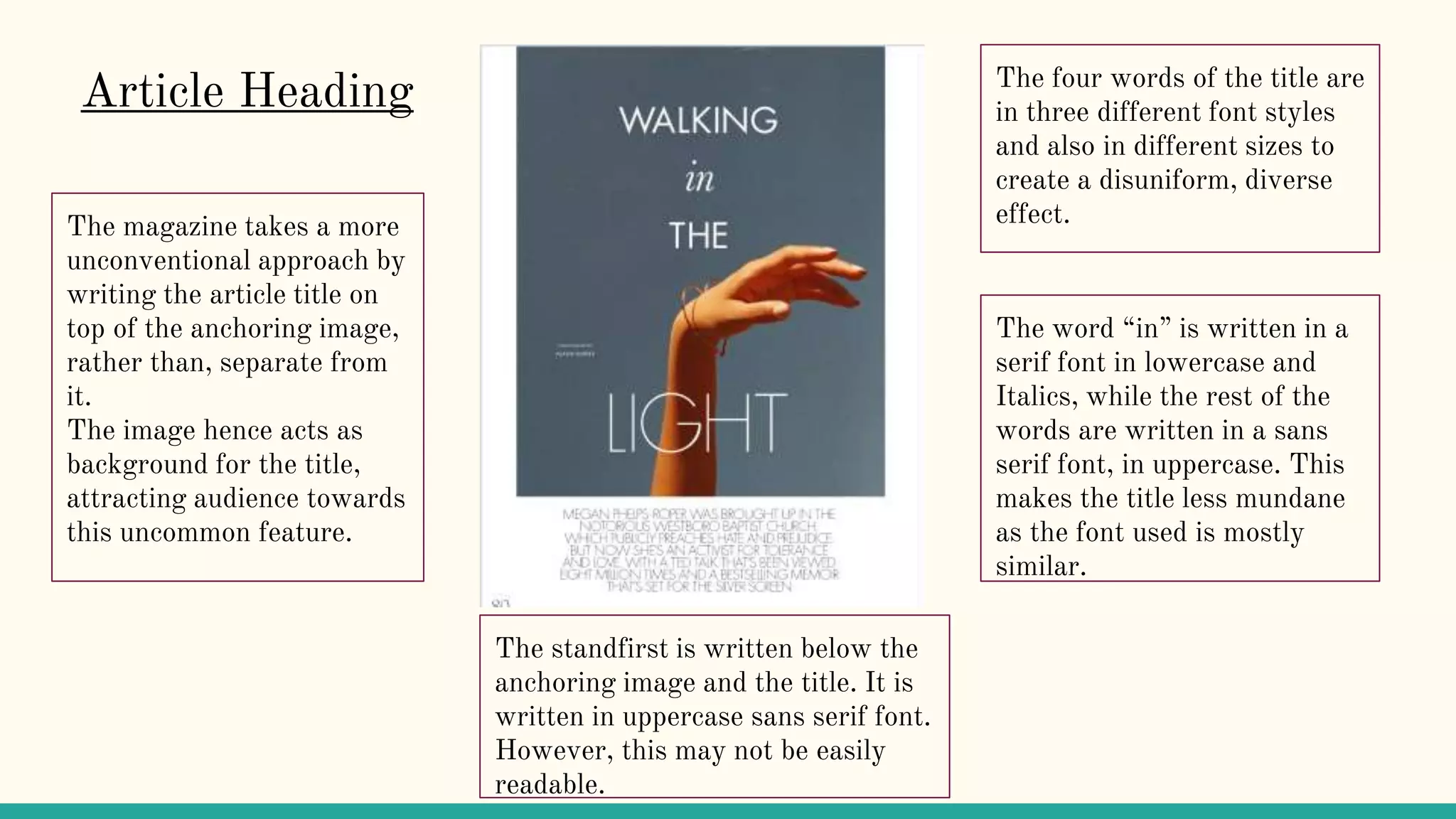
The magazine takes a more
unconventional approach by
writing the article title on
top of the anchoring image,
rather than, separate from
it.
The image hence acts as
background for the title,
attracting audience towards
this uncommon feature.
Article Heading The four words of the title are
in three different font styles
and also in different sizes to
create a disuniform, diverse
effect.
The word “in” is written in a
serif font in lowercase and
Italics, while the rest of the
words are written in a sans
serif font, in uppercase. This
makes the title less mundane
as the font used is mostly
similar.
The standfirst is written below the
anchoring image and the title. It is
written in uppercase sans serif font.
However, this may not be easily
readable.
The article is divided
into two columns to
enhance easier
readability.
The font is a serif font,
following the
conventional font style.
There is no drop cap in
the article, however, to
indicate the beginning of
the article, the first
three words are in
uppercase.
The quotation is placed
in the centre of the page
in mostly uppercase
letter to be identified
easily. The quote is
extracted from the
article itself.
The text wraps around
the quotation making it
appear as if in a frame.
Header
Article
Title
Standfirst
Drop Cap
Anchoring
Image
Article
Footer
Article Heading
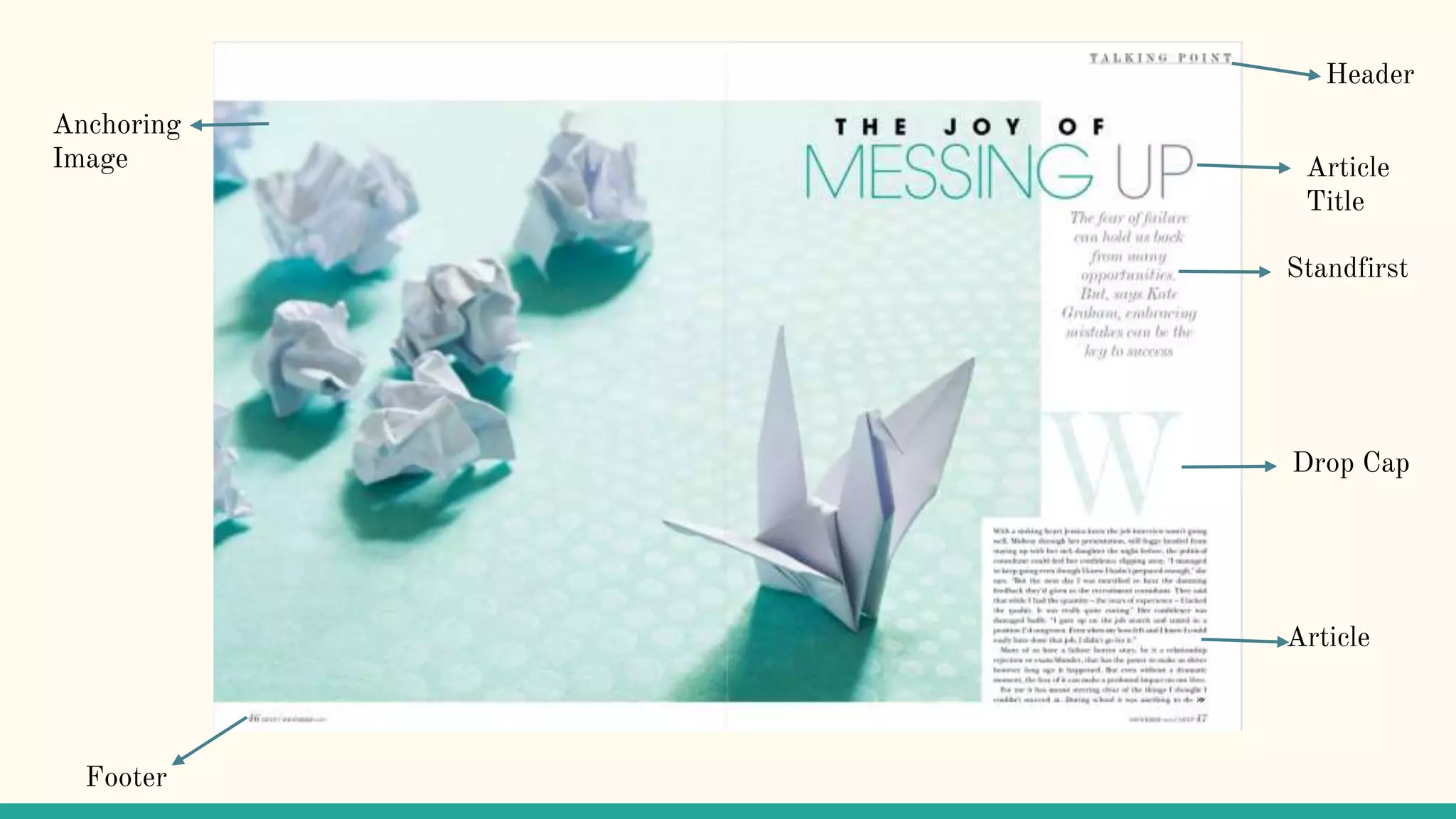
The heading is written
in different fonts, sizes
and colours, creating a
diverse title on the page.
This attracts the
audience when they
open the magazine as it
stands out from the rest
of the text.
The heading is written
in a sans serif font to
create a more modern
effect.
The title is spread over two lines. The text
in the first line is written in a smaller size
and in black and bold with a significant
amount of spacing between the letters.
The words in the next line are in a larger
size and the font style is condensed. This
highlights the main words of the article
“messing up”.
Standfirst is written
below the title as
usual. The standfirst
is a brief description
of the article.
It is written in serif
font and italicized to
differentiate it from
the article title.
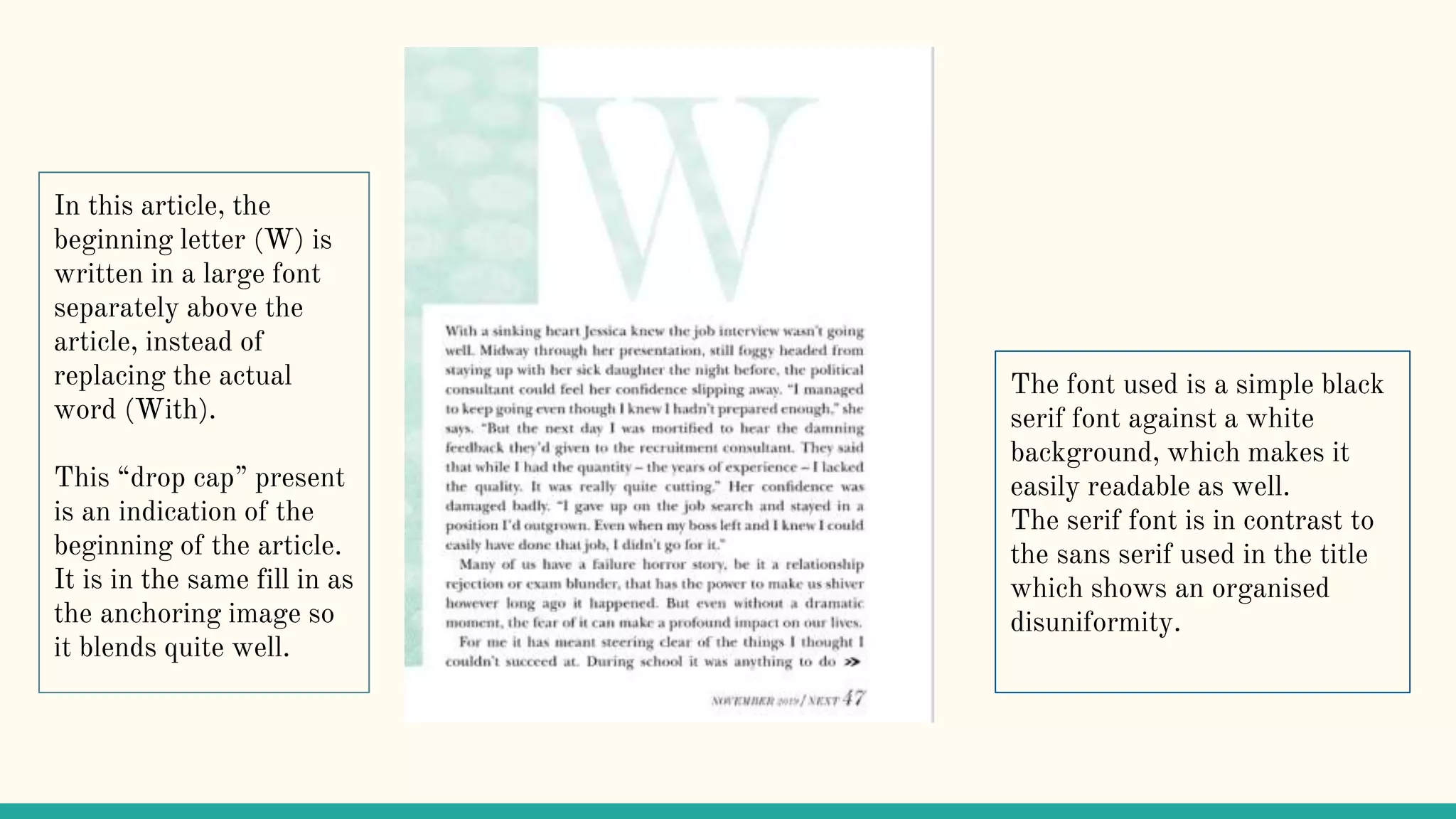
In this article, the
beginning letter (W) is
written in a large font
separately above the
article, instead of
replacing the actual
word (With).
This “drop cap” present
is an indication of the
beginning of the article.
It is in the same fill in as
the anchoring image so
it blends quite well.
The font used is a simple black
serif font against a white
background, which makes it
easily readable as well.
The serif font is in contrast to
the sans serif used in the title
which shows an organised
disuniformity.
Anchoring Image
The image is spread over a full page and
half of the second page. This creates a
more dramatic effect as there is less
written text and more visual appeal.
The colour palette of the magazine article is
established by the magazine. These same
colours are used in the heading of the
article.

Double Spread Analysis

  • 1.
  • 2.
  • 3.
    Article Heading The article headingis written in uppercase in black to make it clear as the title, and to make it prominent on a white background. The title is in a serif font to increase its appeal and not make it seem mundane. The title takes up two lines and is centralised. The same word “our”, is used to start the title on both lines. This also enhances the attraction to the title, as it makes it sound lyrical. Standfirs t The standfirst is given underneath the article title, so that the reader can easily know what the article contains/deals with, and does not have to read the entire article. The standfirst is written in a sans serif font so that it can be read easily and gives a sophisticated view. The font is also very small in order to not steal attention from the title.
  • 4.
    The drops capmakes it clear where the article is beginning and also creates more sophistication. The serif font of the drop cap also makes it stand out. The body text is divided into two columns. This makes readability much easier and quick for the audience. A serif font also increases makes it more contemporary and easily legible. It also sets the body font apart from the title font. The columns give the article a cleaner and organised look and shape. The body text is in a small font and in black to make it easily readable on the background which is simply kept white. Body Copy/Article
  • 5.
    Anchoring image The anchoring image portraysthe message that the magazine is trying to relay. The article focuses on empowerment of females, specifically blacks women. The pose and the positioning of the models, as well as their expressions convey the idea of strength and a sense of “royalty”, because of the crowns. The image takes up an entire page of the issue, to highlight it as the main image as no other images are used on the article page with the main text. The credits are given to the models at the bottom corner of the page, along with a very brief description as it does not need much explaining. The matching colour scheme of the outfits also adds to the appeal of the image.
  • 6.
  • 7.
    The magazine takesa more unconventional approach by writing the article title on top of the anchoring image, rather than, separate from it. The image hence acts as background for the title, attracting audience towards this uncommon feature. Article Heading The four words of the title are in three different font styles and also in different sizes to create a disuniform, diverse effect. The word “in” is written in a serif font in lowercase and Italics, while the rest of the words are written in a sans serif font, in uppercase. This makes the title less mundane as the font used is mostly similar. The standfirst is written below the anchoring image and the title. It is written in uppercase sans serif font. However, this may not be easily readable.
  • 8.
    The article isdivided into two columns to enhance easier readability. The font is a serif font, following the conventional font style. There is no drop cap in the article, however, to indicate the beginning of the article, the first three words are in uppercase. The quotation is placed in the centre of the page in mostly uppercase letter to be identified easily. The quote is extracted from the article itself. The text wraps around the quotation making it appear as if in a frame.
  • 9.
  • 10.
    Article Heading The headingis written in different fonts, sizes and colours, creating a diverse title on the page. This attracts the audience when they open the magazine as it stands out from the rest of the text. The heading is written in a sans serif font to create a more modern effect. The title is spread over two lines. The text in the first line is written in a smaller size and in black and bold with a significant amount of spacing between the letters. The words in the next line are in a larger size and the font style is condensed. This highlights the main words of the article “messing up”. Standfirst is written below the title as usual. The standfirst is a brief description of the article. It is written in serif font and italicized to differentiate it from the article title.
  • 11.
    In this article,the beginning letter (W) is written in a large font separately above the article, instead of replacing the actual word (With). This “drop cap” present is an indication of the beginning of the article. It is in the same fill in as the anchoring image so it blends quite well. The font used is a simple black serif font against a white background, which makes it easily readable as well. The serif font is in contrast to the sans serif used in the title which shows an organised disuniformity.
  • 12.
    Anchoring Image The imageis spread over a full page and half of the second page. This creates a more dramatic effect as there is less written text and more visual appeal. The colour palette of the magazine article is established by the magazine. These same colours are used in the heading of the article.