INTRODUCTION
INTRODUCTION
TO
TO
PHARMACOLOGY
PHARMACOLOGY
DR.SUDHAKAR LAKAVATH
Pharmacology
Pharmacology
embraces the knowledge of:
History, Source, Physical
History, Source, Physical and
and chemical properties,
chemical properties,
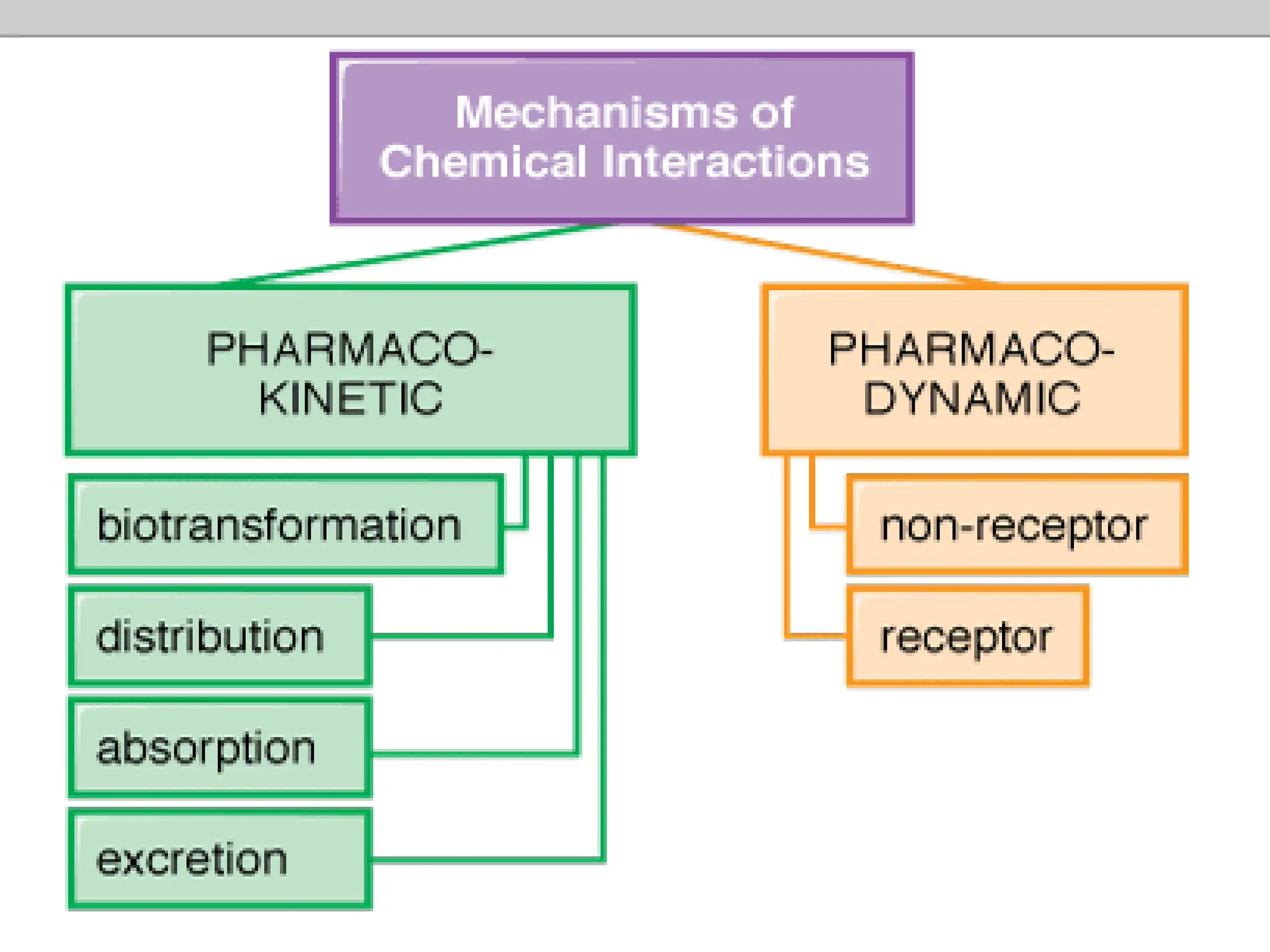
Absorption, Distribution, Biotransformation and
Excretion of drugs,
Excretion of drugs,
Biochemical and physiological effects,
Mechanism of Action,
Therapeutic and Other uses of drugs
Therapeutic and Other uses of drugs.
.
HISTORY
HISTORY
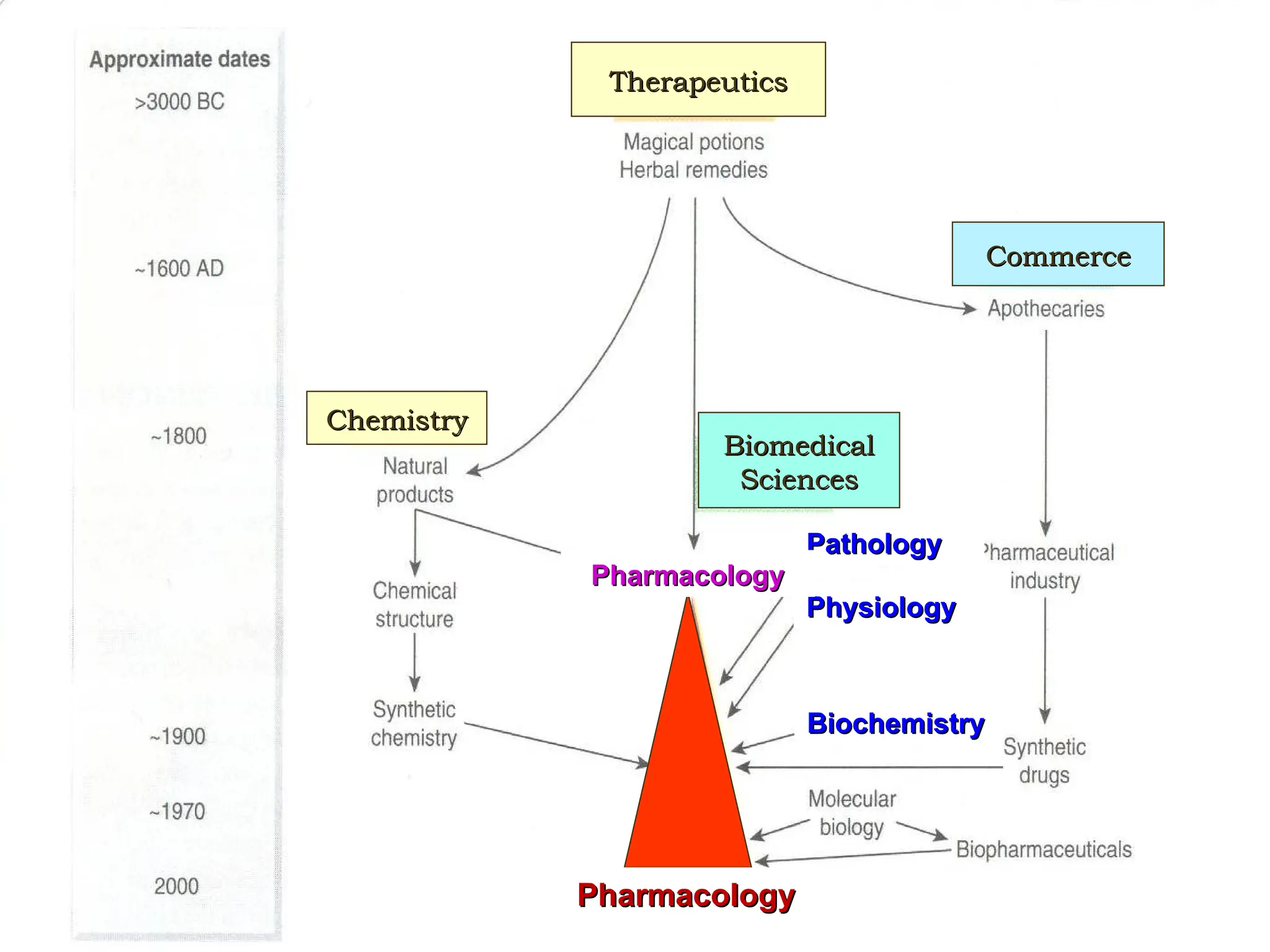
Pharmacology
Pharmacology
Therapeutics
Therapeutics
Commerce
Commerce
Chemistry
Chemistry
Biomedical
Biomedical
Sciences
Sciences
Pathology
Pathology
Physiology
Physiology
Biochemistry
Biochemistry
Pharmacology
Pharmacology
DRUG
DRUG
A drug may be broadly defined as
any chemical agent which affects living
protoplasm.
protoplasm.
According to definition of WHO,
a drug is any substance or product that is used
or
or
intended to be used to modify or explore
physiological systems or pathological states
for the benefit of recipient.
It means a chemical used in prevention,
diagnosis or
diagnosis or
treatment of disease
treatment of disease.
.
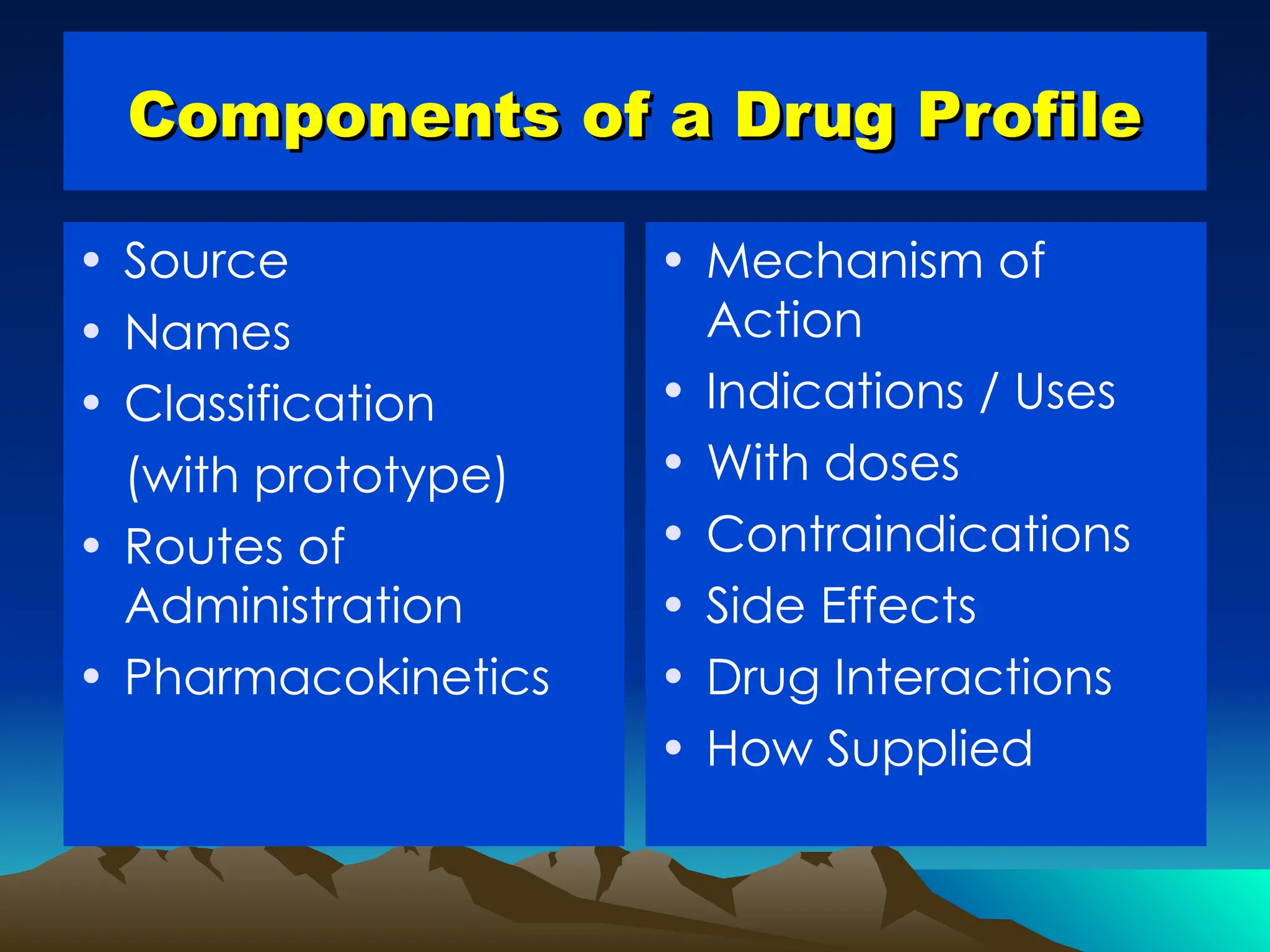
Components of a Drug Profile
• Source
• Names
• Classification
(with prototype)
• Routes of
Administration
• Pharmacokinetics
• Mechanism of
Action
• Indications / Uses
• With doses
• Contraindications
• Side Effects
• Drug Interactions
• How Supplied
SOURCE
Example
Example
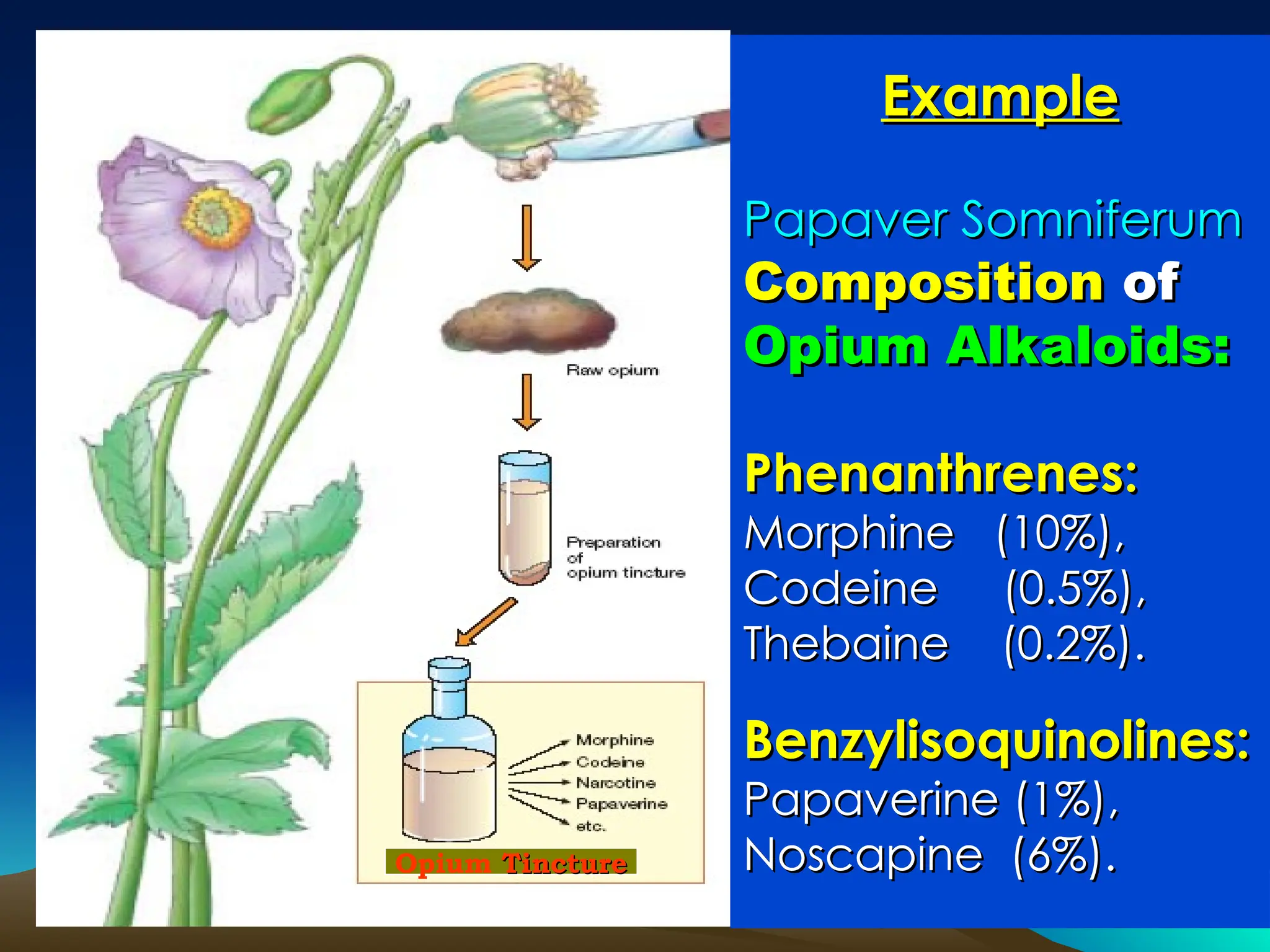
Papaver Somniferum
Papaver Somniferum
Composition
Composition of
of
Opium Alkaloids:
Opium Alkaloids:
Phenanthrenes:
Phenanthrenes:
Morphine (10%),
Morphine (10%),
Codeine (0.5%),
Codeine (0.5%),
Thebaine (0.2%).
Thebaine (0.2%).
Benzylisoquinolines:
Papaverine (1%),
Papaverine (1%),
Noscapine (6%).
Noscapine (6%).
Opium Tincture
Tincture
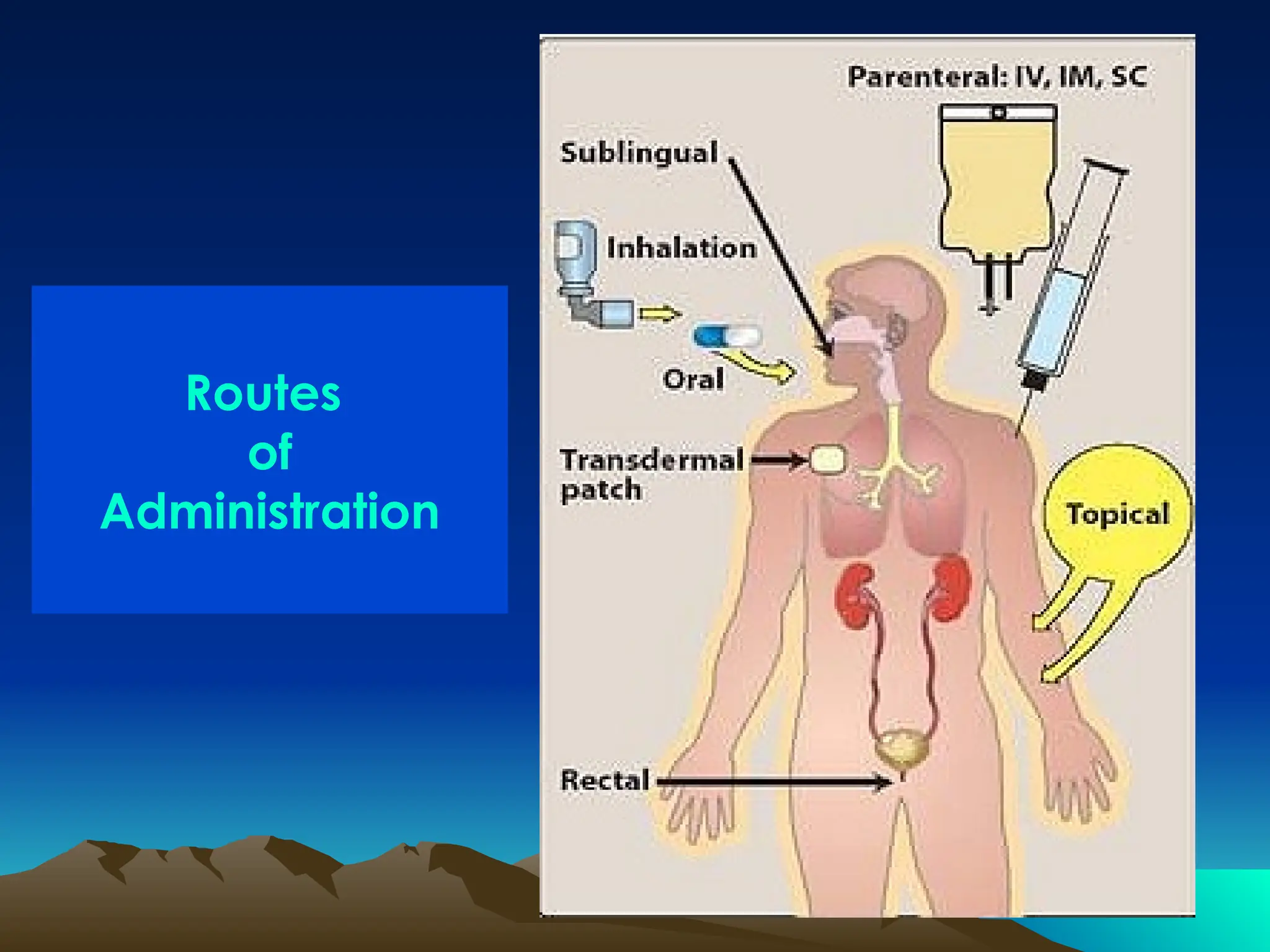
Routes
of
Administration
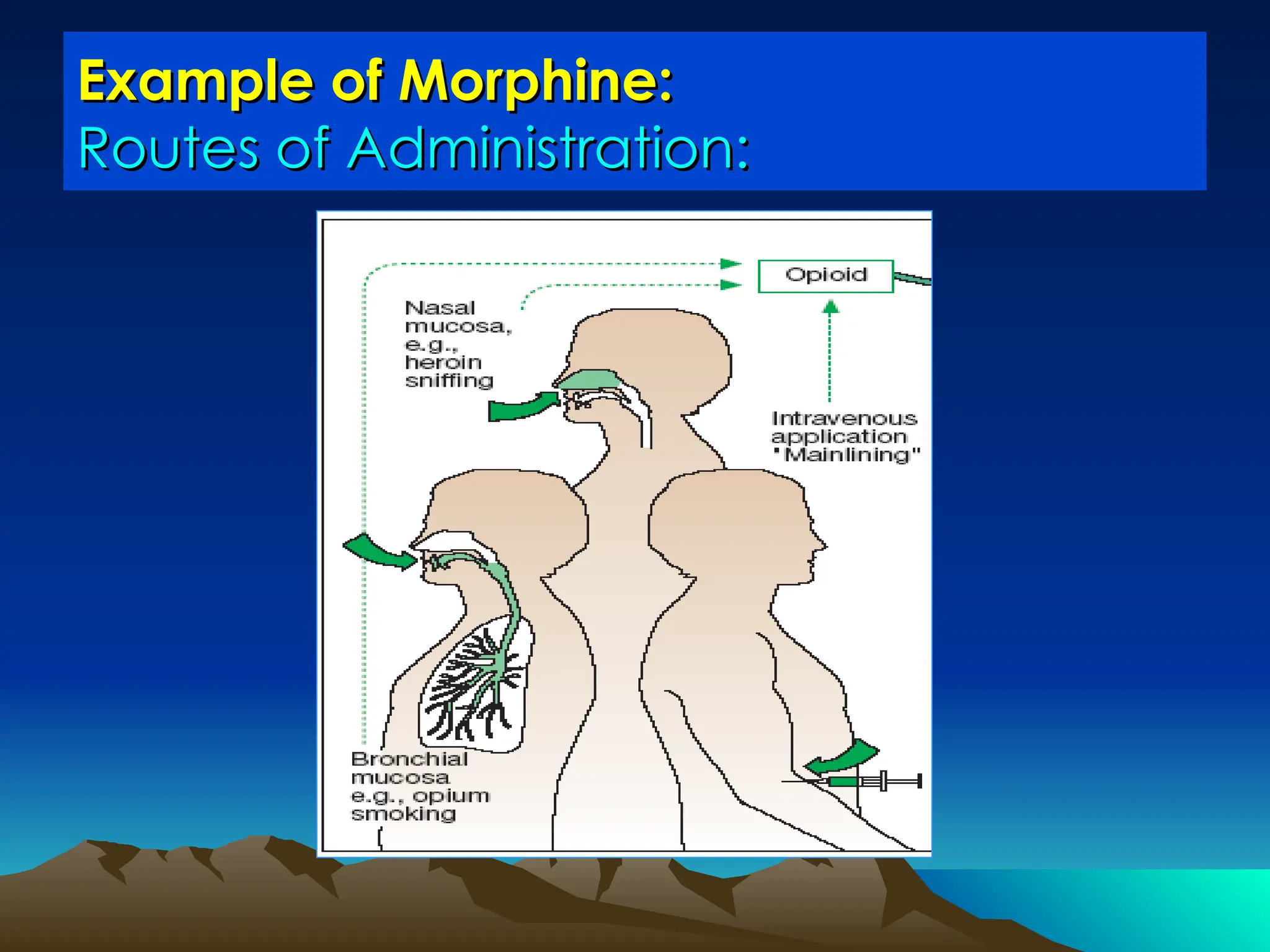
Example of Morphine:
Routes of Administration:
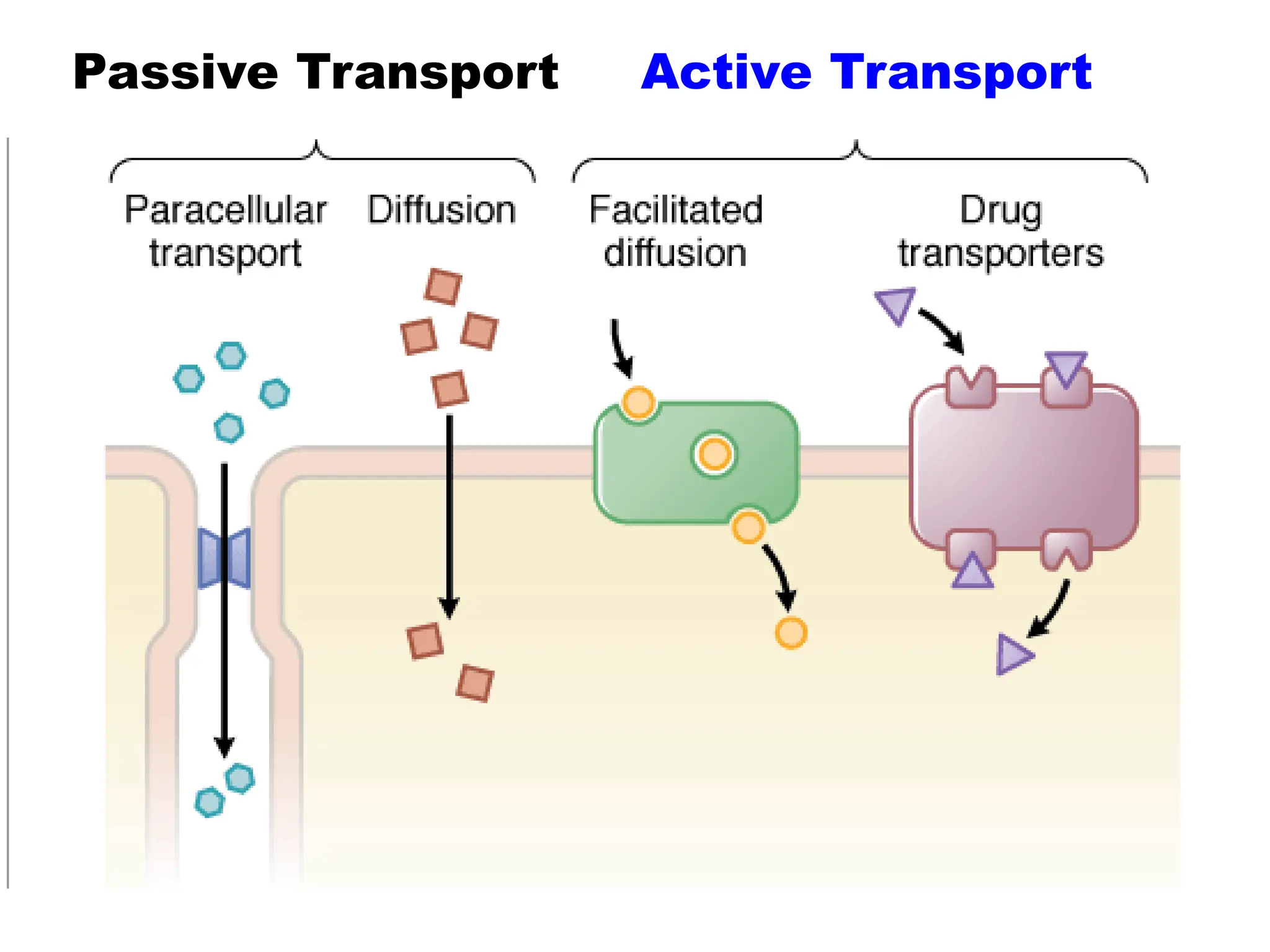
Passive Transport Active Transport
Where it acts ?
Where it acts ?
( Site of action )
( Site of action )
How it acts ?
How it acts ?
( Mechanism of action )
What are the Effects ?
( Pharmacological Effects )
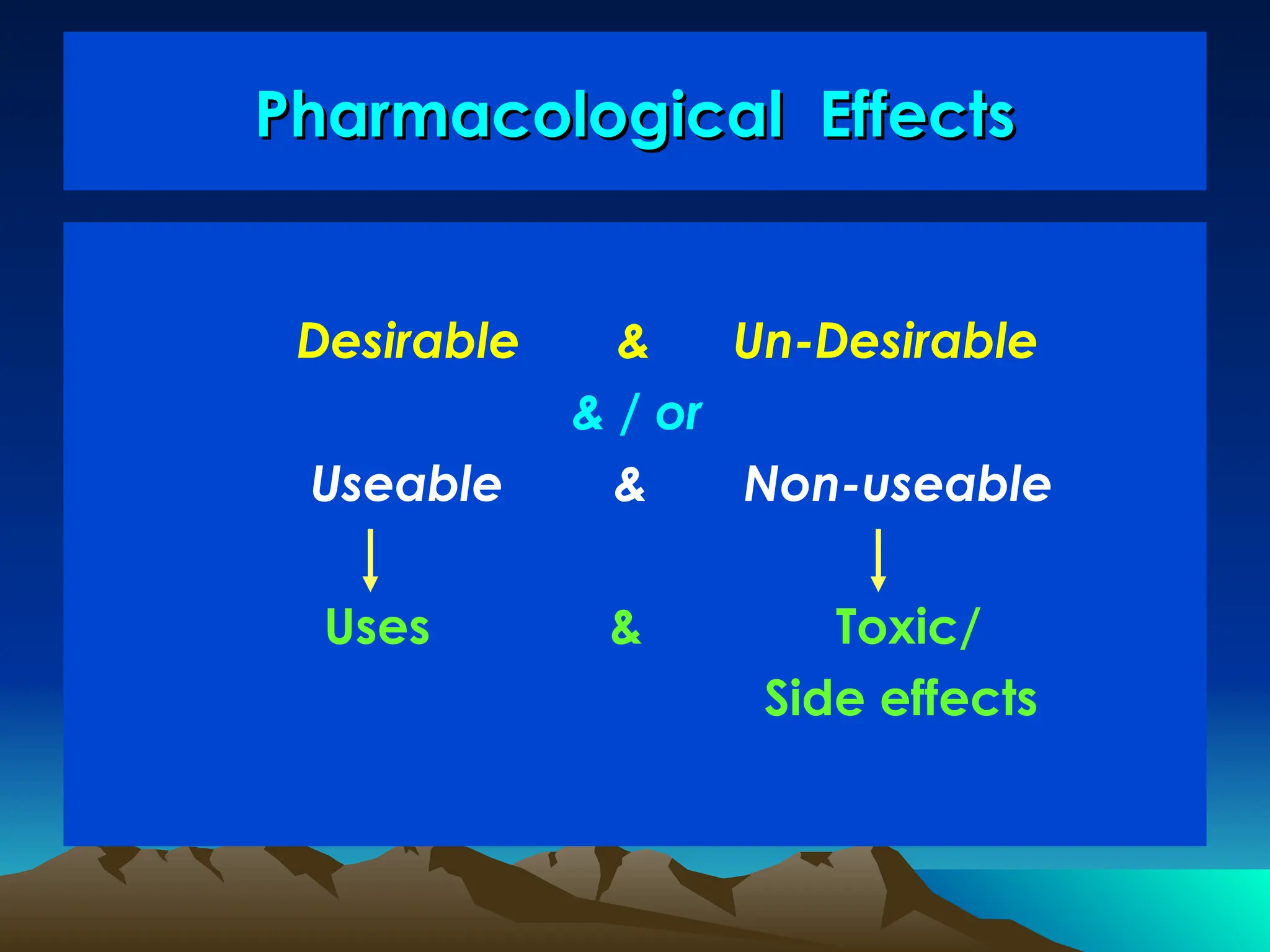
Pharmacological Effects
Desirable & Un-Desirable
& / or
Useable & Non-useable
Uses & Toxic/
Side effects
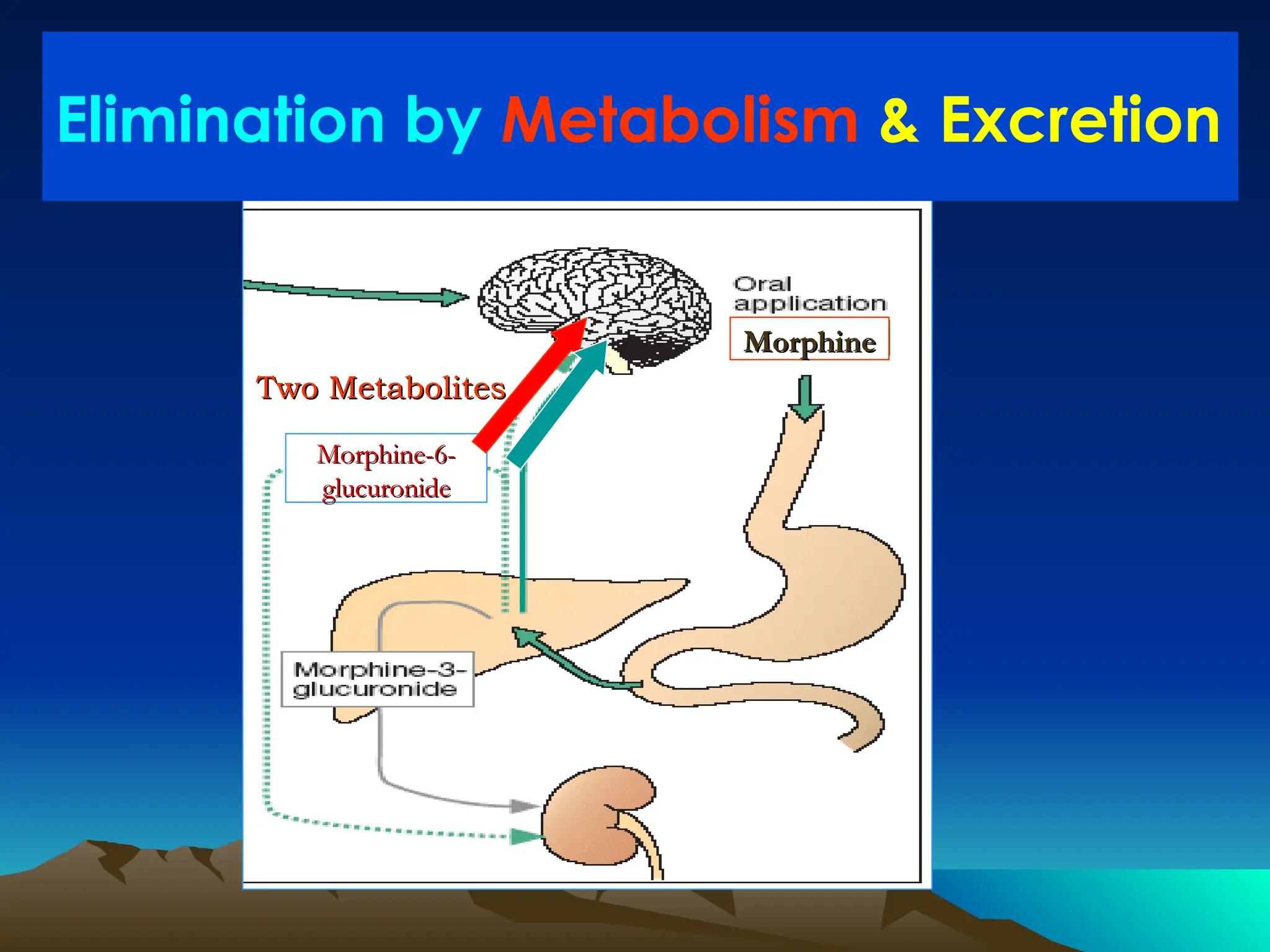
Morphine-6-
Morphine-6-
glucuronide
glucuronide
Morphine
Morphine
Elimination by Metabolism & Excretion
Two Metabolites
Two Metabolites
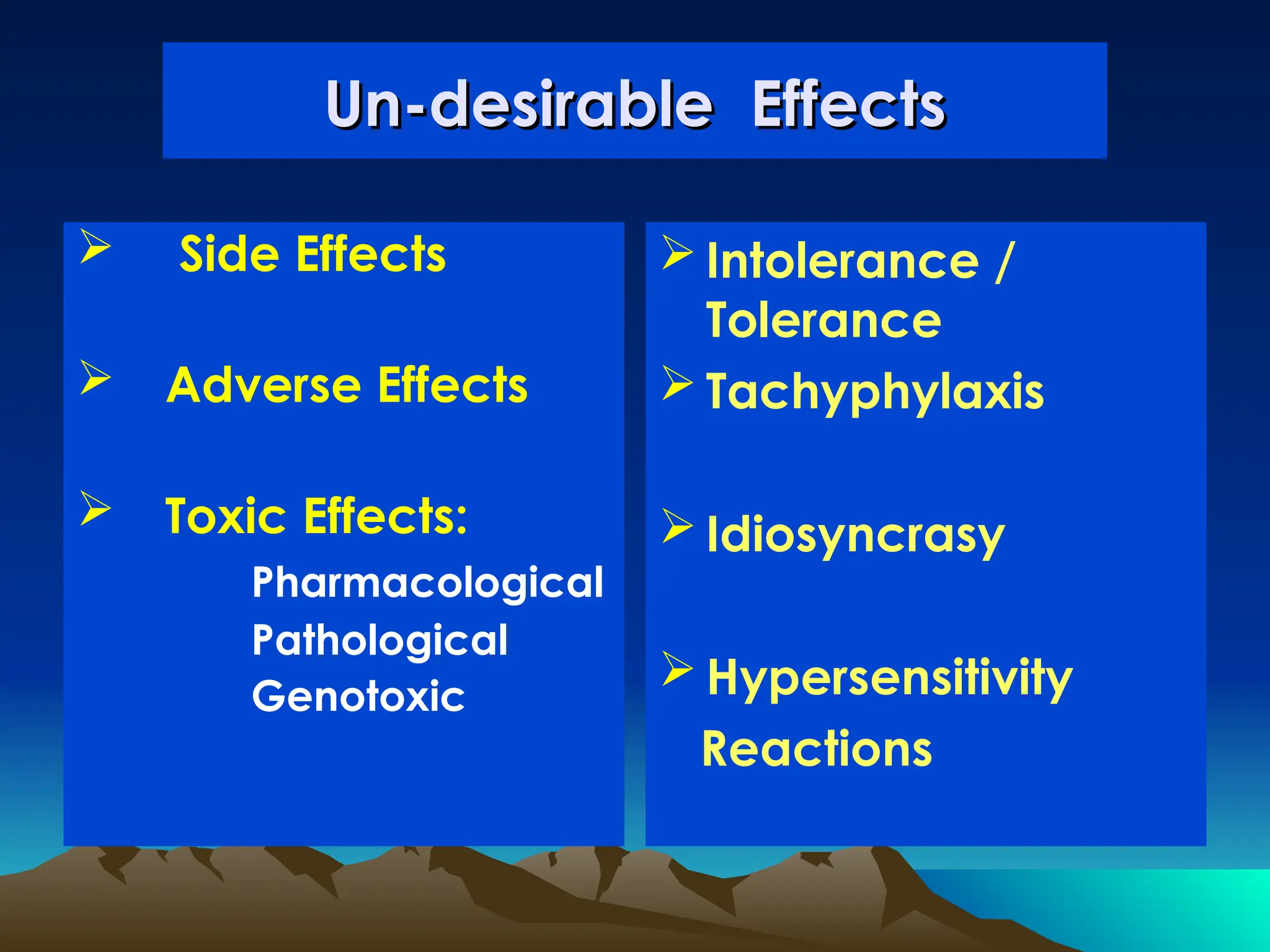
Un-desirable Effects
 Side Effects
 Adverse Effects
 Toxic Effects:
Pharmacological
Pathological
Genotoxic
 Intolerance /
Tolerance
 Tachyphylaxis
 Idiosyncrasy
 Hypersensitivity
Reactions
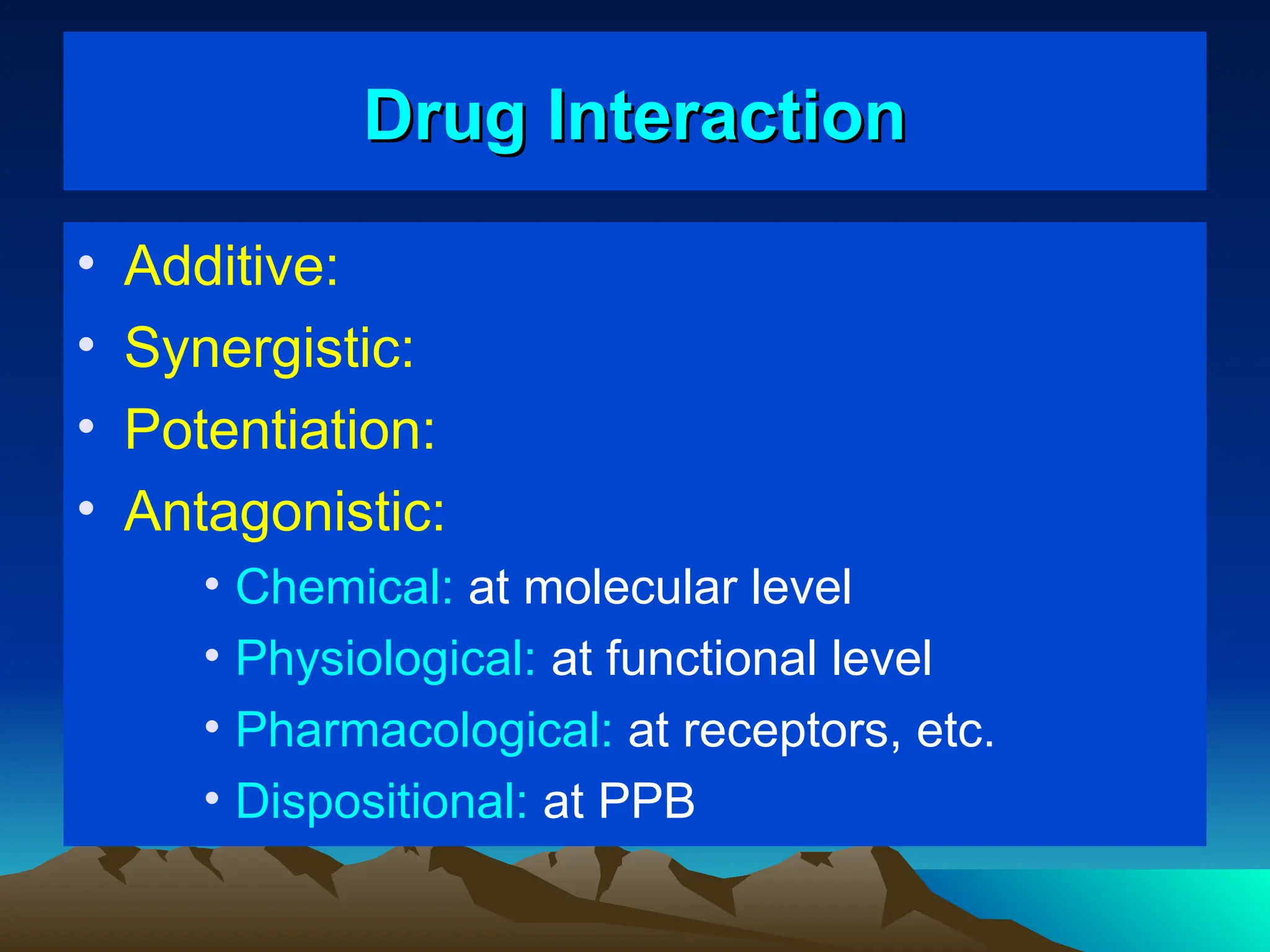
Drug Interaction
Drug Interaction
• Additive:
• Synergistic:
• Potentiation:
• Antagonistic:
• Chemical: at molecular level
• Physiological: at functional level
• Pharmacological: at receptors, etc.
• Dispositional: at PPB
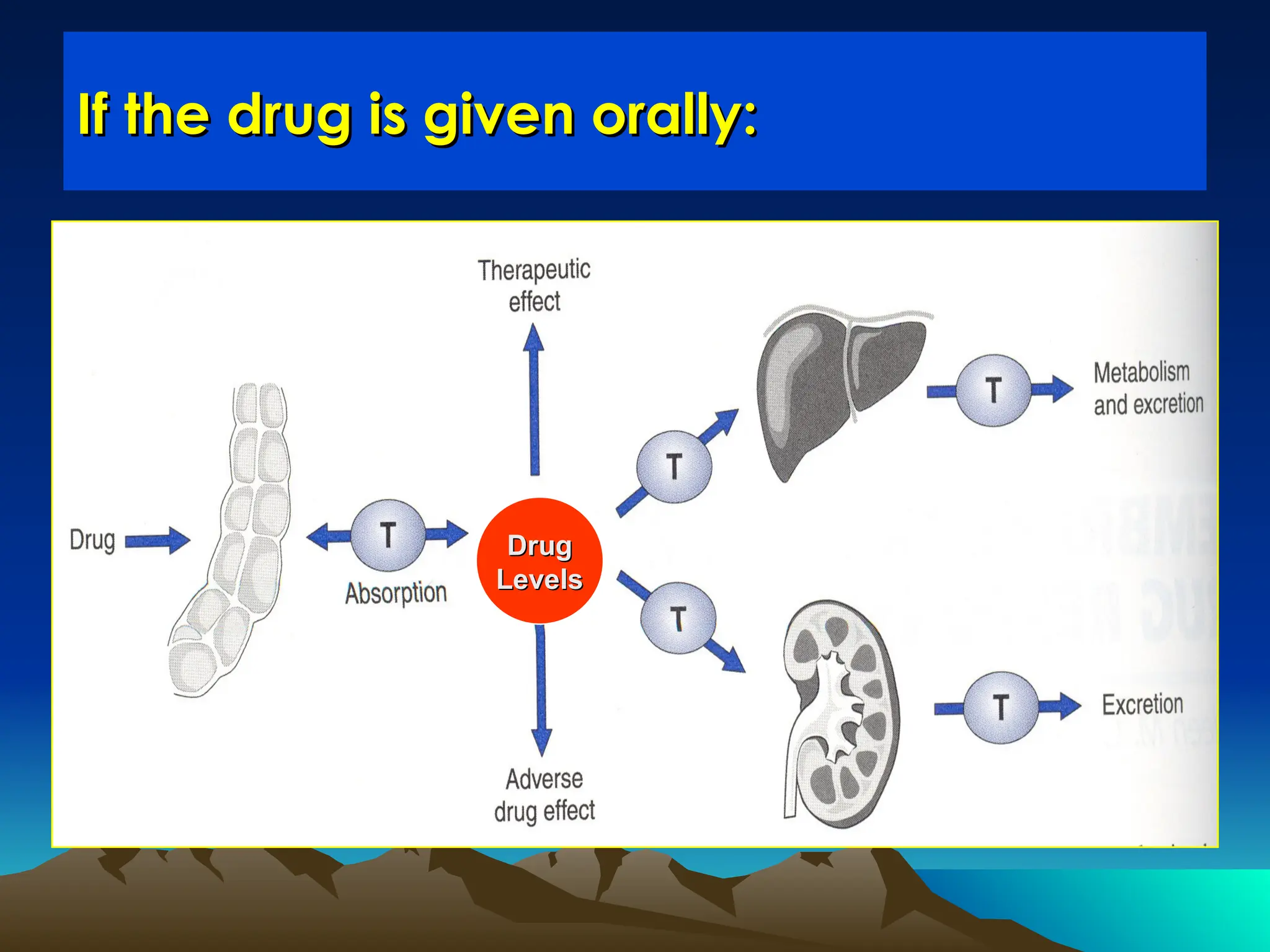
If the drug is given orally:
Drug
Drug
Levels
Levels
Drug
Drug
Dose
Dose
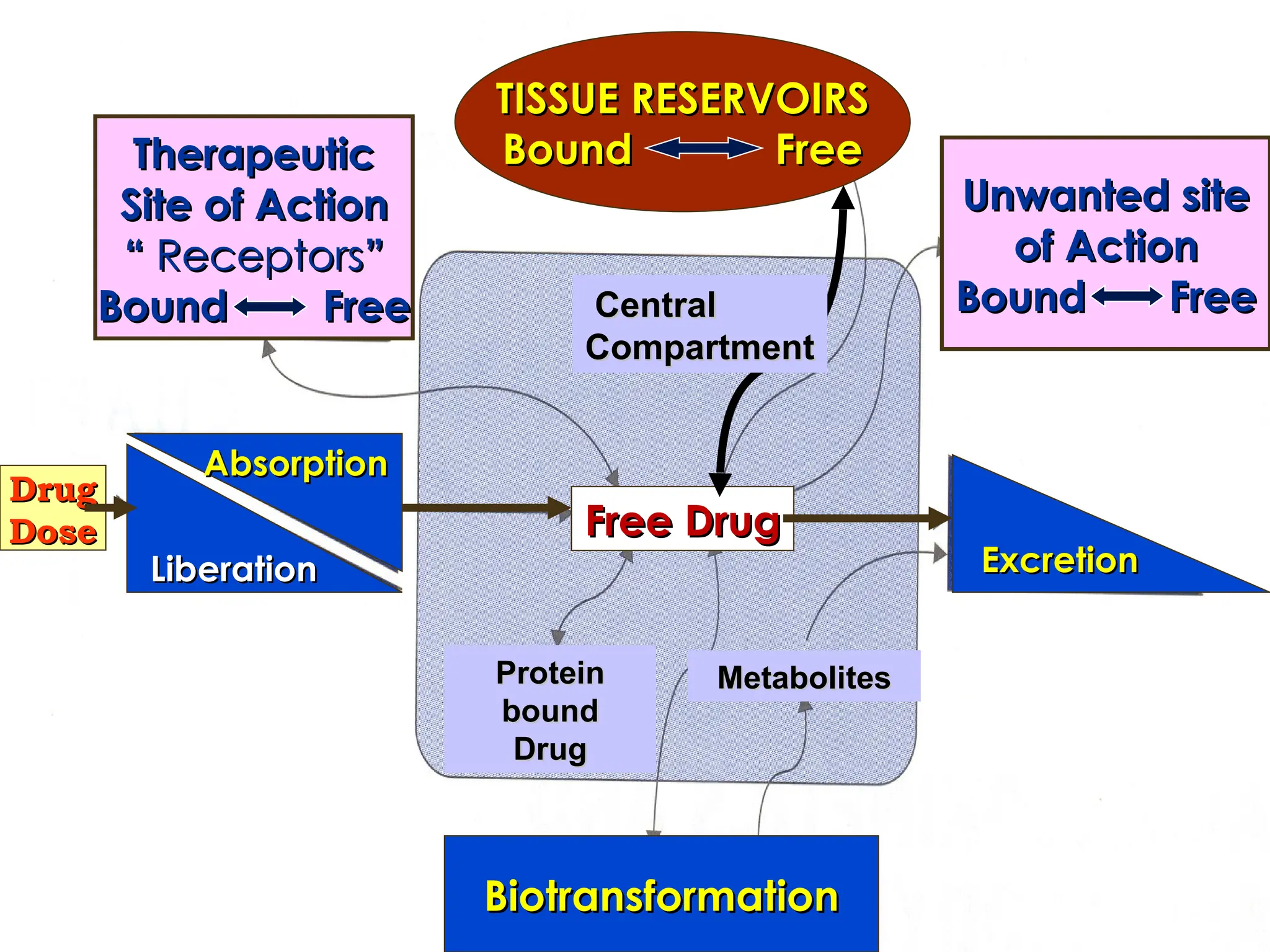
TISSUE RESERVOIRS
TISSUE RESERVOIRS
Bound Free
Bound Free
Biotransformation
Biotransformation
Excretion
Excretion
Free Drug
Free Drug
Therapeutic
Therapeutic
Site of Action
Site of Action
“
“ Receptors
Receptors”
”
Bound Free
Bound Free
Unwanted site
Unwanted site
of Action
of Action
Bound Free
Bound Free
Liberation
Liberation
Absorption
Absorption
Protein
Protein
bound
bound
Drug
Drug
Metabolites
Metabolites
Central
Central
Compartment
Compartment
Branches of Pharmacology
Pharmacodynamics
Pharmacodynamics
The word
The word ‘
‘dynamis
dynamis’
’ means
means power / activity.
power / activity.
Thus this branch deals with the study of
“
“ What the drug does to the body
What the drug does to the body”
”.
.
It is concerned with the response of living
organism to the chemical substances or drugs.
It deals with physiological and biochemical
changes produced by the drugs and their
mechanism of action at macromolecular
level.
level.
It is concerned with the relationships
between
between
the concentration of drugs at its site of
action
action
and the magnitude of effect that is
achieved.
achieved.
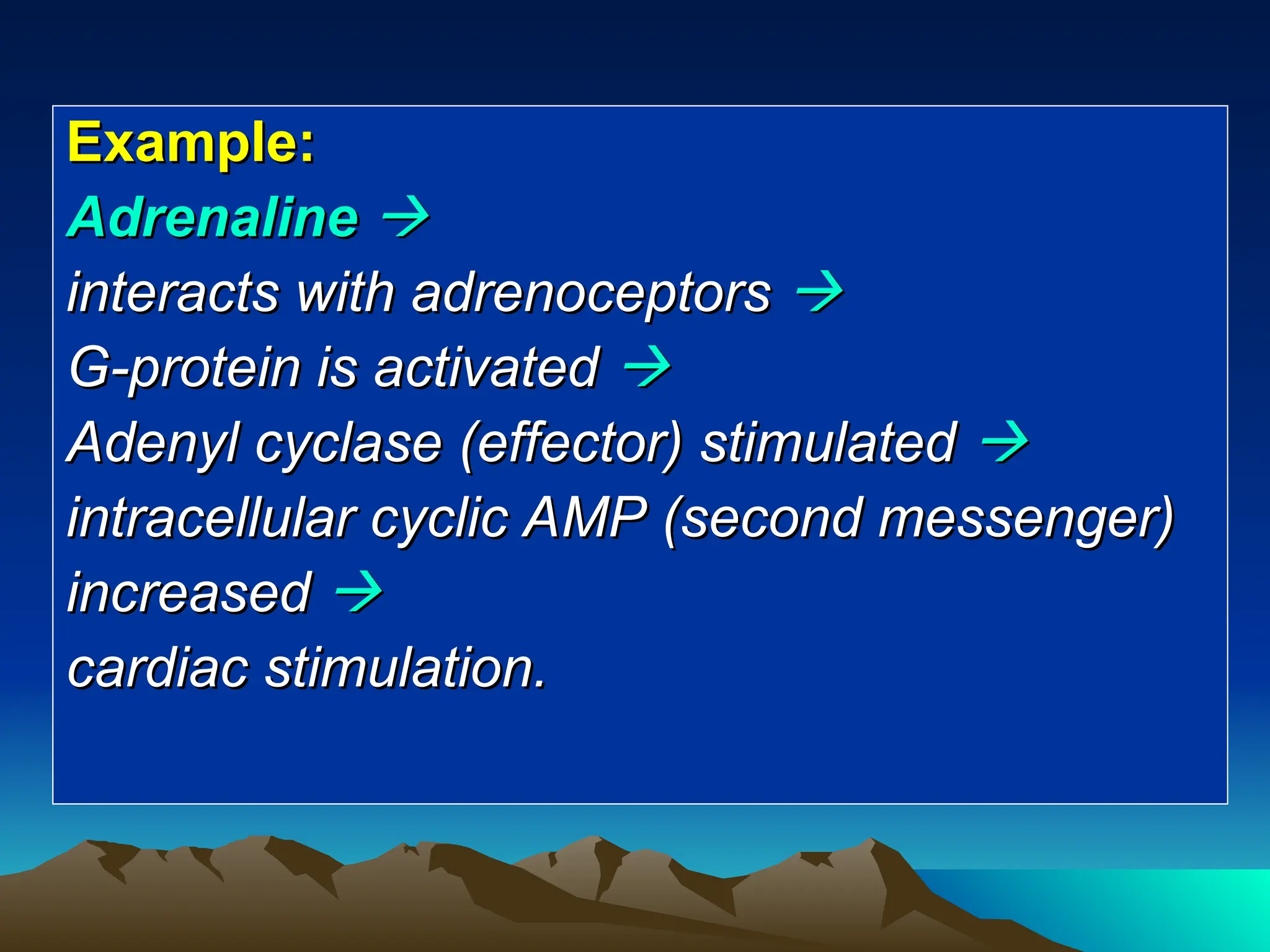
Example:
Example:
Adrenaline
Adrenaline 

interacts with adrenoceptors
interacts with adrenoceptors 

G-protein is activated
G-protein is activated 

Adenyl cyclase (effector) stimulated
Adenyl cyclase (effector) stimulated 

intracellular cyclic AMP (second messenger)
increased
increased 

cardiac stimulation.
Pharmacokinetics
Pharmacokinetics
(
( kinesis
kinesis 
 movement )
movement )
This branch deals with the study of
“
“What the body does to the drug
What the body does to the drug”
”.
.
This refers to the movement of drug in the body and
alteration of drug by the body.
Pharmacokinetics
Pharmacokinetics
It is the study of time-course of absorption,
distribution, metabolism and excretion of
drugs.
drugs.
Pharmacokinetics explores the factors that
determine
determine
The relationship between
drug dosage and
drug dosage and
the time-varying concentration of
drug at its
drug at its site of action.
site of action.
Pharmacotherapeutics
It deals with the use of drugs in the
prevention and treatment of disease and
the amelioration of symptoms
Clinical Pharmacology
It is the scientific study of drugs in
healthy volunteers and in patients.
It includes :
It includes :
pharmacodynamic and
pharmacodynamic and
pharmacokinetic investigations and it
evaluates the efficacy and safety of
drugs
drugs
CHEMOTHERAPY
CHEMOTHERAPY
It is the treatment of systemic
infections/malignancy with drugs
which have selective toxicity for
the infecting organism/malignant
cell with no/minimal effects on the
host cells
host cells
PHARMACY
PHARMACY
It is the art and science of
compounding and dispensing
drugs and
drugs and preparing
preparing suitable
suitable
dosage forms
dosage forms
PHARMACOGNOSY
PHARMACOGNOSY
It deals with :
It deals with :
source, identification and physical
and chemical properties
characteristics of drugs obtained
from plants
from plants
TOXICOLOGY
TOXICOLOGY
It deals with the :
It deals with the :
adverse effects of drugs and the
toxic effects
toxic effects due to poisoning by
due to poisoning by
drugs
drugs
PHARMACOGENETICS
PHARMACOGENETICS
It deals with :
It deals with :
variations
variations in drug response due
in drug response due
to genetic factors
to genetic factors
IMMUNOPHARMACOLOGY
IMMUNOPHARMACOLOGY
It deals with :
It deals with :
the study of
the study of immunological aspects
immunological aspects
of drug action including effects of
drugs on immune response and
production of antibodies in
response to drugs
response to drugs
POSOLOGY
POSOLOGY
This branch of Pharmacology deals
with
with doses
doses of drugs
of drugs
PLACEBO
PLACEBO
It is defined as :
It is defined as :
an inactive dummy preparation
which is deliberately used for its
nonspecific, psychological effect
on a patient, on symptoms or on
an illness
an illness
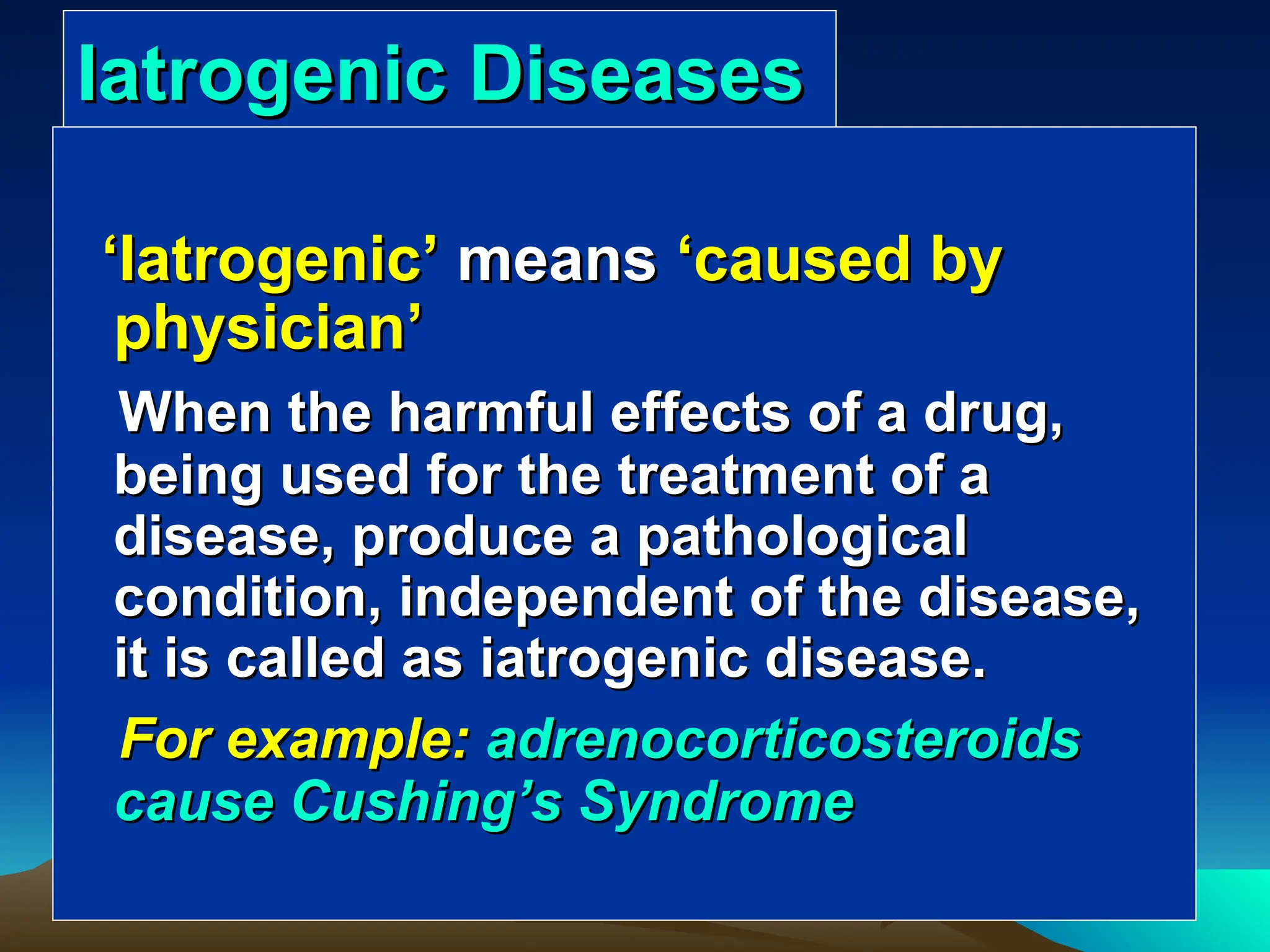
Iatrogenic Diseases
Iatrogenic Diseases
‘
‘Iatrogenic
Iatrogenic’
’ means
means ‘
‘caused by
caused by
physician
physician’
’
When the harmful effects of a drug,
being used for the treatment of a
disease, produce a pathological
condition, independent of the disease,
it is called as iatrogenic disease.
For example:
For example: adrenocorticosteroids
adrenocorticosteroids
cause Cushing
cause Cushing’
’s Syndrome
s Syndrome
ORPHAN DRUGS
ORPHAN DRUGS
These are drugs or biological products for
Diagnosis / Treatment / Prevention of
Rare Disease
Rare Disease or condition.
or condition.
It is expected that the cost of developing and
marketing them will not be recovered from their
sales.
sales.
Examples:
Examples: Sodium nitrite, Protamine sulfate,
Sodium nitrite, Protamine sulfate,
Calcitonin
Calcitonin
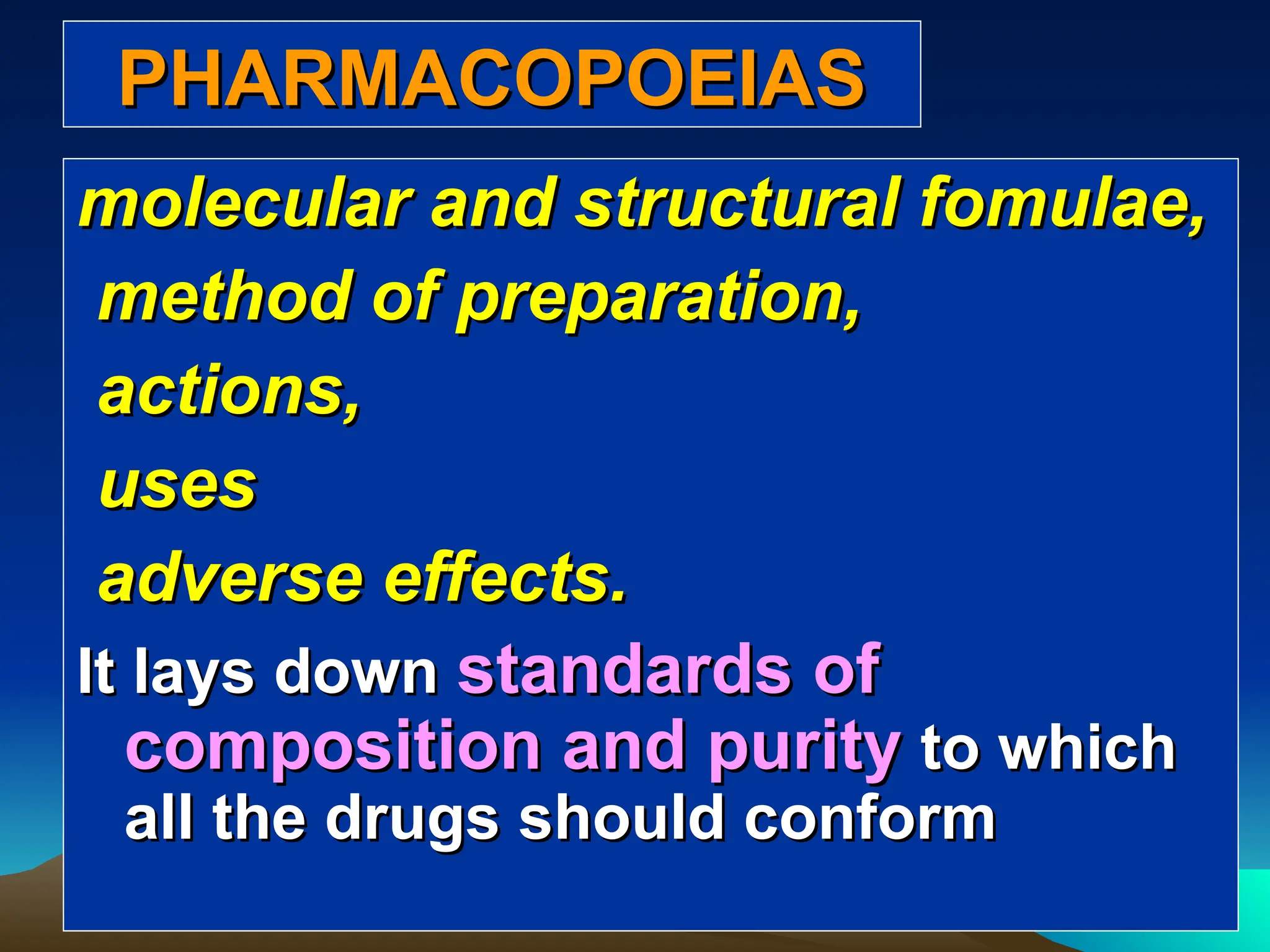
PHARMACOPOEIAS
PHARMACOPOEIAS
Pharmacopoeia is an :
authoritative list
authoritative list of useful drugs,
of useful drugs,
published by many countries
every five years,
every five years,
for the guidance of physician and
pharmacist which gives all the details
about drugs
about drugs
PHARMACOPOEIAS
PHARMACOPOEIAS
molecular and structural fomulae,
method of preparation,
actions,
actions,
uses
uses
adverse effects.
adverse effects.
It lays down
It lays down standards of
standards of
composition and purity
composition and purity to which
to which
all the drugs should conform
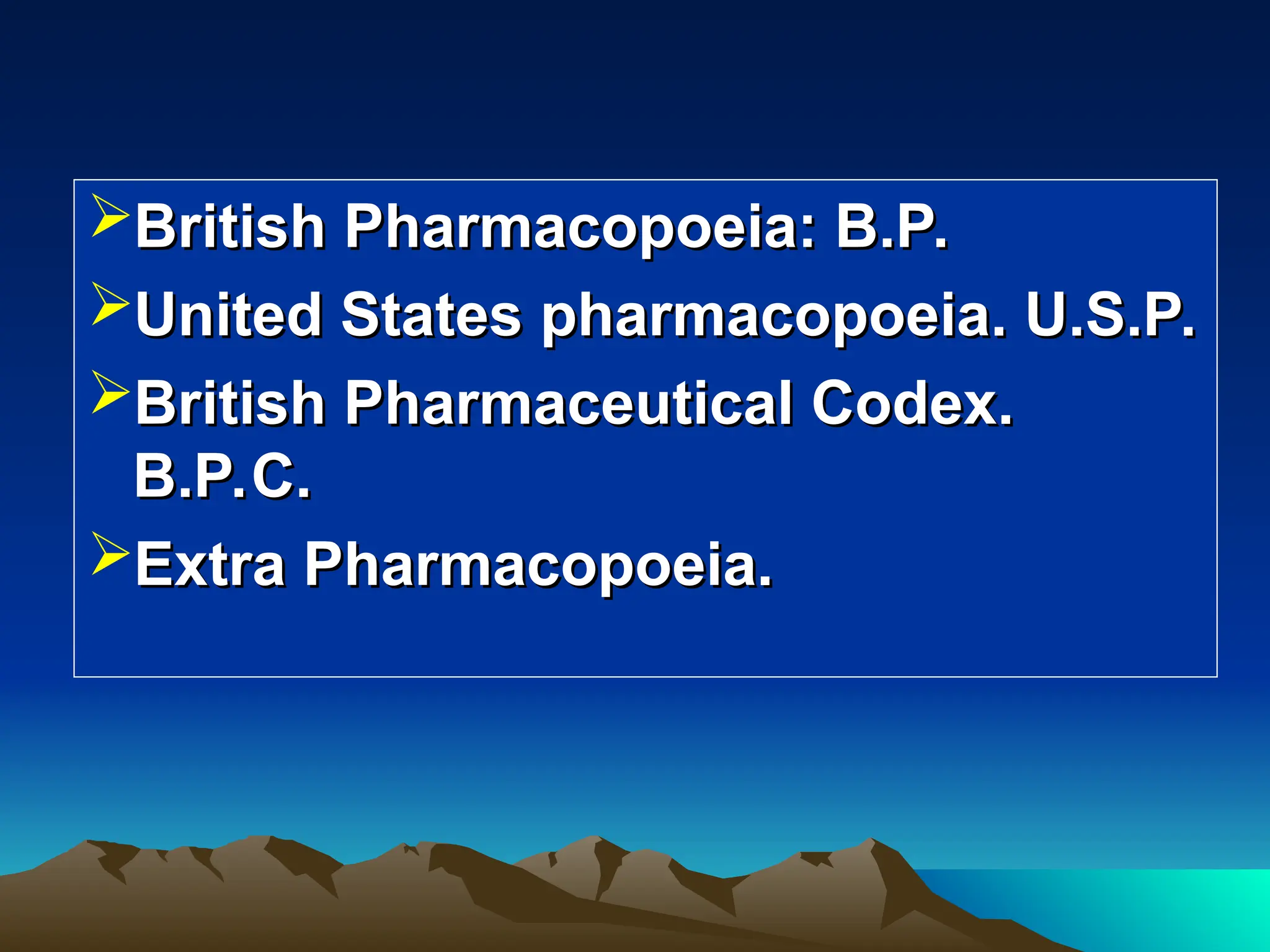
British Pharmacopoeia: B.P.
British Pharmacopoeia: B.P.
United States pharmacopoeia. U.S.P.
United States pharmacopoeia. U.S.P.
British Pharmaceutical Codex.
British Pharmaceutical Codex.
B.P.C.
B.P.C.
Extra Pharmacopoeia.
Extra Pharmacopoeia.
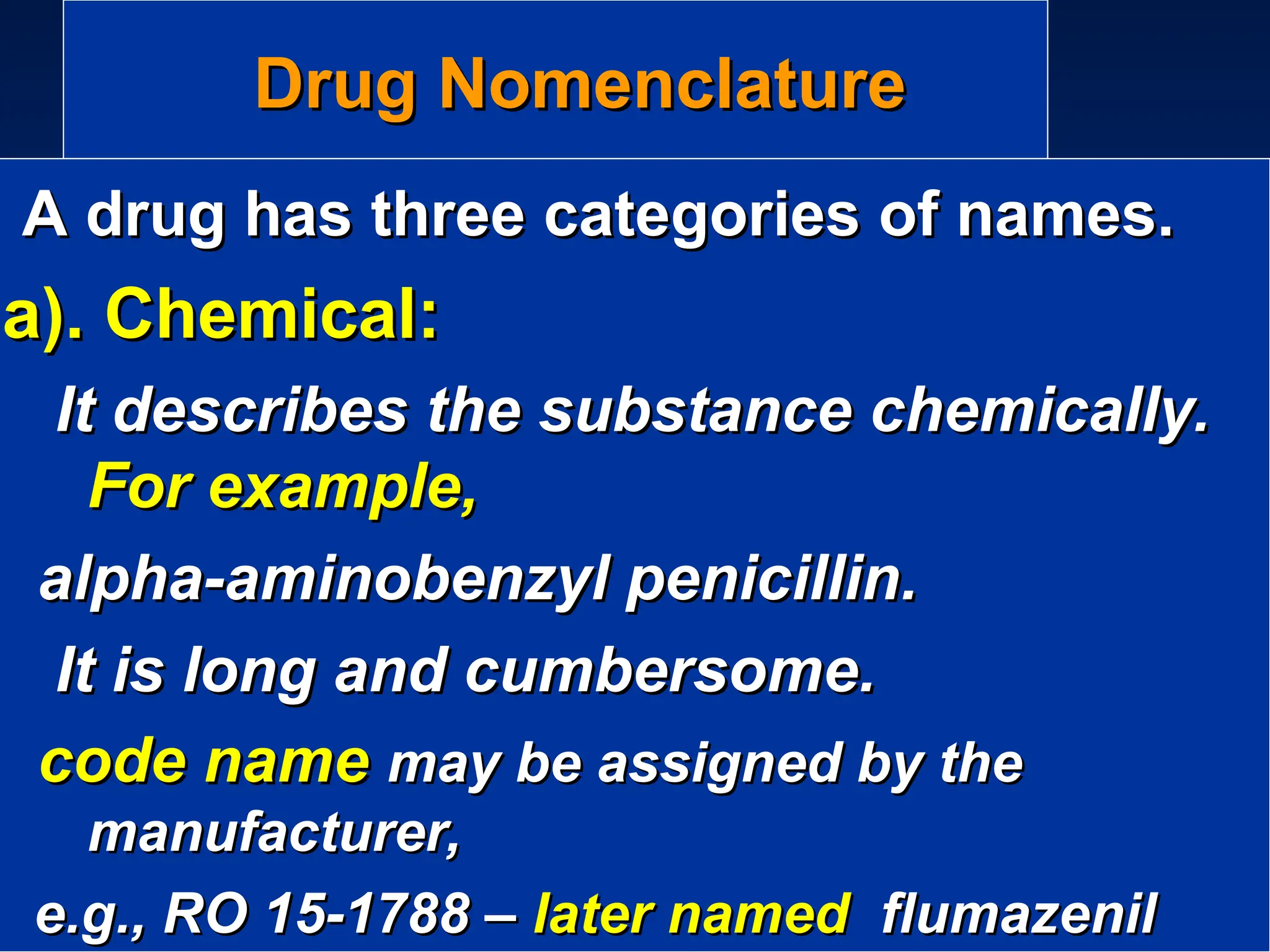
Drug Nomenclature
Drug Nomenclature
A drug has three categories of names.
a). Chemical:
a). Chemical:
It describes the substance chemically.
For example,
For example,
alpha-aminobenzyl penicillin.
It is long and cumbersome.
code name
code name may be assigned by the
may be assigned by the
manufacturer,
manufacturer,
e.g., RO 15-1788 –
e.g., RO 15-1788 – later named
later named flumazenil
flumazenil
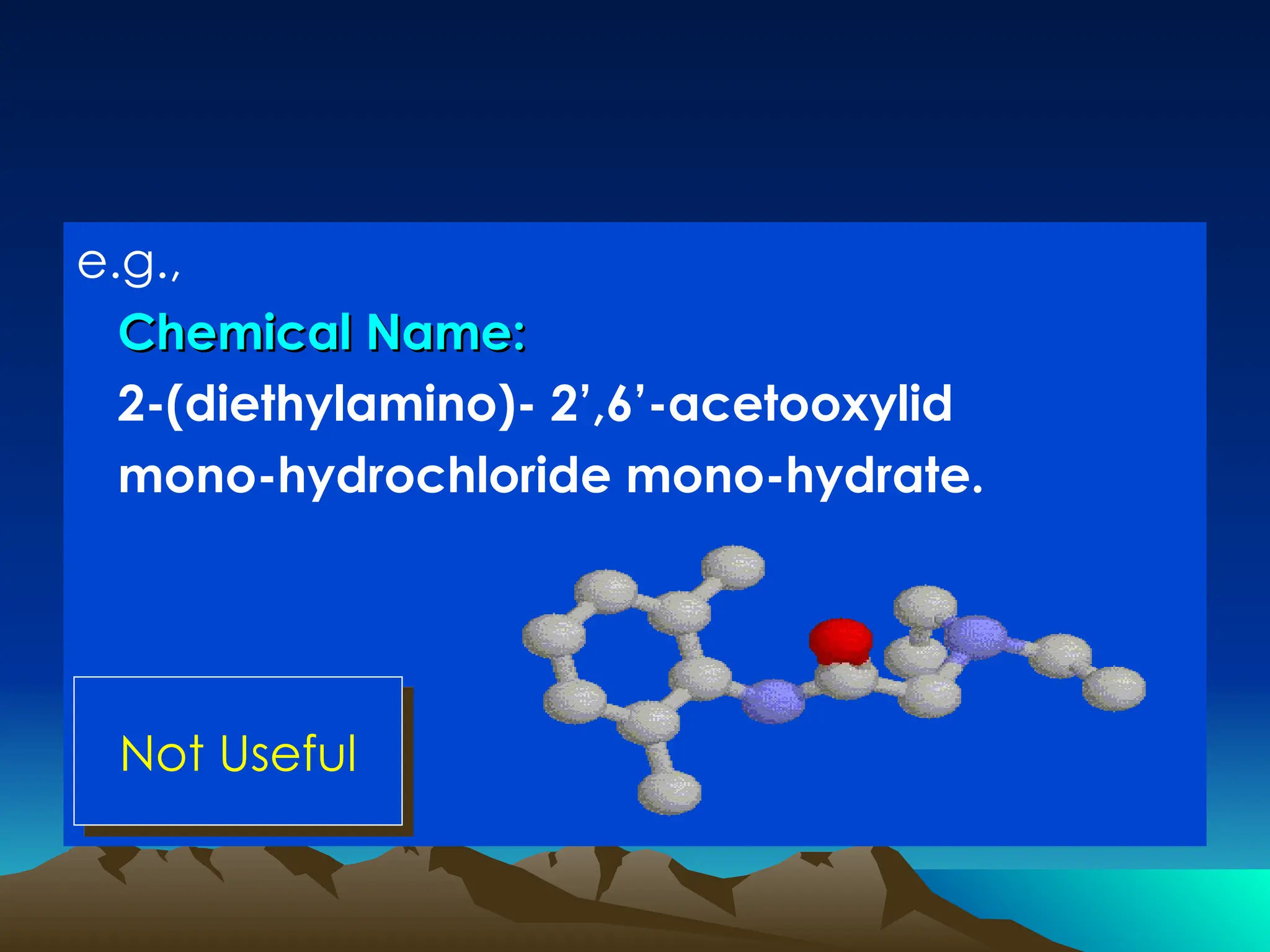
e.g.,
Chemical Name:
Chemical Name:
2-(diethylamino)- 2’,6’-acetooxylid
mono-hydrochloride mono-hydrate.
Not Useful
b). Generic name or non-proprietary name.
This name is used in :
text-books,
text-books,
pharmacopoeias
pharmacopoeias
journals.
journals.
For example,
For example, Ampicillin.
Ampicillin.
It is also known as
It is also known as ‘
‘approved name
approved name’
’.
.
When it is included in Pharmacopoeia, it
is called
is called
‘
‘Official Name
Official Name’
’
(c)
(c) Proprietary Name or
Proprietary Name or
Brand Name:
Brand Name:
This name is given by
This name is given by pharmaceutical
pharmaceutical
company
company and it is its trade mark and
and it is its trade mark and
property.
property.
One drug may have multiple proprietary
names.
names.
One drug may have Multiple Proprietary
Names, e.g., Ampicillin:
Penbritin®
Omnipen®
Standacillin®
(GSK) (Wyeth)
(Novartis /
Sandoz)
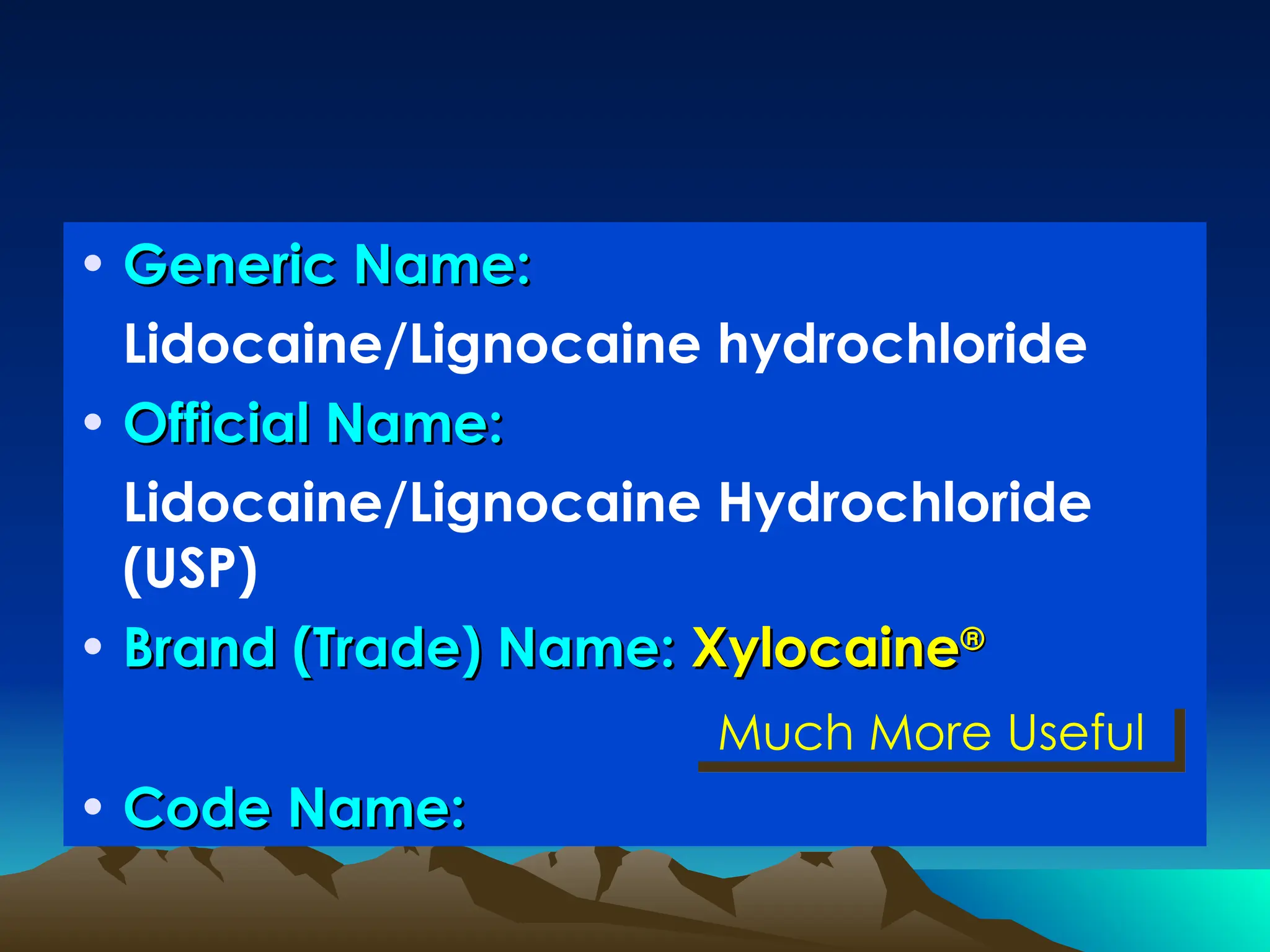
• Generic Name:
Generic Name:
Lidocaine/Lignocaine hydrochloride
• Official Name:
Official Name:
Lidocaine/Lignocaine Hydrochloride
(USP)
• Brand (Trade) Name:
Brand (Trade) Name: Xylocaine
Xylocaine®
®
• Code Name:
Code Name:
Much More Useful
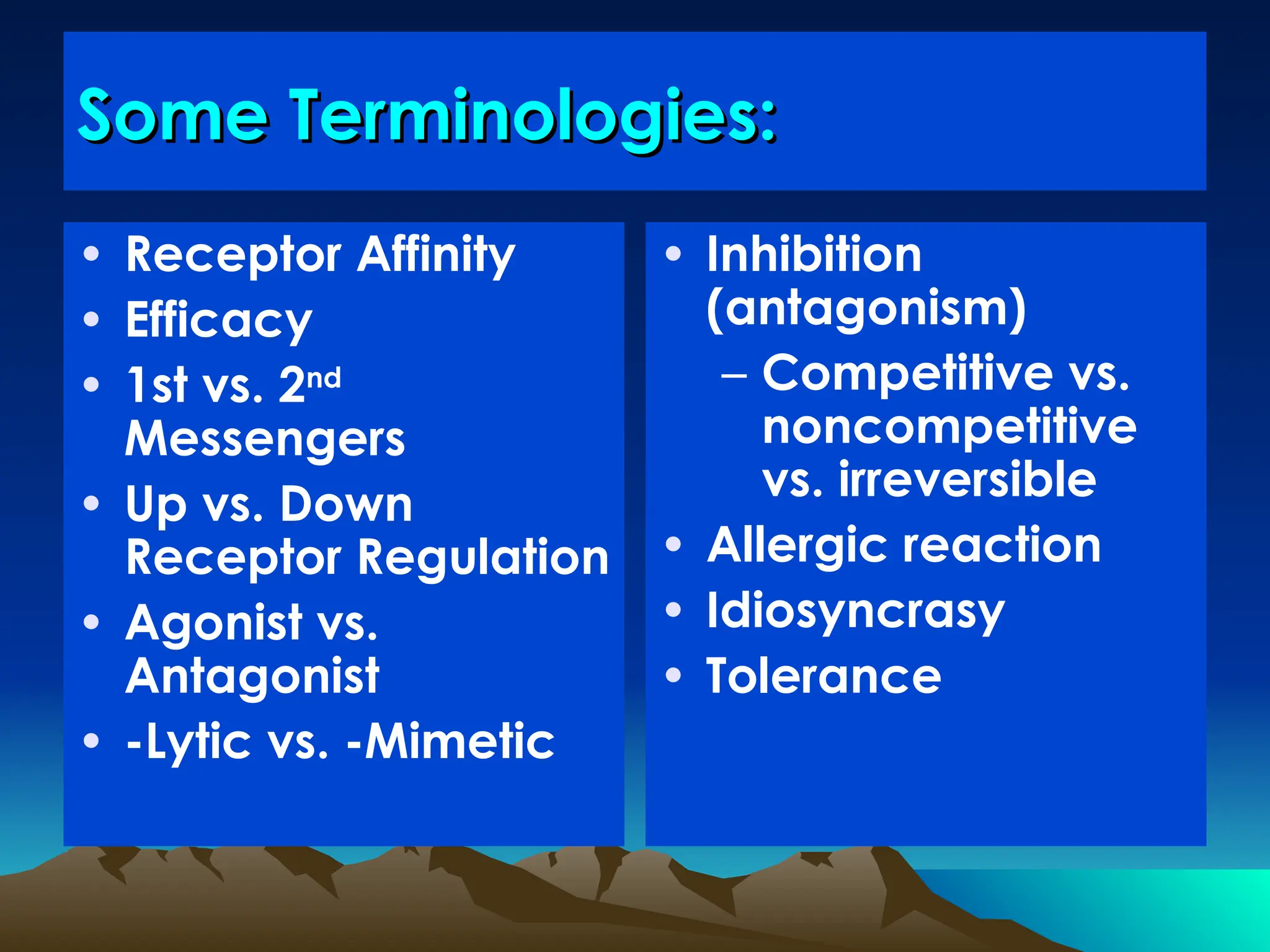
Some Terminologies:
Some Terminologies:
• Receptor Affinity
• Efficacy
• 1st vs. 2nd
Messengers
• Up vs. Down
Receptor Regulation
• Agonist vs.
Antagonist
• -Lytic vs. -Mimetic
• Inhibition
(antagonism)
– Competitive vs.
noncompetitive
vs. irreversible
• Allergic reaction
• Idiosyncrasy
• Tolerance
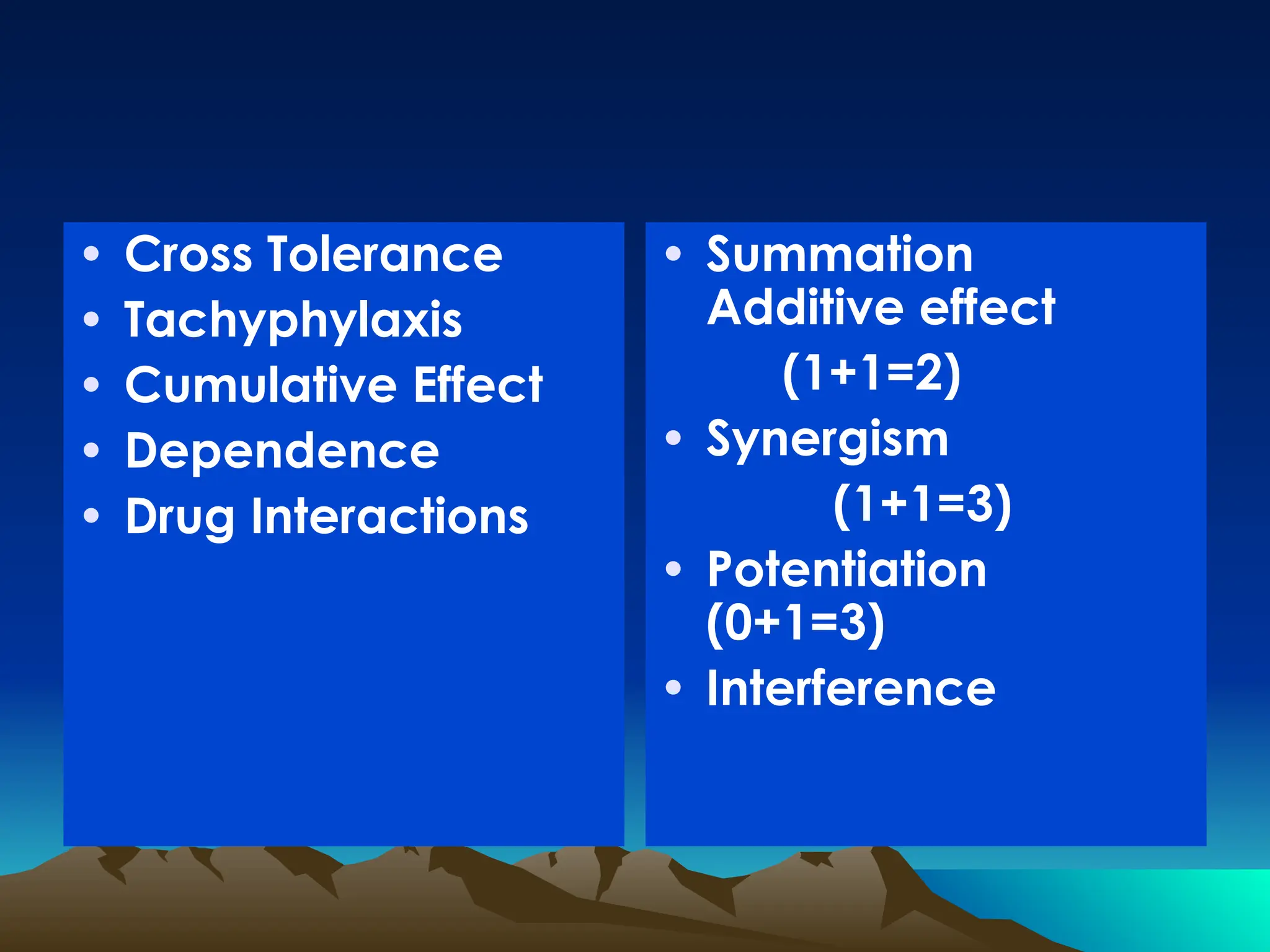
• Cross Tolerance
• Tachyphylaxis
• Cumulative Effect
• Dependence
• Drug Interactions
• Summation
Additive effect
(1+1=2)
• Synergism
(1+1=3)
• Potentiation
(0+1=3)
• Interference

Introduction to Pharmacology.power point

  • 1.
  • 2.
    Pharmacology Pharmacology embraces the knowledgeof: embraces the knowledge of: History, Source, Physical History, Source, Physical and and chemical properties, chemical properties, Absorption, Distribution, Biotransformation and Absorption, Distribution, Biotransformation and Excretion of drugs, Excretion of drugs, Biochemical and physiological effects, Biochemical and physiological effects, Mechanism of Action, Mechanism of Action, Therapeutic and Other uses of drugs Therapeutic and Other uses of drugs. .
  • 3.
  • 4.
  • 5.
    DRUG DRUG A drug maybe broadly defined as A drug may be broadly defined as any chemical agent which affects living any chemical agent which affects living protoplasm. protoplasm. According to definition of WHO, According to definition of WHO, a drug is any substance or product that is used a drug is any substance or product that is used or or intended to be used to modify or explore intended to be used to modify or explore physiological systems or pathological states physiological systems or pathological states for the benefit of recipient. for the benefit of recipient. It means a chemical used in prevention, It means a chemical used in prevention, diagnosis or diagnosis or treatment of disease treatment of disease. .
  • 6.
    Components of aDrug Profile Components of a Drug Profile • Source • Names • Classification (with prototype) • Routes of Administration • Pharmacokinetics • Mechanism of Action • Indications / Uses • With doses • Contraindications • Side Effects • Drug Interactions • How Supplied
  • 7.
  • 8.
    Example Example Papaver Somniferum Papaver Somniferum Composition Compositionof of Opium Alkaloids: Opium Alkaloids: Phenanthrenes: Phenanthrenes: Morphine (10%), Morphine (10%), Codeine (0.5%), Codeine (0.5%), Thebaine (0.2%). Thebaine (0.2%). Benzylisoquinolines: Benzylisoquinolines: Papaverine (1%), Papaverine (1%), Noscapine (6%). Noscapine (6%). Opium Tincture Tincture
  • 9.
  • 10.
    Example of Morphine: Exampleof Morphine: Routes of Administration: Routes of Administration:
  • 11.
  • 12.
    Where it acts? Where it acts ? ( Site of action ) ( Site of action ) How it acts ? How it acts ? ( Mechanism of action ) ( Mechanism of action ) What are the Effects ? What are the Effects ? ( Pharmacological Effects ) ( Pharmacological Effects )
  • 13.
    Pharmacological Effects Pharmacological Effects Desirable& Un-Desirable & / or Useable & Non-useable Uses & Toxic/ Side effects
  • 14.
  • 16.
    Un-desirable Effects Un-desirable Effects Side Effects  Adverse Effects  Toxic Effects: Pharmacological Pathological Genotoxic  Intolerance / Tolerance  Tachyphylaxis  Idiosyncrasy  Hypersensitivity Reactions
  • 17.
    Drug Interaction Drug Interaction •Additive: • Synergistic: • Potentiation: • Antagonistic: • Chemical: at molecular level • Physiological: at functional level • Pharmacological: at receptors, etc. • Dispositional: at PPB
  • 19.
    If the drugis given orally: If the drug is given orally: Drug Drug Levels Levels
  • 20.
    Drug Drug Dose Dose TISSUE RESERVOIRS TISSUE RESERVOIRS BoundFree Bound Free Biotransformation Biotransformation Excretion Excretion Free Drug Free Drug Therapeutic Therapeutic Site of Action Site of Action “ “ Receptors Receptors” ” Bound Free Bound Free Unwanted site Unwanted site of Action of Action Bound Free Bound Free Liberation Liberation Absorption Absorption Protein Protein bound bound Drug Drug Metabolites Metabolites Central Central Compartment Compartment
  • 21.
  • 22.
    Pharmacodynamics Pharmacodynamics The word The word‘ ‘dynamis dynamis’ ’ means means power / activity. power / activity. Thus this branch deals with the study of Thus this branch deals with the study of “ “ What the drug does to the body What the drug does to the body” ”. . It is concerned with the response of living It is concerned with the response of living organism to the chemical substances or drugs. organism to the chemical substances or drugs.
  • 23.
    It deals withphysiological and biochemical It deals with physiological and biochemical changes produced by the drugs and their changes produced by the drugs and their mechanism of action at macromolecular mechanism of action at macromolecular level. level. It is concerned with the relationships It is concerned with the relationships between between the concentration of drugs at its site of the concentration of drugs at its site of action action and the magnitude of effect that is and the magnitude of effect that is achieved. achieved.
  • 24.
    Example: Example: Adrenaline Adrenaline   interacts withadrenoceptors interacts with adrenoceptors   G-protein is activated G-protein is activated   Adenyl cyclase (effector) stimulated Adenyl cyclase (effector) stimulated   intracellular cyclic AMP (second messenger) intracellular cyclic AMP (second messenger) increased increased   cardiac stimulation. cardiac stimulation.
  • 25.
    Pharmacokinetics Pharmacokinetics ( ( kinesis kinesis  movement ) movement ) This branch deals with the study of This branch deals with the study of “ “What the body does to the drug What the body does to the drug” ”. . This refers to the movement of drug in the body and This refers to the movement of drug in the body and alteration of drug by the body. alteration of drug by the body.
  • 26.
    Pharmacokinetics Pharmacokinetics It is thestudy of time-course of absorption, It is the study of time-course of absorption, distribution, metabolism and excretion of distribution, metabolism and excretion of drugs. drugs. Pharmacokinetics explores the factors that Pharmacokinetics explores the factors that determine determine The relationship between The relationship between drug dosage and drug dosage and the time-varying concentration of the time-varying concentration of drug at its drug at its site of action. site of action.
  • 27.
    Pharmacotherapeutics Pharmacotherapeutics It deals withthe use of drugs in the It deals with the use of drugs in the prevention and treatment of disease and prevention and treatment of disease and the amelioration of symptoms the amelioration of symptoms
  • 28.
    Clinical Pharmacology Clinical Pharmacology Itis the scientific study of drugs in It is the scientific study of drugs in healthy volunteers and in patients. healthy volunteers and in patients. It includes : It includes : pharmacodynamic and pharmacodynamic and pharmacokinetic investigations and it pharmacokinetic investigations and it evaluates the efficacy and safety of evaluates the efficacy and safety of drugs drugs
  • 29.
    CHEMOTHERAPY CHEMOTHERAPY It is thetreatment of systemic It is the treatment of systemic infections/malignancy with drugs infections/malignancy with drugs which have selective toxicity for which have selective toxicity for the infecting organism/malignant the infecting organism/malignant cell with no/minimal effects on the cell with no/minimal effects on the host cells host cells
  • 30.
    PHARMACY PHARMACY It is theart and science of It is the art and science of compounding and dispensing compounding and dispensing drugs and drugs and preparing preparing suitable suitable dosage forms dosage forms
  • 31.
    PHARMACOGNOSY PHARMACOGNOSY It deals with: It deals with : source, identification and physical source, identification and physical and chemical properties and chemical properties characteristics of drugs obtained characteristics of drugs obtained from plants from plants
  • 32.
    TOXICOLOGY TOXICOLOGY It deals withthe : It deals with the : adverse effects of drugs and the adverse effects of drugs and the toxic effects toxic effects due to poisoning by due to poisoning by drugs drugs
  • 33.
    PHARMACOGENETICS PHARMACOGENETICS It deals with: It deals with : variations variations in drug response due in drug response due to genetic factors to genetic factors
  • 34.
    IMMUNOPHARMACOLOGY IMMUNOPHARMACOLOGY It deals with: It deals with : the study of the study of immunological aspects immunological aspects of drug action including effects of of drug action including effects of drugs on immune response and drugs on immune response and production of antibodies in production of antibodies in response to drugs response to drugs
  • 35.
    POSOLOGY POSOLOGY This branch ofPharmacology deals This branch of Pharmacology deals with with doses doses of drugs of drugs
  • 36.
    PLACEBO PLACEBO It is definedas : It is defined as : an inactive dummy preparation an inactive dummy preparation which is deliberately used for its which is deliberately used for its nonspecific, psychological effect nonspecific, psychological effect on a patient, on symptoms or on on a patient, on symptoms or on an illness an illness
  • 37.
    Iatrogenic Diseases Iatrogenic Diseases ‘ ‘Iatrogenic Iatrogenic’ ’means means ‘ ‘caused by caused by physician physician’ ’ When the harmful effects of a drug, When the harmful effects of a drug, being used for the treatment of a being used for the treatment of a disease, produce a pathological disease, produce a pathological condition, independent of the disease, condition, independent of the disease, it is called as iatrogenic disease. it is called as iatrogenic disease. For example: For example: adrenocorticosteroids adrenocorticosteroids cause Cushing cause Cushing’ ’s Syndrome s Syndrome
  • 38.
    ORPHAN DRUGS ORPHAN DRUGS Theseare drugs or biological products for These are drugs or biological products for Diagnosis / Treatment / Prevention of Diagnosis / Treatment / Prevention of Rare Disease Rare Disease or condition. or condition. It is expected that the cost of developing and It is expected that the cost of developing and marketing them will not be recovered from their marketing them will not be recovered from their sales. sales. Examples: Examples: Sodium nitrite, Protamine sulfate, Sodium nitrite, Protamine sulfate, Calcitonin Calcitonin
  • 39.
    PHARMACOPOEIAS PHARMACOPOEIAS Pharmacopoeia is an: Pharmacopoeia is an : authoritative list authoritative list of useful drugs, of useful drugs, published by many countries published by many countries every five years, every five years, for the guidance of physician and for the guidance of physician and pharmacist which gives all the details pharmacist which gives all the details about drugs about drugs
  • 40.
    PHARMACOPOEIAS PHARMACOPOEIAS molecular and structuralfomulae, molecular and structural fomulae, method of preparation, method of preparation, actions, actions, uses uses adverse effects. adverse effects. It lays down It lays down standards of standards of composition and purity composition and purity to which to which all the drugs should conform all the drugs should conform
  • 41.
    British Pharmacopoeia: B.P. BritishPharmacopoeia: B.P. United States pharmacopoeia. U.S.P. United States pharmacopoeia. U.S.P. British Pharmaceutical Codex. British Pharmaceutical Codex. B.P.C. B.P.C. Extra Pharmacopoeia. Extra Pharmacopoeia.
  • 42.
    Drug Nomenclature Drug Nomenclature Adrug has three categories of names. A drug has three categories of names. a). Chemical: a). Chemical: It describes the substance chemically. It describes the substance chemically. For example, For example, alpha-aminobenzyl penicillin. alpha-aminobenzyl penicillin. It is long and cumbersome. It is long and cumbersome. code name code name may be assigned by the may be assigned by the manufacturer, manufacturer, e.g., RO 15-1788 – e.g., RO 15-1788 – later named later named flumazenil flumazenil
  • 43.
    e.g., Chemical Name: Chemical Name: 2-(diethylamino)-2’,6’-acetooxylid mono-hydrochloride mono-hydrate. Not Useful
  • 44.
    b). Generic nameor non-proprietary name. b). Generic name or non-proprietary name. This name is used in : This name is used in : text-books, text-books, pharmacopoeias pharmacopoeias journals. journals. For example, For example, Ampicillin. Ampicillin. It is also known as It is also known as ‘ ‘approved name approved name’ ’. . When it is included in Pharmacopoeia, it When it is included in Pharmacopoeia, it is called is called ‘ ‘Official Name Official Name’ ’
  • 45.
    (c) (c) Proprietary Nameor Proprietary Name or Brand Name: Brand Name: This name is given by This name is given by pharmaceutical pharmaceutical company company and it is its trade mark and and it is its trade mark and property. property. One drug may have multiple proprietary One drug may have multiple proprietary names. names.
  • 46.
    One drug mayhave Multiple Proprietary Names, e.g., Ampicillin: Penbritin® Omnipen® Standacillin® (GSK) (Wyeth) (Novartis / Sandoz)
  • 47.
    • Generic Name: GenericName: Lidocaine/Lignocaine hydrochloride • Official Name: Official Name: Lidocaine/Lignocaine Hydrochloride (USP) • Brand (Trade) Name: Brand (Trade) Name: Xylocaine Xylocaine® ® • Code Name: Code Name: Much More Useful
  • 49.
    Some Terminologies: Some Terminologies: •Receptor Affinity • Efficacy • 1st vs. 2nd Messengers • Up vs. Down Receptor Regulation • Agonist vs. Antagonist • -Lytic vs. -Mimetic • Inhibition (antagonism) – Competitive vs. noncompetitive vs. irreversible • Allergic reaction • Idiosyncrasy • Tolerance
  • 50.
    • Cross Tolerance •Tachyphylaxis • Cumulative Effect • Dependence • Drug Interactions • Summation Additive effect (1+1=2) • Synergism (1+1=3) • Potentiation (0+1=3) • Interference