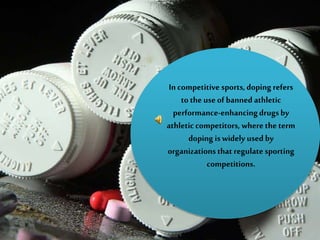

Incompetitive sports, doping refers
to the useofbanned athletic
performance-enhancingdrugsby
athletic competitors, where the term
doping is widely used by
organizations that regulate sporting
competitions.
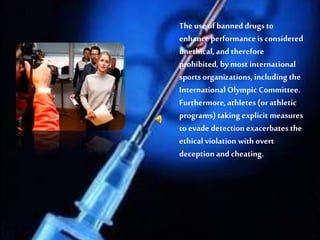
Theuseofbanned drugsto
enhanceperformanceis considered
unethical, and therefore
prohibited, by most international
sportsorganizations, including the
International Olympic Committee.
Furthermore,athletes (or athletic
programs) taking explicit measures
to evade detection exacerbates the
ethical violation with overt
deception and cheating.
HISTORY OF DOPING
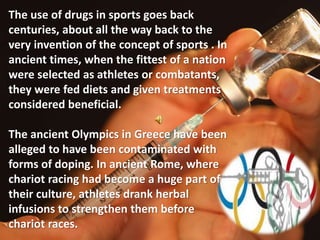
The use of drugs in sports goes back
centuries, about all the way back to the
very invention of the concept of sports . In
ancient times, when the fittest of a nation
were selected as athletes or combatants,
they were fed diets and given treatments
considered beneficial.
The ancient Olympics in Greece have been
alleged to have been contaminated with
forms of doping. In ancient Rome, where
chariot racing had become a huge part of
their culture, athletes drank herbal
infusions to strengthen them before
chariot races.
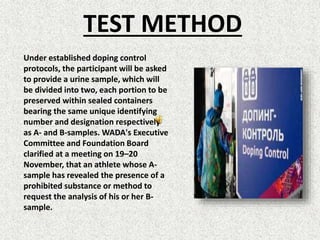
TEST METHOD
Under established doping control
protocols, the participant will be asked
to provide a urine sample, which will
be divided into two, each portion to be
preserved within sealed containers
bearing the same unique identifying
number and designation respectively
as A- and B-samples. WADA's Executive
Committee and Foundation Board
clarified at a meeting on 19–20
November, that an athlete whose A-
sample has revealed the presence of a
prohibited substance or method to
request the analysis of his or her B-
sample.
Anti-doping policies instituted by individual
sporting governing bodies may conflict with
local laws. A notable case includes the National
Football League (NFL) inability to suspend
players found with banned substances, after it
was ruled by a federal court, that local labor
laws superseded the NFL's anti-doping regime.
The challenge was supported by the National
Football League Players Association.
Athletes caught doping may be subject to
penalties from their locality as well from the
individual sporting governing body. The legal
status of anabolic steroids varies from country
to country. Using performance-enhancing drugs
in mixed martial arts competitions like the UFC
could find the guilty fighter charged or sued
once Bill S-209 passes.
L
E
G
A
L
THANK YOU
By
Anju Varghese
Social Science
Roll No : 40
K.S.T College

DOPING

  • 2.
    Incompetitive sports, dopingrefers to the useofbanned athletic performance-enhancingdrugsby athletic competitors, where the term doping is widely used by organizations that regulate sporting competitions.
  • 3.
    Theuseofbanned drugsto enhanceperformanceis considered unethical,and therefore prohibited, by most international sportsorganizations, including the International Olympic Committee. Furthermore,athletes (or athletic programs) taking explicit measures to evade detection exacerbates the ethical violation with overt deception and cheating.
  • 4.
  • 5.
    The use ofdrugs in sports goes back centuries, about all the way back to the very invention of the concept of sports . In ancient times, when the fittest of a nation were selected as athletes or combatants, they were fed diets and given treatments considered beneficial. The ancient Olympics in Greece have been alleged to have been contaminated with forms of doping. In ancient Rome, where chariot racing had become a huge part of their culture, athletes drank herbal infusions to strengthen them before chariot races.
  • 6.
    TEST METHOD Under establisheddoping control protocols, the participant will be asked to provide a urine sample, which will be divided into two, each portion to be preserved within sealed containers bearing the same unique identifying number and designation respectively as A- and B-samples. WADA's Executive Committee and Foundation Board clarified at a meeting on 19–20 November, that an athlete whose A- sample has revealed the presence of a prohibited substance or method to request the analysis of his or her B- sample.
  • 7.
    Anti-doping policies institutedby individual sporting governing bodies may conflict with local laws. A notable case includes the National Football League (NFL) inability to suspend players found with banned substances, after it was ruled by a federal court, that local labor laws superseded the NFL's anti-doping regime. The challenge was supported by the National Football League Players Association. Athletes caught doping may be subject to penalties from their locality as well from the individual sporting governing body. The legal status of anabolic steroids varies from country to country. Using performance-enhancing drugs in mixed martial arts competitions like the UFC could find the guilty fighter charged or sued once Bill S-209 passes. L E G A L
  • 8.
    THANK YOU By Anju Varghese SocialScience Roll No : 40 K.S.T College