Domestication of E-Learning in Higher Learning Institutions in South AfricaRabelaniDagadaUniversity of the Witwatersrand, South AfricaPaper presented during the Global Learn Asia Pacific Conference, 30 March 2011, The Sebel Albert Park Hotel, Melbourne, Australia
Overview  Context FrameworkMethodologyFindings Conclusions
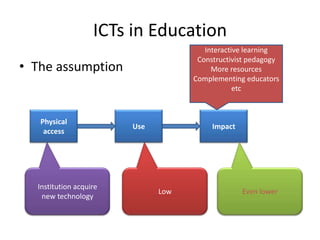
ICTs in EducationThe assumptionInteractive learningConstructivist pedagogyMore resourcesComplementing educatorsetcPhysical accessUseImpactInstitution acquire new technologyLowEven lower
Aim of the study To understand how e-learning is integrated into pedagogical processes in some higher learning institutions in South Africa. In  particular – the factors that affect the domestication of e-learning in the institutions.
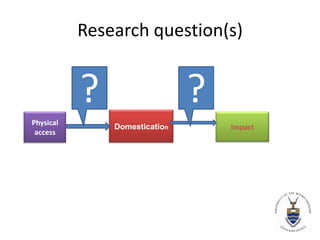
Research question(s)??DomesticationPhysical accessImpact
Framework Domestication theory “integration of new technologies into the domestic sphere and the ‘moral economy’ of the household” (Habib 2005:84)  constructs observed – how  individuals encounter technologies and deal with them, either rejecting or accepting the technologies
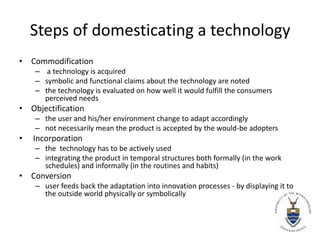
Steps of domesticating a technologyCommodification a technology is acquired symbolic and functional claims about the technology are notedthe technology is evaluated on how well it would fulfill the consumers perceived needsObjectification the user and his/her environment change to adapt accordinglynot necessarily mean the product is accepted by the would-be adopters Incorporationthe  technology has to be actively usedintegrating the product in temporal structures both formally (in the work schedules) and informally (in the routines and habits)Conversion user feeds back the adaptation into innovation processes - by displaying it to the outside world physically or symbolically
Methodology Studies about domestication usually employ qualitative approaches interviews and other ethnographic techniques - to explore the meanings of the technology, the changing behaviours, and conflicts which may not be accessible if using quantitative approaches. Sampling Snow ball sampling 18 lecturers drawn from eight out of 23 universities in the country
Methodology  cont..Data gathering and analysisOne-on-one in-depth interviews the interviews were audio recorded and then transcribedanalysis of the interview data -four stages of domestication process
Findings The findings were organised under the following themes:Acquisition of technologyFactors affecting objectification of e-learning platformsFactors affecting incorporation of e-learningConversion of e-learning platforms
Findings  cont..Acquisition of technologythe institution buys the technology and tries to get the end-users (the lecturers) on board or forces the technology upon the users. The lecturers are not usually involved in the decision making. while some institutions acquired the technology to enhance teaching and learning processes,  others just joined the bandwagon for the sake of not seen to be backward “They just say, ‘ready, fire, aim’ they don’t get the aims sorted before they fire.  There is a lot of attitude of ‘we have to do it because we are expected to do it... everyone else is doing it so we should do it’”
Findings  cont..Factors affecting objectification of e-learning platformslecturers had to appropriate or take possession of the technologyObjectification was affected byCompetence - LMS’ such as Moodle have reduced the gradient of the learning curve for the lecturers who are less technologically-inclined.”... in the early days, there were lots of restrictions on what you can upload in the system in terms of the format. For example, WebCT, it’s difficult to get some things online. But nowadays, with Moodle, you can just upload your word document as is, you don’t have to do anything.”Compatibility -some lecturers getting on board because were pressurised by their students”some students started asking some lecturers if there was something wrong with them and questioned their hard work. They went on to say how convenient these online classes were for them, and pressurized all other lecturers to get involved in online classes.” Policies- some institutions in the study are coming up with a policy which requires the employees to be computer literate at least by the end of their probation.
Findings  cont..Factors affecting incorporation of e-learningEfficacyComputerself-efficacy even incentivize the incorporation of technology, the lectures will do less or no work with it as long as their computer self-efficacy is low“Despite having attended training, getting time off from work and all other incentives; they still provided shady work”EfficiencyWithout appropriate pedagogical techniques that use technologies in constructive ways, e-learning is less likely to fulfil its potential in the higher education sector“ A lot of people, who are enthusiastic about technology, will use it simply because it is new and it is interesting. I am sure you have seen the power point presentations that reflect such a notion, where they have pushed all the buttons and made all the animations because they could”
Findings  cont..Conversion of e-learning platformsmost academics who participated in the study seem to have successfully integrated the platform in their work“I love using it. I have over the three years been able to teach myself how to use most of the functions that I want to use - it takes time - 3 years from first putting a module onto the system and then getting it running smoothly - but it is exciting”This could be an example of a successful domestication since the technology seems to be embedded within the respondent’s work
Conclusions Few lecturers have domesticated e-learningThe most common hindrance reported is inadequate training on how to integrate the technology into teaching.the lecturers lack technological pedagogical content knowledge to effectively use it in their curriculum deliveryThere is need for more professional development for e-learning
Thank you!?

Domestication edit

  • 1.
    Domestication of E-Learningin Higher Learning Institutions in South AfricaRabelaniDagadaUniversity of the Witwatersrand, South AfricaPaper presented during the Global Learn Asia Pacific Conference, 30 March 2011, The Sebel Albert Park Hotel, Melbourne, Australia
  • 2.
    Overview ContextFrameworkMethodologyFindings Conclusions
  • 3.
    ICTs in EducationTheassumptionInteractive learningConstructivist pedagogyMore resourcesComplementing educatorsetcPhysical accessUseImpactInstitution acquire new technologyLowEven lower
  • 4.
    Aim of thestudy To understand how e-learning is integrated into pedagogical processes in some higher learning institutions in South Africa. In particular – the factors that affect the domestication of e-learning in the institutions.
  • 5.
  • 6.
    Framework Domestication theory“integration of new technologies into the domestic sphere and the ‘moral economy’ of the household” (Habib 2005:84) constructs observed – how individuals encounter technologies and deal with them, either rejecting or accepting the technologies
  • 7.
    Steps of domesticatinga technologyCommodification a technology is acquired symbolic and functional claims about the technology are notedthe technology is evaluated on how well it would fulfill the consumers perceived needsObjectification the user and his/her environment change to adapt accordinglynot necessarily mean the product is accepted by the would-be adopters Incorporationthe technology has to be actively usedintegrating the product in temporal structures both formally (in the work schedules) and informally (in the routines and habits)Conversion user feeds back the adaptation into innovation processes - by displaying it to the outside world physically or symbolically
  • 8.
    Methodology Studies aboutdomestication usually employ qualitative approaches interviews and other ethnographic techniques - to explore the meanings of the technology, the changing behaviours, and conflicts which may not be accessible if using quantitative approaches. Sampling Snow ball sampling 18 lecturers drawn from eight out of 23 universities in the country
  • 9.
    Methodology cont..Datagathering and analysisOne-on-one in-depth interviews the interviews were audio recorded and then transcribedanalysis of the interview data -four stages of domestication process
  • 10.
    Findings The findingswere organised under the following themes:Acquisition of technologyFactors affecting objectification of e-learning platformsFactors affecting incorporation of e-learningConversion of e-learning platforms
  • 11.
    Findings cont..Acquisitionof technologythe institution buys the technology and tries to get the end-users (the lecturers) on board or forces the technology upon the users. The lecturers are not usually involved in the decision making. while some institutions acquired the technology to enhance teaching and learning processes, others just joined the bandwagon for the sake of not seen to be backward “They just say, ‘ready, fire, aim’ they don’t get the aims sorted before they fire. There is a lot of attitude of ‘we have to do it because we are expected to do it... everyone else is doing it so we should do it’”
  • 12.
    Findings cont..Factorsaffecting objectification of e-learning platformslecturers had to appropriate or take possession of the technologyObjectification was affected byCompetence - LMS’ such as Moodle have reduced the gradient of the learning curve for the lecturers who are less technologically-inclined.”... in the early days, there were lots of restrictions on what you can upload in the system in terms of the format. For example, WebCT, it’s difficult to get some things online. But nowadays, with Moodle, you can just upload your word document as is, you don’t have to do anything.”Compatibility -some lecturers getting on board because were pressurised by their students”some students started asking some lecturers if there was something wrong with them and questioned their hard work. They went on to say how convenient these online classes were for them, and pressurized all other lecturers to get involved in online classes.” Policies- some institutions in the study are coming up with a policy which requires the employees to be computer literate at least by the end of their probation.
  • 13.
    Findings cont..Factorsaffecting incorporation of e-learningEfficacyComputerself-efficacy even incentivize the incorporation of technology, the lectures will do less or no work with it as long as their computer self-efficacy is low“Despite having attended training, getting time off from work and all other incentives; they still provided shady work”EfficiencyWithout appropriate pedagogical techniques that use technologies in constructive ways, e-learning is less likely to fulfil its potential in the higher education sector“ A lot of people, who are enthusiastic about technology, will use it simply because it is new and it is interesting. I am sure you have seen the power point presentations that reflect such a notion, where they have pushed all the buttons and made all the animations because they could”
  • 14.
    Findings cont..Conversionof e-learning platformsmost academics who participated in the study seem to have successfully integrated the platform in their work“I love using it. I have over the three years been able to teach myself how to use most of the functions that I want to use - it takes time - 3 years from first putting a module onto the system and then getting it running smoothly - but it is exciting”This could be an example of a successful domestication since the technology seems to be embedded within the respondent’s work
  • 15.
    Conclusions Few lecturershave domesticated e-learningThe most common hindrance reported is inadequate training on how to integrate the technology into teaching.the lecturers lack technological pedagogical content knowledge to effectively use it in their curriculum deliveryThere is need for more professional development for e-learning
  • 16.