The Philippine
Family Planning
Program
(PFPP)
The Evolution of the Philippine FP
Program
• The FP Program has been implemented for
about 38 years which started from a
demographic perspective to a health
intervention oriented program.
• In 1970's to mid-80, PFPP started as a family
planning service delivery component to achieve
fertility reduction to a contraceptive-oriented
approach. During 1986 to 1992, the program was
reoriented from mere fertility reduction to a
health intervention by improving the health of
women and children.
The Evolution of the Philippine FP
Program
• In 1993 to 1997 - the family planning program
underwent another shift that emphasized
integration with other RH programs giving
importance of recognizing choice and rights of
FP users. This shift was in line with the country's
commitments made in the International
Conference on Population and Development
(ICPD), held in Cairo in 1994 and the Fourth
World Conference on Women, held in Beijing
in 1995.
• In 1998 to present - the Philippines has
adopted and developed an RH policy and
framework with the goal of providing
universal access to RH services with family
planning as the flagship program.
The Evolution of the Philippine FP
Program
• Implicit in this last condition is the right of
men and women to be informed and to have
access to safe, effective, affordable, and
acceptable methods of family planning of
their choice, and the right of access to
appropriate health-care services that will
enable women to go safely through
pregnancy and childbirth and provide couples
with and the freedom to decide if, when, and
how often to do so.
The Evolution of the Philippine FP
Program
1. Responsible Parenthood is the will and
ability to respond to the needs and aspirations
of the family. It promotes the freedom of
responsible parents to decide on the timing
and size of their families in pursuit of a better
life.
2. Respect for life. The 1987 Constitution
protects the life of the unborn from the
moment of conception. FP aims to prevent
abortions thereby saving lives of both women
and children.
Four (4) Pillars / Guiding Principles
of the PFPP
3. Birth Spacing. Proper spacing of 3 to 5
years from recent pregnancy enables women
to recover from pregnancy and to improve
their well-being, the health of the child, and
the relationship between husband and wife,
and between parents and children.
Four (4) Pillars / Guiding Principles
of the PFPP
Four (4) Pillars / Guiding Principles
of the PFPP
4. Informed choice. Couples and individuals
are fully informed on the different modern FP
methods. Couples and individuals decide and
may choose the methods that they will use
based on informed choice and to exercise
responsible parenthood in accordance with their
religious and ethical values and cultural
background, subject to conformity with
universally recognized international human
rights.
PFPP Components
• Responsible parenthood / family
planning program
• Adolescent health and youth
development program
• POPDEV integration
Responsible Parenthood / Family
Planning Program
GENERAL OBJECTIVES
• Help couples/parents and individuals to
achieve their desired number, timing and
spacing of children through responsible
parenthood and to contribute in improving
maternal, neonatal and child health, and
nutrition (MNCHN) conditions.
SPECIFIC OBJECTIVES
• Reduce the unmet need of 2.2 million
women by 2016
• Attain desired total fertility rate of couples at
2.4-2.96
• Increase Contraceptive Prevalence Rate from
50.7 % to 63 %;
• Reduce family planning unmet need from 22
% to 11%
• Reduce Maternal Mortality Rate from 162 to
52.2 deaths per 100,000 live births
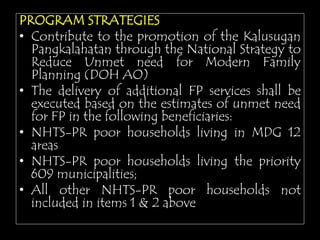
PROGRAM STRATEGIES
• Contribute to the promotion of the Kalusugan
Pangkalahatan through the National Strategy to
Reduce Unmet need for Modern Family
Planning (DOH AO)
• The delivery of additional FP services shall be
executed based on the estimates of unmet need
for FP in the following beneficiaries:
• NHTS-PR poor households living in MDG 12
areas
• NHTS-PR poor households living the priority
609 municipalities;
• All other NHTS-PR poor households not
included in items 1 & 2 above
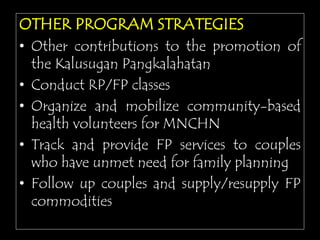
OTHER PROGRAM STRATEGIES
• Other contributions to the promotion of
the Kalusugan Pangkalahatan
• Conduct RP/FP classes
• Organize and mobilize community-based
health volunteers for MNCHN
• Track and provide FP services to couples
who have unmet need for family planning
• Follow up couples and supply/resupply FP
commodities
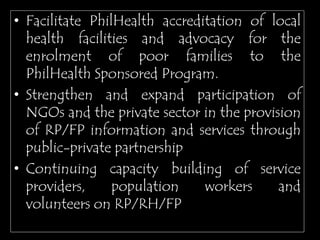
• Facilitate PhilHealth accreditation of local
health facilities and advocacy for the
enrolment of poor families to the
PhilHealth Sponsored Program.
• Strengthen and expand participation of
NGOs and the private sector in the provision
of RP/FP information and services through
public-private partnership
• Continuing capacity building of service
providers, population workers and
volunteers on RP/RH/FP
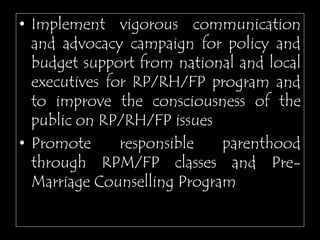
• Implement vigorous communication
and advocacy campaign for policy and
budget support from national and local
executives for RP/RH/FP program and
to improve the consciousness of the
public on RP/RH/FP issues
• Promote responsible parenthood
through RPM/FP classes and Pre-
Marriage Counselling Program
• Promote, operationalize, and sustain
men's involvement in RP/RH/FP
• Conduct of operations research and
documentation of good practices for
replication
• Strengthen the On-line Reporting
System on RP/FP and work for its
harmonization with existing health
database systems
Design and implement innovative strategies
to address the socio-economic factors
hindering the exercise of reproductive
rights of poor couples
• Integration of entrepreneurship or
livelihood strategies in RPM program
• Integration of RPM with ALS among less
educated women
• Integration of RPM in poverty reduction
strategies

The philippine family planning program (PPT)

  • 1.
  • 2.
    The Evolution ofthe Philippine FP Program • The FP Program has been implemented for about 38 years which started from a demographic perspective to a health intervention oriented program. • In 1970's to mid-80, PFPP started as a family planning service delivery component to achieve fertility reduction to a contraceptive-oriented approach. During 1986 to 1992, the program was reoriented from mere fertility reduction to a health intervention by improving the health of women and children.
  • 3.
    The Evolution ofthe Philippine FP Program • In 1993 to 1997 - the family planning program underwent another shift that emphasized integration with other RH programs giving importance of recognizing choice and rights of FP users. This shift was in line with the country's commitments made in the International Conference on Population and Development (ICPD), held in Cairo in 1994 and the Fourth World Conference on Women, held in Beijing in 1995.
  • 4.
    • In 1998to present - the Philippines has adopted and developed an RH policy and framework with the goal of providing universal access to RH services with family planning as the flagship program. The Evolution of the Philippine FP Program
  • 5.
    • Implicit inthis last condition is the right of men and women to be informed and to have access to safe, effective, affordable, and acceptable methods of family planning of their choice, and the right of access to appropriate health-care services that will enable women to go safely through pregnancy and childbirth and provide couples with and the freedom to decide if, when, and how often to do so. The Evolution of the Philippine FP Program
  • 6.
    1. Responsible Parenthoodis the will and ability to respond to the needs and aspirations of the family. It promotes the freedom of responsible parents to decide on the timing and size of their families in pursuit of a better life. 2. Respect for life. The 1987 Constitution protects the life of the unborn from the moment of conception. FP aims to prevent abortions thereby saving lives of both women and children. Four (4) Pillars / Guiding Principles of the PFPP
  • 7.
    3. Birth Spacing.Proper spacing of 3 to 5 years from recent pregnancy enables women to recover from pregnancy and to improve their well-being, the health of the child, and the relationship between husband and wife, and between parents and children. Four (4) Pillars / Guiding Principles of the PFPP
  • 8.
    Four (4) Pillars/ Guiding Principles of the PFPP 4. Informed choice. Couples and individuals are fully informed on the different modern FP methods. Couples and individuals decide and may choose the methods that they will use based on informed choice and to exercise responsible parenthood in accordance with their religious and ethical values and cultural background, subject to conformity with universally recognized international human rights.
  • 9.
    PFPP Components • Responsibleparenthood / family planning program • Adolescent health and youth development program • POPDEV integration
  • 10.
    Responsible Parenthood /Family Planning Program GENERAL OBJECTIVES • Help couples/parents and individuals to achieve their desired number, timing and spacing of children through responsible parenthood and to contribute in improving maternal, neonatal and child health, and nutrition (MNCHN) conditions.
  • 11.
    SPECIFIC OBJECTIVES • Reducethe unmet need of 2.2 million women by 2016 • Attain desired total fertility rate of couples at 2.4-2.96 • Increase Contraceptive Prevalence Rate from 50.7 % to 63 %; • Reduce family planning unmet need from 22 % to 11% • Reduce Maternal Mortality Rate from 162 to 52.2 deaths per 100,000 live births
  • 12.
    PROGRAM STRATEGIES • Contributeto the promotion of the Kalusugan Pangkalahatan through the National Strategy to Reduce Unmet need for Modern Family Planning (DOH AO) • The delivery of additional FP services shall be executed based on the estimates of unmet need for FP in the following beneficiaries: • NHTS-PR poor households living in MDG 12 areas • NHTS-PR poor households living the priority 609 municipalities; • All other NHTS-PR poor households not included in items 1 & 2 above
  • 13.
    OTHER PROGRAM STRATEGIES •Other contributions to the promotion of the Kalusugan Pangkalahatan • Conduct RP/FP classes • Organize and mobilize community-based health volunteers for MNCHN • Track and provide FP services to couples who have unmet need for family planning • Follow up couples and supply/resupply FP commodities
  • 14.
    • Facilitate PhilHealthaccreditation of local health facilities and advocacy for the enrolment of poor families to the PhilHealth Sponsored Program. • Strengthen and expand participation of NGOs and the private sector in the provision of RP/FP information and services through public-private partnership • Continuing capacity building of service providers, population workers and volunteers on RP/RH/FP
  • 15.
    • Implement vigorouscommunication and advocacy campaign for policy and budget support from national and local executives for RP/RH/FP program and to improve the consciousness of the public on RP/RH/FP issues • Promote responsible parenthood through RPM/FP classes and Pre- Marriage Counselling Program
  • 16.
    • Promote, operationalize,and sustain men's involvement in RP/RH/FP • Conduct of operations research and documentation of good practices for replication • Strengthen the On-line Reporting System on RP/FP and work for its harmonization with existing health database systems
  • 17.
    Design and implementinnovative strategies to address the socio-economic factors hindering the exercise of reproductive rights of poor couples • Integration of entrepreneurship or livelihood strategies in RPM program • Integration of RPM with ALS among less educated women • Integration of RPM in poverty reduction strategies