Infant and Young Child
Feeding Guidelines
• Breastfeeding
• WHO UNICEF have emphasized the first 1000 days
of life i.e, the 270 days and the first two years after
birth as the critical window period for nutritional
interventions.
THE OPTIMAL AND APPROPRIATE INFANT AND
YOUNG CHILD NUTRITION PRACTICES AND
STRATEGIES
• EBF should be practiced till end of six
months(180 days)
.After completion of six months, introduction
of optimal complementary feeding should be
practiced preferably with energy dense, home-
made food.
Breastfeeding should be continued minimum
for 2 years and beyond.
Mother should communicate, look into the
eyes, touch and caress the baby while feeding.
Practice responsive feeding.
WHO Growth Charts recommended for
monitoring growth.
As the maximal brain growth occurs,
malnutrition in this critical period can lead to
stunting and suboptimal developmental
outcome.
a) Breastfeeding should be promoted as the
gold standard feeding options.
b) Antenatal counseling individually or in
groups organized by maternity facility or
mother support group (MSG) should
prepare expectant mothers for successful
breastfeeding.
c) All newborns includingthosebycaesarean
section) skin-to-skin contact should be
initiated in about 5 minutes of birth in
order that baby initiates breastfeeding in
an hour of birth.
(d) Baby should be fed “on cues”. The early feeding cues include sucking movements
and sucking sounds, hand to mouth movements, rapid eye movements, soft cooing or
sighing sounds, lip smacking, restlessness etc. Crying is a late cue and may interfere
with successful feeding. Babies should be breastfed at least 8 to 10 times in 24 hours
till lactation is established (1 to 2 weeks) indicated by frequent urination, stooling and
adequate weight gain. Periodic feeding is practiced in certain situations like in the
case of a very small infant who is likely to become hypoglycemic unless fed regularly,
or an infant who ‘does not demand’ milk in initial few days. Adequacy of breastfeeding
in this critical period should be monitored by clinical parameters complemented by
weighing on digital weighing scale (minimum sensitivity of 5 g) on Day 1, 4, 7, 14 and
28. Maternity service should have a protocol to manage post-discharge follow ups
along with protocols for management of excessive weight loss (>10%) and weight-
faltering.
f) The main reason given by majority of working mothers for
stopping breastfeeding is their return to work following the
maternity leave. Mothers who work outside should be assisted
with obtaining adequate Maternity/ Baby Care/Breastfeeding
leave, should be encouraged to continue EBF for 6 months by
expressing milk while they are out at work. They may be
encouraged to carry the baby to a work place/ crèche
wherever such facility exists.
If the breastfeeding was temporarily discontinued due to an inadvertent
situation, re-lactation should be tried as soon as possible. Supplemental
Suckling Technique (SST) is a technique which can be used as a strategy
to initiate re-lactation in mothers who have (d) developed lactation
failure or Mother’s Milk Insufficiency (MMI). WHO recommends re-
lactation through Supplemental Suckling technique.
i) The possibility of índuced lactation shall be
explored according to the situation e.g.
adoption, surrogacy. It helps to create mother-
infant bonding apart from security and comfort
for the baby. The technique involves
motivating the surrogate mother, having a
willing and vigorously sucking infant, and an
adequate support group. Prolactin and
oxytocin, the hormone which govern lactation,
are pituitary and not ovarian. Hence,
stimulation of nipple and areola and repeated
suckling by the baby are important. Lact-aid as
nursingtrainer is also useful A course of
prolactin enhancing drugs such as
Metoclopromide or Domperidone is initiated
j) Nursing in Public (NIP): Mothers should feel
comfortable to nurse in public. All efforts
should be taken to remove hurdles impeding
breastfeeding in public places, special areas /
rooms shall be identified/ constructed or
established in places like Bus stands, Railway
stations, Air ports etc.
Complementary Feeding
(a) Appropriately thick homogenous complementary foods home-
made from locally available foods should be introduced at six
completed months while continuing breastfeeding ad libitum
During this period, breastfeeding should be actively supported
and the term ‘weaning’ should be avoided
(b) Complementary feeding should be projected as the bridge that
the mother has to make between liquid to solid transition and to
empower the baby to ‘family pot feeding
b) To address the issue of a small stomach size,
each meal must be made energy dense by
adding sugar / jaggery and ghee/butter/oil. To
provide more calories from smaller volumes,
food must be thick in consistency– thick
enough to stay on the spoon without running
off, when the spoon is tilted
(c) Foods can be enriched by making a
fermented porridge, use of germinated or
sprouted flour and toasting of grains before
grinding .
d)Adequate total energy intake can also be
ensured by addition of one to two nutritious
snacks between the three main meals. Snacks
are in addition and should not replace meals.
They should not to be confused with foods
such as sweets, chips or other processed foods
e)Parents must identify the staple homemade
food (as these are fresh, clean and cheap),
comprising of cereal- pulse mixture in the ratio
2:1, and make them caloric and nutrient rich
with locally available products
f)bottle feeding shall be discouraged at all
levels
g)The food should be a balanced diet
consisting of various (as diverse as possible)
food groups / components in different
combinations. Easily available, cost-effective
seasonal uncooked fruits, green and other dark
colored vegetables, milk and milk products,
pulses/ legumes, animal foods, oil/ butter,
sugar/ jaggery may be added in the staples
gradually
h.Hygienic practices are essential for food
safety during all the involved steps viz.
preparation, storage and feeding. Hand
washing with soap and water at critical times-
including before eating or preparing food and
after using the toilet
I.Practice responsive feeding. Self-feeding
should be encouraged despite spillage. Each
child should be fed under supervision in a
separate plate to develop an individual
identity. Forced feeding, threatening and
punishment interfere with development of
good/ proper feeding habits.
J.Consistency of foods should be appropriate
to the developmental readiness of the child in
munching, chewing and swallowing.
‘Neophobia’ is the rule in them and any item
may have to be offered several times for
acceptance. Avoid foods which can pose
choking hazard. Introduce lumpy or granular
foods and most tastes by about 9 to 10
months.
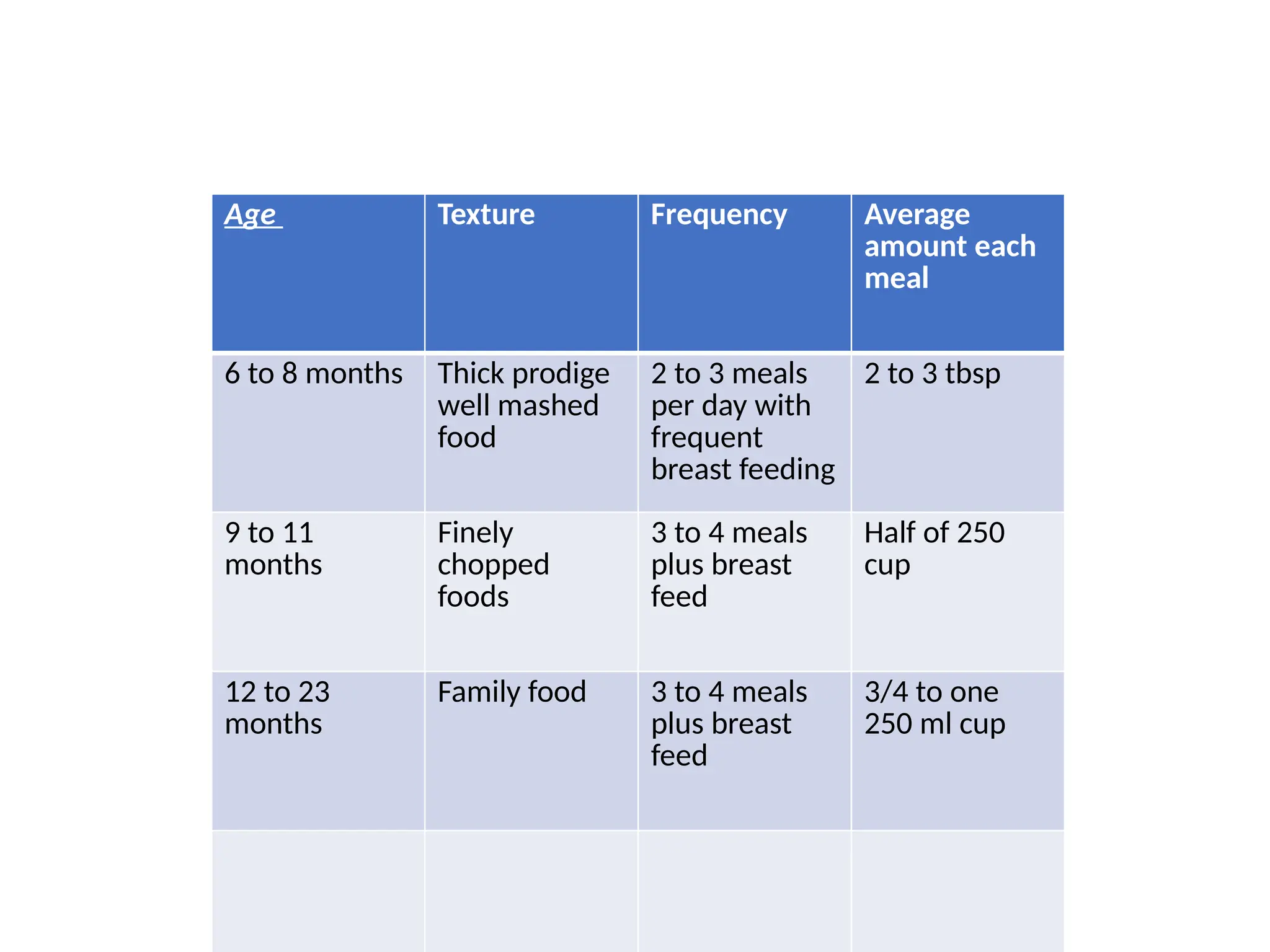
Age Texture Frequency Average
amount each
meal
6 to 8 months Thick prodige
well mashed
food
2 to 3 meals
per day with
frequent
breast feeding
2 to 3 tbsp
9 to 11
months
Finely
chopped
foods
3 to 4 meals
plus breast
feed
Half of 250
cup
12 to 23
months
Family food 3 to 4 meals
plus breast
feed
3/4 to one
250 ml cup
HIV AND INFANT FEEDING
a) The best time to counsel HIV-positive
mothers is during antenatal period. They
should be informed about infant feeding
options, viz. exclusive breastfeeding or
exclusive replacement feeding that is
recommended .Exclusive breastfeeding is
superior to exclusive replacement feeding
in developing countries because it
maximizes the chances of survival of the
infant
b) Prevention of parent-to-child transmission
(PPTCT) interventions should begin early in
the pregnancy for all HIV infected pregnant
women
c) In resource-limited settings, HIV-infected
mothers of HIV-uninfected infants often have
difficulty in deciding about feeding options,
breastfeeding risks transmission of HIV to their
infants and formula feeding is not always a
feasible option due to high cost, lack of clean
water or stigma associated with not
breastfeeding. Recent clinical studies have
proven that the risk of transmission through
breastfeeding is minimal provided mother and
the infant receive appropriate antiretroviral
prophylaxis.
d) WHO 2013 guidelines recommend two
options:• Providing lifelong antiretroviral
treatment (ART) (one simplified triple regimen)
to all pregnant and breastfeeding women
regardless of CD4 count or clinical stage.• To
provide ART to pregnant and breastfeeding
women with HIV during the period of risk of
mother- to-child HIV transmission and then
continuing lifelong ART
(e) The global target is “elimination of new HIV
infections among children” by 2015 and
government of India is actively working
towards it. Following the new guidelines from
WHO (June 2013), National AIDS control
organization (NACO) has decided to provide
life-long ART (triple drug regimen) to all
pregnant and breastfeeding women living with
HIV. With this step, all pregnant women living
with HIV should receive a triple drug ART
regimen regardless of CD4 count or WHO
clinical stage. This would also help in increasing
the coverage for those needing treatment to
keep them alive and for their own health,
avoiding stopping and starting drugs with
repeat pregnancies, provide early protection
against mother-to-child transmission in future
pregnancies and avoiding drug resistance.
These recommendations can potentially
reduce the risk of mother-to-child-transmission
to less than 5% in breastfeeding populations.
f) Providing daily first-line ARV regimen of
Tenofovir (TDF), Lamivudine (3TC) (or
Emtricitabine [FTC]) and Efavirenz (EFZ) to all
pregnant and breastfeeding women HIV has
important programmatic and clinical benefit.
(g) Exclusive breastfeeding is the
recommended infant feeding choice in the first
6 months, irrespective of the fact that mother
is on ART early or infant is provided with anti-
retroviral prophylaxis for 6 weeks.
h) No Mixed Feeding is to be done during the
first 6 months.
i) Mothers known to be infected with HIV and
whose infants are HIV uninfected or of
unknown HIV status should exclusively
breastfeed their infants. Complementary foods
should be appropriately introduced thereafter,
and breastfeeding should be continued for the
first 12 months of life. Initiate maternal ART
and give Nevirapine (NVP) for 6 weeks.
j) Mothers known to be infected with HIV and
whose infants are HIV infected should
exclusively breastfeed for the first 6 months of
life, complementary foods should be
appropriately introduced thereafter, and
breastfeeding should be continued for 24
months of life. Initiate maternal ART and give
NVP for 6 weeks.
K) Mothers who are diagnosed with HIV during
labor or in the immediate postpartum period
and are planning to breastfeed, such mothers
should be initiated on ART and their infants
should receive extended NVP prophylaxis for
12 weeks.
l. Mothers diagnosed with HIV immediate
postpartum period and are planning exclusive
replacement feeding (ERF) should be referred
for evaluation and treatment of HIV. Infants of
these mothers should be given NVP
prophylaxis for 6 weeks
m)Mothers who are HIV-infected and insist on not breastfeeding and opt for exclusive
replacement feeding (ERF) should be explained that they are doing so at their own risk
and this is contrary to the WHO/ NACO’s guidelines of giving exclusive breastfeeds.
When taking choice for exclusive replacement. feeding, they should fulfill the AFASS (A
– Affordable F – Feasible A – Acceptable S – Sustainable S – Safe) criteria[21].
ExplaintheadvantagesofERFas(i)No risk of HIV transmission; and (ii) ERF milk can be
given by other persons. Also enumerate the disadvantages like (i) Animal milk is not a
complete food for baby; (ii) Formula milk may be complete but is expensive; (iii) Baby
has more risk of infections- diarrhea, respiratory and ear infection and malnutrition;
and (iv) Careful and hygienic preparation required each time to sterilize feeding cups,
using boiled water and fresh preparation of all feeds 12-15 times in the first 4 months
of baby’s life.
Feeding in Other Specific Situations
a) Feeding during sickness is important for
recovery and for prevention of under nutrition.
Even sick babies mostly continue to breastfeed
and the infant can be encouraged to eat small
quantities of nutrient rich food more
frequently and by offering foods that the child
likes to eat.
b) Infant feeding in
maternal illnesses
(i) Painful and/ or infective breast conditions
like breast abscess, mastitis and psychiatric
illnesses which pose a danger to the child’s life
e.g. postpartum psychosis, schizophrenia may
need a temporary cessation of breastfeeding.
(ii) Chronic infections like tuberculosis, leprosy,
or medical conditions like hypothyroidism need
treatment of the primary condition and do not
warrant discontinuation of breastfeeding.(iii)
Breastfeeding is contraindicated when the
mother is receiving certain drugs like anti-
neoplastic agents, immuno-suppressants,
antithyroid drugs like thiouracil,
amphetamines, gold salts, etc. Breastfeeding
may be avoided or continued with caution
when the mother is receiving following drugs–
atropine, reserpine, psychotropic drugs. Other
drugs like antibiotics, anesthetics,
antiepileptics, antihistamines, digoxin,
diuretics, prednisone, propranolol etc. are
considered safe for breastfeeding
c) Infant feeding in various conditions related
to the infant
(i)Breastfeeding on demand should be
promoted in normal active babies. However, in
difficult situations like VLBW, sick, or depressed
babies, alternative methods of feeding can be
used based on neuro- developmental status.
These include feeding expressed breastmilk
through intra-gastric tube or with the use of
cup and spoon. For very sick babies, expert
guidance should be sought. If the baby is
transferred to SNCU/NICU, mothers should be
supported to start breastmilk expression within
initial hours, continue at least 3 hourly during
the day time and at least once at night.
ii)Ensure early transfer of mothers with the
baby in SNCU/NICU and that has arrangement
to accommodate the mothers in the
immediate vicinity and that mothers are
permitted to visit, hold and touch the baby at
will if the baby’s condition permits
iii).Ensure that majority of babies are on
exclusive breastfeeding or on breastfeeding
plus expressed breastmilk at discharge from
the SNCU/NICU.
iv)Gastro-Esophageal Reflux Disease (GERD) is
often treated conservatively when it is mild,
through thickening of the complementary
foods, frequent small feeds and upright
positioning for 30 minutes after feeds.
v) Primary Lactose Intolerance is congenital
and may require long term lactose restriction.
Secondary Lactose Intolerance is usually
transient and resolves after the underlying
condition has remitted. Most of the cases of
diarrhea do not require stoppage of
breastfeeding.
vi)Various Inborn Errors of Metabolism warrant
restriction of specific offending agent and
certain dietary modifications e.g. in
galactosemia, galactose should be avoided.
This is probably the only absolute
contraindication to breastfeeding.

Presentation (1) copy.pptx infant feeding

  • 1.
    Infant and YoungChild Feeding Guidelines
  • 2.
    • Breastfeeding • WHOUNICEF have emphasized the first 1000 days of life i.e, the 270 days and the first two years after birth as the critical window period for nutritional interventions.
  • 3.
    THE OPTIMAL ANDAPPROPRIATE INFANT AND YOUNG CHILD NUTRITION PRACTICES AND STRATEGIES • EBF should be practiced till end of six months(180 days) .After completion of six months, introduction of optimal complementary feeding should be practiced preferably with energy dense, home- made food. Breastfeeding should be continued minimum for 2 years and beyond. Mother should communicate, look into the eyes, touch and caress the baby while feeding. Practice responsive feeding. WHO Growth Charts recommended for monitoring growth.
  • 4.
    As the maximalbrain growth occurs, malnutrition in this critical period can lead to stunting and suboptimal developmental outcome. a) Breastfeeding should be promoted as the gold standard feeding options. b) Antenatal counseling individually or in groups organized by maternity facility or mother support group (MSG) should prepare expectant mothers for successful breastfeeding. c) All newborns includingthosebycaesarean section) skin-to-skin contact should be initiated in about 5 minutes of birth in order that baby initiates breastfeeding in an hour of birth.
  • 5.
    (d) Baby shouldbe fed “on cues”. The early feeding cues include sucking movements and sucking sounds, hand to mouth movements, rapid eye movements, soft cooing or sighing sounds, lip smacking, restlessness etc. Crying is a late cue and may interfere with successful feeding. Babies should be breastfed at least 8 to 10 times in 24 hours till lactation is established (1 to 2 weeks) indicated by frequent urination, stooling and adequate weight gain. Periodic feeding is practiced in certain situations like in the case of a very small infant who is likely to become hypoglycemic unless fed regularly, or an infant who ‘does not demand’ milk in initial few days. Adequacy of breastfeeding in this critical period should be monitored by clinical parameters complemented by weighing on digital weighing scale (minimum sensitivity of 5 g) on Day 1, 4, 7, 14 and 28. Maternity service should have a protocol to manage post-discharge follow ups along with protocols for management of excessive weight loss (>10%) and weight- faltering.
  • 6.
    f) The mainreason given by majority of working mothers for stopping breastfeeding is their return to work following the maternity leave. Mothers who work outside should be assisted with obtaining adequate Maternity/ Baby Care/Breastfeeding leave, should be encouraged to continue EBF for 6 months by expressing milk while they are out at work. They may be encouraged to carry the baby to a work place/ crèche wherever such facility exists.
  • 7.
    If the breastfeedingwas temporarily discontinued due to an inadvertent situation, re-lactation should be tried as soon as possible. Supplemental Suckling Technique (SST) is a technique which can be used as a strategy to initiate re-lactation in mothers who have (d) developed lactation failure or Mother’s Milk Insufficiency (MMI). WHO recommends re- lactation through Supplemental Suckling technique.
  • 8.
    i) The possibilityof índuced lactation shall be explored according to the situation e.g. adoption, surrogacy. It helps to create mother- infant bonding apart from security and comfort for the baby. The technique involves motivating the surrogate mother, having a willing and vigorously sucking infant, and an adequate support group. Prolactin and oxytocin, the hormone which govern lactation, are pituitary and not ovarian. Hence, stimulation of nipple and areola and repeated suckling by the baby are important. Lact-aid as nursingtrainer is also useful A course of prolactin enhancing drugs such as Metoclopromide or Domperidone is initiated
  • 9.
    j) Nursing inPublic (NIP): Mothers should feel comfortable to nurse in public. All efforts should be taken to remove hurdles impeding breastfeeding in public places, special areas / rooms shall be identified/ constructed or established in places like Bus stands, Railway stations, Air ports etc.
  • 10.
    Complementary Feeding (a) Appropriatelythick homogenous complementary foods home- made from locally available foods should be introduced at six completed months while continuing breastfeeding ad libitum During this period, breastfeeding should be actively supported and the term ‘weaning’ should be avoided (b) Complementary feeding should be projected as the bridge that the mother has to make between liquid to solid transition and to empower the baby to ‘family pot feeding
  • 11.
    b) To addressthe issue of a small stomach size, each meal must be made energy dense by adding sugar / jaggery and ghee/butter/oil. To provide more calories from smaller volumes, food must be thick in consistency– thick enough to stay on the spoon without running off, when the spoon is tilted
  • 12.
    (c) Foods canbe enriched by making a fermented porridge, use of germinated or sprouted flour and toasting of grains before grinding .
  • 13.
    d)Adequate total energyintake can also be ensured by addition of one to two nutritious snacks between the three main meals. Snacks are in addition and should not replace meals. They should not to be confused with foods such as sweets, chips or other processed foods e)Parents must identify the staple homemade food (as these are fresh, clean and cheap), comprising of cereal- pulse mixture in the ratio 2:1, and make them caloric and nutrient rich with locally available products
  • 14.
    f)bottle feeding shallbe discouraged at all levels g)The food should be a balanced diet consisting of various (as diverse as possible) food groups / components in different combinations. Easily available, cost-effective seasonal uncooked fruits, green and other dark colored vegetables, milk and milk products, pulses/ legumes, animal foods, oil/ butter, sugar/ jaggery may be added in the staples gradually
  • 15.
    h.Hygienic practices areessential for food safety during all the involved steps viz. preparation, storage and feeding. Hand washing with soap and water at critical times- including before eating or preparing food and after using the toilet I.Practice responsive feeding. Self-feeding should be encouraged despite spillage. Each child should be fed under supervision in a separate plate to develop an individual identity. Forced feeding, threatening and punishment interfere with development of good/ proper feeding habits.
  • 16.
    J.Consistency of foodsshould be appropriate to the developmental readiness of the child in munching, chewing and swallowing. ‘Neophobia’ is the rule in them and any item may have to be offered several times for acceptance. Avoid foods which can pose choking hazard. Introduce lumpy or granular foods and most tastes by about 9 to 10 months.
  • 17.
    Age Texture FrequencyAverage amount each meal 6 to 8 months Thick prodige well mashed food 2 to 3 meals per day with frequent breast feeding 2 to 3 tbsp 9 to 11 months Finely chopped foods 3 to 4 meals plus breast feed Half of 250 cup 12 to 23 months Family food 3 to 4 meals plus breast feed 3/4 to one 250 ml cup
  • 18.
  • 19.
    a) The besttime to counsel HIV-positive mothers is during antenatal period. They should be informed about infant feeding options, viz. exclusive breastfeeding or exclusive replacement feeding that is recommended .Exclusive breastfeeding is superior to exclusive replacement feeding in developing countries because it maximizes the chances of survival of the infant b) Prevention of parent-to-child transmission (PPTCT) interventions should begin early in the pregnancy for all HIV infected pregnant women
  • 20.
    c) In resource-limitedsettings, HIV-infected mothers of HIV-uninfected infants often have difficulty in deciding about feeding options, breastfeeding risks transmission of HIV to their infants and formula feeding is not always a feasible option due to high cost, lack of clean water or stigma associated with not breastfeeding. Recent clinical studies have proven that the risk of transmission through breastfeeding is minimal provided mother and the infant receive appropriate antiretroviral prophylaxis. d) WHO 2013 guidelines recommend two options:• Providing lifelong antiretroviral treatment (ART) (one simplified triple regimen) to all pregnant and breastfeeding women regardless of CD4 count or clinical stage.• To provide ART to pregnant and breastfeeding women with HIV during the period of risk of mother- to-child HIV transmission and then continuing lifelong ART
  • 21.
    (e) The globaltarget is “elimination of new HIV infections among children” by 2015 and government of India is actively working towards it. Following the new guidelines from WHO (June 2013), National AIDS control organization (NACO) has decided to provide life-long ART (triple drug regimen) to all pregnant and breastfeeding women living with HIV. With this step, all pregnant women living with HIV should receive a triple drug ART regimen regardless of CD4 count or WHO clinical stage. This would also help in increasing the coverage for those needing treatment to keep them alive and for their own health, avoiding stopping and starting drugs with repeat pregnancies, provide early protection against mother-to-child transmission in future pregnancies and avoiding drug resistance. These recommendations can potentially reduce the risk of mother-to-child-transmission to less than 5% in breastfeeding populations.
  • 22.
    f) Providing dailyfirst-line ARV regimen of Tenofovir (TDF), Lamivudine (3TC) (or Emtricitabine [FTC]) and Efavirenz (EFZ) to all pregnant and breastfeeding women HIV has important programmatic and clinical benefit. (g) Exclusive breastfeeding is the recommended infant feeding choice in the first 6 months, irrespective of the fact that mother is on ART early or infant is provided with anti- retroviral prophylaxis for 6 weeks. h) No Mixed Feeding is to be done during the first 6 months.
  • 23.
    i) Mothers knownto be infected with HIV and whose infants are HIV uninfected or of unknown HIV status should exclusively breastfeed their infants. Complementary foods should be appropriately introduced thereafter, and breastfeeding should be continued for the first 12 months of life. Initiate maternal ART and give Nevirapine (NVP) for 6 weeks.
  • 24.
    j) Mothers knownto be infected with HIV and whose infants are HIV infected should exclusively breastfeed for the first 6 months of life, complementary foods should be appropriately introduced thereafter, and breastfeeding should be continued for 24 months of life. Initiate maternal ART and give NVP for 6 weeks. K) Mothers who are diagnosed with HIV during labor or in the immediate postpartum period and are planning to breastfeed, such mothers should be initiated on ART and their infants should receive extended NVP prophylaxis for 12 weeks.
  • 25.
    l. Mothers diagnosedwith HIV immediate postpartum period and are planning exclusive replacement feeding (ERF) should be referred for evaluation and treatment of HIV. Infants of these mothers should be given NVP prophylaxis for 6 weeks
  • 26.
    m)Mothers who areHIV-infected and insist on not breastfeeding and opt for exclusive replacement feeding (ERF) should be explained that they are doing so at their own risk and this is contrary to the WHO/ NACO’s guidelines of giving exclusive breastfeeds. When taking choice for exclusive replacement. feeding, they should fulfill the AFASS (A – Affordable F – Feasible A – Acceptable S – Sustainable S – Safe) criteria[21]. ExplaintheadvantagesofERFas(i)No risk of HIV transmission; and (ii) ERF milk can be given by other persons. Also enumerate the disadvantages like (i) Animal milk is not a complete food for baby; (ii) Formula milk may be complete but is expensive; (iii) Baby has more risk of infections- diarrhea, respiratory and ear infection and malnutrition; and (iv) Careful and hygienic preparation required each time to sterilize feeding cups, using boiled water and fresh preparation of all feeds 12-15 times in the first 4 months of baby’s life.
  • 27.
    Feeding in OtherSpecific Situations a) Feeding during sickness is important for recovery and for prevention of under nutrition. Even sick babies mostly continue to breastfeed and the infant can be encouraged to eat small quantities of nutrient rich food more frequently and by offering foods that the child likes to eat.
  • 28.
    b) Infant feedingin maternal illnesses
  • 29.
    (i) Painful and/or infective breast conditions like breast abscess, mastitis and psychiatric illnesses which pose a danger to the child’s life e.g. postpartum psychosis, schizophrenia may need a temporary cessation of breastfeeding.
  • 30.
    (ii) Chronic infectionslike tuberculosis, leprosy, or medical conditions like hypothyroidism need treatment of the primary condition and do not warrant discontinuation of breastfeeding.(iii) Breastfeeding is contraindicated when the mother is receiving certain drugs like anti- neoplastic agents, immuno-suppressants, antithyroid drugs like thiouracil, amphetamines, gold salts, etc. Breastfeeding may be avoided or continued with caution when the mother is receiving following drugs– atropine, reserpine, psychotropic drugs. Other drugs like antibiotics, anesthetics, antiepileptics, antihistamines, digoxin, diuretics, prednisone, propranolol etc. are considered safe for breastfeeding
  • 31.
    c) Infant feedingin various conditions related to the infant (i)Breastfeeding on demand should be promoted in normal active babies. However, in difficult situations like VLBW, sick, or depressed babies, alternative methods of feeding can be used based on neuro- developmental status. These include feeding expressed breastmilk through intra-gastric tube or with the use of cup and spoon. For very sick babies, expert guidance should be sought. If the baby is transferred to SNCU/NICU, mothers should be supported to start breastmilk expression within initial hours, continue at least 3 hourly during the day time and at least once at night.
  • 32.
    ii)Ensure early transferof mothers with the baby in SNCU/NICU and that has arrangement to accommodate the mothers in the immediate vicinity and that mothers are permitted to visit, hold and touch the baby at will if the baby’s condition permits iii).Ensure that majority of babies are on exclusive breastfeeding or on breastfeeding plus expressed breastmilk at discharge from the SNCU/NICU. iv)Gastro-Esophageal Reflux Disease (GERD) is often treated conservatively when it is mild, through thickening of the complementary foods, frequent small feeds and upright positioning for 30 minutes after feeds.
  • 33.
    v) Primary LactoseIntolerance is congenital and may require long term lactose restriction. Secondary Lactose Intolerance is usually transient and resolves after the underlying condition has remitted. Most of the cases of diarrhea do not require stoppage of breastfeeding.
  • 34.
    vi)Various Inborn Errorsof Metabolism warrant restriction of specific offending agent and certain dietary modifications e.g. in galactosemia, galactose should be avoided. This is probably the only absolute contraindication to breastfeeding.