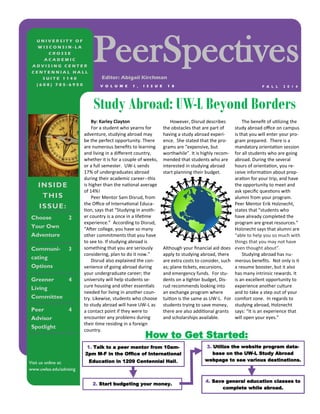
How to Get Started:
The benefit of utilizing the
study abroad office on campus
is that you will enter your pro-
gram prepared. There is a
mandatory orientation session
for all students who are going
abroad. During the several
hours of orientation, you re-
ceive information about prep-
aration for your trip, and have
the opportunity to meet and
ask specific questions with
alumni from your program.
Peer Mentor Erik Holznecht,
states that “students who
have already completed the
program are great resources.”
Holznecht says that alumni are
“able to help you so much with
things that you may not have
even thought about”.
Studying abroad has nu-
merous benefits. Not only is it
a resume booster, but it also
has many intrinsic rewards. It
is an excellent opportunity to
experience another culture
and to take a step out of your
comfort zone. In regards to
studying abroad, Holznecht
says: “It is an experience that
will open your eyes.”
By: Karley Clayton
For a student who yearns for
adventure, studying abroad may
be the perfect opportunity. There
are numerous benefits to learning
and living in a different country,
whether it is for a couple of weeks,
or a full semester. UW-L sends
17% of undergraduates abroad
during their academic career--this
is higher than the national average
of 14%!
Peer Mentor Sam Disrud, from
the Office of International Educa-
tion, says that “Studying in anoth-
er country is a once in a lifetime
experience.” According to Disrud,
“After college, you have so many
other commitments that you have
to see to. If studying abroad is
something that you are seriously
considering, plan to do it now.”
Disrud also explained the con-
venience of going abroad during
your undergraduate career; the
university will help students se-
cure housing and other essentials
needed for living in another coun-
try. Likewise, students who choose
to study abroad will have UW-L as
a contact point if they were to
encounter any problems during
their time residing in a foreign
country.
However, Disrud describes
the obstacles that are part of
having a study abroad experi-
ence. She stated that the pro-
grams are “expensive, but
worthwhile”. It is highly recom-
mended that students who are
interested in studying abroad
start planning their budget.
Although your financial aid does
apply to studying abroad, there
are extra costs to consider, such
as; plane tickets, excursions,
and emergency funds. For stu-
dents on a tighter budget, Dis-
rud recommends looking into
an exchange program where
tuition is the same as UW-L. For
students trying to save money,
there are also additional grants
and scholarships available.
1. Talk to a peer mentor from 10am-
2pm M-F in the Office of International
Education in 1209 Centennial Hall.
Study Abroad: UW-L Beyond Borders
INSIDE
THIS
ISSUE:
Choose
Your Own
Adventure
2
Communi-
cating
Options
3
Greener
Living
Committee
4
Peer
Advisor
Spotlight
4
U N I V E R S I T Y O F
W I S C O N S I N - L A
C R O S S E
A C A D E M I C
A D V I S I N G C E N T E R
C E N T E N N I A L H A L L
S U I T E 1 1 4 0
( 6 0 8 ) 7 8 5 - 6 9 5 0 F A L L 2 0 1 4V O L U M E 1 , I S S U E 1 8
Editor: Abigail Kirchman
PeerSpectives
Visit us online at:
www.uwlax.edu/advising
2. Start budgeting your money.
3. Utilize the website program data-
base on the UW-L Study Abroad
webpage to see various destinations.
4. Save general education classes to
complete while abroad.
P A G E 2
“Graduating
with a
Bachelor of
Arts in English
will provide a
versatile and
open-ended
degree that
gives you the
freedom to
choose your
own destiny,
and your own
destination.”
Choose Your Own Adventure
By: Madeline Marquardt
If you are an English ma-
jor, or if you have ever consid-
ered majoring in English, then
you have probably asked
yourself, “What can I do with
my degree?” The typical an-
swer to this question is to
teach. According to Montclair
State University, only 30% of
English majors go on to be-
come teachers. Teaching is
only the third highest occupa-
tional field that employs indi-
viduals with a B.A. in English.
According to the College Ma-
jors Handbook, the highest
occupational field is arts and
communication. This is where
English majors become em-
ployed as artists, broadcast
and print journalists, technical
writers, communication spe-
cialists, and public relations
specialists. The second high-
est occupational field that
English majors work in, is the
business field as top and mid-
level managers, executives
and administrators.
UW-L English majors can
choose this major along with a
Literature emphasis, a Rheto-
ric and Writing emphasis, or
an English Education empha-
sis. No matter which empha-
sis a student selects, a major
in English is versatile and will
provide students with the
skills and knowledge to pur-
sue a career in business, art,
journalism, or even law to
name a few. What makes
English majors so marketable
and able to work in such a
variety of fields are the skills
they possess.
According to Arizona State
University’s website, “English
is the most widespread lan-
guage used in business
around the world and is the
official language for most or-
ganizations that conduct
their business on an interna-
tional scale. No matter who
you talk to in the worlds of
business, education, gov-
ernment, or community ser-
vices, you will find real-world
professionals clamoring for
employees with solid com-
munication skills.”
The first skill English ma-
jors will be able to offer fu-
ture employers is excellent
writing skills. A good writer
is one of the top ten most
marketable skills that job
candidates are encouraged
to have in order to be com-
petitive in the job market.
English majors also have
effective communication
skills. Each of the English
majors offered at UW-L pro-
vides students with critical
thinking and public speaking
skills required to excel in
any career. Many business
owners would list effective
communication skills as one
of the most important skills
for candidates in the work-
place. Another beneficial
skill that English majors
learn is critical thinking be-
cause they are required to
examine and analyze vari-
ous themes and ideas in
texts. Finally, English majors
learn how to relate to people
from all different back-
grounds because of the
diverse texts examined,
and the different authors’
viewpoints that English
majors are required to read
and understand.
According to Sharon
Jessee, a Professor in the
English Department at UW-
L, “English majors will be
able to recognize and syn-
thesize differing perspec-
tives on society, the envi-
ronment, and/or human
experience as represented
in literary texts. Practice
the discipline of formulating
meaningful questions and
apply various modes of
inquiry to investigate them.
Recognize and value nu-
ance, question assump-
tions, appreciate a diversity
of perspectives, and
demonstrate rhetorical self-
awareness with the ability
to appropriately consider
audience in written commu-
nications.”
The various courses
students take as English
majors mold them into im-
pressive job candidates for
future employers. For ex-
ample, classes on the
study of Rhetoric provide
students with the ability to
present themselves per-
suasively and credibly.
Courses on linguistics and
language teach students
about the broad ranges of
diversity in a multitude of
countries. Technical and
professional communica-
tion courses provide stu-
dents with fundamental
organization, and presenta-
tion skills that better pre-
pare them for a future in
any type of workplace envi-
ronment.
P E E R S P E C T I V E S
~Madeline Marquardt
Communicating Options: A Breakdown of
Four Emphasis Areas in the Communication Studies Major
P A G E 3
V O L U M E 1 , I S S U E 1 8
By Brandon Forcier
Have you ever wondered why
people communicate? How about
the process behind a conversation?
If you answered yes, then maybe
majoring in Communication Studies
is the right route for you!
The mission statement of the
Communication Studies Department
summarizes their main objective,
“[to] provide students with oppor-
tunities to increase their under-
standing of the communication pro-
cess and develop communication
competences necessary for their
personal and professional lives.”
Communication is inevitable, no
matter if you are
with a friend or with
your boss; to com-
municate effectively
is an important tool
to possess.
You might be
thinking, “What can
I do with a Commu-
nication Studies
degree?” Within the
Communication Studies Department
there are four emphasis areas you
can pursue during your undergradu-
ate education. The four emphasis
areas are: Interpersonal Communi-
cation, Organizational and Profes-
sional Communication, Advocacy
and Communication Criticism, and
Broadcast and Digital Media.
Someone would pursue a Com-
munication Studies degree with an
emphasis in Interpersonal Communi-
cation if they had an interest in:
communication in romantic, friend-
ship, and family relationships. Two
functions of interpersonal commu-
nication include relational develop-
ment and maintenance, as well as
conflict management and deception
in relationships. Dr. Dena Huisman,
an Interpersonal emphasis professor,
describes the main focus as being,
“on the relationships people estab-
lish with each other as they search
for meaningful communication in an
increasingly complex world.” Some
graduates have worked in hospitals,
clinics, and even school settings. If
you want to pursue a graduate de-
gree, many have gone into counsel-
ing, social work, and higher educa-
tion programs.
Organizational and Professional
Communication is another emphasis.
Dr. Ronda Leahy’s research focuses
on this area and describes it as,
“[having] the opportunity to study
how to communicate in a variety of
work related contexts; for example:
interviewing, leadership, public rela-
tions, group communication, and
computer mediated communication.”
Communication is arguably the num-
complish specific goals in the public
sector,” as stated by Dr. Kate Lavelle,
an Advocacy and Communication
Criticism professor. Upon completion
of the program, students go on to
pursue careers in law, politics, or
government; some graduates have
gone on to work in various areas of
Washington D.C. and others work
with nonprofit organizations.
The final emphasis area within the
Communication Studies Major is
Broadcast and Digital Media . Dr. Pat
Turner, a Broadcast and Digital Media
professor, defines this emphasis area
as, “the study of how people com-
municate with others through elec-
tronic means—
primarily radio and
television.” With the
inclusion of the internet
and the constantly
changing telecommuni-
cation media, it is im-
portant to understand
the various effects of
using those different
mediums while com-
municating. This emphasis area is a
rather unique one because it gives
students a “hands on” approach in
learning how to use the necessary
equipment in radio stations, television
studios, and even webcast program-
ming. UW-L offers students the op-
portunities to run their own radio
show or contribute in the production
of WMCM-TV, which is the all stu-
dent run TV station. Once the stu-
dents receive their degree, they could
work in a number of job fields, such
as: broadcast stations, cable compa-
nies, corporate communication facili-
ties, educational stations, and govern-
mental agencies all over the nation.
If any of the emphasis areas have
sparked your interest and you want to
learn more about the programs, con-
tact the department chair, Linda Dick-
meyer!
Office: Centennial Hall 4210,
Phone: (608) 785-6715
Email: ldickmeyer@uwlax.edu
ber one skill employers are seeking
when hiring new employees. It is vital
for organizational leaders to under-
stand how communication makes up
the work place, which is why this
emphasis area could be beneficial for
anyone pursuing an occupation with-
in the business realm. After earning
this degree, many graduates have
found jobs in: management, human
resources, public relations, market-
ing, community relations, and sales.
If neither of these options are
appealing, then you might consider a
Advocacy and Communication Criti-
cism Emphasis. Students seeking this
route would be “focusing on the use
of communication as a tool to ac-
“Communication is inevitable, no matter if you are
with a friend or with your boss; being able to
communicate effectively is an extremely beneficial tool
to possess.” ~Brandon Forcier
awareness of water and electricity
usage, as well as paper, plastic,
and glass recycling. Greener Liv-
ing has planned a Do-It-Yourself
Pinterest event for the current fall
semester that includes projects
with recycled objects to promote
the green concept of reusing ma-
terials with a purpose.
As brought forth by Professor
James Longhurst, bike fixit sta-
tions are being supported by
Greener Living and are currently
in the works to be put on campus
for those students who utilize
bicycles as a means of transporta-
tion. Stated by Professor Long-
hurst, “Bike fixit stations are per-
manently installed outdoor repair
racks with tools and air pumps,
which are weatherproofed and
theft-resistant. Students can repair
their own bikes -or even longboards
- to help them use sustainable trans-
portation on and off campus.” This
project has been made possible
with the assistance of UW-L stu-
dents Marina Dvorak co-chair of
Students For Sustainability and
Green Fund leader Ian Wright.
If interested in anything Greener
Living is involved in or have your
own ideas, then think about joining
the committee. The Greener Living
Committee meets every Wednesday
at 8:00pm in the
Office of Resi-
dence Life con-
ference room
within Eagle
Hall. All are
welcome.
By: Abigail Kirchman
Looking for a way to get in-
volved on campus while making a
positive environmental impact?
Want to help decrease the carbon
footprint on campus by planning
programs and raising environ-
mental awareness? Consider join-
ing the Greener Living Com-
mittee! All students and staff are
welcome to join at any time.
The committee works towards
making greener improvements
across campus. Some examples
include water saving showerheads
and light bulbs with lower watt-
ages within the residence halls.
The committee is currently work-
ing on composing a Stall Seat
Journal with the Wellness Re-
source Center in order to increase
Peer Advisor Spotlight:
Madeline Marquardt
Year: Junior
Major: English - Rhetoric and Writing, and Political Sci-
ence
Favorite Things About UW-L: The beautiful surround-
ings and campus, class sizes, and the closeness of the
student body.
Why You Chose To Become A Peer Advisor: I love meeting new people, and have
always enjoyed exploring different career and major paths. I also wanted to become more
involved on campus.
Future Plans/Aspirations: I hope to pursue a career in the Public Relations, Jour-
nalism or Legal field. I also hope to move out of Wisconsin.
Fun Fact About You: My dream job would be to write for Buzzfeed, or be a cast
member on Saturday Night Live.
Greener Living Committee
Academic
Advising Center

Peerspectives 2014 [Fall]}

  • 1.
    How to GetStarted: The benefit of utilizing the study abroad office on campus is that you will enter your pro- gram prepared. There is a mandatory orientation session for all students who are going abroad. During the several hours of orientation, you re- ceive information about prep- aration for your trip, and have the opportunity to meet and ask specific questions with alumni from your program. Peer Mentor Erik Holznecht, states that “students who have already completed the program are great resources.” Holznecht says that alumni are “able to help you so much with things that you may not have even thought about”. Studying abroad has nu- merous benefits. Not only is it a resume booster, but it also has many intrinsic rewards. It is an excellent opportunity to experience another culture and to take a step out of your comfort zone. In regards to studying abroad, Holznecht says: “It is an experience that will open your eyes.” By: Karley Clayton For a student who yearns for adventure, studying abroad may be the perfect opportunity. There are numerous benefits to learning and living in a different country, whether it is for a couple of weeks, or a full semester. UW-L sends 17% of undergraduates abroad during their academic career--this is higher than the national average of 14%! Peer Mentor Sam Disrud, from the Office of International Educa- tion, says that “Studying in anoth- er country is a once in a lifetime experience.” According to Disrud, “After college, you have so many other commitments that you have to see to. If studying abroad is something that you are seriously considering, plan to do it now.” Disrud also explained the con- venience of going abroad during your undergraduate career; the university will help students se- cure housing and other essentials needed for living in another coun- try. Likewise, students who choose to study abroad will have UW-L as a contact point if they were to encounter any problems during their time residing in a foreign country. However, Disrud describes the obstacles that are part of having a study abroad experi- ence. She stated that the pro- grams are “expensive, but worthwhile”. It is highly recom- mended that students who are interested in studying abroad start planning their budget. Although your financial aid does apply to studying abroad, there are extra costs to consider, such as; plane tickets, excursions, and emergency funds. For stu- dents on a tighter budget, Dis- rud recommends looking into an exchange program where tuition is the same as UW-L. For students trying to save money, there are also additional grants and scholarships available. 1. Talk to a peer mentor from 10am- 2pm M-F in the Office of International Education in 1209 Centennial Hall. Study Abroad: UW-L Beyond Borders INSIDE THIS ISSUE: Choose Your Own Adventure 2 Communi- cating Options 3 Greener Living Committee 4 Peer Advisor Spotlight 4 U N I V E R S I T Y O F W I S C O N S I N - L A C R O S S E A C A D E M I C A D V I S I N G C E N T E R C E N T E N N I A L H A L L S U I T E 1 1 4 0 ( 6 0 8 ) 7 8 5 - 6 9 5 0 F A L L 2 0 1 4V O L U M E 1 , I S S U E 1 8 Editor: Abigail Kirchman PeerSpectives Visit us online at: www.uwlax.edu/advising 2. Start budgeting your money. 3. Utilize the website program data- base on the UW-L Study Abroad webpage to see various destinations. 4. Save general education classes to complete while abroad.
  • 2.
    P A GE 2 “Graduating with a Bachelor of Arts in English will provide a versatile and open-ended degree that gives you the freedom to choose your own destiny, and your own destination.” Choose Your Own Adventure By: Madeline Marquardt If you are an English ma- jor, or if you have ever consid- ered majoring in English, then you have probably asked yourself, “What can I do with my degree?” The typical an- swer to this question is to teach. According to Montclair State University, only 30% of English majors go on to be- come teachers. Teaching is only the third highest occupa- tional field that employs indi- viduals with a B.A. in English. According to the College Ma- jors Handbook, the highest occupational field is arts and communication. This is where English majors become em- ployed as artists, broadcast and print journalists, technical writers, communication spe- cialists, and public relations specialists. The second high- est occupational field that English majors work in, is the business field as top and mid- level managers, executives and administrators. UW-L English majors can choose this major along with a Literature emphasis, a Rheto- ric and Writing emphasis, or an English Education empha- sis. No matter which empha- sis a student selects, a major in English is versatile and will provide students with the skills and knowledge to pur- sue a career in business, art, journalism, or even law to name a few. What makes English majors so marketable and able to work in such a variety of fields are the skills they possess. According to Arizona State University’s website, “English is the most widespread lan- guage used in business around the world and is the official language for most or- ganizations that conduct their business on an interna- tional scale. No matter who you talk to in the worlds of business, education, gov- ernment, or community ser- vices, you will find real-world professionals clamoring for employees with solid com- munication skills.” The first skill English ma- jors will be able to offer fu- ture employers is excellent writing skills. A good writer is one of the top ten most marketable skills that job candidates are encouraged to have in order to be com- petitive in the job market. English majors also have effective communication skills. Each of the English majors offered at UW-L pro- vides students with critical thinking and public speaking skills required to excel in any career. Many business owners would list effective communication skills as one of the most important skills for candidates in the work- place. Another beneficial skill that English majors learn is critical thinking be- cause they are required to examine and analyze vari- ous themes and ideas in texts. Finally, English majors learn how to relate to people from all different back- grounds because of the diverse texts examined, and the different authors’ viewpoints that English majors are required to read and understand. According to Sharon Jessee, a Professor in the English Department at UW- L, “English majors will be able to recognize and syn- thesize differing perspec- tives on society, the envi- ronment, and/or human experience as represented in literary texts. Practice the discipline of formulating meaningful questions and apply various modes of inquiry to investigate them. Recognize and value nu- ance, question assump- tions, appreciate a diversity of perspectives, and demonstrate rhetorical self- awareness with the ability to appropriately consider audience in written commu- nications.” The various courses students take as English majors mold them into im- pressive job candidates for future employers. For ex- ample, classes on the study of Rhetoric provide students with the ability to present themselves per- suasively and credibly. Courses on linguistics and language teach students about the broad ranges of diversity in a multitude of countries. Technical and professional communica- tion courses provide stu- dents with fundamental organization, and presenta- tion skills that better pre- pare them for a future in any type of workplace envi- ronment. P E E R S P E C T I V E S ~Madeline Marquardt
  • 3.
    Communicating Options: ABreakdown of Four Emphasis Areas in the Communication Studies Major P A G E 3 V O L U M E 1 , I S S U E 1 8 By Brandon Forcier Have you ever wondered why people communicate? How about the process behind a conversation? If you answered yes, then maybe majoring in Communication Studies is the right route for you! The mission statement of the Communication Studies Department summarizes their main objective, “[to] provide students with oppor- tunities to increase their under- standing of the communication pro- cess and develop communication competences necessary for their personal and professional lives.” Communication is inevitable, no matter if you are with a friend or with your boss; to com- municate effectively is an important tool to possess. You might be thinking, “What can I do with a Commu- nication Studies degree?” Within the Communication Studies Department there are four emphasis areas you can pursue during your undergradu- ate education. The four emphasis areas are: Interpersonal Communi- cation, Organizational and Profes- sional Communication, Advocacy and Communication Criticism, and Broadcast and Digital Media. Someone would pursue a Com- munication Studies degree with an emphasis in Interpersonal Communi- cation if they had an interest in: communication in romantic, friend- ship, and family relationships. Two functions of interpersonal commu- nication include relational develop- ment and maintenance, as well as conflict management and deception in relationships. Dr. Dena Huisman, an Interpersonal emphasis professor, describes the main focus as being, “on the relationships people estab- lish with each other as they search for meaningful communication in an increasingly complex world.” Some graduates have worked in hospitals, clinics, and even school settings. If you want to pursue a graduate de- gree, many have gone into counsel- ing, social work, and higher educa- tion programs. Organizational and Professional Communication is another emphasis. Dr. Ronda Leahy’s research focuses on this area and describes it as, “[having] the opportunity to study how to communicate in a variety of work related contexts; for example: interviewing, leadership, public rela- tions, group communication, and computer mediated communication.” Communication is arguably the num- complish specific goals in the public sector,” as stated by Dr. Kate Lavelle, an Advocacy and Communication Criticism professor. Upon completion of the program, students go on to pursue careers in law, politics, or government; some graduates have gone on to work in various areas of Washington D.C. and others work with nonprofit organizations. The final emphasis area within the Communication Studies Major is Broadcast and Digital Media . Dr. Pat Turner, a Broadcast and Digital Media professor, defines this emphasis area as, “the study of how people com- municate with others through elec- tronic means— primarily radio and television.” With the inclusion of the internet and the constantly changing telecommuni- cation media, it is im- portant to understand the various effects of using those different mediums while com- municating. This emphasis area is a rather unique one because it gives students a “hands on” approach in learning how to use the necessary equipment in radio stations, television studios, and even webcast program- ming. UW-L offers students the op- portunities to run their own radio show or contribute in the production of WMCM-TV, which is the all stu- dent run TV station. Once the stu- dents receive their degree, they could work in a number of job fields, such as: broadcast stations, cable compa- nies, corporate communication facili- ties, educational stations, and govern- mental agencies all over the nation. If any of the emphasis areas have sparked your interest and you want to learn more about the programs, con- tact the department chair, Linda Dick- meyer! Office: Centennial Hall 4210, Phone: (608) 785-6715 Email: ldickmeyer@uwlax.edu ber one skill employers are seeking when hiring new employees. It is vital for organizational leaders to under- stand how communication makes up the work place, which is why this emphasis area could be beneficial for anyone pursuing an occupation with- in the business realm. After earning this degree, many graduates have found jobs in: management, human resources, public relations, market- ing, community relations, and sales. If neither of these options are appealing, then you might consider a Advocacy and Communication Criti- cism Emphasis. Students seeking this route would be “focusing on the use of communication as a tool to ac- “Communication is inevitable, no matter if you are with a friend or with your boss; being able to communicate effectively is an extremely beneficial tool to possess.” ~Brandon Forcier
  • 4.
    awareness of waterand electricity usage, as well as paper, plastic, and glass recycling. Greener Liv- ing has planned a Do-It-Yourself Pinterest event for the current fall semester that includes projects with recycled objects to promote the green concept of reusing ma- terials with a purpose. As brought forth by Professor James Longhurst, bike fixit sta- tions are being supported by Greener Living and are currently in the works to be put on campus for those students who utilize bicycles as a means of transporta- tion. Stated by Professor Long- hurst, “Bike fixit stations are per- manently installed outdoor repair racks with tools and air pumps, which are weatherproofed and theft-resistant. Students can repair their own bikes -or even longboards - to help them use sustainable trans- portation on and off campus.” This project has been made possible with the assistance of UW-L stu- dents Marina Dvorak co-chair of Students For Sustainability and Green Fund leader Ian Wright. If interested in anything Greener Living is involved in or have your own ideas, then think about joining the committee. The Greener Living Committee meets every Wednesday at 8:00pm in the Office of Resi- dence Life con- ference room within Eagle Hall. All are welcome. By: Abigail Kirchman Looking for a way to get in- volved on campus while making a positive environmental impact? Want to help decrease the carbon footprint on campus by planning programs and raising environ- mental awareness? Consider join- ing the Greener Living Com- mittee! All students and staff are welcome to join at any time. The committee works towards making greener improvements across campus. Some examples include water saving showerheads and light bulbs with lower watt- ages within the residence halls. The committee is currently work- ing on composing a Stall Seat Journal with the Wellness Re- source Center in order to increase Peer Advisor Spotlight: Madeline Marquardt Year: Junior Major: English - Rhetoric and Writing, and Political Sci- ence Favorite Things About UW-L: The beautiful surround- ings and campus, class sizes, and the closeness of the student body. Why You Chose To Become A Peer Advisor: I love meeting new people, and have always enjoyed exploring different career and major paths. I also wanted to become more involved on campus. Future Plans/Aspirations: I hope to pursue a career in the Public Relations, Jour- nalism or Legal field. I also hope to move out of Wisconsin. Fun Fact About You: My dream job would be to write for Buzzfeed, or be a cast member on Saturday Night Live. Greener Living Committee Academic Advising Center