OSI and DOD model
OSI: (Open Systems Interconnection) is reference
model for how applications can communicate over
a network. A reference model is a conceptual
framework for understanding relationships.
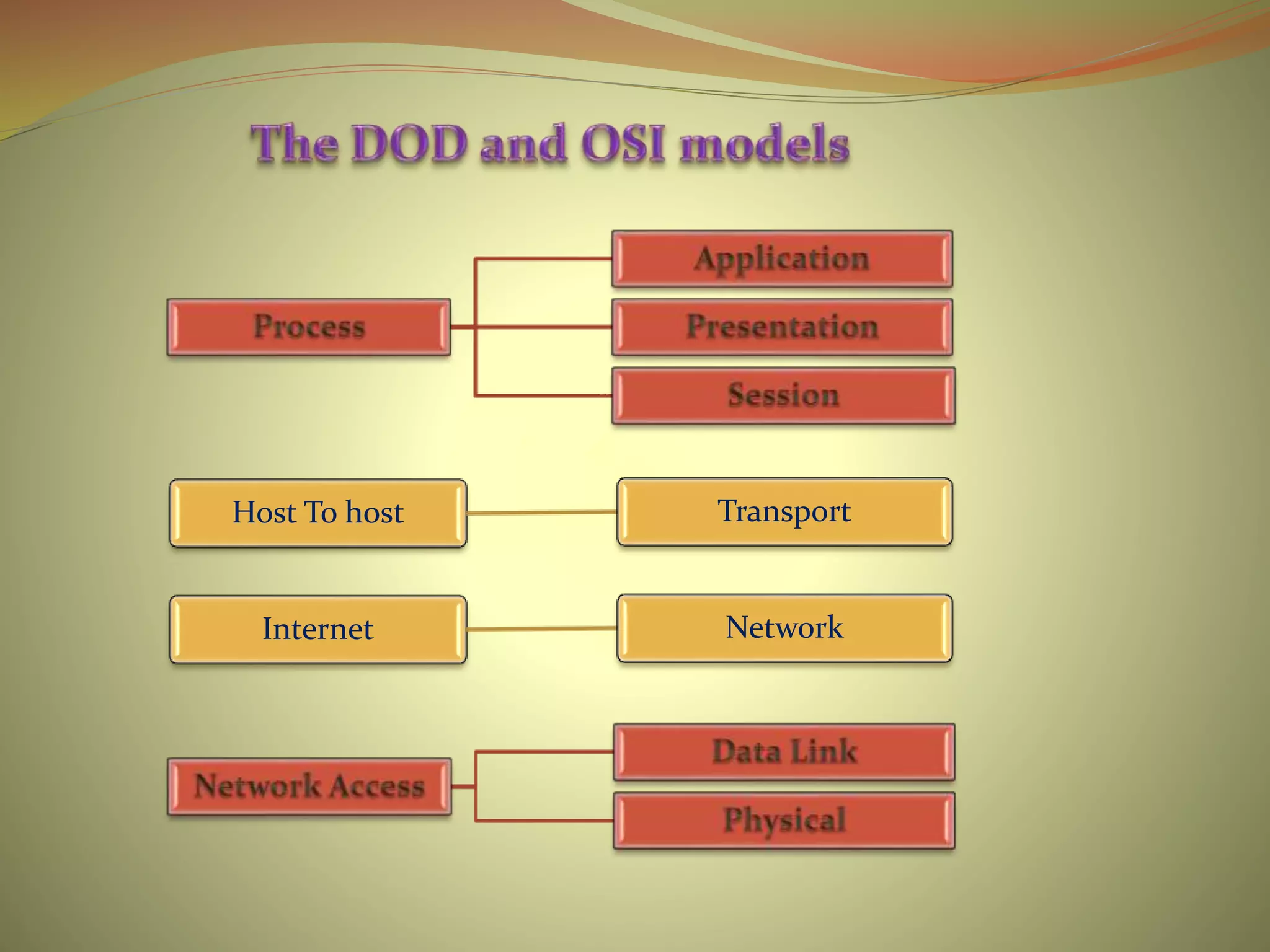
DOD: The Department of Defense (DOD) is a
condensed version of the OSI model. Instead of 7
layers, the DOD model is composed of four layers.
Host To host Transport
Internet Network
OSI LAYERS
The main concept of OSI is that the process of
communication between two endpoints in a
telecommunication network can be divided into seven
distinct groups of related functions, or layers.
The seven Open Systems Interconnection layers are:
Application (Layer 7): The application layer serves as the
window for users and application processes to access network
services
Presentation (Layer 6): The presentation layer works to
transform data into the form that the application layer can
accept. This layer formats and encrypts data to be sent across
a network, providing freedom from compatibility problems
Session (Layer 5): The session layer controls the dialogues
(connections) between computers. It establishes, manages
and terminates the connections between the local and
remote application.
Transport (Layer 4): Transport layer provides transparent
transfer of data between end systems, or hosts , and is
responsible for end-to-end error recovery and flow control. It
ensures complete data transfer.
Network (Layer 3): Layer 3 provides switching and routing
technologies, creating logical paths, known as virtual
circuits, for transmitting data from node to node.
Data Link (Layer 2): This layer sets up links across the
physical network, putting packets into network frames.
Physical (Layer 1): This layer conveys the bit stream through
the network at the electrical, optical or radio level. It provides
the hardware means of sending and receiving data on a
carrier network.
DOD LAYERS
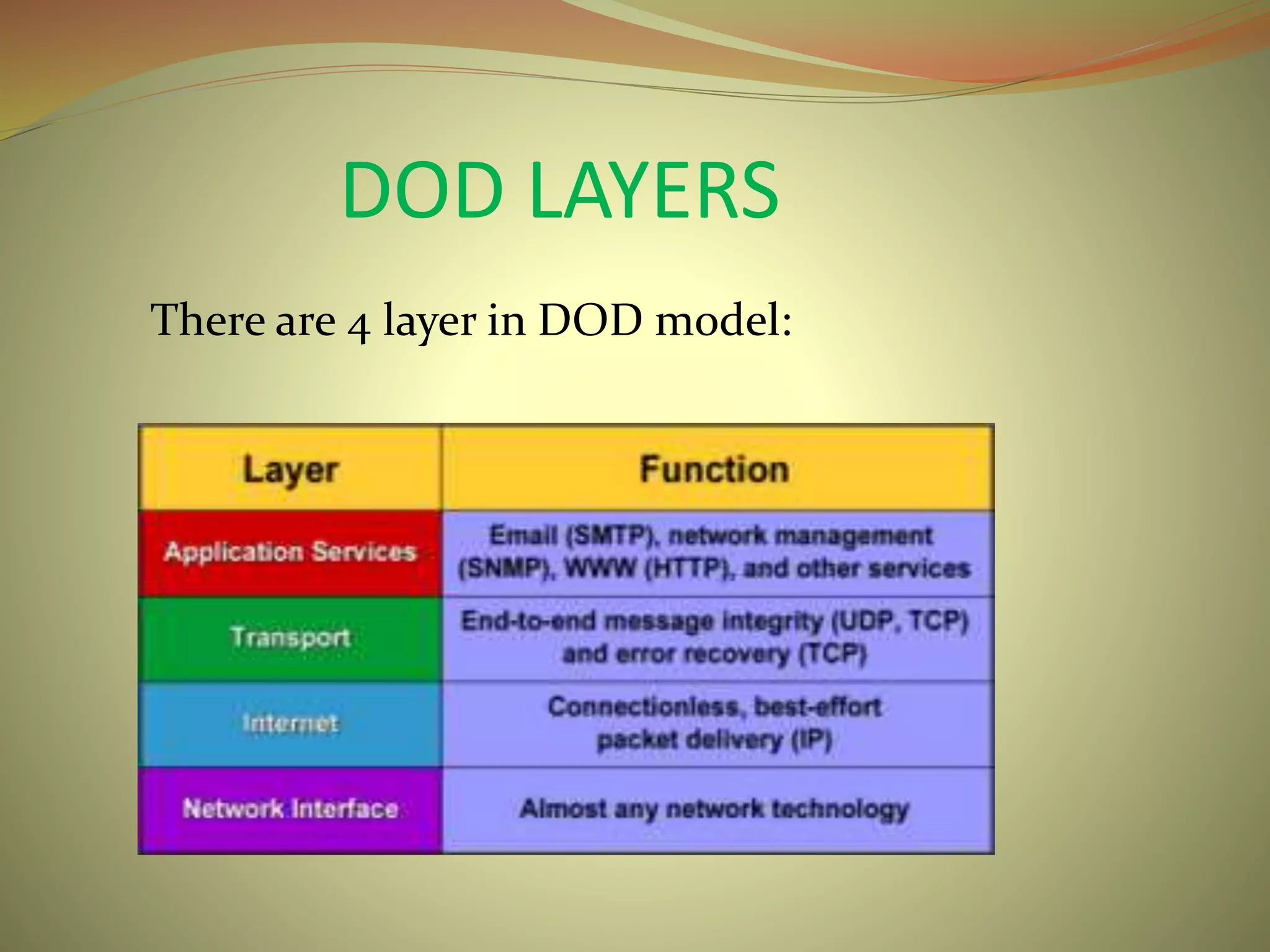
There are 4 layer in DOD model:
Process Layer : The Process Layer contains protocols that
implement user-level functions, such as mail delivery, file
transfer and remote login.
Host-to-Host Layer : The Host-to-Host Layer handles
connection rendezvous, flow control, retransmission of lost
data, and other generic data flow management. The mutually
exclusive TCP and UDP protocols are this layer's most
important members.
Internet Layer : The Internet Layer is responsible for
delivering data across a series of different physical
networks that interconnect a source and destination
machine. Routing protocols are most closely associated
with this layer, as is the IP Protocol, the Internet's
fundamental protocol.
Network Access Layer : The Network Access Layer is
responsible for delivering data over the particular
hardware media in use. Different protocols are selected
from this layer, depending on the type of physical
network.
THANKS TO JOIN WITH US

Dod & osi model

  • 2.
    OSI and DODmodel OSI: (Open Systems Interconnection) is reference model for how applications can communicate over a network. A reference model is a conceptual framework for understanding relationships. DOD: The Department of Defense (DOD) is a condensed version of the OSI model. Instead of 7 layers, the DOD model is composed of four layers.
  • 3.
    Host To hostTransport Internet Network
  • 4.
    OSI LAYERS The mainconcept of OSI is that the process of communication between two endpoints in a telecommunication network can be divided into seven distinct groups of related functions, or layers. The seven Open Systems Interconnection layers are: Application (Layer 7): The application layer serves as the window for users and application processes to access network services
  • 5.
    Presentation (Layer 6):The presentation layer works to transform data into the form that the application layer can accept. This layer formats and encrypts data to be sent across a network, providing freedom from compatibility problems Session (Layer 5): The session layer controls the dialogues (connections) between computers. It establishes, manages and terminates the connections between the local and remote application. Transport (Layer 4): Transport layer provides transparent transfer of data between end systems, or hosts , and is responsible for end-to-end error recovery and flow control. It ensures complete data transfer.
  • 6.
    Network (Layer 3):Layer 3 provides switching and routing technologies, creating logical paths, known as virtual circuits, for transmitting data from node to node. Data Link (Layer 2): This layer sets up links across the physical network, putting packets into network frames. Physical (Layer 1): This layer conveys the bit stream through the network at the electrical, optical or radio level. It provides the hardware means of sending and receiving data on a carrier network.
  • 7.
    DOD LAYERS There are4 layer in DOD model:
  • 8.
    Process Layer :The Process Layer contains protocols that implement user-level functions, such as mail delivery, file transfer and remote login. Host-to-Host Layer : The Host-to-Host Layer handles connection rendezvous, flow control, retransmission of lost data, and other generic data flow management. The mutually exclusive TCP and UDP protocols are this layer's most important members.
  • 9.
    Internet Layer :The Internet Layer is responsible for delivering data across a series of different physical networks that interconnect a source and destination machine. Routing protocols are most closely associated with this layer, as is the IP Protocol, the Internet's fundamental protocol. Network Access Layer : The Network Access Layer is responsible for delivering data over the particular hardware media in use. Different protocols are selected from this layer, depending on the type of physical network.
  • 10.