Software Advice IndustryView:
PM Software & Document Collaboration
Trends and best practices from the industry
In 2015, we surveyed hundreds of employees from a variety of industries to
determine how they were collaborating on documents. We wanted to determine
how using project management (PM) software impacted document collaboration.
Specifically, we wanted to know:
• How does using PM software affect communication when collaborating on files?
• How do employees typically store shared documents?
• What are the biggest challenges employees face with respect to document
collaboration, and how effective is PM software at addressing these challenges?
Abstract
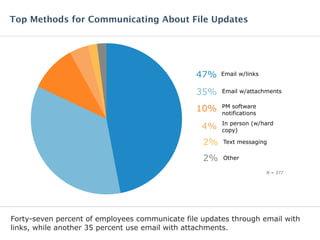
Forty-seven percent of employees communicate file updates through email with
links, while another 35 percent use email with attachments.
Top Methods for Communicating About File Updates
N = 377
Email w/links47%
Email w/attachments35%
PM software
notifications
10%
In person (w/hard
copy)
4%
Other2%
Text messaging2%
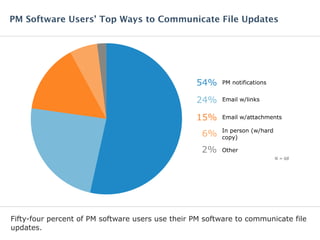
Fifty-four percent of PM software users use their PM software to communicate file
updates.
PM Software Users’ Top Ways to Communicate File Updates
N = 68
PM notifications54%
Email w/links24%
Email w/attachments15%
Other2%
6% In person (w/hard
copy)
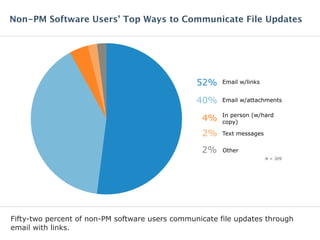
Fifty-two percent of non-PM software users communicate file updates through
email with links.
Non-PM Software Users’ Top Ways to Communicate File Updates
Email w/links52%
Email w/attachments40%
In person (w/hard
copy)
4%
Other2%
Text messages2%
N = 309
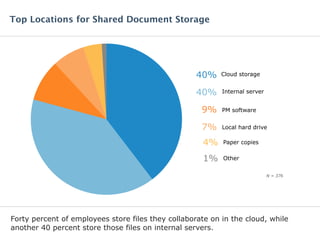
Forty percent of employees store files they collaborate on in the cloud, while
another 40 percent store those files on internal servers.
Top Locations for Shared Document Storage
N = 376
Cloud storage40%
Internal server40%
PM software9%
Local hard drive7%
Other1%
Paper copies4%
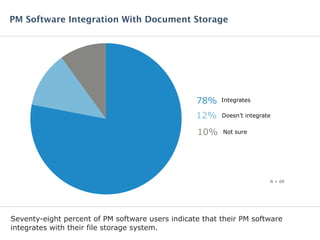
Seventy-eight percent of PM software users indicate that their PM software
integrates with their file storage system.
PM Software Integration With Document Storage
Integrates78%
Doesn’t integrate12%
Not sure10%
N = 68
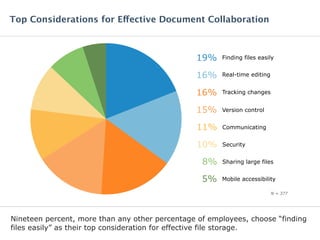
Nineteen percent, more than any other percentage of employees, choose “finding
files easily” as their top consideration for effective file storage.
Top Considerations for Effective Document Collaboration
N = 377
Finding files easily19%
Real-time editing16%
Tracking changes16%
Version control15%
Communicating11%
Security10%
Sharing large files8%
Mobile accessibility5%
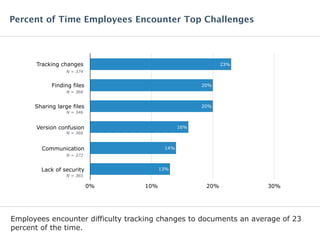
Employees encounter difficulty tracking changes to documents an average of 23
percent of the time.
Percent of Time Employees Encounter Top Challenges
Tracking changes
Finding files
Sharing large files
Version confusion
Communication
Lack of security
0% 10% 20% 30%
13%
14%
16%
20%
20%
23%
N = 368
N = 372
N = 374
N = 365
N = 346
N = 366
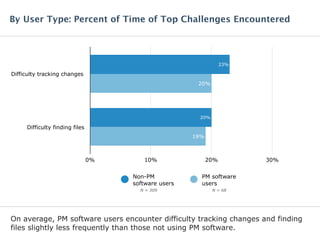
On average, PM software users encounter difficulty tracking changes and finding
files slightly less frequently than those not using PM software.
By User Type: Percent of Time of Top Challenges Encountered
Difficulty tracking changes
Difficulty finding files
0% 10% 20% 30%
19%
20%
20%
23%
N = 309 N = 68
PM software
users
Non-PM
software users
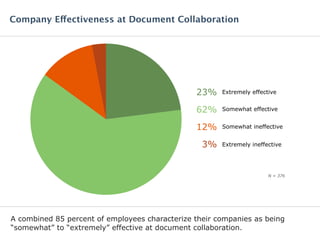
A combined 85 percent of employees characterize their companies as being
“somewhat” to “extremely” effective at document collaboration.
Company Effectiveness at Document Collaboration
Extremely effective23%
Somewhat effective62%
Somewhat ineffective12%
Extremely ineffective3%
N = 376
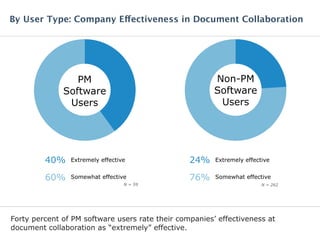
Forty percent of PM software users rate their companies’ effectiveness at
document collaboration as “extremely” effective.
By User Type: Company Effectiveness in Document Collaboration
PM
Software
Users
Extremely effective40%
Somewhat effective60%
N = 262N = 59
Non-PM
Software
Users
Extremely effective24%
Somewhat effective76%
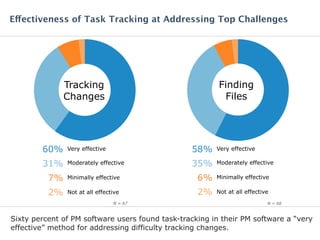
Sixty percent of PM software users found task-tracking in their PM software a “very
effective” method for addressing difficulty tracking changes.
Effectiveness of Task Tracking at Addressing Top Challenges
Finding
Files
Very effective58%
Moderately effective35%
Minimally effective6%
Not at all effective2%
N = 66N = 67
Tracking
Changes
Very effective60%
Moderately effective31%
Minimally effective7%
Not at all effective2%
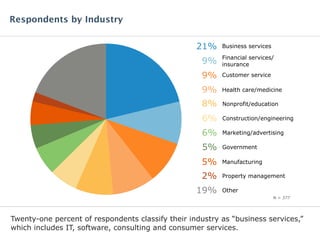
Twenty-one percent of respondents classify their industry as “business services,”
which includes IT, software, consulting and consumer services.
Respondents by Industry
N = 377
Business services21%
Financial services/
insurance9%
Customer service9%
Health care/medicine9%
Construction/engineering6%
Marketing/advertising6%
Government5%
Manufacturing5%
Property management2%
Other19%
Nonprofit/education8%
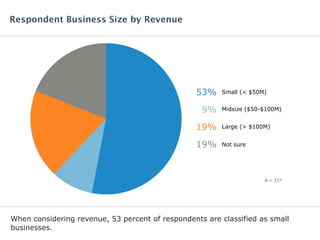
When considering revenue, 53 percent of respondents are classified as small
businesses.
Respondent Business Size by Revenue
N = 377
Small (< $50M)53%
Midsize ($50-$100M)9%
Large (> $100M)19%
Not sure19%
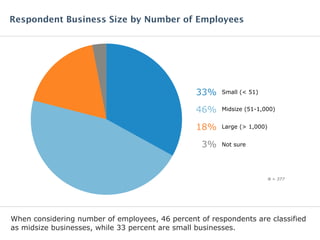
When considering number of employees, 46 percent of respondents are classified
as midsize businesses, while 33 percent are small businesses.
Respondent Business Size by Number of Employees
N = 377
Small (< 51)33%
Midsize (51-1,000)46%
Large (> 1,000)18%
Not sure3%
Read the full report
Get free price quotes on top
project management software
Get unbiased reviews & free
demos on top project management software
Learn More About Project Management Software
Read Report
Get Free Quotes
Get Free Demos
Software Advice™ is a trusted resource for software buyers. We provide detailed
reviews and research on thousands of software applications. Our team of software
advisors provides free telephone consultations to help buyers build a shortlist of
systems that will meet their needs. For more information, visit softwareadvice.com.
Software Advice is a Gartner company. Gartner (NYSE: IT) is the world's leading
information technology research and advisory company. For more information, visit
gartner.com.
@SoftwareAdvice /company/software-advice
@SoftwareAdvice/SoftwareAdvice

Software Advice IndustryView: Document Collaboration Report 2015

  • 1.
    Software Advice IndustryView: PMSoftware & Document Collaboration Trends and best practices from the industry
  • 2.
    In 2015, wesurveyed hundreds of employees from a variety of industries to determine how they were collaborating on documents. We wanted to determine how using project management (PM) software impacted document collaboration. Specifically, we wanted to know: • How does using PM software affect communication when collaborating on files? • How do employees typically store shared documents? • What are the biggest challenges employees face with respect to document collaboration, and how effective is PM software at addressing these challenges? Abstract
  • 3.
    Forty-seven percent ofemployees communicate file updates through email with links, while another 35 percent use email with attachments. Top Methods for Communicating About File Updates N = 377 Email w/links47% Email w/attachments35% PM software notifications 10% In person (w/hard copy) 4% Other2% Text messaging2%
  • 4.
    Fifty-four percent ofPM software users use their PM software to communicate file updates. PM Software Users’ Top Ways to Communicate File Updates N = 68 PM notifications54% Email w/links24% Email w/attachments15% Other2% 6% In person (w/hard copy)
  • 5.
    Fifty-two percent ofnon-PM software users communicate file updates through email with links. Non-PM Software Users’ Top Ways to Communicate File Updates Email w/links52% Email w/attachments40% In person (w/hard copy) 4% Other2% Text messages2% N = 309
  • 6.
    Forty percent ofemployees store files they collaborate on in the cloud, while another 40 percent store those files on internal servers. Top Locations for Shared Document Storage N = 376 Cloud storage40% Internal server40% PM software9% Local hard drive7% Other1% Paper copies4%
  • 7.
    Seventy-eight percent ofPM software users indicate that their PM software integrates with their file storage system. PM Software Integration With Document Storage Integrates78% Doesn’t integrate12% Not sure10% N = 68
  • 8.
    Nineteen percent, morethan any other percentage of employees, choose “finding files easily” as their top consideration for effective file storage. Top Considerations for Effective Document Collaboration N = 377 Finding files easily19% Real-time editing16% Tracking changes16% Version control15% Communicating11% Security10% Sharing large files8% Mobile accessibility5%
  • 9.
    Employees encounter difficultytracking changes to documents an average of 23 percent of the time. Percent of Time Employees Encounter Top Challenges Tracking changes Finding files Sharing large files Version confusion Communication Lack of security 0% 10% 20% 30% 13% 14% 16% 20% 20% 23% N = 368 N = 372 N = 374 N = 365 N = 346 N = 366
  • 10.
    On average, PMsoftware users encounter difficulty tracking changes and finding files slightly less frequently than those not using PM software. By User Type: Percent of Time of Top Challenges Encountered Difficulty tracking changes Difficulty finding files 0% 10% 20% 30% 19% 20% 20% 23% N = 309 N = 68 PM software users Non-PM software users
  • 11.
    A combined 85percent of employees characterize their companies as being “somewhat” to “extremely” effective at document collaboration. Company Effectiveness at Document Collaboration Extremely effective23% Somewhat effective62% Somewhat ineffective12% Extremely ineffective3% N = 376
  • 12.
    Forty percent ofPM software users rate their companies’ effectiveness at document collaboration as “extremely” effective. By User Type: Company Effectiveness in Document Collaboration PM Software Users Extremely effective40% Somewhat effective60% N = 262N = 59 Non-PM Software Users Extremely effective24% Somewhat effective76%
  • 13.
    Sixty percent ofPM software users found task-tracking in their PM software a “very effective” method for addressing difficulty tracking changes. Effectiveness of Task Tracking at Addressing Top Challenges Finding Files Very effective58% Moderately effective35% Minimally effective6% Not at all effective2% N = 66N = 67 Tracking Changes Very effective60% Moderately effective31% Minimally effective7% Not at all effective2%
  • 14.
    Twenty-one percent ofrespondents classify their industry as “business services,” which includes IT, software, consulting and consumer services. Respondents by Industry N = 377 Business services21% Financial services/ insurance9% Customer service9% Health care/medicine9% Construction/engineering6% Marketing/advertising6% Government5% Manufacturing5% Property management2% Other19% Nonprofit/education8%
  • 15.
    When considering revenue,53 percent of respondents are classified as small businesses. Respondent Business Size by Revenue N = 377 Small (< $50M)53% Midsize ($50-$100M)9% Large (> $100M)19% Not sure19%
  • 16.
    When considering numberof employees, 46 percent of respondents are classified as midsize businesses, while 33 percent are small businesses. Respondent Business Size by Number of Employees N = 377 Small (< 51)33% Midsize (51-1,000)46% Large (> 1,000)18% Not sure3%
  • 17.
    Read the fullreport Get free price quotes on top project management software Get unbiased reviews & free demos on top project management software Learn More About Project Management Software Read Report Get Free Quotes Get Free Demos
  • 18.
    Software Advice™ isa trusted resource for software buyers. We provide detailed reviews and research on thousands of software applications. Our team of software advisors provides free telephone consultations to help buyers build a shortlist of systems that will meet their needs. For more information, visit softwareadvice.com. Software Advice is a Gartner company. Gartner (NYSE: IT) is the world's leading information technology research and advisory company. For more information, visit gartner.com. @SoftwareAdvice /company/software-advice @SoftwareAdvice/SoftwareAdvice