Software Advice IndustryView:
Social Collaboration Software Report
Trends and best practices from the industry
In March of 2015, we surveyed hundreds of employees from a variety of
disciplines in a variety of industries. We wanted to determine how many were
using social collaboration software (SCS), and how they were using this software.
Specifically, we wanted to know:
• How common is SCS used in workplace collaboration?
• How are employees using SCS to communicate in the workplace and
collaborate on documents?
• What specific benefits does SCS provide for companies seeking to enhance
internal communication and documentation?
Abstract
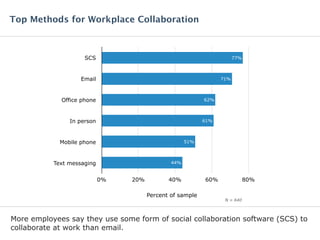
More employees say they use some form of social collaboration software (SCS) to
collaborate at work than email.
Top Methods for Workplace Collaboration
39%
SCS
Email
Office phone
In person
Mobile phone
Text messaging
0% 20% 40% 60% 80%
44%
51%
61%
62%
71%
77%
Percent of sample
N = 640
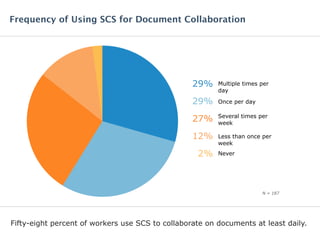
Fifty-eight percent of workers use SCS to collaborate on documents at least daily.
Frequency of Using SCS for Document Collaboration
Multiple times per
day
29%
Once per day29%
Several times per
week
27%
Less than once per
week
12%
Never2%
N = 187
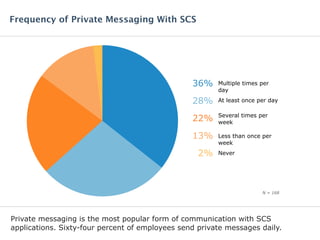
Private messaging is the most popular form of communication with SCS
applications. Sixty-four percent of employees send private messages daily.
Frequency of Private Messaging With SCS
Multiple times per
day
36%
At least once per day28%
Several times per
week
22%
Less than once per
week
13%
Never2%
N = 168
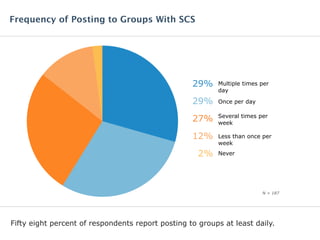
Frequency of Posting to Groups With SCS
Multiple times per
day
29%
Once per day29%
Several times per
week
27%
Less than once per
week
12%
Never2%
N = 187
Fifty eight percent of respondents report posting to groups at least daily.
A typical company information asset will travel a path from conception to execution
and maintenance, with collaboration along the way.
Typical Asset Journey
Create
Collaborate Maintain
Share Measure
Execute
Nineteen percent of respondents classify their business unit or department as IT,
while another 13 percent classify it as marketing.
Respondents by Business Unit
N = 191
IT19%
Marketing13%
Customer support12%
Human resources12%
Sales9%
Research & development8%
Production6%
Purchasing1%
Other10%
Accounting/finance10%
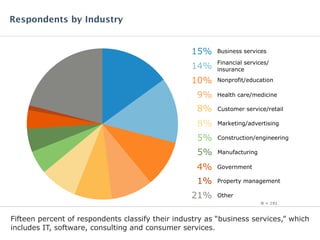
Fifteen percent of respondents classify their industry as “business services,” which
includes IT, software, consulting and consumer services.
Respondents by Industry
N = 191
Business services15%
Financial services/
insurance14%
Nonprofit/education10%
Health care/medicine9%
Marketing/advertising8%
Construction/engineering5%
Manufacturing5%
Government4%
Property management1%
Other21%
Customer service/retail8%
When considering number of employees, 52 percent of respondents are classified
as midsize businesses, while 13 percent are small businesses.
By Number of Employees: Respondents’ Business Size
N = 191
Small (<51)13%
Midsize (51 - 1,000)52%
Large (>1,000)35%
When considering revenue, 51 percent of respondents are classified as small
businesses.
By Revenue: Respondents’ Business Size
N = 191
Small (<$50M)51%
Midsize ($50 - $100M)8%
Large (>$100M)28%
Not sure13%
Read the full report
Get free price quotes on top
project management
software
Get unbiased reviews & free
demos on top project
management software
Learn More About Project Management Software
Read Report
Get Free Quotes
Get Free Demos
Software Advice™ is a trusted resource for software buyers. The company's
website, www.softwareadvice.com, provides detailed reviews, comparisons and
research to help organizations choose the right software. Meanwhile, the company’s
team of software analysts provide free telephone consultations to help each
software buyer identify systems that best fit their needs. In the process, Software
Advice connects software buyers and sellers, generating high-quality opportunities
for software vendors.
@SoftwareAdvice /company/software-advice
@SoftwareAdvice/SoftwareAdvice

Software Advice IndustryView: Social Collaboration Software

  • 1.
    Software Advice IndustryView: SocialCollaboration Software Report Trends and best practices from the industry
  • 2.
    In March of2015, we surveyed hundreds of employees from a variety of disciplines in a variety of industries. We wanted to determine how many were using social collaboration software (SCS), and how they were using this software. Specifically, we wanted to know: • How common is SCS used in workplace collaboration? • How are employees using SCS to communicate in the workplace and collaborate on documents? • What specific benefits does SCS provide for companies seeking to enhance internal communication and documentation? Abstract
  • 3.
    More employees saythey use some form of social collaboration software (SCS) to collaborate at work than email. Top Methods for Workplace Collaboration 39% SCS Email Office phone In person Mobile phone Text messaging 0% 20% 40% 60% 80% 44% 51% 61% 62% 71% 77% Percent of sample N = 640
  • 4.
    Fifty-eight percent ofworkers use SCS to collaborate on documents at least daily. Frequency of Using SCS for Document Collaboration Multiple times per day 29% Once per day29% Several times per week 27% Less than once per week 12% Never2% N = 187
  • 5.
    Private messaging isthe most popular form of communication with SCS applications. Sixty-four percent of employees send private messages daily. Frequency of Private Messaging With SCS Multiple times per day 36% At least once per day28% Several times per week 22% Less than once per week 13% Never2% N = 168
  • 6.
    Frequency of Postingto Groups With SCS Multiple times per day 29% Once per day29% Several times per week 27% Less than once per week 12% Never2% N = 187 Fifty eight percent of respondents report posting to groups at least daily.
  • 7.
    A typical companyinformation asset will travel a path from conception to execution and maintenance, with collaboration along the way. Typical Asset Journey Create Collaborate Maintain Share Measure Execute
  • 8.
    Nineteen percent ofrespondents classify their business unit or department as IT, while another 13 percent classify it as marketing. Respondents by Business Unit N = 191 IT19% Marketing13% Customer support12% Human resources12% Sales9% Research & development8% Production6% Purchasing1% Other10% Accounting/finance10%
  • 9.
    Fifteen percent ofrespondents classify their industry as “business services,” which includes IT, software, consulting and consumer services. Respondents by Industry N = 191 Business services15% Financial services/ insurance14% Nonprofit/education10% Health care/medicine9% Marketing/advertising8% Construction/engineering5% Manufacturing5% Government4% Property management1% Other21% Customer service/retail8%
  • 10.
    When considering numberof employees, 52 percent of respondents are classified as midsize businesses, while 13 percent are small businesses. By Number of Employees: Respondents’ Business Size N = 191 Small (<51)13% Midsize (51 - 1,000)52% Large (>1,000)35%
  • 11.
    When considering revenue,51 percent of respondents are classified as small businesses. By Revenue: Respondents’ Business Size N = 191 Small (<$50M)51% Midsize ($50 - $100M)8% Large (>$100M)28% Not sure13%
  • 12.
    Read the fullreport Get free price quotes on top project management software Get unbiased reviews & free demos on top project management software Learn More About Project Management Software Read Report Get Free Quotes Get Free Demos
  • 13.
    Software Advice™ isa trusted resource for software buyers. The company's website, www.softwareadvice.com, provides detailed reviews, comparisons and research to help organizations choose the right software. Meanwhile, the company’s team of software analysts provide free telephone consultations to help each software buyer identify systems that best fit their needs. In the process, Software Advice connects software buyers and sellers, generating high-quality opportunities for software vendors. @SoftwareAdvice /company/software-advice @SoftwareAdvice/SoftwareAdvice