fusionQ
“Your Data Guardian”
Today, successful businesses recognise that the most effective decisions are evidence-based or data-
driven. The elusive single customer view is very hard to obtain and manage. Time spent analysing on
data trends can be lost.
Organisations implementing quality strategies can face significant obstacles including insufficient
budgets, unrealistic time frames and lack of tools and processes. Whilst lowering costs, to achieve
visibility, take control of standards, and enjoy real-time reporting, trusted data is critical for business
operations and decisions.
 Source relevant data
 Use technology to aid the process
 Empower resources for Data Management
 Cleanse the data
 Setup processes to prevent further corruption
Tier 1 
 Data governance
is not formalised
 Awareness of
data quality
problems
 Applying tactical
solutions
 Root causes not
addressed
Tier 2 
 Data Governance is
not a formalised
practice
 Data quality issues are
addressed in an ad-
hoc manner
 Localised business and
technical solutions
 Initiatives do not
address broader
organisational needs
which may cross
functional boundaries
Tier 3 
 Data Governance is a
formalised practice
 Roles and responsibilities
defined and assigned at the
appropriate level
 Consistent business terms and
definitions, measures and
remediation activities
 Data Quality is managed at the
organisation level
 Data Quality is reported at the
Senior Executive Group
 Business and I.T are
collaborating through
structured groups and forums
to standardise business
processes
Tier 4
 Data and information is
governed at the organisation
level
 Strategic oversight applied
based on industry best
practice/ standards and
continuous improvements
 Data Quality is aligned with
business processes and
measured consistently across
the organisation
 Data corrections are being
applied at the source
 Executive KPI s incorporate
agreed levels of data quality
 Information architecture is
driving structured &
unstructured data integration
and alignment across the
organisation
fusionQ
“Your Data Guardian”
Certified PAF Engine
Gartner on data
Gartner predicts that by 2017,
33% of Fortune 100 will
experience information crisis
due to their inability to
adequately value, govern and
trust their enterprise
information.
By 2016, 30% of organisations
will be directly or indirectly
monetising their information
assets by bartering or selling
them.
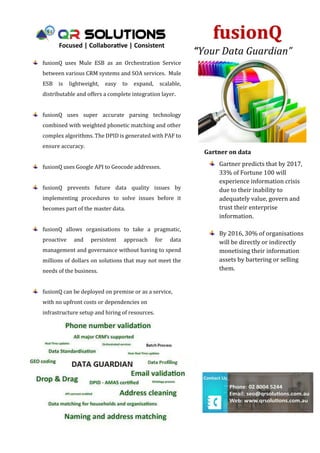
fusionQ uses Mule ESB as an Orchestration Service
between various CRM systems and SOA services. Mule
ESB is lightweight, easy to expand, scalable,
distributable and offers a complete integration layer.
fusionQ uses super accurate parsing technology
combined with weighted phonetic matching and other
complex algorithms. The DPID is generated with PAF to
ensure accuracy.
fusionQ uses Google API to Geocode addresses.
fusionQ prevents future data quality issues by
implementing procedures to solve issues before it
becomes part of the master data.
fusionQ allows organisations to take a pragmatic,
proactive and persistent approach for data
management and governance without having to spend
millions of dollars on solutions that may not meet the
needs of the business.
fusionQ can be deployed on premise or as a service,
with no upfront costs or dependencies on
infrastructure setup and hiring of resources.
Powered by TCPDF (www.tcpdf.org)Powered by TCPDF (www.tcpdf.org)

Fusion Q

  • 1.
    fusionQ “Your Data Guardian” Today,successful businesses recognise that the most effective decisions are evidence-based or data- driven. The elusive single customer view is very hard to obtain and manage. Time spent analysing on data trends can be lost. Organisations implementing quality strategies can face significant obstacles including insufficient budgets, unrealistic time frames and lack of tools and processes. Whilst lowering costs, to achieve visibility, take control of standards, and enjoy real-time reporting, trusted data is critical for business operations and decisions.  Source relevant data  Use technology to aid the process  Empower resources for Data Management  Cleanse the data  Setup processes to prevent further corruption Tier 1   Data governance is not formalised  Awareness of data quality problems  Applying tactical solutions  Root causes not addressed Tier 2   Data Governance is not a formalised practice  Data quality issues are addressed in an ad- hoc manner  Localised business and technical solutions  Initiatives do not address broader organisational needs which may cross functional boundaries Tier 3   Data Governance is a formalised practice  Roles and responsibilities defined and assigned at the appropriate level  Consistent business terms and definitions, measures and remediation activities  Data Quality is managed at the organisation level  Data Quality is reported at the Senior Executive Group  Business and I.T are collaborating through structured groups and forums to standardise business processes Tier 4  Data and information is governed at the organisation level  Strategic oversight applied based on industry best practice/ standards and continuous improvements  Data Quality is aligned with business processes and measured consistently across the organisation  Data corrections are being applied at the source  Executive KPI s incorporate agreed levels of data quality  Information architecture is driving structured & unstructured data integration and alignment across the organisation
  • 2.
    fusionQ “Your Data Guardian” CertifiedPAF Engine Gartner on data Gartner predicts that by 2017, 33% of Fortune 100 will experience information crisis due to their inability to adequately value, govern and trust their enterprise information. By 2016, 30% of organisations will be directly or indirectly monetising their information assets by bartering or selling them. fusionQ uses Mule ESB as an Orchestration Service between various CRM systems and SOA services. Mule ESB is lightweight, easy to expand, scalable, distributable and offers a complete integration layer. fusionQ uses super accurate parsing technology combined with weighted phonetic matching and other complex algorithms. The DPID is generated with PAF to ensure accuracy. fusionQ uses Google API to Geocode addresses. fusionQ prevents future data quality issues by implementing procedures to solve issues before it becomes part of the master data. fusionQ allows organisations to take a pragmatic, proactive and persistent approach for data management and governance without having to spend millions of dollars on solutions that may not meet the needs of the business. fusionQ can be deployed on premise or as a service, with no upfront costs or dependencies on infrastructure setup and hiring of resources. Powered by TCPDF (www.tcpdf.org)Powered by TCPDF (www.tcpdf.org)