LEVI’S
Case study analysis
         Olya Dyachuk ,
        Fernanda S. Russo,
        Karim H. Hussien,
        Abiodun Ogundele

    Lecturer: Dr Wilson Ozuem
Overview

Levi’s faced a problem that their jeans were
  increasingly regarded as ‘uncool’ in the
  beginning of 1990s what lead to the fallen in
  sales.
The poor connection with young customers in
  terms of rap music popularity growth and a new
  subculture phenomenon development was the
  major reason.
To maintain the current market share and expand
  it Levi’s had to find a way to attract young
  audience through changes in their products,
  brands, positioning and communications.
Company background
 1853 - Founded in San Francisco by
  Levi Strauss

 1902 – Levi Strauss dies at the age of 73

 1947 – 501 model starts coming off the
  production line

 1966 – The first television commercial
  for Levi’s jeans aired.

 1981 – 501 jeans for women were
  introduced.

 Today the products are sold under
  Levi’s, Dockers, Denizen and signature
  by Levi Strauss & Co.
THE BRAND
ANATOMY OF LEVI’S


      David Jobber and John Fahy 2009
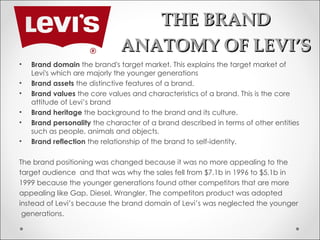
THE BRAND
                              ANATOMY OF LEVI’S
•   Brand domain the brand's target market. This explains the target market of
    Levi's which are majorly the younger generations
•   Brand assets the distinctive features of a brand.
•   Brand values the core values and characteristics of a brand. This is the core
    attitude of Levi’s brand
•   Brand heritage the background to the brand and its culture.
•   Brand personality the character of a brand described in terms of other entities
    such as people, animals and objects.
•   Brand reflection the relationship of the brand to self-identity.

The brand positioning was changed because it was no more appealing to the
target audience and that was why the sales fell from $7.1b in 1996 to $5.1b in
1999 because the younger generations found other competitors that are more
appealing like Gap, Diesel, Wrangler. The competitors product was adopted
instead of Levi’s because the brand domain of Levi’s was neglected the younger
 generations.
POSITIONING
“ Although brand positions, like brands
themselves, exist in people’s heads and hearts,
a company’s marketing communications can
greatly influence how customers perceive a
brand in relation to competition” (Hans
Ouwersloot and Tom Ducan, 2008)

Is it retrievable?

Massive market
         Young consumers
Maintain the idea that Levis is again the cool
brand
         Sponsoring and supporting musicians,
          bands and concerts
         Introduce brand name into target
          consumers’ clubs, concert venues,
          websites and fanzines
         Relaunch famous collection
Restoration of a successful
                                      brand
“Fulfillment of customer needs, or delivering
customer value, in turn increases customer
loyalty” (Laitamaki&Kordupleski, 1997;
Gronholdt, Martensen&Kristensen,
2000;Blattberg, Getz&Thomas, 2001)


•From 1999-2005 Levi's has launch a new
product to keep up with the ever changing
consumer needs.

•Reinforcing itself through tailored products
for different customer bases.

•With the launch of a new product a
supportive campaign is created .
Restoration of a successful
                                brand
“Brands add value by differentiating
the firm’s product and providing
consumers with confidence in the
rational and emotional benefits of the
offering” (Doyle, 2001)


•With the opening of a new levi’s un-
branded store, targeting ‘cultural
connoisseurs’.

•The use of a guerilla technique called
“self-discovery”.
Restoration of a successful
                                brand
“A Source of competitive advantages
that is getting increasing attention
comes from creating, communicating,
and delivering superior value to
customer” (Woodruff and
Garndial,1996; Woodruff, 1997)

•Altering the approach to massified
promotion with the use of viral
communication to penetrate the youth
culture.

•Gently pushing towards the idea that
Levi’s is “cool”
‘Anti-Fit’ – new urban
                                                         street approach
  •Levi’s was on the Decline stage.
  •However the brand was well-known and had a
strong heritage (since 1873).


    STP Process (Baines, Fill, and Page, 2011, p.217)


  •501 was one of the Brands in the line that could
be revive. It had to target the hip-looking 15-24 teens
and young adults group.
  •The Brand’s image was radically changed. From                                             Objectives at different stages of
the more epic style of ads with a more urban street                                             adaption and life cycle.
approach. Sexy, flirting, free.                                                               (Dahlén, M., Lange, F., and
                                                                                                  Smith, T., 2009, p.96)


        Dahlén, M., Lange, F., and Smith, T., 2009. Marketing Communications: A Brand Narrative Approach. John Wiley & Sons.
                                                           Baines, Fill, and Page, 2011. Marketing. Oxford: Oxford University Press)
Jeans design

Free, sexy, stylish, fashionable
design attracts young
audience:
 low cut
 loose fitting
 baggy look
To wear the new 501
to look cool.
Advertising strategy.
 In terms of creating a new image among target audience 501 had to set a Feeling
based objective to change attitude through the development of brand identity and
                              image (Egan, 2007, p.108).
          Advertisers go through three steps (Kotler and Keller, 2012, p. 507):
Questions

Levi's IMC analysis

  • 1.
    LEVI’S Case study analysis Olya Dyachuk , Fernanda S. Russo, Karim H. Hussien, Abiodun Ogundele Lecturer: Dr Wilson Ozuem
  • 2.
    Overview Levi’s faced aproblem that their jeans were increasingly regarded as ‘uncool’ in the beginning of 1990s what lead to the fallen in sales. The poor connection with young customers in terms of rap music popularity growth and a new subculture phenomenon development was the major reason. To maintain the current market share and expand it Levi’s had to find a way to attract young audience through changes in their products, brands, positioning and communications.
  • 3.
    Company background  1853- Founded in San Francisco by Levi Strauss  1902 – Levi Strauss dies at the age of 73  1947 – 501 model starts coming off the production line  1966 – The first television commercial for Levi’s jeans aired.  1981 – 501 jeans for women were introduced.  Today the products are sold under Levi’s, Dockers, Denizen and signature by Levi Strauss & Co.
  • 4.
    THE BRAND ANATOMY OFLEVI’S David Jobber and John Fahy 2009
  • 5.
    THE BRAND ANATOMY OF LEVI’S • Brand domain the brand's target market. This explains the target market of Levi's which are majorly the younger generations • Brand assets the distinctive features of a brand. • Brand values the core values and characteristics of a brand. This is the core attitude of Levi’s brand • Brand heritage the background to the brand and its culture. • Brand personality the character of a brand described in terms of other entities such as people, animals and objects. • Brand reflection the relationship of the brand to self-identity. The brand positioning was changed because it was no more appealing to the target audience and that was why the sales fell from $7.1b in 1996 to $5.1b in 1999 because the younger generations found other competitors that are more appealing like Gap, Diesel, Wrangler. The competitors product was adopted instead of Levi’s because the brand domain of Levi’s was neglected the younger generations.
  • 6.
    POSITIONING “ Although brandpositions, like brands themselves, exist in people’s heads and hearts, a company’s marketing communications can greatly influence how customers perceive a brand in relation to competition” (Hans Ouwersloot and Tom Ducan, 2008) Is it retrievable? Massive market  Young consumers Maintain the idea that Levis is again the cool brand  Sponsoring and supporting musicians, bands and concerts  Introduce brand name into target consumers’ clubs, concert venues, websites and fanzines  Relaunch famous collection
  • 7.
    Restoration of asuccessful brand “Fulfillment of customer needs, or delivering customer value, in turn increases customer loyalty” (Laitamaki&Kordupleski, 1997; Gronholdt, Martensen&Kristensen, 2000;Blattberg, Getz&Thomas, 2001) •From 1999-2005 Levi's has launch a new product to keep up with the ever changing consumer needs. •Reinforcing itself through tailored products for different customer bases. •With the launch of a new product a supportive campaign is created .
  • 8.
    Restoration of asuccessful brand “Brands add value by differentiating the firm’s product and providing consumers with confidence in the rational and emotional benefits of the offering” (Doyle, 2001) •With the opening of a new levi’s un- branded store, targeting ‘cultural connoisseurs’. •The use of a guerilla technique called “self-discovery”.
  • 9.
    Restoration of asuccessful brand “A Source of competitive advantages that is getting increasing attention comes from creating, communicating, and delivering superior value to customer” (Woodruff and Garndial,1996; Woodruff, 1997) •Altering the approach to massified promotion with the use of viral communication to penetrate the youth culture. •Gently pushing towards the idea that Levi’s is “cool”
  • 10.
    ‘Anti-Fit’ – newurban street approach •Levi’s was on the Decline stage. •However the brand was well-known and had a strong heritage (since 1873). STP Process (Baines, Fill, and Page, 2011, p.217) •501 was one of the Brands in the line that could be revive. It had to target the hip-looking 15-24 teens and young adults group. •The Brand’s image was radically changed. From Objectives at different stages of the more epic style of ads with a more urban street adaption and life cycle. approach. Sexy, flirting, free. (Dahlén, M., Lange, F., and Smith, T., 2009, p.96) Dahlén, M., Lange, F., and Smith, T., 2009. Marketing Communications: A Brand Narrative Approach. John Wiley & Sons. Baines, Fill, and Page, 2011. Marketing. Oxford: Oxford University Press)
  • 11.
    Jeans design Free, sexy,stylish, fashionable design attracts young audience:  low cut  loose fitting  baggy look To wear the new 501 to look cool.
  • 12.
    Advertising strategy. Interms of creating a new image among target audience 501 had to set a Feeling based objective to change attitude through the development of brand identity and image (Egan, 2007, p.108). Advertisers go through three steps (Kotler and Keller, 2012, p. 507):
  • 13.

Editor's Notes

  • #11 http://adland.tv/commercials/levis-antifit-bike-2004-030-uk