DEFINE RESEARCH PAPER:
Aresearch paper is simply a way to share your discoveries and explain what
you learned about something.
OR
A research paper is a formal, written document that presents the findings of
an original investigation or a thorough analysis and interpretation of existing
information on a specific topic.
• It has different sections that each play a role in explaining your work
clearly
3.
Structure and Layoutof a Research Paper:
• A typical research paper generally follows this structure:
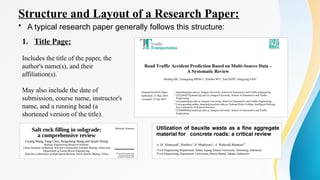
1. Title Page:
Includes the title of the paper, the
author's name(s), and their
affiliation(s).
May also include the date of
submission, course name, instructor's
name, and a running head (a
shortened version of the title).
4.
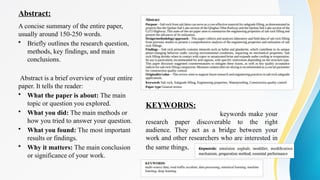
Abstract:
A concise summaryof the entire paper,
usually around 150-250 words.
• Briefly outlines the research question,
methods, key findings, and main
conclusions.
Abstract is a brief overview of your entire
paper. It tells the reader:
• What the paper is about: The main
topic or question you explored.
• What you did: The main methods or
how you tried to answer your question.
• What you found: The most important
results or findings.
• Why it matters: The main conclusion
or significance of your work.
KEYWORDS:
keywords make your
research paper discoverable to the right
audience. They act as a bridge between your
work and other researchers who are interested in
the same things.
5.
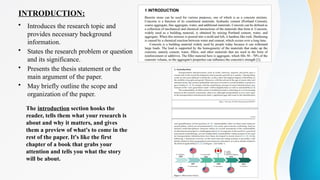
INTRODUCTION:
• Introduces theresearch topic and
provides necessary background
information.
• States the research problem or question
and its significance.
• Presents the thesis statement or the
main argument of the paper.
• May briefly outline the scope and
organization of the paper.
The introduction section hooks the
reader, tells them what your research is
about and why it matters, and gives
them a preview of what's to come in the
rest of the paper. It's like the first
chapter of a book that grabs your
attention and tells you what the story
will be about.
6.
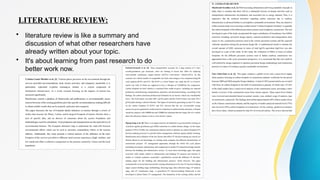
LITERATURE REVIEW:
• literaturereview is like a summary and
discussion of what other researchers have
already written about your topic.
• It's about learning from past research to do
better work now.
7.
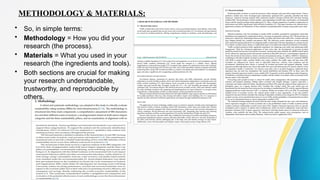
METHODOLOGY & MATERIALS:
•So, in simple terms:
• Methodology = How you did your
research (the process).
• Materials = What you used in your
research (the ingredients and tools).
• Both sections are crucial for making
your research understandable,
trustworthy, and reproducible by
others.
8.
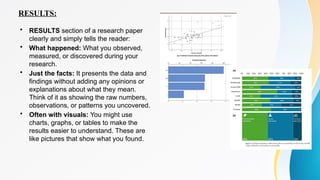
RESULTS:
• RESULTS sectionof a research paper
clearly and simply tells the reader:
• What happened: What you observed,
measured, or discovered during your
research.
• Just the facts: It presents the data and
findings without adding any opinions or
explanations about what they mean.
Think of it as showing the raw numbers,
observations, or patterns you uncovered.
• Often with visuals: You might use
charts, graphs, or tables to make the
results easier to understand. These are
like pictures that show what you found.
9.
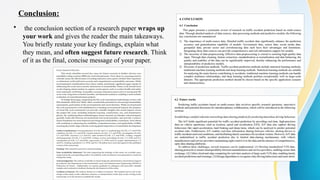
Conclusion:
• the conclusionsection of a research paper wraps up
your work and gives the reader the main takeaways.
You briefly restate your key findings, explain what
they mean, and often suggest future research. Think
of it as the final, concise message of your paper.
10.
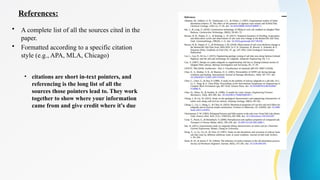
References:
• A completelist of all the sources cited in the
paper.
• Formatted according to a specific citation
style (e.g., APA, MLA, Chicago)
• citations are short in-text pointers, and
referencing is the long list of all the
sources those pointers lead to. They work
together to show where your information
came from and give credit where it's due
11.
LAYOUT OF ARESEARCH PAPER
Layout Considerations:
• Formatting Style: Follow the specific formatting guidelines required
by the journal or institution (e.g., font, margins, line spacing, headings).
• Headings and Subheadings: Use clear and concise headings and
subheadings to organize the content logically and improve readability.
• Page Numbers: Include page numbers consistently throughout the
paper.
• Tables and Figures: Label tables and figures clearly and refer to them
in the text. Place them close to where they are first mentioned.
• Citations: Ensure all sources are properly cited within the text and in
the references section according to the chosen style.
12.
Writing Process ofa Research Paper
Understanding the Assignment: Carefully read and understand the requirements and expectations
of the research paper.
Choosing a Topic: Select a topic that is interesting, manageable, and relevant to the field of study.
Narrow down the topic to a specific research question.
Conducting Preliminary Research: Explore existing literature to get an overview of the topic and
identify potential research gaps.
Developing a Thesis Statement: Formulate a clear and concise statement that presents the main
argument or purpose of the paper.
Creating an Outline: Organize the main points and supporting evidence in a logical structure. This
helps to ensure a coherent flow of ideas.
Gathering and Analyzing Information: Conduct in-depth research using credible sources such as
academic journals, books, and databases. Take detailed notes and critically analyze the information.
13.
Writing the FirstDraft: Begin writing the paper section by section, following the outline. Focus
on getting the ideas down on paper without worrying too much about perfection at this stage.
Citing Sources: Keep track of all sources used and cite them correctly within the text as you
write to avoid plagiarism.
Revising and Editing: Review the first draft for clarity, coherence, organization, and accuracy.
Make necessary revisions to improve the content and flow. Pay attention to grammar, spelling,
punctuation, and formatting. It is helpful to get feedback from peers or instructors.
Writing the Abstract and Introduction: Often written after the main body of the paper is
complete, these sections provide an overview and roadmap for the reader.
Writing the Conclusion: Summarize the main points and offer final thoughts on the research.
Formatting the Paper: Ensure the paper adheres to the required formatting style guidelines.
Proofreading: Carefully read the final version of the paper to catch any remaining errors before
submission.