Entrance Task Session 3 Use the beans at your tables to complete the Place Value sheet.  What mathematics is highlighted as you do this work? When you’ve completed the sheet… Turn to Donna’s Case 12 on pages 47-50 in your DMI books (Lines 82-166). Read and skim the case. What connections can you make between your experience and the one she describes? Record your thoughts in your journals.
Think About It…. Thinking deeply about what we are doing leads us to ask better questions, break out of fruitless routines, make unexpected connections and experiment with fresh ideas.  Ron Brandt
Session 3 Goals Content   Process   Community
BIG IDEA! There is tremendous complexity involved in making sense of our written and spoken number systems.  Our systems are not intuitive or obvious to novices.  Many of these ideas that children express make sense in light of this complexity.  Reflect on the importance of tens and their relationship to other numbers: What is ten? When is ten ones a ten? How can I break up a ten? Why would I want to?  
Case Discussion  Chapter 3 As you work through the case you are assigned, look for elements of logic and where a students thinking goes awry. What are some of the children’s new insights?  Cite evidence. Does this raise any questions  about the way children make sense of our number system? Have you ever noticed children thinking this way in your own classes?
Merging of the Minds Merge with the other group who focused on the same case. Work together to complete the Graphic Organizer. Select at least 2 individuals (preferably one from each group) to present your information to the whole group. Did you have any new insights about our number system?
View and Discuss A Video Watch the 12 minute video of a taped interview with a student named Chris As you watch the interview, focus on the teacher’s moves… What types of questions is she asking? What do you think her goals are? How is she accomplishing this? What evidence from this interview do you have to support these statements? What other questions or tasks would you have included? Record your thoughts in your journals
Key Understanding 4   The whole numbers are in a particular order, and there are patterns in the way we say them which help us to remember the order. Mathematics
Key Understanding 5 Place value is the key to understanding how we say, read, write and calculate with whole numbers. The order of the digits makes a difference The position of a digit tells us the quantity it represents Zero is used as a place holder There is a constant multiplicative relationship between the places with the values of the position increasing in powers of ten from right to left   The value of the digit multiplied by the value of the place tells us the quantity a digit represents Mathematics
An Interview with Hannah Read through the interview with Hannah In your groups determine Hannah’s rules for writing large numbers *Note…this material is from Australia.  In Australia they use the word “and” to indicate a place value change and not decimals. Mathematics
Place Value Tasks Work with your grade level teams to select a place value task that you would like to administer between now and January 16 th .
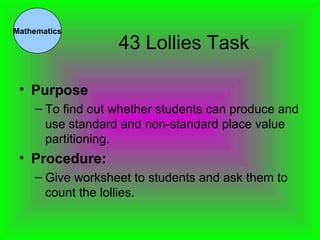
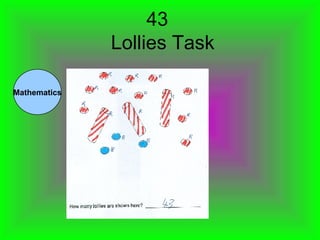
43 Lollies Task Purpose To find out whether students can produce and use standard and non-standard place value partitioning. Procedure: Give worksheet to students and ask them to count the lollies. Mathematics
43   Lollies Task Mathematics
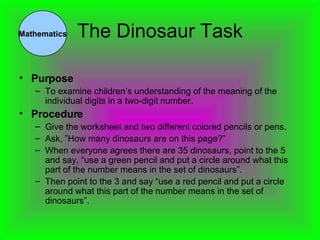
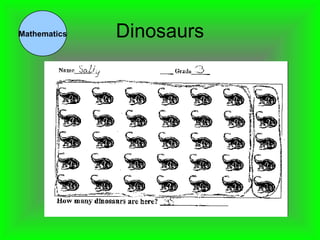
The Dinosaur Task Purpose To examine children’s understanding of the meaning of the individual digits in a two-digit number.  Procedure Give the worksheet and two different colored pencils or pens.  Ask, ”How many dinosaurs are on this page?” When everyone agrees there are 35 dinosaurs, point to the 5 and say, “use a green pencil and put a circle around what this part of the number means in the set of dinosaurs”. Then point to the 3 and say “use a red pencil and put a circle around what this part of the number means in the set of dinosaurs”. Mathematics
Dinosaurs Mathematics
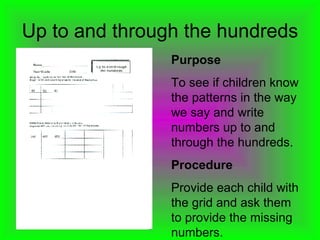
Up to and through the hundreds Purpose To see if children know the patterns in the way we say and write numbers up to and through the hundreds.  Procedure Provide each child with the grid and ask them to provide the missing numbers.
The 800 Game Purpose To see the extent of children’s understanding of the relationship between the places.  Procedure This can be played as a whole group or small group activity. Each person makes a number with the cards they were given. Decide how you could change the value of the 8 in your number so that it will equal the value of your partner’s 8. Use a calculator to try out your idea. Try other ways. Talk to other players.  Are they doing it the same way as you? How do you account for any differences? 800
Circle the Biggest Purpose To see if children can compare numbers using multiplicative relationships. Procedure Distribute the worksheet and ask students to write a full explanation of their reasoning on each choice they make.  You may need to get clarification from a few students if their reasoning is questionable or unclear.
Wipe out Enter a number such as 256 into the calculator. Ask: “ How can we make the 5 a zero?” (Subtract 50) “ Why did you do that?” “What number have we got now?” “ How can we make the 2 a zero?” “What number have we got now?” “ How can we make the 6 a zero?” Students play wipe out in pairs taking turns to give each other the instructions. Mathematics
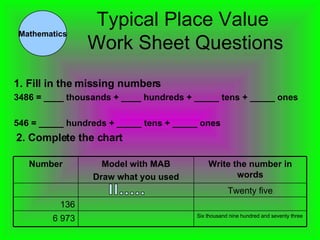
Typical Place Value  Work Sheet Questions 1. Fill in the missing numbers 3486 = ____ thousands + ____ hundreds + _____ tens + _____ ones 546 = _____ hundreds + _____ tens + _____ ones   2. Complete the chart Mathematics Six thousand nine hundred and seventy three 6 973 136 Twenty five Write the number in words Model with MAB Draw what you used Number
EXIT Cards What Place Value misconceptions are most common in your grade level? Do you have any insights to share or questions to ask? Homework Read Chapter 4 Administer one of the First Steps Place Value tasks with your class between now and our January 16 th  session. Think About It…. If we only give experiences with things in groups of ten—children never get to see when the pattern doesn’t hold.

DMI Session 3

  • 1.
    Entrance Task Session3 Use the beans at your tables to complete the Place Value sheet. What mathematics is highlighted as you do this work? When you’ve completed the sheet… Turn to Donna’s Case 12 on pages 47-50 in your DMI books (Lines 82-166). Read and skim the case. What connections can you make between your experience and the one she describes? Record your thoughts in your journals.
  • 2.
    Think About It….Thinking deeply about what we are doing leads us to ask better questions, break out of fruitless routines, make unexpected connections and experiment with fresh ideas. Ron Brandt
  • 3.
    Session 3 GoalsContent Process Community
  • 4.
    BIG IDEA! Thereis tremendous complexity involved in making sense of our written and spoken number systems. Our systems are not intuitive or obvious to novices. Many of these ideas that children express make sense in light of this complexity. Reflect on the importance of tens and their relationship to other numbers: What is ten? When is ten ones a ten? How can I break up a ten? Why would I want to?  
  • 5.
    Case Discussion Chapter 3 As you work through the case you are assigned, look for elements of logic and where a students thinking goes awry. What are some of the children’s new insights? Cite evidence. Does this raise any questions about the way children make sense of our number system? Have you ever noticed children thinking this way in your own classes?
  • 6.
    Merging of theMinds Merge with the other group who focused on the same case. Work together to complete the Graphic Organizer. Select at least 2 individuals (preferably one from each group) to present your information to the whole group. Did you have any new insights about our number system?
  • 7.
    View and DiscussA Video Watch the 12 minute video of a taped interview with a student named Chris As you watch the interview, focus on the teacher’s moves… What types of questions is she asking? What do you think her goals are? How is she accomplishing this? What evidence from this interview do you have to support these statements? What other questions or tasks would you have included? Record your thoughts in your journals
  • 8.
    Key Understanding 4 The whole numbers are in a particular order, and there are patterns in the way we say them which help us to remember the order. Mathematics
  • 9.
    Key Understanding 5Place value is the key to understanding how we say, read, write and calculate with whole numbers. The order of the digits makes a difference The position of a digit tells us the quantity it represents Zero is used as a place holder There is a constant multiplicative relationship between the places with the values of the position increasing in powers of ten from right to left The value of the digit multiplied by the value of the place tells us the quantity a digit represents Mathematics
  • 10.
    An Interview withHannah Read through the interview with Hannah In your groups determine Hannah’s rules for writing large numbers *Note…this material is from Australia. In Australia they use the word “and” to indicate a place value change and not decimals. Mathematics
  • 11.
    Place Value TasksWork with your grade level teams to select a place value task that you would like to administer between now and January 16 th .
  • 12.
    43 Lollies TaskPurpose To find out whether students can produce and use standard and non-standard place value partitioning. Procedure: Give worksheet to students and ask them to count the lollies. Mathematics
  • 13.
    43 Lollies Task Mathematics
  • 14.
    The Dinosaur TaskPurpose To examine children’s understanding of the meaning of the individual digits in a two-digit number. Procedure Give the worksheet and two different colored pencils or pens. Ask, ”How many dinosaurs are on this page?” When everyone agrees there are 35 dinosaurs, point to the 5 and say, “use a green pencil and put a circle around what this part of the number means in the set of dinosaurs”. Then point to the 3 and say “use a red pencil and put a circle around what this part of the number means in the set of dinosaurs”. Mathematics
  • 15.
  • 16.
    Up to andthrough the hundreds Purpose To see if children know the patterns in the way we say and write numbers up to and through the hundreds. Procedure Provide each child with the grid and ask them to provide the missing numbers.
  • 17.
    The 800 GamePurpose To see the extent of children’s understanding of the relationship between the places. Procedure This can be played as a whole group or small group activity. Each person makes a number with the cards they were given. Decide how you could change the value of the 8 in your number so that it will equal the value of your partner’s 8. Use a calculator to try out your idea. Try other ways. Talk to other players. Are they doing it the same way as you? How do you account for any differences? 800
  • 18.
    Circle the BiggestPurpose To see if children can compare numbers using multiplicative relationships. Procedure Distribute the worksheet and ask students to write a full explanation of their reasoning on each choice they make. You may need to get clarification from a few students if their reasoning is questionable or unclear.
  • 19.
    Wipe out Entera number such as 256 into the calculator. Ask: “ How can we make the 5 a zero?” (Subtract 50) “ Why did you do that?” “What number have we got now?” “ How can we make the 2 a zero?” “What number have we got now?” “ How can we make the 6 a zero?” Students play wipe out in pairs taking turns to give each other the instructions. Mathematics
  • 20.
    Typical Place Value Work Sheet Questions 1. Fill in the missing numbers 3486 = ____ thousands + ____ hundreds + _____ tens + _____ ones 546 = _____ hundreds + _____ tens + _____ ones   2. Complete the chart Mathematics Six thousand nine hundred and seventy three 6 973 136 Twenty five Write the number in words Model with MAB Draw what you used Number
  • 21.
    EXIT Cards WhatPlace Value misconceptions are most common in your grade level? Do you have any insights to share or questions to ask? Homework Read Chapter 4 Administer one of the First Steps Place Value tasks with your class between now and our January 16 th session. Think About It…. If we only give experiences with things in groups of ten—children never get to see when the pattern doesn’t hold.