Mixtures: Introduction
Ana Emelia P. Galindo
MT II
Calamba Central School
Calamba, Misamis Occ.,
Mindanao
OBJECTIVES:
Content Standards:
The learners demonstrate understanding of different types of mixtures
and their characteristics
Performance Standard:
The learners should be able to prepare beneficial and useful mixtures
such as drinks, food and herbal medicines
Learning Competencies/Objectives:
The learners should be able to describe the appearance and uses of
uniform and non-uniform mixtures
Code: (S6MT-Ia-c-1)
Describe the appearance of mixtures formed
II. CONTENT:
Mixtures: Introduction
III.LEARNING RESOURCES:
A. Reference
1. Teacher’s Guide
2. Learner’s Materials pages
3. Textbook Pages: Science Links Worktext in Science and Technology page 65
4. Additional Materials from Learning Resources (LR) portal
Grade 6 Science Activities (First Quarter) pages 2-3
A. Other Learning Resources
Multimedia Presentations, charts, pictures, real objects, textbooks, activity
sheets
Let’s review our
previous lesson
Show Me
Board/Flashcards
SOLID LIQUID GAS
The molecules are slightly
apart from each other.
LIQUID
SOLID LIQUID GAS
The molecules can roll, glide, and
take the shape of the container.
LIQUID
SOLID LIQUID GAS
Molecules are far from each
other so they can move freely
GAS
SOLID LIQUID GAS
Have definite volume and definite
shape.
SOLID
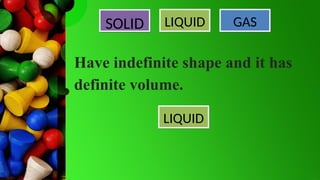
SOLID LIQUID GAS
Have indefinite shape and it has
definite volume.
LIQUID
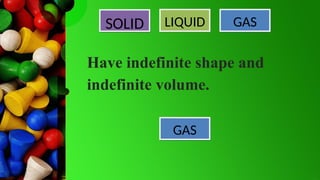
SOLID LIQUID GAS
GAS
Have indefinite shape and
indefinite volume.
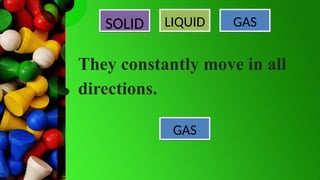
SOLID LIQUID GAS
They constantly move in all
directions.
GAS
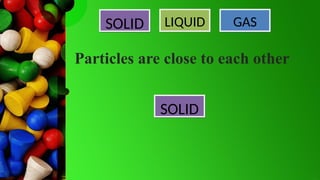
SOLID LIQUID GAS
Particles are close to each other
SOLID
SOLID LIQUID GAS
LIQUID
It follows the shape of the container.
MIXTURE
What will happen if you
combine or mix solid matter to
another solid matter, solid
matter to a liquid matter and so
on? Why is this important to
learn? How can these be of help
to our daily activity?
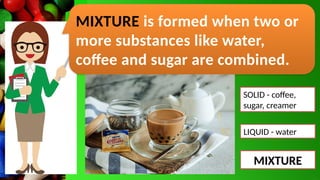
MIXTURE is formed when two or
more substances like water,
coffee and sugar are combined.
SOLID - coffee,
sugar, creamer
LIQUID - water
MIXTURE
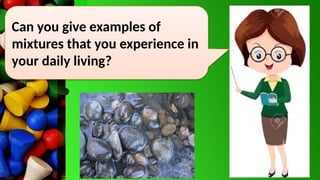
Can you give examples of
mixtures that you experience in
your daily living?
Lets do another activity
which is called Mystery
Combinations
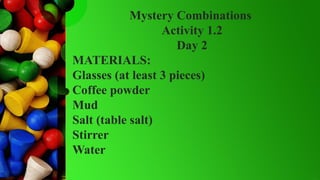
Mystery Combinations
Activity 1.2
Day 2
MATERIALS:
Glasses (at least 3 pieces)
Coffee powder
Mud
Salt (table salt)
Stirrer
Water
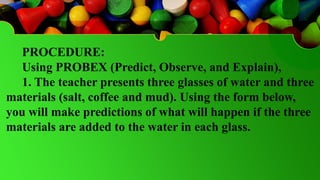
PROCEDURE:
Using PROBEX (Predict, Observe, and Explain),
1. The teacher presents three glasses of water and three
materials (salt, coffee and mud). Using the form below,
you will make predictions of what will happen if the three
materials are added to the water in each glass.
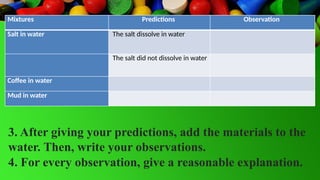
Mixtures Predictions Observation
Salt in water The salt dissolve in water
The salt did not dissolve in water
Coffee in water
Mud in water
3. After giving your predictions, add the materials to the
water. Then, write your observations.
4. For every observation, give a reasonable explanation.
Let’s answer the guide
questions:
1. What are the states of the materials
used that were combined with water?
3. What happened to these materials when
mixed with water?
4. What is the appearance of the
combination of the materials?
5. What can you conclude in doing this
activity?
What is MIXTURE?
Mixture is the combination of two
materials without any chemical
changes or reaction. Liquid mixture
is a common and observable mixture
in our daily living. A solid, liquid,
and gas matter can be combined
with another liquid to form a liquid
mixture.
Let’s do the Story Wheel
activity. You give your
summary of what you
have learned from the
lesson. Spin the story
wheel.
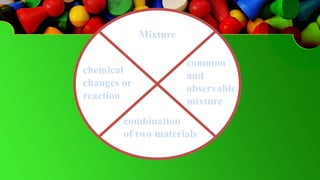
Mixture
combination
of two materials
chemical
changes or
reaction
common
and
observable
mixture
Materials for the next activity
cooking oil sugar
pebbles vinegar
sand soy sauce

1ST QUARTER GRADE 6 - MIXTURES INTRODUCTION

  • 1.
    Mixtures: Introduction Ana EmeliaP. Galindo MT II Calamba Central School Calamba, Misamis Occ., Mindanao
  • 2.
    OBJECTIVES: Content Standards: The learnersdemonstrate understanding of different types of mixtures and their characteristics Performance Standard: The learners should be able to prepare beneficial and useful mixtures such as drinks, food and herbal medicines Learning Competencies/Objectives: The learners should be able to describe the appearance and uses of uniform and non-uniform mixtures Code: (S6MT-Ia-c-1) Describe the appearance of mixtures formed
  • 3.
    II. CONTENT: Mixtures: Introduction III.LEARNINGRESOURCES: A. Reference 1. Teacher’s Guide 2. Learner’s Materials pages 3. Textbook Pages: Science Links Worktext in Science and Technology page 65 4. Additional Materials from Learning Resources (LR) portal Grade 6 Science Activities (First Quarter) pages 2-3 A. Other Learning Resources Multimedia Presentations, charts, pictures, real objects, textbooks, activity sheets
  • 4.
  • 5.
  • 6.
    SOLID LIQUID GAS Themolecules are slightly apart from each other. LIQUID
  • 7.
    SOLID LIQUID GAS Themolecules can roll, glide, and take the shape of the container. LIQUID
  • 8.
    SOLID LIQUID GAS Moleculesare far from each other so they can move freely GAS
  • 9.
    SOLID LIQUID GAS Havedefinite volume and definite shape. SOLID
  • 10.
    SOLID LIQUID GAS Haveindefinite shape and it has definite volume. LIQUID
  • 11.
    SOLID LIQUID GAS GAS Haveindefinite shape and indefinite volume.
  • 12.
    SOLID LIQUID GAS Theyconstantly move in all directions. GAS
  • 13.
    SOLID LIQUID GAS Particlesare close to each other SOLID
  • 14.
    SOLID LIQUID GAS LIQUID Itfollows the shape of the container.
  • 15.
  • 16.
    What will happenif you combine or mix solid matter to another solid matter, solid matter to a liquid matter and so on? Why is this important to learn? How can these be of help to our daily activity?
  • 17.
    MIXTURE is formedwhen two or more substances like water, coffee and sugar are combined. SOLID - coffee, sugar, creamer LIQUID - water MIXTURE
  • 18.
    Can you giveexamples of mixtures that you experience in your daily living?
  • 19.
    Lets do anotheractivity which is called Mystery Combinations
  • 20.
    Mystery Combinations Activity 1.2 Day2 MATERIALS: Glasses (at least 3 pieces) Coffee powder Mud Salt (table salt) Stirrer Water
  • 21.
    PROCEDURE: Using PROBEX (Predict,Observe, and Explain), 1. The teacher presents three glasses of water and three materials (salt, coffee and mud). Using the form below, you will make predictions of what will happen if the three materials are added to the water in each glass.
  • 22.
    Mixtures Predictions Observation Saltin water The salt dissolve in water The salt did not dissolve in water Coffee in water Mud in water 3. After giving your predictions, add the materials to the water. Then, write your observations. 4. For every observation, give a reasonable explanation.
  • 23.
    Let’s answer theguide questions: 1. What are the states of the materials used that were combined with water? 3. What happened to these materials when mixed with water? 4. What is the appearance of the combination of the materials? 5. What can you conclude in doing this activity?
  • 24.
    What is MIXTURE? Mixtureis the combination of two materials without any chemical changes or reaction. Liquid mixture is a common and observable mixture in our daily living. A solid, liquid, and gas matter can be combined with another liquid to form a liquid mixture.
  • 25.
    Let’s do theStory Wheel activity. You give your summary of what you have learned from the lesson. Spin the story wheel.
  • 26.
    Mixture combination of two materials chemical changesor reaction common and observable mixture
  • 27.
    Materials for thenext activity cooking oil sugar pebbles vinegar sand soy sauce