
CHANGING HOW
WE THINK
ABOUT CONTENT
2015 AIIM Roadtrip – Calgary, AB
Rob Hanna, Precision Content Authoring Solutions
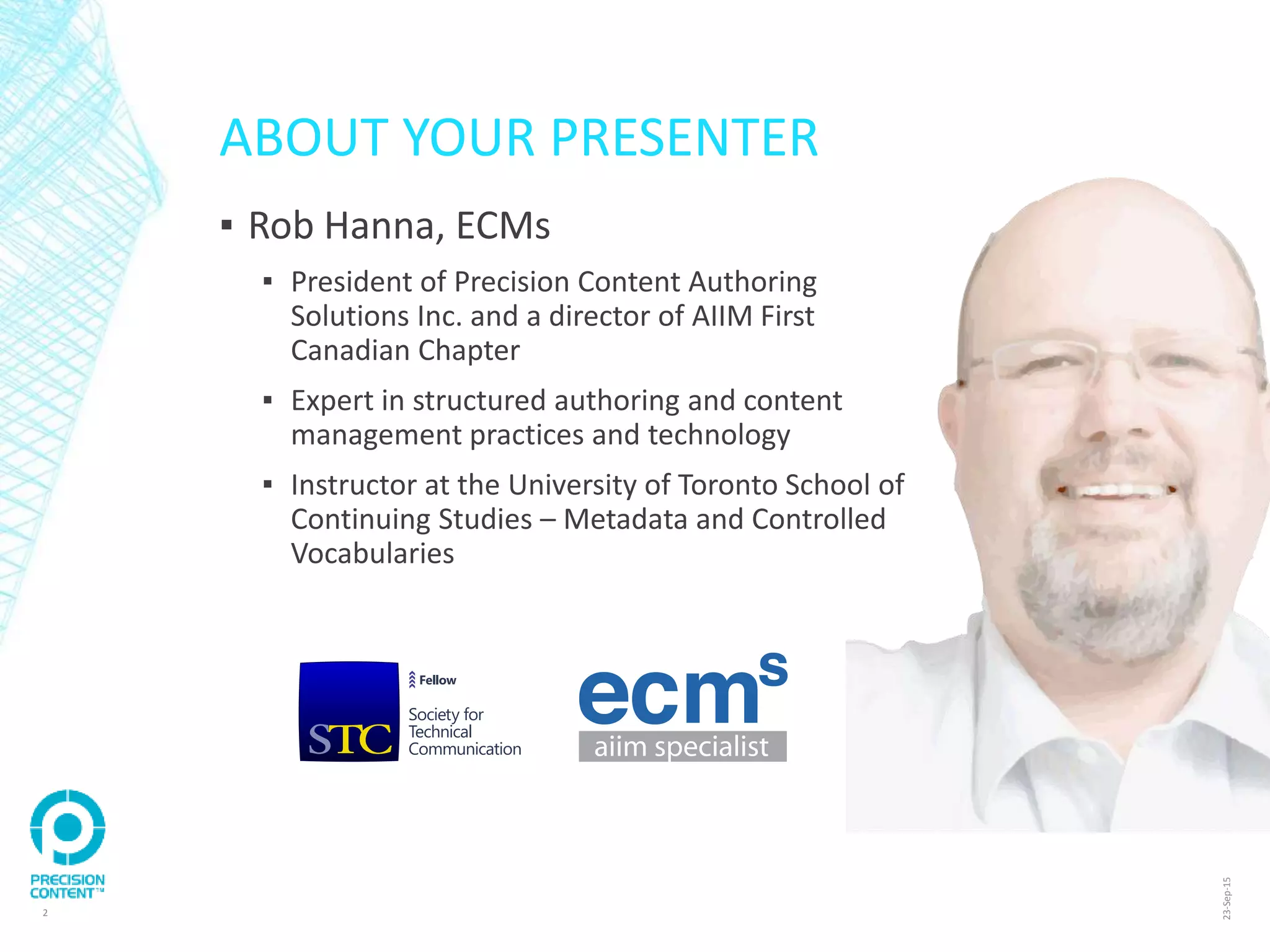
ABOUT YOUR PRESENTER
▪ Rob Hanna, ECMs
▪ President of Precision Content Authoring
Solutions Inc. and a director of AIIM First
Canadian Chapter
▪ Expert in structured authoring and content
management practices and technology
▪ Instructor at the University of Toronto School of
Continuing Studies – Metadata and Controlled
Vocabularies
23-Sep-15©2015AscanInformationArchitectsLimited
2
WHO IS PRECISION CONTENT AUTHORING
SOLUTIONS INC.?
▪ We help organizations make their information easier to use
▪ Our solutions consist of
▪ Content strategy
▪ Detailed information architecture
▪ Content lifecycle design and development
▪ Turn-key content transformation
▪ Tools selection and development
▪ Multi-channel publishing
▪ www.precisioncontent.com
©2015PrecisionContentAuthoringSolutionsInc.
HOW SHOULD
MOBILE/CLOUD CHANGE
THE WAY YOU DEVELOP
CONTENT AND DEPLOY
PROCESSES?
WHY CHANGE?
▪ The complexity of requirements for moving towards more agile content
development is rapidly outpacing an organization’s ability to
▪ create
▪ manage, and
▪ publish content.
▪ The promises of improved
▪ collaboration
▪ accessibility, and
▪ time-to-market are falling flat.
▪ This isn’t simply a technology problem. The solution also involves new
processes and skills.
23-Sep-15©2015PrecisionContentAuthoringSolutionsInc.
5
THE ERA OF ECM IS
PASSING
Or what I learned from John Mancini, President of AIIM
AIIM 2015 Conference – Closing Keynote Presentation
http://www.aiim.org/~/media/Files/Events/AIIM%20Conference%202015/
Presentations/AIIM15_John%20Mancini_Concluding%20Keynote%20Read-Only.ashx
info.AIIM.org/cm2020
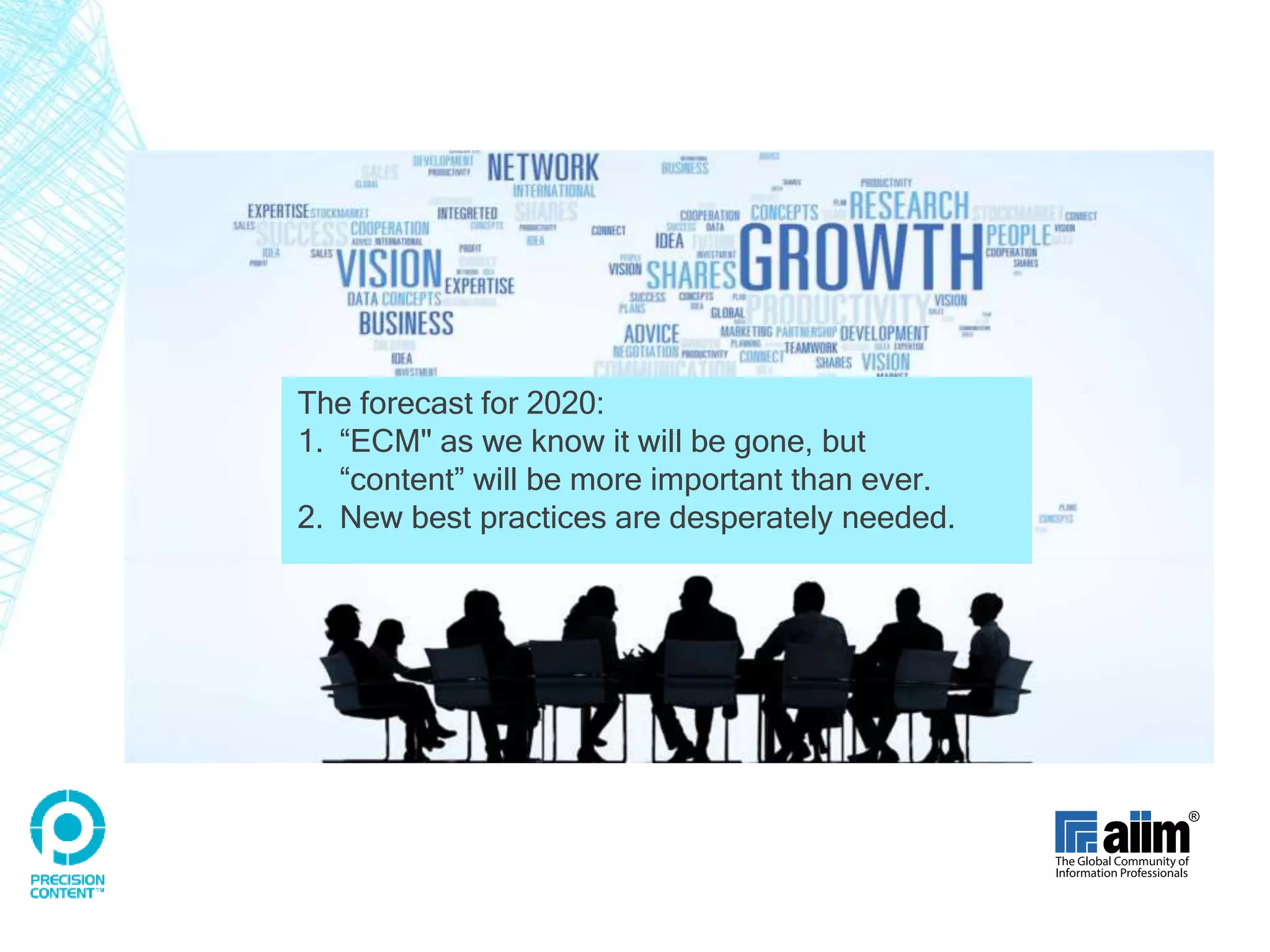
The forecast for 2020:
1. “ECM" as we know it will be gone, but
“content” will be more important than ever.
2. New best practices are desperately needed.
Every organization, every
executive, every individual, every
object is on a digital journey
--Thornton A. May, Futurist
“
and content and information are at
the heart of that journey.
Content is ubiquitous and critical,
but ECM is rapidly becoming
invisible.”
Whatever we call it, organizations
are desperate for best practices –
and for digital transformation heroes
-- amidst the chaos of the emerging
sixth era.
CONTENT MUST
TRANSCEND SILOS
Integration across silos to support collaboration across teams
Michael Priestley – Enterprise Content Technology Strategist IBM
http://www.slideshare.net/mpriestley/let-your-content-flow
THE EVOLUTION OF CONTENT
What if I could take a piece of content and publish it to
multiple output channels, all set to display in different
ways (because of the rules that I set) without having to
handcraft each piece of content separately?
Technical communicators have been doing this for years
Joe Pullizi, The Evolution of Content Marketing Will Include Intelligent Content
WE NEED STANDARDS
Needs and standards:
• Adaptive display
• Reusable modules
Process: Benefits
• Taxonomy and metadata
standards
• Content standards for type,
format, and granularity that
enable smart or intelligent
content
• Create templates and
transforms
• Focus on industry standards
like DITA/XML
• Support co-existence of
single-use and multi-use
content
• Provide support for
incremental migration
• Consistent structure across
formats
• Consistent metadata across
formats
• Avoid single-vendor
dependencies
• More ROI for content
• Content is Findable, Usable
and Reusable
Content is findable,
usable, and reusable
We need content that is intelligent:
1. Portable across systems 2. Useful across applications 3. Findable, usable and reusable
SO WHAT DOES THIS
MEAN TO US?
DO WE HAVE A PROBLEM THAT NEEDS
SOLVING?
▪ 5,900,000,000 google searches
per day (who did we ask these
questions to before Google?)
▪ 540,000 word in the English
language – 5 times more than in
Shakespeare’s time
▪ 90% of the world’s data has
been generated in the last 2
years
In the year … Human knowledge
doubled every…
1900 100 years
1945 25 years
2014 13 months
2020 12 hours
Did you know? Shift Happens 2014 Remix
– Youtube.com
STOP THE INSANITY!
Stop
throwing
more
technology
at your
content
problems!
Content problems
require
content solutions!
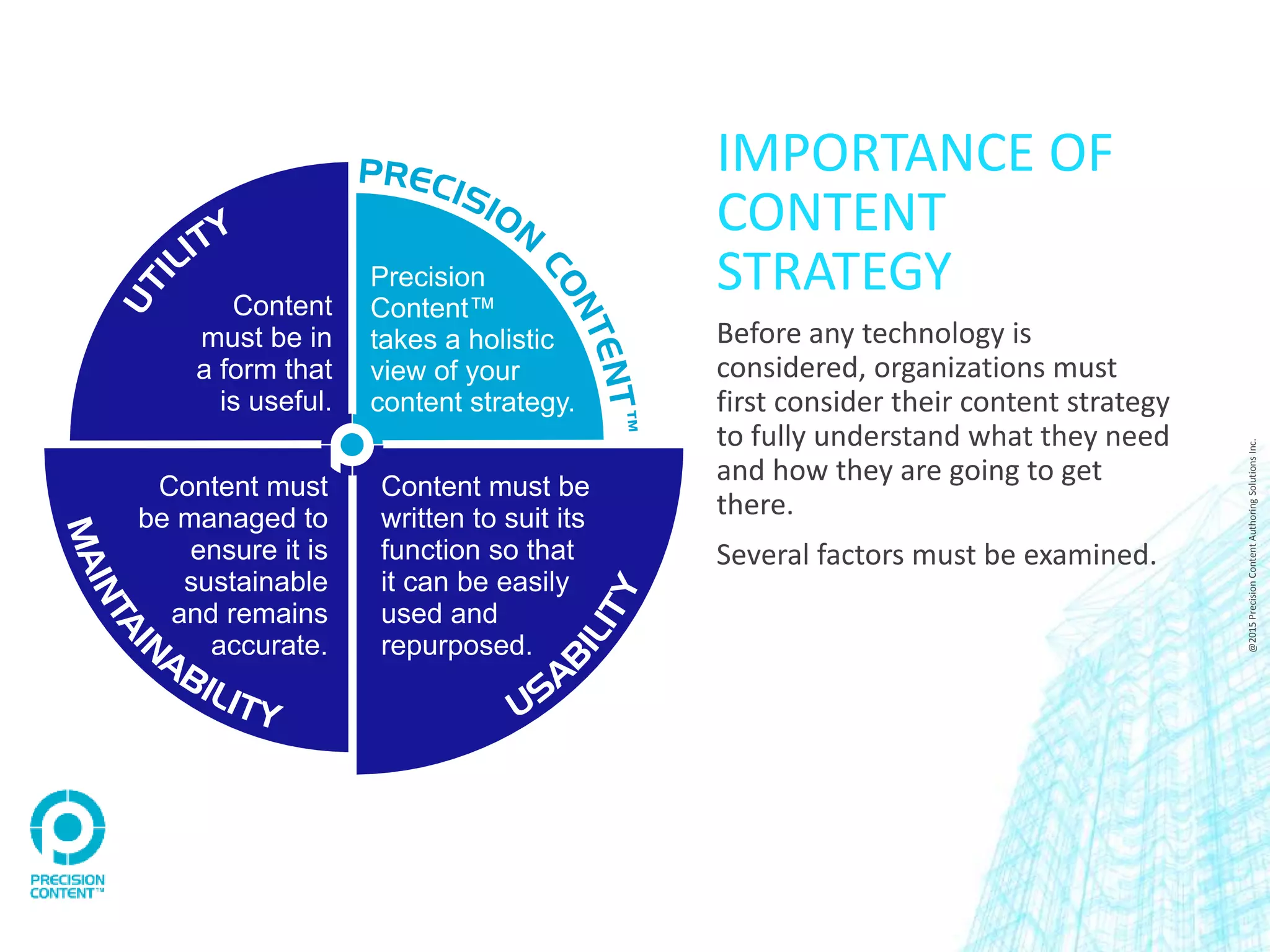
IMPORTANCE OF
CONTENT
STRATEGY
Before any technology is
considered, organizations must
first consider their content strategy
to fully understand what they need
and how they are going to get
there.
Several factors must be examined.
@2015PrecisionContentAuthoringSolutionsInc.
INTELLIGENT CONTENT
▪ is content that is
▪ not limited to one
▪ purpose
▪ technology, or
▪ output, and is
▪ structurally rich and semantically
aware, making it
▪ discoverable
▪ reusable
▪ reconfigurable, and
▪ adaptable.
SINGLE-SOURCING TECHNOLOGY
Single-sourcing is a methodology, not a technology. Although the
software tools associated with single-sourcing are complex, it is the
modular writing, not technology, that ultimately determines the
success of your single-sourcing project.
▪ Kurt Ament – Single Sourcing: Building Modular Documentation, 2003
STRUCTURED BUILDING BLOCKS OF
INFORMATION
MEETING 2 SETS OF FUNDAMENTAL NEEDS
The Human Brain
Technology
Find
Understand
Use, and
Retain
Integrate
Search
Process, and
Reuse
Well-structured content helps
OKAY… BUT HOW?
Entering the world of structured content
WHAT IS XML?
▪ (eXtensible Markup Language) is an open
standard for the exchange of information
▪ first published in 1998 by W3C
▪ to encode electronic documents readable by
▪ human, and
▪ machine
▪ for a multitude of applications ranging from
▪ corporate financial reporting applications, to
▪ Microsoft Word
XML IS
EVERYWHERE
XML defines meaningful data structures for
documents and data. It is a human-readable
file format used to power
• manufacturing assembly lines
• medical devices
• military applications, and
• many other things.
XML is the language of the Web. It enables
smart phones and web browsers.
©2015PrecisionContentAuthoringSolutionsInc.
XML PROVIDES
▪ Database-functionality for content
▪ A separation of presentation and content
▪ A structure with which to modularise
▪ A single piece of information can start it’s life in any department, and
be shared inside and outside the department or organisation
▪ By explicitly labelling all units of information inside a document based
on meaning, source, and status
▪ i.e., everything is tagged and accessible
▪ This enables content management and publishing automation
WHAT IS DITA? (N. DIT-UH)
▪ (Darwin Information Typing Architecture) is an
XML standard
▪ developed in late 90’s at IBM, and
▪ given to the open source community in 2004
▪ used for topic-based, structured authoring
▪ designed for scalability using mechanisms for
specialization and inheritance
▪ defining an extendable set of information types
MULTI-CHANNEL
PUBLISHING
▪ Supports complex, multi-
channel publishing to
many common output
formats
▪ Add new formats or styles
easily
?
WHO USES DITA?
▪ Hundreds of companies worldwide,
including:
▪ Adobe, Apple, Caterpillar, Dell, Elekta, IBM,
Juniper Networks, McAfee, Nokia, PayPal,
Philips, RIM, SAP, SDL, Xerox and many more
▪ IBM publishes 60M pages of content in
40 languages using DITA
DEFINITION OF PRECISION CONTENT™
▪ Precision Content™ is an authoring system for high-value enterprise
content.
▪ Benefits of use include
▪ greater accessibility and ease of use
▪ increased consistency and accuracy, and
▪ extensive multi-channel publishing capabilities.
▪ This system consists of
▪ content strategy and management best practices
▪ innovative applications of open-source technology and standards, and
▪ modernized adaptations to information mapping writing practices researched
and developed at Harvard University in the 1960’s.
INFORMATION
TYPES
Reference
Principle
Task
Process
Concept
“We will be flying
at an altitude of
60,000 feet.”
“Always put on
your oxygen mask
before assisting
other passengers.”
“To open the
emergency exit,
look out the
window, pull the
lever, and push out
the exit door.”
“In the event of loss of
cabin pressure, an
oxygen mask will drop
from the overhead
compartment.”
“We are a member
of the Star Alliance
group of airlines.”
Flight safety briefing
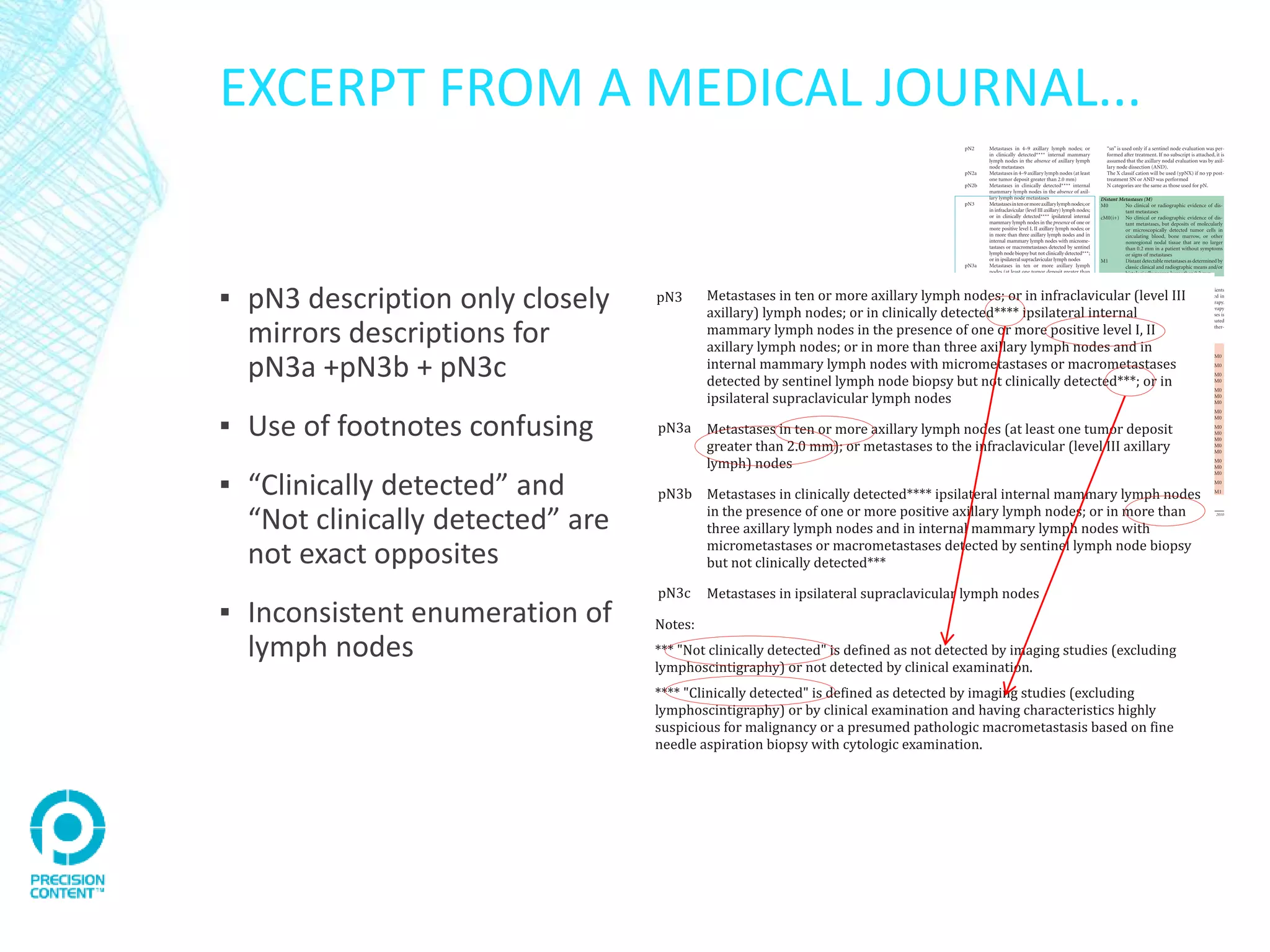
EXCERPT FROM A MEDICAL JOURNAL...
▪ pN3 description only closely
mirrors descriptions for
pN3a +pN3b + pN3c
▪ Use of footnotes confusing
▪ “Clinically detected” and
“Not clinically detected” are
not exact opposites
▪ Inconsistent enumeration of
lymph nodes
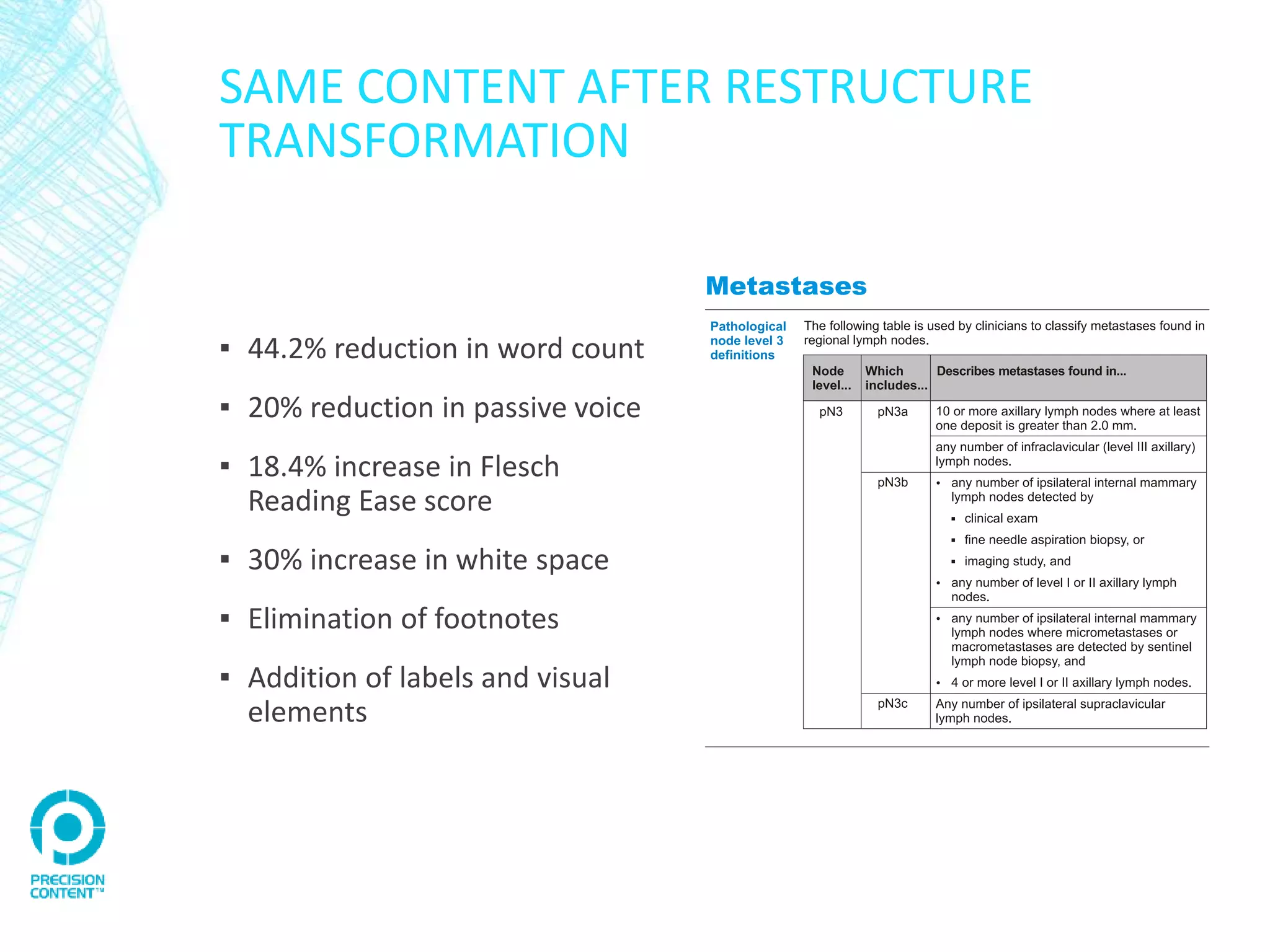
SAME CONTENT AFTER RESTRUCTURE
TRANSFORMATION
▪ 44.2% reduction in word count
▪ 20% reduction in passive voice
▪ 18.4% increase in Flesch
Reading Ease score
▪ 30% increase in white space
▪ Elimination of footnotes
▪ Addition of labels and visual
elements
QUESTIONS?
Come over to our booth and speak with us.

Changing how we think about content

  • 1.
    CHANGING HOW WE THINK ABOUTCONTENT 2015 AIIM Roadtrip – Calgary, AB Rob Hanna, Precision Content Authoring Solutions
  • 2.
    ABOUT YOUR PRESENTER ▪Rob Hanna, ECMs ▪ President of Precision Content Authoring Solutions Inc. and a director of AIIM First Canadian Chapter ▪ Expert in structured authoring and content management practices and technology ▪ Instructor at the University of Toronto School of Continuing Studies – Metadata and Controlled Vocabularies 23-Sep-15©2015AscanInformationArchitectsLimited 2
  • 3.
    WHO IS PRECISIONCONTENT AUTHORING SOLUTIONS INC.? ▪ We help organizations make their information easier to use ▪ Our solutions consist of ▪ Content strategy ▪ Detailed information architecture ▪ Content lifecycle design and development ▪ Turn-key content transformation ▪ Tools selection and development ▪ Multi-channel publishing ▪ www.precisioncontent.com ©2015PrecisionContentAuthoringSolutionsInc.
  • 4.
    HOW SHOULD MOBILE/CLOUD CHANGE THEWAY YOU DEVELOP CONTENT AND DEPLOY PROCESSES?
  • 5.
    WHY CHANGE? ▪ Thecomplexity of requirements for moving towards more agile content development is rapidly outpacing an organization’s ability to ▪ create ▪ manage, and ▪ publish content. ▪ The promises of improved ▪ collaboration ▪ accessibility, and ▪ time-to-market are falling flat. ▪ This isn’t simply a technology problem. The solution also involves new processes and skills. 23-Sep-15©2015PrecisionContentAuthoringSolutionsInc. 5
  • 6.
    THE ERA OFECM IS PASSING Or what I learned from John Mancini, President of AIIM AIIM 2015 Conference – Closing Keynote Presentation http://www.aiim.org/~/media/Files/Events/AIIM%20Conference%202015/ Presentations/AIIM15_John%20Mancini_Concluding%20Keynote%20Read-Only.ashx
  • 7.
  • 8.
    The forecast for2020: 1. “ECM" as we know it will be gone, but “content” will be more important than ever. 2. New best practices are desperately needed.
  • 9.
    Every organization, every executive,every individual, every object is on a digital journey --Thornton A. May, Futurist “ and content and information are at the heart of that journey. Content is ubiquitous and critical, but ECM is rapidly becoming invisible.”
  • 10.
    Whatever we callit, organizations are desperate for best practices – and for digital transformation heroes -- amidst the chaos of the emerging sixth era.
  • 11.
    CONTENT MUST TRANSCEND SILOS Integrationacross silos to support collaboration across teams Michael Priestley – Enterprise Content Technology Strategist IBM http://www.slideshare.net/mpriestley/let-your-content-flow
  • 12.
    THE EVOLUTION OFCONTENT What if I could take a piece of content and publish it to multiple output channels, all set to display in different ways (because of the rules that I set) without having to handcraft each piece of content separately? Technical communicators have been doing this for years Joe Pullizi, The Evolution of Content Marketing Will Include Intelligent Content
  • 13.
    WE NEED STANDARDS Needsand standards: • Adaptive display • Reusable modules Process: Benefits • Taxonomy and metadata standards • Content standards for type, format, and granularity that enable smart or intelligent content • Create templates and transforms • Focus on industry standards like DITA/XML • Support co-existence of single-use and multi-use content • Provide support for incremental migration • Consistent structure across formats • Consistent metadata across formats • Avoid single-vendor dependencies • More ROI for content • Content is Findable, Usable and Reusable Content is findable, usable, and reusable We need content that is intelligent: 1. Portable across systems 2. Useful across applications 3. Findable, usable and reusable
  • 14.
    SO WHAT DOESTHIS MEAN TO US?
  • 15.
    DO WE HAVEA PROBLEM THAT NEEDS SOLVING? ▪ 5,900,000,000 google searches per day (who did we ask these questions to before Google?) ▪ 540,000 word in the English language – 5 times more than in Shakespeare’s time ▪ 90% of the world’s data has been generated in the last 2 years In the year … Human knowledge doubled every… 1900 100 years 1945 25 years 2014 13 months 2020 12 hours Did you know? Shift Happens 2014 Remix – Youtube.com
  • 16.
    STOP THE INSANITY! Stop throwing more technology atyour content problems! Content problems require content solutions!
  • 17.
    IMPORTANCE OF CONTENT STRATEGY Before anytechnology is considered, organizations must first consider their content strategy to fully understand what they need and how they are going to get there. Several factors must be examined. @2015PrecisionContentAuthoringSolutionsInc.
  • 18.
    INTELLIGENT CONTENT ▪ iscontent that is ▪ not limited to one ▪ purpose ▪ technology, or ▪ output, and is ▪ structurally rich and semantically aware, making it ▪ discoverable ▪ reusable ▪ reconfigurable, and ▪ adaptable.
  • 19.
    SINGLE-SOURCING TECHNOLOGY Single-sourcing isa methodology, not a technology. Although the software tools associated with single-sourcing are complex, it is the modular writing, not technology, that ultimately determines the success of your single-sourcing project. ▪ Kurt Ament – Single Sourcing: Building Modular Documentation, 2003
  • 20.
  • 21.
    MEETING 2 SETSOF FUNDAMENTAL NEEDS The Human Brain Technology Find Understand Use, and Retain Integrate Search Process, and Reuse Well-structured content helps
  • 22.
    OKAY… BUT HOW? Enteringthe world of structured content
  • 23.
    WHAT IS XML? ▪(eXtensible Markup Language) is an open standard for the exchange of information ▪ first published in 1998 by W3C ▪ to encode electronic documents readable by ▪ human, and ▪ machine ▪ for a multitude of applications ranging from ▪ corporate financial reporting applications, to ▪ Microsoft Word
  • 24.
    XML IS EVERYWHERE XML definesmeaningful data structures for documents and data. It is a human-readable file format used to power • manufacturing assembly lines • medical devices • military applications, and • many other things. XML is the language of the Web. It enables smart phones and web browsers. ©2015PrecisionContentAuthoringSolutionsInc.
  • 25.
    XML PROVIDES ▪ Database-functionalityfor content ▪ A separation of presentation and content ▪ A structure with which to modularise ▪ A single piece of information can start it’s life in any department, and be shared inside and outside the department or organisation ▪ By explicitly labelling all units of information inside a document based on meaning, source, and status ▪ i.e., everything is tagged and accessible ▪ This enables content management and publishing automation
  • 26.
    WHAT IS DITA?(N. DIT-UH) ▪ (Darwin Information Typing Architecture) is an XML standard ▪ developed in late 90’s at IBM, and ▪ given to the open source community in 2004 ▪ used for topic-based, structured authoring ▪ designed for scalability using mechanisms for specialization and inheritance ▪ defining an extendable set of information types
  • 27.
    MULTI-CHANNEL PUBLISHING ▪ Supports complex,multi- channel publishing to many common output formats ▪ Add new formats or styles easily ?
  • 28.
    WHO USES DITA? ▪Hundreds of companies worldwide, including: ▪ Adobe, Apple, Caterpillar, Dell, Elekta, IBM, Juniper Networks, McAfee, Nokia, PayPal, Philips, RIM, SAP, SDL, Xerox and many more ▪ IBM publishes 60M pages of content in 40 languages using DITA
  • 29.
    DEFINITION OF PRECISIONCONTENT™ ▪ Precision Content™ is an authoring system for high-value enterprise content. ▪ Benefits of use include ▪ greater accessibility and ease of use ▪ increased consistency and accuracy, and ▪ extensive multi-channel publishing capabilities. ▪ This system consists of ▪ content strategy and management best practices ▪ innovative applications of open-source technology and standards, and ▪ modernized adaptations to information mapping writing practices researched and developed at Harvard University in the 1960’s.
  • 30.
    INFORMATION TYPES Reference Principle Task Process Concept “We will beflying at an altitude of 60,000 feet.” “Always put on your oxygen mask before assisting other passengers.” “To open the emergency exit, look out the window, pull the lever, and push out the exit door.” “In the event of loss of cabin pressure, an oxygen mask will drop from the overhead compartment.” “We are a member of the Star Alliance group of airlines.” Flight safety briefing
  • 31.
    EXCERPT FROM AMEDICAL JOURNAL... ▪ pN3 description only closely mirrors descriptions for pN3a +pN3b + pN3c ▪ Use of footnotes confusing ▪ “Clinically detected” and “Not clinically detected” are not exact opposites ▪ Inconsistent enumeration of lymph nodes
  • 32.
    SAME CONTENT AFTERRESTRUCTURE TRANSFORMATION ▪ 44.2% reduction in word count ▪ 20% reduction in passive voice ▪ 18.4% increase in Flesch Reading Ease score ▪ 30% increase in white space ▪ Elimination of footnotes ▪ Addition of labels and visual elements
  • 33.
    QUESTIONS? Come over toour booth and speak with us.