Distributed Systems
   and Consistency


Because everything else is easy.
What we're talking about
●   What are distributed systems?
●   Why are they good, why are they bad?
●   CAP theorem
●   Possible CAP configurations
●   Strategies for consistency, including:
    ●   Point-in-time consistency with LSS
    ●   Vector clocks for distributed consistency
    ●   CRDTs for consistency from the data structure
    ●   Bloom, a natively consistent distributed language
What's a distributed system?
●   Short answer: big data systems
    ●   Lots of machines, geographically distributed
●   Technical answer:
    ●   Any system where events are not global
    ●   Where events can happen simultaneously
Why are they good?
●   Centralized systems scale poorly & expensively
    ●   More locks, more contention
    ●   Expensive hardware
    ●   Vertical scaling
●   Distributed systems scale well & cheaply
    ●   No locks, no contention
    ●   (Lots of) cheap hardware
    ●   Linear scaling
So what's the catch?
●   Consistency
    ●   “Easy” in centralized systems
    ●   Hard in distributed systems
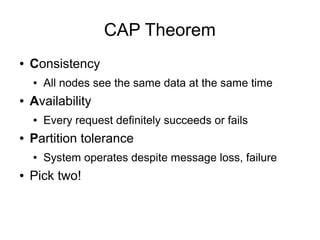
CAP Theorem
●   Consistency
    ●   All nodes see the same data at the same time
●   Availability
    ●   Every request definitely succeeds or fails
●   Partition tolerance
    ●   System operates despite message loss, failure
●   Pick two!
No P
●   No partition tolerance = centralized
    ●   Writes can't reach the store? Broken.
    ●   Reads can't find the data? Broken.
●   The most common database type
    ●   MySQL
    ●   Postgres
    ●   Oracle
No A
●   An unavailable database = a crappy database
    ●   Read or write didn't work? Try again.
    ●   Everything sacrifices A to some degree
●   Has some use-cases
    ●   High-volume logs & statistics
    ●   Google BigTable
    ●   Mars orbiters!
No C
●   Lower consistency = distributed systems
    ●   “Eventual consistency”
    ●   Writes will work, or definitely fail
    ●   Reads will work, but might not be entirely true
●   The new hotness
    ●   Amazon S3, Riak, Google Spanner
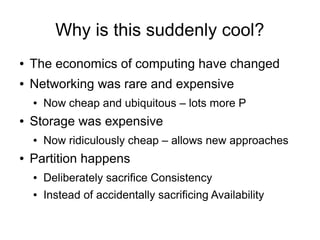
Why is this suddenly cool?
●   The economics of computing have changed
●   Networking was rare and expensive
    ●   Now cheap and ubiquitous – lots more P
●   Storage was expensive
    ●   Now ridiculously cheap – allows new approaches
●   Partition happens
    ●   Deliberately sacrifice Consistency
    ●   Instead of accidentally sacrificing Availability
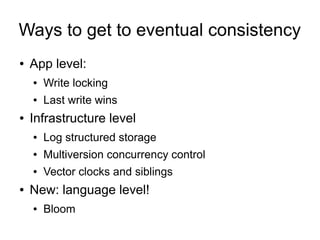
Ways to get to eventual consistency
●   App level:
    ●   Write locking
    ●   Last write wins
●   Infrastructure level
    ●   Log structured storage
    ●   Multiversion concurrency control
    ●   Vector clocks and siblings
●   New: language level!
    ●   Bloom
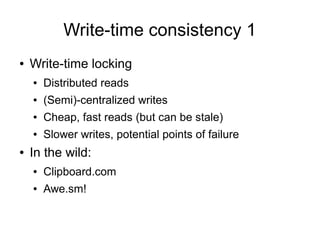
Write-time consistency 1
●   Write-time locking
    ●   Distributed reads
    ●   (Semi)-centralized writes
    ●   Cheap, fast reads (but can be stale)
    ●   Slower writes, potential points of failure
●   In the wild:
    ●   Clipboard.com
    ●   Awe.sm!
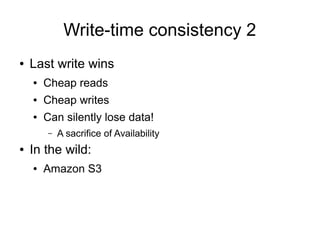
Write-time consistency 2
●   Last write wins
    ●   Cheap reads
    ●   Cheap writes
    ●   Can silently lose data!
        –   A sacrifice of Availability
●   In the wild:
    ●   Amazon S3
Side note: Twitter
●   Twitter is eventually consistent!
●   Your timeline isn't guaranteed correct
●   Older tweets can appear or disappear
●   Twitter sacrifices C for A and P
    ●   But doesn't get a lot of A
Infrastructure level consistency 1
●   Log structured storage
    ●   Also called append-only databases
    ●   A new angle on consistency: external consistency
    ●   a.k.a. Point-in-time consistency
●   In the wild:
    ●   BigTable
    ●   Spanner
How LSS Works
●   Every write is appended
●   Indexes are built and appended
●   Reads work backwards through the log
●   Challenges
    ●   Index-building can get chunky
        –   Build them in memory, easily rebuilt
    ●   Garbage collection
        –   But storage is cheap now!
Why is LSS so cool?
●   Easier to manage big data
    ●   Size, schema, allocation of storage simplified
●   Indexes are impossible to corrupt
●   Reads and writes are cheap
●   Point-in-time consistency is free!
    ●   Called Multiversion Concurrency Control
Infrastructure level consistency 2
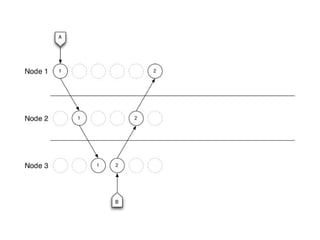
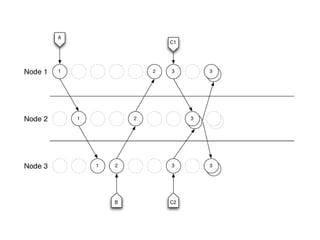
●   Vector clocks
    ●   Vectors as in math
    ●   Basically an array
Not enough for consistency
●   Different nodes know different things!
●   Quorum reads
    ●   N or more nodes must agree
●   Quorum writes
    ●   N or more nodes must receive new value
●   Can tune N for your application
But siblings suck!
Dealing with siblings
●   1: Consistency at read time
    ●   Slower reads
    ●   Pay every time
●   2: Consistency at write time
    ●   Slower writes
    ●   Pay once
●   3: Consistency at infrastructure level
    ●   CRDTs: Commutative Replicated Data Types
    ●   Monotonic lattices of commutative operations
Don't Panic
●   We're going to go slowly
●   There's no math
Monotonicity
●   Operations only affect the data in one way
    ●   e.g. increment vs. set
●   Instead of storing values, store operations
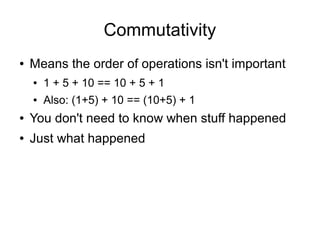
Commutativity
●   Means the order of operations isn't important
    ●   1 + 5 + 10 == 10 + 5 + 1
    ●   Also: (1+5) + 10 == (10+5) + 1
●   You don't need to know when stuff happened
●   Just what happened
Lattices
●   A data structure of operations
    ●   Like a vector clock, sets of operations
●   “Partially” ordered
    ●   Means you can throw away oldest operations
Put it all together: CRDTs
●   Commutative Replicated Data Types
    ●   Each node stores every entry as a lattice
    ●   Lattices are distributed and merged
    ●   Operations are commutative
        –   So collisions don't break stuff
CRDTs are monotonic
●   Each new operation adds information
●   Data is never deleted or destroyed
●   Applications don't need to know
●   Everything is in the store
CRDTs are pretty awesome
●   But
    ●   use a lot more space
    ●   garbage collection is non-trivial
●   In the wild:
    ●   The data processor!
Language level consistency
●   Bloom
    ●   A natively distributed-safe language
    ●   All operations are monotonic and commutative
    ●   Allows compiler-level analysis
    ●   Flag where unsafe things are happening
        –   And suggest fixes and coordination
    ●   Crazy future stuff
In Summary
●   Big data is easy
    ●   Just use distributed systems!
●   Consistency is hard
    ●   The solution may be in data structures
    ●   Making use of radically cheaper storage
●   Store operations, not values
    ●   And make operations commutative
●   Data is so cool!
More reading
●   Log Structured Storage:
    ●   http://blog.notdot.net/2009/12/Damn-Cool-Algorithms-Log-structured-
        storage
●   Lattice data structures and CALM theorem:
    ●   http://db.cs.berkeley.edu/papers/UCB-lattice-tr.pdf
●   Bloom:
    ●   http://www.bloom-lang.net/
●   Ops: Riak in the Cloud
    ●   https://speakerdeck.com/u/randommood/p/getting-starte
Even more reading
●   http://en.wikipedia.org/wiki/Multiversion_concurrency_control
●   http://en.wikipedia.org/wiki/Monotonic_function
●   http://en.wikipedia.org/wiki/Commutative_property
●   http://en.wikipedia.org/wiki/CAP_theorem
●   http://en.wikipedia.org/wiki/Fallacies_of_Distributed_Computing
●   http://pagesperso-systeme.lip6.fr/Marc.Shapiro/papers/RR-6956.pdf
●   http://en.wikipedia.org/wiki/Vector_clock

Distributed systems and consistency

  • 1.
    Distributed Systems and Consistency Because everything else is easy.
  • 2.
    What we're talkingabout ● What are distributed systems? ● Why are they good, why are they bad? ● CAP theorem ● Possible CAP configurations ● Strategies for consistency, including: ● Point-in-time consistency with LSS ● Vector clocks for distributed consistency ● CRDTs for consistency from the data structure ● Bloom, a natively consistent distributed language
  • 3.
    What's a distributedsystem? ● Short answer: big data systems ● Lots of machines, geographically distributed ● Technical answer: ● Any system where events are not global ● Where events can happen simultaneously
  • 4.
    Why are theygood? ● Centralized systems scale poorly & expensively ● More locks, more contention ● Expensive hardware ● Vertical scaling ● Distributed systems scale well & cheaply ● No locks, no contention ● (Lots of) cheap hardware ● Linear scaling
  • 5.
    So what's thecatch? ● Consistency ● “Easy” in centralized systems ● Hard in distributed systems
  • 6.
    CAP Theorem ● Consistency ● All nodes see the same data at the same time ● Availability ● Every request definitely succeeds or fails ● Partition tolerance ● System operates despite message loss, failure ● Pick two!
  • 7.
    No P ● No partition tolerance = centralized ● Writes can't reach the store? Broken. ● Reads can't find the data? Broken. ● The most common database type ● MySQL ● Postgres ● Oracle
  • 8.
    No A ● An unavailable database = a crappy database ● Read or write didn't work? Try again. ● Everything sacrifices A to some degree ● Has some use-cases ● High-volume logs & statistics ● Google BigTable ● Mars orbiters!
  • 9.
    No C ● Lower consistency = distributed systems ● “Eventual consistency” ● Writes will work, or definitely fail ● Reads will work, but might not be entirely true ● The new hotness ● Amazon S3, Riak, Google Spanner
  • 10.
    Why is thissuddenly cool? ● The economics of computing have changed ● Networking was rare and expensive ● Now cheap and ubiquitous – lots more P ● Storage was expensive ● Now ridiculously cheap – allows new approaches ● Partition happens ● Deliberately sacrifice Consistency ● Instead of accidentally sacrificing Availability
  • 11.
    Ways to getto eventual consistency ● App level: ● Write locking ● Last write wins ● Infrastructure level ● Log structured storage ● Multiversion concurrency control ● Vector clocks and siblings ● New: language level! ● Bloom
  • 12.
    Write-time consistency 1 ● Write-time locking ● Distributed reads ● (Semi)-centralized writes ● Cheap, fast reads (but can be stale) ● Slower writes, potential points of failure ● In the wild: ● Clipboard.com ● Awe.sm!
  • 13.
    Write-time consistency 2 ● Last write wins ● Cheap reads ● Cheap writes ● Can silently lose data! – A sacrifice of Availability ● In the wild: ● Amazon S3
  • 14.
    Side note: Twitter ● Twitter is eventually consistent! ● Your timeline isn't guaranteed correct ● Older tweets can appear or disappear ● Twitter sacrifices C for A and P ● But doesn't get a lot of A
  • 15.
    Infrastructure level consistency1 ● Log structured storage ● Also called append-only databases ● A new angle on consistency: external consistency ● a.k.a. Point-in-time consistency ● In the wild: ● BigTable ● Spanner
  • 16.
    How LSS Works ● Every write is appended ● Indexes are built and appended ● Reads work backwards through the log ● Challenges ● Index-building can get chunky – Build them in memory, easily rebuilt ● Garbage collection – But storage is cheap now!
  • 17.
    Why is LSSso cool? ● Easier to manage big data ● Size, schema, allocation of storage simplified ● Indexes are impossible to corrupt ● Reads and writes are cheap ● Point-in-time consistency is free! ● Called Multiversion Concurrency Control
  • 18.
    Infrastructure level consistency2 ● Vector clocks ● Vectors as in math ● Basically an array
  • 21.
    Not enough forconsistency ● Different nodes know different things! ● Quorum reads ● N or more nodes must agree ● Quorum writes ● N or more nodes must receive new value ● Can tune N for your application
  • 22.
  • 23.
    Dealing with siblings ● 1: Consistency at read time ● Slower reads ● Pay every time ● 2: Consistency at write time ● Slower writes ● Pay once ● 3: Consistency at infrastructure level ● CRDTs: Commutative Replicated Data Types ● Monotonic lattices of commutative operations
  • 24.
    Don't Panic ● We're going to go slowly ● There's no math
  • 25.
    Monotonicity ● Operations only affect the data in one way ● e.g. increment vs. set ● Instead of storing values, store operations
  • 26.
    Commutativity ● Means the order of operations isn't important ● 1 + 5 + 10 == 10 + 5 + 1 ● Also: (1+5) + 10 == (10+5) + 1 ● You don't need to know when stuff happened ● Just what happened
  • 27.
    Lattices ● A data structure of operations ● Like a vector clock, sets of operations ● “Partially” ordered ● Means you can throw away oldest operations
  • 28.
    Put it alltogether: CRDTs ● Commutative Replicated Data Types ● Each node stores every entry as a lattice ● Lattices are distributed and merged ● Operations are commutative – So collisions don't break stuff
  • 29.
    CRDTs are monotonic ● Each new operation adds information ● Data is never deleted or destroyed ● Applications don't need to know ● Everything is in the store
  • 30.
    CRDTs are prettyawesome ● But ● use a lot more space ● garbage collection is non-trivial ● In the wild: ● The data processor!
  • 31.
    Language level consistency ● Bloom ● A natively distributed-safe language ● All operations are monotonic and commutative ● Allows compiler-level analysis ● Flag where unsafe things are happening – And suggest fixes and coordination ● Crazy future stuff
  • 32.
    In Summary ● Big data is easy ● Just use distributed systems! ● Consistency is hard ● The solution may be in data structures ● Making use of radically cheaper storage ● Store operations, not values ● And make operations commutative ● Data is so cool!
  • 33.
    More reading ● Log Structured Storage: ● http://blog.notdot.net/2009/12/Damn-Cool-Algorithms-Log-structured- storage ● Lattice data structures and CALM theorem: ● http://db.cs.berkeley.edu/papers/UCB-lattice-tr.pdf ● Bloom: ● http://www.bloom-lang.net/ ● Ops: Riak in the Cloud ● https://speakerdeck.com/u/randommood/p/getting-starte
  • 34.
    Even more reading ● http://en.wikipedia.org/wiki/Multiversion_concurrency_control ● http://en.wikipedia.org/wiki/Monotonic_function ● http://en.wikipedia.org/wiki/Commutative_property ● http://en.wikipedia.org/wiki/CAP_theorem ● http://en.wikipedia.org/wiki/Fallacies_of_Distributed_Computing ● http://pagesperso-systeme.lip6.fr/Marc.Shapiro/papers/RR-6956.pdf ● http://en.wikipedia.org/wiki/Vector_clock

Editor's Notes

  • #4 - What's a distributed system? - Short answer: "big data" - Lots of machines, geographically distributed - Actual answer: any system where events are not global - Can a read and write happen at the same time? == Distributed - Mostly things are queued - Or in database systems, it's fudged -- no lock, so no problem
  • #5 - Why are they good? - Centralized systems scale poorly & expensively - More locks, more contention - Really fast hardware - Vertical scaling - Diminishing returns -- will always eventually fail - Distributed systems scale well & cheaply - Lots of cheap hardware - No locks, no contention - Linear scaling -- can theoretically scale indefinitely
  • #6 - So what's the catch? - Consistency - In a centralized system consistency is simple: single source of truth - The problem is writing to it performantly - In a distributed system writes are really fast - But the definition of "truth" is much, much harder
  • #7 - CAP theorem - Consistency (all nodes see the same data at the same time) - Availability (a guarantee that every request receives a response about whether it was successful or failed) - Partition tolerance (the system continues to operate despite arbitrary message loss or failure of part of the system) - Pick 2 - But actually it's usually a sliding scale
  • #8 - P: No partition tolerance = centralized database - Can't connect to read or write? You're broken. - Replication log got corrupted? You're broken. <img: welcome to our ool>
  • #9 - A: No availability guarantee = guessing - Read or write didn't work: try again - Cost/benefit calculation -- everything is unavailable *sometimes* - High-volume logs, statistics - Google BigTable locks data on write, will throw errors if you try to read it - Mars orbiters! Not all the data makes it back, and that's okay.
  • #10 - C: Lower consistency = Amazon S3, Riak, other distributed systems - "Eventual" consistency - Write will work, or definitely fail - Reads will work, but might not be "true" - Keep retrying for the truth
  • #11 - Why is this a big deal now? - The last 10 years have been about systems getting so big that P has become a bigger and bigger problem - Network was expensive, now it's cheap - And everything is networked - Storage was expensive, now it's cheap - Sacrificing A has been the accidental solution - Instead we can deliberately dial down C to get bigger
  • #12 - Ways to get to eventual consistency - There are a ton! - App level: - Write locking - Last write wins - Infrastructure level: - Log structured storage, multiversion concurrency control - Vector clocks and siblings - New: language level! - Bloom
  • #13 - Eventual consistency at write time: 1 - Write-time locking - Like a centralized database, except reads are okay with stale data - Slower writes, potential points of failure - Cheap, fast reads
  • #14 - Eventual consistency at write time: 2 - Last write wins - This is Amazon S3. - Relies on accurate clocks - Cheap reads and writes - Can lose data! - Okay for image files, bad for payment processing
  • #15 - Side note: twitter is eventually consistent - Your timeline doesn't always turn up exactly in order - Older tweets can slot themselves in - Tweets can disappear - Two new tweets can never collide - This is a form of eventual consistency, last write wins, but no conflicts
  • #16 - A consistency approach: log-structured storage - Also called append-only databases - Eventual consistency where *consistency* is important, but *currency* is not <diagram>
  • #17 - How LSS works - Each write is appended - Indexes are also appended - To get a value, consult the index - As the data grows, throw away older values - Index doesn't need to be updated as often - If you find operations before the index, rebuild an index from them - Relies of lots of really cheap storage - But it turns out we have that!
  • #18 - Why is this good? - Don't have to care about the size or schema of the object - Deleting old objects is automatic - Can't corrupt the index - Reads and writes are cheap - Point-in-time consistency is automatic: just read values older than the one you started with - BUT: you still could be behind reality
  • #19 - Another consistency approach: vector clocks - Eventual consistency where consistency and currency both matter - Vector, as in math - It means an array, but mathematicians are annoying <diagram> - Simultaneous writes produce siblings - never any data lost
  • #22 - Not good enough! - Read consistency: quorum reads - N or more sources must return the same value - Write consistency: quorum writes - N or more nodes must receive the new value
  • #23 - Pretty good - But man do siblings suck! http://3.bp.blogspot.com/-h60iS4_uwfg/T2B4rntiV4I/AAAAAAAAK9M/Wc_jaXLRowg/s400/istock_brothers-fighting-300x198.jpg
  • #24 - Dealing with siblings - 1: Consistency at read time through clever resolution - Cheap, fast writes - Potentially slower reads, duplicated dispute resolution logic - Pay on every read - 2: Avoid creating them in the first place - Put a sharded lock in front of your writes - Potentially slower writes - Pay once on write - 3: CRDTs: Commutative Replicated Data Types - monotonic lattices of commutative operations - Don't panic
  • #26 - Monotonicity - Means operations only affect the data in one way - Simplest example: setter vs. incrementer - Bad: http://en.wikipedia.org/wiki/File:Monotonicity_example3.png - Good: http://en.wikipedia.org/wiki/File:Monotonicity_example1.png - The setter can get it wrong, destroy information - The incrementer doesn't need to know the exact value, just that it goes up by one ( Also good: http://en.wikipedia.org/wiki/File:Monotonicity_example2.png ) - Instead of storing values, store operations
  • #27 - Commutativity - Means the order of operations isn't important - 1 + 5 + 10 == 10 + 5 + 1 - Also: (1+5) + 10 == 1 + (5+10) - Means you don't need to know what order the operations happened in - Just that they happened
  • #28 - Lattices - A data structure consisting of a set of operatios - Like vector clocks, a (partial) order of operations - Doesn't have to be exact - Just enough to able to avoid having to re-run every operation every time
  • #29 - Put it all together: CRDTs - Commutative Replicated Data Types - Each node stores operations in a lattice - As data is distributed, lattices are merged - Because operations are commutative, collisions are okay - Because the exact order is irrelevant
  • #30 - CRDTs are a monotonic data structure - Each new operation only adds information - It's never taken away or destroyed - This is really exciting! - It means we don't have to build application logic to handle it - Just get your data types right, and the database will sort it out - Enables radically distributed systems
  • #32 - Crazy future shit: Bloom - A language where all the operations available are monotonic, commutative - Calls to non-monotonic operations are special - Allows for compiler-level analysis of distributed code - Flag in advance whether or not you are safe, where you need coordination, and what type - Crazy shit
  • #33 - In summary: - Big data is easy - Distributed systems are the answer - Distribution makes consistency harder in exchange for better partition - The solution may be changing the way data is stored - Don't store a value, store a sequence of operations - Make the operations commutative, the structure monotonic - Pretty cool stuff
  • #34 Log Structured Storage: http://blog.notdot.net/2009/12/Damn-Cool-Algorithms-Log-structured-storage Lattice data structures and CALM theorem: http://db.cs.berkeley.edu/papers/UCB-lattice-tr.pdf Bloom: http://www.bloom-lang.net/ Ops: Riak in the Cloud https://speakerdeck.com/u/randommood/p/getting-starte
  • #35 Other sources: http://en.wikipedia.org/wiki/Multiversion_concurrency_control http://en.wikipedia.org/wiki/Monotonic_function http://en.wikipedia.org/wiki/Commutative_property http://en.wikipedia.org/wiki/CAP_theorem http://en.wikipedia.org/wiki/Fallacies_of_Distributed_Computing http://pagesperso-systeme.lip6.fr/Marc.Shapiro/papers/RR-6956.pdf http://en.wikipedia.org/wiki/Vector_clock