Distributed Streams  [1] Presented by: Ashraf Bashir
Objectives Introduce the model of Distributed Streams. Understand the main factors that affect the Distributed Stream model. How to manage  “One-shot queries”  in Distributed Streams ? Handling  “message loss”  in Distributed Streams. Introduce  “decentralized computations techniques”  in Distributed Streams.  A brief overview on  “Aggregate Computation”  and main problems that exist in it. Overview of “Minos Garofalakis”  [2]  for the future of Distributed Streams System 1/36
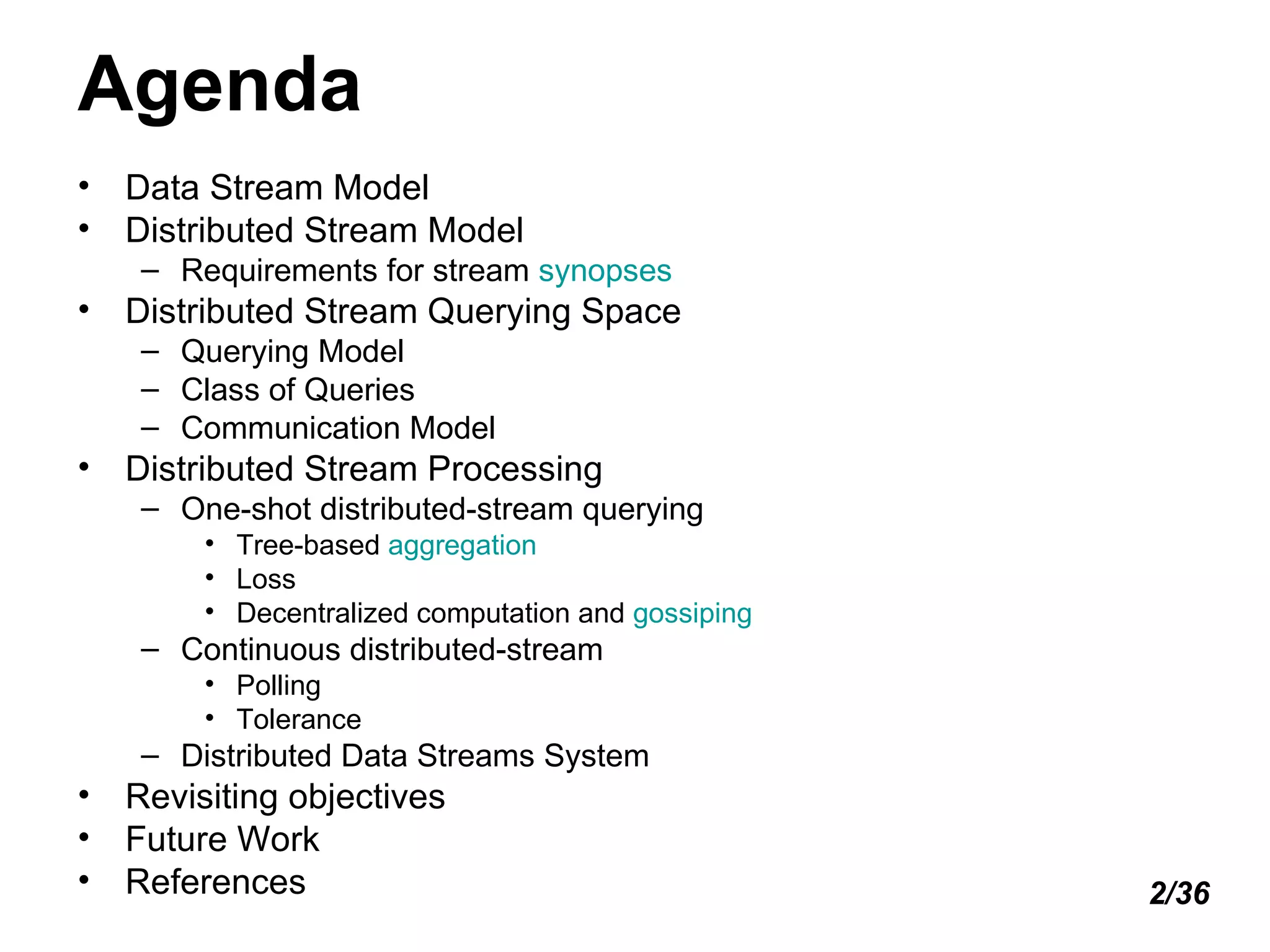
Agenda Data Stream Model  Distributed Stream Model Requirements for stream  synopses Distributed Stream Querying Space Querying Model Class of Queries Communication Model Distributed Stream Processing One-shot distributed-stream querying Tree-based  aggregation Loss Decentralized computation and  gossiping Continuous distributed-stream Polling Tolerance Distributed Data Streams System Revisiting objectives Future Work References 2/36
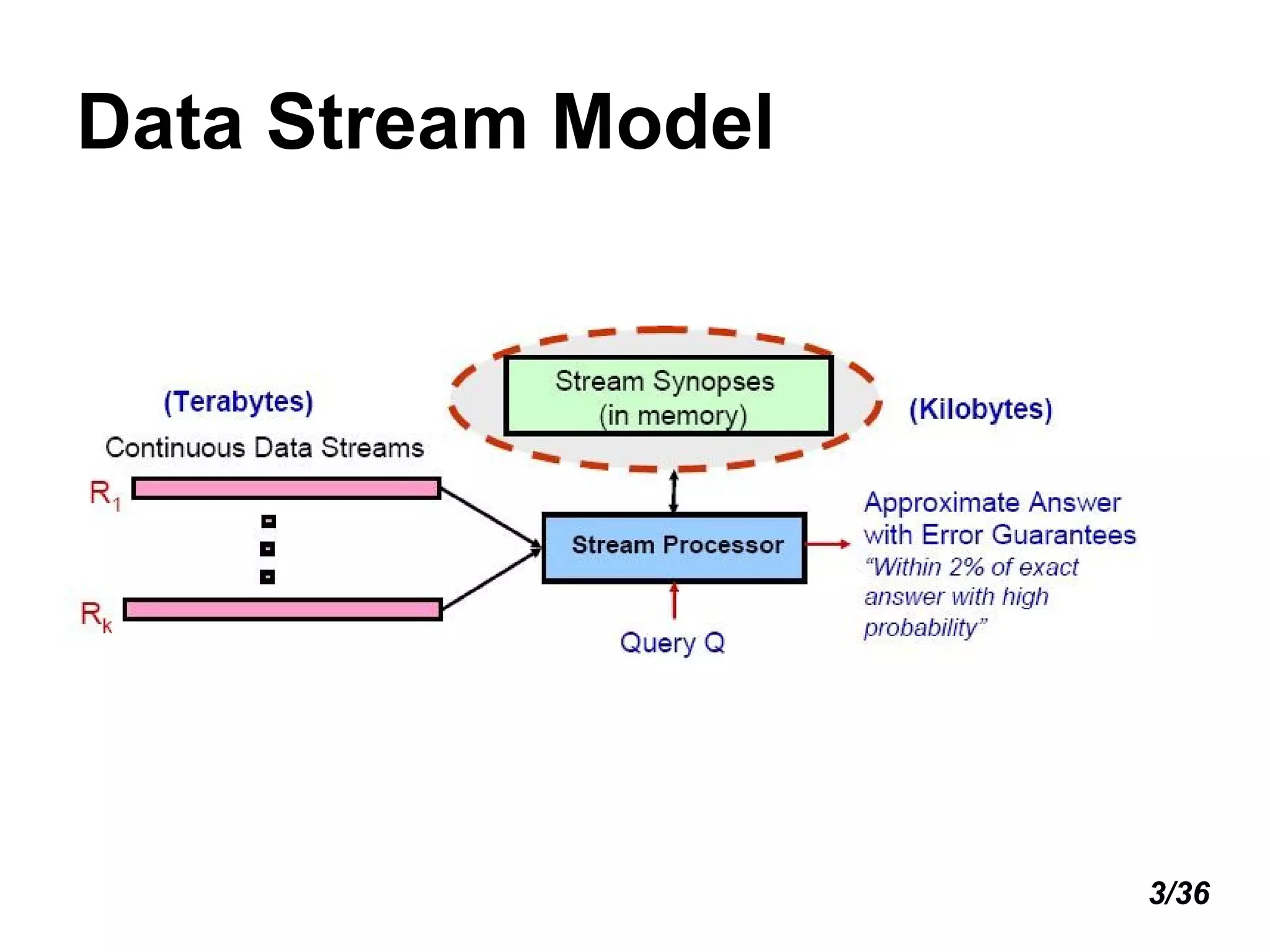
Data Stream Model 3/36
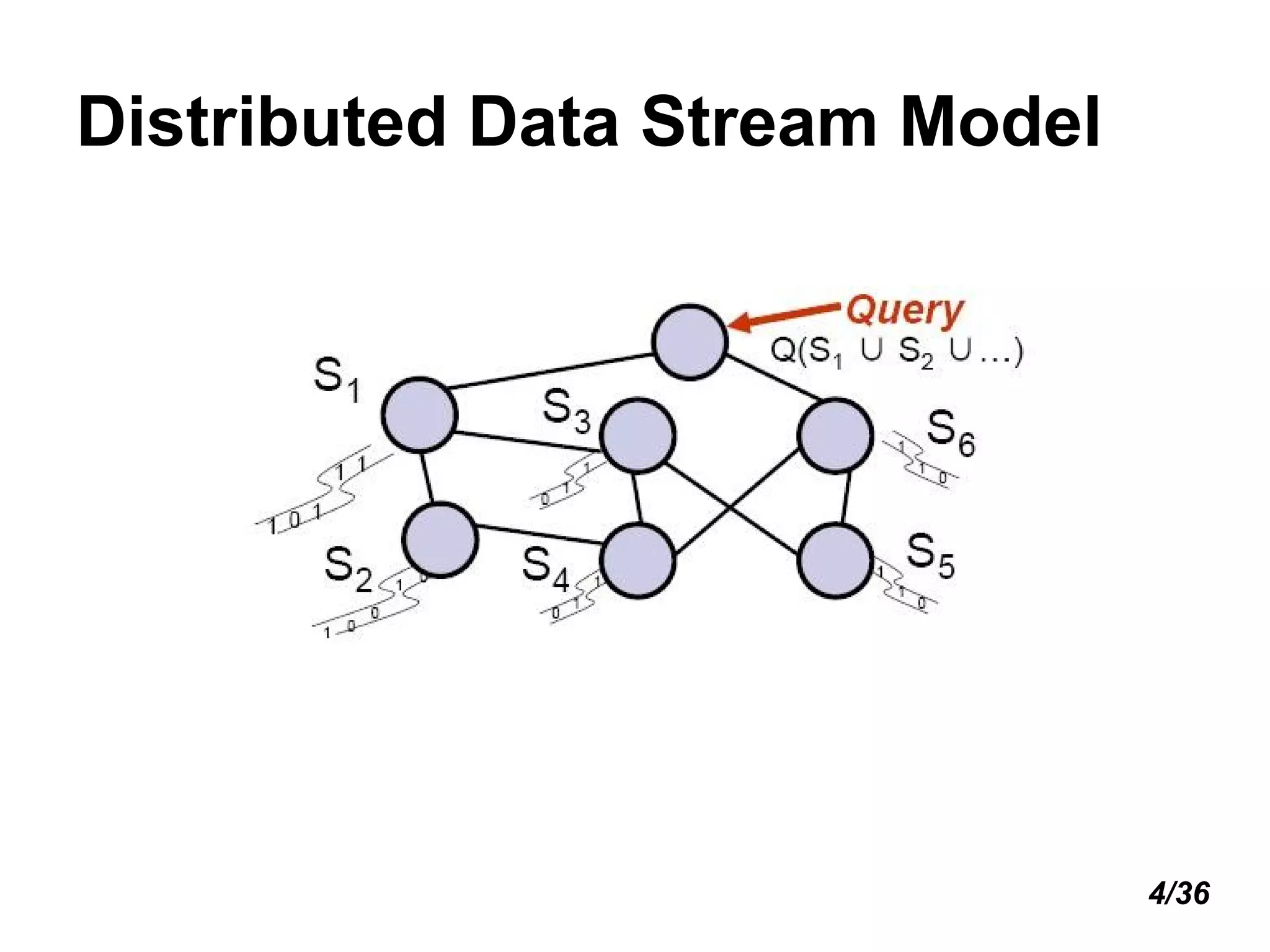
Distributed Data Stream Model 4/36
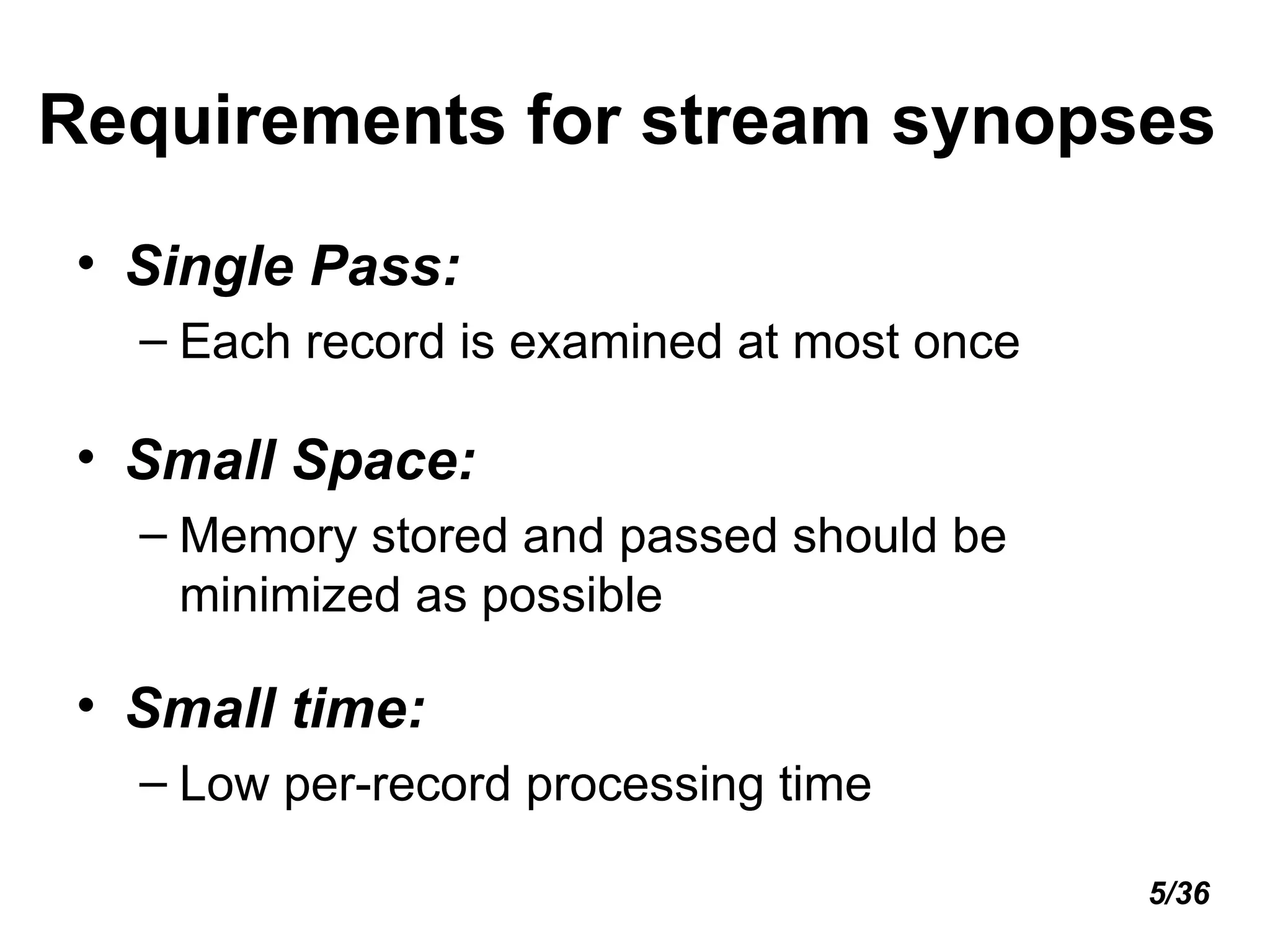
Requirements for stream synopses Single Pass:  Each record is examined at most once Small Space:   Memory stored and passed should be minimized as possible Small time:  Low per-record processing time 5/36
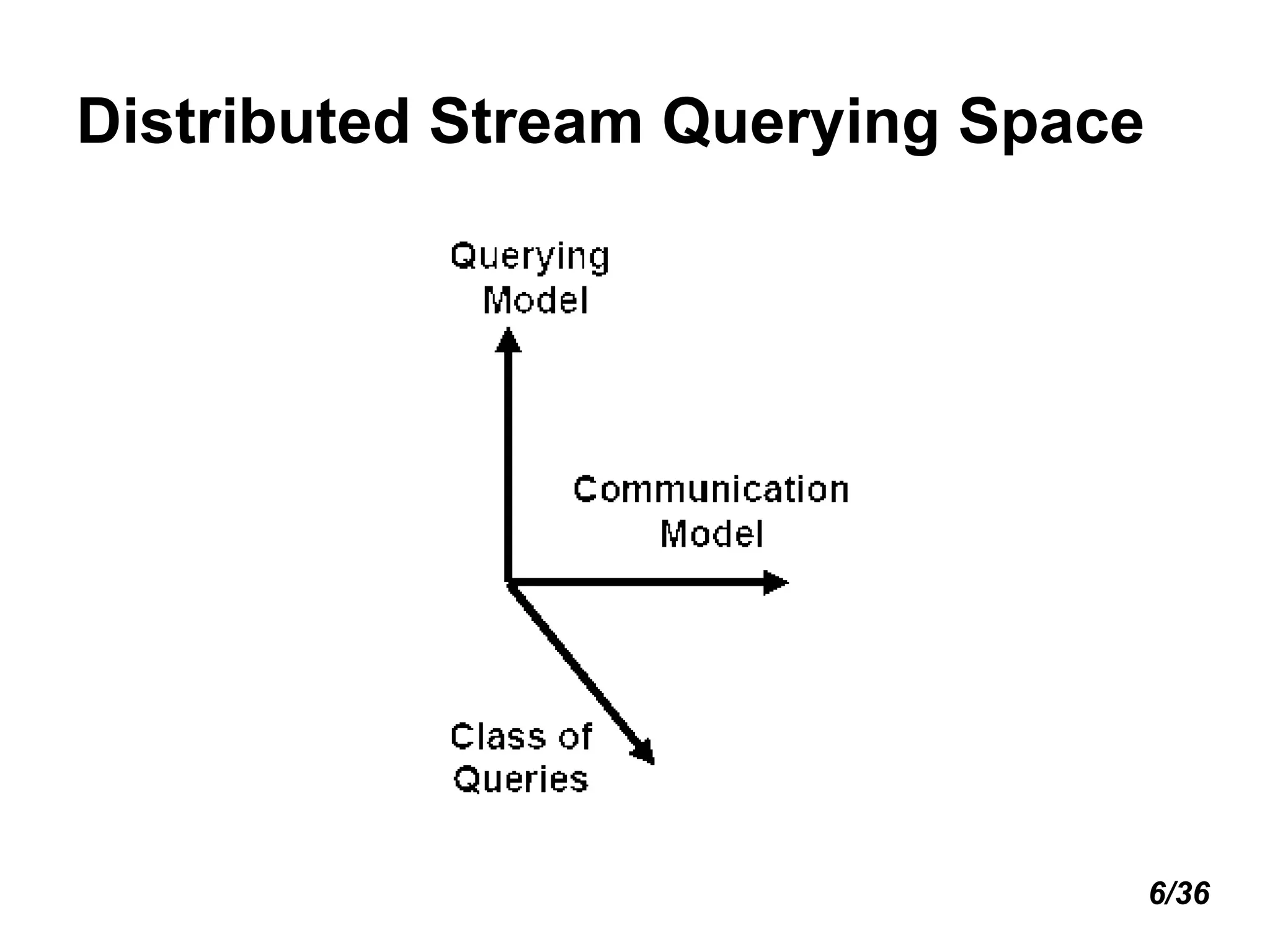
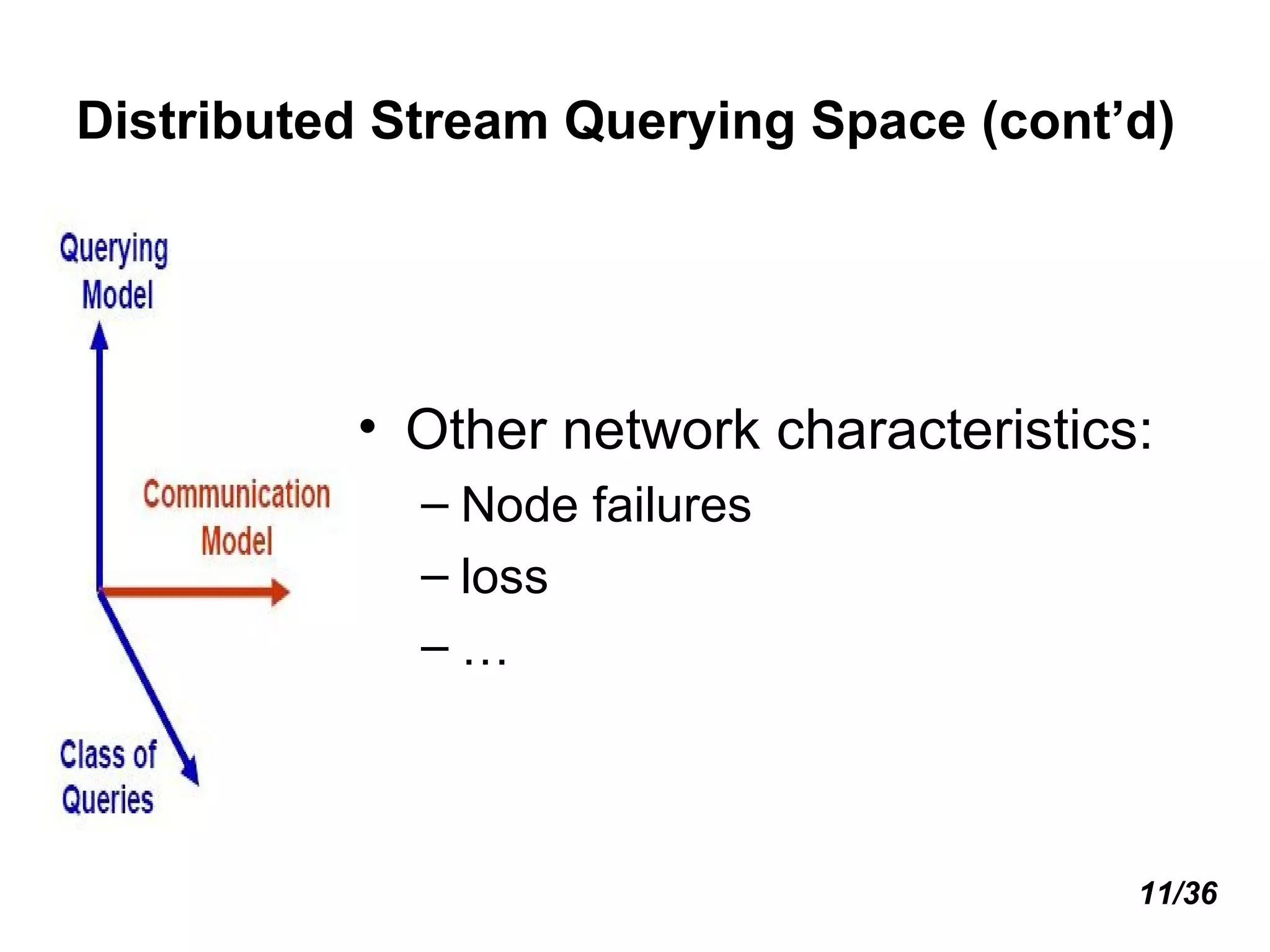
Distributed Stream Querying Space 6/36
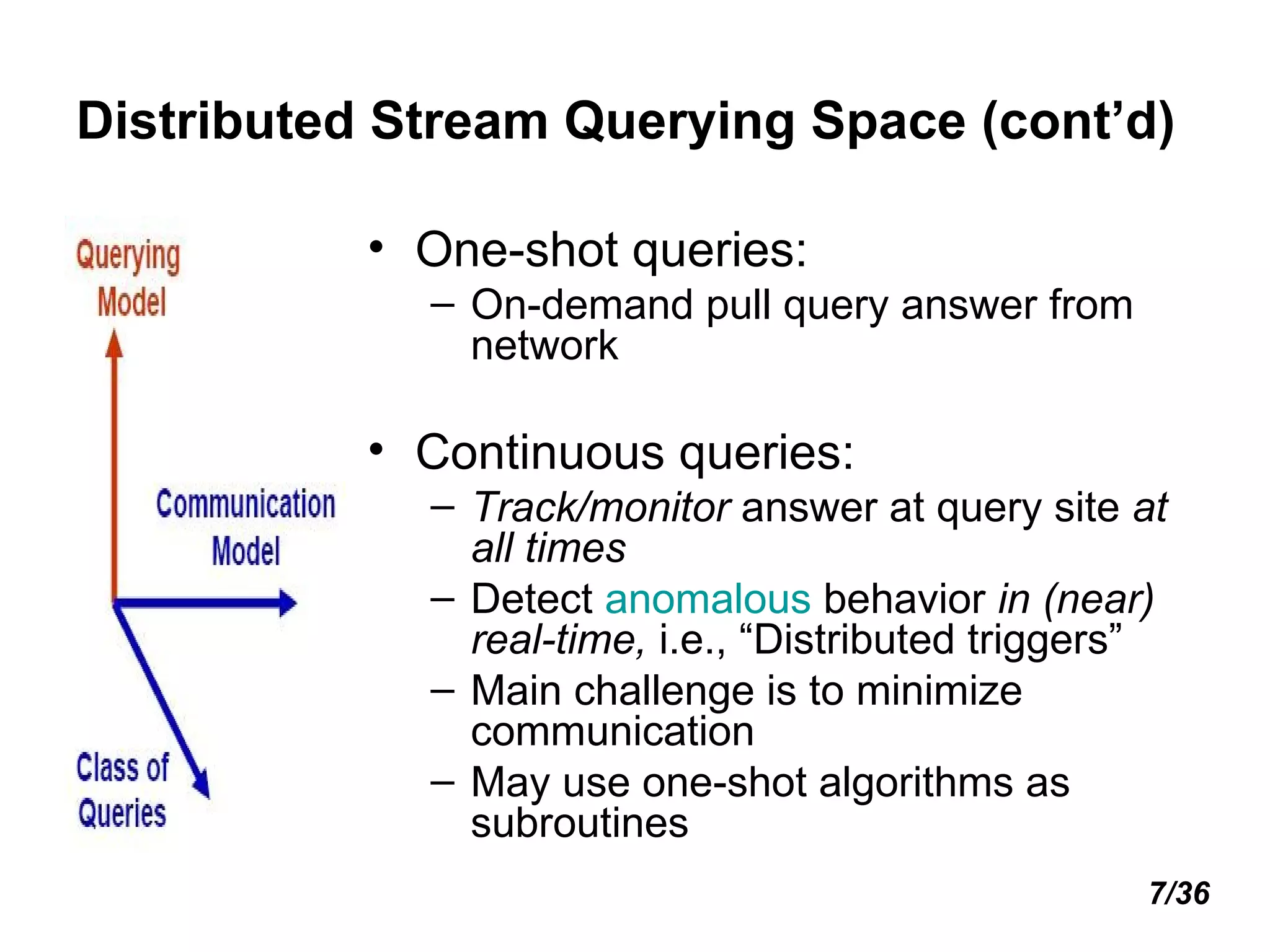
Distributed Stream Querying Space (cont’d) One-shot queries:  On-demand pull query answer from network Continuous queries:  Track/monitor  answer at query site  at all times Detect  anomalous  behavior  in (near) real-time,  i.e., “Distributed triggers” Main challenge is to minimize communication May use one-shot algorithms as subroutines 7/36
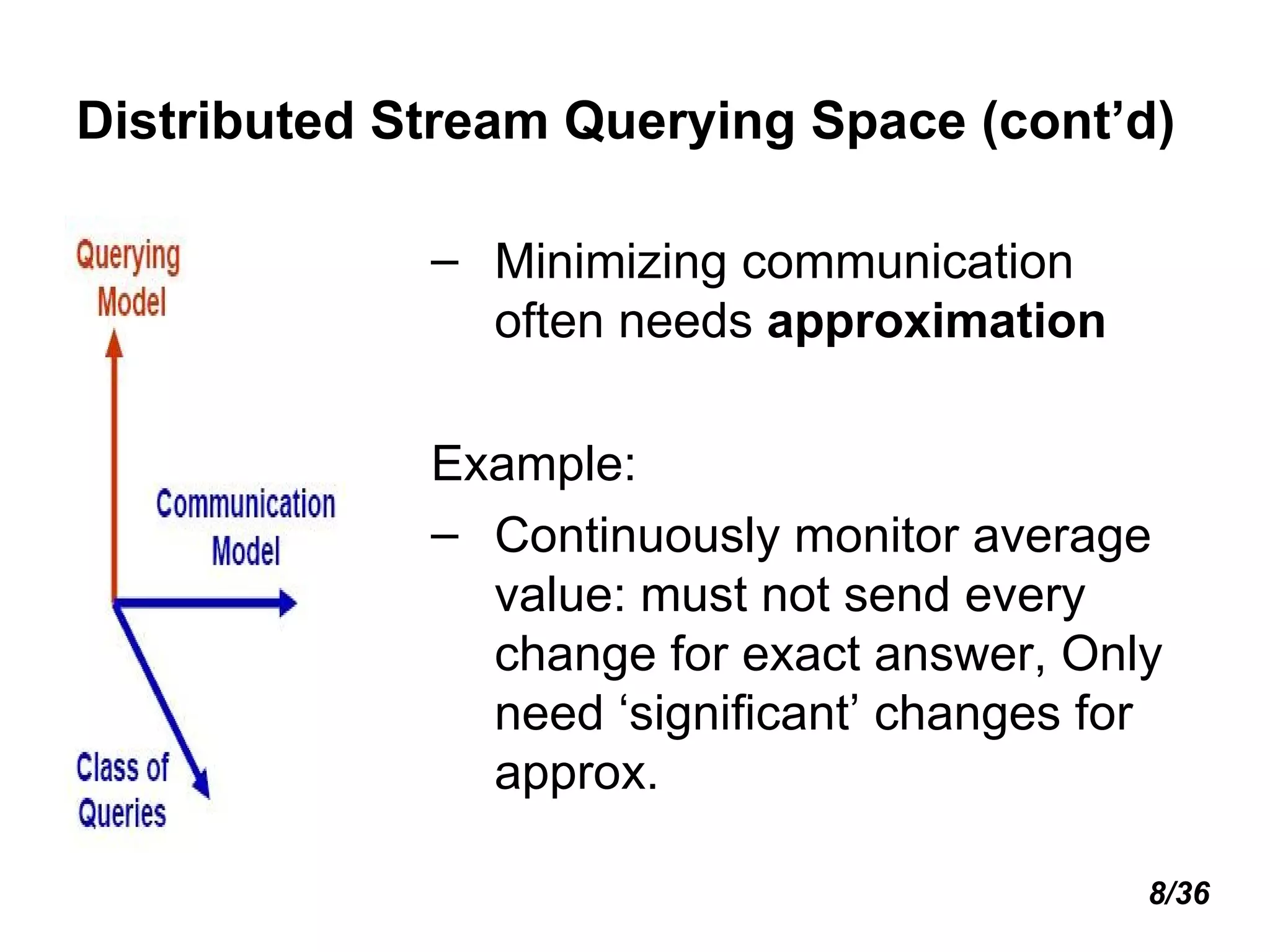
Distributed Stream Querying Space (cont’d) Minimizing communication often needs  approximation   Example: Continuously monitor average value: must not send every change for exact answer, Only need ‘significant’ changes for approx. 8/36
Distributed Stream Querying Space (cont’d) Simple algebraic vs. holistic aggregates   [3] Holistic aggregates  need the whole input to compute the query result  (no summary suffices) E.g.,  count distinct , need to remember all distinct items to tell if new item is distinct or not Duplicate-sensitive vs. duplicate-insensitive Duplicate sensitivity indicates whether the result of aggregation evaluator is affected by a duplicated reading or not. E.g., BINARY AND vs SUM Complex queries E.g., distributed joins 9/36
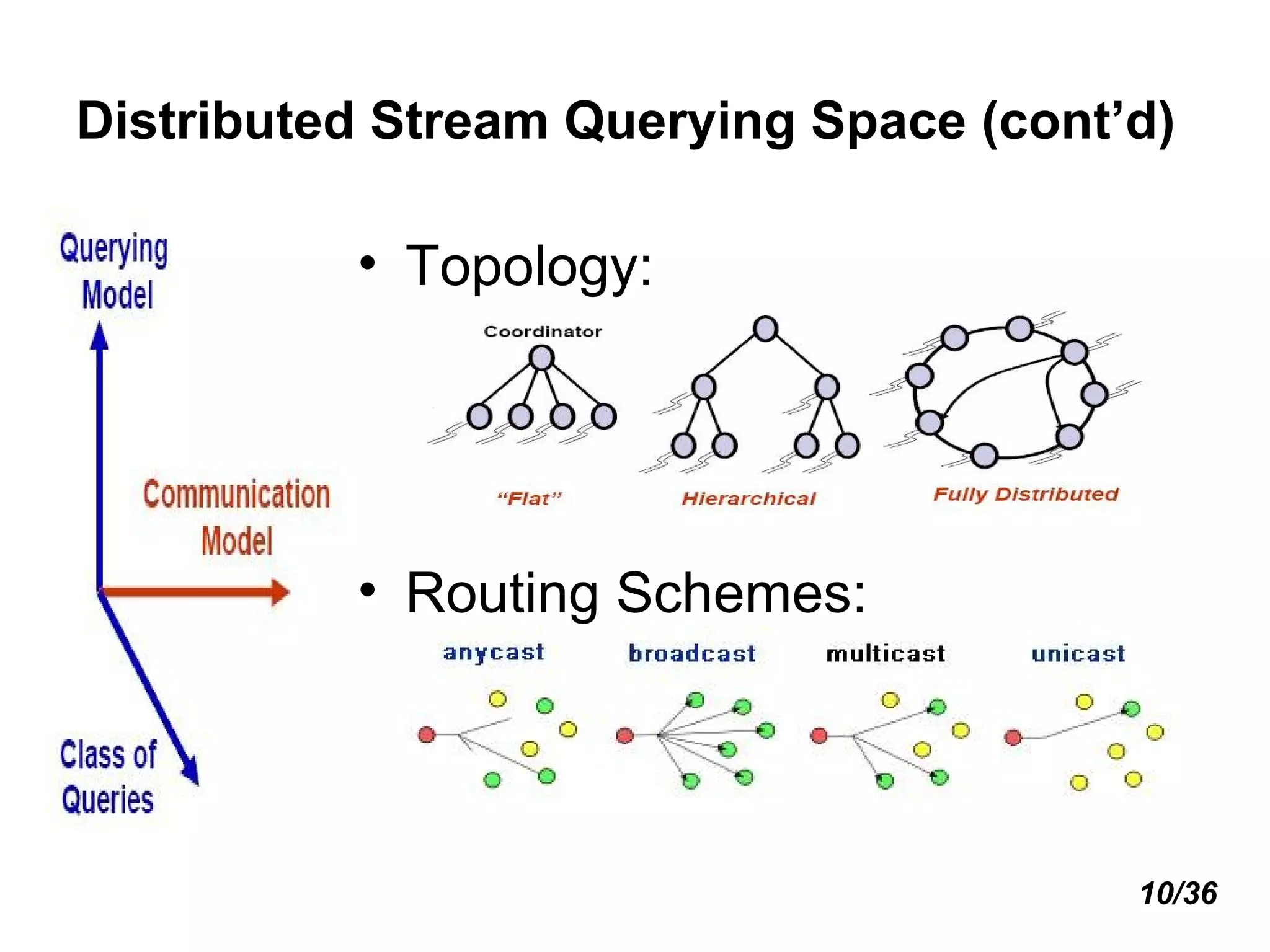
Distributed Stream Querying Space (cont’d) Topology: Routing Schemes: 10/36
Distributed Stream Querying Space (cont’d) Other network characteristics: Node failures loss  … 11/36
One-shot distributed-stream querying Tree-based aggregation Loss Decentralized computation  Gossiping 12/36
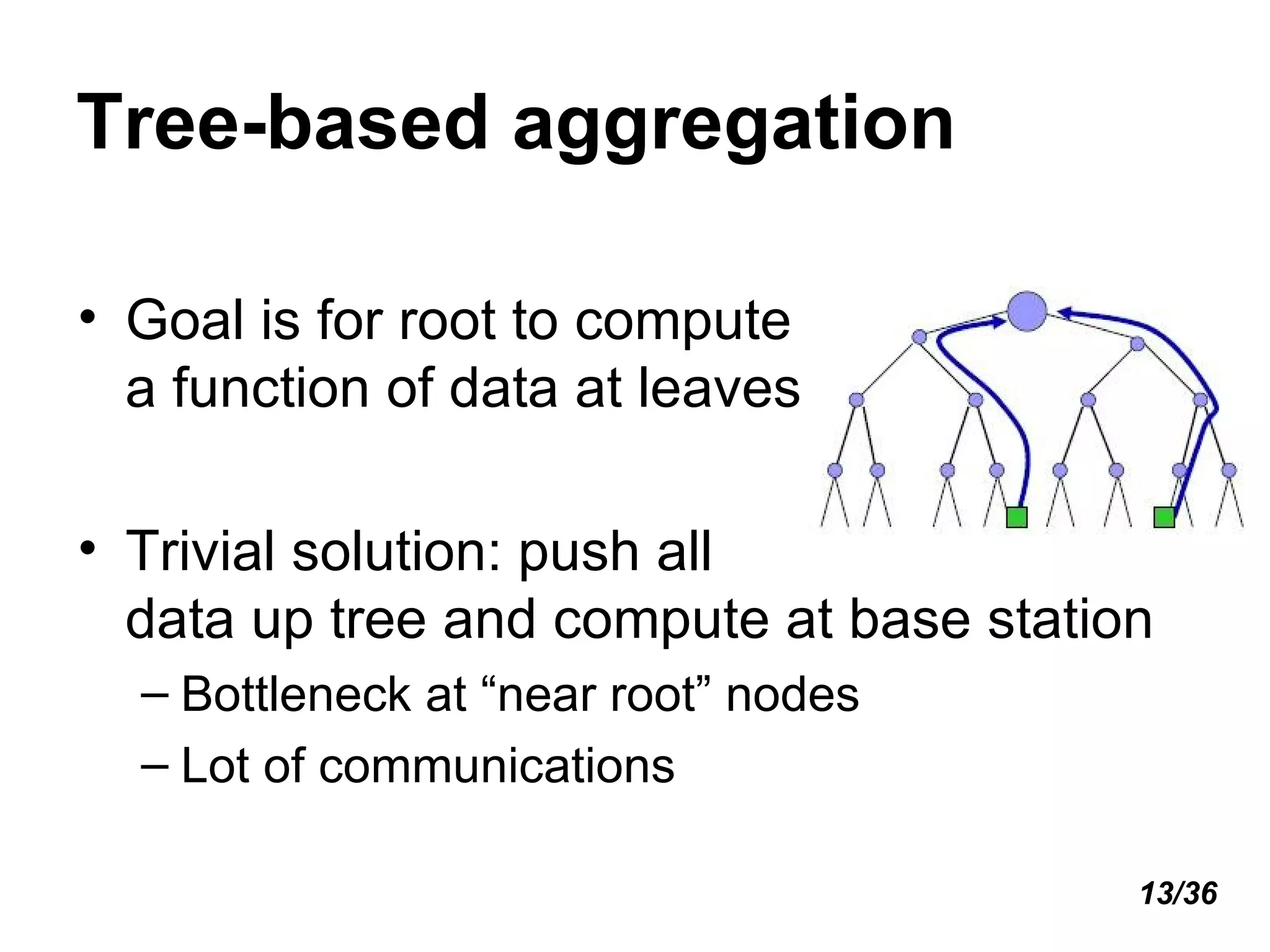
Tree-based aggregation Goal is for root to compute  a function of data at leaves Trivial solution: push all  data up tree and compute at base station Bottleneck at “near root” nodes Lot of communications 13/36
Tree-based aggregation (cont’d) Can do much better by  “ In-network”  query processing example: computing max Instead of sending all data to root node then the root compute the max, each node hears from all children, computes max and sends to parent. 14/36
Tree-based aggregation (cont’d) Aggregates of interest SQL Primitives:   min, max, sum, count, avg More complex:   count distinct, range queries Data mining:  association rules, clusterings 15/36
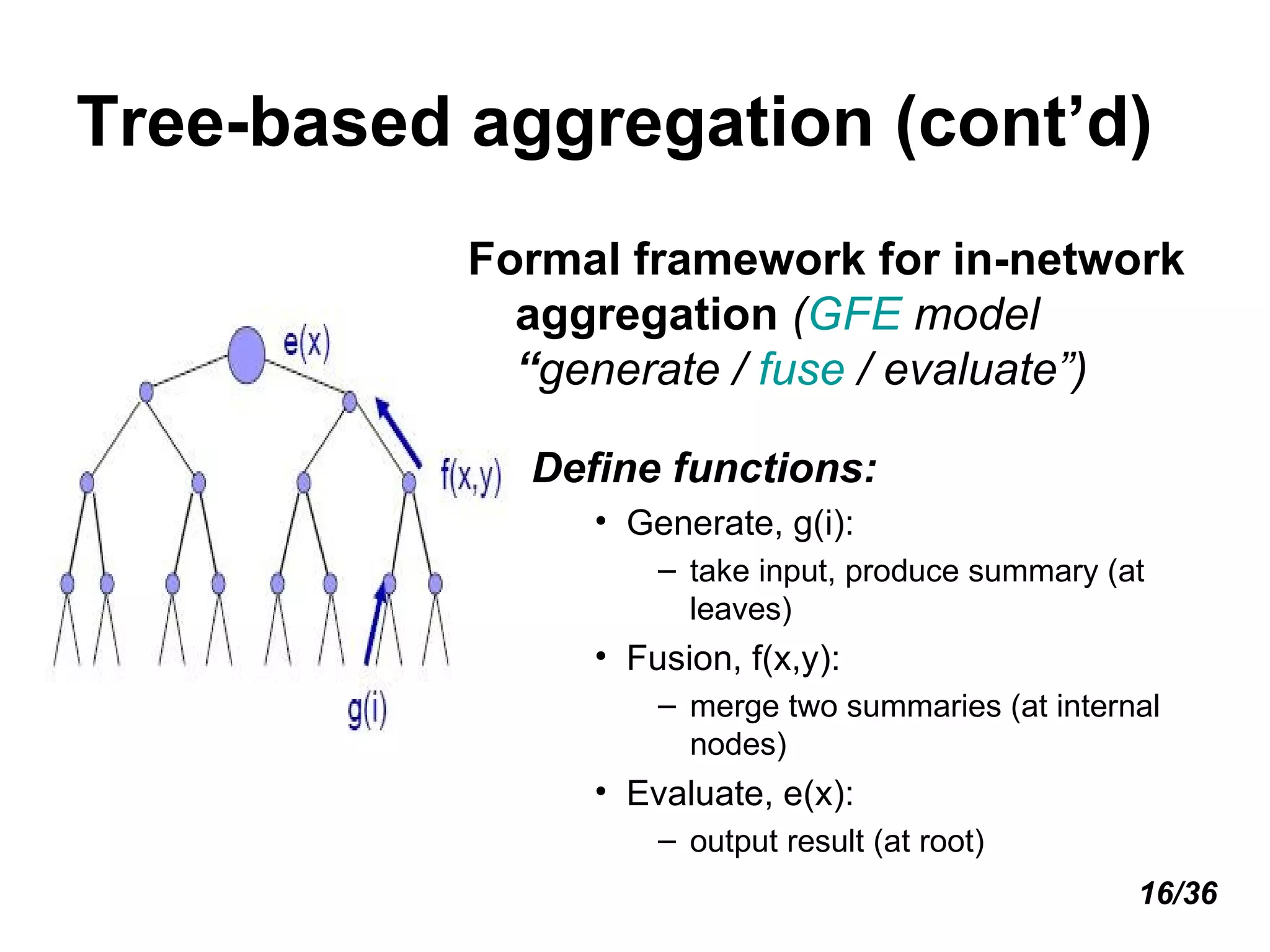
Tree-based aggregation (cont’d) Formal framework for in-network aggregation  ( GFE  model  “ generate /  fuse  / evaluate”) Define functions: Generate, g(i):  take input, produce summary (at leaves) Fusion, f(x,y):  merge two summaries (at internal nodes) Evaluate, e(x):  output result (at root) 16/36
Loss Unreliability Tree aggregation techniques assumed a reliable network assuming no node failure Assuming no loss of messages Failure can dramatically affect the computation E.g.,  sum  – if a node near the root fails, then a whole subtree may be lost 17/36
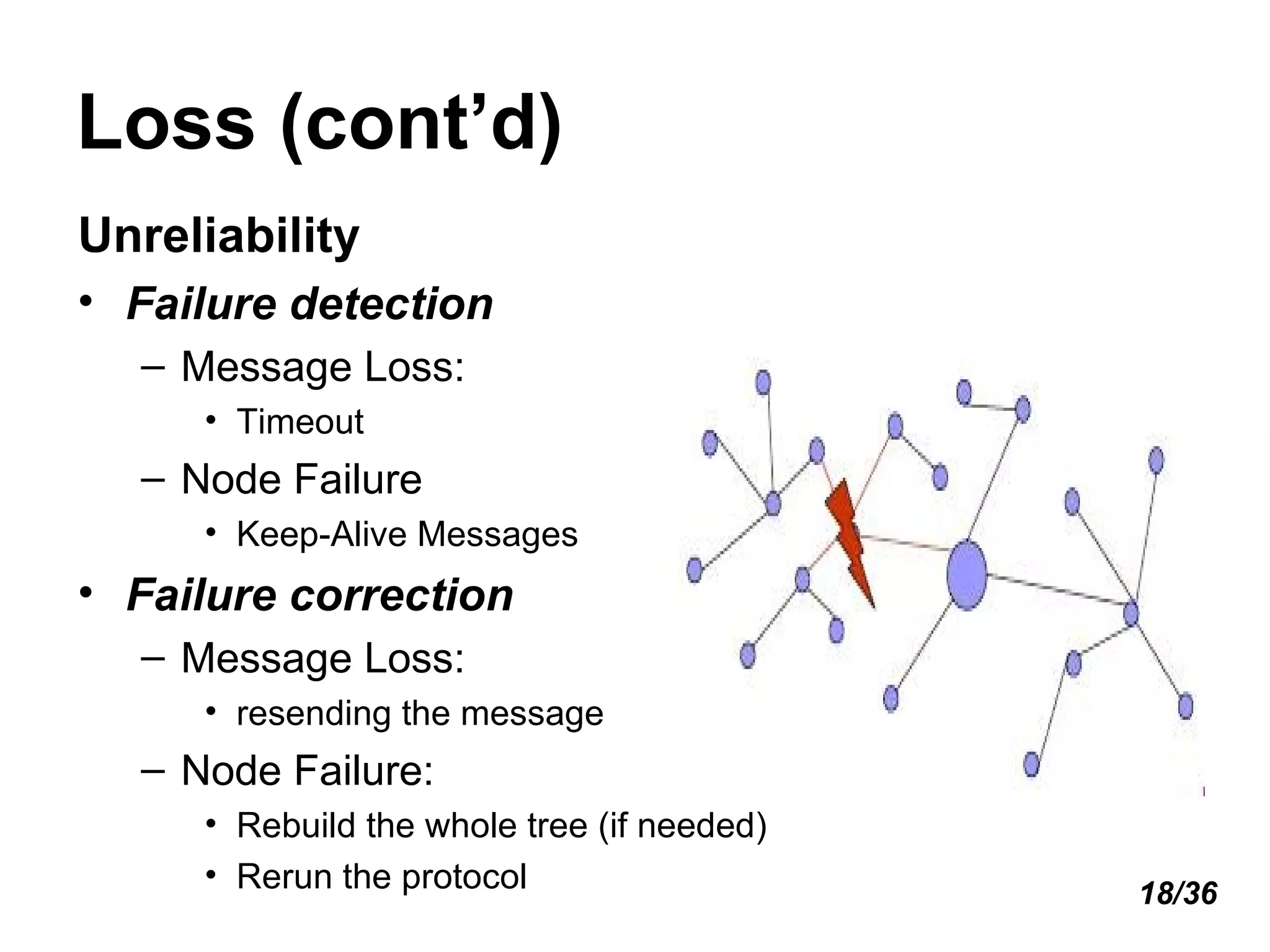
Loss (cont’d) Unreliability Failure detection Message Loss: Timeout Node Failure Keep-Alive Messages  Failure correction Message Loss:  resending the message Node Failure:  Rebuild the whole tree (if needed) Rerun the protocol  18/36
Loss (cont’d) Order and duplicate insensitivity ( ODI ) e.g., SUM is not ODI e.g., MIN and MAX are ODIs How to make ODI summaries for other aggregates? Example transform “ count distinct ” to ODI using  FM  Sketch (Flajolet, Martin ‘85) 19/36
Loss (cont’d) The Flajolet-Martin sketch  [4] Target:   Estimates number of distinct inputs ( count distinct ) Given:  A sequence of input x i Steps: Use hash function mapping input items to i with prob 2 -I Pr[ h(x) = 1 ] = 1/2 Pr[ h(x) = 2 ] = 1/4 Pr[ h(x) = 3 ] = 1/8  … etc. Construct an FM bitmap of length log N where N is number of inputs 20/36
The Flajolet-Martin sketch (cont’d) For each incoming value x, set FM[h(x)] = 1 The position of the least significant 0 in the bitmap indicates the logarithm of the number of distinct items seen. Accuracy: Taking repetitions with randomly chosen hash functions improves the accuracy Loss (cont’d) 21/36
Decentralized Computation  Concepts: All participate in computation. All get the result. Anyone can talk to anyone else directly. 22/36
Gossiping At each round, everyone who knows the data sends it to one of the n participants,  chosen at random . After O(log n) rounds, all n participants know the information. 23/36
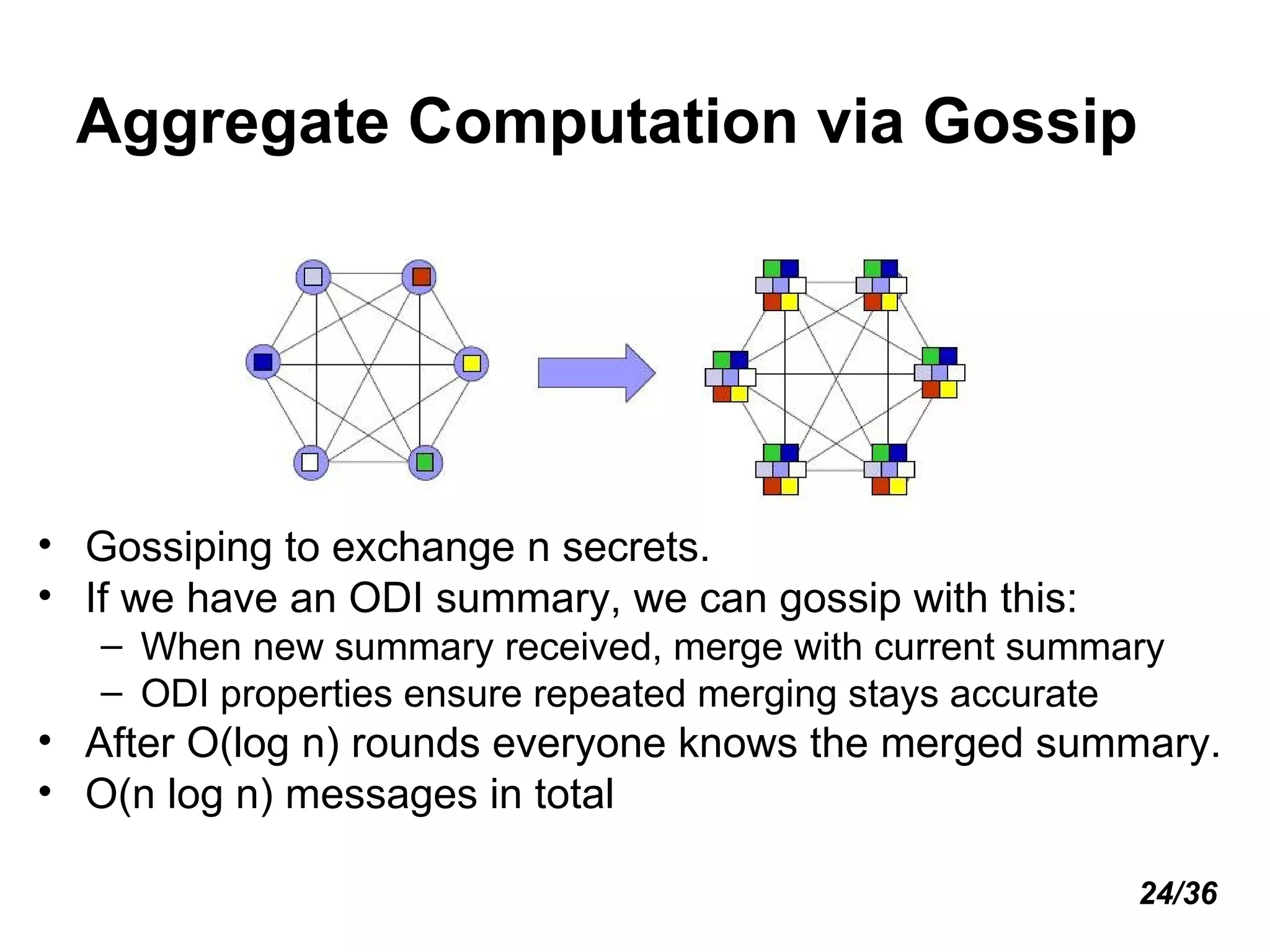
Aggregate Computation via Gossip Gossiping to exchange n secrets. If we have an ODI summary, we can gossip with this: When new summary received, merge with current summary ODI properties ensure repeated merging stays accurate After O(log n) rounds everyone knows the merged summary. O(n log n) messages in total 24/36
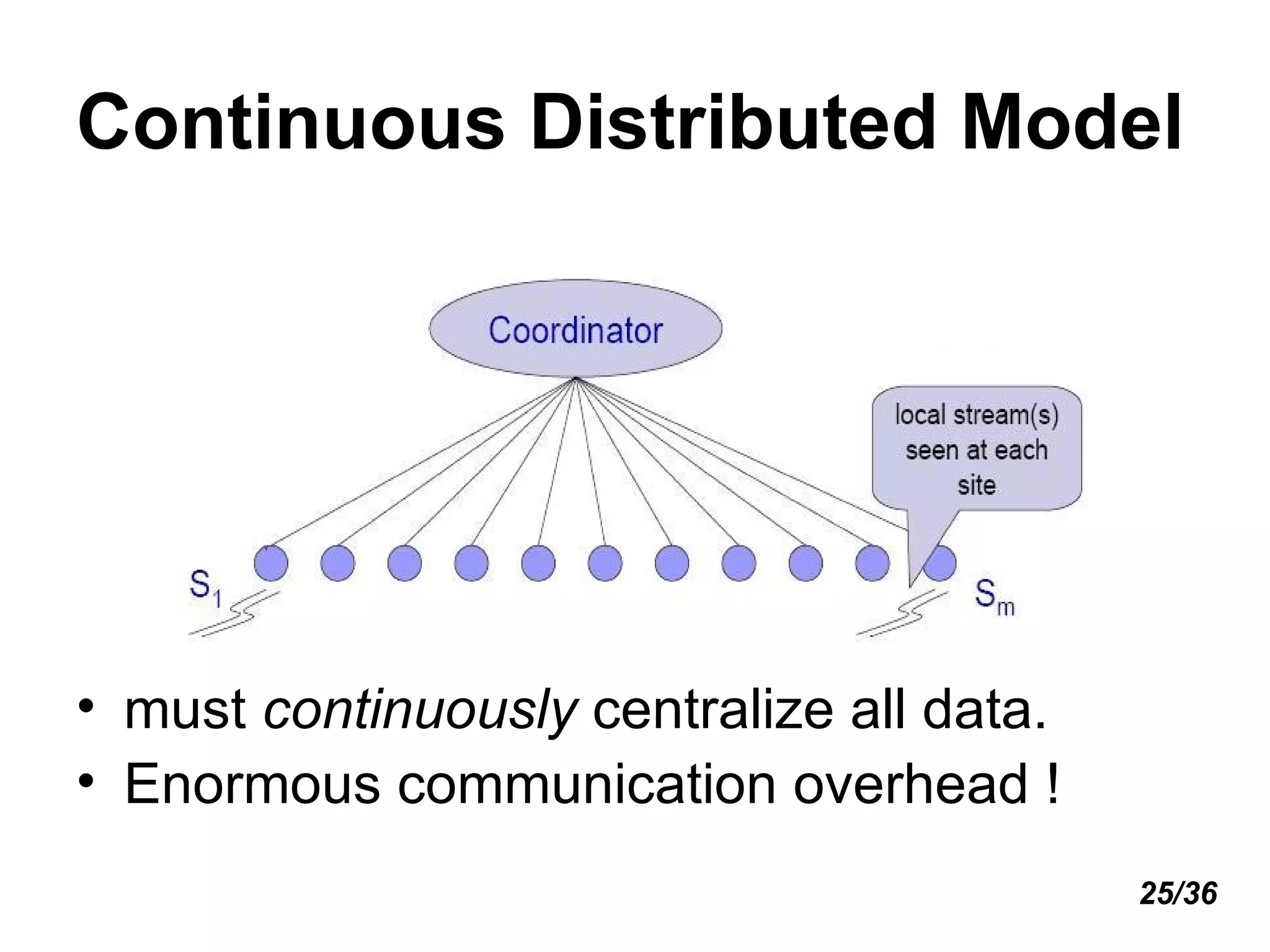
Continuous Distributed Model must  continuously  centralize all data. Enormous communication overhead ! 25/36
Continuous Distributed Model (cont’d) Continuous Real-time tracking, rather than one-shot query/response Distributed Each remote site only observes part of the global stream(s) Communication constraints:  must minimize monitoring  burden Streaming Each site sees a high-speed local data stream 26/36
Continuous Distributed Model (cont’d) Naïve solution continuously  centralize all data. 27/36
Continuous Distributed Model (cont’d) Naïve solution continuously  centralize all data. Enormous communication overhead ! 28/36
Continuous Distributed Model (cont’d) Naïve solution continuously  centralize all data. Enormous communication overhead ! So what about polling ? 29/36
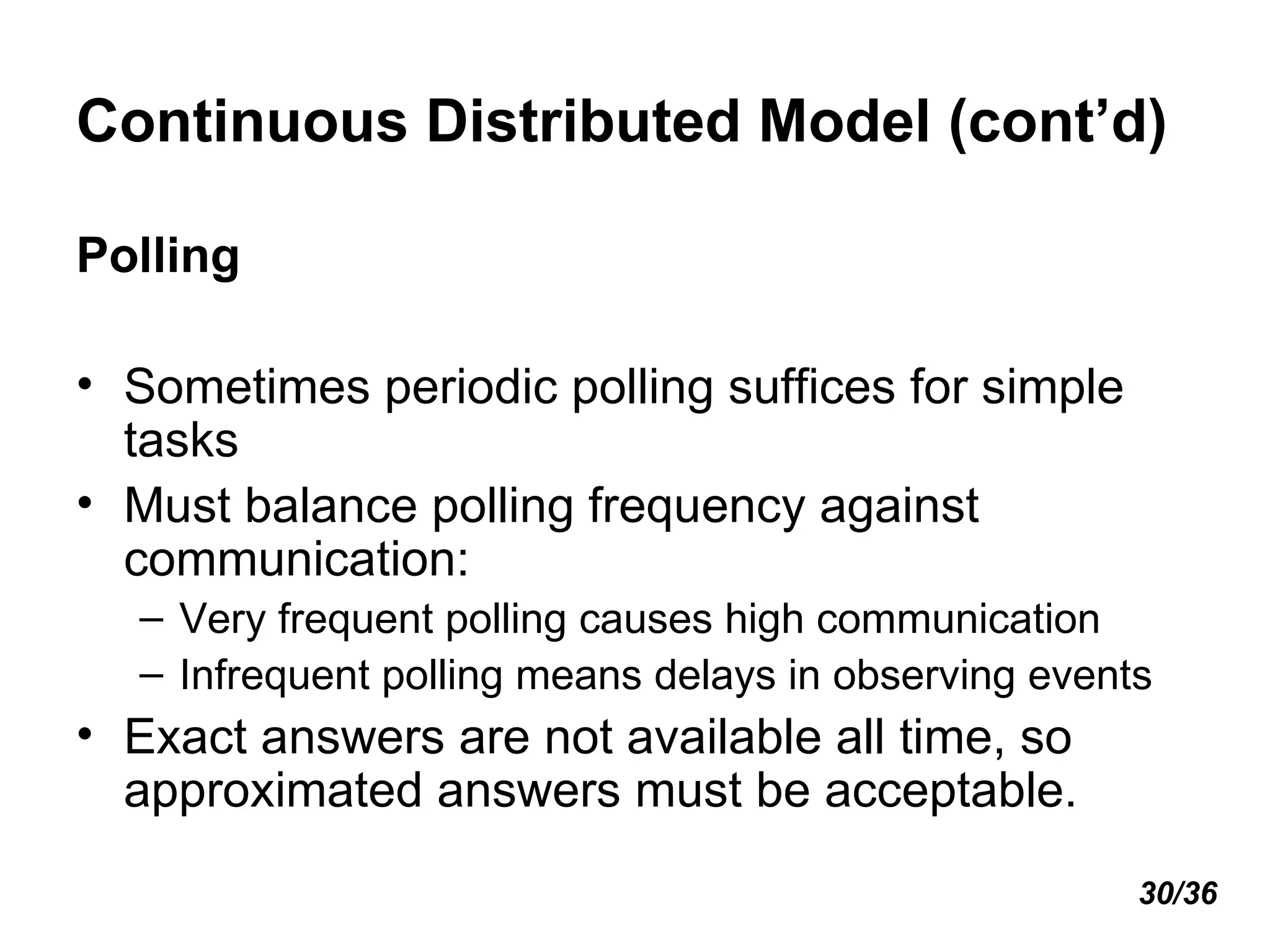
Continuous Distributed Model (cont’d) Polling Sometimes periodic polling suffices for simple tasks Must balance polling frequency against communication: Very frequent polling causes high communication Infrequent polling means delays in observing events Exact answers are not available all time, so approximated answers must be acceptable. 30/36
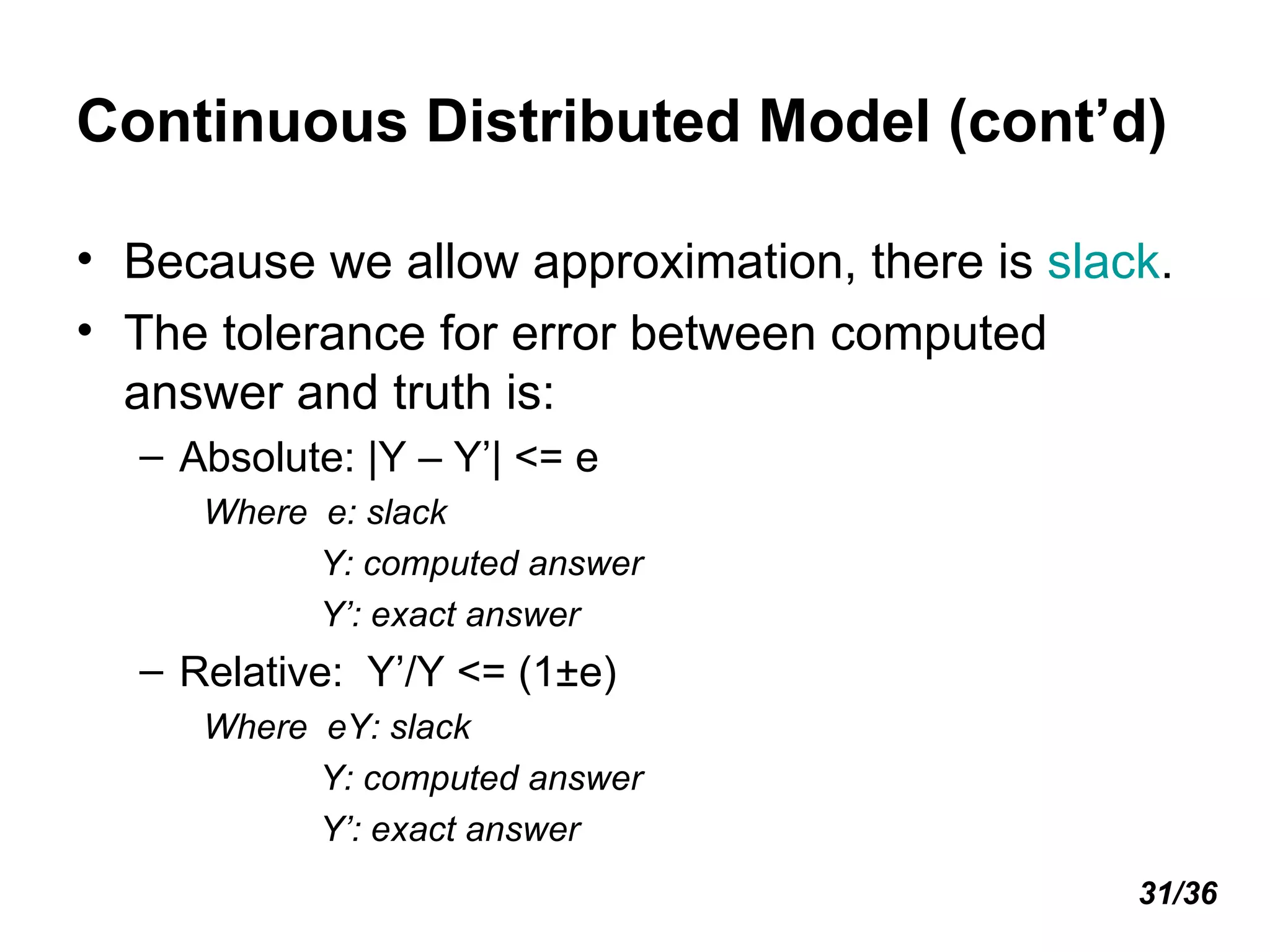
Continuous Distributed Model (cont’d) Because we allow approximation, there is  slack . The tolerance for error between computed answer and truth is: Absolute: |Y – Y’| <= e Where  e: slack Y: computed answer Y’: exact answer Relative:  Y’/Y <= (1±e) Where  eY: slack Y: computed answer Y’: exact answer 31/36
Distributed Data Streams System Overview of “Minos Garofalakis”  [2]  on the future of  DSS Main algorithmic idea:  Trade-off  communication/ approximation  “ Unfortunately, approximate query processing tools are still not widely adopted in current Stream Processing Engines”  [5]   “ More complex tools for  approximate  in-network data processing/collection have yet to gain wider acceptance”  [5] 32/36
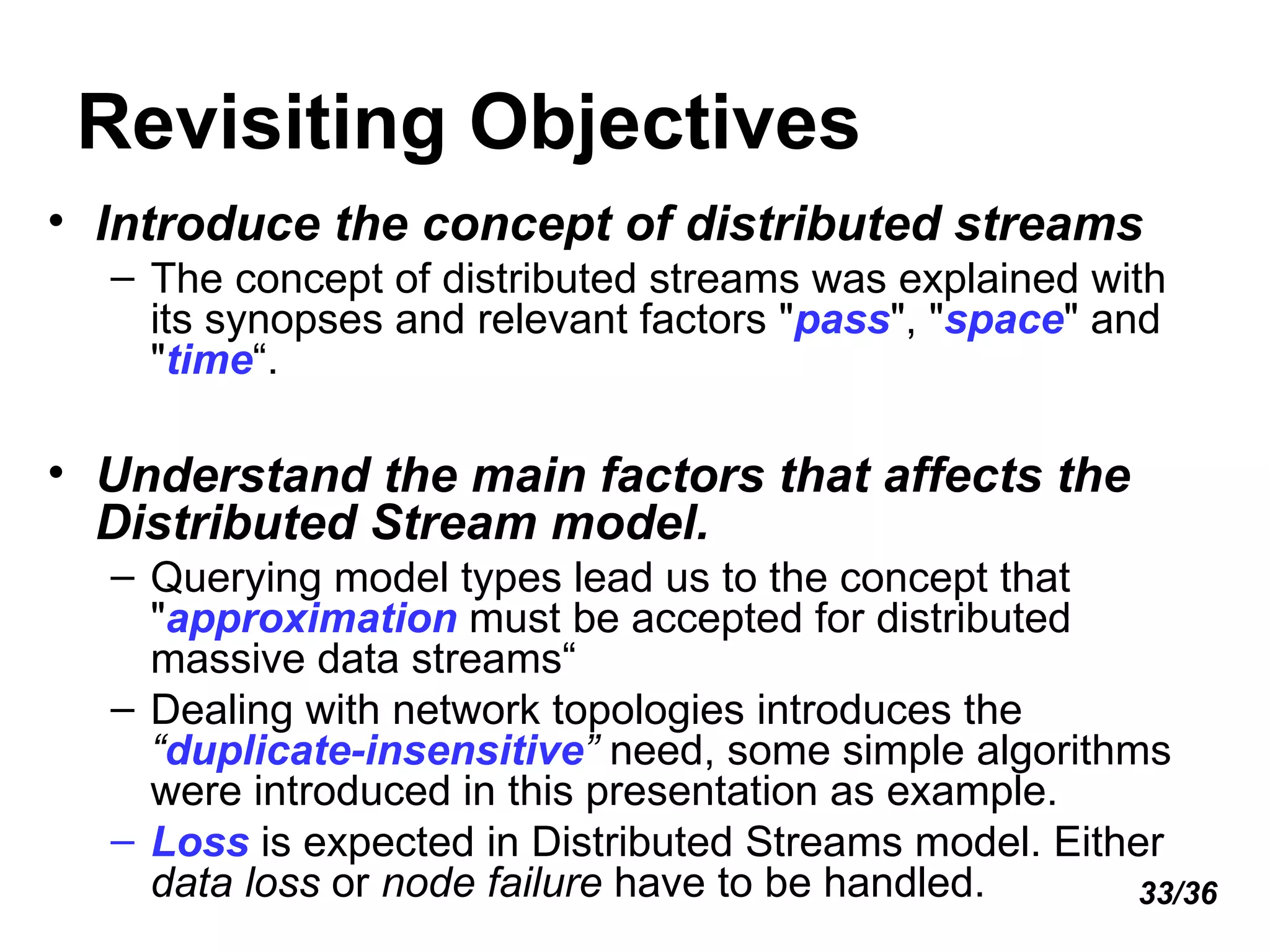
Revisiting Objectives Introduce the concept of distributed streams The concept of distributed streams was explained with its synopses and relevant factors &quot; pass &quot;, &quot; space &quot; and &quot; time “. Understand the main factors that affects the Distributed Stream model. Querying model types lead us to the concept that &quot; approximation  must be accepted for distributed massive data streams“ Dealing with network topologies introduces the  “ duplicate-insensitive ”  need, some simple algorithms were introduced in this presentation as example. Loss  is expected in Distributed Streams model. Either  data loss  or  node failure  have to be handled. 33/36
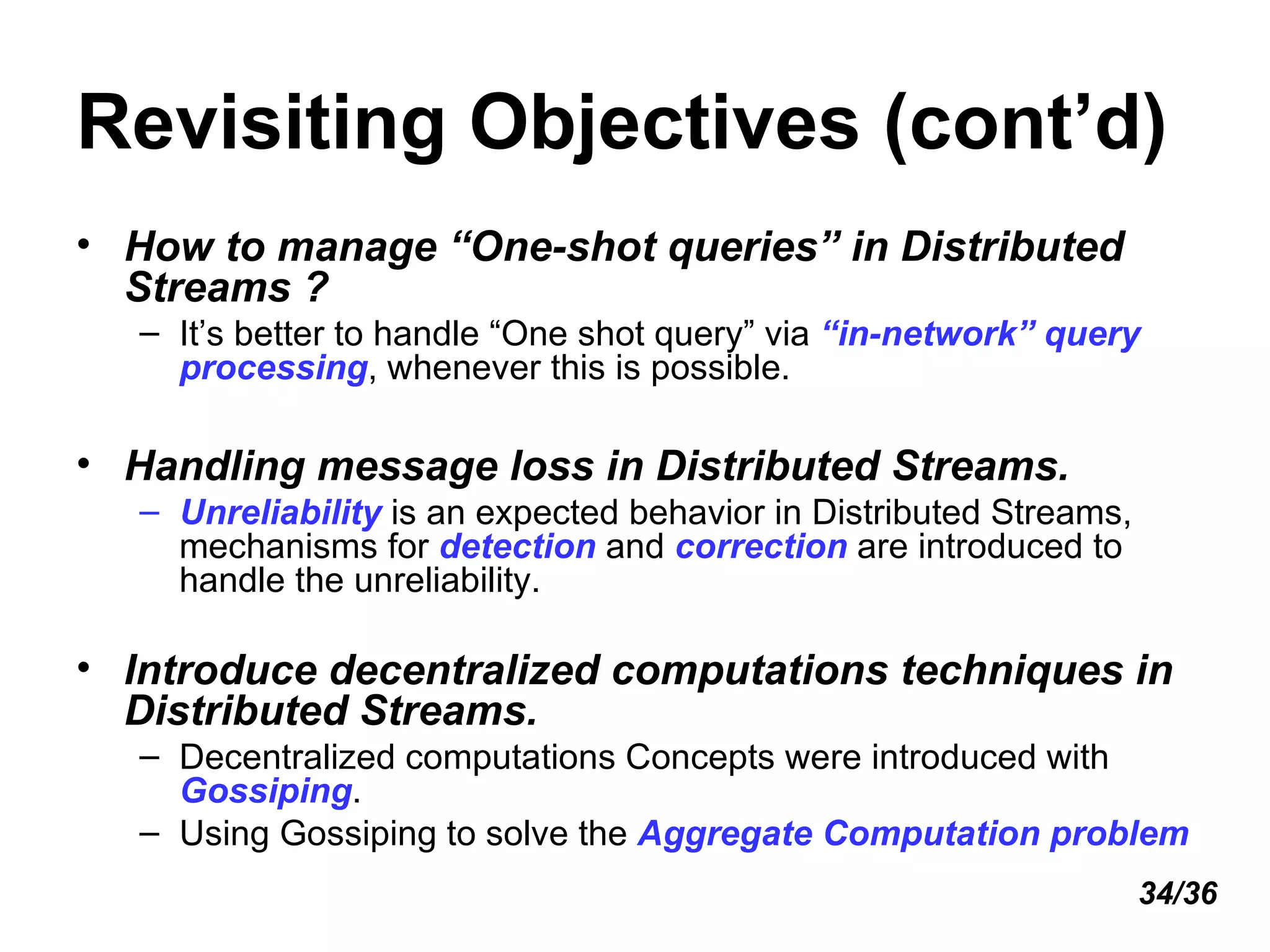
Revisiting Objectives (cont’d) How to manage “One-shot queries” in Distributed Streams ? It’s better to handle “One shot query” via  “in-network” query processing , whenever this is possible. Handling message loss in Distributed Streams. Unreliability  is an expected behavior in Distributed Streams, mechanisms for  detection  and  correction  are introduced to handle the unreliability. Introduce decentralized computations techniques in Distributed Streams.  Decentralized computations Concepts were introduced with  Gossiping . Using Gossiping to solve the  Aggregate Computation problem 34/36
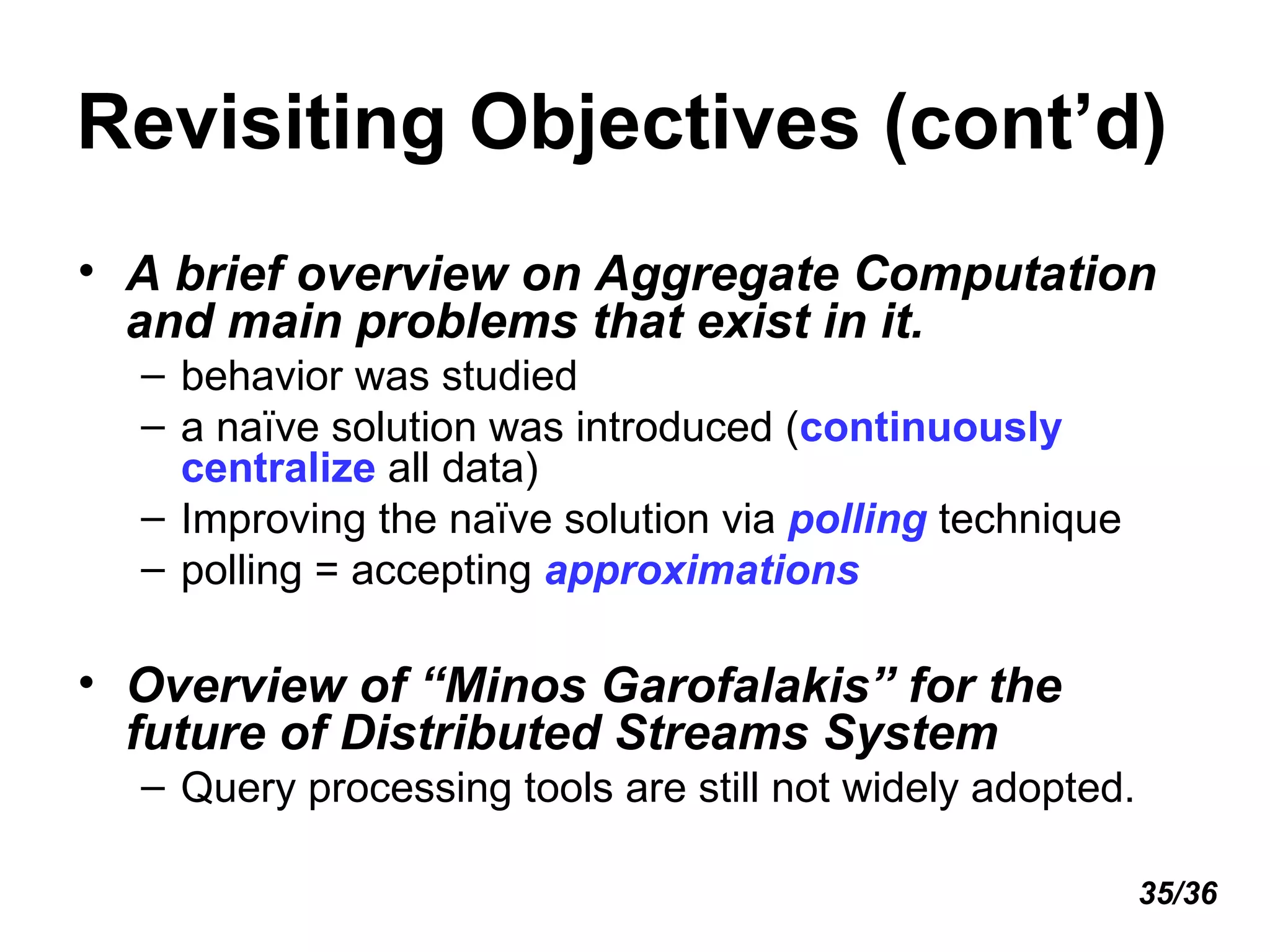
Revisiting Objectives (cont’d) A brief overview on Aggregate Computation and main problems that exist in it. behavior was studied a naïve solution was introduced ( continuously centralize  all data) Improving the naïve solution via  polling  technique polling = accepting  approximations Overview of “Minos Garofalakis” for the future of Distributed Streams System Query processing tools are still not widely adopted. 35/36
Future Work How to make  Stream mining  (clustering, associations, classification, change detection,…etc. ) ? Can all queries be converted to  ODI  ? Compressing  and  Filtering  XML Streams  [6] Graph-data streams   [7]   [8] Extend  ERD  to express streams (ERD stream modeling) A general  distributed query language  (dist-streamSQL?) Define a language so a query optimizer can find a plan that guarantees good performance, small communication? 36/36
References [1]  Minos Garofalakis, Processing Massive Data Streams, Yahoo Research & UC Berkeley, The VLDB school in Egypt, April 2008. [2]  Dr. Minos Garofalakis homepage http:// www.softnet.tuc.gr/~minos /   (last visit 25 th  May 2009) [3]  Graham Cormode, Minos N. Garofalakis, S. Muthukrishnan and Rajeev Rastogi. ACM SIGMOD Conference. Holistic Aggregates in a Networked World Distributed Tracking of Approximate Quantiles. Baltimore, Maryland, USA. 14 th -16 th  June, 2005.  [4]  Graham Cormode, Fundamentals of Analyzing and Mining Data Streams, Workshop on data stream analysis, San Leucio-Italy, March 15 th -16 th , 2007 [5]  Quoted from reference 1, slide 185 [6]  Giovanni Guardalben, Compressing and Filtering XML Streams, The W3C Workshop on Binary Interchange of XML Information Item Sets, 24 th , 25 th  and 26 th  September, 2003, Santa Clara, California, USA [7]  Jian Zhang , Massive Data Streams in Graph Theory and Computational Geometry, Yale University, New Haven, CT, USA, 2005 [8]  Prof. Dr. Joan Feigenbaum ’s publications  http://www.cs.yale.edu/homes/jf/Massive-Data-Pubs.html   (last visit 25 th  May 2009)
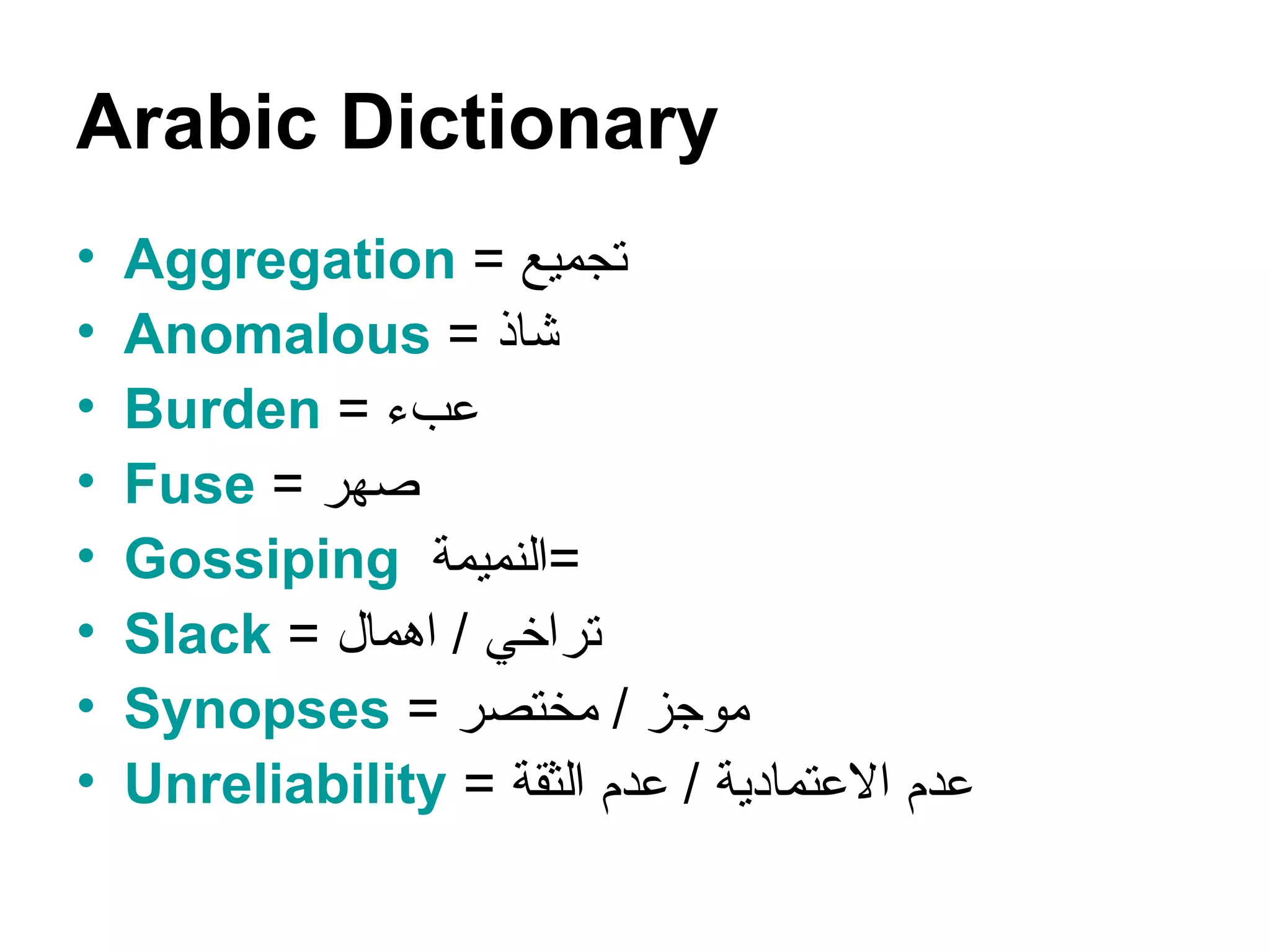
Arabic Dictionary Aggregation  =  تجميع Anomalous  =  شاذ Burden  =  عبء Fuse  =  صهر Gossiping   النميمة  =  Slack  =  تراخي  /  اهمال Synopses  =  موجز  /  مختصر Unreliability   =  عدم الاعتمادية  /  عدم الثقة
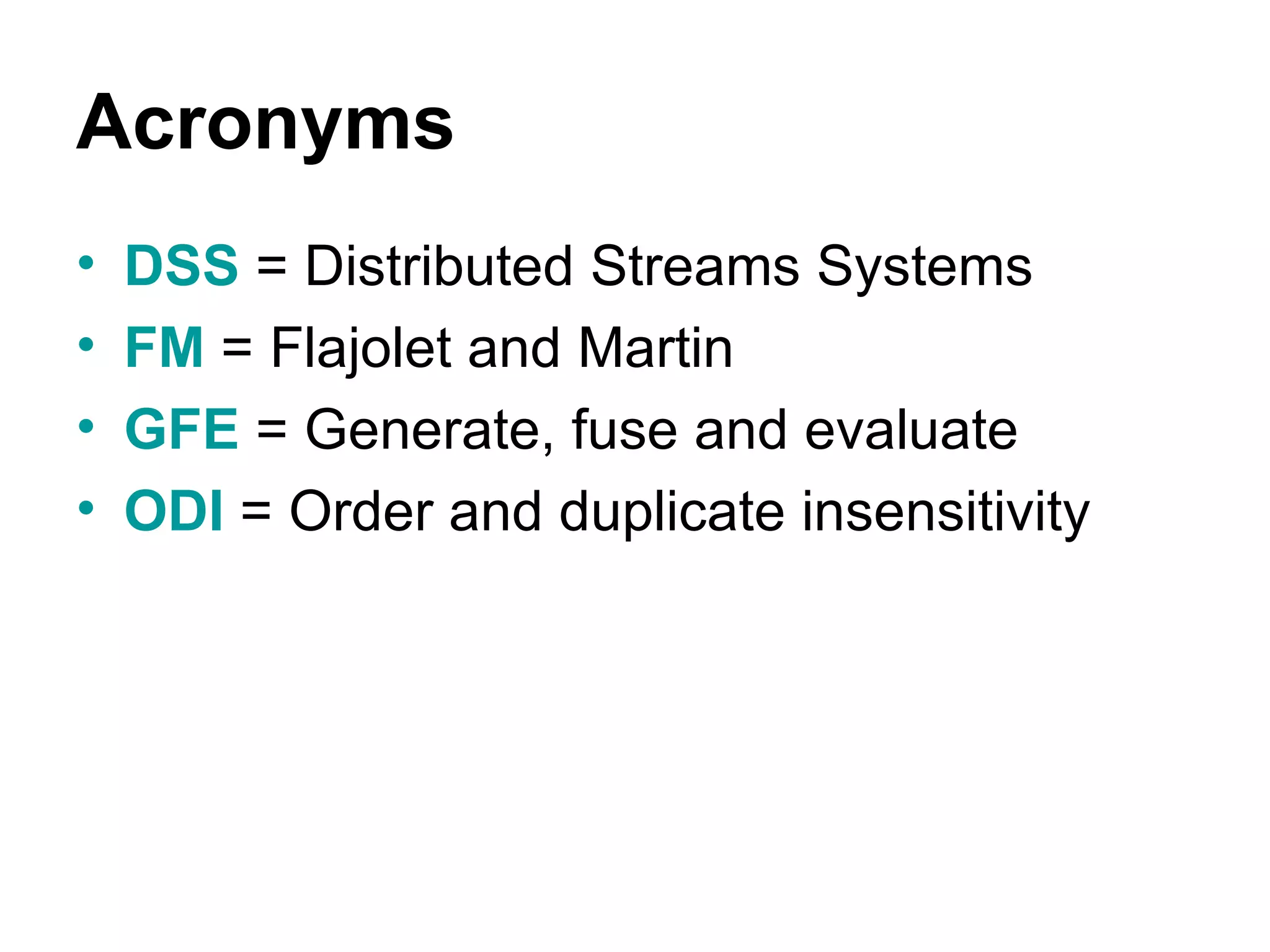
Acronyms DSS  = Distributed Streams Systems FM  = Flajolet and Martin GFE  = Generate, fuse and evaluate ODI  = Order and duplicate insensitivity

Distributed Streams

  • 1.
    Distributed Streams [1] Presented by: Ashraf Bashir
  • 2.
    Objectives Introduce themodel of Distributed Streams. Understand the main factors that affect the Distributed Stream model. How to manage “One-shot queries” in Distributed Streams ? Handling “message loss” in Distributed Streams. Introduce “decentralized computations techniques” in Distributed Streams. A brief overview on “Aggregate Computation” and main problems that exist in it. Overview of “Minos Garofalakis” [2] for the future of Distributed Streams System 1/36
  • 3.
    Agenda Data StreamModel Distributed Stream Model Requirements for stream synopses Distributed Stream Querying Space Querying Model Class of Queries Communication Model Distributed Stream Processing One-shot distributed-stream querying Tree-based aggregation Loss Decentralized computation and gossiping Continuous distributed-stream Polling Tolerance Distributed Data Streams System Revisiting objectives Future Work References 2/36
  • 4.
  • 5.
  • 6.
    Requirements for streamsynopses Single Pass: Each record is examined at most once Small Space: Memory stored and passed should be minimized as possible Small time: Low per-record processing time 5/36
  • 7.
  • 8.
    Distributed Stream QueryingSpace (cont’d) One-shot queries: On-demand pull query answer from network Continuous queries: Track/monitor answer at query site at all times Detect anomalous behavior in (near) real-time, i.e., “Distributed triggers” Main challenge is to minimize communication May use one-shot algorithms as subroutines 7/36
  • 9.
    Distributed Stream QueryingSpace (cont’d) Minimizing communication often needs approximation Example: Continuously monitor average value: must not send every change for exact answer, Only need ‘significant’ changes for approx. 8/36
  • 10.
    Distributed Stream QueryingSpace (cont’d) Simple algebraic vs. holistic aggregates [3] Holistic aggregates need the whole input to compute the query result (no summary suffices) E.g., count distinct , need to remember all distinct items to tell if new item is distinct or not Duplicate-sensitive vs. duplicate-insensitive Duplicate sensitivity indicates whether the result of aggregation evaluator is affected by a duplicated reading or not. E.g., BINARY AND vs SUM Complex queries E.g., distributed joins 9/36
  • 11.
    Distributed Stream QueryingSpace (cont’d) Topology: Routing Schemes: 10/36
  • 12.
    Distributed Stream QueryingSpace (cont’d) Other network characteristics: Node failures loss … 11/36
  • 13.
    One-shot distributed-stream queryingTree-based aggregation Loss Decentralized computation Gossiping 12/36
  • 14.
    Tree-based aggregation Goalis for root to compute a function of data at leaves Trivial solution: push all data up tree and compute at base station Bottleneck at “near root” nodes Lot of communications 13/36
  • 15.
    Tree-based aggregation (cont’d)Can do much better by “ In-network” query processing example: computing max Instead of sending all data to root node then the root compute the max, each node hears from all children, computes max and sends to parent. 14/36
  • 16.
    Tree-based aggregation (cont’d)Aggregates of interest SQL Primitives: min, max, sum, count, avg More complex: count distinct, range queries Data mining: association rules, clusterings 15/36
  • 17.
    Tree-based aggregation (cont’d)Formal framework for in-network aggregation ( GFE model “ generate / fuse / evaluate”) Define functions: Generate, g(i): take input, produce summary (at leaves) Fusion, f(x,y): merge two summaries (at internal nodes) Evaluate, e(x): output result (at root) 16/36
  • 18.
    Loss Unreliability Treeaggregation techniques assumed a reliable network assuming no node failure Assuming no loss of messages Failure can dramatically affect the computation E.g., sum – if a node near the root fails, then a whole subtree may be lost 17/36
  • 19.
    Loss (cont’d) UnreliabilityFailure detection Message Loss: Timeout Node Failure Keep-Alive Messages Failure correction Message Loss: resending the message Node Failure: Rebuild the whole tree (if needed) Rerun the protocol 18/36
  • 20.
    Loss (cont’d) Orderand duplicate insensitivity ( ODI ) e.g., SUM is not ODI e.g., MIN and MAX are ODIs How to make ODI summaries for other aggregates? Example transform “ count distinct ” to ODI using FM Sketch (Flajolet, Martin ‘85) 19/36
  • 21.
    Loss (cont’d) TheFlajolet-Martin sketch [4] Target: Estimates number of distinct inputs ( count distinct ) Given: A sequence of input x i Steps: Use hash function mapping input items to i with prob 2 -I Pr[ h(x) = 1 ] = 1/2 Pr[ h(x) = 2 ] = 1/4 Pr[ h(x) = 3 ] = 1/8 … etc. Construct an FM bitmap of length log N where N is number of inputs 20/36
  • 22.
    The Flajolet-Martin sketch(cont’d) For each incoming value x, set FM[h(x)] = 1 The position of the least significant 0 in the bitmap indicates the logarithm of the number of distinct items seen. Accuracy: Taking repetitions with randomly chosen hash functions improves the accuracy Loss (cont’d) 21/36
  • 23.
    Decentralized Computation Concepts: All participate in computation. All get the result. Anyone can talk to anyone else directly. 22/36
  • 24.
    Gossiping At eachround, everyone who knows the data sends it to one of the n participants, chosen at random . After O(log n) rounds, all n participants know the information. 23/36
  • 25.
    Aggregate Computation viaGossip Gossiping to exchange n secrets. If we have an ODI summary, we can gossip with this: When new summary received, merge with current summary ODI properties ensure repeated merging stays accurate After O(log n) rounds everyone knows the merged summary. O(n log n) messages in total 24/36
  • 26.
    Continuous Distributed Modelmust continuously centralize all data. Enormous communication overhead ! 25/36
  • 27.
    Continuous Distributed Model(cont’d) Continuous Real-time tracking, rather than one-shot query/response Distributed Each remote site only observes part of the global stream(s) Communication constraints: must minimize monitoring burden Streaming Each site sees a high-speed local data stream 26/36
  • 28.
    Continuous Distributed Model(cont’d) Naïve solution continuously centralize all data. 27/36
  • 29.
    Continuous Distributed Model(cont’d) Naïve solution continuously centralize all data. Enormous communication overhead ! 28/36
  • 30.
    Continuous Distributed Model(cont’d) Naïve solution continuously centralize all data. Enormous communication overhead ! So what about polling ? 29/36
  • 31.
    Continuous Distributed Model(cont’d) Polling Sometimes periodic polling suffices for simple tasks Must balance polling frequency against communication: Very frequent polling causes high communication Infrequent polling means delays in observing events Exact answers are not available all time, so approximated answers must be acceptable. 30/36
  • 32.
    Continuous Distributed Model(cont’d) Because we allow approximation, there is slack . The tolerance for error between computed answer and truth is: Absolute: |Y – Y’| <= e Where e: slack Y: computed answer Y’: exact answer Relative: Y’/Y <= (1±e) Where eY: slack Y: computed answer Y’: exact answer 31/36
  • 33.
    Distributed Data StreamsSystem Overview of “Minos Garofalakis” [2] on the future of DSS Main algorithmic idea: Trade-off communication/ approximation “ Unfortunately, approximate query processing tools are still not widely adopted in current Stream Processing Engines” [5] “ More complex tools for approximate in-network data processing/collection have yet to gain wider acceptance” [5] 32/36
  • 34.
    Revisiting Objectives Introducethe concept of distributed streams The concept of distributed streams was explained with its synopses and relevant factors &quot; pass &quot;, &quot; space &quot; and &quot; time “. Understand the main factors that affects the Distributed Stream model. Querying model types lead us to the concept that &quot; approximation must be accepted for distributed massive data streams“ Dealing with network topologies introduces the “ duplicate-insensitive ” need, some simple algorithms were introduced in this presentation as example. Loss is expected in Distributed Streams model. Either data loss or node failure have to be handled. 33/36
  • 35.
    Revisiting Objectives (cont’d)How to manage “One-shot queries” in Distributed Streams ? It’s better to handle “One shot query” via “in-network” query processing , whenever this is possible. Handling message loss in Distributed Streams. Unreliability is an expected behavior in Distributed Streams, mechanisms for detection and correction are introduced to handle the unreliability. Introduce decentralized computations techniques in Distributed Streams. Decentralized computations Concepts were introduced with Gossiping . Using Gossiping to solve the Aggregate Computation problem 34/36
  • 36.
    Revisiting Objectives (cont’d)A brief overview on Aggregate Computation and main problems that exist in it. behavior was studied a naïve solution was introduced ( continuously centralize all data) Improving the naïve solution via polling technique polling = accepting approximations Overview of “Minos Garofalakis” for the future of Distributed Streams System Query processing tools are still not widely adopted. 35/36
  • 37.
    Future Work Howto make Stream mining (clustering, associations, classification, change detection,…etc. ) ? Can all queries be converted to ODI ? Compressing and Filtering XML Streams [6] Graph-data streams [7] [8] Extend ERD to express streams (ERD stream modeling) A general distributed query language (dist-streamSQL?) Define a language so a query optimizer can find a plan that guarantees good performance, small communication? 36/36
  • 38.
    References [1] Minos Garofalakis, Processing Massive Data Streams, Yahoo Research & UC Berkeley, The VLDB school in Egypt, April 2008. [2] Dr. Minos Garofalakis homepage http:// www.softnet.tuc.gr/~minos / (last visit 25 th May 2009) [3] Graham Cormode, Minos N. Garofalakis, S. Muthukrishnan and Rajeev Rastogi. ACM SIGMOD Conference. Holistic Aggregates in a Networked World Distributed Tracking of Approximate Quantiles. Baltimore, Maryland, USA. 14 th -16 th June, 2005. [4] Graham Cormode, Fundamentals of Analyzing and Mining Data Streams, Workshop on data stream analysis, San Leucio-Italy, March 15 th -16 th , 2007 [5] Quoted from reference 1, slide 185 [6] Giovanni Guardalben, Compressing and Filtering XML Streams, The W3C Workshop on Binary Interchange of XML Information Item Sets, 24 th , 25 th and 26 th September, 2003, Santa Clara, California, USA [7] Jian Zhang , Massive Data Streams in Graph Theory and Computational Geometry, Yale University, New Haven, CT, USA, 2005 [8] Prof. Dr. Joan Feigenbaum ’s publications http://www.cs.yale.edu/homes/jf/Massive-Data-Pubs.html (last visit 25 th May 2009)
  • 39.
    Arabic Dictionary Aggregation = تجميع Anomalous = شاذ Burden = عبء Fuse = صهر Gossiping النميمة = Slack = تراخي / اهمال Synopses = موجز / مختصر Unreliability = عدم الاعتمادية / عدم الثقة
  • 40.
    Acronyms DSS = Distributed Streams Systems FM = Flajolet and Martin GFE = Generate, fuse and evaluate ODI = Order and duplicate insensitivity