Distributed Operating System
OPERATING SYSTEM
Er. Harpreet Kaur
(Assistant Professor)
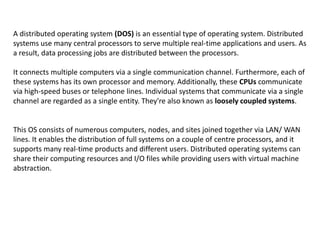
A distributed operating system (DOS) is an essential type of operating system. Distributed
systems use many central processors to serve multiple real-time applications and users. As
a result, data processing jobs are distributed between the processors.
It connects multiple computers via a single communication channel. Furthermore, each of
these systems has its own processor and memory. Additionally, these CPUs communicate
via high-speed buses or telephone lines. Individual systems that communicate via a single
channel are regarded as a single entity. They're also known as loosely coupled systems.
This OS consists of numerous computers, nodes, and sites joined together via LAN/ WAN
lines. It enables the distribution of full systems on a couple of centre processors, and it
supports many real-time products and different users. Distributed operating systems can
share their computing resources and I/O files while providing users with virtual machine
abstraction.
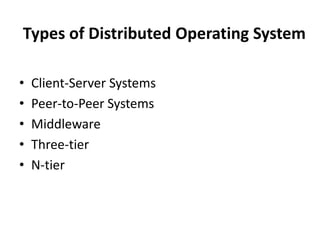
Types of Distributed Operating System
• Client-Server Systems
• Peer-to-Peer Systems
• Middleware
• Three-tier
• N-tier
Client-Server System
• This type of system requires the client to request a
resource, after which the server gives the requested
resource. When a client connects to a server, the
server may serve multiple clients at the same time.
• Client-Server Systems are also referred to as "Tightly
Coupled Operating Systems". This system is primarily
intended for multiprocessors and homogenous
multicomputer. Client-Server Systems function as a
centralized server since they approve all requests
issued by client systems.
Server systems can be divided into
two parts:
1. Computer Server System
• This system allows the interface, and the client
then sends its own requests to be executed as an
action. After completing the activity, it sends a
back response and transfers the result to the
client.
2. File Server System
• It provides a file system interface for clients,
allowing them to execute actions like file
creation, updating, deletion, and more.
Peer-to-Peer System
• The nodes play an important role in this
system. The task is evenly distributed among
the nodes. Additionally, these nodes can share
data and resources as needed. Once again,
they require a network to connect.
• Middleware
Middleware enables the interoperability of all
applications running on different operating systems.
Those programs are capable of transferring all data to
one other by using these services.
• Three-tier
The information about the client is saved in the
intermediate tier rather than in the client, which
simplifies development. This type of architecture is
most commonly used in online applications.
• N-tier
When a server or application has to transmit requests
to other enterprise services on the network, n-tier
systems are used.
Features of Distributed Operating
System
• Openness
It means that the system's services are freely
displayed through interfaces. Furthermore,
these interfaces only give the service syntax.
For example, the type of function, its return
type, parameters, and so on. Interface
Definition Languages are used to create these
interfaces (IDL).
Resource Sharing
• Its most essential feature is that it allows users
to share resources. They can also share
resources in a secure and controlled manner.
Printers, files, data, storage, web pages, etc.,
are examples of shared resources.
Transparency
• It is the most important feature of the
distributed operating system. The primary
purpose of a distributed operating system is to
hide the fact that resources are shared.
• Transparency also implies that the user should
be unaware that the resources he is accessing
are shared. Furthermore, the system should
be a separate independent unit for the user.
Flexibility
• A DOS's flexibility is enhanced by modular
qualities and delivers a more advanced range
of high-level services. The kernel/
microkernel's quality and completeness
simplify the implementation of such services.
Examples of Distributed Operating
System
Solaris
• It is designed for the SUN multiprocessor workstations
OSF/1
• It's compatible with Unix and was designed by the Open
Foundation Software Company.
Micros
• The MICROS operating system ensures a balanced data
load while allocating jobs to all nodes in the system.
DYNIX
• It is developed for the Symmetry multiprocessor
computers.
END

Distributed Operating System.pptx

  • 1.
    Distributed Operating System OPERATINGSYSTEM Er. Harpreet Kaur (Assistant Professor)
  • 2.
    A distributed operatingsystem (DOS) is an essential type of operating system. Distributed systems use many central processors to serve multiple real-time applications and users. As a result, data processing jobs are distributed between the processors. It connects multiple computers via a single communication channel. Furthermore, each of these systems has its own processor and memory. Additionally, these CPUs communicate via high-speed buses or telephone lines. Individual systems that communicate via a single channel are regarded as a single entity. They're also known as loosely coupled systems. This OS consists of numerous computers, nodes, and sites joined together via LAN/ WAN lines. It enables the distribution of full systems on a couple of centre processors, and it supports many real-time products and different users. Distributed operating systems can share their computing resources and I/O files while providing users with virtual machine abstraction.
  • 3.
    Types of DistributedOperating System • Client-Server Systems • Peer-to-Peer Systems • Middleware • Three-tier • N-tier
  • 4.
    Client-Server System • Thistype of system requires the client to request a resource, after which the server gives the requested resource. When a client connects to a server, the server may serve multiple clients at the same time. • Client-Server Systems are also referred to as "Tightly Coupled Operating Systems". This system is primarily intended for multiprocessors and homogenous multicomputer. Client-Server Systems function as a centralized server since they approve all requests issued by client systems.
  • 5.
    Server systems canbe divided into two parts: 1. Computer Server System • This system allows the interface, and the client then sends its own requests to be executed as an action. After completing the activity, it sends a back response and transfers the result to the client. 2. File Server System • It provides a file system interface for clients, allowing them to execute actions like file creation, updating, deletion, and more.
  • 6.
    Peer-to-Peer System • Thenodes play an important role in this system. The task is evenly distributed among the nodes. Additionally, these nodes can share data and resources as needed. Once again, they require a network to connect.
  • 7.
    • Middleware Middleware enablesthe interoperability of all applications running on different operating systems. Those programs are capable of transferring all data to one other by using these services. • Three-tier The information about the client is saved in the intermediate tier rather than in the client, which simplifies development. This type of architecture is most commonly used in online applications. • N-tier When a server or application has to transmit requests to other enterprise services on the network, n-tier systems are used.
  • 8.
    Features of DistributedOperating System • Openness It means that the system's services are freely displayed through interfaces. Furthermore, these interfaces only give the service syntax. For example, the type of function, its return type, parameters, and so on. Interface Definition Languages are used to create these interfaces (IDL).
  • 9.
    Resource Sharing • Itsmost essential feature is that it allows users to share resources. They can also share resources in a secure and controlled manner. Printers, files, data, storage, web pages, etc., are examples of shared resources.
  • 10.
    Transparency • It isthe most important feature of the distributed operating system. The primary purpose of a distributed operating system is to hide the fact that resources are shared. • Transparency also implies that the user should be unaware that the resources he is accessing are shared. Furthermore, the system should be a separate independent unit for the user.
  • 11.
    Flexibility • A DOS'sflexibility is enhanced by modular qualities and delivers a more advanced range of high-level services. The kernel/ microkernel's quality and completeness simplify the implementation of such services.
  • 12.
    Examples of DistributedOperating System Solaris • It is designed for the SUN multiprocessor workstations OSF/1 • It's compatible with Unix and was designed by the Open Foundation Software Company. Micros • The MICROS operating system ensures a balanced data load while allocating jobs to all nodes in the system. DYNIX • It is developed for the Symmetry multiprocessor computers.
  • 13.