Lecture Topics
Promises of DDBSs
Distributed Database Systems
Lecture #2
By Muhammad Iqbal
Superior College Mian Channu
Computer Graphics
Promises of DDBSs
by Muhammad Iqbal
Superior College Mian Channu
Distributed Database Systems
1 Transparent Management of Distributed and Replicated Data
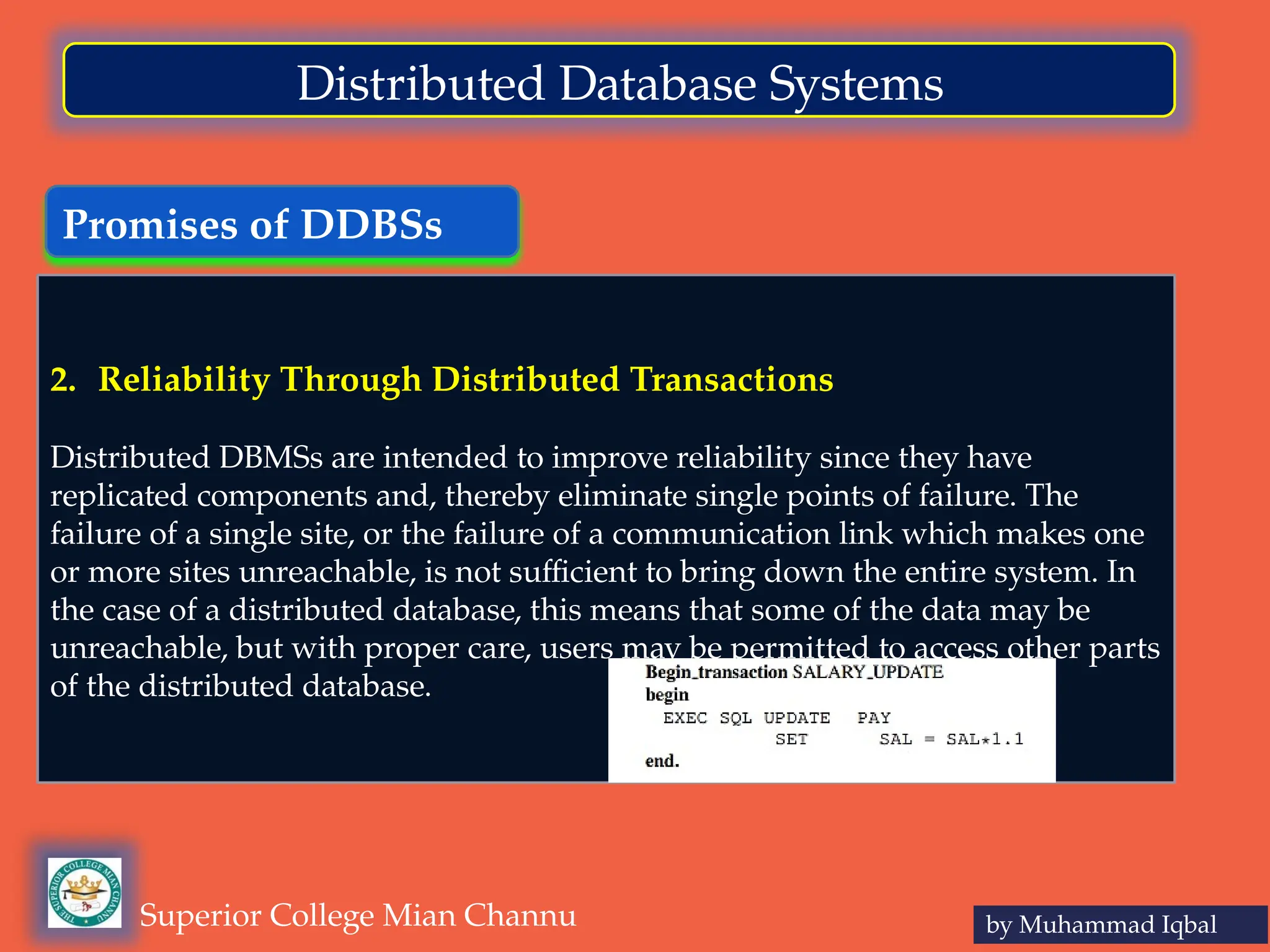
2 Reliability Through Distributed Transactions
3 Improved Performance
4 Easier System Expansion
Promises of DDBSs
by Muhammad Iqbal
Superior College Mian Channu
Distributed Database Systems
1 Transparent Management of Distributed and Replicated Data
Transparency refers to separation of the higher-level semantics of a
system from lower-level implementation issues. In other words, a
transparent system “hides” the implementation details from users.
SELECT ENAME, AMT FROM EMP, ASG, SAL
WHERE ASG.DUR > 12
AND EMP.ENO = ASG.ENO
AND SAL.TITLE = EMP.TITLE
Promises of DDBSs
by Muhammad Iqbal
Superior College Mian Channu
Distributed Database Systems
• 1 Transparent Management of Distributed and Replicated Data
• Data Independence
• Network Transparency
• Replication Transparency
• Fragmentation Transparency
Promises of DDBSs
by Muhammad Iqbal
Superior College Mian Channu
Distributed Database Systems
• 1 Transparent Management of Distributed and Replicated Data
• Data Independence
Data independence is a fundamental form of transparency that we look for
within a DBMS. It is also the only type that is important within the context of a
centralized DBMS. It refers to the immunity of user applications to changes in
the definition and organization of data, and vice versa.
Promises of DDBSs
by Muhammad Iqbal
Superior College Mian Channu
Distributed Database Systems
• 1 Transparent Management of Distributed and Replicated Data
• Network Transparency
Sometimes two types of distribution transparency are identified: location
transparency and naming transparency. Location transparency refers to the fact
that the command used to perform a task is independent of both the location of
the data and the system on which an operation is carried out. Naming
transparency means that a unique name is provided for each object in the
database.
Promises of DDBSs
by Muhammad Iqbal
Superior College Mian Channu
Distributed Database Systems
• 1 Transparent Management of Distributed and Replicated Data
• Replication Transparency
Assuming that data are replicated, the transparency issue is whether the users
should be aware of the existence of copies or whether the system should
handle the management of copies and the user should act as if there is a single
copy of the data
Promises of DDBSs
by Muhammad Iqbal
Superior College Mian Channu
Distributed Database Systems
1 Transparent Management of Distributed and Replicated Data
Fragmentation Transparency
The final form of transparency that needs to be addressed within the context of
a distributed database system is that of fragmentation transparency.
There are two general types of fragmentation alternatives. In one case, called
horizontal fragmentation, a relation is partitioned into a set of sub-relations
each of which have a subset of the tuples (rows) of the original relation. The
second alternative is vertical fragmentation where each sub-relation is defined
on a subset of the attributes (columns) of the original relation.
Promises of DDBSs
by Muhammad Iqbal
Superior College Mian Channu
Distributed Database Systems
2. Reliability Through Distributed Transactions
Distributed DBMSs are intended to improve reliability since they have
replicated components and, thereby eliminate single points of failure. The
failure of a single site, or the failure of a communication link which makes one
or more sites unreachable, is not sufficient to bring down the entire system. In
the case of a distributed database, this means that some of the data may be
unreachable, but with proper care, users may be permitted to access other parts
of the distributed database.
Promises of DDBSs
by Muhammad Iqbal
Superior College Mian Channu
Distributed Database Systems
3. Improved Performance
The case for the improved performance of distributed DBMSs is typically made
based on two points. First, a distributed DBMS fragments the conceptual
database, enabling data to be stored in close proximity to its points of use (also
called data localization). This has two potential advantages.
1. Since each site handles only a portion of the database, contention for CPU
and I/O services is not as severe as for centralized databases.
2. Localization reduces remote access delays that are usually involved in wide
area networks (for example, the minimum round-trip message propagation
delay in satellite-based systems is about 1 second).
:
Promises of DDBSs
by Muhammad Iqbal
Superior College Mian Channu
Distributed Database Systems
4. Easier System Expansion
In a distributed environment, it is much easier to accommodate increasing
database sizes. Major system overhauls are seldom necessary; expansion can
usually be handled by adding processing and storage power to the network.
Obviously, it may not be possible to obtain a linear increase in “power,” since
this also depends on the overhead of distribution. However, significant
improvements are still possible.:
Allah Hafiz

Distributed Database Systems-DDS Promises.pptx

  • 2.
    Lecture Topics Promises ofDDBSs Distributed Database Systems Lecture #2 By Muhammad Iqbal Superior College Mian Channu Computer Graphics
  • 3.
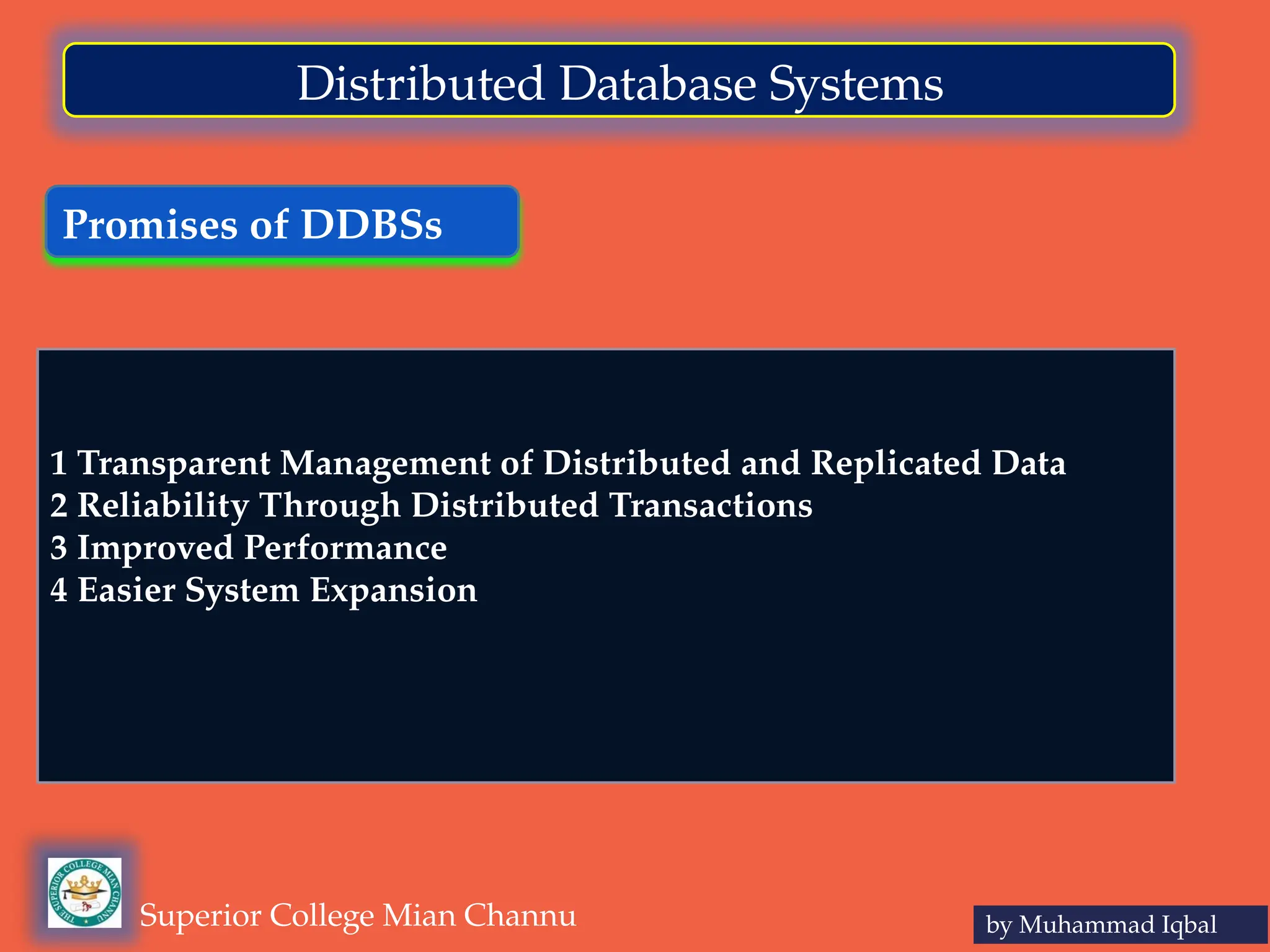
    Promises of DDBSs byMuhammad Iqbal Superior College Mian Channu Distributed Database Systems 1 Transparent Management of Distributed and Replicated Data 2 Reliability Through Distributed Transactions 3 Improved Performance 4 Easier System Expansion
  • 4.
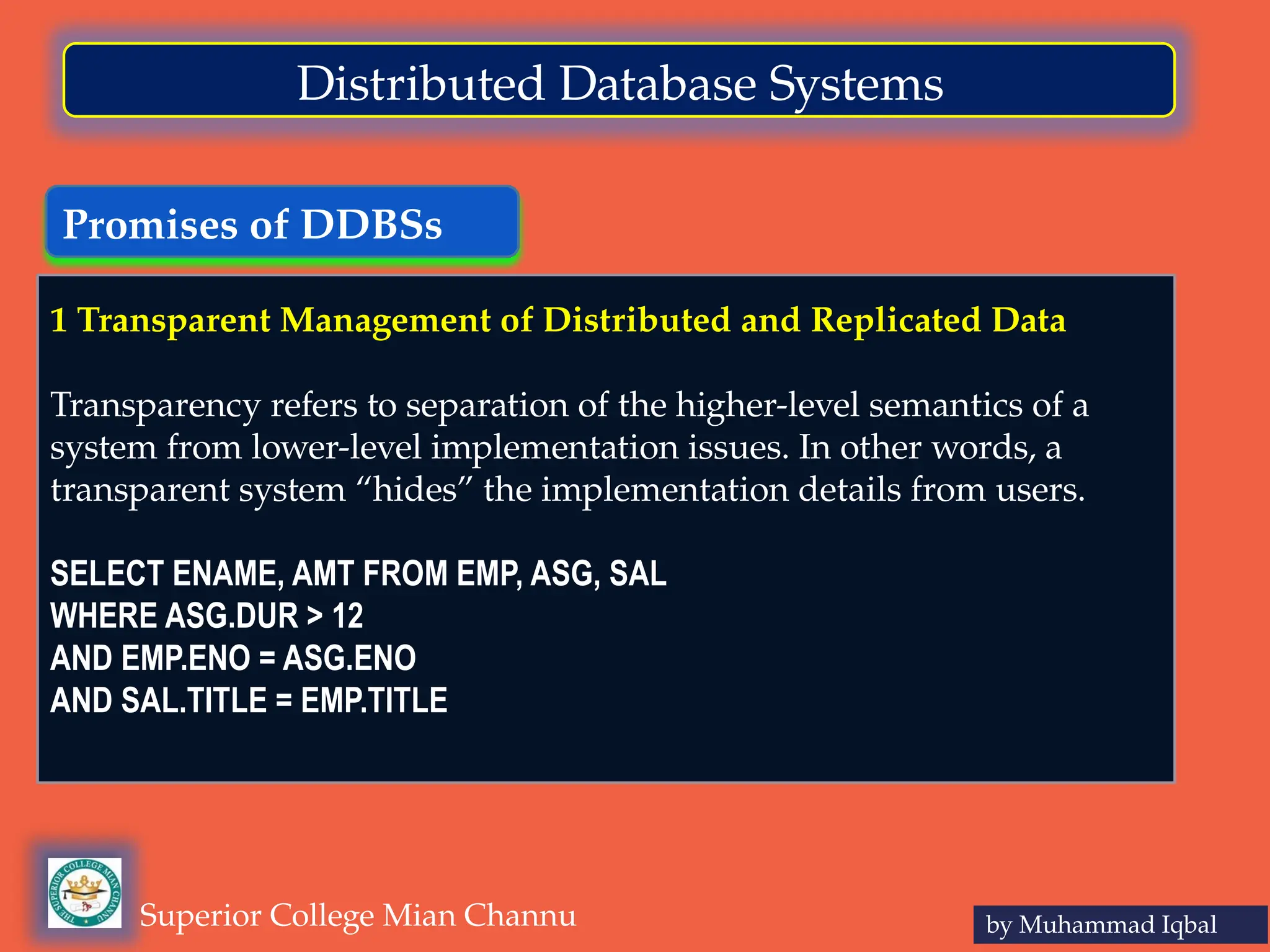
    Promises of DDBSs byMuhammad Iqbal Superior College Mian Channu Distributed Database Systems 1 Transparent Management of Distributed and Replicated Data Transparency refers to separation of the higher-level semantics of a system from lower-level implementation issues. In other words, a transparent system “hides” the implementation details from users. SELECT ENAME, AMT FROM EMP, ASG, SAL WHERE ASG.DUR > 12 AND EMP.ENO = ASG.ENO AND SAL.TITLE = EMP.TITLE
  • 5.
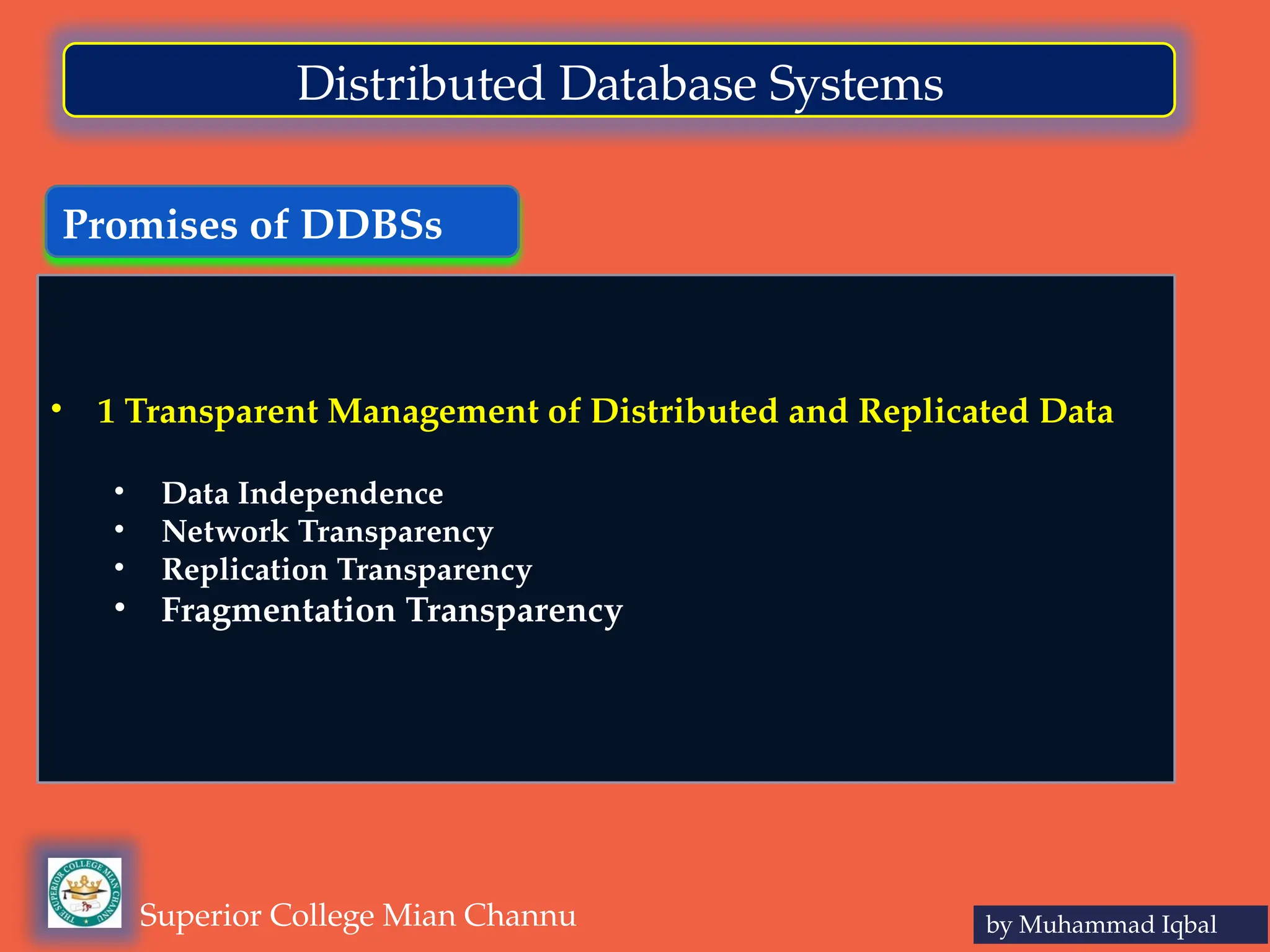
    Promises of DDBSs byMuhammad Iqbal Superior College Mian Channu Distributed Database Systems • 1 Transparent Management of Distributed and Replicated Data • Data Independence • Network Transparency • Replication Transparency • Fragmentation Transparency
  • 6.
    Promises of DDBSs byMuhammad Iqbal Superior College Mian Channu Distributed Database Systems • 1 Transparent Management of Distributed and Replicated Data • Data Independence Data independence is a fundamental form of transparency that we look for within a DBMS. It is also the only type that is important within the context of a centralized DBMS. It refers to the immunity of user applications to changes in the definition and organization of data, and vice versa.
  • 7.
    Promises of DDBSs byMuhammad Iqbal Superior College Mian Channu Distributed Database Systems • 1 Transparent Management of Distributed and Replicated Data • Network Transparency Sometimes two types of distribution transparency are identified: location transparency and naming transparency. Location transparency refers to the fact that the command used to perform a task is independent of both the location of the data and the system on which an operation is carried out. Naming transparency means that a unique name is provided for each object in the database.
  • 8.
    Promises of DDBSs byMuhammad Iqbal Superior College Mian Channu Distributed Database Systems • 1 Transparent Management of Distributed and Replicated Data • Replication Transparency Assuming that data are replicated, the transparency issue is whether the users should be aware of the existence of copies or whether the system should handle the management of copies and the user should act as if there is a single copy of the data
  • 9.
    Promises of DDBSs byMuhammad Iqbal Superior College Mian Channu Distributed Database Systems 1 Transparent Management of Distributed and Replicated Data Fragmentation Transparency The final form of transparency that needs to be addressed within the context of a distributed database system is that of fragmentation transparency. There are two general types of fragmentation alternatives. In one case, called horizontal fragmentation, a relation is partitioned into a set of sub-relations each of which have a subset of the tuples (rows) of the original relation. The second alternative is vertical fragmentation where each sub-relation is defined on a subset of the attributes (columns) of the original relation.
  • 10.
    Promises of DDBSs byMuhammad Iqbal Superior College Mian Channu Distributed Database Systems 2. Reliability Through Distributed Transactions Distributed DBMSs are intended to improve reliability since they have replicated components and, thereby eliminate single points of failure. The failure of a single site, or the failure of a communication link which makes one or more sites unreachable, is not sufficient to bring down the entire system. In the case of a distributed database, this means that some of the data may be unreachable, but with proper care, users may be permitted to access other parts of the distributed database.
  • 11.
    Promises of DDBSs byMuhammad Iqbal Superior College Mian Channu Distributed Database Systems 3. Improved Performance The case for the improved performance of distributed DBMSs is typically made based on two points. First, a distributed DBMS fragments the conceptual database, enabling data to be stored in close proximity to its points of use (also called data localization). This has two potential advantages. 1. Since each site handles only a portion of the database, contention for CPU and I/O services is not as severe as for centralized databases. 2. Localization reduces remote access delays that are usually involved in wide area networks (for example, the minimum round-trip message propagation delay in satellite-based systems is about 1 second). :
  • 12.
    Promises of DDBSs byMuhammad Iqbal Superior College Mian Channu Distributed Database Systems 4. Easier System Expansion In a distributed environment, it is much easier to accommodate increasing database sizes. Major system overhauls are seldom necessary; expansion can usually be handled by adding processing and storage power to the network. Obviously, it may not be possible to obtain a linear increase in “power,” since this also depends on the overhead of distribution. However, significant improvements are still possible.:
  • 13.