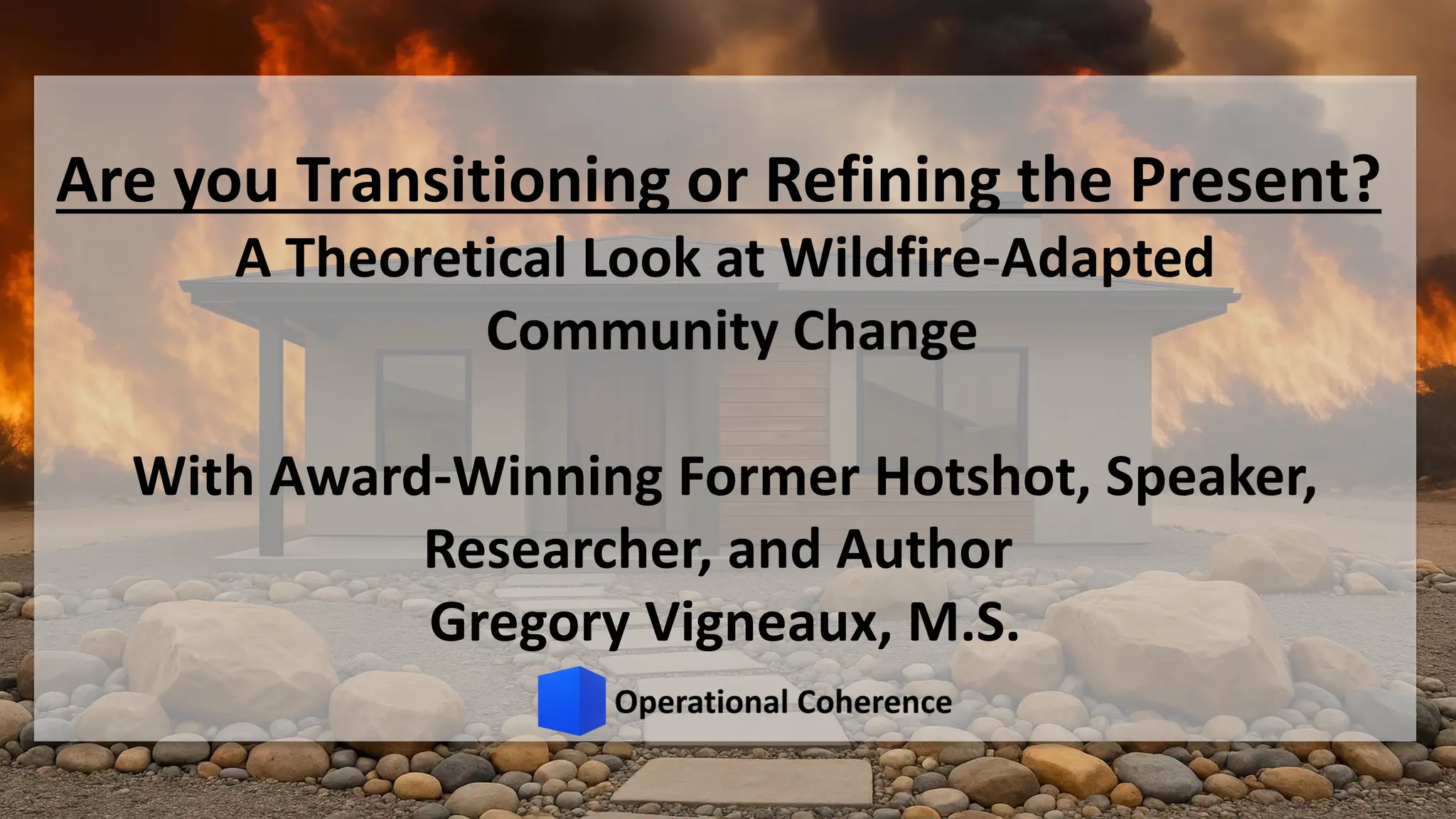
Are you Transitioning or Refining the Present?
A Theoretical Look at Wildfire-Adapted
Community Change
With Award-Winning Former Hotshot, Speaker,
Researcher, and Author
Gregory Vigneaux, M.S.
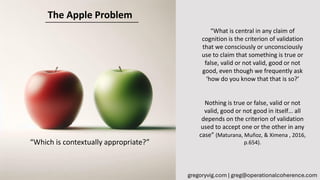
“What is central in any claim of
cognition is the criterion of validation
that we consciously or unconsciously
use to claim that something is true or
false, valid or not valid, good or not
good, even though we frequently ask
‘how do you know that that is so?’
Nothing is true or false, valid or not
valid, good or not good in itself… all
depends on the criterion of validation
used to accept one or the other in any
case” (Maturana, Muñoz, & Ximena , 2016,
p.654).
“Which is contextually appropriate?”
The Apple Problem
gregoryvig.com | greg@operationalcoherence.com
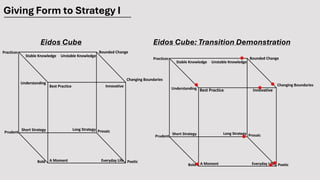
Giving Form to Strategy I
Eidos Cube Eidos Cube: Transition Demonstration
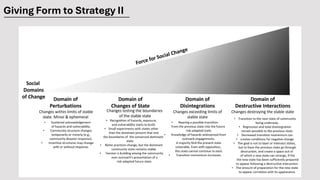
Giving Form to Strategy II
“In Heidegger and Merleau-Ponty, it is not merely human identity
that is tied to place, but the very possibility of being the sort of
creature that can engage with a world (and, more particularly, of the
objects and events within it), that can think about the world, and
that can find itself in the world [Italics Added]” (Malpas, 2018, p. 7)
“It is indeed only in and through place that the world presents itself –
it is in place and in relation to our own being-in-place, that the world
begins” (Malpas, 2018, p. 12).
Exploring Place
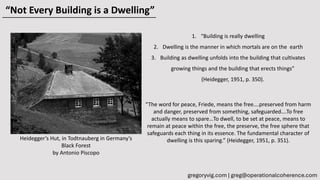
1. “Building is really dwelling
2. Dwelling is the manner in which mortals are on the earth
3. Building as dwelling unfolds into the building that cultivates
growing things and the building that erects things”
(Heidegger, 1951, p. 350).
Heidegger’s Hut, in Todtnauberg in Germany’s
Black Forest
by Antonio Piscopo
“Not Every Building is a Dwelling”
gregoryvig.com | greg@operationalcoherence.com
“The word for peace, Friede, means the free….preserved from harm
and danger, preserved from something, safeguarded….To free
actually means to spare…To dwell, to be set at peace, means to
remain at peace within the free, the preserve, the free sphere that
safeguards each thing in its essence. The fundamental character of
dwelling is this sparing.” (Heidegger, 1951, p. 351).
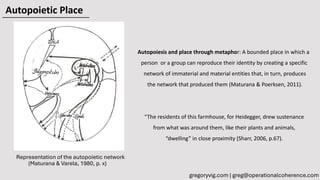
Autopoiesis and place through metaphor: A bounded place in which a
person or a group can reproduce their identity by creating a specific
network of immaterial and material entities that, in turn, produces
the network that produced them (Maturana & Poerksen, 2011).
“The residents of this farmhouse, for Heidegger, drew sustenance
from what was around them, like their plants and animals,
“dwelling” in close proximity (Sharr, 2006, p.67).
Representation of the autopoietic network
Autopoietic Place
(Maturana & Varela, 1980, p. x)
gregoryvig.com | greg@operationalcoherence.com
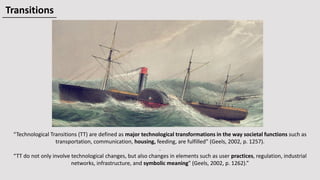
“Technological Transitions (TT) are defined as major technological transformations in the way societal functions such as
transportation, communication, housing, feeding, are fulfilled” (Geels, 2002, p. 1257).
.
“TT do not only involve technological changes, but also changes in elements such as user practices, regulation, industrial
networks, infrastructure, and symbolic meaning” (Geels, 2002, p. 1262).”
Transitions
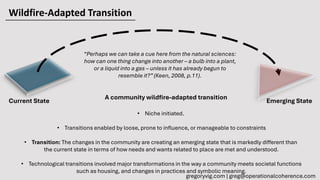
A community wildfire-adapted transition
• Niche initiated.
• Transitions enabled by loose, prone to influence, or manageable to constraints
• Transition: The changes in the community are creating an emerging state that is markedly different than
the current state in terms of how needs and wants related to place are met and understood.
• Technological transitions involved major transformations in the way a community meets societal functions
such as housing, and changes in practices and symbolic meaning.
“Perhaps we can take a cue here from the natural sciences:
how can one thing change into another – a bulb into a plant,
or a liquid into a gas – unless it has already begun to
resemble it?”(Keen, 2008, p.11).
Current State Emerging State
Wildfire-Adapted Transition
gregoryvig.com | greg@operationalcoherence.com
Wildfire-Adapted Transition
gregoryvig.com | greg@operationalcoherence.com
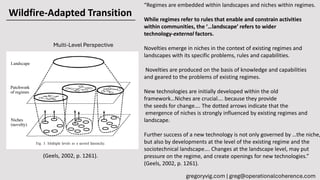
Multi-Level Perspective
(Geels, 2002, p. 1261).
“Regimes are embedded within landscapes and niches within regimes.
While regimes refer to rules that enable and constrain activities
within communities, the ‘…landscape’ refers to wider
technology-external factors.
Novelties emerge in niches in the context of existing regimes and
landscapes with its specific problems, rules and capabilities.
Novelties are produced on the basis of knowledge and capabilities
and geared to the problems of existing regimes.
New technologies are initially developed within the old
framework…Niches are crucial…. because they provide
the seeds for change…. The dotted arrows indicate that the
emergence of niches is strongly influenced by existing regimes and
landscape.
Further success of a new technology is not only governed by …the niche,
but also by developments at the level of the existing regime and the
sociotechnical landscape…. Changes at the landscape level, may put
pressure on the regime, and create openings for new technologies.”
(Geels, 2002, p. 1261).
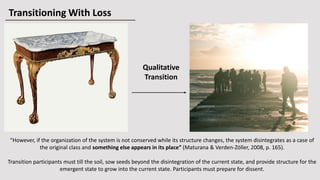
“However, if the organization of the system is not conserved while its structure changes, the system disintegrates as a case of
the original class and something else appears in its place” (Maturana & Verden-Zöller, 2008, p. 165).
Transition participants must till the soil, sow seeds beyond the disintegration of the current state, and provide structure for the
emergent state to grow into the current state. Participants must prepare for dissent.
Transitioning With Loss
Qualitative
Transition
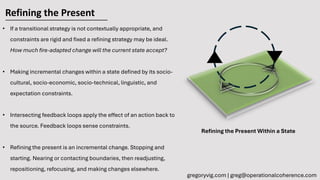
Refining the Present
• If a transitional strategy is not contextually appropriate, and
constraints are rigid and fixed a refining strategy may be ideal.
How much fire-adapted change will the current state accept?
• Making incremental changes within a state defined by its socio-
cultural, socio-economic, socio-technical, linguistic, and
expectation constraints.
• Intersecting feedback loops apply the effect of an action back to
the source. Feedback loops sense constraints.
• Refining the present is an incremental change. Stopping and
starting. Nearing or contacting boundaries, then readjusting,
repositioning, refocusing, and making changes elsewhere.
gregoryvig.com | greg@operationalcoherence.com
Refining the Present Within a State
“Because of these ever-increasing possibilities for interaction,
improvements are always possible. Just as it makes no sense to try an
optimal rainforest” (Holland, 2014, p. 58), so it is with any human
community.
“Though some parts of the system may settle down temporarily at a local
optimum, they are usually ‘dead’ or uninteresting if they remain at that
equilibrium for an extended period. It is the process of becoming, rather
than the never-reached end points, that we must study if we are to gain
insight [Italics Added]” (Holland, 1992, p.20).
Process over Optimization
Optimizing Wildfire Adaptation: Refining the Present
gregoryvig.com | greg@operationalcoherence.com
• Complimenting over Challenging Constraints
• Quantitative Change over Qualitative Change
• Following a Map over Charting a New Course
• Shorter Strategies over Longer Strategies
• Benchmarks over Direction of Travel
• Intermittent over Protracted Involvement
• Hybrid strategies are possible, but may lack clear
direction
Refining the Present & Transitions
gregoryvig.com | greg@operationalcoherence.com
References
Geels, F. W. (2002). Technological transitions as evolutionary reconfiguration: processes: A multi-level perspective and a case-study. Research Policy, 31, 1257–1274.
Heidegger, M. (1951). Building Dwelling Thinking. In D. F. Krell (Ed.), Basic writings: Revised & Expanded edition.
Ten key essays, plus the introduction to BEING AND TIME (pp. 343-365). San Francisco, CA: HarperSanFrancisco.
Holland, J. H. (1992). Complex adaptive systems. Daedalus, 121(1), 17-30.
Holland, J. H. (2014). Signals and boundaries: Building blocks for complex adaptive systems. Cambridge, MA: MIT Press.
Keen, D. (2008). Complex emergencies. Malden, MA: Polity Press.
Malpas, J. (2012). Heidegger and the thinking of place: Explorations in the topology of being. Cambridge, MA: The MIT Press.
Malpas, J. (2018). Place and experience: A philosophical topography. London, UK: Routledge.
Maturana, H. R., & Poerksen, B. (2011). From being to doing: The origins of the biology of cognition (2nd ed.). (W. K. Koeck, & A. R. Koeck, Trans.) Kaunas, Lithuania: Carl-Auer.
Maturana, H. R., & Varela, F. J. (1980). Autopoiesis and cognition: The realization of the living (Vol. 42). (R. S. Cohen, & W. W. Marx, Eds.) Dordrecht, Holland: D. Reidel Publishing
Company.
Maturana, H. R., & Verden-Zöller, G. (2008). The origin of humanness in the biology of love. (B. Pille, Ed.) Exeter, Devon, UK: Imprint Academic.
Maturana, H. R., Muñoz, S. R., & Ximena , D. Y. (2016). Cultural-Biology: Systemic consequences of our evolutionary natural drift as molecular autopoietic systems.
Foundations of Science, 21, 631-678.
Sharr, A. (2006). Heidegger's hut. Cambridge, MA: The MIT Press.
gregoryvig.com | greg@operationalcoherence.com

Are you Transitioning or Refining Now..?

  • 1.
    Are you Transitioningor Refining the Present? A Theoretical Look at Wildfire-Adapted Community Change With Award-Winning Former Hotshot, Speaker, Researcher, and Author Gregory Vigneaux, M.S.
  • 2.
    “What is centralin any claim of cognition is the criterion of validation that we consciously or unconsciously use to claim that something is true or false, valid or not valid, good or not good, even though we frequently ask ‘how do you know that that is so?’ Nothing is true or false, valid or not valid, good or not good in itself… all depends on the criterion of validation used to accept one or the other in any case” (Maturana, Muñoz, & Ximena , 2016, p.654). “Which is contextually appropriate?” The Apple Problem gregoryvig.com | greg@operationalcoherence.com
  • 3.
    Giving Form toStrategy I Eidos Cube Eidos Cube: Transition Demonstration
  • 4.
    Giving Form toStrategy II
  • 5.
    “In Heidegger andMerleau-Ponty, it is not merely human identity that is tied to place, but the very possibility of being the sort of creature that can engage with a world (and, more particularly, of the objects and events within it), that can think about the world, and that can find itself in the world [Italics Added]” (Malpas, 2018, p. 7) “It is indeed only in and through place that the world presents itself – it is in place and in relation to our own being-in-place, that the world begins” (Malpas, 2018, p. 12). Exploring Place
  • 6.
    1. “Building isreally dwelling 2. Dwelling is the manner in which mortals are on the earth 3. Building as dwelling unfolds into the building that cultivates growing things and the building that erects things” (Heidegger, 1951, p. 350). Heidegger’s Hut, in Todtnauberg in Germany’s Black Forest by Antonio Piscopo “Not Every Building is a Dwelling” gregoryvig.com | greg@operationalcoherence.com “The word for peace, Friede, means the free….preserved from harm and danger, preserved from something, safeguarded….To free actually means to spare…To dwell, to be set at peace, means to remain at peace within the free, the preserve, the free sphere that safeguards each thing in its essence. The fundamental character of dwelling is this sparing.” (Heidegger, 1951, p. 351).
  • 7.
    Autopoiesis and placethrough metaphor: A bounded place in which a person or a group can reproduce their identity by creating a specific network of immaterial and material entities that, in turn, produces the network that produced them (Maturana & Poerksen, 2011). “The residents of this farmhouse, for Heidegger, drew sustenance from what was around them, like their plants and animals, “dwelling” in close proximity (Sharr, 2006, p.67). Representation of the autopoietic network Autopoietic Place (Maturana & Varela, 1980, p. x) gregoryvig.com | greg@operationalcoherence.com
  • 8.
    “Technological Transitions (TT)are defined as major technological transformations in the way societal functions such as transportation, communication, housing, feeding, are fulfilled” (Geels, 2002, p. 1257). . “TT do not only involve technological changes, but also changes in elements such as user practices, regulation, industrial networks, infrastructure, and symbolic meaning” (Geels, 2002, p. 1262).” Transitions
  • 9.
    A community wildfire-adaptedtransition • Niche initiated. • Transitions enabled by loose, prone to influence, or manageable to constraints • Transition: The changes in the community are creating an emerging state that is markedly different than the current state in terms of how needs and wants related to place are met and understood. • Technological transitions involved major transformations in the way a community meets societal functions such as housing, and changes in practices and symbolic meaning. “Perhaps we can take a cue here from the natural sciences: how can one thing change into another – a bulb into a plant, or a liquid into a gas – unless it has already begun to resemble it?”(Keen, 2008, p.11). Current State Emerging State Wildfire-Adapted Transition gregoryvig.com | greg@operationalcoherence.com
  • 10.
    Wildfire-Adapted Transition gregoryvig.com |greg@operationalcoherence.com Multi-Level Perspective (Geels, 2002, p. 1261). “Regimes are embedded within landscapes and niches within regimes. While regimes refer to rules that enable and constrain activities within communities, the ‘…landscape’ refers to wider technology-external factors. Novelties emerge in niches in the context of existing regimes and landscapes with its specific problems, rules and capabilities. Novelties are produced on the basis of knowledge and capabilities and geared to the problems of existing regimes. New technologies are initially developed within the old framework…Niches are crucial…. because they provide the seeds for change…. The dotted arrows indicate that the emergence of niches is strongly influenced by existing regimes and landscape. Further success of a new technology is not only governed by …the niche, but also by developments at the level of the existing regime and the sociotechnical landscape…. Changes at the landscape level, may put pressure on the regime, and create openings for new technologies.” (Geels, 2002, p. 1261).
  • 11.
    “However, if theorganization of the system is not conserved while its structure changes, the system disintegrates as a case of the original class and something else appears in its place” (Maturana & Verden-Zöller, 2008, p. 165). Transition participants must till the soil, sow seeds beyond the disintegration of the current state, and provide structure for the emergent state to grow into the current state. Participants must prepare for dissent. Transitioning With Loss Qualitative Transition
  • 12.
    Refining the Present •If a transitional strategy is not contextually appropriate, and constraints are rigid and fixed a refining strategy may be ideal. How much fire-adapted change will the current state accept? • Making incremental changes within a state defined by its socio- cultural, socio-economic, socio-technical, linguistic, and expectation constraints. • Intersecting feedback loops apply the effect of an action back to the source. Feedback loops sense constraints. • Refining the present is an incremental change. Stopping and starting. Nearing or contacting boundaries, then readjusting, repositioning, refocusing, and making changes elsewhere. gregoryvig.com | greg@operationalcoherence.com Refining the Present Within a State
  • 13.
    “Because of theseever-increasing possibilities for interaction, improvements are always possible. Just as it makes no sense to try an optimal rainforest” (Holland, 2014, p. 58), so it is with any human community. “Though some parts of the system may settle down temporarily at a local optimum, they are usually ‘dead’ or uninteresting if they remain at that equilibrium for an extended period. It is the process of becoming, rather than the never-reached end points, that we must study if we are to gain insight [Italics Added]” (Holland, 1992, p.20). Process over Optimization Optimizing Wildfire Adaptation: Refining the Present gregoryvig.com | greg@operationalcoherence.com
  • 14.
    • Complimenting overChallenging Constraints • Quantitative Change over Qualitative Change • Following a Map over Charting a New Course • Shorter Strategies over Longer Strategies • Benchmarks over Direction of Travel • Intermittent over Protracted Involvement • Hybrid strategies are possible, but may lack clear direction Refining the Present & Transitions gregoryvig.com | greg@operationalcoherence.com
  • 15.
    References Geels, F. W.(2002). Technological transitions as evolutionary reconfiguration: processes: A multi-level perspective and a case-study. Research Policy, 31, 1257–1274. Heidegger, M. (1951). Building Dwelling Thinking. In D. F. Krell (Ed.), Basic writings: Revised & Expanded edition. Ten key essays, plus the introduction to BEING AND TIME (pp. 343-365). San Francisco, CA: HarperSanFrancisco. Holland, J. H. (1992). Complex adaptive systems. Daedalus, 121(1), 17-30. Holland, J. H. (2014). Signals and boundaries: Building blocks for complex adaptive systems. Cambridge, MA: MIT Press. Keen, D. (2008). Complex emergencies. Malden, MA: Polity Press. Malpas, J. (2012). Heidegger and the thinking of place: Explorations in the topology of being. Cambridge, MA: The MIT Press. Malpas, J. (2018). Place and experience: A philosophical topography. London, UK: Routledge. Maturana, H. R., & Poerksen, B. (2011). From being to doing: The origins of the biology of cognition (2nd ed.). (W. K. Koeck, & A. R. Koeck, Trans.) Kaunas, Lithuania: Carl-Auer. Maturana, H. R., & Varela, F. J. (1980). Autopoiesis and cognition: The realization of the living (Vol. 42). (R. S. Cohen, & W. W. Marx, Eds.) Dordrecht, Holland: D. Reidel Publishing Company. Maturana, H. R., & Verden-Zöller, G. (2008). The origin of humanness in the biology of love. (B. Pille, Ed.) Exeter, Devon, UK: Imprint Academic. Maturana, H. R., Muñoz, S. R., & Ximena , D. Y. (2016). Cultural-Biology: Systemic consequences of our evolutionary natural drift as molecular autopoietic systems. Foundations of Science, 21, 631-678. Sharr, A. (2006). Heidegger's hut. Cambridge, MA: The MIT Press. gregoryvig.com | greg@operationalcoherence.com