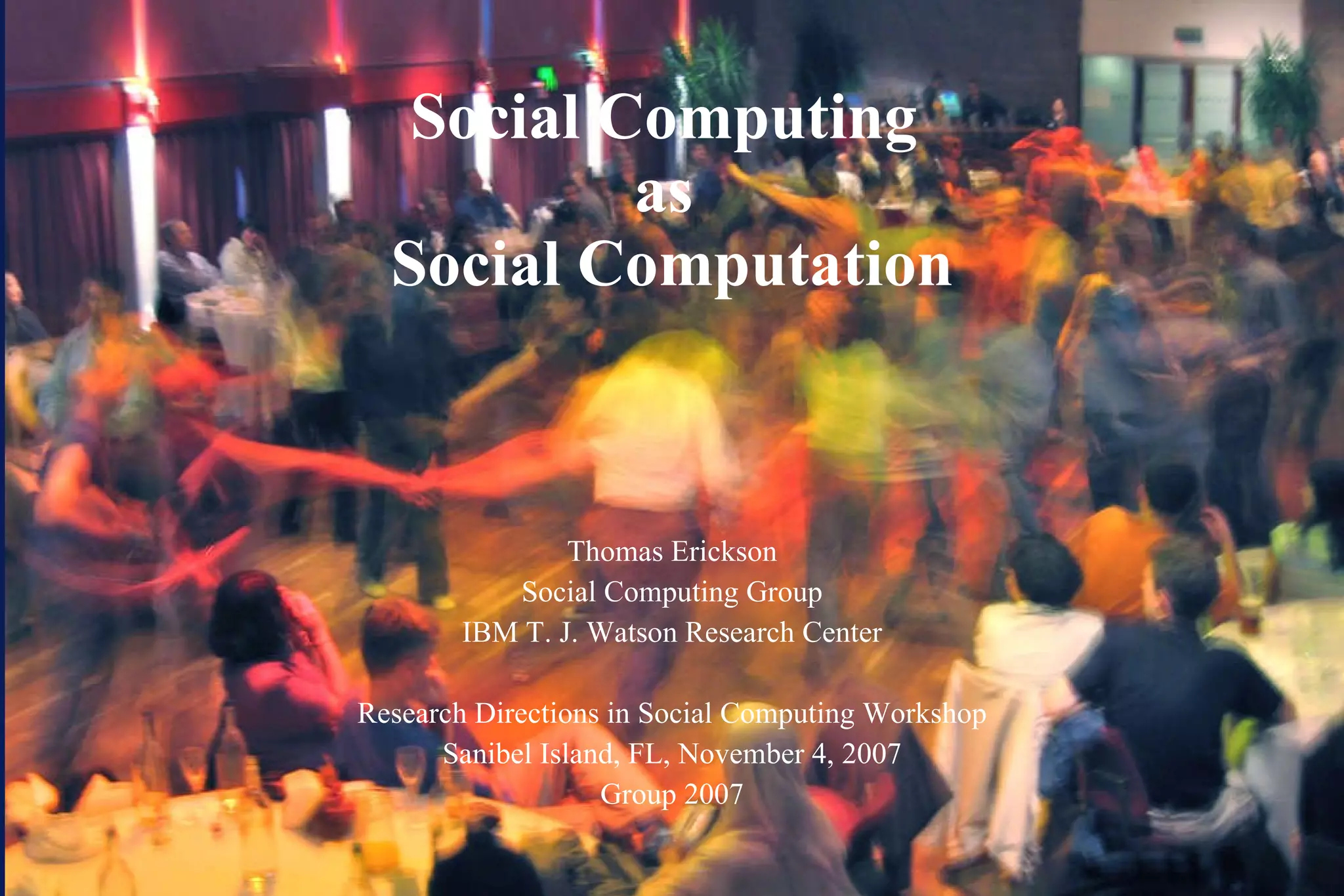

Social Computing  as  Social Computation Thomas Erickson Social Computing Group IBM T. J. Watson Research Center Research Directions in Social Computing Workshop Sanibel Island, FL, November 4, 2007 Group 2007
A Definition Social Computing refers to systems that support the gathering, re-presentation, processing, use and dissemination  of information that is distributed across social collectivities  such as teams, communities, organizations and markets. Moreover the “information” is not ‘anonymous,’  but is significant precisely because it is linked to people,  who are in turn linked to other people The Short Form Social computing involves the processing of information distributed across social collectivities
A Few Comments on the Definition Notice that the definition doesn’t require computers the issue of “identity” is central: information is significant because it “is linked to people, who are in turn linked to other people”
An Example of Social Computing The Situation A group of 30 people who had written chapters for a book A 3-day off-site in which small groups read each others’ chapter drafts and critiqued them... but no one had read them all A collective effort to come up with an organization for the book
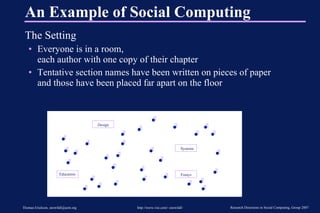
An Example of Social Computing The Setting Everyone is in a room,  each author with one copy of their chapter Tentative section names have been written on pieces of paper  and those have been placed far apart on the floor Design Systems Education Essays
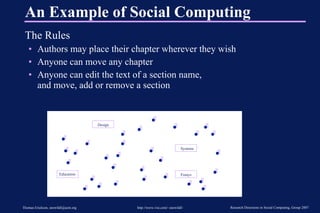
An Example of Social Computing The Rules Authors may place their chapter wherever they wish Anyone can move any chapter Anyone can edit the text of a section name,  and move, add or remove a section Design Systems Education Essays
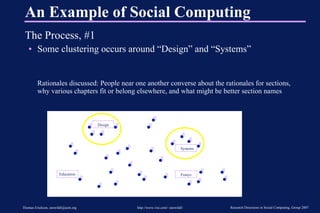
An Example of Social Computing The Process, #1 Some clustering occurs around “Design” and “Systems” Rationales discussed: People near one another converse about the rationales for sections,  why various chapters fit or belong elsewhere, and what might be better section names Design Systems Education Essays
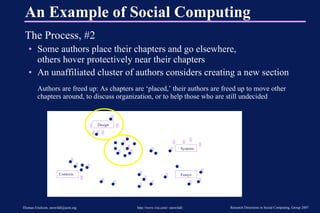
An Example of Social Computing The Process, #2 Some authors place their chapters and go elsewhere, others hover protectively near their chapters An unaffiliated cluster of authors considers creating a new section Authors are freed up: As chapters are ‘placed,’ their authors are freed up to move other chapters around, to discuss organization, or to help those who are still undecided Design Systems Contexts Essays
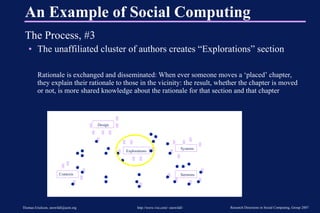
An Example of Social Computing The Process, #3 The unaffiliated cluster of authors creates “Explorations” section Rationale is exchanged and disseminated: When ever someone moves a ‘placed’ chapter, they explain their rationale to those in the vicinity: the result, whether the chapter is moved or not, is more shared knowledge about the rationale for that section and that chapter  Design Systems Contexts Sermons Explorations
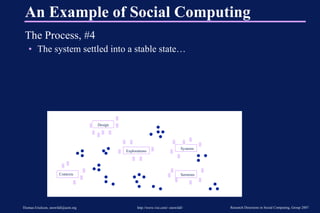
An Example of Social Computing The Process, #4 The system settled into a stable state… Design Systems Contexts Sermons Explorations
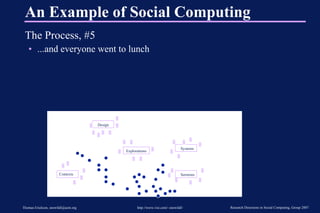
An Example of Social Computing The Process, #5 ...and everyone went to lunch Design Systems Contexts Sermons Explorations
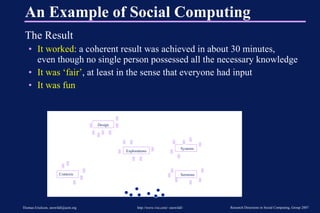
An Example of Social Computing The Result It worked : a coherent result was achieved in about 30 minutes, even though no single person possessed all the necessary knowledge It was ‘fair’ , at least in the sense that everyone had input It was fun Design Systems Contexts Sermons Explorations
Comments on the Example How the setting supported the social computation It showed the  dynamic state  of the process ‘ solidified’ sections, ‘orphans’, contested sections
Comments on the Example How the setting supported the social computation It showed the  dynamic state  of the process It supported  modulated awareness  amongst users participants could  see/hear those nearby, but not far away; people felt accountable
Comments on the Example How the setting supported the social computation It showed the  dynamic state  of the process It supported  modulated awareness  amongst users It created  foci for activity  by making (pending) state changes visible proposed moves would be discussed by those near (i.e. committed to) a section
Comments on the Example How the setting supported the social computation It showed the  dynamic state  of the process It supported  modulated awareness  amongst users It created  foci for activity  by making (pending) state changes visible It  partitioned activity  (by virtue of physical constraints) not enough space for everyone to gather around a single section
Comments on the Example How the setting supported the social computation It showed the  dynamic state  of the process It supported  modulated awareness  amongst users It created  foci for activity  by making (pending) state changes visible It  partitioned activity  (by virtue of physical constraints) It  encouraged specialization  (by virtue of physical constraints) no one could dominate: people had to focus on a particular level of granularity
Comments on the Example How the setting supported the social computation It showed the  dynamic state  of the process It supported  modulated awareness  amongst users It created  foci for activity  by making (pending) state changes visible It  partitioned activity  (by virtue of physical constraints) It  encouraged specialization  (by virtue of physical constraints) It provided opportunities to  strengthen/repair relationships talk; lunch
More Generally Although this example was unusual, social computation is not Auctions are way of ‘computing’ the prices of goods Markets are a way of both valuing and predicting the performance of companies and other entities Elections (and election campaigns) can also be seen as computations
More Generally Over the last decade, digital technology, and the way in which its been taken up by the population, has progressed to a point where it can enable new forms of social computation Wikipedia The ESP Game (AKA Google Image Labeler) SlashDot Mechanical Turk FixMyStreet (or FillThatHole or SeeClickFix) For more on this topic, see “Designing Systems that Support Social Behavior,” and http://www.visi.com/~snowfall/
Towards a Framework Given the increasing number of examples of social computation, and their great potential, it would be useful to  have a framework for thinking about the topic The remainder of this presentation lays out some grist for a discussion at this workshop
Towards a Framework Levels Identity networks Partitioned awareness Action and Interaction Permanent and emergent structure
Towards a Framework Levels Identity networks Partitioned awareness Action and Interaction Permanent and emergent structure Mechanisms that span levels Processor enlistment and release Management of multiple foci Mode transitions Might the parallel computing literature have useful constructs?
Summary Definition of social computing Social computing doesn’t need to involve a digital substrate Levels: Identity, Awareness, (Inter)Action, Structure Mechanisms: Systems that span these levels

Social Computing as Social Computation

  • 1.
    Social Computing as Social Computation Thomas Erickson Social Computing Group IBM T. J. Watson Research Center Research Directions in Social Computing Workshop Sanibel Island, FL, November 4, 2007 Group 2007
  • 2.
    A Definition SocialComputing refers to systems that support the gathering, re-presentation, processing, use and dissemination of information that is distributed across social collectivities such as teams, communities, organizations and markets. Moreover the “information” is not ‘anonymous,’ but is significant precisely because it is linked to people, who are in turn linked to other people The Short Form Social computing involves the processing of information distributed across social collectivities
  • 3.
    A Few Commentson the Definition Notice that the definition doesn’t require computers the issue of “identity” is central: information is significant because it “is linked to people, who are in turn linked to other people”
  • 4.
    An Example ofSocial Computing The Situation A group of 30 people who had written chapters for a book A 3-day off-site in which small groups read each others’ chapter drafts and critiqued them... but no one had read them all A collective effort to come up with an organization for the book
  • 5.
    An Example ofSocial Computing The Setting Everyone is in a room, each author with one copy of their chapter Tentative section names have been written on pieces of paper and those have been placed far apart on the floor Design Systems Education Essays
  • 6.
    An Example ofSocial Computing The Rules Authors may place their chapter wherever they wish Anyone can move any chapter Anyone can edit the text of a section name, and move, add or remove a section Design Systems Education Essays
  • 7.
    An Example ofSocial Computing The Process, #1 Some clustering occurs around “Design” and “Systems” Rationales discussed: People near one another converse about the rationales for sections, why various chapters fit or belong elsewhere, and what might be better section names Design Systems Education Essays
  • 8.
    An Example ofSocial Computing The Process, #2 Some authors place their chapters and go elsewhere, others hover protectively near their chapters An unaffiliated cluster of authors considers creating a new section Authors are freed up: As chapters are ‘placed,’ their authors are freed up to move other chapters around, to discuss organization, or to help those who are still undecided Design Systems Contexts Essays
  • 9.
    An Example ofSocial Computing The Process, #3 The unaffiliated cluster of authors creates “Explorations” section Rationale is exchanged and disseminated: When ever someone moves a ‘placed’ chapter, they explain their rationale to those in the vicinity: the result, whether the chapter is moved or not, is more shared knowledge about the rationale for that section and that chapter Design Systems Contexts Sermons Explorations
  • 10.
    An Example ofSocial Computing The Process, #4 The system settled into a stable state… Design Systems Contexts Sermons Explorations
  • 11.
    An Example ofSocial Computing The Process, #5 ...and everyone went to lunch Design Systems Contexts Sermons Explorations
  • 12.
    An Example ofSocial Computing The Result It worked : a coherent result was achieved in about 30 minutes, even though no single person possessed all the necessary knowledge It was ‘fair’ , at least in the sense that everyone had input It was fun Design Systems Contexts Sermons Explorations
  • 13.
    Comments on theExample How the setting supported the social computation It showed the dynamic state of the process ‘ solidified’ sections, ‘orphans’, contested sections
  • 14.
    Comments on theExample How the setting supported the social computation It showed the dynamic state of the process It supported modulated awareness amongst users participants could see/hear those nearby, but not far away; people felt accountable
  • 15.
    Comments on theExample How the setting supported the social computation It showed the dynamic state of the process It supported modulated awareness amongst users It created foci for activity by making (pending) state changes visible proposed moves would be discussed by those near (i.e. committed to) a section
  • 16.
    Comments on theExample How the setting supported the social computation It showed the dynamic state of the process It supported modulated awareness amongst users It created foci for activity by making (pending) state changes visible It partitioned activity (by virtue of physical constraints) not enough space for everyone to gather around a single section
  • 17.
    Comments on theExample How the setting supported the social computation It showed the dynamic state of the process It supported modulated awareness amongst users It created foci for activity by making (pending) state changes visible It partitioned activity (by virtue of physical constraints) It encouraged specialization (by virtue of physical constraints) no one could dominate: people had to focus on a particular level of granularity
  • 18.
    Comments on theExample How the setting supported the social computation It showed the dynamic state of the process It supported modulated awareness amongst users It created foci for activity by making (pending) state changes visible It partitioned activity (by virtue of physical constraints) It encouraged specialization (by virtue of physical constraints) It provided opportunities to strengthen/repair relationships talk; lunch
  • 19.
    More Generally Althoughthis example was unusual, social computation is not Auctions are way of ‘computing’ the prices of goods Markets are a way of both valuing and predicting the performance of companies and other entities Elections (and election campaigns) can also be seen as computations
  • 20.
    More Generally Overthe last decade, digital technology, and the way in which its been taken up by the population, has progressed to a point where it can enable new forms of social computation Wikipedia The ESP Game (AKA Google Image Labeler) SlashDot Mechanical Turk FixMyStreet (or FillThatHole or SeeClickFix) For more on this topic, see “Designing Systems that Support Social Behavior,” and http://www.visi.com/~snowfall/
  • 21.
    Towards a FrameworkGiven the increasing number of examples of social computation, and their great potential, it would be useful to have a framework for thinking about the topic The remainder of this presentation lays out some grist for a discussion at this workshop
  • 22.
    Towards a FrameworkLevels Identity networks Partitioned awareness Action and Interaction Permanent and emergent structure
  • 23.
    Towards a FrameworkLevels Identity networks Partitioned awareness Action and Interaction Permanent and emergent structure Mechanisms that span levels Processor enlistment and release Management of multiple foci Mode transitions Might the parallel computing literature have useful constructs?
  • 24.
    Summary Definition ofsocial computing Social computing doesn’t need to involve a digital substrate Levels: Identity, Awareness, (Inter)Action, Structure Mechanisms: Systems that span these levels