PhD Process- In Brief
Singh, Renu (PhD.)
Department of Biosciences (Biotechnology),
JJT University, Jhunjhunu, Rajasthan
“You can not create experiences,
You must undergo it’
‘If you have knowledge,
Let others light their candles with it’
Why PhD?
▪ PhD is the only degree accepted universally
▪ It’s an academic requirement for carrier advancements for academicians and scientists
▪ It’s a requirement to get fellowship of professional bodies, membership of elite
professional bodies.
▪ To get research projects and funds at national and international level
▪ To get recognition and appreciation as a researcher
Why PhD?
▪ Learn methodological approach to any work or project
▪ To inculcate transferable skills
▪ For future readiness for a change in job, better opportunities, government or educational policies
▪ Personal development
▪ Social Recognition
▪ Built a professional network
▪ To get an edge in interviews,
▪ For your children’s
▪ And many more…….
What is PhD?
▪ It is a process of doing research not invention
▪ Research: Systematic investigation in order to establish facts and reach to new
conclusions. Creation of new knowledge is important.
▪ Doctor of Philosophy: Beyond mastering a subject/area, for creation of new
knowledge based on philosophical, rationale, integrated, methodological thinking,
planning and implementing
Prior to topic selection for PhD
▪ Most important
▪ No topic/area is easy or difficult
▪ Identity your area of interest (having some good theoretical and fundamental background)
▪ Workout your strengths an weaknesses
▪ Identify the technological trends in your area of interest
▪ Type of work you would like to do i.e., Experimental, Analytical, Survey based etc..
▪ Refer good book/s on research methodology
▪ Get out of your comfort area or zone
▪ Be true to yourself
Sources of PhD Topic
▪ Funded research project of guide or co-guide
▪ Sponsored research problem through industry
▪ Your own research related background
▪ PhD thesis of same area of research (further scope of research section- Preferable last 3 years)
▪ Research collaboration with any research organisation
▪ JRF and SRF through UGC/University
▪ Suggestions from current and past research scholars
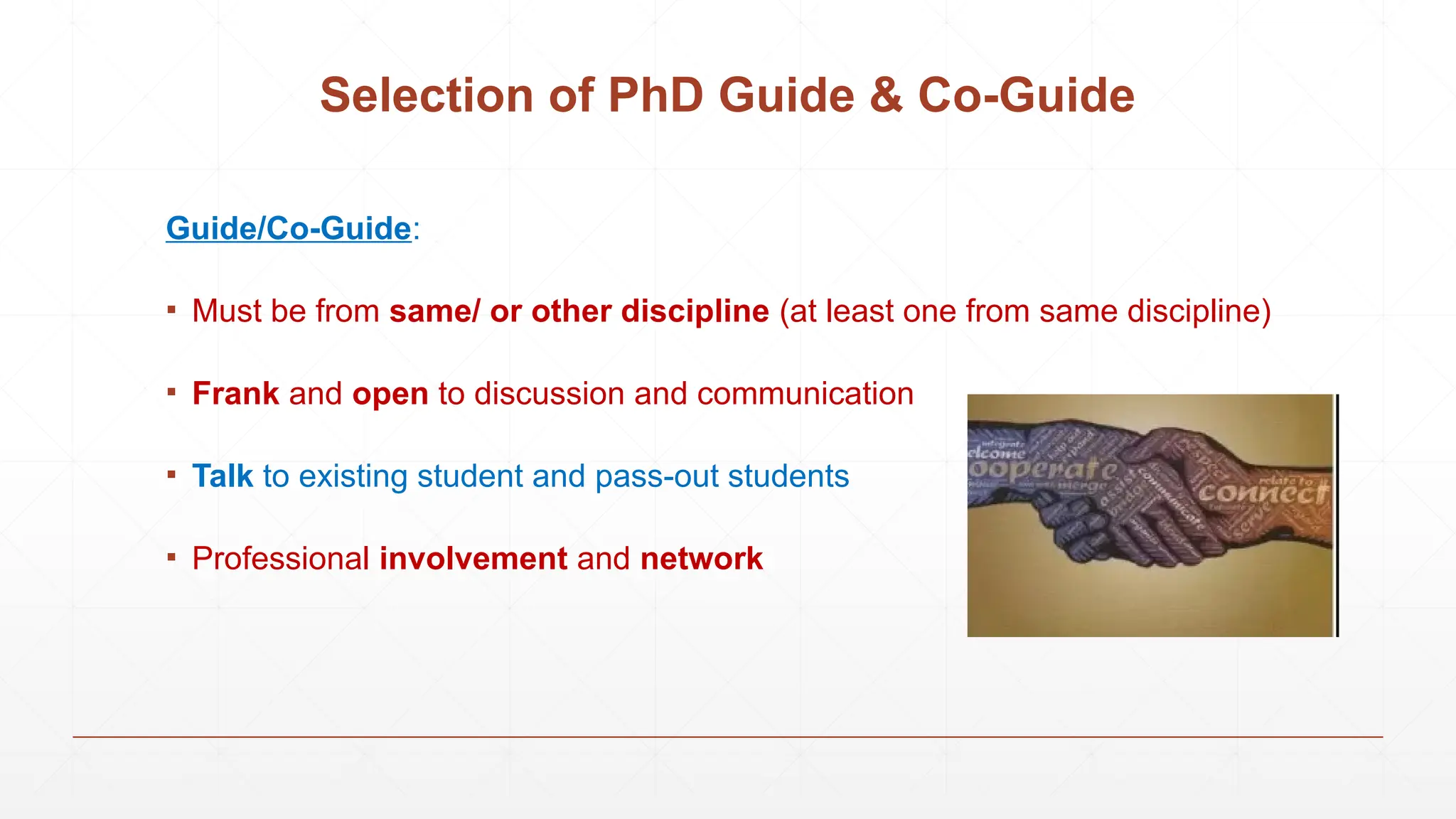
Selection of PhD Guide & Co-Guide
Guide/Co-Guide:
▪ Must be from same/ or other discipline (at least one from same discipline)
▪ Frank and open to discussion and communication
▪ Talk to existing student and pass-out students
▪ Professional involvement and network
Review of Literature
▪ Starts from the very first day and end up to the last day…
▪ Use scientific research platforms for searching research publications
▪ Identify top 3-4 publication’s- Science direct, Springer, Taylor & Francis etc.
▪ Reverse chorological year (preferably from last three years)
▪ Read abstract and conclusions only at first
▪ Use any reference management tool like of End note
Sources For Review of Literature
▪ Google
▪ Scopus
▪ Shodhganga- Indian repository
▪ Recent doctoral thesis and its reference section (Last 3 years or 10-15)
▪ Recent research papers and its reference section (Last 3 years or 300 papers)
Useful Platforms, Forums, Community for
Research
▪ ResearchGate
▪ Acdemia.edu
▪ LinkedIn
▪ Google Scholar
Preparing a Research Proposal
▪ A working title: Make this clear and descriptive
▪ Describe concisely the core contents of the paper
▪ Make a list of the most important keywords and think of a title that contains these words
▪ The title NEVER contains abbreviations, chemical formulas, proprietary names
▪ It must highlight the type of work presented in the paper i.e. review, experimental data, hypothesis based,
optimization based, a novel idea or product or process of findings.
▪ It must be decided at last
▪ Indexing and abstracting of the paper depends on the accuracy
Define Problem Statement
▪ The heart of a doctoral (PhD) research is the PROBLEM STATEMENT
▪ It is the crux of the entire study in terms of a question and a probable answer
▪ The problem statement, gives idea about Why? What? How?
▪ Present the problem: The first step is to explain what you have chosen to study and more importantly, why?
The rationale for study needs to be clearly communicated to justify an in-depth research.
▪ Provide evidence: To stress the seriousness of the issue, you must back the problem with reliable data. A
problem statement is only effective when supported by authentic factual data.
▪ Propose the solution: After starting the problem emphatically, present the possible solution as a result of the
study. Here, the solution is not presented in detail but rather concisely just to indicate the success of the
research. The methodology used to reach the conclusion is also worth mentioning here.
▪ Polish the statement: As with every section, through revision and editing of the problem statement is a must.
The problem statement should be free from any loopholes in terms of facts and figures, language or format. You
must have to confine within the word limit that is prescribed in the university guidelines.
Frame Research Objectives
▪ PhD topic is a research question for which you have to find answer/s.
▪ The research aim is a single overall statement of your purpose, which may be expressed
as a research question or a statement.
▪ The research objectives describe a series of tasks which, if completed would enable the
aim to be met.
▪ Working on each objectives one by one take you one step closer to answer your research
question. (and your PhD degree).
Research Proposal- M&M
▪ A description of your theoretical framework and methodological approach-
▪ Why is this best suited to your topic?
▪ What are the theoretical and research issues related to your research question?
▪ What sources/data will you use?
▪ What are the activities necessary for the completion of your project?
▪ Will you need to collaborate with other researchers or organisations?
▪ Are there ethical considerations that need to be considered?
▪ How realistic is your project in practical terms?
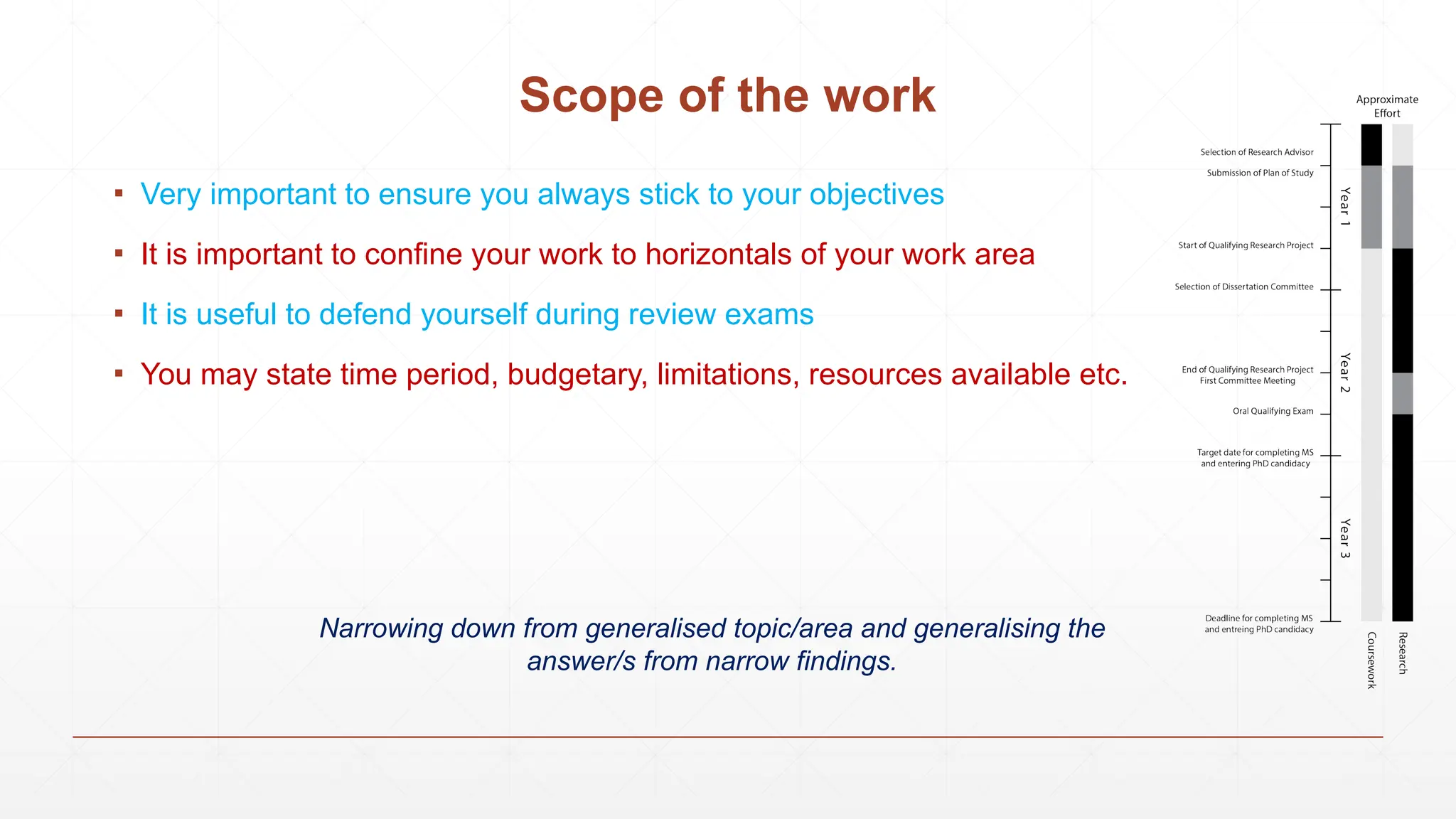
Scope of the work
▪ Very important to ensure you always stick to your objectives
▪ It is important to confine your work to horizontals of your work area
▪ It is useful to defend yourself during review exams
▪ You may state time period, budgetary, limitations, resources available etc.
Narrowing down from generalised topic/area and generalising the
answer/s from narrow findings.
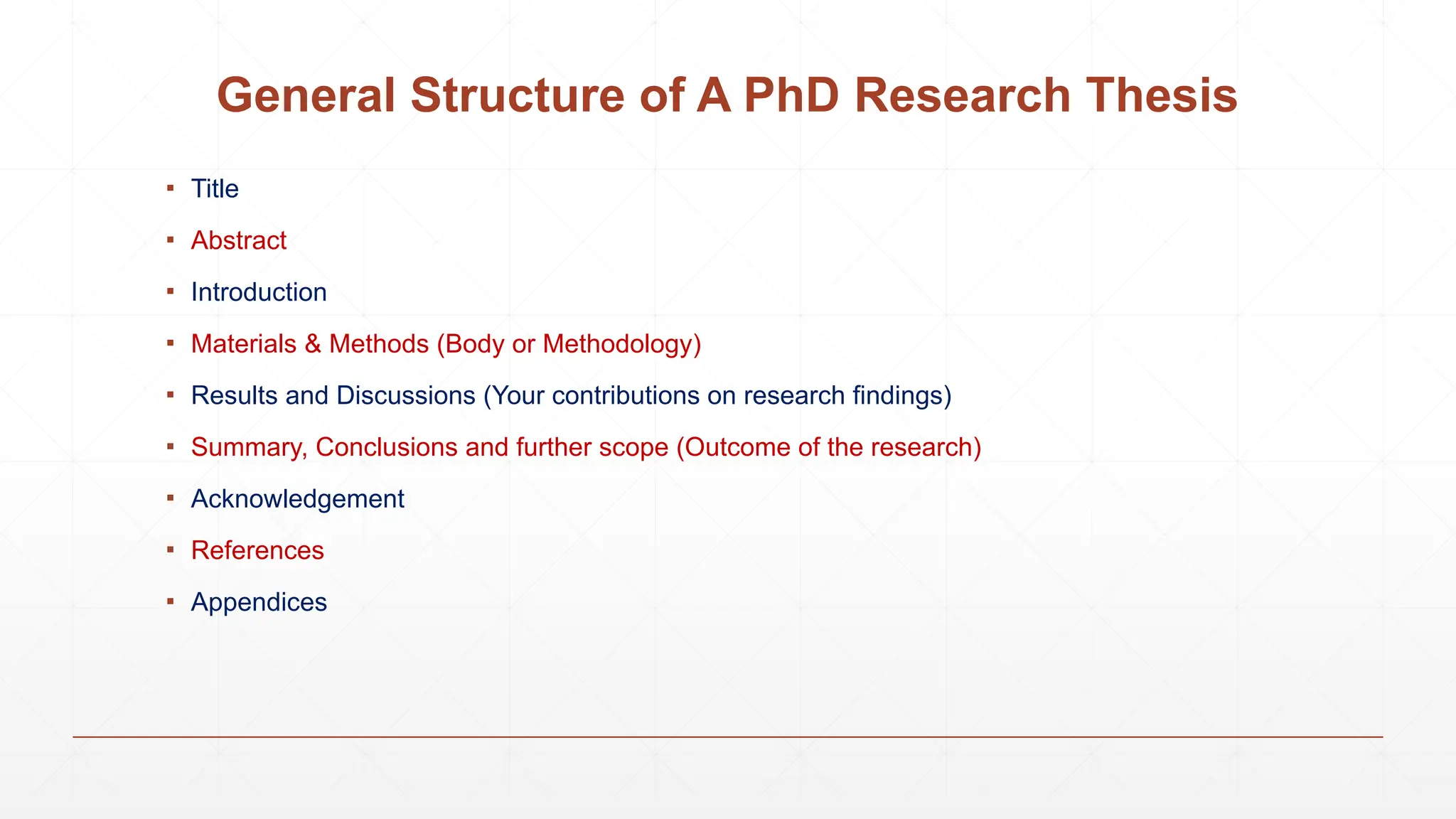
General Structure of A PhD Research Thesis
▪ Title
▪ Abstract
▪ Introduction
▪ Materials & Methods (Body or Methodology)
▪ Results and Discussions (Your contributions on research findings)
▪ Summary, Conclusions and further scope (Outcome of the research)
▪ Acknowledgement
▪ References
▪ Appendices
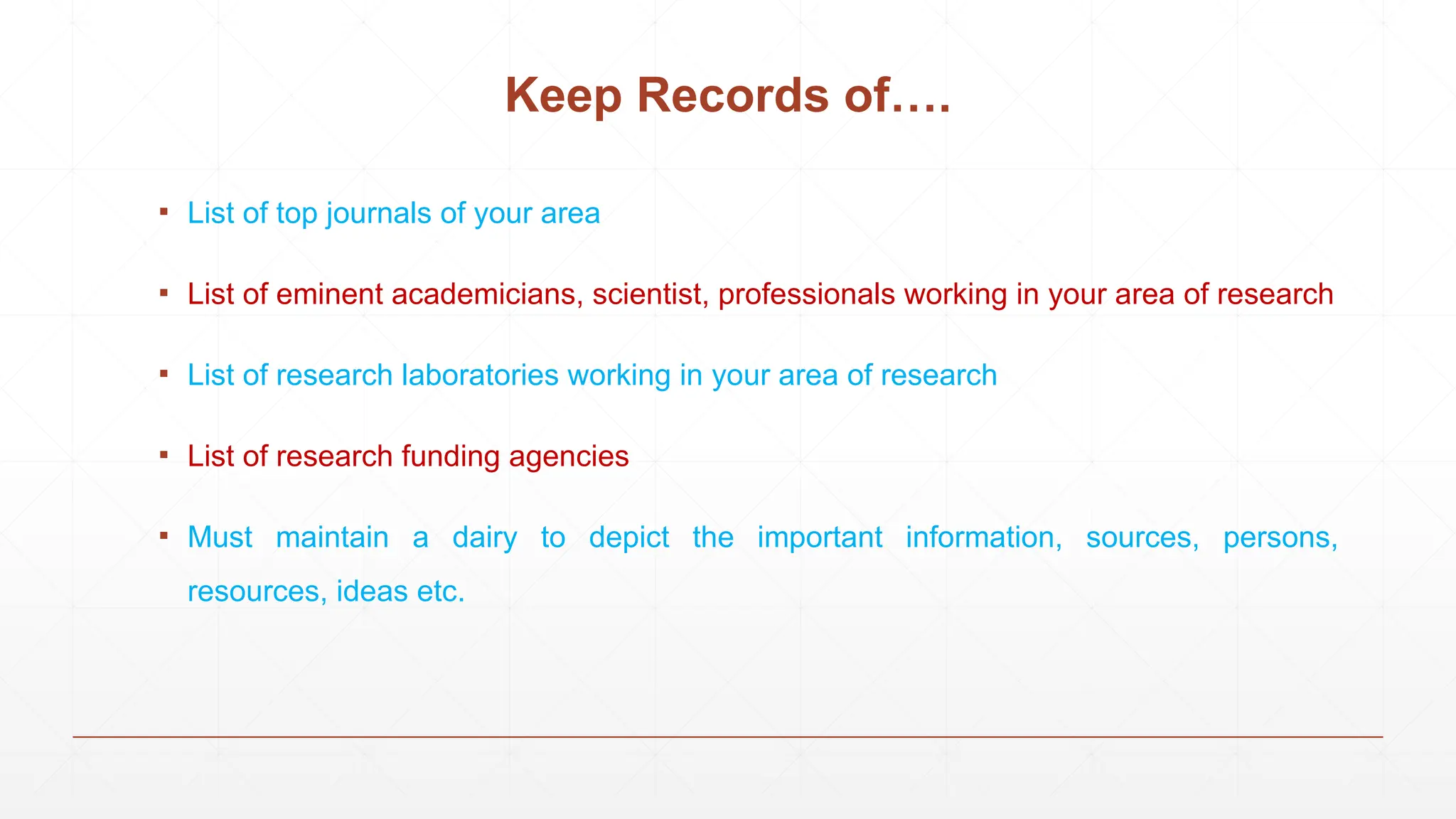
Keep Records of….
▪ List of top journals of your area
▪ List of eminent academicians, scientist, professionals working in your area of research
▪ List of research laboratories working in your area of research
▪ List of research funding agencies
▪ Must maintain a dairy to depict the important information, sources, persons,
resources, ideas etc.
Expected Research Outcomes
▪ For academia
▪ For industry
▪ For Society
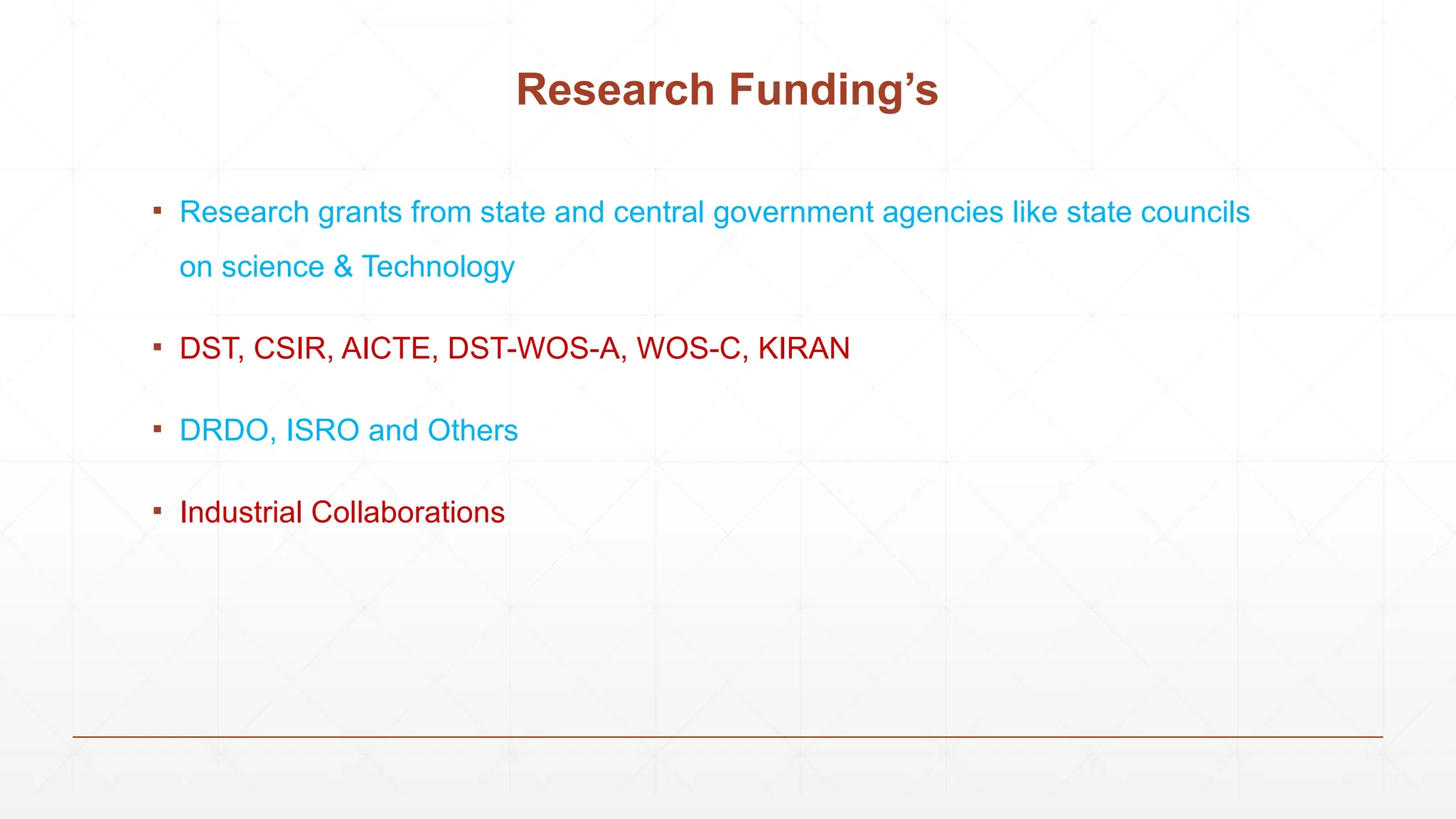
Research Funding’s
▪ Research grants from state and central government agencies like state councils
on science & Technology
▪ DST, CSIR, AICTE, DST-WOS-A, WOS-C, KIRAN
▪ DRDO, ISRO and Others
▪ Industrial Collaborations
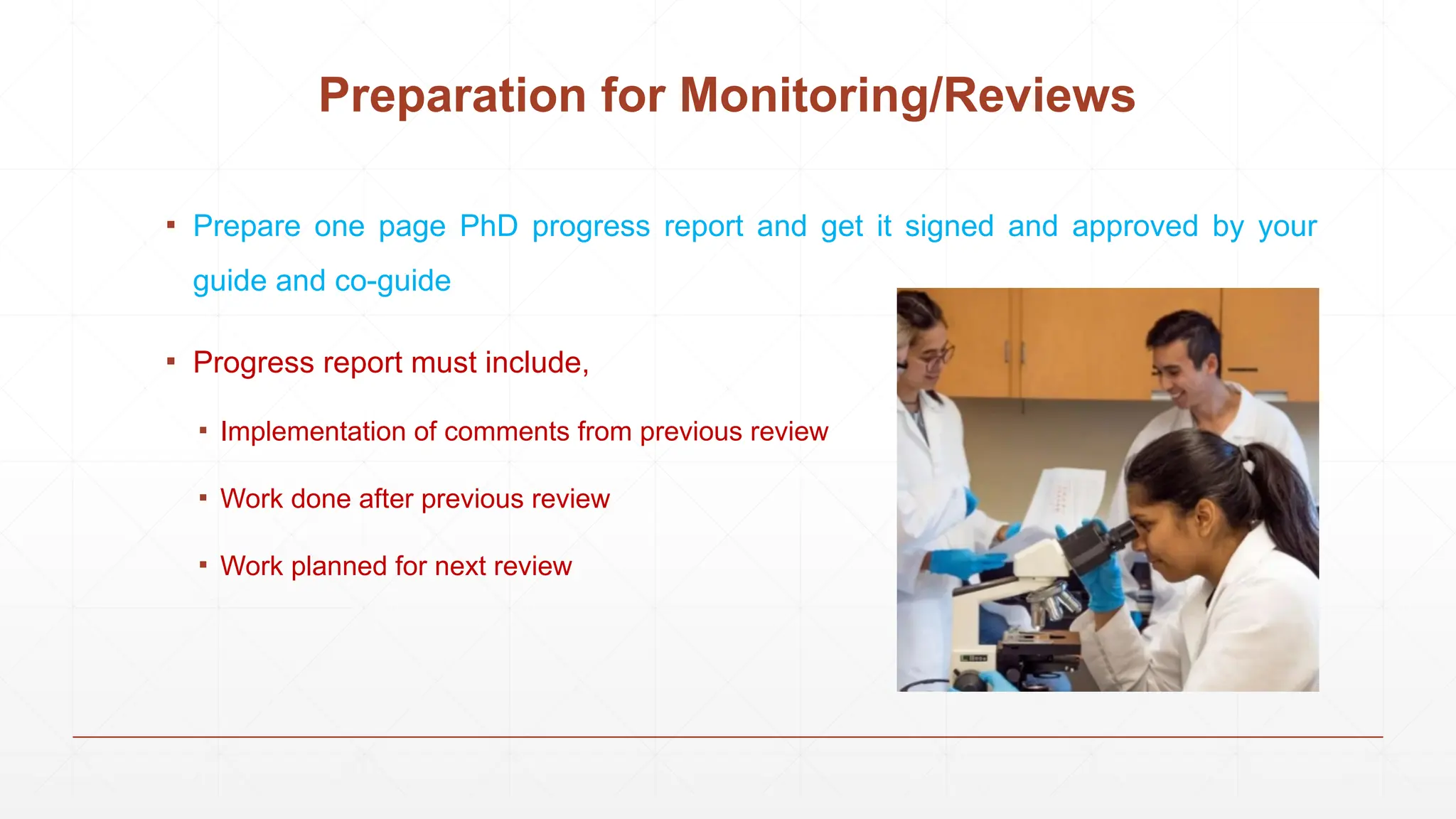
Preparation for Monitoring/Reviews
▪ Prepare one page PhD progress report and get it signed and approved by your
guide and co-guide
▪ Progress report must include,
▪ Implementation of comments from previous review
▪ Work done after previous review
▪ Work planned for next review
Preparation for Monitoring/Reviews
▪ Preferably use black and white slide design and use same for all the reviews
▪ Must include ‘The presentation outline’ slide next to your title slide
▪ Third/fourth slides include your progress report and implementation of comments
▪ From fifth slide, your work to be presented ..
▪ Must include photographs, small videos, machines, instruments used for your
work appropriately, if there are any…
▪ Use tabular format for literatures reviewed
▪ Include literature review in all review exams related to the work
▪ Do extra work than planned for a particular review
▪ Never try to present a dreamy, glorious and over ambitious picture to experts
(stick to the basic theme of the research only)
▪ Always put your point, if some comments seems diverting your plan of work
▪ Always have a scope to skew/divert your work to some parallel directions and work
Preparation for Monitoring/Reviews
Essential tools for PhD Scholar
▪ Reference management
▪ Data backup- Google Drive
▪ Proof reading tools- Ginger, Grammarly
▪ Plagiarism detection- Turnitin
▪ Image editing tools- Photoshop, Paint
▪ Online free softwares- pdf to word, word to pdf, jpg to TIFF etc.
▪ Microsoft Word- for thesis and paper writing
▪ Microsoft Excel- for handling data, calculations etc.
▪ Microsoft PowerPoint- for presentations during your reviews and defence
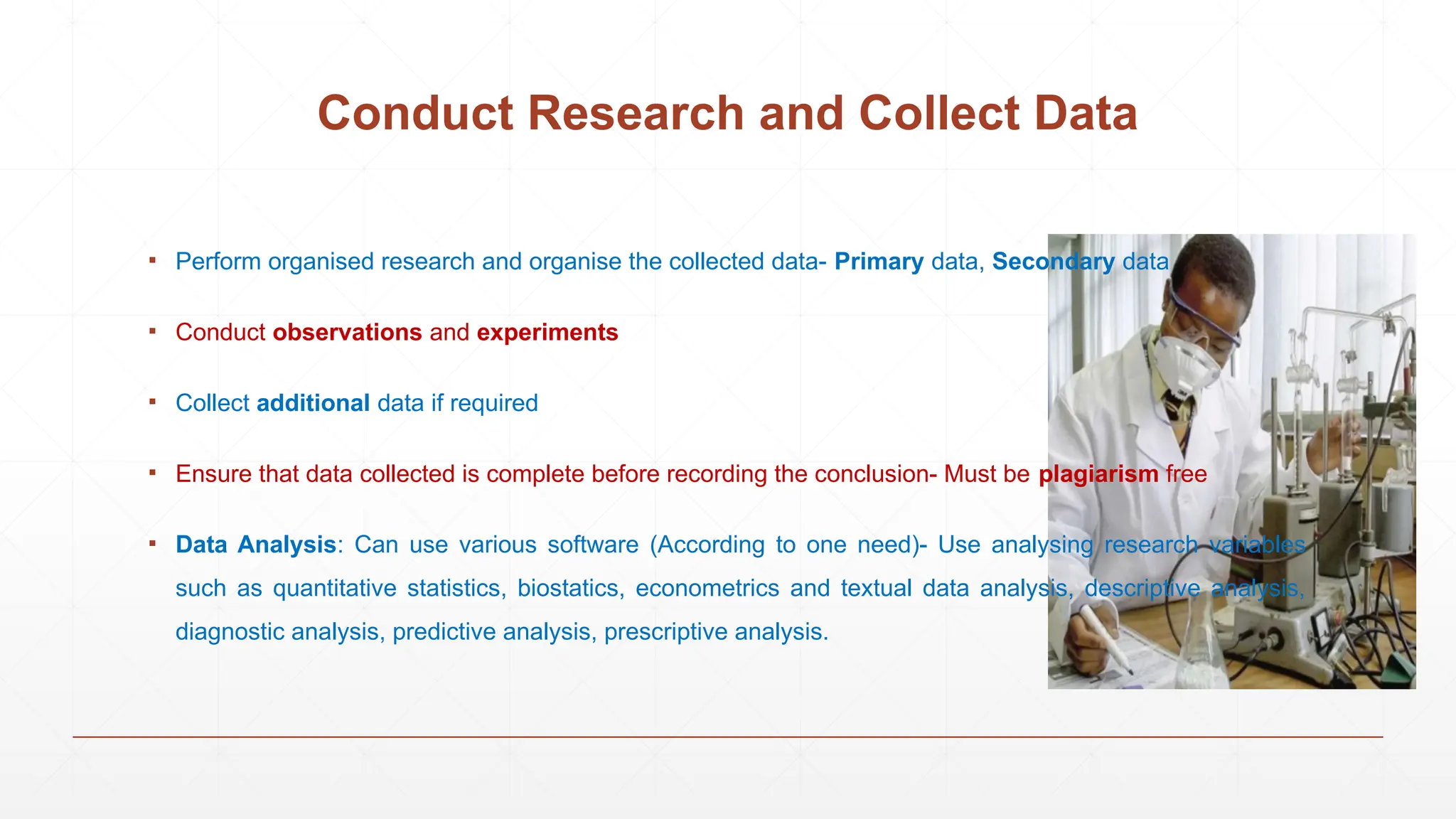
Conduct Research and Collect Data
▪ Perform organised research and organise the collected data- Primary data, Secondary data
▪ Conduct observations and experiments
▪ Collect additional data if required
▪ Ensure that data collected is complete before recording the conclusion- Must be plagiarism free
▪ Data Analysis: Can use various software (According to one need)- Use analysing research variables
such as quantitative statistics, biostatics, econometrics and textual data analysis, descriptive analysis,
diagnostic analysis, predictive analysis, prescriptive analysis.
Presenting the work!
▪ Viva Help- Ensure that you are aware of reference materials used in the research work, Refer every article
whether a journal, article, textbook, PhD dissertations, Translated works, Newspaper articles, dictionary or
web pages, lectures, PDFs, PPTS, Videos, annual reports and many more which will be helpful during the
viva or any other similar process.
▪ Research Paper Publication: Research paper development and publication of your research paper in
impact factor journals of the relevant filed, be it research related to scientific or social studies subjects.
▪ Patent & Copyright Registration of PhD research work- Copyright protects creative expression.
Setting PhD expectations
• A PhD must represent a significant advance in human knowledge
• Don’t be scared by that bar – that’s why you have an advisor. But realize that there’s a
high standard and let it energize you.
• It doesn’t necessarily have to be a unified piece of work
• No one cites PhD theses; what’s important for your career are first-author papers.
• A PhD should take 3-5 years and produce 2-4 important papers
• The “PhD thesis” is just stapled papers.
• Criticism/redirection/rewriting by advisor may make you wonder if you own your research. Relax,
you own it. The advisor is operating on a different plane of ownership. The research is coming out of
his/her shop. You’re an apprentice.
• Take criticism constructively but don’t hesitate to push back. Learn from the criticism so you can
improve. Again, this is apprenticeship.
• Criticism is hard to take: For now at least, you can learn from the criticism and improve. As a career
scientist you’ll be criticized all the time (usually anonymously) with less opportunity to improve.
Ownership of your research and dealing with
criticism
How to benefit most from your PhD
• Own your research problem
• Have clear idea of scientific value, road to paper
• Do work that’s important to you
• Get the supervision you need
• Don’t neglect communications
• Research is nothing if not communicated properly
• You will be judged by your publications and presentations
• Never miss an opportunity to talk about your research
• Broaden your perspectives
• Understand and engage in what others are doing
• Take advantage of constant flow of visitors
• Develop your professional ambitions
• Embrace high standards, self-improvement
• Find out what you want to be
• Don’t compare yourself to others too much
• Be a team player
• Be generous with help, and ask for help when you need it
• Engage socially with the group
How to benefit most from your PhD
PhD Process- In Brief
Preparing a research proposal
Carrying out a literature review
Conducting research and collecting results
Completing an MPhil to PhD upgrade
PhD teaching, conferences and publications
Writing your thesis
Defending your PhD results at a viva voce

Lecture 2-PhD Process-A Journey in Brief.pptx

  • 1.
    PhD Process- InBrief Singh, Renu (PhD.) Department of Biosciences (Biotechnology), JJT University, Jhunjhunu, Rajasthan
  • 2.
    “You can notcreate experiences, You must undergo it’ ‘If you have knowledge, Let others light their candles with it’
  • 3.
    Why PhD? ▪ PhDis the only degree accepted universally ▪ It’s an academic requirement for carrier advancements for academicians and scientists ▪ It’s a requirement to get fellowship of professional bodies, membership of elite professional bodies. ▪ To get research projects and funds at national and international level ▪ To get recognition and appreciation as a researcher
  • 4.
    Why PhD? ▪ Learnmethodological approach to any work or project ▪ To inculcate transferable skills ▪ For future readiness for a change in job, better opportunities, government or educational policies ▪ Personal development ▪ Social Recognition ▪ Built a professional network ▪ To get an edge in interviews, ▪ For your children’s ▪ And many more…….
  • 5.
    What is PhD? ▪It is a process of doing research not invention ▪ Research: Systematic investigation in order to establish facts and reach to new conclusions. Creation of new knowledge is important. ▪ Doctor of Philosophy: Beyond mastering a subject/area, for creation of new knowledge based on philosophical, rationale, integrated, methodological thinking, planning and implementing
  • 6.
    Prior to topicselection for PhD ▪ Most important ▪ No topic/area is easy or difficult ▪ Identity your area of interest (having some good theoretical and fundamental background) ▪ Workout your strengths an weaknesses ▪ Identify the technological trends in your area of interest ▪ Type of work you would like to do i.e., Experimental, Analytical, Survey based etc.. ▪ Refer good book/s on research methodology ▪ Get out of your comfort area or zone ▪ Be true to yourself
  • 7.
    Sources of PhDTopic ▪ Funded research project of guide or co-guide ▪ Sponsored research problem through industry ▪ Your own research related background ▪ PhD thesis of same area of research (further scope of research section- Preferable last 3 years) ▪ Research collaboration with any research organisation ▪ JRF and SRF through UGC/University ▪ Suggestions from current and past research scholars
  • 8.
    Selection of PhDGuide & Co-Guide Guide/Co-Guide: ▪ Must be from same/ or other discipline (at least one from same discipline) ▪ Frank and open to discussion and communication ▪ Talk to existing student and pass-out students ▪ Professional involvement and network
  • 9.
    Review of Literature ▪Starts from the very first day and end up to the last day… ▪ Use scientific research platforms for searching research publications ▪ Identify top 3-4 publication’s- Science direct, Springer, Taylor & Francis etc. ▪ Reverse chorological year (preferably from last three years) ▪ Read abstract and conclusions only at first ▪ Use any reference management tool like of End note
  • 10.
    Sources For Reviewof Literature ▪ Google ▪ Scopus ▪ Shodhganga- Indian repository ▪ Recent doctoral thesis and its reference section (Last 3 years or 10-15) ▪ Recent research papers and its reference section (Last 3 years or 300 papers)
  • 11.
    Useful Platforms, Forums,Community for Research ▪ ResearchGate ▪ Acdemia.edu ▪ LinkedIn ▪ Google Scholar
  • 12.
    Preparing a ResearchProposal ▪ A working title: Make this clear and descriptive ▪ Describe concisely the core contents of the paper ▪ Make a list of the most important keywords and think of a title that contains these words ▪ The title NEVER contains abbreviations, chemical formulas, proprietary names ▪ It must highlight the type of work presented in the paper i.e. review, experimental data, hypothesis based, optimization based, a novel idea or product or process of findings. ▪ It must be decided at last ▪ Indexing and abstracting of the paper depends on the accuracy
  • 13.
    Define Problem Statement ▪The heart of a doctoral (PhD) research is the PROBLEM STATEMENT ▪ It is the crux of the entire study in terms of a question and a probable answer ▪ The problem statement, gives idea about Why? What? How? ▪ Present the problem: The first step is to explain what you have chosen to study and more importantly, why? The rationale for study needs to be clearly communicated to justify an in-depth research. ▪ Provide evidence: To stress the seriousness of the issue, you must back the problem with reliable data. A problem statement is only effective when supported by authentic factual data. ▪ Propose the solution: After starting the problem emphatically, present the possible solution as a result of the study. Here, the solution is not presented in detail but rather concisely just to indicate the success of the research. The methodology used to reach the conclusion is also worth mentioning here. ▪ Polish the statement: As with every section, through revision and editing of the problem statement is a must. The problem statement should be free from any loopholes in terms of facts and figures, language or format. You must have to confine within the word limit that is prescribed in the university guidelines.
  • 14.
    Frame Research Objectives ▪PhD topic is a research question for which you have to find answer/s. ▪ The research aim is a single overall statement of your purpose, which may be expressed as a research question or a statement. ▪ The research objectives describe a series of tasks which, if completed would enable the aim to be met. ▪ Working on each objectives one by one take you one step closer to answer your research question. (and your PhD degree).
  • 15.
    Research Proposal- M&M ▪A description of your theoretical framework and methodological approach- ▪ Why is this best suited to your topic? ▪ What are the theoretical and research issues related to your research question? ▪ What sources/data will you use? ▪ What are the activities necessary for the completion of your project? ▪ Will you need to collaborate with other researchers or organisations? ▪ Are there ethical considerations that need to be considered? ▪ How realistic is your project in practical terms?
  • 16.
    Scope of thework ▪ Very important to ensure you always stick to your objectives ▪ It is important to confine your work to horizontals of your work area ▪ It is useful to defend yourself during review exams ▪ You may state time period, budgetary, limitations, resources available etc. Narrowing down from generalised topic/area and generalising the answer/s from narrow findings.
  • 17.
    General Structure ofA PhD Research Thesis ▪ Title ▪ Abstract ▪ Introduction ▪ Materials & Methods (Body or Methodology) ▪ Results and Discussions (Your contributions on research findings) ▪ Summary, Conclusions and further scope (Outcome of the research) ▪ Acknowledgement ▪ References ▪ Appendices
  • 18.
    Keep Records of…. ▪List of top journals of your area ▪ List of eminent academicians, scientist, professionals working in your area of research ▪ List of research laboratories working in your area of research ▪ List of research funding agencies ▪ Must maintain a dairy to depict the important information, sources, persons, resources, ideas etc.
  • 19.
    Expected Research Outcomes ▪For academia ▪ For industry ▪ For Society
  • 20.
    Research Funding’s ▪ Researchgrants from state and central government agencies like state councils on science & Technology ▪ DST, CSIR, AICTE, DST-WOS-A, WOS-C, KIRAN ▪ DRDO, ISRO and Others ▪ Industrial Collaborations
  • 21.
    Preparation for Monitoring/Reviews ▪Prepare one page PhD progress report and get it signed and approved by your guide and co-guide ▪ Progress report must include, ▪ Implementation of comments from previous review ▪ Work done after previous review ▪ Work planned for next review
  • 22.
    Preparation for Monitoring/Reviews ▪Preferably use black and white slide design and use same for all the reviews ▪ Must include ‘The presentation outline’ slide next to your title slide ▪ Third/fourth slides include your progress report and implementation of comments ▪ From fifth slide, your work to be presented .. ▪ Must include photographs, small videos, machines, instruments used for your work appropriately, if there are any…
  • 23.
    ▪ Use tabularformat for literatures reviewed ▪ Include literature review in all review exams related to the work ▪ Do extra work than planned for a particular review ▪ Never try to present a dreamy, glorious and over ambitious picture to experts (stick to the basic theme of the research only) ▪ Always put your point, if some comments seems diverting your plan of work ▪ Always have a scope to skew/divert your work to some parallel directions and work Preparation for Monitoring/Reviews
  • 24.
    Essential tools forPhD Scholar ▪ Reference management ▪ Data backup- Google Drive ▪ Proof reading tools- Ginger, Grammarly ▪ Plagiarism detection- Turnitin ▪ Image editing tools- Photoshop, Paint ▪ Online free softwares- pdf to word, word to pdf, jpg to TIFF etc. ▪ Microsoft Word- for thesis and paper writing ▪ Microsoft Excel- for handling data, calculations etc. ▪ Microsoft PowerPoint- for presentations during your reviews and defence
  • 25.
    Conduct Research andCollect Data ▪ Perform organised research and organise the collected data- Primary data, Secondary data ▪ Conduct observations and experiments ▪ Collect additional data if required ▪ Ensure that data collected is complete before recording the conclusion- Must be plagiarism free ▪ Data Analysis: Can use various software (According to one need)- Use analysing research variables such as quantitative statistics, biostatics, econometrics and textual data analysis, descriptive analysis, diagnostic analysis, predictive analysis, prescriptive analysis.
  • 26.
    Presenting the work! ▪Viva Help- Ensure that you are aware of reference materials used in the research work, Refer every article whether a journal, article, textbook, PhD dissertations, Translated works, Newspaper articles, dictionary or web pages, lectures, PDFs, PPTS, Videos, annual reports and many more which will be helpful during the viva or any other similar process. ▪ Research Paper Publication: Research paper development and publication of your research paper in impact factor journals of the relevant filed, be it research related to scientific or social studies subjects. ▪ Patent & Copyright Registration of PhD research work- Copyright protects creative expression.
  • 27.
    Setting PhD expectations •A PhD must represent a significant advance in human knowledge • Don’t be scared by that bar – that’s why you have an advisor. But realize that there’s a high standard and let it energize you. • It doesn’t necessarily have to be a unified piece of work • No one cites PhD theses; what’s important for your career are first-author papers. • A PhD should take 3-5 years and produce 2-4 important papers • The “PhD thesis” is just stapled papers.
  • 28.
    • Criticism/redirection/rewriting byadvisor may make you wonder if you own your research. Relax, you own it. The advisor is operating on a different plane of ownership. The research is coming out of his/her shop. You’re an apprentice. • Take criticism constructively but don’t hesitate to push back. Learn from the criticism so you can improve. Again, this is apprenticeship. • Criticism is hard to take: For now at least, you can learn from the criticism and improve. As a career scientist you’ll be criticized all the time (usually anonymously) with less opportunity to improve. Ownership of your research and dealing with criticism
  • 29.
    How to benefitmost from your PhD • Own your research problem • Have clear idea of scientific value, road to paper • Do work that’s important to you • Get the supervision you need • Don’t neglect communications • Research is nothing if not communicated properly • You will be judged by your publications and presentations • Never miss an opportunity to talk about your research • Broaden your perspectives • Understand and engage in what others are doing • Take advantage of constant flow of visitors
  • 30.
    • Develop yourprofessional ambitions • Embrace high standards, self-improvement • Find out what you want to be • Don’t compare yourself to others too much • Be a team player • Be generous with help, and ask for help when you need it • Engage socially with the group How to benefit most from your PhD
  • 32.
    PhD Process- InBrief Preparing a research proposal Carrying out a literature review Conducting research and collecting results Completing an MPhil to PhD upgrade PhD teaching, conferences and publications Writing your thesis Defending your PhD results at a viva voce