Mobile and financial services
@NadsBads
@InnovationSoc
July 2013
The rise of
mobile banking
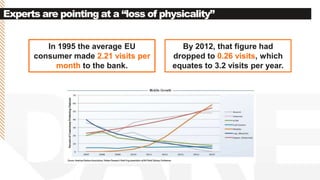
Experts are pointing at a “loss of physicality”
In 1995 the average EU
consumer made 2.21 visits per
month to the bank.
By 2012, that figure had
dropped to 0.26 visits, which
equates to 3.2 visits per year.
Consumers have shown mounting enthusiasm for mobile
services
* TNS. Mobile Life. June 2012
“All the figures are pointing to the fact that we
have reached a tipping point in worldwide
desire for mobile financial services. Globally,
people are opening their minds to using their
mobile to bank or buy”*.
James Fergusson, Global Head, TNS Connect
Mobiles are even displacing PCs for the most routine tasks
“Mobile banking is displacing online banking. Technologies like
apps let customers perform simple banking tasks more quickly
and easily on a mobile or a than on a PC. As a result, banking
on Smartphones and tablets is already displacing banking on
PCs for routine interactions.
Over the coming decade, Smartphones, tablets, and other
portable devices will become the dashboard through which
many customers, both rich and poor, manage their money.”
Forrester
Strategies being
employed
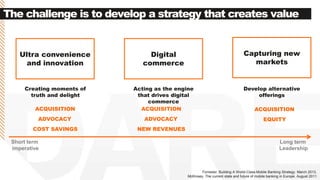
The challenge is to develop a strategy that creates value
Ultra convenience
and innovation
Capturing new
markets
Digital
commerce
Creating moments of
truth and delight
ACQUISITION
ADVOCACY
COST SAVINGS
Acting as the engine
that drives digital
commerce
Develop alternative
offerings
NEW REVENUES
ACQUISITION
Forrester. Building A World-Class Mobile Banking Strategy. March 2013.
McKinsey. The current state and future of mobile banking in Europe. August 2011
Short term
imperative
Long term
Leadership
ADVOCACY
ACQUISITION
EQUITY
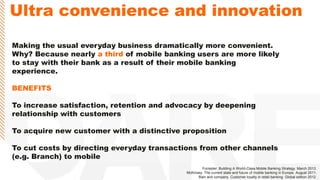
Ultra convenience and innovation
Making the usual everyday business dramatically more convenient.
Why? Because nearly a third of mobile banking users are more likely
to stay with their bank as a result of their mobile banking
experience.
BENEFITS
To increase satisfaction, retention and advocacy by deepening
relationship with customers
To acquire new customer with a distinctive proposition
To cut costs by directing everyday transactions from other channels
(e.g. Branch) to mobile
Forrester. Building A World-Class Mobile Banking Strategy. March 2013.
McKinsey. The current state and future of mobile banking in Europe. August 2011.
Bain and company. Customer loyalty in retail banking. Global edition 2012.
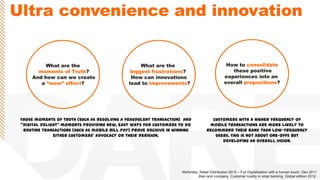
What are the
moments of Truth?
And how can we create
a “wow” effect?
What are the
biggest frustrations?
How can innovations
lead to improvements?
Those moments of truth (such as resolving a fraudulent transaction) and
“digital delight” moments providing new, easy ways for customers to do
routine transactions (such as mobile bill pay) prove decisive in winning
either customers’ advocacy or their derision.
McKinsey. Retail Distribution 2015 – Full Digitalisation with a human touch. Dec 2011
Bain and company. Customer loyalty in retail banking. Global edition 2012.
How to consolidate
these positive
experiences into an
overall propositions?
Customers with a higher frequency of
mobile transactions are more likely to
recommend their bank than low-frequency
users. This is not about one-offs but
developing an overall vision.
Ultra convenience and innovation
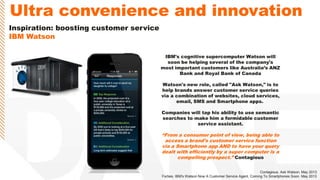
Inspiration: boosting customer service
IBM Watson
IBM's cognitive supercomputer Watson will
soon be helping several of the company's
most important customers like Australia‟s ANZ
Bank and Royal Bank of Canada
Watson's new role, called "Ask Watson," is to
help brands answer customer service queries
via a combination of websites, cloud services,
email, SMS and Smartphone apps.
Companies will tap his ability to use semantic
searches to make him a formidable customer
service assistant.
“From a consumer point of view, being able to
access a brand's customer service function
via a Smartphone app AND to have your query
dealt with efficiently by a super computer is a
compelling prospect.” Contagious
Contagious. Ask Watson. May 2013
Forbes. IBM's Watson Now A Customer Service Agent, Coming To Smartphones Soon. May 2013
Ultra convenience and innovation
Digital commerce
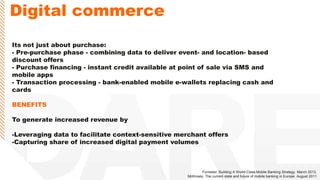
Its not just about purchase:
- Pre-purchase phase - combining data to deliver event- and location- based
discount offers
- Purchase financing - instant credit available at point of sale via SMS and
mobile apps
- Transaction processing - bank-enabled mobile e-wallets replacing cash and
cards
BENEFITS
To generate increased revenue by
-Leveraging data to facilitate context-sensitive merchant offers
-Capturing share of increased digital payment volumes
Forrester. Building A World-Class Mobile Banking Strategy. March 2013.
McKinsey. The current state and future of mobile banking in Europe. August 2011
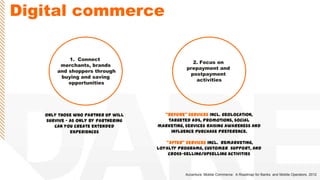
1. Connect
merchants, brands
and shoppers through
buying and saving
opportunities
Only those who partner up will
survive – as only by partnering
can you create extended
experiences
2. Focus on
prepayment and
postpayment
activities
“Before” services incl. geolocation,
targeted ads, promotions, social
marketing, services raising awareness and
influence purchase preference.
“After” services incl. remarketing,
loyalty programs, customer support, and
cross-selling/upselling activities
Accenture. Mobile Commerce: A Roadmap for Banks and Mobile Operators. 2012
Digital commerce
A variety of new players are
entering the market, including
tech specialists such as Google,
start-ups such as Square, and
established online payment
providers such as PayPal.
Google in particular has bold
plans: It wants to close the last
mile and is willing to give away
everything to merchants
(including point-of-sale
terminals, digital wallets, and
Trusted Service Manager [TSM]
services) to make this happen.
Digital commerce
New Markets
Key opportunity to use mobile to access the world‟s 2.5 billion adults who are
either unbanked or underbanked.
Non-incumbent „attacking banks‟ may more easily be able to build a low-cost
proposition in partnership with an established Telco.
BENEFITS
-Growing market share with a disruptive proposition
-This could support a broader vision and purpose and boost long term brand
equity
McKinsey. The current state and future of mobile banking in Europe. August 2011
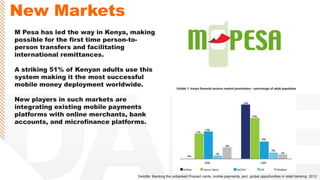
M Pesa has led the way in Kenya, making
possible for the first time person-to-
person transfers and facilitating
international remittances.
A striking 51% of Kenyan adults use this
system making it the most successful
mobile money deployment worldwide.
New players in such markets are
integrating existing mobile payments
platforms with online merchants, bank
accounts, and microfinance platforms.
Deloitte. Banking the unbanked Prepaid cards, mobile payments, and global opportunities in retail banking. 2012
New Markets
Case studies:
who‟s innovating?
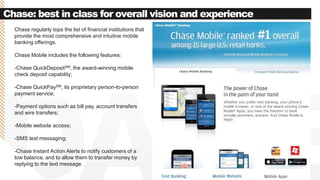
Chase: best in class for overall vision and experience
Chase regularly tops the list of financial institutions that
provide the most comprehensive and intuitive mobile
banking offerings.
Chase Mobile includes the following features:
-Chase QuickDepositSM, the award-winning mobile
check deposit capability;
-Chase QuickPaySM, its proprietary person-to-person
payment service;
-Payment options such as bill pay, account transfers
and wire transfers;
-Mobile website access;
-SMS text messaging;
-Chase Instant Action Alerts to notify customers of a
low balance, and to allow them to transfer money by
replying to the text message.
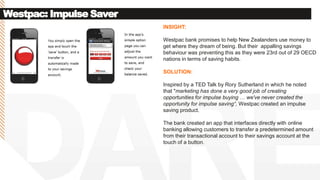
Westpac: Impulse Saver
INSIGHT:
Westpac bank promises to help New Zealanders use money to
get where they dream of being. But their appalling savings
behaviour was preventing this as they were 23rd out of 29 OECD
nations in terms of saving habits.
SOLUTION:
Inspired by a TED Talk by Rory Sutherland in which he noted
that "marketing has done a very good job of creating
opportunities for impulse buying … we've never created the
opportunity for impulse saving“, Westpac created an impulse
saving product.
The bank created an app that interfaces directly with online
banking allowing customers to transfer a predetermined amount
from their transactional account to their savings account at the
touch of a button.
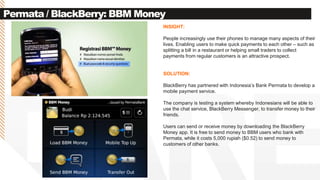
Permata / BlackBerry: BBM Money
INSIGHT:
People increasingly use their phones to manage many aspects of their
lives. Enabling users to make quick payments to each other – such as
splitting a bill in a restaurant or helping small traders to collect
payments from regular customers is an attractive prospect.
SOLUTION:
BlackBerry has partnered with Indonesia’s Bank Permata to develop a
mobile payment service.
The company is testing a system whereby Indonesians will be able to
use the chat service, BlackBerry Messenger, to transfer money to their
friends.
Users can send or receive money by downloading the BlackBerry
Money app. It is free to send money to BBM users who bank with
Permata, while it costs 5,000 rupiah ($0.52) to send money to
customers of other banks.
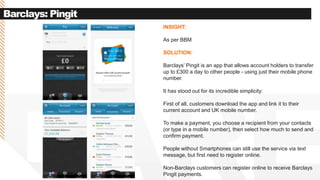
Barclays: Pingit
INSIGHT:
As per BBM
SOLUTION:
Barclays’ Pingit is an app that allows account holders to transfer
up to £300 a day to other people - using just their mobile phone
number.
It has stood out for its incredible simplicity:
First of all, customers download the app and link it to their
current account and UK mobile number.
To make a payment, you choose a recipient from your contacts
(or type in a mobile number), then select how much to send and
confirm payment.
People without Smartphones can still use the service via text
message, but first need to register online.
Non-Barclays customers can register online to receive Barclays
Pingit payments.
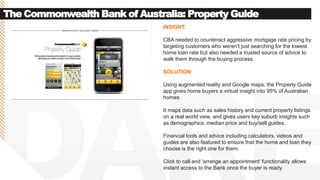
The Commonwealth Bank of Australia: Property Guide
INSIGHT:
CBA needed to counteract aggressive mortgage rate pricing by
targeting customers who weren't just searching for the lowest
home loan rate but also needed a trusted source of advice to
walk them through the buying process.
SOLUTION:
Using augmented reality and Google maps, the Property Guide
app gives home buyers a virtual insight into 95% of Australian
homes.
It maps data such as sales history and current property listings
on a real world view, and gives users key suburb insights such
as demographics, median price and buy/sell guides.
Financial tools and advice including calculators, videos and
guides are also featured to ensure that the home and loan they
choose is the right one for them.
Click to call and 'arrange an appointment‘ functionality allows
instant access to the Bank once the buyer is ready.
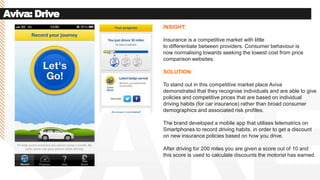
Aviva: Drive
INSIGHT:
Insurance is a competitive market with little
to differentiate between providers. Consumer behaviour is
now normalising towards seeking the lowest cost from price
comparison websites.
SOLUTION:
To stand out in this competitive market place Aviva
demonstrated that they recognise individuals and are able to give
policies and competitive prices that are based on individual
driving habits (for car insurance) rather than broad consumer
demographics and associated risk profiles.
The brand developed a mobile app that utilises telematrics on
Smartphones to record driving habits, in order to get a discount
on new insurance policies based on how you drive.
After driving for 200 miles you are given a score out of 10 and
this score is used to calculate discounts the motorist has earned.
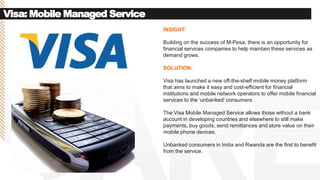
Visa: Mobile Managed Service
INSIGHT:
Building on the success of M-Pesa, there is an opportunity for
financial services companies to help maintain these services as
demand grows.
SOLUTION:
Visa has launched a new off-the-shelf mobile money platform
that aims to make it easy and cost-efficient for financial
institutions and mobile network operators to offer mobile financial
services to the ‘unbanked’ consumers.
The Visa Mobile Managed Service allows those without a bank
account in developing countries and elsewhere to still make
payments, buy goods, send remittances and store value on their
mobile phone devices.
Unbanked consumers in India and Rwanda are the first to benefit
from the service.
Three golden rules
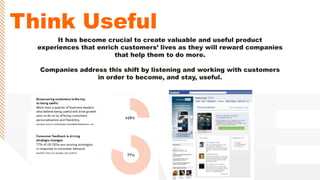
Think Useful
It has become crucial to create valuable and useful product
experiences that enrich customers‟ lives as they will reward companies
that help them to do more.
Companies address this shift by listening and working with customers
in order to become, and stay, useful.
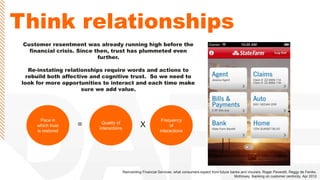
Think relationships
Customer resentment was already running high before the
financial crisis. Since then, trust has plummeted even
further.
Re-instating relationships require words and actions to
rebuild both affective and cognitive trust. So we need to
look for more opportunities to interact and each time make
sure we add value.
Pace in
which trust
is restored
Quality of
interactions
Frequency
of
interactions
= X
Reinventing Financial Services: what consumers expect from future banks and insurers. Roger Peverelli, Reggy de Feniks.
McKinsey. Banking on customer centricity. Apr 2012
Think small
We learn in small steps. We need to experiment and place lots of
small bets. This should help shift emphasis from saying to doing.
@NadsBads
@InnovationSoc

Disruption, mobile and financial services

  • 1.
    Mobile and financialservices @NadsBads @InnovationSoc July 2013
  • 2.
  • 3.
    Experts are pointingat a “loss of physicality” In 1995 the average EU consumer made 2.21 visits per month to the bank. By 2012, that figure had dropped to 0.26 visits, which equates to 3.2 visits per year.
  • 4.
    Consumers have shownmounting enthusiasm for mobile services * TNS. Mobile Life. June 2012 “All the figures are pointing to the fact that we have reached a tipping point in worldwide desire for mobile financial services. Globally, people are opening their minds to using their mobile to bank or buy”*. James Fergusson, Global Head, TNS Connect
  • 5.
    Mobiles are evendisplacing PCs for the most routine tasks “Mobile banking is displacing online banking. Technologies like apps let customers perform simple banking tasks more quickly and easily on a mobile or a than on a PC. As a result, banking on Smartphones and tablets is already displacing banking on PCs for routine interactions. Over the coming decade, Smartphones, tablets, and other portable devices will become the dashboard through which many customers, both rich and poor, manage their money.” Forrester
  • 6.
  • 7.
    The challenge isto develop a strategy that creates value Ultra convenience and innovation Capturing new markets Digital commerce Creating moments of truth and delight ACQUISITION ADVOCACY COST SAVINGS Acting as the engine that drives digital commerce Develop alternative offerings NEW REVENUES ACQUISITION Forrester. Building A World-Class Mobile Banking Strategy. March 2013. McKinsey. The current state and future of mobile banking in Europe. August 2011 Short term imperative Long term Leadership ADVOCACY ACQUISITION EQUITY
  • 8.
    Ultra convenience andinnovation Making the usual everyday business dramatically more convenient. Why? Because nearly a third of mobile banking users are more likely to stay with their bank as a result of their mobile banking experience. BENEFITS To increase satisfaction, retention and advocacy by deepening relationship with customers To acquire new customer with a distinctive proposition To cut costs by directing everyday transactions from other channels (e.g. Branch) to mobile Forrester. Building A World-Class Mobile Banking Strategy. March 2013. McKinsey. The current state and future of mobile banking in Europe. August 2011. Bain and company. Customer loyalty in retail banking. Global edition 2012.
  • 9.
    What are the momentsof Truth? And how can we create a “wow” effect? What are the biggest frustrations? How can innovations lead to improvements? Those moments of truth (such as resolving a fraudulent transaction) and “digital delight” moments providing new, easy ways for customers to do routine transactions (such as mobile bill pay) prove decisive in winning either customers’ advocacy or their derision. McKinsey. Retail Distribution 2015 – Full Digitalisation with a human touch. Dec 2011 Bain and company. Customer loyalty in retail banking. Global edition 2012. How to consolidate these positive experiences into an overall propositions? Customers with a higher frequency of mobile transactions are more likely to recommend their bank than low-frequency users. This is not about one-offs but developing an overall vision. Ultra convenience and innovation
  • 10.
    Inspiration: boosting customerservice IBM Watson IBM's cognitive supercomputer Watson will soon be helping several of the company's most important customers like Australia‟s ANZ Bank and Royal Bank of Canada Watson's new role, called "Ask Watson," is to help brands answer customer service queries via a combination of websites, cloud services, email, SMS and Smartphone apps. Companies will tap his ability to use semantic searches to make him a formidable customer service assistant. “From a consumer point of view, being able to access a brand's customer service function via a Smartphone app AND to have your query dealt with efficiently by a super computer is a compelling prospect.” Contagious Contagious. Ask Watson. May 2013 Forbes. IBM's Watson Now A Customer Service Agent, Coming To Smartphones Soon. May 2013 Ultra convenience and innovation
  • 11.
    Digital commerce Its notjust about purchase: - Pre-purchase phase - combining data to deliver event- and location- based discount offers - Purchase financing - instant credit available at point of sale via SMS and mobile apps - Transaction processing - bank-enabled mobile e-wallets replacing cash and cards BENEFITS To generate increased revenue by -Leveraging data to facilitate context-sensitive merchant offers -Capturing share of increased digital payment volumes Forrester. Building A World-Class Mobile Banking Strategy. March 2013. McKinsey. The current state and future of mobile banking in Europe. August 2011
  • 12.
    1. Connect merchants, brands andshoppers through buying and saving opportunities Only those who partner up will survive – as only by partnering can you create extended experiences 2. Focus on prepayment and postpayment activities “Before” services incl. geolocation, targeted ads, promotions, social marketing, services raising awareness and influence purchase preference. “After” services incl. remarketing, loyalty programs, customer support, and cross-selling/upselling activities Accenture. Mobile Commerce: A Roadmap for Banks and Mobile Operators. 2012 Digital commerce
  • 13.
    A variety ofnew players are entering the market, including tech specialists such as Google, start-ups such as Square, and established online payment providers such as PayPal. Google in particular has bold plans: It wants to close the last mile and is willing to give away everything to merchants (including point-of-sale terminals, digital wallets, and Trusted Service Manager [TSM] services) to make this happen. Digital commerce
  • 14.
    New Markets Key opportunityto use mobile to access the world‟s 2.5 billion adults who are either unbanked or underbanked. Non-incumbent „attacking banks‟ may more easily be able to build a low-cost proposition in partnership with an established Telco. BENEFITS -Growing market share with a disruptive proposition -This could support a broader vision and purpose and boost long term brand equity McKinsey. The current state and future of mobile banking in Europe. August 2011
  • 15.
    M Pesa hasled the way in Kenya, making possible for the first time person-to- person transfers and facilitating international remittances. A striking 51% of Kenyan adults use this system making it the most successful mobile money deployment worldwide. New players in such markets are integrating existing mobile payments platforms with online merchants, bank accounts, and microfinance platforms. Deloitte. Banking the unbanked Prepaid cards, mobile payments, and global opportunities in retail banking. 2012 New Markets
  • 16.
  • 17.
    Chase: best inclass for overall vision and experience Chase regularly tops the list of financial institutions that provide the most comprehensive and intuitive mobile banking offerings. Chase Mobile includes the following features: -Chase QuickDepositSM, the award-winning mobile check deposit capability; -Chase QuickPaySM, its proprietary person-to-person payment service; -Payment options such as bill pay, account transfers and wire transfers; -Mobile website access; -SMS text messaging; -Chase Instant Action Alerts to notify customers of a low balance, and to allow them to transfer money by replying to the text message.
  • 18.
    Westpac: Impulse Saver INSIGHT: Westpacbank promises to help New Zealanders use money to get where they dream of being. But their appalling savings behaviour was preventing this as they were 23rd out of 29 OECD nations in terms of saving habits. SOLUTION: Inspired by a TED Talk by Rory Sutherland in which he noted that "marketing has done a very good job of creating opportunities for impulse buying … we've never created the opportunity for impulse saving“, Westpac created an impulse saving product. The bank created an app that interfaces directly with online banking allowing customers to transfer a predetermined amount from their transactional account to their savings account at the touch of a button.
  • 19.
    Permata / BlackBerry:BBM Money INSIGHT: People increasingly use their phones to manage many aspects of their lives. Enabling users to make quick payments to each other – such as splitting a bill in a restaurant or helping small traders to collect payments from regular customers is an attractive prospect. SOLUTION: BlackBerry has partnered with Indonesia’s Bank Permata to develop a mobile payment service. The company is testing a system whereby Indonesians will be able to use the chat service, BlackBerry Messenger, to transfer money to their friends. Users can send or receive money by downloading the BlackBerry Money app. It is free to send money to BBM users who bank with Permata, while it costs 5,000 rupiah ($0.52) to send money to customers of other banks.
  • 20.
    Barclays: Pingit INSIGHT: As perBBM SOLUTION: Barclays’ Pingit is an app that allows account holders to transfer up to £300 a day to other people - using just their mobile phone number. It has stood out for its incredible simplicity: First of all, customers download the app and link it to their current account and UK mobile number. To make a payment, you choose a recipient from your contacts (or type in a mobile number), then select how much to send and confirm payment. People without Smartphones can still use the service via text message, but first need to register online. Non-Barclays customers can register online to receive Barclays Pingit payments.
  • 21.
    The Commonwealth Bankof Australia: Property Guide INSIGHT: CBA needed to counteract aggressive mortgage rate pricing by targeting customers who weren't just searching for the lowest home loan rate but also needed a trusted source of advice to walk them through the buying process. SOLUTION: Using augmented reality and Google maps, the Property Guide app gives home buyers a virtual insight into 95% of Australian homes. It maps data such as sales history and current property listings on a real world view, and gives users key suburb insights such as demographics, median price and buy/sell guides. Financial tools and advice including calculators, videos and guides are also featured to ensure that the home and loan they choose is the right one for them. Click to call and 'arrange an appointment‘ functionality allows instant access to the Bank once the buyer is ready.
  • 22.
    Aviva: Drive INSIGHT: Insurance isa competitive market with little to differentiate between providers. Consumer behaviour is now normalising towards seeking the lowest cost from price comparison websites. SOLUTION: To stand out in this competitive market place Aviva demonstrated that they recognise individuals and are able to give policies and competitive prices that are based on individual driving habits (for car insurance) rather than broad consumer demographics and associated risk profiles. The brand developed a mobile app that utilises telematrics on Smartphones to record driving habits, in order to get a discount on new insurance policies based on how you drive. After driving for 200 miles you are given a score out of 10 and this score is used to calculate discounts the motorist has earned.
  • 23.
    Visa: Mobile ManagedService INSIGHT: Building on the success of M-Pesa, there is an opportunity for financial services companies to help maintain these services as demand grows. SOLUTION: Visa has launched a new off-the-shelf mobile money platform that aims to make it easy and cost-efficient for financial institutions and mobile network operators to offer mobile financial services to the ‘unbanked’ consumers. The Visa Mobile Managed Service allows those without a bank account in developing countries and elsewhere to still make payments, buy goods, send remittances and store value on their mobile phone devices. Unbanked consumers in India and Rwanda are the first to benefit from the service.
  • 24.
  • 25.
    Think Useful It hasbecome crucial to create valuable and useful product experiences that enrich customers‟ lives as they will reward companies that help them to do more. Companies address this shift by listening and working with customers in order to become, and stay, useful.
  • 26.
    Think relationships Customer resentmentwas already running high before the financial crisis. Since then, trust has plummeted even further. Re-instating relationships require words and actions to rebuild both affective and cognitive trust. So we need to look for more opportunities to interact and each time make sure we add value. Pace in which trust is restored Quality of interactions Frequency of interactions = X Reinventing Financial Services: what consumers expect from future banks and insurers. Roger Peverelli, Reggy de Feniks. McKinsey. Banking on customer centricity. Apr 2012
  • 27.
    Think small We learnin small steps. We need to experiment and place lots of small bets. This should help shift emphasis from saying to doing.
  • 28.

Editor's Notes

  • #4 Stats: Telecoms.com. Mobile and internet to “destroy” retail banking models. April 2013 quoting Brett KingBrett King is the author of Banking 2.0, a widely-known book that explores the effect of new technology on consumer behaviour and banking. He is also the founder of Moven, a new mobile-only bank that focuses on the concept of a ‘digital wallet’, in which the consumer’s smartphonereplaces their debit card and cash payment tools.Graph: Deloitte. Impact of Mobile Banking on the Traditional Branch Banking Model. July 2012
  • #9 McKinsey. The current state and future of mobile banking in Europe. August 2011
  • #10 Mobile Banking Will Become The Hub Of Many Customers' Banking Relationships Banking on smartphones and tablets is already displacing banking on PCs for routine interactions. Over the coming decade, smartphones, tablets, and other portable devices will become the dashboard through which many customers, both rich and poor, manage their money -- disrupting the retail banking and payments businesses in the process.
  • #12 Smartphones and tablets may be proving effective and efficient for managing our money, but they are also fairing pretty well at replacingthe need for cash and cards altogether.
  • #18 Business Wire. Chase Tops Keynote’s Mobile Banking Scorecard for Third Time in a Row. May 2013Forrester. Who leads in mobile banking: forrester ranks 15 banks around the world. April 2013
  • #19 Cannes creative lions. Westpac Impulse Saver: Helping people save as impulsively as they spend. 2012
  • #20 Contagious. BlackBerry, Bank Permata. March 2013.
  • #21 The Guardian. Barclays launches Pingit money-sending service for smartphones. February 2012.Contagious. Barclays. February 2012
  • #22 Contagious. Financial services sector 2012
  • #23 Contagious. Financial services sector 2012
  • #26 Leveraging social media – Danske Bank. The Danish Danske Bank is demonstrating its commitment to be more engaging and transparent by leveraging crowdsourcing via social media to “become a better bank.” The initial focus Danske Bank chose was to use Facebook to ask how they could improve their mobile banking app. Their “Idebank” received 263 ideas, 185 comments, 3,110 votes, and trebled their fan base.M-Pesa is a branchless banking service that uses mobile technology, and is currently available in Kenya, Afghanistan and Tanzania. M-Pesa designed for people in rural areas where banking services are scarce. Its founders observed that Kenyan locals were trading mobile minutes as currency. So they created a service that offers money transfers, bill payments and withdrawals — all through mobile phones. It is also creating adjacent services: M-Health, agribusiness and M-Farm allow farmer co-ops to buy products via SMS and pay via M-Pesa.
  • #27 Mobile and digital are key to drive frequency of interaction and increase satisfaction as well as advocacy. State Farm (US) realised that they only had one point of contact a year with consumers - a negative one to announce an increase in premium. So they created the Pocket Agent, a mobile app that is ‘always ready to help’ – from claims and driving tips to insurance covering and financial planning.
  • #28 Wolfolins. Game changers. 2012