1
2
3
4
5
6
7
8
9
10
11
12
DISPERSE SYSTEMS
(Emulsions)
ANSEL’S PHARMACEUTICAL DOSAGE
FORMS AND DRUG DELIVERY SYSTEMS
:instructor:
Fahad khan tareen
1
2
3
4
5
6
7
8
9
10
11
12
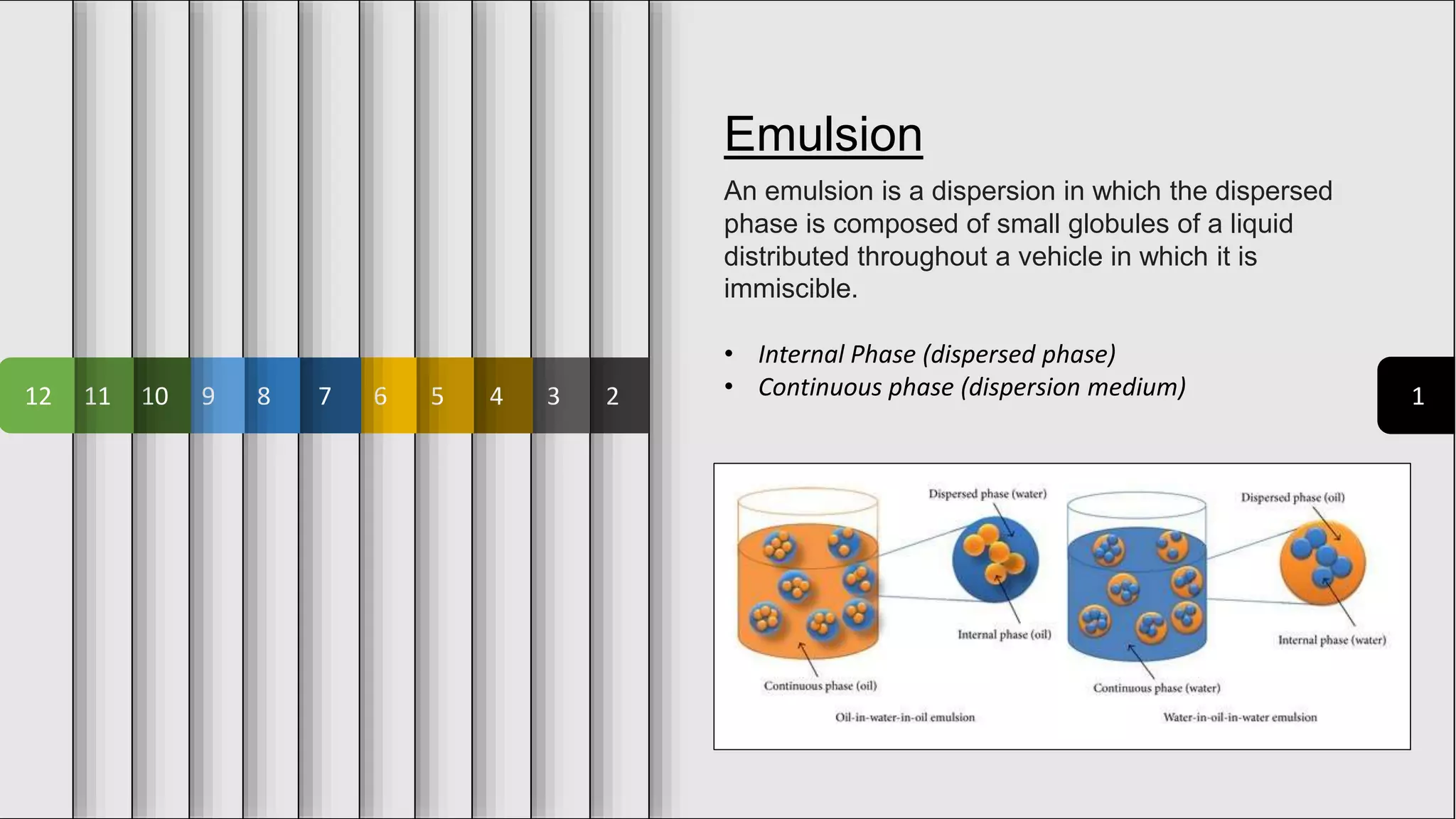
Emulsion
An emulsion is a dispersion in which the dispersed
phase is composed of small globules of a liquid
distributed throughout a vehicle in which it is
immiscible.
• Internal Phase (dispersed phase)
• Continuous phase (dispersion medium)
1
2
3
4
5
6
7
8
9
10
11
12
Purpose
1. Emulsification enables the pharmacist to prepare
relatively stable and homogeneous mixtures of
two immiscible liquids.
2. Enhanced palatability
3. Reduced particle size of oil globules enhance its
efficacy
4. Good for topical applications
Theories of emulsification
1. Surface Tension Theory
2. Oriented wedge theory
3. Plastic or interfacial theory
1
2
3
4
5
6
7
8
9
10
11
12
Surface Tension
Theory
When the liquid is in contact with a second liquid in
which it is insoluble and immiscible, the force
causing each liquid to resist breaking up into smaller
particles is called interfacial tension.
“The use of substances as emulsifiers and stabilizers
lowers the interfacial tension of the two immiscible
liquids, reducing the repellent force between the
liquids and diminishing each liquid’s attraction for its
own molecules.”
1
2
3
4
5
6
7
8
9
10
11
12
Oriented wedge theory
The oriented-wedge theory assumes monomolecular
layers of emulsifying agent curved around a droplet of
the internal phase of the emulsion.
1
2
3
4
5
6
7
8
9
10
11
12
Plastic or interfacial theory
The plastic or interfacial film theory places the
emulsifying agent at the interface between the oil
and water, surrounding the droplets of the
internal phase as a thin layer of film adsorbed on
the surface of the drops.
1
2
3
4
5
6
7
8
9
10
11
12
Emulsifying agents
1. Carbohydrate materials (acacia, tragacanth, pectin)
2. Protein substances (gelatin, egg yolk, casein)
3. High molecular weight alcohols (stearyl alcohol,
cetyl alcohol, and glyceryl monostearate)
4. Wetting agents (triethanolamine oleate,
benzalkonium chloride, sorbitan esters)
5. Finely divided solids (colloidal clays, including
bentonite, magnesium hydroxide, and aluminum
hydroxide)
1
2
3
4
5
6
7
8
9
10
11
12
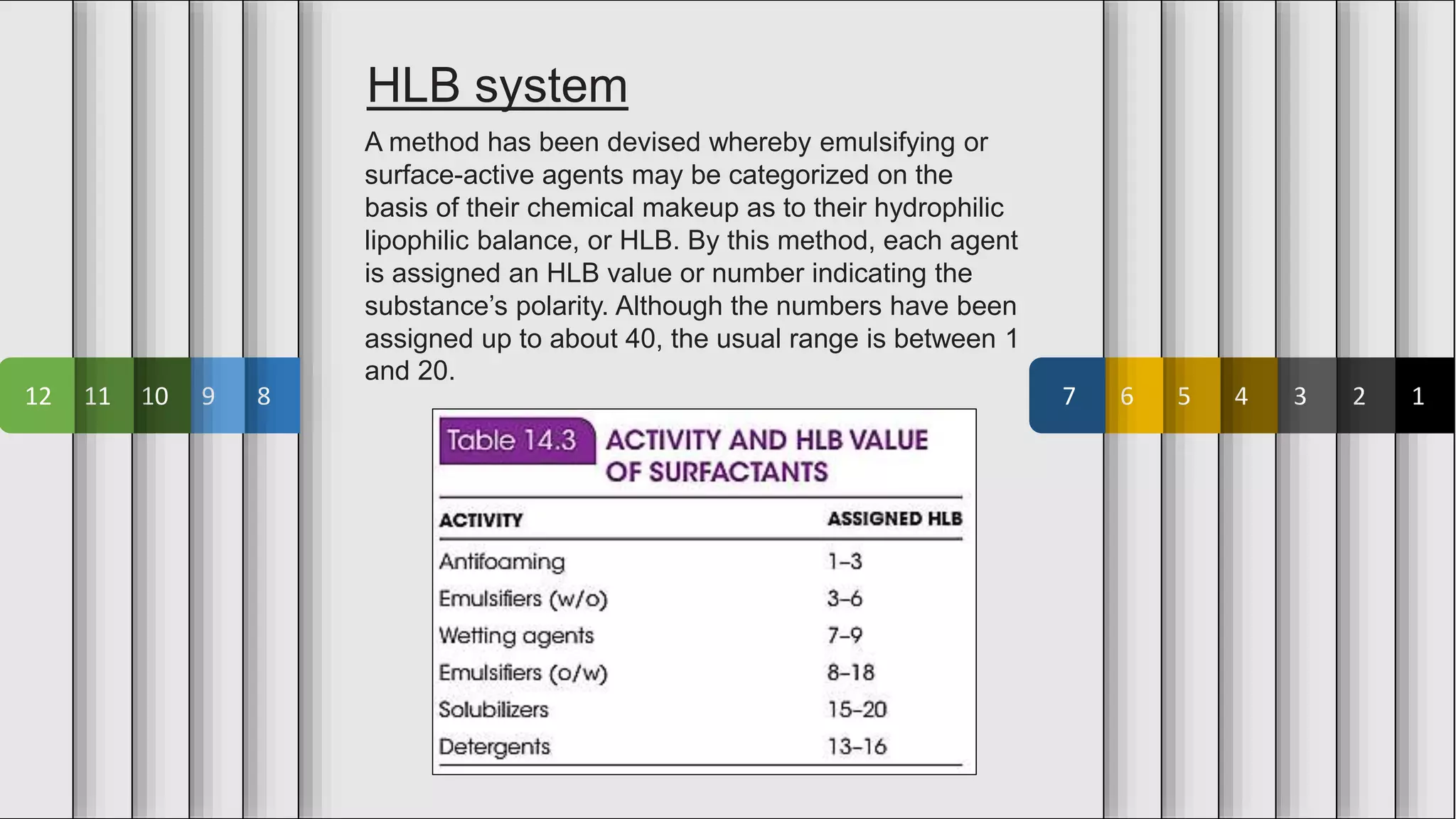
HLB system
A method has been devised whereby emulsifying or
surface-active agents may be categorized on the
basis of their chemical makeup as to their hydrophilic
lipophilic balance, or HLB. By this method, each agent
is assigned an HLB value or number indicating the
substance’s polarity. Although the numbers have been
assigned up to about 40, the usual range is between 1
and 20.
1
2
3
4
5
6
7
8
9
10
11
12
Methods of Preparation
1
2
3
4
5
6
7
8
9
10
11
12
The continental method is also referred to
as the 4:2:1 method because for every 4
parts by volume of oil, 2 parts of water and
1 part of gum are added in preparing the
initial or primary emulsion.
Order of mixing:
First add the 4 parts with 1 part, then add 2
parts to this mixture
1. Continental or Dry gum
method
2. English or Wet gum
method
Order of mixing is different
1
2
3
4
5
6
7
8
9
10
11
12
Bottle or Forbes bottle
method
The bottle method is useful for the extemporaneous
preparation of emulsions from volatile oils or
oleaginous substances of low viscosities. Powdered
acacia is placed in a dry bottle, two parts of oil are
added, and the mixture is thoroughly shaken in the
capped container. A volume of water approximately
equal to that of the oil is then added in portions and
the mixture thoroughly shaken after each addition.
When all of the water has been added, the primary
emulsion thus formed may be diluted to the proper
volume with water or an aqueous solution of other
formulative agents
1
2
3
4
5
6
7
8
9
10
11
12
Microemulsions are thermodynamically
stable, optically transparent isotropic
mixtures of a biphasic o/w system
stabilized with surfactants. The diameter
of droplets in a microemulsion may be in
the range of 100 Å to 1,000 Å, whereas
in a macroemulsion, the droplets may
be 5,000 Å in diameter.
Microemulsion
1
2
3
4
5
6
7
8
9
10
11
12
Thank You

Dispersion System 'Emulsions'

  • 1.
    1 2 3 4 5 6 7 8 9 10 11 12 DISPERSE SYSTEMS (Emulsions) ANSEL’S PHARMACEUTICALDOSAGE FORMS AND DRUG DELIVERY SYSTEMS :instructor: Fahad khan tareen
  • 2.
    1 2 3 4 5 6 7 8 9 10 11 12 Emulsion An emulsion isa dispersion in which the dispersed phase is composed of small globules of a liquid distributed throughout a vehicle in which it is immiscible. • Internal Phase (dispersed phase) • Continuous phase (dispersion medium)
  • 3.
    1 2 3 4 5 6 7 8 9 10 11 12 Purpose 1. Emulsification enablesthe pharmacist to prepare relatively stable and homogeneous mixtures of two immiscible liquids. 2. Enhanced palatability 3. Reduced particle size of oil globules enhance its efficacy 4. Good for topical applications Theories of emulsification 1. Surface Tension Theory 2. Oriented wedge theory 3. Plastic or interfacial theory
  • 4.
    1 2 3 4 5 6 7 8 9 10 11 12 Surface Tension Theory When theliquid is in contact with a second liquid in which it is insoluble and immiscible, the force causing each liquid to resist breaking up into smaller particles is called interfacial tension. “The use of substances as emulsifiers and stabilizers lowers the interfacial tension of the two immiscible liquids, reducing the repellent force between the liquids and diminishing each liquid’s attraction for its own molecules.”
  • 5.
    1 2 3 4 5 6 7 8 9 10 11 12 Oriented wedge theory Theoriented-wedge theory assumes monomolecular layers of emulsifying agent curved around a droplet of the internal phase of the emulsion.
  • 6.
    1 2 3 4 5 6 7 8 9 10 11 12 Plastic or interfacialtheory The plastic or interfacial film theory places the emulsifying agent at the interface between the oil and water, surrounding the droplets of the internal phase as a thin layer of film adsorbed on the surface of the drops.
  • 7.
    1 2 3 4 5 6 7 8 9 10 11 12 Emulsifying agents 1. Carbohydratematerials (acacia, tragacanth, pectin) 2. Protein substances (gelatin, egg yolk, casein) 3. High molecular weight alcohols (stearyl alcohol, cetyl alcohol, and glyceryl monostearate) 4. Wetting agents (triethanolamine oleate, benzalkonium chloride, sorbitan esters) 5. Finely divided solids (colloidal clays, including bentonite, magnesium hydroxide, and aluminum hydroxide)
  • 8.
    1 2 3 4 5 6 7 8 9 10 11 12 HLB system A methodhas been devised whereby emulsifying or surface-active agents may be categorized on the basis of their chemical makeup as to their hydrophilic lipophilic balance, or HLB. By this method, each agent is assigned an HLB value or number indicating the substance’s polarity. Although the numbers have been assigned up to about 40, the usual range is between 1 and 20.
  • 9.
  • 10.
    1 2 3 4 5 6 7 8 9 10 11 12 The continental methodis also referred to as the 4:2:1 method because for every 4 parts by volume of oil, 2 parts of water and 1 part of gum are added in preparing the initial or primary emulsion. Order of mixing: First add the 4 parts with 1 part, then add 2 parts to this mixture 1. Continental or Dry gum method 2. English or Wet gum method Order of mixing is different
  • 11.
    1 2 3 4 5 6 7 8 9 10 11 12 Bottle or Forbesbottle method The bottle method is useful for the extemporaneous preparation of emulsions from volatile oils or oleaginous substances of low viscosities. Powdered acacia is placed in a dry bottle, two parts of oil are added, and the mixture is thoroughly shaken in the capped container. A volume of water approximately equal to that of the oil is then added in portions and the mixture thoroughly shaken after each addition. When all of the water has been added, the primary emulsion thus formed may be diluted to the proper volume with water or an aqueous solution of other formulative agents
  • 12.
    1 2 3 4 5 6 7 8 9 10 11 12 Microemulsions are thermodynamically stable,optically transparent isotropic mixtures of a biphasic o/w system stabilized with surfactants. The diameter of droplets in a microemulsion may be in the range of 100 Å to 1,000 Å, whereas in a macroemulsion, the droplets may be 5,000 Å in diameter. Microemulsion
  • 13.