Disorders of the parathyroid
glands
Dr A Sankar
Asso Professor
Dept of Medicine
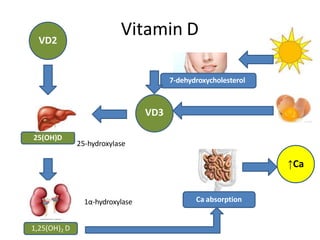
Vitamin D
25(OH)D
1,25(OH)2 D
7-dehydroxycholesterol
VD3
VD2
25-hydroxylase
1α-hydroxylase Ca absorption
↑Ca
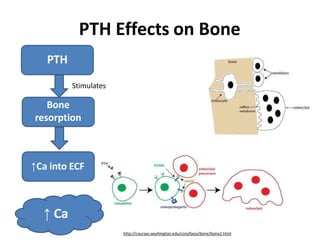
PTH Effects on Bone
PTH
Stimulates
Bone
resorption
↑Ca into ECF
↑ Ca
http://courses.washington.edu/conj/bess/bone/bone2.html
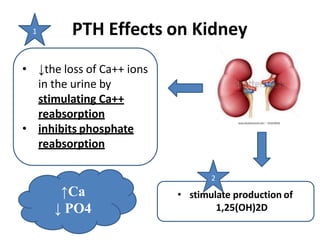
PTH Effects on Kidney
• ↓the loss of Ca++ ions
in the urine by
stimulating Ca++
reabsorption
• inhibits phosphate
reabsorption
• stimulate production of
1,25(OH)2D
↑Ca
↓ PO4
1
2
Endocrine Regulation of [Ca++]ECF
http://courses.washington.edu/conj/bess/calcium/calcium.html
1. PTH stimulates the release of Ca++ from
bone, in part by stimulating bone
resorption.
2. PTH decreases urinary loss of Ca++ by
stimulating Ca++ reabsorption.
3. PTH
stimulates
intestine
indirectly
Ca++ absorption in the small
by stimulating synthesis of
1,25(OH)2D in the kidney.
Parathyroid hormone
• Parathyroid hormone (PTH) plays a key role in
the regulation of calcium and phosphate
homeostasis and vitamin D metabolism.
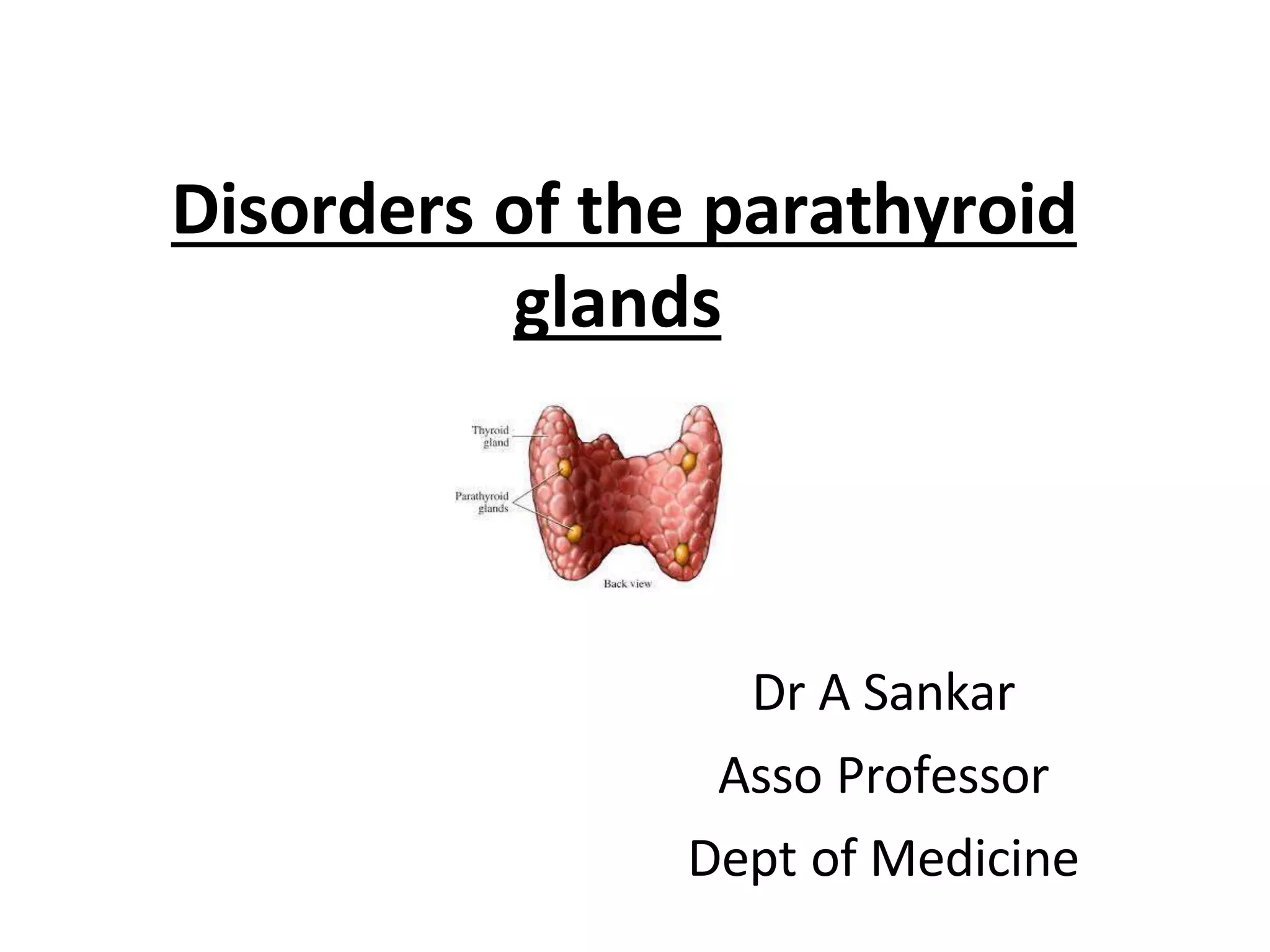
• The four parathyroid glands lie behind the
lobes of the thyroid. The parathyroid chief
cells respond directly to changes in calcium
concentrations When serum ionised calcium
levels fall, PTH secretion rises.
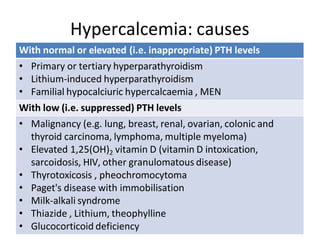
Hypercalcemia: causes
With normal or elevated (i.e. inappropriate) PTH levels
• Primary or tertiary hyperparathyroidism
• Lithium-induced hyperparathyroidism
• Familial hypocalciuric hypercalcaemia , MEN
With low (i.e. suppressed) PTH levels
• Malignancy (e.g. lung, breast, renal, ovarian, colonic and
thyroid carcinoma, lymphoma, multiple myeloma)
• Elevated 1,25(OH)2 vitamin D (vitamin D intoxication,
sarcoidosis, HIV, other granulomatous disease)
• Thyrotoxicosis , pheochromocytoma
• Paget's disease with immobilisation
• Milk-alkali syndrome
• Thiazide , Lithium, theophylline
• Glucocorticoid deficiency
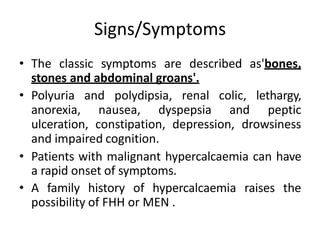
Signs/Symptoms
• The classic symptoms are described as'bones,
stones and abdominal groans'.
• Polyuria and polydipsia, renal colic, lethargy,
anorexia, nausea, dyspepsia and peptic
ulceration, constipation, depression, drowsiness
and impaired cognition.
• Patients with malignant hypercalcaemia can have
a rapid onset of symptoms.
• A family history of hypercalcaemia raises the
possibility of FHH or MEN .
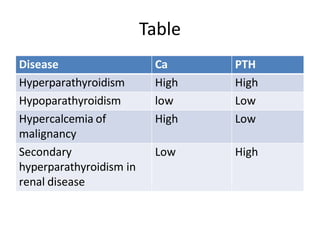
Table
Disease Ca PTH
Hyperparathyroidism High High
Hypoparathyroidism low Low
Hypercalcemia of
malignancy
High Low
Secondary
hyperparathyroidism in
renal disease
Low High
Hypercalcemia of malignancy
• one of the most common causes of non-PTH-
mediated hypercalcemia.
• DX : confirmed by demonstrating an ↑serum
concentration of PTH-related protein (PTHrp) .
• Levels of PTH and 1,25-dihydroxyvitamin D
(calcitriol) are usually appropriately
suppressed in these patients.
Management
• Mild /mod hypercalcemia : asymptomatic or
mildly symptomatic hypercalcemia (Ca <12
mg/dL do not require immediate Rx. However
maintain adequate hydration and avoid
factors that aggravate .
• Severe hypercalcemia : Patients with Ca >14
mg/dL require more aggressive Rx.
Severe Hypercalcemia
• Volume expansion with isotonic saline at an
initial rate of 200-300 mL/hr then adjusted to
maintain the UO at 100-150 mL/hour.
• Calcitonin
• If malignancy: zoledronic acid or pamidronate
• Hemodialysis
• Correct hyperparathyroidism if present
Hypocalcemia
• Hypocalcaemia is much less common than
hypercalcaemia.
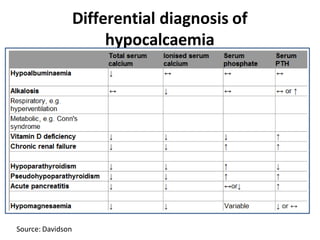
• The most common cause of hypocalcaemia is
a low serum albumin with normal ionised
calcium concentration.
Differential diagnosis of
hypocalcaemia
Source: Davidson
Hypocalcemia:Clinical manifestation
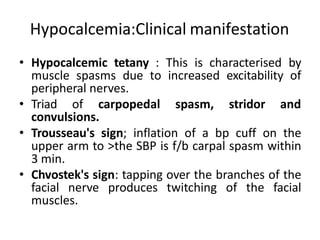
• Hypocalcemic tetany : This is characterised by
muscle spasms due to increased excitability of
peripheral nerves.
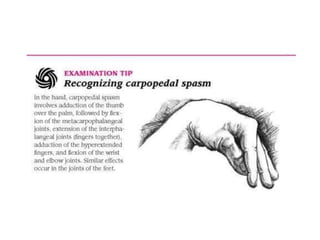
• Triad of carpopedal spasm, stridor and
convulsions.
• Trousseau's sign; inflation of a bp cuff on the
upper arm to >the SBP is f/b carpal spasm within
3 min.
• Chvostek's sign: tapping over the branches of the
facial nerve produces twitching of the facial
muscles.
Management
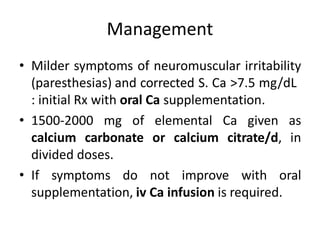
• Milder symptoms of neuromuscular irritability
(paresthesias) and corrected S. Ca >7.5 mg/dL
: initial Rx with oral Ca supplementation.
• 1500-2000 mg of elemental Ca given as
calcium carbonate or calcium citrate/d, in
divided doses.
• If symptoms do not improve with oral
supplementation, iv Ca infusion is required.
Management of severe
hypocalcaemia
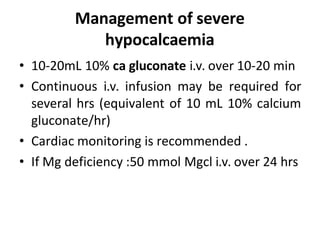
• 10-20mL 10% ca gluconate i.v. over 10-20 min
• Continuous i.v. infusion may be required for
several hrs (equivalent of 10 mL 10% calcium
gluconate/hr)
• Cardiac monitoring is recommended .
• If Mg deficiency :50 mmol Mgcl i.v. over 24 hrs
Hyperparathyroidism
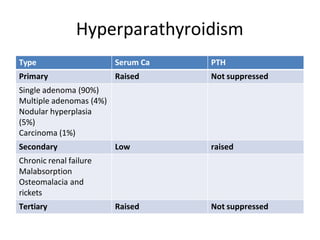
Type Serum Ca PTH
Primary Raised Not suppressed
Single adenoma (90%)
Multiple adenomas (4%)
Nodular hyperplasia
(5%)
Carcinoma (1%)
Secondary Low raised
Chronic renal failure
Malabsorption
Osteomalacia and
rickets
Tertiary Raised Not suppressed
Multiple endocrine neoplasia
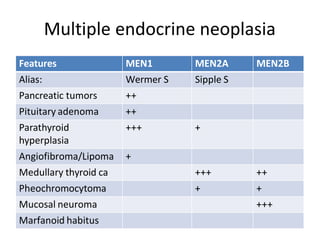
Features MEN1 MEN2A MEN2B
Alias: Wermer S Sipple S
Pancreatic tumors ++
Pituitary adenoma ++
Parathyroid
hyperplasia
+++ +
Angiofibroma/Lipoma +
Medullary thyroid ca +++ ++
Pheochromocytoma + +
Mucosal neuroma +++
Marfanoid habitus
Primary Hyperthyroidsm :
Clinical features
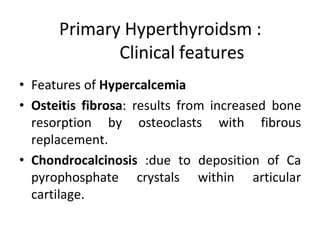
• Features of Hypercalcemia
• Osteitis fibrosa: results from increased bone
resorption by osteoclasts with fibrous
replacement.
• Chondrocalcinosis :due to deposition of Ca
pyrophosphate crystals within articular
cartilage.
Imaging
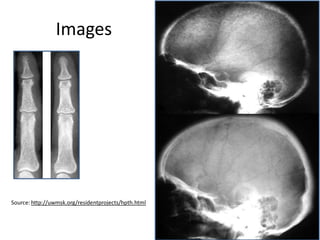
• In the early stages there is demineralisation, with
subperiosteal erosions and terminal resorption in the
phalanges.
• A 'pepper-pot' appearance :lateral X-rays of the skull.
• Reduced bone mineral density, resulting in either
osteopenia or osteoporosis. And is assessed by DEXA
• In nephrocalcinosis, scattered opacities within the
renal outline.
• There may be soft tissue calcification in arterial walls,
soft tissues of the hands and the cornea.
Images
Source: http://uwmsk.org/residentprojects/hpth.html
Investigations
• The diagnosis can be confirmed by finding a
raised PTH level in the presence of
hypercalcaemia, provided that FHH is
excluded.
• Parathyroid scanning by 99mTc-sestamibi
scintigraphy or ultrasound examination to
localise an adenoma and allow a targeted
resection.
Management
• Surgery
• Post op vit D and Calcium supplements
according to lab values.
• Treatment of Hypercalcemia
Hypoparathyroidism
• The MC cause is damage to the parathyroid
glands (or their bld supply) during thyroid Sx.
• Rarely, hypoparathyroidism can occur as a
result of infiltration of the glands, e.g. in
haemochromatosis and Wilson's disease.
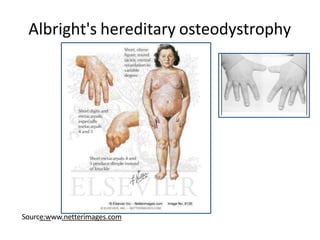
Albright's hereditary osteodystrophy
Source:www.netterimages.com
Pseudohypoparathyroidism
• The disorder is characterized by a lack of
responsiveness to PTH, resulting in ↓ Ca, ↑Po4,
and appropriately ↑ PTH.
• Individuals with Albright’s hereditary
osteodystrophy have short stature, shortened 4th
& 5th metacarpals, rounded facies, and often
mild mental retardation.
• The kidney responds as if PTH were absent. The
PTH receptor itself is normal, but there are
defective post-receptor mechanisms due to
mutations.
Management of hypoparathyroidism
• Persistent hypoparathyroidism and
pseudohypoparathyroidism are Rx with oral
calcium salts and vitamin D analogues, either
1α-hydroxycholecalciferol (alfacalcidol) or
1,25-dihydroxycholecalciferol (calcitriol).
• Recombinant PTH is available as SC injection
therapy for osteoporosis.
THANK YOU

disordersoftheparathyroidglands-141113110252-conversion-gate02 (1).pdf

  • 1.
    Disorders of theparathyroid glands Dr A Sankar Asso Professor Dept of Medicine
  • 2.
  • 3.
    PTH Effects onBone PTH Stimulates Bone resorption ↑Ca into ECF ↑ Ca http://courses.washington.edu/conj/bess/bone/bone2.html
  • 4.
    PTH Effects onKidney • ↓the loss of Ca++ ions in the urine by stimulating Ca++ reabsorption • inhibits phosphate reabsorption • stimulate production of 1,25(OH)2D ↑Ca ↓ PO4 1 2
  • 5.
    Endocrine Regulation of[Ca++]ECF http://courses.washington.edu/conj/bess/calcium/calcium.html 1. PTH stimulates the release of Ca++ from bone, in part by stimulating bone resorption. 2. PTH decreases urinary loss of Ca++ by stimulating Ca++ reabsorption. 3. PTH stimulates intestine indirectly Ca++ absorption in the small by stimulating synthesis of 1,25(OH)2D in the kidney.
  • 6.
    Parathyroid hormone • Parathyroidhormone (PTH) plays a key role in the regulation of calcium and phosphate homeostasis and vitamin D metabolism. • The four parathyroid glands lie behind the lobes of the thyroid. The parathyroid chief cells respond directly to changes in calcium concentrations When serum ionised calcium levels fall, PTH secretion rises.
  • 7.
    Hypercalcemia: causes With normalor elevated (i.e. inappropriate) PTH levels • Primary or tertiary hyperparathyroidism • Lithium-induced hyperparathyroidism • Familial hypocalciuric hypercalcaemia , MEN With low (i.e. suppressed) PTH levels • Malignancy (e.g. lung, breast, renal, ovarian, colonic and thyroid carcinoma, lymphoma, multiple myeloma) • Elevated 1,25(OH)2 vitamin D (vitamin D intoxication, sarcoidosis, HIV, other granulomatous disease) • Thyrotoxicosis , pheochromocytoma • Paget's disease with immobilisation • Milk-alkali syndrome • Thiazide , Lithium, theophylline • Glucocorticoid deficiency
  • 8.
    Signs/Symptoms • The classicsymptoms are described as'bones, stones and abdominal groans'. • Polyuria and polydipsia, renal colic, lethargy, anorexia, nausea, dyspepsia and peptic ulceration, constipation, depression, drowsiness and impaired cognition. • Patients with malignant hypercalcaemia can have a rapid onset of symptoms. • A family history of hypercalcaemia raises the possibility of FHH or MEN .
  • 9.
    Table Disease Ca PTH HyperparathyroidismHigh High Hypoparathyroidism low Low Hypercalcemia of malignancy High Low Secondary hyperparathyroidism in renal disease Low High
  • 10.
    Hypercalcemia of malignancy •one of the most common causes of non-PTH- mediated hypercalcemia. • DX : confirmed by demonstrating an ↑serum concentration of PTH-related protein (PTHrp) . • Levels of PTH and 1,25-dihydroxyvitamin D (calcitriol) are usually appropriately suppressed in these patients.
  • 11.
    Management • Mild /modhypercalcemia : asymptomatic or mildly symptomatic hypercalcemia (Ca <12 mg/dL do not require immediate Rx. However maintain adequate hydration and avoid factors that aggravate . • Severe hypercalcemia : Patients with Ca >14 mg/dL require more aggressive Rx.
  • 12.
    Severe Hypercalcemia • Volumeexpansion with isotonic saline at an initial rate of 200-300 mL/hr then adjusted to maintain the UO at 100-150 mL/hour. • Calcitonin • If malignancy: zoledronic acid or pamidronate • Hemodialysis • Correct hyperparathyroidism if present
  • 13.
    Hypocalcemia • Hypocalcaemia ismuch less common than hypercalcaemia. • The most common cause of hypocalcaemia is a low serum albumin with normal ionised calcium concentration.
  • 14.
  • 15.
    Hypocalcemia:Clinical manifestation • Hypocalcemictetany : This is characterised by muscle spasms due to increased excitability of peripheral nerves. • Triad of carpopedal spasm, stridor and convulsions. • Trousseau's sign; inflation of a bp cuff on the upper arm to >the SBP is f/b carpal spasm within 3 min. • Chvostek's sign: tapping over the branches of the facial nerve produces twitching of the facial muscles.
  • 17.
    Management • Milder symptomsof neuromuscular irritability (paresthesias) and corrected S. Ca >7.5 mg/dL : initial Rx with oral Ca supplementation. • 1500-2000 mg of elemental Ca given as calcium carbonate or calcium citrate/d, in divided doses. • If symptoms do not improve with oral supplementation, iv Ca infusion is required.
  • 18.
    Management of severe hypocalcaemia •10-20mL 10% ca gluconate i.v. over 10-20 min • Continuous i.v. infusion may be required for several hrs (equivalent of 10 mL 10% calcium gluconate/hr) • Cardiac monitoring is recommended . • If Mg deficiency :50 mmol Mgcl i.v. over 24 hrs
  • 19.
    Hyperparathyroidism Type Serum CaPTH Primary Raised Not suppressed Single adenoma (90%) Multiple adenomas (4%) Nodular hyperplasia (5%) Carcinoma (1%) Secondary Low raised Chronic renal failure Malabsorption Osteomalacia and rickets Tertiary Raised Not suppressed
  • 20.
    Multiple endocrine neoplasia FeaturesMEN1 MEN2A MEN2B Alias: Wermer S Sipple S Pancreatic tumors ++ Pituitary adenoma ++ Parathyroid hyperplasia +++ + Angiofibroma/Lipoma + Medullary thyroid ca +++ ++ Pheochromocytoma + + Mucosal neuroma +++ Marfanoid habitus
  • 21.
    Primary Hyperthyroidsm : Clinicalfeatures • Features of Hypercalcemia • Osteitis fibrosa: results from increased bone resorption by osteoclasts with fibrous replacement. • Chondrocalcinosis :due to deposition of Ca pyrophosphate crystals within articular cartilage.
  • 22.
    Imaging • In theearly stages there is demineralisation, with subperiosteal erosions and terminal resorption in the phalanges. • A 'pepper-pot' appearance :lateral X-rays of the skull. • Reduced bone mineral density, resulting in either osteopenia or osteoporosis. And is assessed by DEXA • In nephrocalcinosis, scattered opacities within the renal outline. • There may be soft tissue calcification in arterial walls, soft tissues of the hands and the cornea.
  • 23.
  • 24.
    Investigations • The diagnosiscan be confirmed by finding a raised PTH level in the presence of hypercalcaemia, provided that FHH is excluded. • Parathyroid scanning by 99mTc-sestamibi scintigraphy or ultrasound examination to localise an adenoma and allow a targeted resection.
  • 25.
    Management • Surgery • Postop vit D and Calcium supplements according to lab values. • Treatment of Hypercalcemia
  • 26.
    Hypoparathyroidism • The MCcause is damage to the parathyroid glands (or their bld supply) during thyroid Sx. • Rarely, hypoparathyroidism can occur as a result of infiltration of the glands, e.g. in haemochromatosis and Wilson's disease.
  • 27.
  • 28.
    Pseudohypoparathyroidism • The disorderis characterized by a lack of responsiveness to PTH, resulting in ↓ Ca, ↑Po4, and appropriately ↑ PTH. • Individuals with Albright’s hereditary osteodystrophy have short stature, shortened 4th & 5th metacarpals, rounded facies, and often mild mental retardation. • The kidney responds as if PTH were absent. The PTH receptor itself is normal, but there are defective post-receptor mechanisms due to mutations.
  • 29.
    Management of hypoparathyroidism •Persistent hypoparathyroidism and pseudohypoparathyroidism are Rx with oral calcium salts and vitamin D analogues, either 1α-hydroxycholecalciferol (alfacalcidol) or 1,25-dihydroxycholecalciferol (calcitriol). • Recombinant PTH is available as SC injection therapy for osteoporosis.
  • 30.