Abnormal Psychology
Module 1: Understanding Abnormal Behavior
Module Learning Outcomes
Understanding Abnormal Behavior
1.1: Define mental disorders and explain how they are classified
1.2: Describe the basic features of the Diagnostic and Statistical Manual of
Mental Disorders and how it is used to classify disorders
1.3: Describe and discuss various psychological assessment techniques
Mental Disorders and Classification
Understanding Mental Disorders and Classification
1.1: Define mental disorders and explain how they are classified
1.1.1: Describe how psychological disorders are defined, as well as the
inherent difficulties in doing so
1.1.2: Describe etiological theories (supernatural, somatogenic, and
psychogenic) used to explain mental illness up through the Middle Ages
1.1.3: Explain the rationale for deinstitutionalization, and its impact
1.1.4: Describe the ways in which mental health services are delivered
today, including the distinction between voluntary and involuntary treatment
Class Activity: What are Psychological Disorders?
Write down your responses to the following questions and prepare for discussion.
• What comes to your mind when you think of “Psychological Disorder”?
• How do you think your generation views mental disorders or mental illness?
• How do you think this might differ from other generations?
Abnormal Psychology Overview
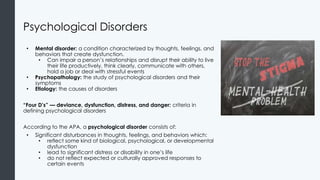
Psychological Disorders
• Mental disorder: a condition characterized by thoughts, feelings, and
behaviors that create dysfunction.
• Can impair a person’s relationships and disrupt their ability to live
their life productively, think clearly, communicate with others,
hold a job or deal with stressful events
• Psychopathology: the study of psychological disorders and their
symptoms
• Etiology: the causes of disorders
“Four D’s” — deviance, dysfunction, distress, and danger: criteria in
defining psychological disorders
According to the APA, a psychological disorder consists of:
• Significant disturbances in thoughts, feelings, and behaviors which:
• reflect some kind of biological, psychological, or developmental
dysfunction
• lead to significant distress or disability in one’s life
• do not reflect expected or culturally approved responses to
certain events
Ancient Views of Mental Illness
• Etiological Theories:
• Supernatural theories: attribute mental illness to
possession by evil or demonic spirits, displeasure of gods,
eclipses, planetary gravitation, curses, and sin.
• Somatogenic theories: identify disturbances in physical
functioning resulting from either illness, genetic
inheritance, or brain damage or imbalance.
• Psychogenic theories: focus on traumatic or stressful
experiences, maladaptive learned associations and
cognitions, or distorted perceptions
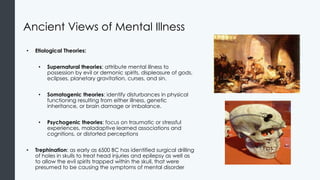
• Trephination: as early as 6500 BC has identified surgical drilling
of holes in skulls to treat head injuries and epilepsy as well as
to allow the evil spirits trapped within the skull, that were
presumed to be causing the symptoms of mental disorder
Deinstitutionalization
• Asylums: the first institutions created for the specific purpose of
housing people with psychological disorders
• The focus was ostracizing them from society rather than
treating their disorders
• Late 1700s, a French physician, Philippe Pinel, argued for
the more humane treatment of the mentally ill
• In the 19th century, Dorothea Dix led reform efforts for
mental health care in the United States
• Emil Kraepelin: founder of modern scientific psychiatry,
psychopharmacology, and psychiatric genetics and believed
the chief origin of psychiatric disease to be biological and
genetic malfunction
• Dementia praecox: Kraepelin’s definition for what we now
call schizophrenia; the "sub-acute development of a
peculiar simple condition of mental weakness occurring at
a youthful age”
• Syndrome: common patterns of symptoms over time (rather
than by simple similarity of major symptoms)
Current Mental Health Services
Biopsychosocial model: model emphasizing the various factors
influencing disorders. While some have a genetic predisposition
for a certain psychological disorder, certain psychological
stressors need to be present for them to develop the disorder.
• Involuntary treatment: therapy that is not the individual’s
choice. Other individuals might voluntarily seek treatment.
• Voluntary treatment: the individual chooses to attend
therapy to obtain relief from symptoms
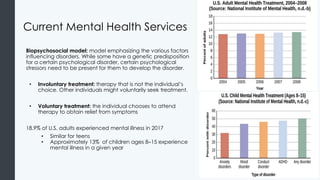
18.9% of U.S. adults experienced mental illness in 2017
• Similar for teens
• Approximately 13% of children ages 8–15 experience
mental illness in a given year
Practice Question 1
Which of the following individuals was associated with ending physical
punishment of patients within asylums?
A. Phillippe Pinel
B. Dorothea Dix
C. Emil Kraepelin
D. Sigmund Freud
DSM Classification
Understanding DSM Classification
1.2: Describe the basic features of the Diagnostic and Statistical
Manual of Mental Disorders and how it is used to classify disorders
1.2.1: Describe the basic features of the Diagnostic and Statistical Manual of
Mental Disorders, Fifth Edition (DSM-5) and how it is used to classify disorders
1.2.2: Outline the major disorder categories of the DSM-5
1.2.3: Explain how the International Classification of Diseases is used to classify
mental disorders
1.2.4: Explain steps of the diagnostic process, including the case formulation
1.2.5: Discuss arguments and objections surrounding the DSM classification
system
1.2.6: Describe problems associated with classification and labeling
1.2.7: Describe the types of stigma associated with mental disorder
DSM-V Simplified
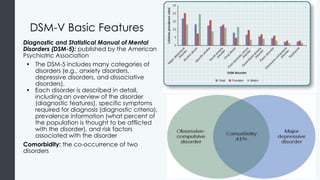
DSM-V Basic Features
Diagnostic and Statistical Manual of Mental
Disorders (DSM-5): published by the American
Psychiatric Association
• The DSM-5 includes many categories of
disorders (e.g., anxiety disorders,
depressive disorders, and dissociative
disorders).
• Each disorder is described in detail,
including an overview of the disorder
(diagnostic features), specific symptoms
required for diagnosis (diagnostic criteria),
prevalence information (what percent of
the population is thought to be afflicted
with the disorder), and risk factors
associated with the disorder
Comorbidity: the co-occurrence of two
disorders
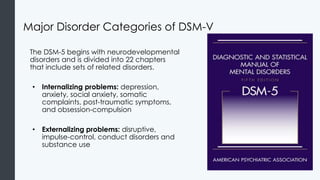
Major Disorder Categories of DSM-V
The DSM-5 begins with neurodevelopmental
disorders and is divided into 22 chapters
that include sets of related disorders.
• Internalizing problems: depression,
anxiety, social anxiety, somatic
complaints, post-traumatic symptoms,
and obsession-compulsion
• Externalizing problems: disruptive,
impulse-control, conduct disorders and
substance use
International Classification of Diseases
• ICD-11: the 11th revision of the International
Classification of Diseases and will eventually replace
the ICD-10 as the global standard for coding health
information and causes of death.
• Will officially come into effect on January 1,
2022
• In conjunction with changes in DSM-5, the ICD-
11 will help harmonize the two classification
systems
• A study that compared the use of the two
classification systems found that worldwide, the ICD
is more frequently used for clinical diagnosis,
whereas the DSM is more valued for research
• Most research findings concerning the etiology and
treatment of psychological disorders are based on
criteria set forth in the DSM
• DSM is the classification system of choice among U.S.
mental health professionals, and the modules in this
course are based on the DSM paradigm.
Steps of the Diagnostic Process
Diagnosis: commonly refers to the identification of the nature and
cause of an illness
• Clinician: a professional who works directly with patients or
clients and may diagnose, treat, and otherwise care for them
• Mental status examination: where evaluations are made of
appearance and behavior, self-reported symptoms, mental
health history, and current life circumstances
• Principal diagnosis: determining the single diagnosis that is
most relevant to the person's chief complaint or need for
treatment
• this will be the main focus of clinical attention or treatment
• Comorbidity: the presence of more than one diagnosis
occurring in an individual at the same time
• Clinical formulation: a theoretically-based explanation of the
information obtained from a clinical assessment
• Cultural formulation: the systematic review of a person's
cultural background and the role of culture in the
manifestation of symptoms and dysfunction
• Treatment plan: type of contract that specifies the goals of
treatment, treatment procedures, and a regular schedule for
the time, place, and duration of their treatment sessions
Arguments for/against DSM-5
Positive:
• Wide acceptance and use of the DSM system
• Revisions of the DSM from the 3rd Edition forward have been mainly
concerned with diagnostic reliability—the degree to which different
diagnosticians agree on a diagnosis
• Useful to insurance companies who adopt its use to establish
coverage for certain clinical disorders
• Helpful in allowing researchers and clinicians to have a common
language with which to discuss clients
• DSM-IV organized diagnoses using five separate axes (clinical
disorders, personality disorders, general medical disorders, and then
sections on psychosocial and environmental factors, and the global
assessment of functioning)
• The inclusion of dimensions in diagnoses; for example, how severely
ill is a patient with schizophrenia or depression
Negative:
• Limitations reflected in the terminology related to diagnosis itself
• Since the DSM III, the goal was to improve the uniformity and validity
of psychiatric diagnosis in the wake of a number of critiques
• Critics believe the DSM needs to become more sensitive to the
importance of cultural and ethnic factors in diagnostic assessment
Classification and Labeling Problems
Labeling: occurs when information about a person's
diagnostic classification is communicated in a
negative manner that leads to stigma for the
individual with a mental disorder
• The labeling theory was first applied to the term
"mentally ill" in 1966 when Thomas J. Scheff
published Being Mentally Ill.
Labeling theory: posits that self-identity and the
behavior of individuals may be determined or
influenced by the terms used to describe or classify
them
• Labeling theory is associated with the concepts
of self-fulfilling prophecy and stereotyping
Mental Illness Stigma
Some negative stereotypes about individuals with
mental health problems are that they are considered
dangerous, unpredictable, and difficult to talk to.
• Stereotype: an expectation that people might
have about every person of a particular group.
• Public stigma: a set of negative attitudes and
beliefs that motivate individuals to fear, reject,
avoid, and discriminate against people with
mental illness
• Self-stigma: is thought to be particularly
damaging, and is said to occur when individuals
internalize stigmatizing social attitudes, and
come to believe the negative societal
conceptions and stereotypes associated with
their condition
• Stigma expectations: “the extent to which
individuals believe that ‘most people’ will
devalue and discriminate against a mental
patient” do not differ between individuals with
and without mental health problems or history of
treatment
Practice Question 2
How many chapters are part of the current Diagnostic Statistical Manual of
Mental Disorders or DSM-V?
A. 15
B. 20
C. 22
D. 23
Evaluation and Assessment of Mental
Disorders
Evaluation and Assessment
1.3: Describe and discuss various psychological assessment techniques
1.3.1: Describe the types and purposes of psychological assessment
1.3.2: Describe clinical interviews and the mental status examination
1.3.3: Explain why intelligence testing is used and the various types of
intelligence testing
1.3.4: Describe personality testing, including self-report inventories and
projective personality tests
1.3.5: Describe how cognitive and behavioral assessments are used to inform
psychotherapy
Types and Purposes of Psychological Assessment
Psychological tests: written, visual, or verbal evaluations
administered to assess the cognitive and emotional functioning of
clients or patients
Standardized tests: are administered and scored in a consistent
manner and the questions, conditions for administering, scoring
procedures, and interpretations are consistent and are
administered and scored in a predetermined, standard manner
Psychological assessments are most often used in the psychiatric,
medical, legal, educational, or psychological clinic settings
● Intelligence & achievement tests: Designed to measure
certain specific kinds of cognitive functioning (often referred
to as IQ) in comparison to a norming group
● Personality tests: aim to describe patterns of behavior,
thoughts, and feelings
● Neuropsychological tests: consist of specifically designed
tasks used to measure psychological functions known to be
linked to a particular brain structure or pathway
● Diagnostic Measurement Tools: Clinical psychologists are able
to diagnose psychological disorders and related disorders
found in the DSM-5 and ICD-10
● Clinical observation: Clinical psychologists are also trained to
gather data by observing behavior
Clinical Interviews and Mental Status Exam
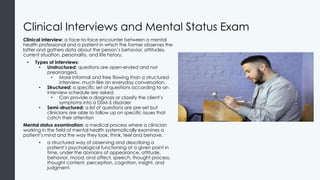
Clinical interview: a face-to-face encounter between a mental
health professional and a patient in which the former observes the
latter and gathers data about the person’s behavior, attitudes,
current situation, personality, and life history.
• Types of Interviews:
• Unstructured: questions are open-ended and not
prearranged.
• More informal and free flowing than a structured
interview, much like an everyday conversation.
• Structured: a specific set of questions according to an
interview schedule are asked.
• Can provide a diagnosis or classify the client’s
symptoms into a DSM-5 disorder
• Semi-structured: a list of questions are pre-set but
clinicians are able to follow up on specific issues that
catch their attention
Mental status examination: a medical process where a clinician
working in the field of mental health systematically examines a
patient’s mind and the way they look, think, feel and behave.
• a structured way of observing and describing a
patient’s psychological functioning at a given point in
time, under the domains of appearance, attitude,
behavior, mood, and affect, speech, thought process,
thought content, perception, cognition, insight, and
judgment.
Class Discussion: Visiting a Therapist
• If you were to visit a therapist or mental health counselor, what things might
take place during your first few appointments?
• How does a therapist make a diagnosis?
• What are the benefits of getting a diagnosis?
Intelligence Testing
Intelligent testing is important for children who seem to be
experiencing learning difficulties or severe behavioral
problems.
• can be used to ascertain whether the child’s
difficulties can be partly attributed to an IQ score
that is significantly different from the mean for her
age group
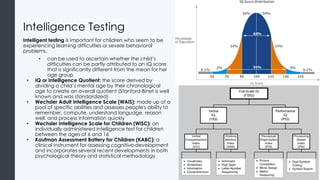
• IQ or Intelligence Quotient: the score derived by
dividing a child’s mental age by their chronological
age to create an overall quotient (Stanford-Binet is well
known and was standardized)
• Wechsler Adult Intelligence Scale (WAIS): made up of a
pool of specific abilities and assesses people's ability to
remember, compute, understand language, reason
well, and process information quickly
• Wechsler Intelligence Scale for Children (WISC): an
individually administered intelligence test for children
between the ages of 6 and 16
• Kaufman Assessment Battery for Children (KABC): a
clinical instrument for assessing cognitive development
and incorporates several recent developments in both
psychological theory and statistical methodology
Personality Testing
• Self-report inventories: a kind of objective test used to assess
personality
• standardized questions with fixed response categories that
the test-taker completes independently
• Minnesota Multiphasic Personality Inventory (MMPI): The original MMPI
was based on a small, limited sample, composed mostly of Minnesota
farmers and psychiatric patients.
• Now the responses are scored to produce a clinical profile
composed of 10 scales: hypochondriasis, depression, hysteria,
psychopathic deviance, masculinity versus femininity, paranoia,
psychasthenia , schizophrenia, hypomania, and social introversion
• Projective testing: sometimes called performance-based testing
• Rorschach Inkblot Test: a series of symmetrical inkblot cards that are
presented to a client by a psychologist
• what the test-taker sees reveals unconscious feelings and
struggles
• Thematic Apperception Test (TAT): a person taking the TAT is shown 8–
12 ambiguous pictures and is asked to tell a story about each picture
• the stories give insight into their social world, revealing hopes,
fears, interests, and goals
• Rotter Incomplete Sentence Blank (RISB): there are three forms of this
test for use with different age groups: the school form, the college form,
and the adult form
• people are asked to complete as quickly as possible, and it is
presumed that responses will reveal desires, fears, and struggles
Cognitive and Behavioral Assessments
Cognitive assessments: are useful to test for cognitive or
neurological impairments, deficiencies in knowledge, thought
process, or judgment
• MMSE: usually takes less than ten minutes to administer but
is now used less frequently due to copyright laws and
additional costs
• MoCA: a popular screening tool that evaluates visuospatial
skills, attention, language, abstract reasoning, delayed
recall, executive function, and orientation
• Mini-Cog: one of the faster cognitive assessment screens
used. Tests memory, while the clock drawing test evaluates
cognitive function, language, executive function, and
visuospatial skills
Behavioral assessment: involves the identification and
measurement of particular behaviors and the variables
affecting their occurrence
• Child Behavior Checklist (CBCL): a widely used caregiver
report form identifying problem behavior in children and
examines: Aggressive Behavior, Anxious/Depressed,
Attention Problems, Rule-Breaking Behavior, Somatic
Complaints, Social Problems, Thought Problems,
Withdrawn/Depressed
Practice Question 3
Which of the following Personality tests focuses on examining instantaneous
unconscious factors by asking for word association with an abstract image?
A. MMPI
B. TAT
C. Rorschach’s
D. RISB

Abnormal+Psychology+Module+1+Understanding+Abnormal+Behavior+PPT.pptx

  • 1.
    Abnormal Psychology Module 1:Understanding Abnormal Behavior
  • 2.
    Module Learning Outcomes UnderstandingAbnormal Behavior 1.1: Define mental disorders and explain how they are classified 1.2: Describe the basic features of the Diagnostic and Statistical Manual of Mental Disorders and how it is used to classify disorders 1.3: Describe and discuss various psychological assessment techniques
  • 3.
    Mental Disorders andClassification
  • 4.
    Understanding Mental Disordersand Classification 1.1: Define mental disorders and explain how they are classified 1.1.1: Describe how psychological disorders are defined, as well as the inherent difficulties in doing so 1.1.2: Describe etiological theories (supernatural, somatogenic, and psychogenic) used to explain mental illness up through the Middle Ages 1.1.3: Explain the rationale for deinstitutionalization, and its impact 1.1.4: Describe the ways in which mental health services are delivered today, including the distinction between voluntary and involuntary treatment
  • 5.
    Class Activity: Whatare Psychological Disorders? Write down your responses to the following questions and prepare for discussion. • What comes to your mind when you think of “Psychological Disorder”? • How do you think your generation views mental disorders or mental illness? • How do you think this might differ from other generations?
  • 6.
  • 7.
    Psychological Disorders • Mentaldisorder: a condition characterized by thoughts, feelings, and behaviors that create dysfunction. • Can impair a person’s relationships and disrupt their ability to live their life productively, think clearly, communicate with others, hold a job or deal with stressful events • Psychopathology: the study of psychological disorders and their symptoms • Etiology: the causes of disorders “Four D’s” — deviance, dysfunction, distress, and danger: criteria in defining psychological disorders According to the APA, a psychological disorder consists of: • Significant disturbances in thoughts, feelings, and behaviors which: • reflect some kind of biological, psychological, or developmental dysfunction • lead to significant distress or disability in one’s life • do not reflect expected or culturally approved responses to certain events
  • 8.
    Ancient Views ofMental Illness • Etiological Theories: • Supernatural theories: attribute mental illness to possession by evil or demonic spirits, displeasure of gods, eclipses, planetary gravitation, curses, and sin. • Somatogenic theories: identify disturbances in physical functioning resulting from either illness, genetic inheritance, or brain damage or imbalance. • Psychogenic theories: focus on traumatic or stressful experiences, maladaptive learned associations and cognitions, or distorted perceptions • Trephination: as early as 6500 BC has identified surgical drilling of holes in skulls to treat head injuries and epilepsy as well as to allow the evil spirits trapped within the skull, that were presumed to be causing the symptoms of mental disorder
  • 9.
    Deinstitutionalization • Asylums: thefirst institutions created for the specific purpose of housing people with psychological disorders • The focus was ostracizing them from society rather than treating their disorders • Late 1700s, a French physician, Philippe Pinel, argued for the more humane treatment of the mentally ill • In the 19th century, Dorothea Dix led reform efforts for mental health care in the United States • Emil Kraepelin: founder of modern scientific psychiatry, psychopharmacology, and psychiatric genetics and believed the chief origin of psychiatric disease to be biological and genetic malfunction • Dementia praecox: Kraepelin’s definition for what we now call schizophrenia; the "sub-acute development of a peculiar simple condition of mental weakness occurring at a youthful age” • Syndrome: common patterns of symptoms over time (rather than by simple similarity of major symptoms)
  • 10.
    Current Mental HealthServices Biopsychosocial model: model emphasizing the various factors influencing disorders. While some have a genetic predisposition for a certain psychological disorder, certain psychological stressors need to be present for them to develop the disorder. • Involuntary treatment: therapy that is not the individual’s choice. Other individuals might voluntarily seek treatment. • Voluntary treatment: the individual chooses to attend therapy to obtain relief from symptoms 18.9% of U.S. adults experienced mental illness in 2017 • Similar for teens • Approximately 13% of children ages 8–15 experience mental illness in a given year
  • 11.
    Practice Question 1 Whichof the following individuals was associated with ending physical punishment of patients within asylums? A. Phillippe Pinel B. Dorothea Dix C. Emil Kraepelin D. Sigmund Freud
  • 12.
  • 13.
    Understanding DSM Classification 1.2:Describe the basic features of the Diagnostic and Statistical Manual of Mental Disorders and how it is used to classify disorders 1.2.1: Describe the basic features of the Diagnostic and Statistical Manual of Mental Disorders, Fifth Edition (DSM-5) and how it is used to classify disorders 1.2.2: Outline the major disorder categories of the DSM-5 1.2.3: Explain how the International Classification of Diseases is used to classify mental disorders 1.2.4: Explain steps of the diagnostic process, including the case formulation 1.2.5: Discuss arguments and objections surrounding the DSM classification system 1.2.6: Describe problems associated with classification and labeling 1.2.7: Describe the types of stigma associated with mental disorder
  • 14.
  • 15.
    DSM-V Basic Features Diagnosticand Statistical Manual of Mental Disorders (DSM-5): published by the American Psychiatric Association • The DSM-5 includes many categories of disorders (e.g., anxiety disorders, depressive disorders, and dissociative disorders). • Each disorder is described in detail, including an overview of the disorder (diagnostic features), specific symptoms required for diagnosis (diagnostic criteria), prevalence information (what percent of the population is thought to be afflicted with the disorder), and risk factors associated with the disorder Comorbidity: the co-occurrence of two disorders
  • 16.
    Major Disorder Categoriesof DSM-V The DSM-5 begins with neurodevelopmental disorders and is divided into 22 chapters that include sets of related disorders. • Internalizing problems: depression, anxiety, social anxiety, somatic complaints, post-traumatic symptoms, and obsession-compulsion • Externalizing problems: disruptive, impulse-control, conduct disorders and substance use
  • 17.
    International Classification ofDiseases • ICD-11: the 11th revision of the International Classification of Diseases and will eventually replace the ICD-10 as the global standard for coding health information and causes of death. • Will officially come into effect on January 1, 2022 • In conjunction with changes in DSM-5, the ICD- 11 will help harmonize the two classification systems • A study that compared the use of the two classification systems found that worldwide, the ICD is more frequently used for clinical diagnosis, whereas the DSM is more valued for research • Most research findings concerning the etiology and treatment of psychological disorders are based on criteria set forth in the DSM • DSM is the classification system of choice among U.S. mental health professionals, and the modules in this course are based on the DSM paradigm.
  • 18.
    Steps of theDiagnostic Process Diagnosis: commonly refers to the identification of the nature and cause of an illness • Clinician: a professional who works directly with patients or clients and may diagnose, treat, and otherwise care for them • Mental status examination: where evaluations are made of appearance and behavior, self-reported symptoms, mental health history, and current life circumstances • Principal diagnosis: determining the single diagnosis that is most relevant to the person's chief complaint or need for treatment • this will be the main focus of clinical attention or treatment • Comorbidity: the presence of more than one diagnosis occurring in an individual at the same time • Clinical formulation: a theoretically-based explanation of the information obtained from a clinical assessment • Cultural formulation: the systematic review of a person's cultural background and the role of culture in the manifestation of symptoms and dysfunction • Treatment plan: type of contract that specifies the goals of treatment, treatment procedures, and a regular schedule for the time, place, and duration of their treatment sessions
  • 19.
    Arguments for/against DSM-5 Positive: •Wide acceptance and use of the DSM system • Revisions of the DSM from the 3rd Edition forward have been mainly concerned with diagnostic reliability—the degree to which different diagnosticians agree on a diagnosis • Useful to insurance companies who adopt its use to establish coverage for certain clinical disorders • Helpful in allowing researchers and clinicians to have a common language with which to discuss clients • DSM-IV organized diagnoses using five separate axes (clinical disorders, personality disorders, general medical disorders, and then sections on psychosocial and environmental factors, and the global assessment of functioning) • The inclusion of dimensions in diagnoses; for example, how severely ill is a patient with schizophrenia or depression Negative: • Limitations reflected in the terminology related to diagnosis itself • Since the DSM III, the goal was to improve the uniformity and validity of psychiatric diagnosis in the wake of a number of critiques • Critics believe the DSM needs to become more sensitive to the importance of cultural and ethnic factors in diagnostic assessment
  • 20.
    Classification and LabelingProblems Labeling: occurs when information about a person's diagnostic classification is communicated in a negative manner that leads to stigma for the individual with a mental disorder • The labeling theory was first applied to the term "mentally ill" in 1966 when Thomas J. Scheff published Being Mentally Ill. Labeling theory: posits that self-identity and the behavior of individuals may be determined or influenced by the terms used to describe or classify them • Labeling theory is associated with the concepts of self-fulfilling prophecy and stereotyping
  • 21.
    Mental Illness Stigma Somenegative stereotypes about individuals with mental health problems are that they are considered dangerous, unpredictable, and difficult to talk to. • Stereotype: an expectation that people might have about every person of a particular group. • Public stigma: a set of negative attitudes and beliefs that motivate individuals to fear, reject, avoid, and discriminate against people with mental illness • Self-stigma: is thought to be particularly damaging, and is said to occur when individuals internalize stigmatizing social attitudes, and come to believe the negative societal conceptions and stereotypes associated with their condition • Stigma expectations: “the extent to which individuals believe that ‘most people’ will devalue and discriminate against a mental patient” do not differ between individuals with and without mental health problems or history of treatment
  • 22.
    Practice Question 2 Howmany chapters are part of the current Diagnostic Statistical Manual of Mental Disorders or DSM-V? A. 15 B. 20 C. 22 D. 23
  • 23.
    Evaluation and Assessmentof Mental Disorders
  • 24.
    Evaluation and Assessment 1.3:Describe and discuss various psychological assessment techniques 1.3.1: Describe the types and purposes of psychological assessment 1.3.2: Describe clinical interviews and the mental status examination 1.3.3: Explain why intelligence testing is used and the various types of intelligence testing 1.3.4: Describe personality testing, including self-report inventories and projective personality tests 1.3.5: Describe how cognitive and behavioral assessments are used to inform psychotherapy
  • 25.
    Types and Purposesof Psychological Assessment Psychological tests: written, visual, or verbal evaluations administered to assess the cognitive and emotional functioning of clients or patients Standardized tests: are administered and scored in a consistent manner and the questions, conditions for administering, scoring procedures, and interpretations are consistent and are administered and scored in a predetermined, standard manner Psychological assessments are most often used in the psychiatric, medical, legal, educational, or psychological clinic settings ● Intelligence & achievement tests: Designed to measure certain specific kinds of cognitive functioning (often referred to as IQ) in comparison to a norming group ● Personality tests: aim to describe patterns of behavior, thoughts, and feelings ● Neuropsychological tests: consist of specifically designed tasks used to measure psychological functions known to be linked to a particular brain structure or pathway ● Diagnostic Measurement Tools: Clinical psychologists are able to diagnose psychological disorders and related disorders found in the DSM-5 and ICD-10 ● Clinical observation: Clinical psychologists are also trained to gather data by observing behavior
  • 26.
    Clinical Interviews andMental Status Exam Clinical interview: a face-to-face encounter between a mental health professional and a patient in which the former observes the latter and gathers data about the person’s behavior, attitudes, current situation, personality, and life history. • Types of Interviews: • Unstructured: questions are open-ended and not prearranged. • More informal and free flowing than a structured interview, much like an everyday conversation. • Structured: a specific set of questions according to an interview schedule are asked. • Can provide a diagnosis or classify the client’s symptoms into a DSM-5 disorder • Semi-structured: a list of questions are pre-set but clinicians are able to follow up on specific issues that catch their attention Mental status examination: a medical process where a clinician working in the field of mental health systematically examines a patient’s mind and the way they look, think, feel and behave. • a structured way of observing and describing a patient’s psychological functioning at a given point in time, under the domains of appearance, attitude, behavior, mood, and affect, speech, thought process, thought content, perception, cognition, insight, and judgment.
  • 27.
    Class Discussion: Visitinga Therapist • If you were to visit a therapist or mental health counselor, what things might take place during your first few appointments? • How does a therapist make a diagnosis? • What are the benefits of getting a diagnosis?
  • 28.
    Intelligence Testing Intelligent testingis important for children who seem to be experiencing learning difficulties or severe behavioral problems. • can be used to ascertain whether the child’s difficulties can be partly attributed to an IQ score that is significantly different from the mean for her age group • IQ or Intelligence Quotient: the score derived by dividing a child’s mental age by their chronological age to create an overall quotient (Stanford-Binet is well known and was standardized) • Wechsler Adult Intelligence Scale (WAIS): made up of a pool of specific abilities and assesses people's ability to remember, compute, understand language, reason well, and process information quickly • Wechsler Intelligence Scale for Children (WISC): an individually administered intelligence test for children between the ages of 6 and 16 • Kaufman Assessment Battery for Children (KABC): a clinical instrument for assessing cognitive development and incorporates several recent developments in both psychological theory and statistical methodology
  • 29.
    Personality Testing • Self-reportinventories: a kind of objective test used to assess personality • standardized questions with fixed response categories that the test-taker completes independently • Minnesota Multiphasic Personality Inventory (MMPI): The original MMPI was based on a small, limited sample, composed mostly of Minnesota farmers and psychiatric patients. • Now the responses are scored to produce a clinical profile composed of 10 scales: hypochondriasis, depression, hysteria, psychopathic deviance, masculinity versus femininity, paranoia, psychasthenia , schizophrenia, hypomania, and social introversion • Projective testing: sometimes called performance-based testing • Rorschach Inkblot Test: a series of symmetrical inkblot cards that are presented to a client by a psychologist • what the test-taker sees reveals unconscious feelings and struggles • Thematic Apperception Test (TAT): a person taking the TAT is shown 8– 12 ambiguous pictures and is asked to tell a story about each picture • the stories give insight into their social world, revealing hopes, fears, interests, and goals • Rotter Incomplete Sentence Blank (RISB): there are three forms of this test for use with different age groups: the school form, the college form, and the adult form • people are asked to complete as quickly as possible, and it is presumed that responses will reveal desires, fears, and struggles
  • 30.
    Cognitive and BehavioralAssessments Cognitive assessments: are useful to test for cognitive or neurological impairments, deficiencies in knowledge, thought process, or judgment • MMSE: usually takes less than ten minutes to administer but is now used less frequently due to copyright laws and additional costs • MoCA: a popular screening tool that evaluates visuospatial skills, attention, language, abstract reasoning, delayed recall, executive function, and orientation • Mini-Cog: one of the faster cognitive assessment screens used. Tests memory, while the clock drawing test evaluates cognitive function, language, executive function, and visuospatial skills Behavioral assessment: involves the identification and measurement of particular behaviors and the variables affecting their occurrence • Child Behavior Checklist (CBCL): a widely used caregiver report form identifying problem behavior in children and examines: Aggressive Behavior, Anxious/Depressed, Attention Problems, Rule-Breaking Behavior, Somatic Complaints, Social Problems, Thought Problems, Withdrawn/Depressed
  • 31.
    Practice Question 3 Whichof the following Personality tests focuses on examining instantaneous unconscious factors by asking for word association with an abstract image? A. MMPI B. TAT C. Rorschach’s D. RISB