eParticipation’s Challenge Dismantling mutual Mistrust
Summary Short history of eParticipation policy at BZK Personal Observations Challenges for the future
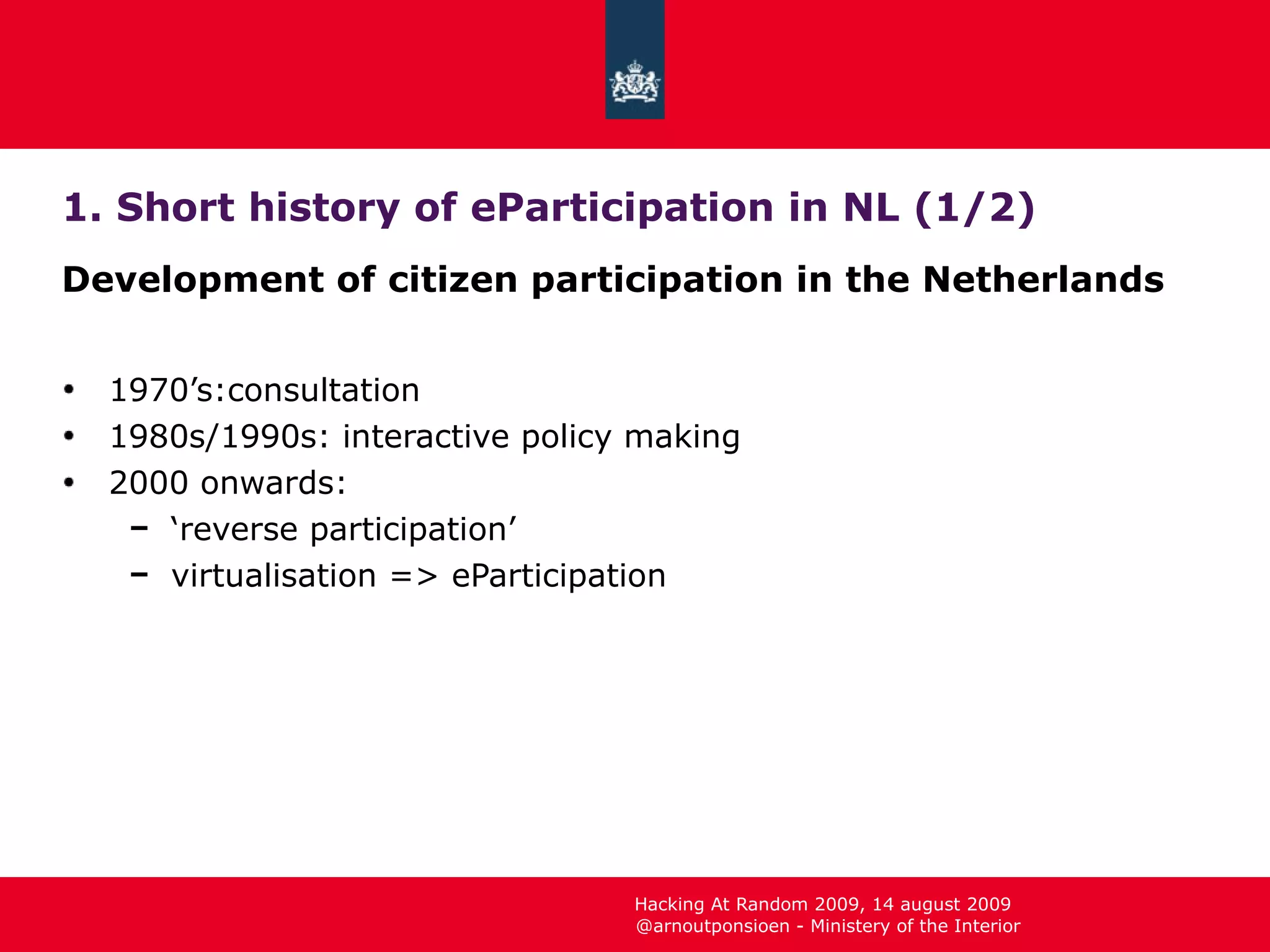
1. Short history of eParticipation in NL (1/2) Development of citizen participation in the Netherlands 1970’s:consultation 1980s/1990s: interactive policy making 2000 onwards: ‘ reverse participation’ virtualisation => eParticipation
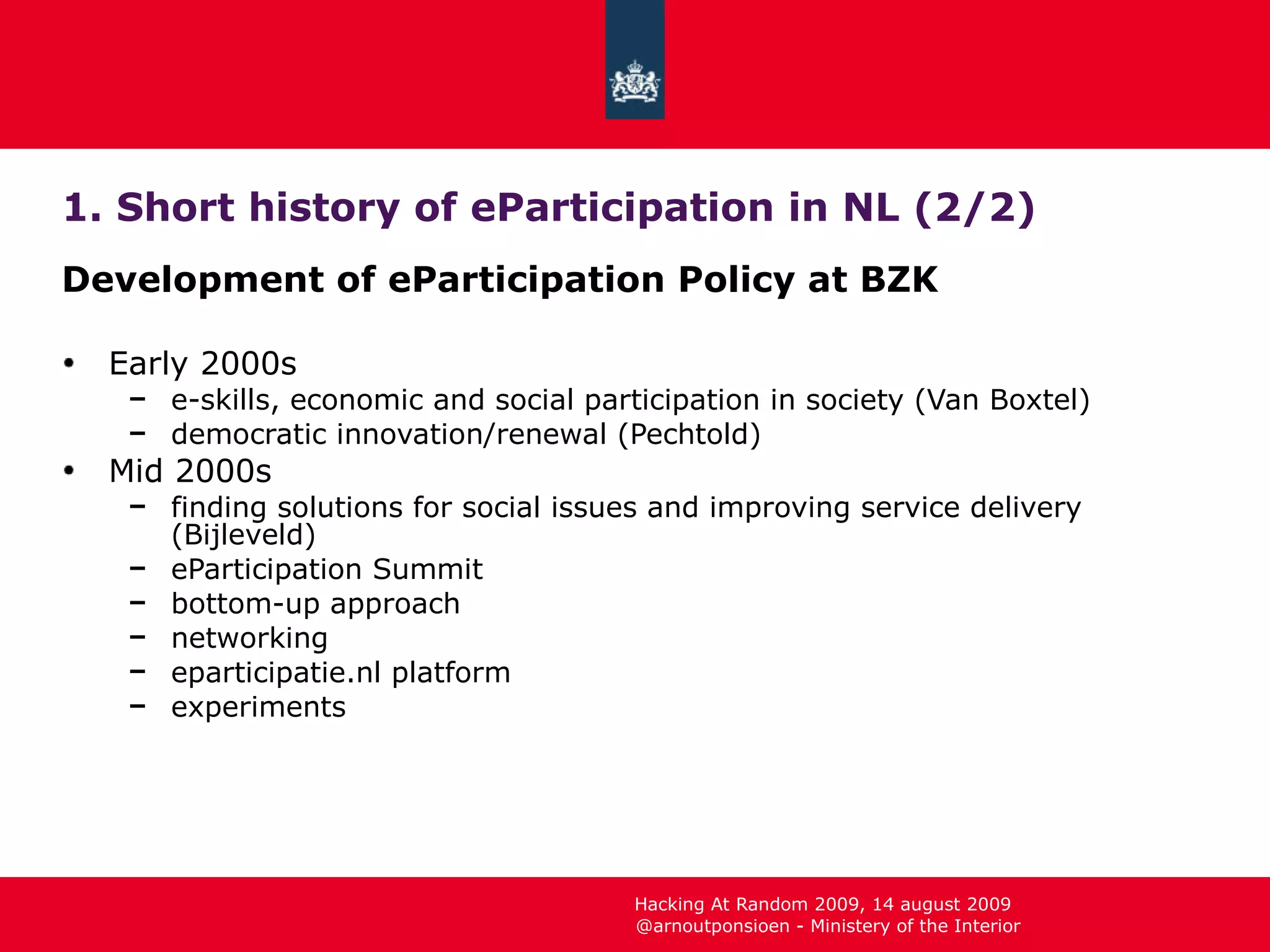
1. Short history of eParticipation in NL (2/2) Development of eParticipation Policy at BZK Early 2000s e-skills, economic and social participation in society (Van Boxtel) democratic innovation/renewal (Pechtold) Mid 2000s finding solutions for social issues and improving service delivery (Bijleveld) eParticipation Summit bottom-up approach networking eparticipatie.nl platform experiments
1. Short history of eParticipation in NL (2/2) Some experiments mid 2000s
1. Short history of eParticipation in NL (2/2) www.watstemtmijnraad.nl
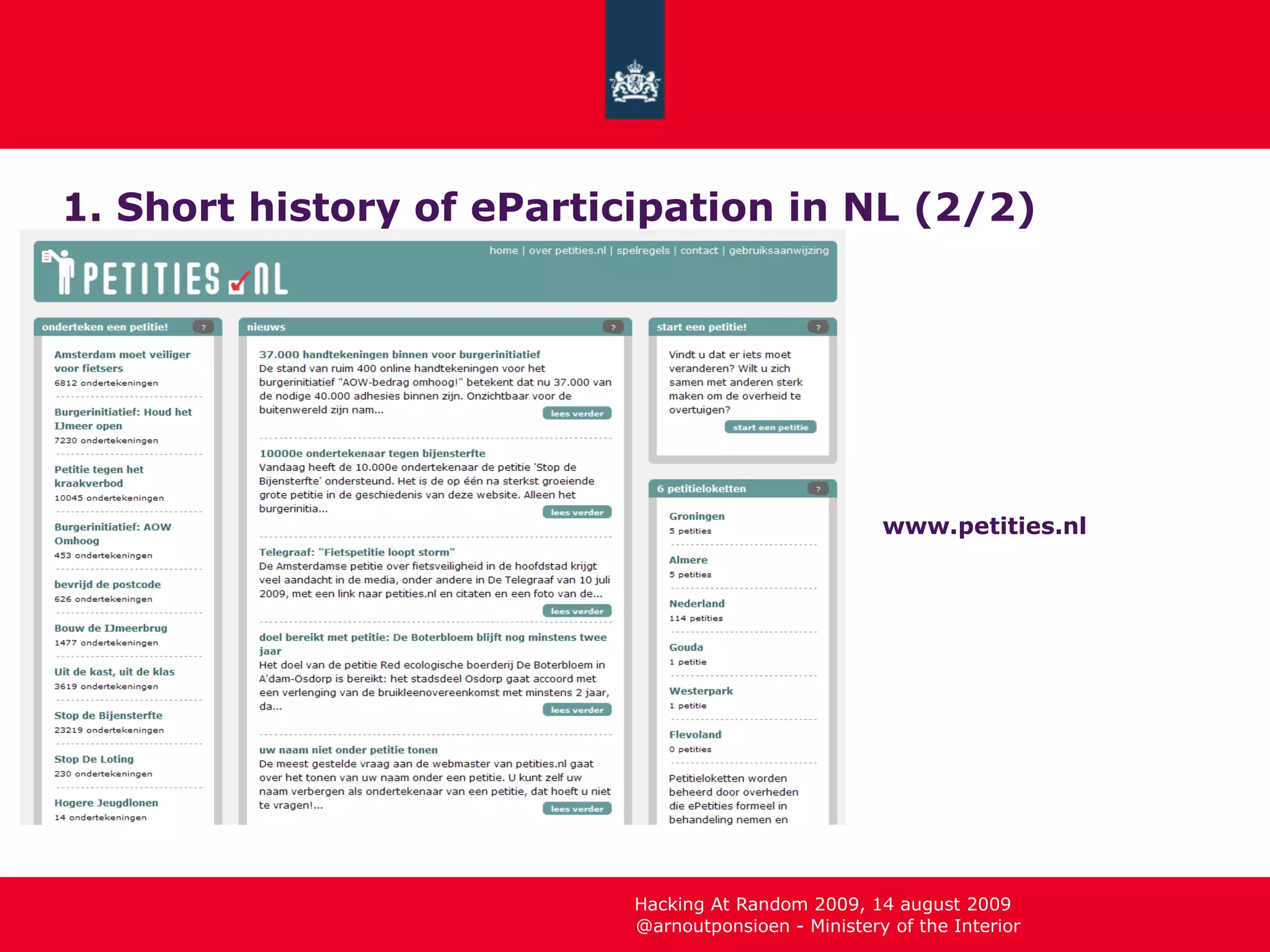
1. Short history of eParticipation in NL (2/2) www.petities.nl
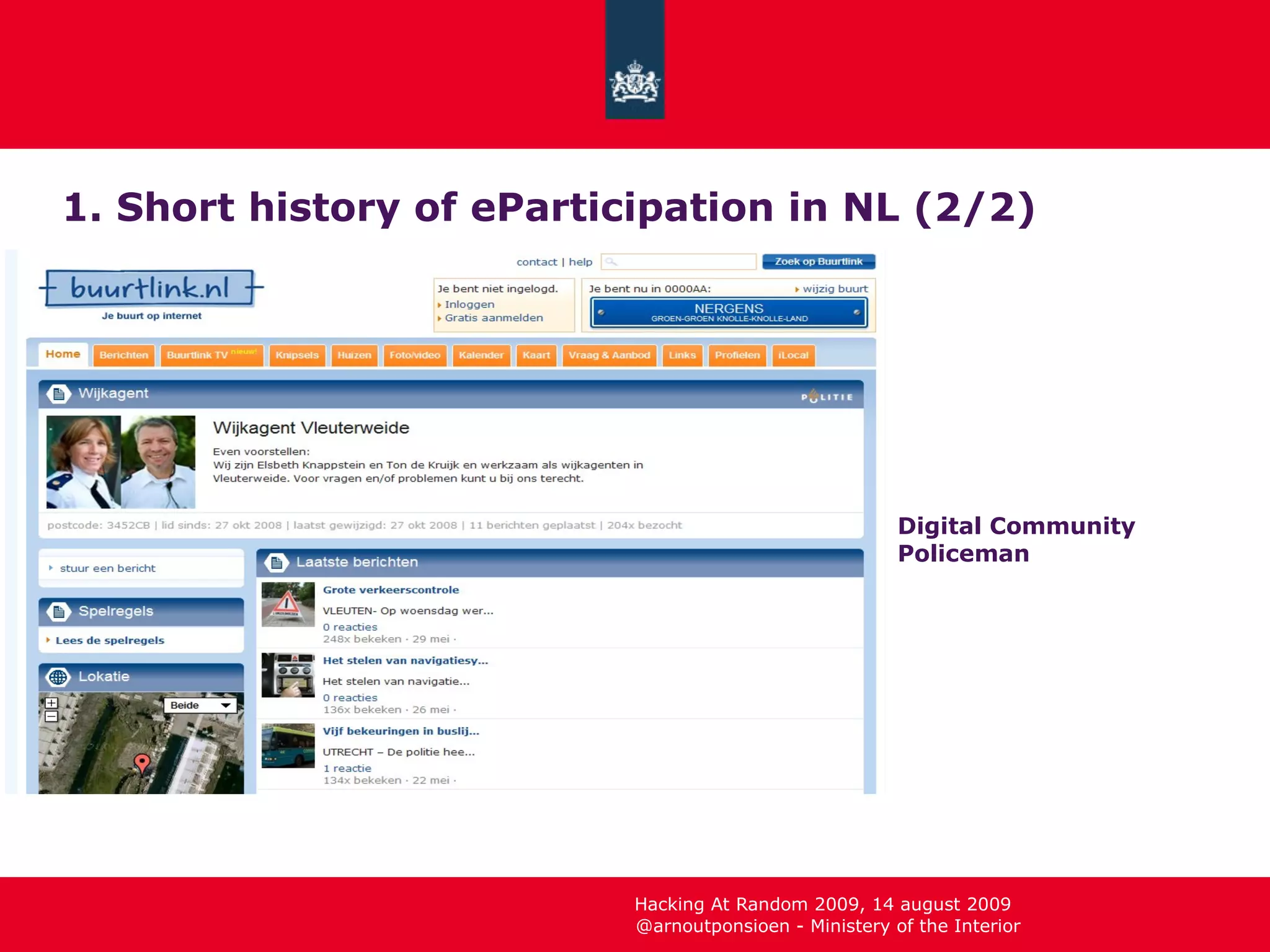
1. Short history of eParticipation in NL (2/2) Digital Community Policeman
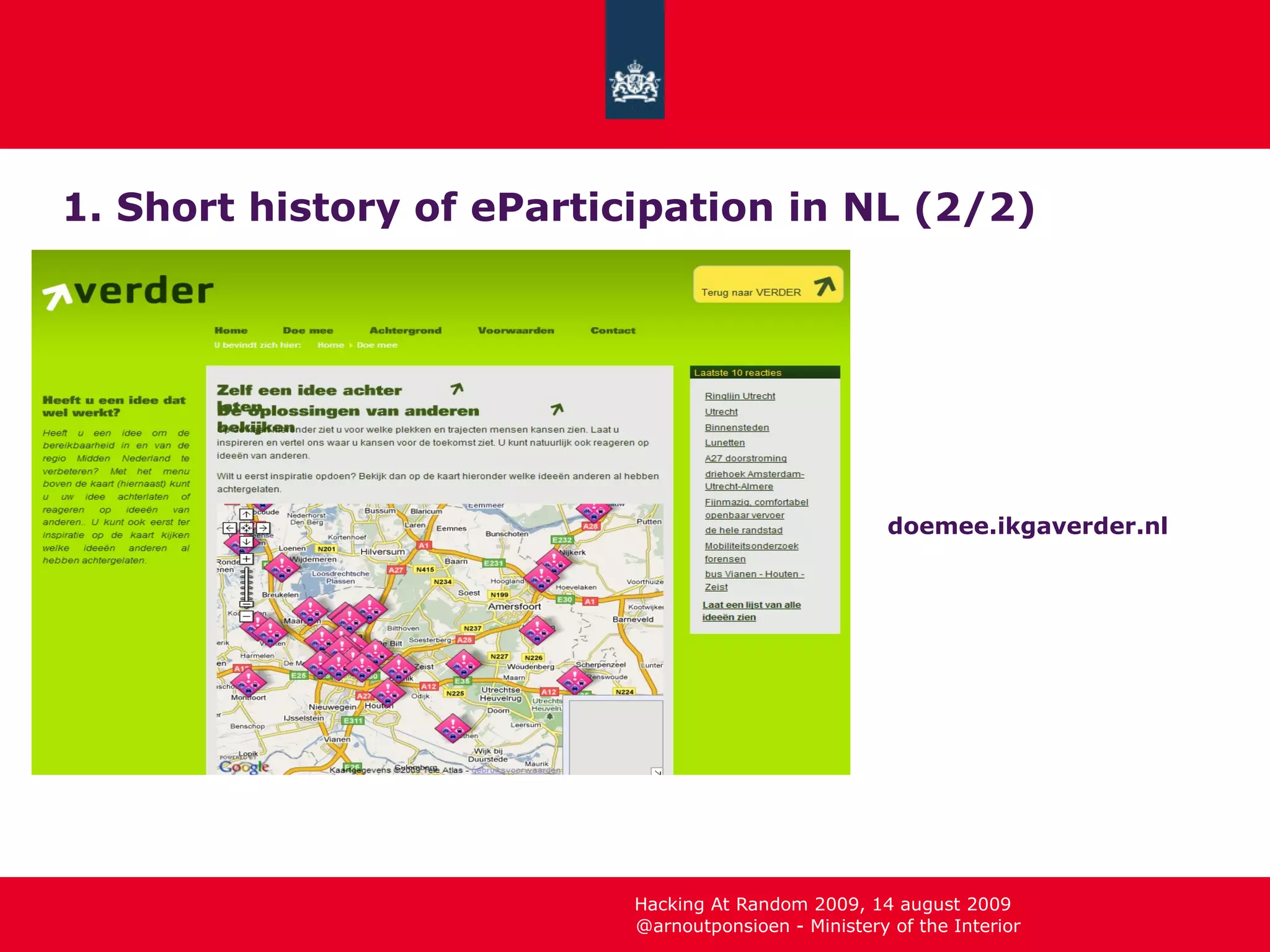
1. Short history of eParticipation in NL (2/2) doemee.ikgaverder.nl
1. Short history of eParticipation (2/2) Development of eParticipation policy at BZK Early 2000s Mid 2000s Late 2000s 7 new experiments: Digital Pioniers Programma
1. Short history of eParticipation in NL (2/2) 7 new experiments via Digital Pioniers verbeterdebuurt.nl democratiespel.nl openkamer.nl polidocs.nl OCO sterren version 2 ikregeer.nl API HNS development environment http://www.digitalepioniers.nl/ (search for: ‘eParticipatie’)
1. Short history of eParticipation (2/2) Development of eParticipation at BZK Early 2000s Mid 2000s Late 2000s 7 new experiments: Digital Pioniers Programma facilitating and stimulating local governments: web 2.0 brigade, citizen participation lab Citizenlink-programme eParticipation Awards upscaling and further development of some eParticipation experiments Governement 2.0 Design contest: hulpbijditformulier.nl, jijendeoverheid.nl Open data contest: datzouhandigzijn.nl Five government widgets Overheid20.nl platform
2. Personal Observations (1/3) citizen’s willingsness for eParticipation is high (preferred channel!) eParticipation modules on government websites is decreasing Far from being business as usual eParticipation is dependant on just 1 enthousiastic lower level civil servant ‘ safety’ issue popular local level high abstraction level or complex forms like laws or regulations lower levels of participation (information, consultation) advanced applications ‘ passive participation’ popular (low level involvement) representativeness is a big concern
2. Personal Observations (1/3) Current eParticipation’s reality: A lot of energy on both sides! Many government initiatives Even more citizens’ initiatives two separate narcistic closed worlds Mainly bonding, hardly any bridging: interaction between like-minded citizens (citizen’s initiatives) closed consultations (government’s initiatives) No reciprocity no furtile dynamic co-creative dialogues between citizens and governments
2. Personal Observations (3/3) Why? Unknown existence? Unable to participate? Not worth it because unsufficient  real  power-shifts No wish nor need for eachother’s involvement Stereotypic mutual mistrust  in both  quality  and  quanity  of participation of 'the other'
3. Challenges for the future (1/2) So…? ICT’s are not the challenge Trust in citizen participation in general is (cultural challenge) How to do that? Be reciprocal: give, receive and return! Bond and Bridge!
2. Personal Observations (3/3) What can governments do to build trust? Open your data Open your processes (policy development, decisions) Organise co-productive reflexivity about the new processes, roles, etc. Promote e-skills and e-awareness in your organisation Invest in your external network truely listen, participate, stimulate, and include citizen's initiatives Make eParticipation worth it offer  real  power-shifts follow citizen’s agenda
2. Personal Observations (3/3) What can citizens do to build trust? Actively inform government about your activities, views, network Make explicit what you expect from government (data, money, expertise, time, etc.) Bridge with other initiatives by citizens and government Plug into pre-existing democratic intitutions Don’t stop investing in society: start new initiatives, mobilize people
2. Personal Observations (3/3) What can hackers do to build trust? Surprise and confront government and citizens with concepts, prototypes, and examples (reflexivity) Use available data, and ask for data you need Bridge: talk and co - produce with government and citizens Join forces with other hackers Be polite, positive and… patient Start working for a government!
Concluding remarks… Trust requires reciprocity: give, receive and return Innovation always comes from unexpected (re)combinations Be polite, positive and patient Have faith!
Some questions I have for you: How can hackers help government and citizens with open data? How can hackers help government and citizens with interactivity? How can hackers help bridge between government and citizens? What are the most crucial issues in the relation between trust, citizen participation and ICT´s? What is the most promising role for governments in field of eParticipation What are the greates risks of hackers´ activities related to trust, open data and interactivity? http://trust20.ning.com Thank you! @arnoutponsioen
Thank you! @arnoutponsioen

Dismantling Mutual Mistrust

  • 1.
  • 2.
    Summary Short historyof eParticipation policy at BZK Personal Observations Challenges for the future
  • 3.
    1. Short historyof eParticipation in NL (1/2) Development of citizen participation in the Netherlands 1970’s:consultation 1980s/1990s: interactive policy making 2000 onwards: ‘ reverse participation’ virtualisation => eParticipation
  • 4.
    1. Short historyof eParticipation in NL (2/2) Development of eParticipation Policy at BZK Early 2000s e-skills, economic and social participation in society (Van Boxtel) democratic innovation/renewal (Pechtold) Mid 2000s finding solutions for social issues and improving service delivery (Bijleveld) eParticipation Summit bottom-up approach networking eparticipatie.nl platform experiments
  • 5.
    1. Short historyof eParticipation in NL (2/2) Some experiments mid 2000s
  • 6.
    1. Short historyof eParticipation in NL (2/2) www.watstemtmijnraad.nl
  • 7.
    1. Short historyof eParticipation in NL (2/2) www.petities.nl
  • 8.
    1. Short historyof eParticipation in NL (2/2) Digital Community Policeman
  • 9.
    1. Short historyof eParticipation in NL (2/2) doemee.ikgaverder.nl
  • 10.
    1. Short historyof eParticipation (2/2) Development of eParticipation policy at BZK Early 2000s Mid 2000s Late 2000s 7 new experiments: Digital Pioniers Programma
  • 11.
    1. Short historyof eParticipation in NL (2/2) 7 new experiments via Digital Pioniers verbeterdebuurt.nl democratiespel.nl openkamer.nl polidocs.nl OCO sterren version 2 ikregeer.nl API HNS development environment http://www.digitalepioniers.nl/ (search for: ‘eParticipatie’)
  • 12.
    1. Short historyof eParticipation (2/2) Development of eParticipation at BZK Early 2000s Mid 2000s Late 2000s 7 new experiments: Digital Pioniers Programma facilitating and stimulating local governments: web 2.0 brigade, citizen participation lab Citizenlink-programme eParticipation Awards upscaling and further development of some eParticipation experiments Governement 2.0 Design contest: hulpbijditformulier.nl, jijendeoverheid.nl Open data contest: datzouhandigzijn.nl Five government widgets Overheid20.nl platform
  • 13.
    2. Personal Observations(1/3) citizen’s willingsness for eParticipation is high (preferred channel!) eParticipation modules on government websites is decreasing Far from being business as usual eParticipation is dependant on just 1 enthousiastic lower level civil servant ‘ safety’ issue popular local level high abstraction level or complex forms like laws or regulations lower levels of participation (information, consultation) advanced applications ‘ passive participation’ popular (low level involvement) representativeness is a big concern
  • 14.
    2. Personal Observations(1/3) Current eParticipation’s reality: A lot of energy on both sides! Many government initiatives Even more citizens’ initiatives two separate narcistic closed worlds Mainly bonding, hardly any bridging: interaction between like-minded citizens (citizen’s initiatives) closed consultations (government’s initiatives) No reciprocity no furtile dynamic co-creative dialogues between citizens and governments
  • 15.
    2. Personal Observations(3/3) Why? Unknown existence? Unable to participate? Not worth it because unsufficient real power-shifts No wish nor need for eachother’s involvement Stereotypic mutual mistrust in both quality and quanity of participation of 'the other'
  • 16.
    3. Challenges forthe future (1/2) So…? ICT’s are not the challenge Trust in citizen participation in general is (cultural challenge) How to do that? Be reciprocal: give, receive and return! Bond and Bridge!
  • 17.
    2. Personal Observations(3/3) What can governments do to build trust? Open your data Open your processes (policy development, decisions) Organise co-productive reflexivity about the new processes, roles, etc. Promote e-skills and e-awareness in your organisation Invest in your external network truely listen, participate, stimulate, and include citizen's initiatives Make eParticipation worth it offer real power-shifts follow citizen’s agenda
  • 18.
    2. Personal Observations(3/3) What can citizens do to build trust? Actively inform government about your activities, views, network Make explicit what you expect from government (data, money, expertise, time, etc.) Bridge with other initiatives by citizens and government Plug into pre-existing democratic intitutions Don’t stop investing in society: start new initiatives, mobilize people
  • 19.
    2. Personal Observations(3/3) What can hackers do to build trust? Surprise and confront government and citizens with concepts, prototypes, and examples (reflexivity) Use available data, and ask for data you need Bridge: talk and co - produce with government and citizens Join forces with other hackers Be polite, positive and… patient Start working for a government!
  • 20.
    Concluding remarks… Trustrequires reciprocity: give, receive and return Innovation always comes from unexpected (re)combinations Be polite, positive and patient Have faith!
  • 21.
    Some questions Ihave for you: How can hackers help government and citizens with open data? How can hackers help government and citizens with interactivity? How can hackers help bridge between government and citizens? What are the most crucial issues in the relation between trust, citizen participation and ICT´s? What is the most promising role for governments in field of eParticipation What are the greates risks of hackers´ activities related to trust, open data and interactivity? http://trust20.ning.com Thank you! @arnoutponsioen
  • 22.