VERBALS
Here starts the
lesson!
OBJECTIVES
At the end of the discussion, you are expected to:
● Recognize different types of verbals
● Analyze and apply the correct function of different
kinds of verbals; gerund, participle and infinitives in
sentence construction
● Value the importance of verbals through applying
their functions when composing literary pieces.
Table of
Contents!
VERBALS
DEFINITION
FUNCTIONS OF
VERBALS AND
ITS DIFFERENT
TYPES
TYPES OF VERBAL
GERUND, PARTICIPLE,
INFINITIVE
01
VERBALS
Definition
A verbal is a word
derived from verb that
functions in a sentence
as a noun or modifier
rather than as verb.
02
FUNCTION
FUNCTION
• functions as a noun,
adjective, or adverb but
not as a verb.
• verbal cannot function as
a sentence’s main verb
unless it is used with one
or more auxiliary verbs
03
TYPES OF
VERBALS
What are the
types of
verbals?
There are three
types of verbals:
• Gerunds
• Participles
• Infinitives
GERUNDS
is a verb that
end in “ing” and
function as
noun in a
sentence
A noun can only
be the subject,
object, or
complement of
the subject of
a sentence.
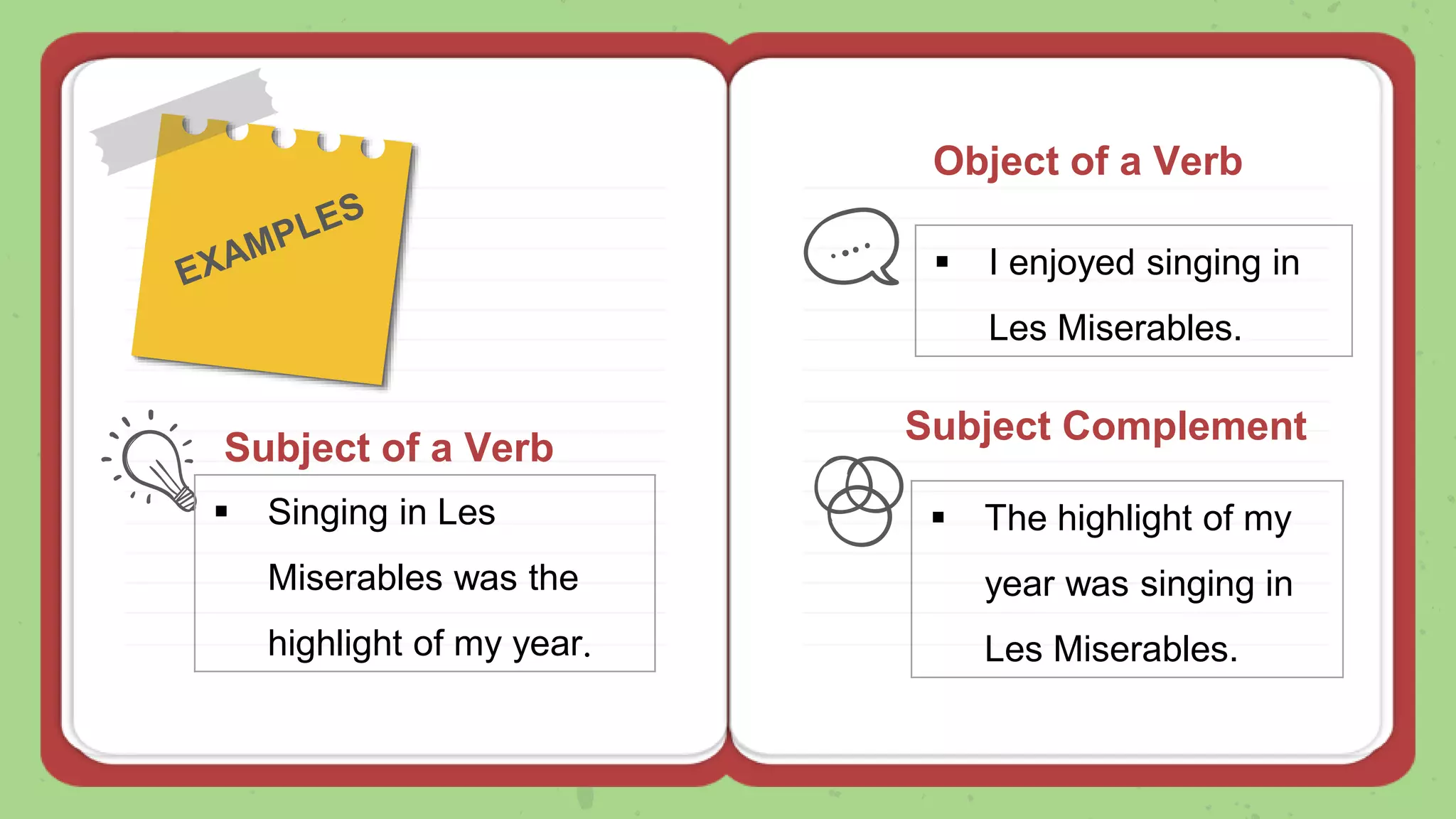
Object of a Verb
Subject Complement
Subject of a Verb
 Singing in Les
Miserables was the
highlight of my year.
 I enjoyed singing in
Les Miserables.
 The highlight of my
year was singing in
Les Miserables.
Let’s Apply
Diving became my
favorite adventure.
SUBJECT OF A VERB
I like reading books
in the library.
OBJECT OF A VERB
The kids were
playing in the park.
SUBJECT
COMPLEMENT
PARTICIPLES
Participles are verbs that can be used as
an adjective. There are two kinds of
participle: present participles and past
participles.
PRESENT
PARTICIPLE EXAMPLES
The present participles of most
regular and irregular verbs are
formed by adding -ing to the base
form of the verb.
Example: imply+ ing= implying
Overwhelm+ ing= overwhelming
 Penelope is very
charming.
 Jessica has a terrifying
experience on the bus
station.
Past participle is used as an
adjective o to form verb tense.
It usually end in -ed, -d, -t, -en,
or -n.
Example:whisper+ed= whispered
ruin+ ed= ruined
● I liked eating mashed
potatoes.
● He still eats the
ruined cake.
Let’s Apply
The [danced, dancing]
dolphin entertained the
crowd.
dancing
The [wrecked, wrecking]
sailboat washed up on
shore
wrecked
INFINITIVES
• the verb in its basic
form. It is a verbal
consisting of to + a verb
and it act as a noun,
adjective or adverb in a
sentence.
EXAMPLES
• I want a gym instructor to help me
become stronger.
• Her job was to train others.
• The students were surprised to
hear the announcement.
Let’s Apply
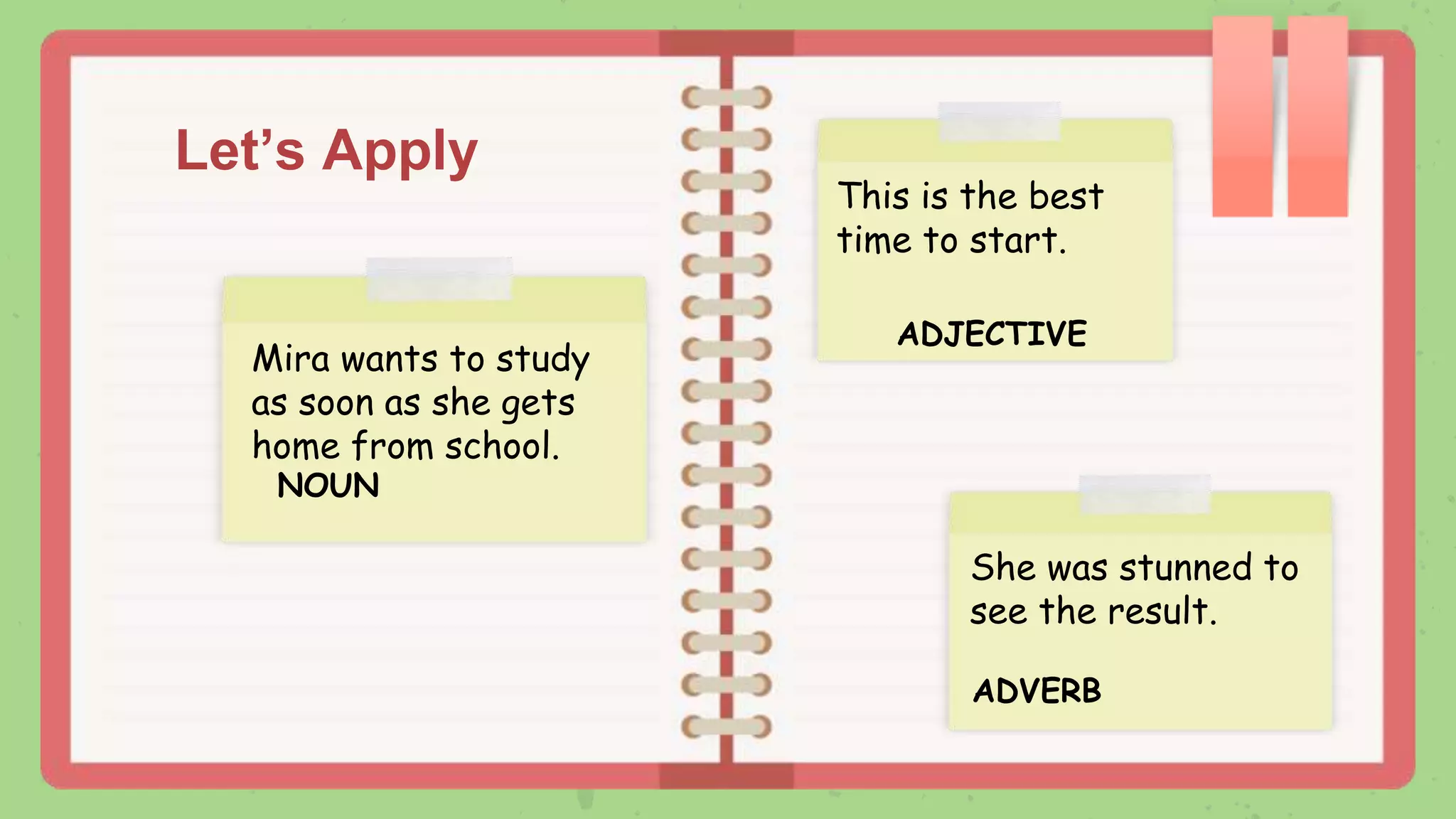
Mira wants to study
as soon as she gets
home from school.
NOUN
She was stunned to
see the result.
ADVERB
This is the best
time to start.
ADJECTIVE
Exercise
ARE YOU READY?
• What are the different
types of verbals?
• What are the
difference between the
three types of verbals?
• How can we identify if a
verbal is a gerund or
present participle?
Assignment
Compose a poem about your
dreams in life applying the
different types of verbals.
Make sure to highlight the
verbals used.
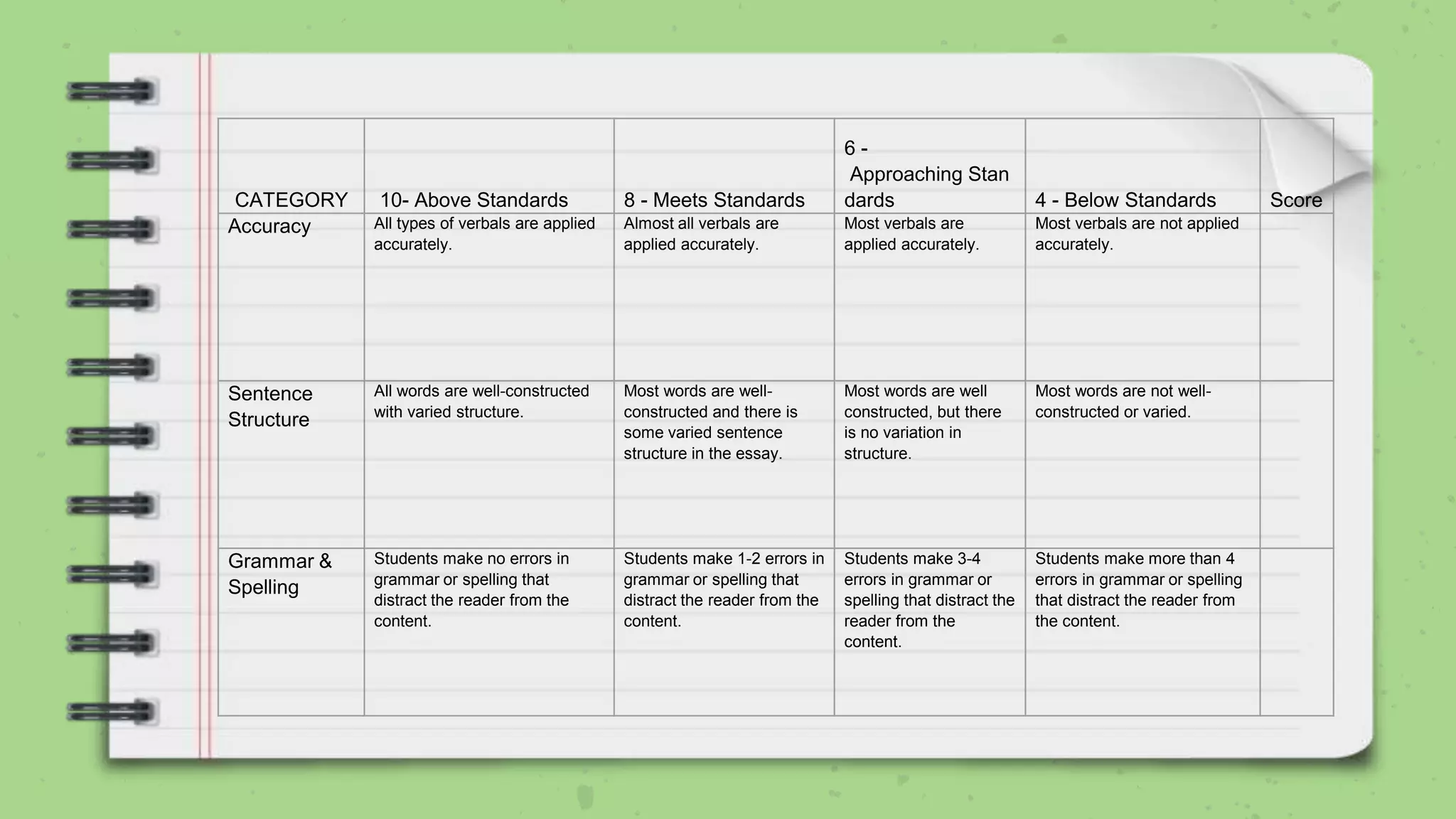
CATEGORY 10- Above Standards 8 - Meets Standards
6 -
Approaching Stan
dards 4 - Below Standards Score
Accuracy All types of verbals are applied
accurately.
Almost all verbals are
applied accurately.
Most verbals are
applied accurately.
Most verbals are not applied
accurately.
Sentence
Structure
All words are well-constructed
with varied structure.
Most words are well-
constructed and there is
some varied sentence
structure in the essay.
Most words are well
constructed, but there
is no variation in
structure.
Most words are not well-
constructed or varied.
Grammar &
Spelling
Students make no errors in
grammar or spelling that
distract the reader from the
content.
Students make 1-2 errors in
grammar or spelling that
distract the reader from the
content.
Students make 3-4
errors in grammar or
spelling that distract the
reader from the
content.
Students make more than 4
errors in grammar or spelling
that distract the reader from
the content.
Thanks!
HAVE A GOOD DAY AHEAD!

DISCUSSION-VERBALS.pptx

  • 1.
  • 2.
    OBJECTIVES At the endof the discussion, you are expected to: ● Recognize different types of verbals ● Analyze and apply the correct function of different kinds of verbals; gerund, participle and infinitives in sentence construction ● Value the importance of verbals through applying their functions when composing literary pieces.
  • 3.
    Table of Contents! VERBALS DEFINITION FUNCTIONS OF VERBALSAND ITS DIFFERENT TYPES TYPES OF VERBAL GERUND, PARTICIPLE, INFINITIVE
  • 4.
  • 5.
    Definition A verbal isa word derived from verb that functions in a sentence as a noun or modifier rather than as verb.
  • 6.
  • 7.
    FUNCTION • functions asa noun, adjective, or adverb but not as a verb. • verbal cannot function as a sentence’s main verb unless it is used with one or more auxiliary verbs
  • 8.
  • 9.
    What are the typesof verbals? There are three types of verbals: • Gerunds • Participles • Infinitives
  • 10.
    GERUNDS is a verbthat end in “ing” and function as noun in a sentence A noun can only be the subject, object, or complement of the subject of a sentence.
  • 11.
    Object of aVerb Subject Complement Subject of a Verb  Singing in Les Miserables was the highlight of my year.  I enjoyed singing in Les Miserables.  The highlight of my year was singing in Les Miserables.
  • 12.
    Let’s Apply Diving becamemy favorite adventure. SUBJECT OF A VERB I like reading books in the library. OBJECT OF A VERB The kids were playing in the park. SUBJECT COMPLEMENT
  • 13.
    PARTICIPLES Participles are verbsthat can be used as an adjective. There are two kinds of participle: present participles and past participles.
  • 14.
    PRESENT PARTICIPLE EXAMPLES The presentparticiples of most regular and irregular verbs are formed by adding -ing to the base form of the verb. Example: imply+ ing= implying Overwhelm+ ing= overwhelming  Penelope is very charming.  Jessica has a terrifying experience on the bus station.
  • 15.
    Past participle isused as an adjective o to form verb tense. It usually end in -ed, -d, -t, -en, or -n. Example:whisper+ed= whispered ruin+ ed= ruined
  • 16.
    ● I likedeating mashed potatoes. ● He still eats the ruined cake.
  • 17.
    Let’s Apply The [danced,dancing] dolphin entertained the crowd. dancing The [wrecked, wrecking] sailboat washed up on shore wrecked
  • 18.
    INFINITIVES • the verbin its basic form. It is a verbal consisting of to + a verb and it act as a noun, adjective or adverb in a sentence.
  • 19.
    EXAMPLES • I wanta gym instructor to help me become stronger. • Her job was to train others. • The students were surprised to hear the announcement.
  • 20.
    Let’s Apply Mira wantsto study as soon as she gets home from school. NOUN She was stunned to see the result. ADVERB This is the best time to start. ADJECTIVE
  • 21.
  • 22.
    • What arethe different types of verbals? • What are the difference between the three types of verbals? • How can we identify if a verbal is a gerund or present participle?
  • 23.
    Assignment Compose a poemabout your dreams in life applying the different types of verbals. Make sure to highlight the verbals used.
  • 24.
    CATEGORY 10- AboveStandards 8 - Meets Standards 6 - Approaching Stan dards 4 - Below Standards Score Accuracy All types of verbals are applied accurately. Almost all verbals are applied accurately. Most verbals are applied accurately. Most verbals are not applied accurately. Sentence Structure All words are well-constructed with varied structure. Most words are well- constructed and there is some varied sentence structure in the essay. Most words are well constructed, but there is no variation in structure. Most words are not well- constructed or varied. Grammar & Spelling Students make no errors in grammar or spelling that distract the reader from the content. Students make 1-2 errors in grammar or spelling that distract the reader from the content. Students make 3-4 errors in grammar or spelling that distract the reader from the content. Students make more than 4 errors in grammar or spelling that distract the reader from the content.
  • 25.