Discharge
and
Transfer
Kaymika Milford
Glorianna Jolly
Treyvonia Carey
Alenna Rahming
Shena Victor
Discharge
Discharge is when patients are released from the hospital after treatment
and no longer need prolonged in- patient care.
Discharge planning is also referred to as “continuity of care.”
The most critical component of discharge planning is obtaining and
organizing patient information. Patients and families should be actively
involved.
Caregivers outside the hospital must be knowledgeable about the
patient’s condition, further treatments, and the necessary procedures
included in-home care. ( changing dressings, use of assistive devices,
preparation of special diets, administration of medications such as Insulin/
how to check glucose levels.)
If caregivers are unprepared/uneducated, this can lead to the downfall of
the patient’s health and possible injuries.
The nurse’s job is to educate the family and patient on the necessary skills
and make referrals to agencies to support patients.
Patients who fall under any of the
categories will need a formal discharge
plan and referral to another agency:
 Lack of knowledge of treatment plan
 Recently diagnosed chronic disease
 Major surgery
 Emotional or mentally unstable
 Financially unstable
 Terminal illness
 Prolonged recuperation from major
surgery or illness
Discharge
planning
• Discharge planning includes goals that are mutual and
realistic.
(Eg. The patient may be placed on a strict diet but may not be
able to afford food products due to financial strain) causes
the patient not to be able to follow the diet as planned.
• After the patient is discharged, follow-ups are done, usually
over the phone or through a home visit.
Barriers in discharge panning
 Lack of
communication
 Placement  Financial
instability
 Unavailable
family/caregivers
•Discharge beings when the patient enters the hospital
•Patients are discharged from a health care facility when the
expected outcomes of care are met, and the patient or
caregiver has the necessary knowledge and skills to provide
additional care.
•The nurse anticipates needs and services as soon as possible.
•Educate the family so they can return safely to the patient.
•Make sure the patient is clean
•Evaluating to see if the goals were met
•Essential components of discharge planning include
assessing the strengths and limitations of the patient, the
family or support person, and the environment.
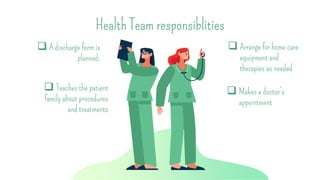
Health Team responsiblities
 Teaches the patient
family about procedures
and treatments
 Arrange for home care
equipment and
therapies as needed
 Makes a doctor’s
appointment
 A discharge form is
planned.
Steps to discharge a patient
Step 1
Make sure consent is
written for a discharge of
the patient
Step 3
Complete patient record
and discharge summary
Step 2
Assist patient in getting
items prepared
Step 4
Transport the patient via
wheelchair into the
vehicle.
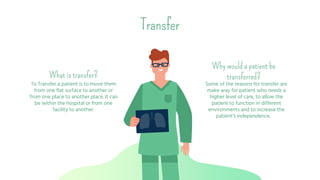
Transfer
To Transfer a patient is to move them
from one flat surface to another or
from one place to another place. It can
be within the hospital or from one
facility to another.
Transfer
Some of the reasons for transfer are
make way for patient who needs a
higher level of care, to allow the
patient to function in different
environments and to increase the
patient’s independence.
What is transfer?
Why would a patient be
transferred?
Identifying Information
Transfers are challenging since the
nurse must consider the patient’s
condition, illness, or probable
accidents. It involves many
individuals, and if they are not
carefully planned, a lot could go
wrong
Patient needs are always put first
to provide a smooth transition and
continued care, and
documentation and procedures
vary based on the institution and
kind of transfer.
Transfer Report
Using the approved handoff method, the nurse in the original
location verbally relays the patient's information to the new
area nurse. The report must include the following information
about the patient: name, age, doctors, admitting diagnosis,
surgical procedure (if applicable), present status and
symptoms, allergies, medications treatments, laboratory data,
and any special equipment needed to provide care. Nursing
care priorities are identified, and advance directives are noted.
The patient must adapt to new surroundings, roommates,
routines, and caregivers. All personal items must be transferred
to the new room. Every effort must be made to prevent lost or
misplaced properties. The patient's records are transferred to
the new location or made electronically accessible.
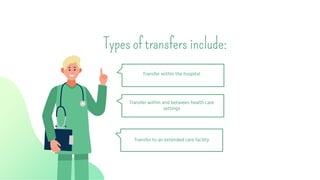
Types of transfers include:
Transfer within the hospital
Transfer within and between health care
settings
Transfer to an extended care facility
Transfer within the hospital
The authorized handoff procedure is used by the
nurse in the original area to verbally relay
information about the patient to the nurse in the
new area when a patient is moved to another unit.
The report should include the patient's name, age,
doctors, admitting diagnosis, surgical procedures (if
the patient had any), current condition and
symptoms, allergies, medications, and therapies, test
results, and any specialized equipment required to
provide care (Taylor, Lillis, Lynn, LeMone, 2015).
Transfer within and between healthcare settings
When a patient is transferred, they must adapt to new
surroundings, new caregivers, new routines, and new
housemates. The patient's family may frequently
encounter unusual sights and noises if the transfer is to a
higher level of care, such as an ICU relocation. Even
though the patient or family may not want to go to a
long-term care facility, it may be required if family
members are unable to give care at home or if no other
support systems are available. These are all things that
lead to anxiety and stress (Taylor, Lillis, Lynn, LeMone,
2015).
Transfer to an extended care facility
The patient is discharged from the hospital, and a copy of the
medical record may be transmitted to the extended care facility
(depending on the physician's request and the agency's policy)
when they are moved from the hospital to an extended care
facility or another community setting. The hospital still has the
original record, which is a legal document. The patient is
transported to the institution with all their possessions. It is also
possible to send prescription cards to the doctor's office for
follow-up appointments. A thorough care plan is also
transmitted from the hospital to the institution, and a verbal
report utilizing the approved handoff technique (Taylor, Lillis,
Lynn, LeMone, 2015)
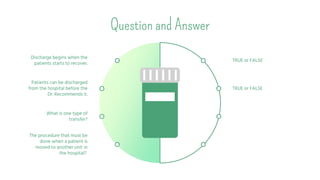
Question and Answer
Patients can be discharged
from the hospital before the
Dr. Recommends it.
Discharge begins when the
patients starts to recover.
The procedure that must be
done when a patient is
moved to another unit in
the hospital?
TRUE or FALSE
TRUE or FALSE
What is one type of
transfer?
Question and answer
A patient is being transferred from the ICU to a
regular hospital room. What must the ICU nurse be
prepared to do as part of this transfer?
a. Provide a verbal report to the nurse on the new
unit.
b. Provide a detailed written report to the unit
secretary.
c. Delegate the responsibility for providing
information.
d. Make a copy of the patient’s medical record.
Question and answer
A hospital nurse is admitting a patient who
sustained a head injury in a motor vehicle accident.
Which activities could the nurse delegate to
licensed assistive personnel?
a. Collecting information for a health history
b. Performing a physical assessment
c. Contacting the physician for medical orders
d. Preparing the bed and collecting needed
supplies
References
● leMone, P., Lillis, C., Lynn, P., & Taylor, C. R. (2010). Fundamentals of Nursing.
The Art and Science of Nursing Care. Lippincott Williams & Wilkins.
CREDITS: This presentation template was created by
Slidesgo, including icons by Flaticon, and infographics
& images by Freepik.
Thanks
Please keep this slide for attribution.
Do you have any questions?
Discharge and Transfer.pptx

Discharge and Transfer.pptx

  • 1.
  • 2.
    Discharge Discharge is whenpatients are released from the hospital after treatment and no longer need prolonged in- patient care. Discharge planning is also referred to as “continuity of care.” The most critical component of discharge planning is obtaining and organizing patient information. Patients and families should be actively involved. Caregivers outside the hospital must be knowledgeable about the patient’s condition, further treatments, and the necessary procedures included in-home care. ( changing dressings, use of assistive devices, preparation of special diets, administration of medications such as Insulin/ how to check glucose levels.) If caregivers are unprepared/uneducated, this can lead to the downfall of the patient’s health and possible injuries. The nurse’s job is to educate the family and patient on the necessary skills and make referrals to agencies to support patients.
  • 3.
    Patients who fallunder any of the categories will need a formal discharge plan and referral to another agency:  Lack of knowledge of treatment plan  Recently diagnosed chronic disease  Major surgery  Emotional or mentally unstable  Financially unstable  Terminal illness  Prolonged recuperation from major surgery or illness
  • 4.
    Discharge planning • Discharge planningincludes goals that are mutual and realistic. (Eg. The patient may be placed on a strict diet but may not be able to afford food products due to financial strain) causes the patient not to be able to follow the diet as planned. • After the patient is discharged, follow-ups are done, usually over the phone or through a home visit.
  • 5.
    Barriers in dischargepanning  Lack of communication  Placement  Financial instability  Unavailable family/caregivers
  • 6.
    •Discharge beings whenthe patient enters the hospital •Patients are discharged from a health care facility when the expected outcomes of care are met, and the patient or caregiver has the necessary knowledge and skills to provide additional care. •The nurse anticipates needs and services as soon as possible. •Educate the family so they can return safely to the patient. •Make sure the patient is clean •Evaluating to see if the goals were met •Essential components of discharge planning include assessing the strengths and limitations of the patient, the family or support person, and the environment.
  • 7.
    Health Team responsiblities Teaches the patient family about procedures and treatments  Arrange for home care equipment and therapies as needed  Makes a doctor’s appointment  A discharge form is planned.
  • 8.
    Steps to dischargea patient Step 1 Make sure consent is written for a discharge of the patient Step 3 Complete patient record and discharge summary Step 2 Assist patient in getting items prepared Step 4 Transport the patient via wheelchair into the vehicle.
  • 9.
  • 10.
    To Transfer apatient is to move them from one flat surface to another or from one place to another place. It can be within the hospital or from one facility to another. Transfer Some of the reasons for transfer are make way for patient who needs a higher level of care, to allow the patient to function in different environments and to increase the patient’s independence. What is transfer? Why would a patient be transferred?
  • 11.
    Identifying Information Transfers arechallenging since the nurse must consider the patient’s condition, illness, or probable accidents. It involves many individuals, and if they are not carefully planned, a lot could go wrong Patient needs are always put first to provide a smooth transition and continued care, and documentation and procedures vary based on the institution and kind of transfer.
  • 12.
    Transfer Report Using theapproved handoff method, the nurse in the original location verbally relays the patient's information to the new area nurse. The report must include the following information about the patient: name, age, doctors, admitting diagnosis, surgical procedure (if applicable), present status and symptoms, allergies, medications treatments, laboratory data, and any special equipment needed to provide care. Nursing care priorities are identified, and advance directives are noted. The patient must adapt to new surroundings, roommates, routines, and caregivers. All personal items must be transferred to the new room. Every effort must be made to prevent lost or misplaced properties. The patient's records are transferred to the new location or made electronically accessible.
  • 13.
    Types of transfersinclude: Transfer within the hospital Transfer within and between health care settings Transfer to an extended care facility
  • 14.
    Transfer within thehospital The authorized handoff procedure is used by the nurse in the original area to verbally relay information about the patient to the nurse in the new area when a patient is moved to another unit. The report should include the patient's name, age, doctors, admitting diagnosis, surgical procedures (if the patient had any), current condition and symptoms, allergies, medications, and therapies, test results, and any specialized equipment required to provide care (Taylor, Lillis, Lynn, LeMone, 2015).
  • 15.
    Transfer within andbetween healthcare settings When a patient is transferred, they must adapt to new surroundings, new caregivers, new routines, and new housemates. The patient's family may frequently encounter unusual sights and noises if the transfer is to a higher level of care, such as an ICU relocation. Even though the patient or family may not want to go to a long-term care facility, it may be required if family members are unable to give care at home or if no other support systems are available. These are all things that lead to anxiety and stress (Taylor, Lillis, Lynn, LeMone, 2015).
  • 16.
    Transfer to anextended care facility The patient is discharged from the hospital, and a copy of the medical record may be transmitted to the extended care facility (depending on the physician's request and the agency's policy) when they are moved from the hospital to an extended care facility or another community setting. The hospital still has the original record, which is a legal document. The patient is transported to the institution with all their possessions. It is also possible to send prescription cards to the doctor's office for follow-up appointments. A thorough care plan is also transmitted from the hospital to the institution, and a verbal report utilizing the approved handoff technique (Taylor, Lillis, Lynn, LeMone, 2015)
  • 17.
    Question and Answer Patientscan be discharged from the hospital before the Dr. Recommends it. Discharge begins when the patients starts to recover. The procedure that must be done when a patient is moved to another unit in the hospital? TRUE or FALSE TRUE or FALSE What is one type of transfer?
  • 18.
    Question and answer Apatient is being transferred from the ICU to a regular hospital room. What must the ICU nurse be prepared to do as part of this transfer? a. Provide a verbal report to the nurse on the new unit. b. Provide a detailed written report to the unit secretary. c. Delegate the responsibility for providing information. d. Make a copy of the patient’s medical record.
  • 19.
    Question and answer Ahospital nurse is admitting a patient who sustained a head injury in a motor vehicle accident. Which activities could the nurse delegate to licensed assistive personnel? a. Collecting information for a health history b. Performing a physical assessment c. Contacting the physician for medical orders d. Preparing the bed and collecting needed supplies
  • 20.
    References ● leMone, P.,Lillis, C., Lynn, P., & Taylor, C. R. (2010). Fundamentals of Nursing. The Art and Science of Nursing Care. Lippincott Williams & Wilkins.
  • 21.
    CREDITS: This presentationtemplate was created by Slidesgo, including icons by Flaticon, and infographics & images by Freepik. Thanks Please keep this slide for attribution. Do you have any questions?