Disaster Relief & Response
Flood Prediction & Rainfall Analysis
TEAM - DIGNITY HACKERS
Mentor and Team Detail
 Team Leader : Harendra Panday
 Team Member 1 : Ankit Khare
 Team Member 2 : Piyush Shukla
 Team Member 3 : Gagarin Dash
 Team Member 4 : Ashutosh Singh
Contents
 Problem Statement
 Solution Approach and Architecture
 Technology/Tool
 Hardware Specifications
 Demo - Video/Prototype
 Business Model (Explain the business plan and placement of this solution in current social
construct)
 Business Impact - (Current state and alternate solutions, market reach, Social ROI, action
plan for marketing)
 Challenges Faced
Problem Statement
 Disaster Relief and Response
 Flood Prediction
 Rainfall Analysis
High level Architecture
F
L
A
S
K
J
I
N
J
A
User Interface
Machine Learning
Architecture
Data Prep Data Ingestion
Model Serving
Data
ML Training
Training
Prediction
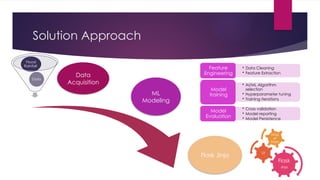
Solution Approach
Flask
Jinja
UI
Mod
el
Store
Data
Flood
Rainfall
Flask Jinja
ML
Modeling
Data
Acquisition
• Data Cleaning
• Feature Extraction
Feature
Engineering
• AI/ML Algorithm
selection
• Hyperparameter tuning
• Training iterations
Model
training
• Cross validation
• Model reporting
• Model Persistence
Model
Evaluation
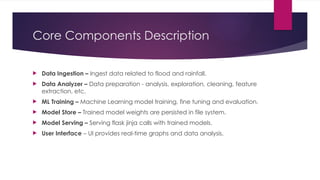
Core Components Description
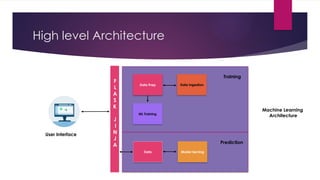
 Data Ingestion – Ingest data related to flood and rainfall.
 Data Analyzer – Data preparation - analysis, exploration, cleaning, feature
extraction, etc.
 ML Training – Machine Learning model training, fine tuning and evaluation.
 Model Store – Trained model weights are persisted in file system.
 Model Serving – Serving flask jinja calls with trained models.
 User Interface – UI provides real-time graphs and data analysis.
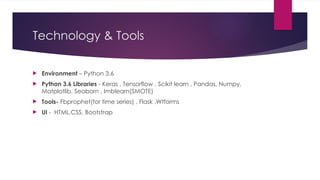
Technology & Tools
 Environment – Python 3.6
 Python 3.6 Libraries - Keras , Tensorflow , Scikit learn , Pandas, Numpy,
Matplotlib, Seaborn , Imblearn(SMOTE)
 Tools- Fbprophet(for time series) , Flask ,Wtforms
 UI - HTML,CSS, Bootstrap
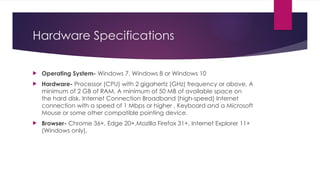
Hardware Specifications
 Operating System- Windows 7, Windows 8 or Windows 10
 Hardware- Processor (CPU) with 2 gigahertz (GHz) frequency or above, A
minimum of 2 GB of RAM, A minimum of 50 MB of available space on
the hard disk, Internet Connection Broadband (high-speed) Internet
connection with a speed of 1 Mbps or higher , Keyboard and a Microsoft
Mouse or some other compatible pointing device.
 Browser- Chrome 36+, Edge 20+,Mozilla Firefox 31+, Internet Explorer 11+
(Windows only).
Business Model
 This model can be used by the government to predict Floods and Rainfall
analysis in various vulnerable regions of the country beforehand so that safety
measures can be taken.
 Effective real-time flood forecasting models could be useful for early warning
and disaster prevention.
 Flood forecasting can also make use of forecasts of precipitation in an attempt
to extend the lead-time available.
 Rainfall analysis can help in anticipation of crop yield and gross production
value in the region.
 Forecasting flow rates and water levels for periods ranging from a few hours to
days ahead
Business Impact
 An alternate solution can be acquisition of factors like humidity, wind flow,
geographical location etc into the dataset.
 Model can be deployed by government in flood prone areas for advance warning.
 Can be used for early decision making of disaster relief responses.
 Can be used for various industrial companies whose products are affected by
rainfall patterns.
 Can be used in agriculture industry for proper planning beforehand.
 Can be used in predicting suitable climatic condition of areas for transportation of
goods and services for companies.
Challenges Faced
 Collection of reliable data from different origins.
 Deciding on a particular machine learning model for achieving maximum
accuracy without overfitting the data to it.
 Prediction of Flood based on rivers discharge and daily, weekly runoff.
 Analysis of River Pattern based on acquire dataset.
 Improving the accuracy of the model with limited data sources available.
 Integrating the model with an User Interface.
Disaster_Flood_rainfall AIML Project .pptx

  • 1.
    Disaster Relief &Response Flood Prediction & Rainfall Analysis TEAM - DIGNITY HACKERS
  • 2.
    Mentor and TeamDetail  Team Leader : Harendra Panday  Team Member 1 : Ankit Khare  Team Member 2 : Piyush Shukla  Team Member 3 : Gagarin Dash  Team Member 4 : Ashutosh Singh
  • 3.
    Contents  Problem Statement Solution Approach and Architecture  Technology/Tool  Hardware Specifications  Demo - Video/Prototype  Business Model (Explain the business plan and placement of this solution in current social construct)  Business Impact - (Current state and alternate solutions, market reach, Social ROI, action plan for marketing)  Challenges Faced
  • 4.
    Problem Statement  DisasterRelief and Response  Flood Prediction  Rainfall Analysis
  • 5.
    High level Architecture F L A S K J I N J A UserInterface Machine Learning Architecture Data Prep Data Ingestion Model Serving Data ML Training Training Prediction
  • 6.
    Solution Approach Flask Jinja UI Mod el Store Data Flood Rainfall Flask Jinja ML Modeling Data Acquisition •Data Cleaning • Feature Extraction Feature Engineering • AI/ML Algorithm selection • Hyperparameter tuning • Training iterations Model training • Cross validation • Model reporting • Model Persistence Model Evaluation
  • 7.
    Core Components Description Data Ingestion – Ingest data related to flood and rainfall.  Data Analyzer – Data preparation - analysis, exploration, cleaning, feature extraction, etc.  ML Training – Machine Learning model training, fine tuning and evaluation.  Model Store – Trained model weights are persisted in file system.  Model Serving – Serving flask jinja calls with trained models.  User Interface – UI provides real-time graphs and data analysis.
  • 8.
    Technology & Tools Environment – Python 3.6  Python 3.6 Libraries - Keras , Tensorflow , Scikit learn , Pandas, Numpy, Matplotlib, Seaborn , Imblearn(SMOTE)  Tools- Fbprophet(for time series) , Flask ,Wtforms  UI - HTML,CSS, Bootstrap
  • 9.
    Hardware Specifications  OperatingSystem- Windows 7, Windows 8 or Windows 10  Hardware- Processor (CPU) with 2 gigahertz (GHz) frequency or above, A minimum of 2 GB of RAM, A minimum of 50 MB of available space on the hard disk, Internet Connection Broadband (high-speed) Internet connection with a speed of 1 Mbps or higher , Keyboard and a Microsoft Mouse or some other compatible pointing device.  Browser- Chrome 36+, Edge 20+,Mozilla Firefox 31+, Internet Explorer 11+ (Windows only).
  • 10.
    Business Model  Thismodel can be used by the government to predict Floods and Rainfall analysis in various vulnerable regions of the country beforehand so that safety measures can be taken.  Effective real-time flood forecasting models could be useful for early warning and disaster prevention.  Flood forecasting can also make use of forecasts of precipitation in an attempt to extend the lead-time available.  Rainfall analysis can help in anticipation of crop yield and gross production value in the region.  Forecasting flow rates and water levels for periods ranging from a few hours to days ahead
  • 11.
    Business Impact  Analternate solution can be acquisition of factors like humidity, wind flow, geographical location etc into the dataset.  Model can be deployed by government in flood prone areas for advance warning.  Can be used for early decision making of disaster relief responses.  Can be used for various industrial companies whose products are affected by rainfall patterns.  Can be used in agriculture industry for proper planning beforehand.  Can be used in predicting suitable climatic condition of areas for transportation of goods and services for companies.
  • 12.
    Challenges Faced  Collectionof reliable data from different origins.  Deciding on a particular machine learning model for achieving maximum accuracy without overfitting the data to it.  Prediction of Flood based on rivers discharge and daily, weekly runoff.  Analysis of River Pattern based on acquire dataset.  Improving the accuracy of the model with limited data sources available.  Integrating the model with an User Interface.