Balanced Trees
AVL TREE
AVL Trees
• AVL tree is a Balanced Binary Search Tree
• Balanced Factor : Balanced Factor of a
node is the absolute difference in heights
between left and right sub trees
• AVL tree is defined is a Binary Search
Tree tree such that, for each node,
balanced factor ≤ 1
AVL-Trees
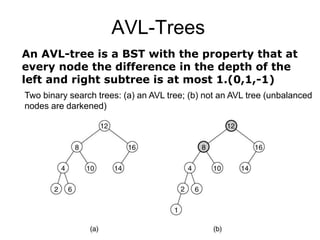
An AVL-tree is a BST with the property that at
every node the difference in the depth of the
left and right subtree is at most 1.(0,1,-1)
OK
not OK
Two binary search trees: (a) an AVL tree; (b) not an AVL tree (unbalanced
nodes are darkened)
AVL Tree
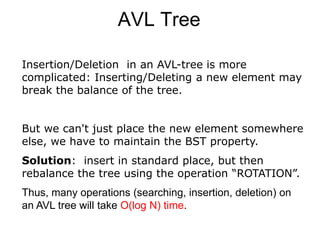
Insertion/Deletion in an AVL-tree is more
complicated: Inserting/Deleting a new element may
break the balance of the tree.
But we can't just place the new element somewhere
else, we have to maintain the BST property.
Solution: insert in standard place, but then
rebalance the tree using the operation “ROTATION”.
Thus, many operations (searching, insertion, deletion) on
an AVL tree will take O(log N) time.
Rotations
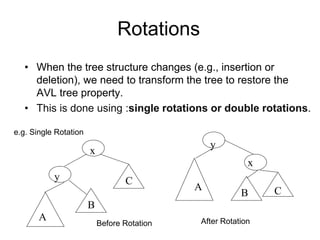
• When the tree structure changes (e.g., insertion or
deletion), we need to transform the tree to restore the
AVL tree property.
• This is done using :single rotations or double rotations.
x
y
A
B
C
y
x
A
B C
Before Rotation After Rotation
e.g. Single Rotation
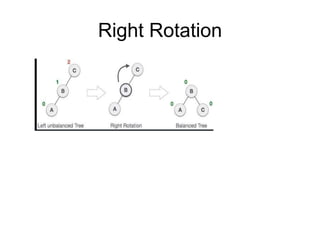
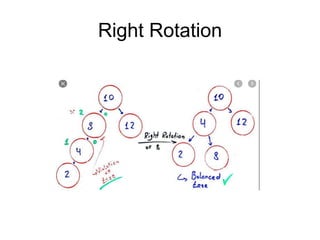
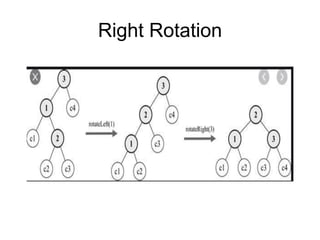
Single rotation: Right Rotation
The new key is inserted in the subtree A.
The AVL-property is violated at x
height of left(x) is h+2
height of right(x) is h.
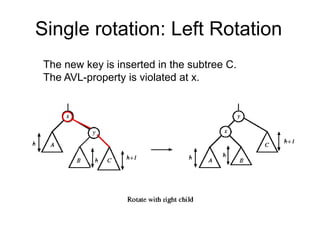
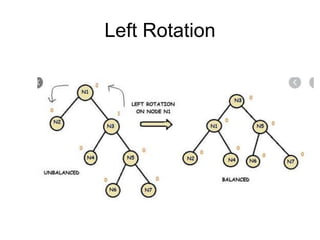
Single rotation: Left Rotation
The new key is inserted in the subtree C.
The AVL-property is violated at x.
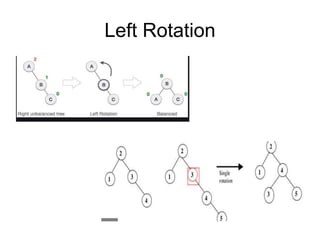
Left Rotation
Left Rotation
Right Rotation
Right Rotation
5
3
1 4
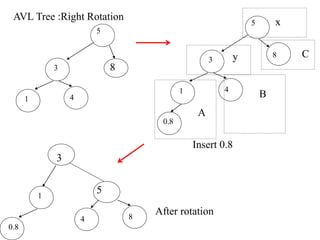
Insert 0.8
AVL Tree :Right Rotation
8
0.8
5
3
1 4
8
x
y
A
B
C
3
5
1
0.8
4 8
After rotation
Right Rotation
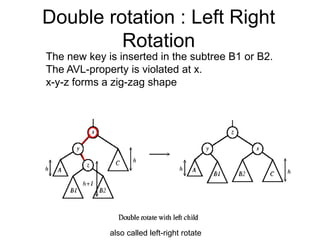
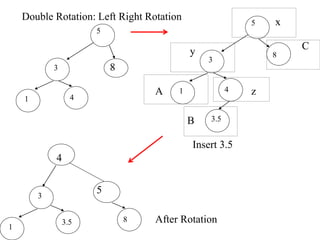
Double rotation : Left Right
Rotation
The new key is inserted in the subtree B1 or B2.
The AVL-property is violated at x.
x-y-z forms a zig-zag shape
also called left-right rotate
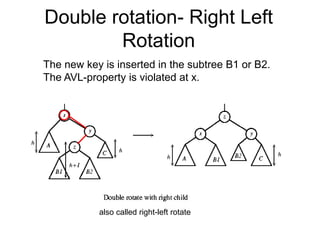
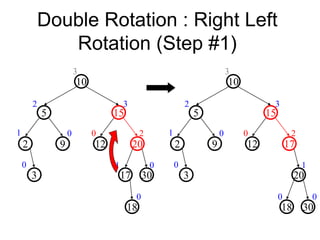
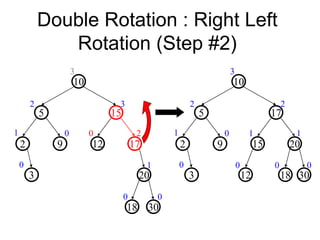
Double rotation- Right Left
Rotation
The new key is inserted in the subtree B1 or B2.
The AVL-property is violated at x.
also called right-left rotate
So?
Rotation does not change the flattening, so we still
have a BST.
But the depth of the leaves change by -1 in A, stay
the same in B, and change by +1 in C.
Double Rotation : Right Left
Rotation (Step #1)
20
9
2
15
5
10
30
17
3
12
1
1
2
0
0
2 3
3
0
0
18
0
17
9
2
15
5
10
20
3
12
1 2
0
0
2 3
3
1
0
30
0
18
0
Double Rotation : Right Left
Rotation (Step #2)
17
9
2
15
5
10
20
3
12
1 2
0
0
2 3
3
1
0
30
0
18
0
20
9
2
17
5
10
30
3
15
1
0
1
1
0
2 2
3
0
0
12
0
18
5
3
1 4
Insert 3.5
Double Rotation: Left Right Rotation
8
3.5
5
3
1 4
8
4
5
1
3
3.5 After Rotation
x
y
A z
B
C
8
Deletion of Node
Steps
1.Delete a node ( As in BST)
2.Balance the AVL Tree
Search is Similar to BST
Applications

AVL_Trees using DSA concepts and how to do

  • 1.
  • 2.
    AVL Trees • AVLtree is a Balanced Binary Search Tree • Balanced Factor : Balanced Factor of a node is the absolute difference in heights between left and right sub trees • AVL tree is defined is a Binary Search Tree tree such that, for each node, balanced factor ≤ 1
  • 3.
    AVL-Trees An AVL-tree isa BST with the property that at every node the difference in the depth of the left and right subtree is at most 1.(0,1,-1) OK not OK Two binary search trees: (a) an AVL tree; (b) not an AVL tree (unbalanced nodes are darkened)
  • 4.
    AVL Tree Insertion/Deletion inan AVL-tree is more complicated: Inserting/Deleting a new element may break the balance of the tree. But we can't just place the new element somewhere else, we have to maintain the BST property. Solution: insert in standard place, but then rebalance the tree using the operation “ROTATION”. Thus, many operations (searching, insertion, deletion) on an AVL tree will take O(log N) time.
  • 5.
    Rotations • When thetree structure changes (e.g., insertion or deletion), we need to transform the tree to restore the AVL tree property. • This is done using :single rotations or double rotations. x y A B C y x A B C Before Rotation After Rotation e.g. Single Rotation
  • 6.
    Single rotation: RightRotation The new key is inserted in the subtree A. The AVL-property is violated at x height of left(x) is h+2 height of right(x) is h.
  • 7.
    Single rotation: LeftRotation The new key is inserted in the subtree C. The AVL-property is violated at x.
  • 8.
  • 9.
  • 10.
  • 11.
  • 12.
    5 3 1 4 Insert 0.8 AVLTree :Right Rotation 8 0.8 5 3 1 4 8 x y A B C 3 5 1 0.8 4 8 After rotation
  • 13.
  • 14.
    Double rotation :Left Right Rotation The new key is inserted in the subtree B1 or B2. The AVL-property is violated at x. x-y-z forms a zig-zag shape also called left-right rotate
  • 15.
    Double rotation- RightLeft Rotation The new key is inserted in the subtree B1 or B2. The AVL-property is violated at x. also called right-left rotate
  • 16.
    So? Rotation does notchange the flattening, so we still have a BST. But the depth of the leaves change by -1 in A, stay the same in B, and change by +1 in C.
  • 17.
    Double Rotation :Right Left Rotation (Step #1) 20 9 2 15 5 10 30 17 3 12 1 1 2 0 0 2 3 3 0 0 18 0 17 9 2 15 5 10 20 3 12 1 2 0 0 2 3 3 1 0 30 0 18 0
  • 18.
    Double Rotation :Right Left Rotation (Step #2) 17 9 2 15 5 10 20 3 12 1 2 0 0 2 3 3 1 0 30 0 18 0 20 9 2 17 5 10 30 3 15 1 0 1 1 0 2 2 3 0 0 12 0 18
  • 19.
    5 3 1 4 Insert 3.5 DoubleRotation: Left Right Rotation 8 3.5 5 3 1 4 8 4 5 1 3 3.5 After Rotation x y A z B C 8
  • 20.
    Deletion of Node Steps 1.Deletea node ( As in BST) 2.Balance the AVL Tree
  • 21.
  • 22.