WHAT COMES INTO YOUR
MIND WHEN YOU HEAR
THE WORD “DISASTER”?
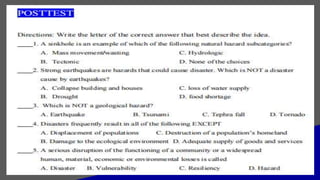
DISASTER
• A serious disruption of the functioning of a
comunity or a society involving widespread
human, material, economic or environmental
losses and impacts, which exceeds the ability
of the affected community or society to cope
using its on resources.
HAZARD
• A dangerous phenomenon, substance, human
activity or condition that may cause loss of
life, injury or other health impacts, property
damage, loss of livelihoods and services,
social and economic disruption, or
environmental damage.
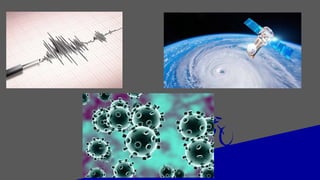
SITUATIONS/PHENOMENA
A shaking or trembling of the earth that is Volcanic or
tectonic in origin.
GROUND SHAKING
TORNADO
• A violent destructive whirling in accompannied by a
funnel-shaped cloud that progresses in a narrow path
over the land.
LANDSLIDE
• The usually rapid downward movement of a mass of rock,
earth, or artificial fill on a slope.
FLOOD
• a rising and overflowing of a body of water especially onto
normally dry land.
LIQUEFACTION
• coversion of soil ito a fluidlike mass during an earthquake
or other seismic event.
OTHER SITUATIONS
• Indoor fire
• Lava flow
• Industrial pollution
• Typhoon
• Forest fire
• Storm Surge
• Tsunami
• Extreme Rain Fall
Question 1: In general, how would you describe
the situations/phenomena given in the list?
Suggest a word that best describe all the
given phenomena above.
Question 2: How would you describe a society if
we presume that they experienced 1or2
phenomena given above?
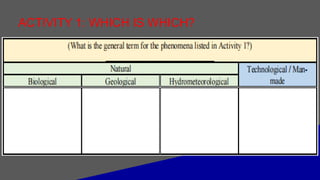
ACTIVITY 1: WHICH IS WHICH?
Explain what you
understand about the
figure.
In your own words,
how would you define
disaster?
ASSIGNMENT
• RISK FACTORS UNDERLYING DISASTERS

Disaster readiness risk Reduction.pptx

  • 2.
    WHAT COMES INTOYOUR MIND WHEN YOU HEAR THE WORD “DISASTER”?
  • 4.
    DISASTER • A seriousdisruption of the functioning of a comunity or a society involving widespread human, material, economic or environmental losses and impacts, which exceeds the ability of the affected community or society to cope using its on resources.
  • 5.
    HAZARD • A dangerousphenomenon, substance, human activity or condition that may cause loss of life, injury or other health impacts, property damage, loss of livelihoods and services, social and economic disruption, or environmental damage.
  • 7.
  • 8.
    A shaking ortrembling of the earth that is Volcanic or tectonic in origin. GROUND SHAKING TORNADO • A violent destructive whirling in accompannied by a funnel-shaped cloud that progresses in a narrow path over the land.
  • 9.
    LANDSLIDE • The usuallyrapid downward movement of a mass of rock, earth, or artificial fill on a slope. FLOOD • a rising and overflowing of a body of water especially onto normally dry land. LIQUEFACTION • coversion of soil ito a fluidlike mass during an earthquake or other seismic event.
  • 10.
    OTHER SITUATIONS • Indoorfire • Lava flow • Industrial pollution • Typhoon • Forest fire • Storm Surge • Tsunami • Extreme Rain Fall
  • 11.
    Question 1: Ingeneral, how would you describe the situations/phenomena given in the list? Suggest a word that best describe all the given phenomena above. Question 2: How would you describe a society if we presume that they experienced 1or2 phenomena given above?
  • 12.
  • 13.
    Explain what you understandabout the figure. In your own words, how would you define disaster?
  • 15.
    ASSIGNMENT • RISK FACTORSUNDERLYING DISASTERS