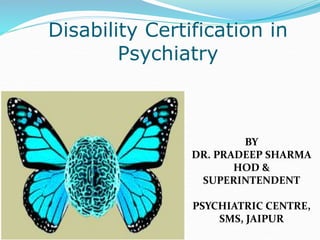
Disability Certification in
Psychiatry
BY
DR. PRADEEP SHARMA
HOD &
SUPERINTENDENT
PSYCHIATRIC CENTRE,
SMS, JAIPUR
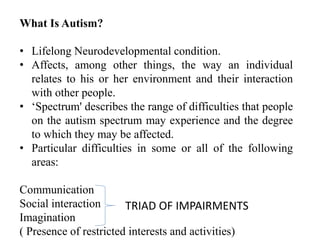
What Is Autism?
• Lifelong Neurodevelopmental condition.
• Affects, among other things, the way an individual
relates to his or her environment and their interaction
with other people.
• ‘Spectrum' describes the range of difficulties that people
on the autism spectrum may experience and the degree
to which they may be affected.
• Particular difficulties in some or all of the following
areas:
Communication
Social interaction
Imagination
( Presence of restricted interests and activities)
TRIAD OF IMPAIRMENTS
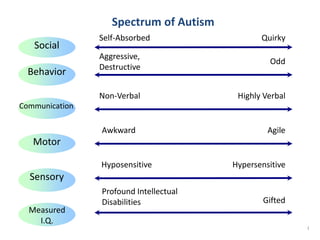
3
Social
Communication
Motor
Sensory
Profound Intellectual
Disabilities Gifted
Self-Absorbed Quirky
Non-Verbal Highly Verbal
Awkward Agile
Hyposensitive Hypersensitive
Measured
I.Q.
Behavior
Aggressive,
Destructive
Odd
Spectrum of Autism
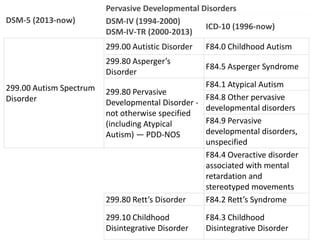
DSM-5 (2013-now)
Pervasive Developmental Disorders
DSM-IV (1994-2000)
DSM-IV-TR (2000-2013)
ICD-10 (1996-now)
299.00 Autism Spectrum
Disorder
299.00 Autistic Disorder F84.0 Childhood Autism
299.80 Asperger’s
Disorder
F84.5 Asperger Syndrome
299.80 Pervasive
Developmental Disorder -
not otherwise specified
(including Atypical
Autism) — PDD-NOS
F84.1 Atypical Autism
F84.8 Other pervasive
developmental disorders
F84.9 Pervasive
developmental disorders,
unspecified
F84.4 Overactive disorder
associated with mental
retardation and
stereotyped movements
299.80 Rett’s Disorder F84.2 Rett’s Syndrome
299.10 Childhood
Disintegrative Disorder
F84.3 Childhood
Disintegrative Disorder
.
EVALUATION AND ASSESSMENT FOR AUTISM
The National Institute for Mentally Handicapped (NIMH) developed
the Indian Scale for Assessment of Autism (ISAA) for diagnosing
and measuring the severity of autism in 2009.
It has 40 items divided under six domains – social relationship and
reciprocity; emotional responsiveness; speech, language and
communication; behavior patterns; sensory aspects and
cognitive component.
The items are rated from 1 to 5, increasing score indicating
increasing severity of the problem.
A score of <70 indicates no autism,
70-106 (mild autism),
107-153 (moderate autism),
and >153 (severe autism).
It takes about 15 to 20 minutes for administration of ISAA.
The ISAA was devised with the aim of quantifying the severity of
autistic symptoms so as to enable measurement of associated disability.
Quantification of disability would help in getting disability benefits.
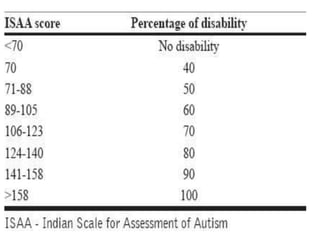
A symptom severity score of 70 in ISAA corresponds to 40%
disability;
71-88 (50%),
89-105 (60%),
106-123 (70%),
124-140 (80%),
141-158 (90%),
whereas >158 (100%) disability.
The subgroup of mild autism (70-106) has two different disability
scores and the group with moderate autism (107-153) has different
disability scores. A score of 153 would mean severe autism, but
100% disability benefits can be expected only if disability score is
>158.
Disability Certification in Psychiatric Practice
Rehabilitation Committee of the Indian Psychiatric Society (IPS)
came up with the Indian disability evaluation and assessment scale
(IDEAS) in 2002. IDEAS was field tested in nine centers all over
India and has now been gazetted by the Ministry of Social Justice
and Empowerment, Government of India, as the recommended
instrument to measure psychiatric disability.
Patients with the following diagnoses are eligible for disability
benefits:
1. Schizophrenia.
2. Bipolar Disorder.
3. Dementia.
4. Obsessive Compulsive Disorder.
Duration of illness - = at least 2 years – the number of months the
patient was symptomatic in the last 2 years (M12Y – months of
illness) should be determined.
The IDEAS, evaluates disability in four areas (termed items in the
scale), namely, Self care, Interpersonal activities, Communication
and Understanding, and Work.
Each item is scored on a 5 point scale with a range of 0-4, i.e. from
no (0) to profound disability (4).
The total disability score is obtained by summing up the ratings on
each item.
Global Disability Total Disability score +MI2Y score = Global
Disability score (range: 1-20)
Percentages For the purpose of welfare benefits, 40% will be the cut-
off point.
The scores above 40% have been categorized as Moderate, Severe
and Profound based on the Global disability score.
This grading will be used to measure change over time.
Score of 0 - No Disability = 0%
1 -7 - Mild Disability = < 40 %
8 and above = > 40 %
(8 -13 Moderate Disability; 14-19 = Severe Disability; 20 =
Profound Disability)
MENTAL RETARDATION
A condition of arrested or incomplete development of the mind,
which is especially characterised by impairment of skills manifested
during the development period which contribute to the overall level
of intelligence, i.e., cognitive, language, motor and social abilities.
Categories of Mental Retardation
Mild Mental Retardation - The range of 50 to 69 (standardised IQ
test) is indicative of mild retardation.
Moderate Mental Retardation - The IQ is in the range of 35 to 49.
Severe Mental Retardation - The IQ is usually in the range of 20 to
34.
Profound Mental Retardation - The IQ in this category estimated to
be under 20.
Disability Assessment of Mental Retardation
• Assess the intelligent quotient (IQ).
• IQ to be assessed by using a standardized test like Binet Kamat
Test, Alexander’s Pass Along Test, Koh’s Block Design test,
Draw A Man Test, Sequin form board for children with MR aged
above 5 years, Wechsler's Intelligence Scale.
• Calculate disability as follows: 110-IQ = Disability scoring.
Example : If IQ is 40 the disability is 70% (110-40-70)
THANK YOU

6_disability_certification_in_Psychiatry.pptx

  • 1.
    Disability Certification in Psychiatry BY DR.PRADEEP SHARMA HOD & SUPERINTENDENT PSYCHIATRIC CENTRE, SMS, JAIPUR
  • 2.
    What Is Autism? •Lifelong Neurodevelopmental condition. • Affects, among other things, the way an individual relates to his or her environment and their interaction with other people. • ‘Spectrum' describes the range of difficulties that people on the autism spectrum may experience and the degree to which they may be affected. • Particular difficulties in some or all of the following areas: Communication Social interaction Imagination ( Presence of restricted interests and activities) TRIAD OF IMPAIRMENTS
  • 3.
    3 Social Communication Motor Sensory Profound Intellectual Disabilities Gifted Self-AbsorbedQuirky Non-Verbal Highly Verbal Awkward Agile Hyposensitive Hypersensitive Measured I.Q. Behavior Aggressive, Destructive Odd Spectrum of Autism
  • 4.
    DSM-5 (2013-now) Pervasive DevelopmentalDisorders DSM-IV (1994-2000) DSM-IV-TR (2000-2013) ICD-10 (1996-now) 299.00 Autism Spectrum Disorder 299.00 Autistic Disorder F84.0 Childhood Autism 299.80 Asperger’s Disorder F84.5 Asperger Syndrome 299.80 Pervasive Developmental Disorder - not otherwise specified (including Atypical Autism) — PDD-NOS F84.1 Atypical Autism F84.8 Other pervasive developmental disorders F84.9 Pervasive developmental disorders, unspecified F84.4 Overactive disorder associated with mental retardation and stereotyped movements 299.80 Rett’s Disorder F84.2 Rett’s Syndrome 299.10 Childhood Disintegrative Disorder F84.3 Childhood Disintegrative Disorder .
  • 5.
    EVALUATION AND ASSESSMENTFOR AUTISM The National Institute for Mentally Handicapped (NIMH) developed the Indian Scale for Assessment of Autism (ISAA) for diagnosing and measuring the severity of autism in 2009. It has 40 items divided under six domains – social relationship and reciprocity; emotional responsiveness; speech, language and communication; behavior patterns; sensory aspects and cognitive component. The items are rated from 1 to 5, increasing score indicating increasing severity of the problem.
  • 6.
    A score of<70 indicates no autism, 70-106 (mild autism), 107-153 (moderate autism), and >153 (severe autism). It takes about 15 to 20 minutes for administration of ISAA. The ISAA was devised with the aim of quantifying the severity of autistic symptoms so as to enable measurement of associated disability. Quantification of disability would help in getting disability benefits.
  • 7.
    A symptom severityscore of 70 in ISAA corresponds to 40% disability; 71-88 (50%), 89-105 (60%), 106-123 (70%), 124-140 (80%), 141-158 (90%), whereas >158 (100%) disability. The subgroup of mild autism (70-106) has two different disability scores and the group with moderate autism (107-153) has different disability scores. A score of 153 would mean severe autism, but 100% disability benefits can be expected only if disability score is >158.
  • 9.
    Disability Certification inPsychiatric Practice Rehabilitation Committee of the Indian Psychiatric Society (IPS) came up with the Indian disability evaluation and assessment scale (IDEAS) in 2002. IDEAS was field tested in nine centers all over India and has now been gazetted by the Ministry of Social Justice and Empowerment, Government of India, as the recommended instrument to measure psychiatric disability. Patients with the following diagnoses are eligible for disability benefits: 1. Schizophrenia. 2. Bipolar Disorder. 3. Dementia. 4. Obsessive Compulsive Disorder. Duration of illness - = at least 2 years – the number of months the patient was symptomatic in the last 2 years (M12Y – months of illness) should be determined.
  • 10.
    The IDEAS, evaluatesdisability in four areas (termed items in the scale), namely, Self care, Interpersonal activities, Communication and Understanding, and Work. Each item is scored on a 5 point scale with a range of 0-4, i.e. from no (0) to profound disability (4). The total disability score is obtained by summing up the ratings on each item. Global Disability Total Disability score +MI2Y score = Global Disability score (range: 1-20)
  • 11.
    Percentages For thepurpose of welfare benefits, 40% will be the cut- off point. The scores above 40% have been categorized as Moderate, Severe and Profound based on the Global disability score. This grading will be used to measure change over time. Score of 0 - No Disability = 0% 1 -7 - Mild Disability = < 40 % 8 and above = > 40 % (8 -13 Moderate Disability; 14-19 = Severe Disability; 20 = Profound Disability)
  • 12.
    MENTAL RETARDATION A conditionof arrested or incomplete development of the mind, which is especially characterised by impairment of skills manifested during the development period which contribute to the overall level of intelligence, i.e., cognitive, language, motor and social abilities. Categories of Mental Retardation Mild Mental Retardation - The range of 50 to 69 (standardised IQ test) is indicative of mild retardation. Moderate Mental Retardation - The IQ is in the range of 35 to 49. Severe Mental Retardation - The IQ is usually in the range of 20 to 34. Profound Mental Retardation - The IQ in this category estimated to be under 20.
  • 13.
    Disability Assessment ofMental Retardation • Assess the intelligent quotient (IQ). • IQ to be assessed by using a standardized test like Binet Kamat Test, Alexander’s Pass Along Test, Koh’s Block Design test, Draw A Man Test, Sequin form board for children with MR aged above 5 years, Wechsler's Intelligence Scale. • Calculate disability as follows: 110-IQ = Disability scoring. Example : If IQ is 40 the disability is 70% (110-40-70)
  • 14.