Guidelines for Evaluation of
Permanent Physical Impairment
(PPI) of Upper Extremities
Dr. Kavin Khatri
MS,DNB,MNAMS,FACS
Associate Professor,
Department of orthopedics,
GGS medical college,
Faridkot.
HEALTH
State of complete physical, mental, and
social well being, and not merely the
absence of disease or infirmity
Read more:
IMPAIRMENT
Any loss or abnormality of psychological,
physiological, or anatomical structure or
function
IMPAIRMENT
Impairment includes clinical features or
manifestations of the disease or
condition. Examples: weakness, limited
ROM, confusion etc.
In this definition function is the function of
a body part, not the whole-person
function.
DISABILITY
Any restriction or lack
resulting from impairment of
ability to perform an activity
in the manner or within the
range considered normal for
a human being
HANDICAP
A disadvantage for a
given individual
resulting from an
impairment or a
disability that limits or
prevents the fulfillment
of a role that is normal
(depending on the age,
gender, social and
cultural factors) for that
individual
WHO DEFINITIONS
Impairment ↔ Organ or Tissue
Disability ↔ Whole Person
Handicap ↔ Society
Guidelines for Evaluation
 Estimation and measurement shall be made
when the clinical condition has reached the
stage of maximum improvement from the
medical treatment.
It is not personal opinion but measured
functional impairment
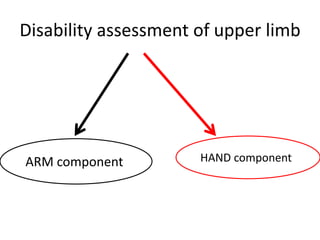
Disability assessment of upper limb
ARM component HAND component
Guidelines for Evaluation
 Measurement of the loss of function of arm
component consists of
• Measuring the loss of range of motion
• Muscle strength
• Co-ordinated activities
Guidelines for Evaluation
 Measurement of loss of function of hand
component consists of
• Prehension
• Sensation
• Strength
Guidelines for Evaluation
 The impairment of the entire extremity
depends on the combination of the
impairments of both components (ARM +
HAND)
 Total disability % will not exceed 100%
 Disability is to be certified as whole number
and not as a fraction
 Disability is to be certified in relation to that
upper extremity
ARM component
• Measuring the loss of range of motion
• Muscle strength
• Co-ordinated activities
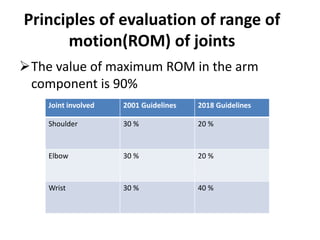
Principles of evaluation of range of
motion(ROM) of joints
The value of maximum ROM in the arm
component is 90%
Joint involved 2001 Guidelines 2018 Guidelines
Shoulder 30 % 20 %
Elbow 30 % 20 %
Wrist 30 % 40 %
• Example: shoulder joint
Range of
motion
Normal Active Loss
Forward flexion 180° 90° 50%
Abduction 180° 90° 50%
Rotations 90° 45° 50%
So, the mean loss of motion at shoulder joint is 50+50+50/3 =
50 %
Shoulder movement constitutes 20% of the motion of arm
component ; therefore loss of motion for arm component will
be 50 x .2 = 10%
Principles of evaluation of strength of
muscles
• Strength of muscles can be tested by manual
method and graded from 0-5 as advocated by
Medical Research Council (MRC), London, UK
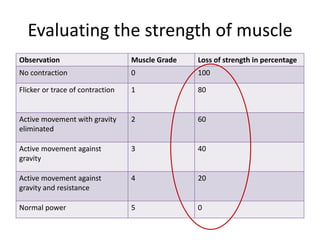
Evaluating the strength of muscle
Observation Muscle Grade Loss of strength in percentage
No contraction 0 100
Flicker or trace of contraction 1 80
Active movement with gravity
eliminated
2 60
Active movement against
gravity
3 40
Active movement against
gravity and resistance
4 20
Normal power 5 0
The mean percentage of loss of muscle strength
around a joint is multiplied by 0.30
• Example: MRC grade 3 = 40% x .3 = 12%
Principles of evaluation of
coordinated activities
Lifting overhead objects remove and placing at the same place 9 %
Touching nose with end of extremity 9 %
Eating Indian Style 9 %
Combing and Plaiting 9 %
Putting on a shirt/kurta 9 %
Holding glass of water 9 %
Drinking Glass of water 9 %
Buttoning 9 %
Tie Nara Dhoti 9 %
Writing 9 %
Combining values for total arm
component (shoulder joint)
Total loss of function:
 Loss of range of motion = 10%
 Loss of muscle strength = 12%
 Loss of co-ordinated movement= 5%
Combination of two values = a+ b(90-a)
= 12 + 10(90-12) = 12+ 8.66 = 20.66
90
90
Again we combine the two values using same
formula a + b(90-a)
90
20.66 + 5 (90—20.66)
= 20.66 + 3.85
= 24.5
90
So , the total value of loss of function in arm component is
24.51% ≈ 25%
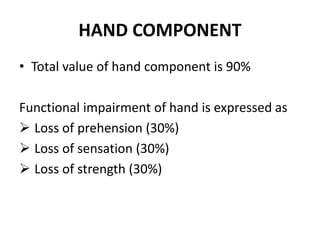
HAND COMPONENT
• Total value of hand component is 90%
Functional impairment of hand is expressed as
 Loss of prehension (30%)
 Loss of sensation (30%)
 Loss of strength (30%)
• 10% weightage to be given to persons with
involvement of dominant upper extremity
(mostly right upper extremity) due to acquired
conditions (diseases/ injuries etc.).
• For shortening of upper extremity, addition
weightage :
• First 1" - No additional weightage
• For each 1" beyond first 1" - 2% additional
weightage
• Additional weightage - A total of upto 10%
additional weightage can be given to
accompanying factors if they are continuous and
persistent despite treatment
BHARAT KUMAR – Paraolympian swimmer

Disability

  • 1.
    Guidelines for Evaluationof Permanent Physical Impairment (PPI) of Upper Extremities Dr. Kavin Khatri MS,DNB,MNAMS,FACS Associate Professor, Department of orthopedics, GGS medical college, Faridkot.
  • 2.
    HEALTH State of completephysical, mental, and social well being, and not merely the absence of disease or infirmity Read more:
  • 3.
    IMPAIRMENT Any loss orabnormality of psychological, physiological, or anatomical structure or function
  • 4.
    IMPAIRMENT Impairment includes clinicalfeatures or manifestations of the disease or condition. Examples: weakness, limited ROM, confusion etc. In this definition function is the function of a body part, not the whole-person function.
  • 5.
    DISABILITY Any restriction orlack resulting from impairment of ability to perform an activity in the manner or within the range considered normal for a human being
  • 6.
    HANDICAP A disadvantage fora given individual resulting from an impairment or a disability that limits or prevents the fulfillment of a role that is normal (depending on the age, gender, social and cultural factors) for that individual
  • 7.
    WHO DEFINITIONS Impairment ↔Organ or Tissue Disability ↔ Whole Person Handicap ↔ Society
  • 10.
    Guidelines for Evaluation Estimation and measurement shall be made when the clinical condition has reached the stage of maximum improvement from the medical treatment. It is not personal opinion but measured functional impairment
  • 11.
    Disability assessment ofupper limb ARM component HAND component
  • 12.
    Guidelines for Evaluation Measurement of the loss of function of arm component consists of • Measuring the loss of range of motion • Muscle strength • Co-ordinated activities
  • 13.
    Guidelines for Evaluation Measurement of loss of function of hand component consists of • Prehension • Sensation • Strength
  • 14.
    Guidelines for Evaluation The impairment of the entire extremity depends on the combination of the impairments of both components (ARM + HAND)  Total disability % will not exceed 100%  Disability is to be certified as whole number and not as a fraction  Disability is to be certified in relation to that upper extremity
  • 15.
    ARM component • Measuringthe loss of range of motion • Muscle strength • Co-ordinated activities
  • 16.
    Principles of evaluationof range of motion(ROM) of joints The value of maximum ROM in the arm component is 90% Joint involved 2001 Guidelines 2018 Guidelines Shoulder 30 % 20 % Elbow 30 % 20 % Wrist 30 % 40 %
  • 17.
    • Example: shoulderjoint Range of motion Normal Active Loss Forward flexion 180° 90° 50% Abduction 180° 90° 50% Rotations 90° 45° 50% So, the mean loss of motion at shoulder joint is 50+50+50/3 = 50 % Shoulder movement constitutes 20% of the motion of arm component ; therefore loss of motion for arm component will be 50 x .2 = 10%
  • 18.
    Principles of evaluationof strength of muscles • Strength of muscles can be tested by manual method and graded from 0-5 as advocated by Medical Research Council (MRC), London, UK
  • 19.
    Evaluating the strengthof muscle Observation Muscle Grade Loss of strength in percentage No contraction 0 100 Flicker or trace of contraction 1 80 Active movement with gravity eliminated 2 60 Active movement against gravity 3 40 Active movement against gravity and resistance 4 20 Normal power 5 0
  • 21.
    The mean percentageof loss of muscle strength around a joint is multiplied by 0.30 • Example: MRC grade 3 = 40% x .3 = 12%
  • 22.
    Principles of evaluationof coordinated activities Lifting overhead objects remove and placing at the same place 9 % Touching nose with end of extremity 9 % Eating Indian Style 9 % Combing and Plaiting 9 % Putting on a shirt/kurta 9 % Holding glass of water 9 % Drinking Glass of water 9 % Buttoning 9 % Tie Nara Dhoti 9 % Writing 9 %
  • 24.
    Combining values fortotal arm component (shoulder joint) Total loss of function:  Loss of range of motion = 10%  Loss of muscle strength = 12%  Loss of co-ordinated movement= 5% Combination of two values = a+ b(90-a) = 12 + 10(90-12) = 12+ 8.66 = 20.66 90 90
  • 25.
    Again we combinethe two values using same formula a + b(90-a) 90 20.66 + 5 (90—20.66) = 20.66 + 3.85 = 24.5 90 So , the total value of loss of function in arm component is 24.51% ≈ 25%
  • 26.
    HAND COMPONENT • Totalvalue of hand component is 90% Functional impairment of hand is expressed as  Loss of prehension (30%)  Loss of sensation (30%)  Loss of strength (30%)
  • 30.
    • 10% weightageto be given to persons with involvement of dominant upper extremity (mostly right upper extremity) due to acquired conditions (diseases/ injuries etc.).
  • 31.
    • For shorteningof upper extremity, addition weightage : • First 1" - No additional weightage • For each 1" beyond first 1" - 2% additional weightage
  • 32.
    • Additional weightage- A total of upto 10% additional weightage can be given to accompanying factors if they are continuous and persistent despite treatment
  • 34.
    BHARAT KUMAR –Paraolympian swimmer

Editor's Notes

  • #11 ) The upper extremity is divided into two component parts; the arm component and the hand component
  • #14 For estimation of prehension opposition, lateral pinch, cylindrical grasp, spherical grasp and hook grasp have to be assessed