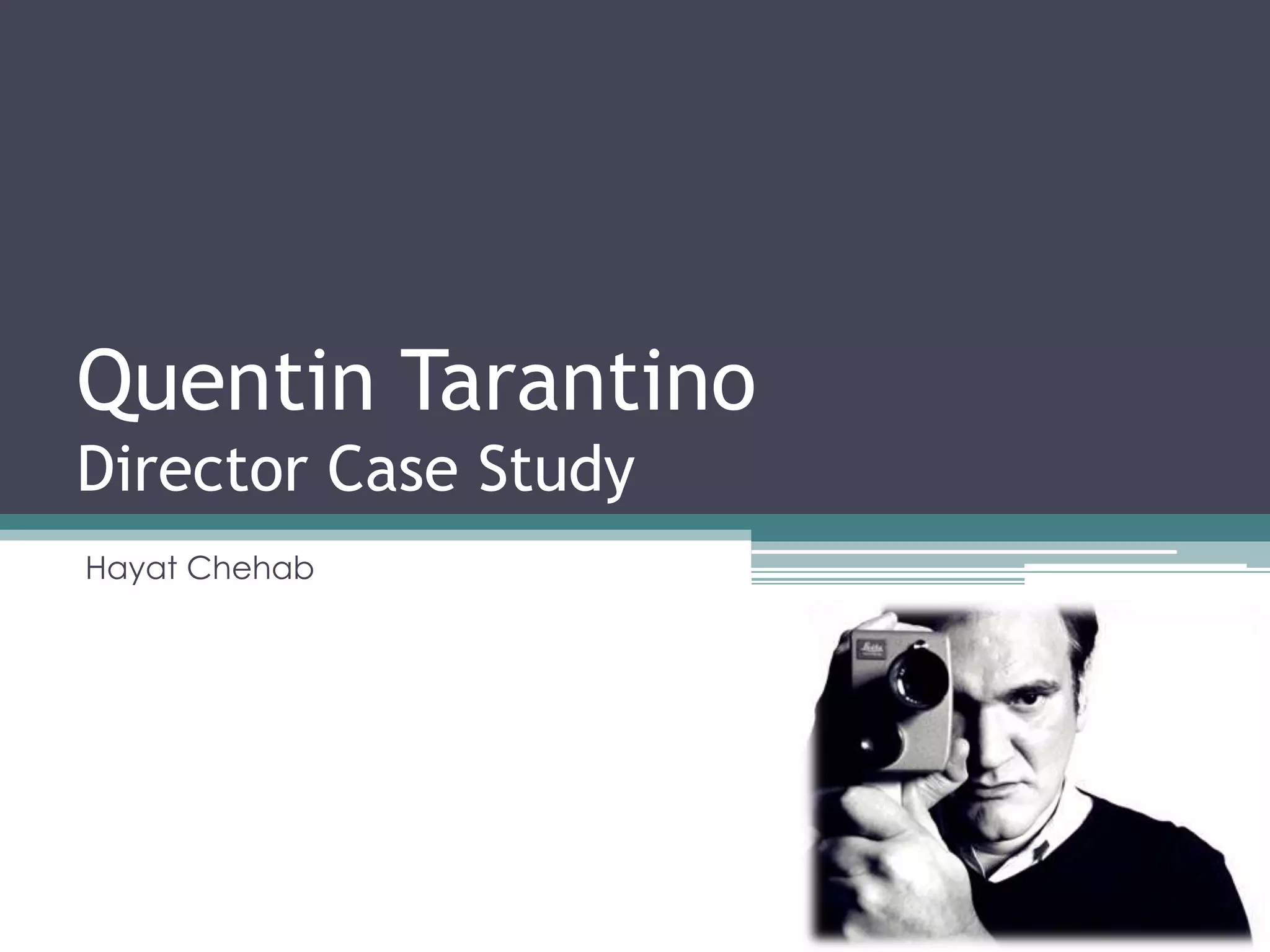
Quentin Tarantino 
Director Case Study 
Hayat Chehab
Early Life 
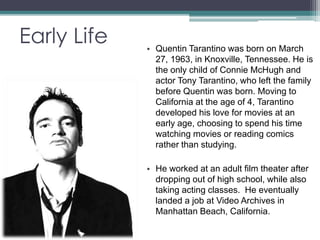
• Quentin Tarantino was born on March 
27, 1963, in Knoxville, Tennessee. He is 
the only child of Connie McHugh and 
actor Tony Tarantino, who left the family 
before Quentin was born. Moving to 
California at the age of 4, Tarantino 
developed his love for movies at an 
early age, choosing to spend his time 
watching movies or reading comics 
rather than studying. 
• He worked at an adult film theater after 
dropping out of high school, while also 
taking acting classes. He eventually 
landed a job at Video Archives in 
Manhattan Beach, California.
Early Films 
• During his time at Video Archives, 
Tarantino worked on several 
screenplays, including True 
Romance and Natural Born Killers. In 
1990, Tarantino left Video Archives to 
work for Cinetel, a production 
company. Through one of the 
producers there, he was able to get his 
script for True Romance in the hands 
of director Tony Scott, who bought the 
rights to it. 
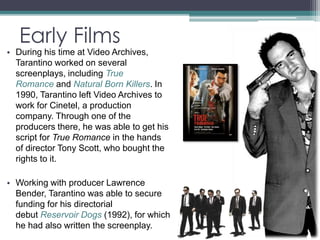
• Working with producer Lawrence 
Bender, Tarantino was able to secure 
funding for his directorial 
debut Reservoir Dogs (1992), for which 
he had also written the screenplay.
Reservoir Dogs 
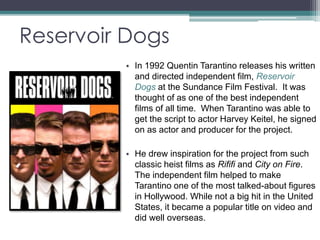
• In 1992 Quentin Tarantino releases his written 
and directed independent film, Reservoir 
Dogs at the Sundance Film Festival. It was 
thought of as one of the best independent 
films of all time. When Tarantino was able to 
get the script to actor Harvey Keitel, he signed 
on as actor and producer for the project. 
• He drew inspiration for the project from such 
classic heist films as Rififi and City on Fire. 
The independent film helped to make 
Tarantino one of the most talked-about figures 
in Hollywood. While not a big hit in the United 
States, it became a popular title on video and 
did well overseas.
Pulp Fiction 
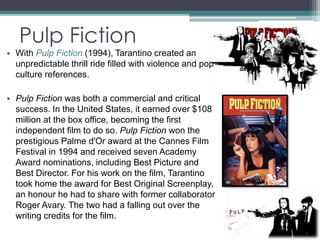
• With Pulp Fiction (1994), Tarantino created an 
unpredictable thrill ride filled with violence and pop 
culture references. 
• Pulp Fiction was both a commercial and critical 
success. In the United States, it earned over $108 
million at the box office, becoming the first 
independent film to do so. Pulp Fiction won the 
prestigious Palme d'Or award at the Cannes Film 
Festival in 1994 and received seven Academy 
Award nominations, including Best Picture and 
Best Director. For his work on the film, Tarantino 
took home the award for Best Original Screenplay, 
an honour he had to share with former collaborator 
Roger Avary. The two had a falling out over the 
writing credits for the film.
Criticism and Success 
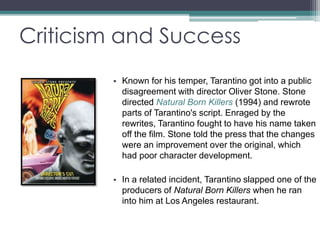
• Known for his temper, Tarantino got into a public 
disagreement with director Oliver Stone. Stone 
directed Natural Born Killers (1994) and rewrote 
parts of Tarantino's script. Enraged by the 
rewrites, Tarantino fought to have his name taken 
off the film. Stone told the press that the changes 
were an improvement over the original, which 
had poor character development. 
• In a related incident, Tarantino slapped one of the 
producers of Natural Born Killers when he ran 
into him at Los Angeles restaurant.
Collaborations 
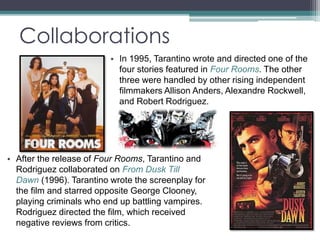
• In 1995, Tarantino wrote and directed one of the 
four stories featured in Four Rooms. The other 
three were handled by other rising independent 
filmmakers Allison Anders, Alexandre Rockwell, 
and Robert Rodriguez. 
• After the release of Four Rooms, Tarantino and 
Rodriguez collaborated on From Dusk Till 
Dawn (1996). Tarantino wrote the screenplay for 
the film and starred opposite George Clooney, 
playing criminals who end up battling vampires. 
Rodriguez directed the film, which received 
negative reviews from critics.
Jackie Brown 
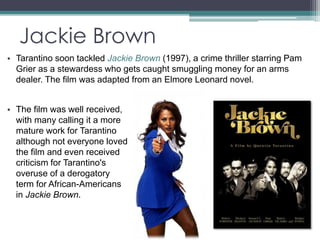
• Tarantino soon tackled Jackie Brown (1997), a crime thriller starring Pam 
Grier as a stewardess who gets caught smuggling money for an arms 
dealer. The film was adapted from an Elmore Leonard novel. 
• The film was well received, 
with many calling it a more 
mature work for Tarantino 
although not everyone loved 
the film and even received 
criticism for Tarantino's 
overuse of a derogatory 
term for African-Americans 
in Jackie Brown.
Kill Bill 
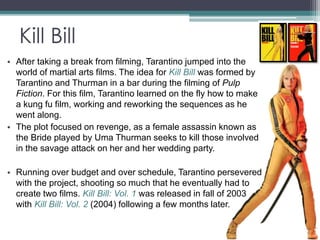
• After taking a break from filming, Tarantino jumped into the 
world of martial arts films. The idea for Kill Bill was formed by 
Tarantino and Thurman in a bar during the filming of Pulp 
Fiction. For this film, Tarantino learned on the fly how to make 
a kung fu film, working and reworking the sequences as he 
went along. 
• The plot focused on revenge, as a female assassin known as 
the Bride played by Uma Thurman seeks to kill those involved 
in the savage attack on her and her wedding party. 
• Running over budget and over schedule, Tarantino persevered 
with the project, shooting so much that he eventually had to 
create two films. Kill Bill: Vol. 1 was released in fall of 2003 
with Kill Bill: Vol. 2 (2004) following a few months later.
Recent Work 
• After Kill Bill, Tarantino experimented in television. He 
wrote and directed an episode of the drama CSI: 
Crime Scene Investigation (2005), for which he 
received an Emmy Award nomination. 
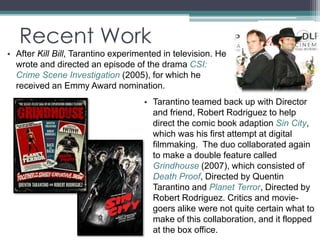
• Tarantino teamed back up with Director 
and friend, Robert Rodriguez to help 
direct the comic book adaption Sin City, 
which was his first attempt at digital 
filmmaking. The duo collaborated again 
to make a double feature called 
Grindhouse (2007), which consisted of 
Death Proof, Directed by Quentin 
Tarantino and Planet Terror, Directed by 
Robert Rodriguez. Critics and movie-goers 
alike were not quite certain what to 
make of this collaboration, and it flopped 
at the box office.
Inglorious Basterds 
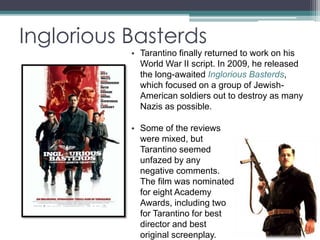
• Tarantino finally returned to work on his 
World War II script. In 2009, he released 
the long-awaited Inglorious Basterds, 
which focused on a group of Jewish- 
American soldiers out to destroy as many 
Nazis as possible. 
• Some of the reviews 
were mixed, but 
Tarantino seemed 
unfazed by any 
negative comments. 
The film was nominated 
for eight Academy 
Awards, including two 
for Tarantino for best 
director and best 
original screenplay.
Django Unchained 
• Tarantino went on to meet with both commercial 
and critical success with his action western Django 
Unchained, released in late 2012. At the 85th 
Academy Awards in 2013, Tarantino won an 
Academy Award for best original screenplay 
for Django Unchained. The film received several 
other Oscar nominations, including for best picture, 
cinematography and sound editing. 
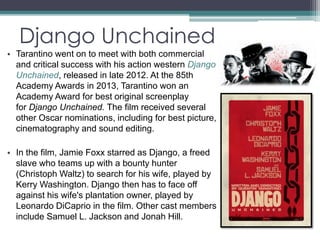
• In the film, Jamie Foxx starred as Django, a freed 
slave who teams up with a bounty hunter 
(Christoph Waltz) to search for his wife, played by 
Kerry Washington. Django then has to face off 
against his wife's plantation owner, played by 
Leonardo DiCaprio in the film. Other cast members 
include Samuel L. Jackson and Jonah Hill.

Director case study - Quentin Tarantino

  • 1.
    Quentin Tarantino DirectorCase Study Hayat Chehab
  • 2.
    Early Life •Quentin Tarantino was born on March 27, 1963, in Knoxville, Tennessee. He is the only child of Connie McHugh and actor Tony Tarantino, who left the family before Quentin was born. Moving to California at the age of 4, Tarantino developed his love for movies at an early age, choosing to spend his time watching movies or reading comics rather than studying. • He worked at an adult film theater after dropping out of high school, while also taking acting classes. He eventually landed a job at Video Archives in Manhattan Beach, California.
  • 3.
    Early Films •During his time at Video Archives, Tarantino worked on several screenplays, including True Romance and Natural Born Killers. In 1990, Tarantino left Video Archives to work for Cinetel, a production company. Through one of the producers there, he was able to get his script for True Romance in the hands of director Tony Scott, who bought the rights to it. • Working with producer Lawrence Bender, Tarantino was able to secure funding for his directorial debut Reservoir Dogs (1992), for which he had also written the screenplay.
  • 4.
    Reservoir Dogs •In 1992 Quentin Tarantino releases his written and directed independent film, Reservoir Dogs at the Sundance Film Festival. It was thought of as one of the best independent films of all time. When Tarantino was able to get the script to actor Harvey Keitel, he signed on as actor and producer for the project. • He drew inspiration for the project from such classic heist films as Rififi and City on Fire. The independent film helped to make Tarantino one of the most talked-about figures in Hollywood. While not a big hit in the United States, it became a popular title on video and did well overseas.
  • 5.
    Pulp Fiction •With Pulp Fiction (1994), Tarantino created an unpredictable thrill ride filled with violence and pop culture references. • Pulp Fiction was both a commercial and critical success. In the United States, it earned over $108 million at the box office, becoming the first independent film to do so. Pulp Fiction won the prestigious Palme d'Or award at the Cannes Film Festival in 1994 and received seven Academy Award nominations, including Best Picture and Best Director. For his work on the film, Tarantino took home the award for Best Original Screenplay, an honour he had to share with former collaborator Roger Avary. The two had a falling out over the writing credits for the film.
  • 6.
    Criticism and Success • Known for his temper, Tarantino got into a public disagreement with director Oliver Stone. Stone directed Natural Born Killers (1994) and rewrote parts of Tarantino's script. Enraged by the rewrites, Tarantino fought to have his name taken off the film. Stone told the press that the changes were an improvement over the original, which had poor character development. • In a related incident, Tarantino slapped one of the producers of Natural Born Killers when he ran into him at Los Angeles restaurant.
  • 7.
    Collaborations • In1995, Tarantino wrote and directed one of the four stories featured in Four Rooms. The other three were handled by other rising independent filmmakers Allison Anders, Alexandre Rockwell, and Robert Rodriguez. • After the release of Four Rooms, Tarantino and Rodriguez collaborated on From Dusk Till Dawn (1996). Tarantino wrote the screenplay for the film and starred opposite George Clooney, playing criminals who end up battling vampires. Rodriguez directed the film, which received negative reviews from critics.
  • 8.
    Jackie Brown •Tarantino soon tackled Jackie Brown (1997), a crime thriller starring Pam Grier as a stewardess who gets caught smuggling money for an arms dealer. The film was adapted from an Elmore Leonard novel. • The film was well received, with many calling it a more mature work for Tarantino although not everyone loved the film and even received criticism for Tarantino's overuse of a derogatory term for African-Americans in Jackie Brown.
  • 9.
    Kill Bill •After taking a break from filming, Tarantino jumped into the world of martial arts films. The idea for Kill Bill was formed by Tarantino and Thurman in a bar during the filming of Pulp Fiction. For this film, Tarantino learned on the fly how to make a kung fu film, working and reworking the sequences as he went along. • The plot focused on revenge, as a female assassin known as the Bride played by Uma Thurman seeks to kill those involved in the savage attack on her and her wedding party. • Running over budget and over schedule, Tarantino persevered with the project, shooting so much that he eventually had to create two films. Kill Bill: Vol. 1 was released in fall of 2003 with Kill Bill: Vol. 2 (2004) following a few months later.
  • 10.
    Recent Work •After Kill Bill, Tarantino experimented in television. He wrote and directed an episode of the drama CSI: Crime Scene Investigation (2005), for which he received an Emmy Award nomination. • Tarantino teamed back up with Director and friend, Robert Rodriguez to help direct the comic book adaption Sin City, which was his first attempt at digital filmmaking. The duo collaborated again to make a double feature called Grindhouse (2007), which consisted of Death Proof, Directed by Quentin Tarantino and Planet Terror, Directed by Robert Rodriguez. Critics and movie-goers alike were not quite certain what to make of this collaboration, and it flopped at the box office.
  • 11.
    Inglorious Basterds •Tarantino finally returned to work on his World War II script. In 2009, he released the long-awaited Inglorious Basterds, which focused on a group of Jewish- American soldiers out to destroy as many Nazis as possible. • Some of the reviews were mixed, but Tarantino seemed unfazed by any negative comments. The film was nominated for eight Academy Awards, including two for Tarantino for best director and best original screenplay.
  • 12.
    Django Unchained •Tarantino went on to meet with both commercial and critical success with his action western Django Unchained, released in late 2012. At the 85th Academy Awards in 2013, Tarantino won an Academy Award for best original screenplay for Django Unchained. The film received several other Oscar nominations, including for best picture, cinematography and sound editing. • In the film, Jamie Foxx starred as Django, a freed slave who teams up with a bounty hunter (Christoph Waltz) to search for his wife, played by Kerry Washington. Django then has to face off against his wife's plantation owner, played by Leonardo DiCaprio in the film. Other cast members include Samuel L. Jackson and Jonah Hill.