DIRECT
THROMBIN
INHIBITORS
INTRODUCTION
 Class of medication that act as anticoagulants (delaying blood clotting) by
directly inhibiting the enzyme thrombin (factor IIa).
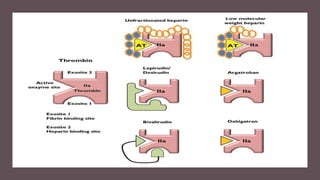
 Their mechanism of action differs from that of heparin and the synthetic
pentasaccharides in that they directly inhibit the active site of thrombin and
do not require interaction with antithrombin to produce an anticoagulant
effect
TYPES
 Bivalent
 Bivalirudin (transient inhibition - is cleaved by thrombin)
 Lepirudin
 Desirudin
 Univalent
 Argatroban
 Inogatran
 Melagatran (and its prodrug ximelagatran)
 Dabigatran
USES
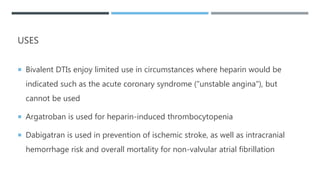
 Bivalent DTIs enjoy limited use in circumstances where heparin would be
indicated such as the acute coronary syndrome ("unstable angina"), but
cannot be used
 Argatroban is used for heparin-induced thrombocytopenia
 Dabigatran is used in prevention of ischemic stroke, as well as intracranial
hemorrhage risk and overall mortality for non-valvular atrial fibrillation
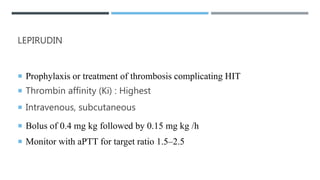
LEPIRUDIN
 Prophylaxis or treatment of thrombosis complicating HIT
 Thrombin affinity (Ki) : Highest
 Intravenous, subcutaneous
 Bolus of 0.4 mg kg followed by 0.15 mg kg /h
 Monitor with aPTT for target ratio 1.5–2.5
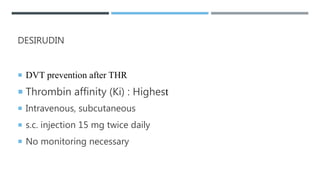
DESIRUDIN
 DVT prevention after THR
 Thrombin affinity (Ki) : Highest
 Intravenous, subcutaneous
 s.c. injection 15 mg twice daily
 No monitoring necessary
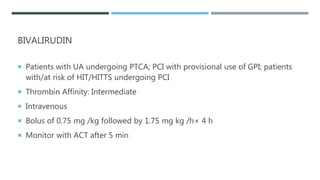
BIVALIRUDIN
 Patients with UA undergoing PTCA; PCI with provisional use of GPI; patients
with/at risk of HIT/HITTS undergoing PCI
 Thrombin Affinity: Intermediate
 Intravenous
 Bolus of 0.75 mg /kg followed by 1.75 mg kg /h× 4 h
 Monitor with ACT after 5 min
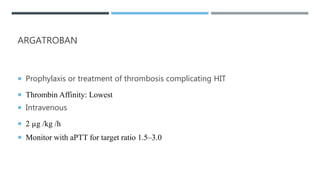
ARGATROBAN
 Prophylaxis or treatment of thrombosis complicating HIT
 Thrombin Affinity: Lowest
 Intravenous
 2 µg /kg /h
 Monitor with aPTT for target ratio 1.5–3.0
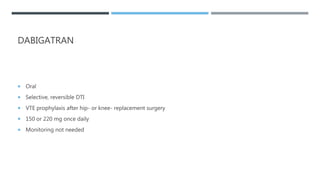
DABIGATRAN
 Oral
 Selective, reversible DTI
 VTE prophylaxis after hip- or knee- replacement surgery
 150 or 220 mg once daily
 Monitoring not needed

Direct thrombin inhibitors

  • 1.
  • 2.
    INTRODUCTION  Class ofmedication that act as anticoagulants (delaying blood clotting) by directly inhibiting the enzyme thrombin (factor IIa).  Their mechanism of action differs from that of heparin and the synthetic pentasaccharides in that they directly inhibit the active site of thrombin and do not require interaction with antithrombin to produce an anticoagulant effect
  • 3.
    TYPES  Bivalent  Bivalirudin(transient inhibition - is cleaved by thrombin)  Lepirudin  Desirudin  Univalent  Argatroban  Inogatran  Melagatran (and its prodrug ximelagatran)  Dabigatran
  • 5.
    USES  Bivalent DTIsenjoy limited use in circumstances where heparin would be indicated such as the acute coronary syndrome ("unstable angina"), but cannot be used  Argatroban is used for heparin-induced thrombocytopenia  Dabigatran is used in prevention of ischemic stroke, as well as intracranial hemorrhage risk and overall mortality for non-valvular atrial fibrillation
  • 6.
    LEPIRUDIN  Prophylaxis ortreatment of thrombosis complicating HIT  Thrombin affinity (Ki) : Highest  Intravenous, subcutaneous  Bolus of 0.4 mg kg followed by 0.15 mg kg /h  Monitor with aPTT for target ratio 1.5–2.5
  • 7.
    DESIRUDIN  DVT preventionafter THR  Thrombin affinity (Ki) : Highest  Intravenous, subcutaneous  s.c. injection 15 mg twice daily  No monitoring necessary
  • 8.
    BIVALIRUDIN  Patients withUA undergoing PTCA; PCI with provisional use of GPI; patients with/at risk of HIT/HITTS undergoing PCI  Thrombin Affinity: Intermediate  Intravenous  Bolus of 0.75 mg /kg followed by 1.75 mg kg /h× 4 h  Monitor with ACT after 5 min
  • 9.
    ARGATROBAN  Prophylaxis ortreatment of thrombosis complicating HIT  Thrombin Affinity: Lowest  Intravenous  2 µg /kg /h  Monitor with aPTT for target ratio 1.5–3.0
  • 10.
    DABIGATRAN  Oral  Selective,reversible DTI  VTE prophylaxis after hip- or knee- replacement surgery  150 or 220 mg once daily  Monitoring not needed

Editor's Notes

  • #4 Bivalent DTIs (hirudin and analogs) bind both to the active site and exosite 1, while univalent DTIs bind only to the active site.
  • #9 GPI, glycoprotein inhibitor UA, unstable angina