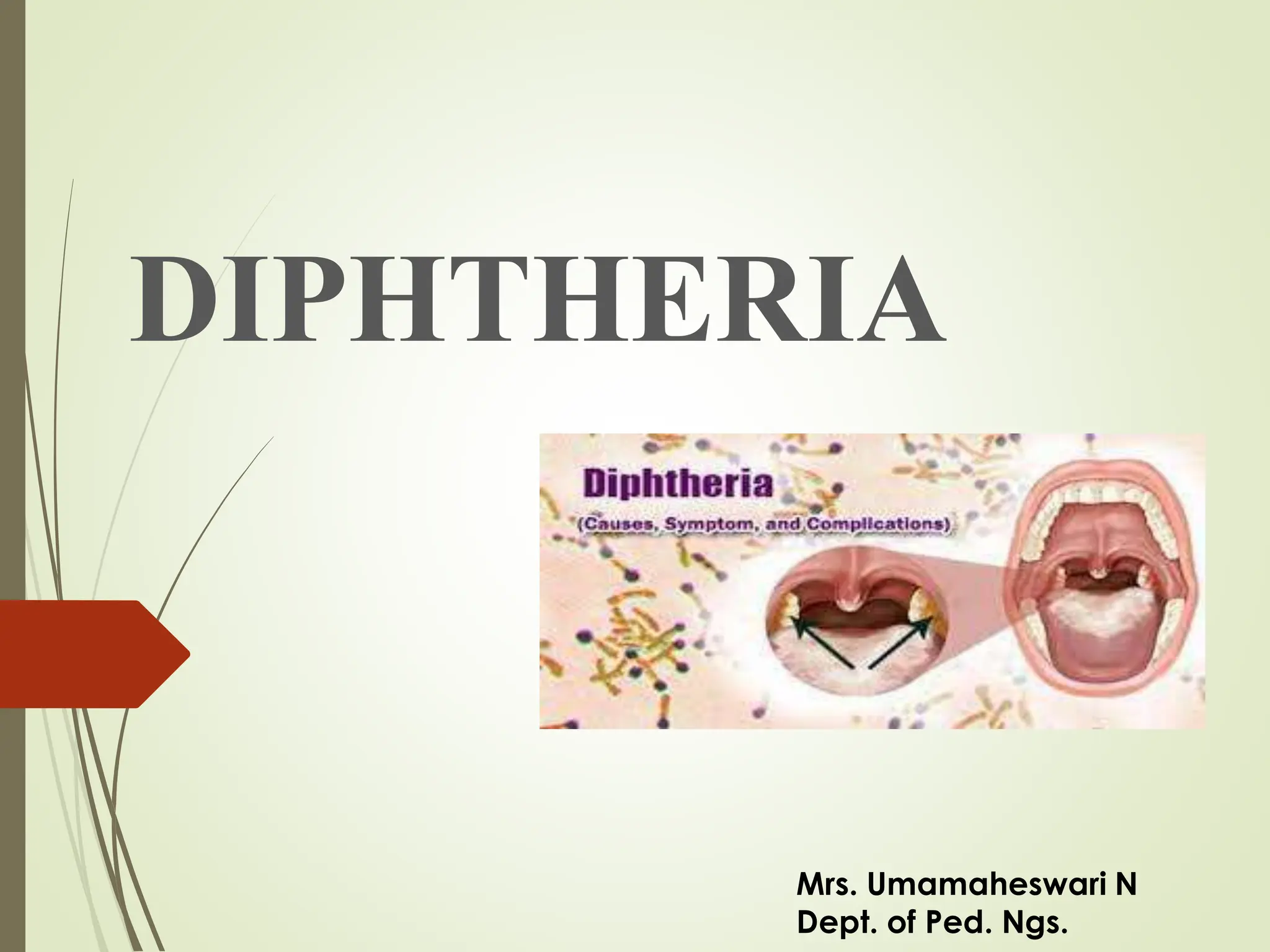
DEFINITION
Diphtheria is anacute infectious infection caused
by corynebacterium species, c.diphtheriae
AGENT FACTORS:
Contagious and lifethreatening disease
The causative organism is corynebacterium diphtheriae
which is a gram positive, non motile organism. It has no
invasive power but produces a powerful exotoxin.
3.
EPIDEMIOLOGY:
Cases of diphtheriaoccur in all seasons, although winter
months favour its spread.
In Kolkata the highest incidence was reported in august,
In Mumbai in the winter months and
In delhi during august to October.
4.
Source of infection:
Thesource of infection may be a case or carrier.
Infective material:
Nasopharyngeal secretions, discharges from skin lesions,
contaminated fomites
Period of infectivity:
14-28 days from the onset of the disease
5.
HOST FACTORS:
Age: 1to 5 years
Sex: Both sexes are affected
Immunity: Infants born of immune mothers are
relatively immune during the first few weeks or
months of life.
Schick test surveys in India have shown that
about 70 percent of children over the age of 3
years and 99 percent over the age of 5 years are
already immune to diphtheria.
6.
MODE OF TRANSMISSION:
dropletinfection.
from infected cutaneous lesions.
by objects e.g cups, thermometers, toys, pencils,
contaminated by the nasopharyngeal secretions
of the patient is possible
7.
PORTAL OF ENTRY:
Respiratoryroute:
Commonly the portal of entry is the respiratory tract
Non Respiratory route:
skin where cuts, wounds and ulcers
Umbilicus in the newborn.
INCUBATION PERIOD:
2-6 days, possibly longer.
8.
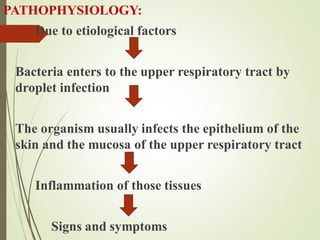
PATHOPHYSIOLOGY:
Due to etiologicalfactors
Bacteria enters to the upper respiratory tract by
droplet infection
The organism usually infects the epithelium of the
skin and the mucosa of the upper respiratory tract
Inflammation of those tissues
Signs and symptoms
Nasal
Nasal diphtheria themildest form of
respiratory diphtheria
Resembles common cold
Mucopurulent nasal discharge without
constitutional symptoms; may have
epistaxis.
11.
Pharyngotonsillar
sore throat,
difficulty inswallowing
low grade fever
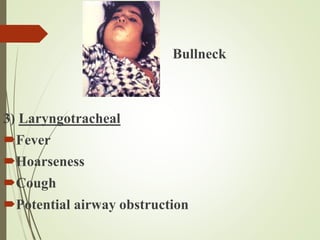
edema of the submandibular area and the
anterior portion of the neck along with
lymphadenopathy giving a characteristic
“bullnecked” appearance.
DIAGNOSTIC EVALUATION:
Specimens forculture should be obtained
from the nose and throat
Swab specimen can be done.
Evaluation of a direct smear using Gram
stain
Schick test
14.
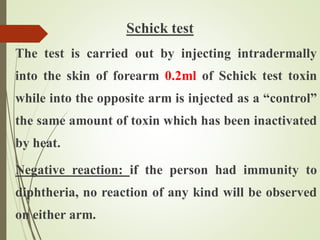
Schick test
The testis carried out by injecting intradermally
into the skin of forearm 0.2ml of Schick test toxin
while into the opposite arm is injected as a “control”
the same amount of toxin which has been inactivated
by heat.
Negative reaction: if the person had immunity to
diphtheria, no reaction of any kind will be observed
on either arm.
15.
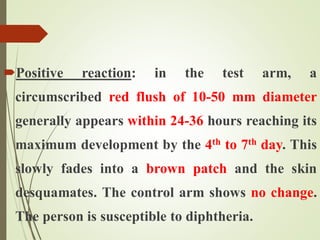
Positive reaction: inthe test arm, a
circumscribed red flush of 10-50 mm diameter
generally appears within 24-36 hours reaching its
maximum development by the 4th to 7th day. This
slowly fades into a brown patch and the skin
desquamates. The control arm shows no change.
The person is susceptible to diphtheria.
16.
Pseudo- Positive reaction:a red flush develops
equally on both the arms, but much less
circumscribed than the true positive reaction.
The reaction fades very quickly and disappears
by the 4th day. This is an allergic type of reaction
found in certain individuals. The test is
interpreted as Schick negative.
17.
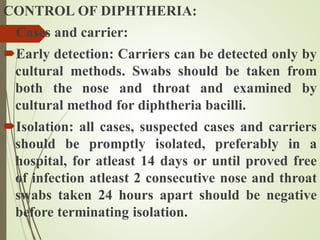
CONTROL OF DIPHTHERIA:
Casesand carrier:
Early detection: Carriers can be detected only by
cultural methods. Swabs should be taken from
both the nose and throat and examined by
cultural method for diphtheria bacilli.
Isolation: all cases, suspected cases and carriers
should be promptly isolated, preferably in a
hospital, for atleast 14 days or until proved free
of infection atleast 2 consecutive nose and throat
swabs taken 24 hours apart should be negative
before terminating isolation.
18.
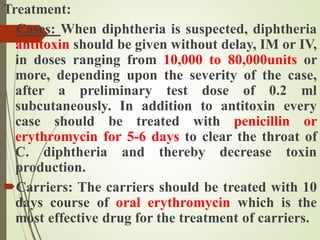
Treatment:
Cases: When diphtheriais suspected, diphtheria
antitoxin should be given without delay, IM or IV,
in doses ranging from 10,000 to 80,000units or
more, depending upon the severity of the case,
after a preliminary test dose of 0.2 ml
subcutaneously. In addition to antitoxin every
case should be treated with penicillin or
erythromycin for 5-6 days to clear the throat of
C. diphtheria and thereby decrease toxin
production.
Carriers: The carriers should be treated with 10
days course of oral erythromycin which is the
most effective drug for the treatment of carriers.
NURSING MANAGEMENT:
Good nursingcare is essential for recovery.
Provide complete bed rest
Suctioning is done as needed
Observe respiration for signs of obstruction
Administer humidified oxygen as prescribed.
Administer antibiotic in time
COMPLICATIONS:
Toxic cardiomyopathy
Toxic neuropathy





![CTEV [ clubfoot] DR ARUN LAL ,DR MOHAMED ASHRAF travancore medical college k...](https://cdn.slidesharecdn.com/ss_thumbnails/ctevclubfootdrarunlaldrmohamedashraftravancoremedicalcollegekollamkeralaindia-260208063247-18fc466c-thumbnail.jpg?width=640&height=640&fit=bounds)


![PERI-PROSTHETIC FRACTURE NAIL-PLATE CONSTRUCT [NPC].pptx](https://cdn.slidesharecdn.com/ss_thumbnails/drarunkumardrmohamedashrafperiprostheticfrasturenail-plateconstructnpc-260209164459-7e9d15a1-thumbnail.jpg?width=640&height=640&fit=bounds)


![ONFH[AVN HIP] -TRIPLE REGIME -A NOVAL SURGICAL CONCEPT .pptx](https://cdn.slidesharecdn.com/ss_thumbnails/onfhavnhip2026koaconcalicutdrgokuldevdrmashraf-260210064517-213ec005-thumbnail.jpg?width=640&height=640&fit=bounds)


