‫بسم‬
‫هللا‬
‫الرحمن‬
‫الرحيم‬
PRESENTED BY
FIRDOUS FAROOQ
B.SC N 2ND YEAR
TOPIC
DIPTHERIA
TERMINOLOGIES
•Exotoxin : Protiens produced inside pathogenic
bacteria as a part of their growth and metabolism.
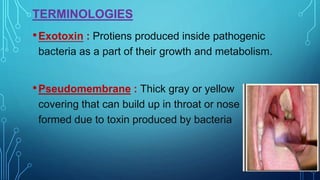
•Pseudomembrane : Thick gray or yellow
covering that can build up in throat or nose
formed due to toxin produced by bacteria
•Case : A person in the population identified as
having a particular disease or is under
investigation
•Carrier : one who carries the causative agent
of a disease but is asymptomatic or immune to
it
•Contact : One who has communicated or get
in touch with case or carrier
•Antisera : A blood serum containing
antibodies againest specific antigens injected
to treat or protect againest specific diseases
•Croupy cough : Bark like cough due to respiratory
tract infection
• Adjuvant : ingrediant used in vaccines that increases
the immune response to a vaccine e.g aluminum
phosphate
•Lymphadenopathy : Abnormal enlargement of
lymph nodes
INTRODUCTION
•Diptheria(Gk word meaning leather) is a highly
infectious and communicable disease characterised
by involvement of the respiratory system,the local
production of membrane and general symptoms
caused by absorption of toxin.
•The powerful exotoxin produced by the bacteria is
responsible for :
 Formation of yellowish membrane commonly over
pharynx or larynx which cannot be wiped away
Local tissue destruction
Enlargement of regional lymph nodes
HISTORY
•Term Diptheria was given by french physician Pierre
Bretonneau
•In the past its name was General disease or killer
disease because of no treatment and having high
mortality rate between children
•Disease killed about 80% of children below 10 years
of age
•In 1884 Friedrich Loeffler discovered the causative
organism of diptheria
•In 1890s physician Behring developed antitoxin that
did not kill the bacterium but neutralized the bacterial
toxins
•The first successful vaccine for diptheria was
developed by Behring in 1913
DEFINITION
•Diptheria is an infectious and highly
contagious,toxin-mediated disease caused by
bacterium corynebacterium diptheria,which primarily
infects throat and upper airways.
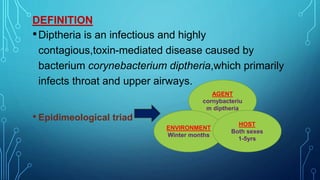
• Epidimeological triad
AGENT
cornybacteriu
m diptheria
ENVIRONMENT
Winter months
HOST
Both sexes
1-5yrs
CAUSATIVE AGENT
•Diptheria is caused by cornybacterium diptheriae
bacteria- a gram positive,nonmotile organism
•Four types of bacteria are differentiated-
gravis,mitis,belfanti and intermedius out of which
gravis is more severe
•It produces a powerful toxin that can affect
heart(myocarditis) or the nerves (paralysis)
•Survies for short time in dust and fomites
SOURCE OF INFECTION
• Source may be case or carrier(most common)
• Ratio is estimated to be 95 carriers for 5 clinical cases
• Nasal carriers are dangerous source of infection because of
frequent shedding of organism into environment than throat
carriers
• A case or carrier may be considered non communicable
when at least 2 cultures obtained from nose & throat ,24
hours apart,are negative for diptheria bacilli
• Period of infectivity may vary from 14 to 28 days
HOST FACTORS
•Diptheria particularly affects children aged 1 to 5 yrs
•Both sexes are affected
ENVIRONMENTAL FACTORS
•Diptheria occurs in all seasons although winter
months favour its spread
MODE OF TRANSMISSION
•Diptheria is transmitted from person to person
usually through respiratory droplets,from coughing or
sneezing
•Also transmitted from infected skin lesions
•Transmission by objects (cups,toys etc)
contaminated by nasopharyngeal secretions of the
patient is also possible
PORTAL OF ENTRY
•Respiratory tract is the common portal of entry
•Portal of entry may be sometimes skin cuts,open
wounds,ulcers & umbilicus of newborn if infected
with diptheria bacilli
INCUBATION PERIOD
•2-6 days,may be longer sometimes
SIGNS AND SYMPTOMS
• Signs and symptoms of diptheria differ depending upon
location of infection
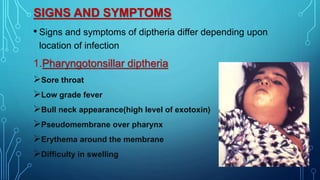
1.Pharyngotonsillar diptheria
Sore throat
Low grade fever
Bull neck appearance(high level of exotoxin)
Pseudomembrane over pharynx
Erythema around the membrane
Difficulty in swelling
2.Laryngotracheal diptheria
• Often preceeded by pharyngotonsillar diptheria
Fever
Croupy cough with hoarseness
Dyspnea ( if bronchial tree involved)
3.Nasal diptheria
• Usualy localized to the septum of nose
• Real public problem as it spreads rapidly than other forms
Bloodstained nasal discharge
• 4.Cutaneous diptheria
•Found in people with poor skin hygiene and causes:
Pain
Ulceration
Demarcated membrane around wound
Redness
Swelling
Numbness (if exotoxin level is high)
SCHICK TEST
• Used to check susceptibility to diptheria
• Developed by american pediatrician Bela Schick in 1913
• A small amount(0.1ml) of diluted diptheria toxin is injected
intradermaly into one arm(test arm) and heat inactivated
toxin on other arm(control arm)
• Results can be interpreted as:
1.Positive reaction:in test arm red induration of 10-15mm
appears within 24-36 hours,reaching its peak in 4-7 days and
slowly fades away
• Control arm shows no change
• This indicates that person lacks antibodies against toxin and
hence is susceptible to diptheria
2.Negative reaction: No reaction in either arm
• Blood serum contains >0.03units/ml antitoxin
• This indicates that the person is immune
3.Pseudopositive reaction: Only erythema occurs in both
arms which disappears within 4 days
• Indicates that person is immune but hypersensitive to toxin
• 4.Combined reaction: It is initially like that of pseudopositive
reaction but Erythema fades off after 4 days only in control
arm and progresses on test arm to a positive reaction
• Indicates person is both susceptible & hypersensitive
Complications
Respiratory failure-due to obstruction of airway by
membrane
Myocarditis-develops by 2nd week and can lead to CHF
and sudden death
Neurological:(polyneuritis)
1.Palatal palsy-nasal intonation of voice
2.Ocular palsy-deviation of eye
3.Blurring of vision
Renal complications
1.oliguria(<400ml of urine/day)
2.Protienuria
• Prevention and control
• Nasal & throat swab-culture tests should be done to detect
cases,carriers and contacts
• Isolate all cases,carriers in the hospital for at least 14 days
• Isolation should be ended when 2 cultures (24hr gap) from
nose and throat are negative
• Maintain high level of immunity in community with 3 doses
of DPT
• Care should be provided by fully immunized staff
• Vaccination is the best way to prevent diptheria
• Immunization
• Current prophylactics are grouped under 3 catogaries :
1.Combined or mixed vaccines
-DPT(diptheria-pertussis-tetanus vaccine)
-DT(diptheria-tetanus toxoid)
-dT(diptheria-tetanus,adult type)
• For immunizing infants,prepration of choice is DPT
• WHO recommends that only adjuvant DPT preprations
should be utilized in immunization programmes
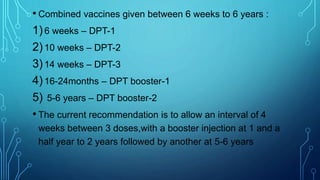
• Combined vaccines given between 6 weeks to 6 years :
1)6 weeks – DPT-1
2)10 weeks – DPT-2
3)14 weeks – DPT-3
4)16-24months – DPT booster-1
5) 5-6 years – DPT booster-2
• The current recommendation is to allow an interval of 4
weeks between 3 doses,with a booster injection at 1 and a
half year to 2 years followed by another at 5-6 years
Storage
• DPT vaccine should be stored in a refrigerator between 2-8
degree
• When issued to a sub-centre,vaccine should be used within
a week
Age-DPT vaccine can be safely and effectively
administered as early as 6 weeks after birth
Doses-3 doses of DPT each 0.5ml
Route & site-IM (anterolateral side of mid thigh)
2.Single vaccines
-FT(formal toxoid)
-APT(alum-precipitated toxoid)
-TAF(toxoid-antitoxin flocculus)
3.Antisera
• Prepared from horse serum to treat diptheria
• Prophylactic dose-500-2000 units SC/IM
• Therapeutic dose-10,000-30,000 units IM
Treatment
Cases
•Diptheria antitoxin 10,000-80,000 units IM or IV
•Apart from antitoxin give penicillin 2.5 lakh units
every 6 hourly or Erythromycin 250mg/6hrly for 5-6
days
Carriers
• Oral Erythromycin for 10 days
Contacts
•Erythromycin or penicillin administered for non
immunized contact
Community level
•Active immunization of all infants as per schedule
•Booster doses every 10 years
Summary
Diptheria is a highly communicable,acute bacterial
infection.it was once a leading cause of death among
children.the bacteria produces a toxin that can spread
from the site of infection to other tissues in the body.it
usually affects the throat and nose but in serious
cases it may affect nervous system and heart.it has
mainly four types.early detection and treatment is the
best way of prevention and control
•Bibliography
• Parks textbook of preventive and social medicine,edition
23rd,page no.159-164
• Textbook of community hralth nursing-1 by shymala D
manivannan,edition 1st,page no.241-243
• http://www.who.in,accessed on 16 june 2021 at 8:30 pm

PPT on Diptheria disease

  • 1.
  • 2.
  • 3.
    TERMINOLOGIES •Exotoxin : Protiensproduced inside pathogenic bacteria as a part of their growth and metabolism. •Pseudomembrane : Thick gray or yellow covering that can build up in throat or nose formed due to toxin produced by bacteria
  • 4.
    •Case : Aperson in the population identified as having a particular disease or is under investigation •Carrier : one who carries the causative agent of a disease but is asymptomatic or immune to it
  • 5.
    •Contact : Onewho has communicated or get in touch with case or carrier •Antisera : A blood serum containing antibodies againest specific antigens injected to treat or protect againest specific diseases
  • 6.
    •Croupy cough :Bark like cough due to respiratory tract infection • Adjuvant : ingrediant used in vaccines that increases the immune response to a vaccine e.g aluminum phosphate •Lymphadenopathy : Abnormal enlargement of lymph nodes
  • 7.
    INTRODUCTION •Diptheria(Gk word meaningleather) is a highly infectious and communicable disease characterised by involvement of the respiratory system,the local production of membrane and general symptoms caused by absorption of toxin.
  • 8.
    •The powerful exotoxinproduced by the bacteria is responsible for :  Formation of yellowish membrane commonly over pharynx or larynx which cannot be wiped away Local tissue destruction Enlargement of regional lymph nodes
  • 9.
    HISTORY •Term Diptheria wasgiven by french physician Pierre Bretonneau •In the past its name was General disease or killer disease because of no treatment and having high mortality rate between children •Disease killed about 80% of children below 10 years of age
  • 10.
    •In 1884 FriedrichLoeffler discovered the causative organism of diptheria •In 1890s physician Behring developed antitoxin that did not kill the bacterium but neutralized the bacterial toxins •The first successful vaccine for diptheria was developed by Behring in 1913
  • 11.
    DEFINITION •Diptheria is aninfectious and highly contagious,toxin-mediated disease caused by bacterium corynebacterium diptheria,which primarily infects throat and upper airways. • Epidimeological triad AGENT cornybacteriu m diptheria ENVIRONMENT Winter months HOST Both sexes 1-5yrs
  • 12.
    CAUSATIVE AGENT •Diptheria iscaused by cornybacterium diptheriae bacteria- a gram positive,nonmotile organism •Four types of bacteria are differentiated- gravis,mitis,belfanti and intermedius out of which gravis is more severe •It produces a powerful toxin that can affect heart(myocarditis) or the nerves (paralysis) •Survies for short time in dust and fomites
  • 13.
    SOURCE OF INFECTION •Source may be case or carrier(most common) • Ratio is estimated to be 95 carriers for 5 clinical cases • Nasal carriers are dangerous source of infection because of frequent shedding of organism into environment than throat carriers • A case or carrier may be considered non communicable when at least 2 cultures obtained from nose & throat ,24 hours apart,are negative for diptheria bacilli • Period of infectivity may vary from 14 to 28 days
  • 14.
    HOST FACTORS •Diptheria particularlyaffects children aged 1 to 5 yrs •Both sexes are affected ENVIRONMENTAL FACTORS •Diptheria occurs in all seasons although winter months favour its spread
  • 15.
    MODE OF TRANSMISSION •Diptheriais transmitted from person to person usually through respiratory droplets,from coughing or sneezing •Also transmitted from infected skin lesions •Transmission by objects (cups,toys etc) contaminated by nasopharyngeal secretions of the patient is also possible
  • 16.
    PORTAL OF ENTRY •Respiratorytract is the common portal of entry •Portal of entry may be sometimes skin cuts,open wounds,ulcers & umbilicus of newborn if infected with diptheria bacilli INCUBATION PERIOD •2-6 days,may be longer sometimes
  • 17.
    SIGNS AND SYMPTOMS •Signs and symptoms of diptheria differ depending upon location of infection 1.Pharyngotonsillar diptheria Sore throat Low grade fever Bull neck appearance(high level of exotoxin) Pseudomembrane over pharynx Erythema around the membrane Difficulty in swelling
  • 18.
    2.Laryngotracheal diptheria • Oftenpreceeded by pharyngotonsillar diptheria Fever Croupy cough with hoarseness Dyspnea ( if bronchial tree involved) 3.Nasal diptheria • Usualy localized to the septum of nose • Real public problem as it spreads rapidly than other forms Bloodstained nasal discharge
  • 19.
    • 4.Cutaneous diptheria •Foundin people with poor skin hygiene and causes: Pain Ulceration Demarcated membrane around wound Redness Swelling Numbness (if exotoxin level is high)
  • 20.
    SCHICK TEST • Usedto check susceptibility to diptheria • Developed by american pediatrician Bela Schick in 1913 • A small amount(0.1ml) of diluted diptheria toxin is injected intradermaly into one arm(test arm) and heat inactivated toxin on other arm(control arm) • Results can be interpreted as: 1.Positive reaction:in test arm red induration of 10-15mm appears within 24-36 hours,reaching its peak in 4-7 days and slowly fades away
  • 21.
    • Control armshows no change • This indicates that person lacks antibodies against toxin and hence is susceptible to diptheria 2.Negative reaction: No reaction in either arm • Blood serum contains >0.03units/ml antitoxin • This indicates that the person is immune 3.Pseudopositive reaction: Only erythema occurs in both arms which disappears within 4 days • Indicates that person is immune but hypersensitive to toxin
  • 22.
    • 4.Combined reaction:It is initially like that of pseudopositive reaction but Erythema fades off after 4 days only in control arm and progresses on test arm to a positive reaction • Indicates person is both susceptible & hypersensitive Complications Respiratory failure-due to obstruction of airway by membrane Myocarditis-develops by 2nd week and can lead to CHF and sudden death
  • 23.
    Neurological:(polyneuritis) 1.Palatal palsy-nasal intonationof voice 2.Ocular palsy-deviation of eye 3.Blurring of vision Renal complications 1.oliguria(<400ml of urine/day) 2.Protienuria
  • 24.
    • Prevention andcontrol • Nasal & throat swab-culture tests should be done to detect cases,carriers and contacts • Isolate all cases,carriers in the hospital for at least 14 days • Isolation should be ended when 2 cultures (24hr gap) from nose and throat are negative • Maintain high level of immunity in community with 3 doses of DPT • Care should be provided by fully immunized staff • Vaccination is the best way to prevent diptheria
  • 25.
    • Immunization • Currentprophylactics are grouped under 3 catogaries : 1.Combined or mixed vaccines -DPT(diptheria-pertussis-tetanus vaccine) -DT(diptheria-tetanus toxoid) -dT(diptheria-tetanus,adult type) • For immunizing infants,prepration of choice is DPT • WHO recommends that only adjuvant DPT preprations should be utilized in immunization programmes
  • 26.
    • Combined vaccinesgiven between 6 weeks to 6 years : 1)6 weeks – DPT-1 2)10 weeks – DPT-2 3)14 weeks – DPT-3 4)16-24months – DPT booster-1 5) 5-6 years – DPT booster-2 • The current recommendation is to allow an interval of 4 weeks between 3 doses,with a booster injection at 1 and a half year to 2 years followed by another at 5-6 years
  • 27.
    Storage • DPT vaccineshould be stored in a refrigerator between 2-8 degree • When issued to a sub-centre,vaccine should be used within a week Age-DPT vaccine can be safely and effectively administered as early as 6 weeks after birth Doses-3 doses of DPT each 0.5ml Route & site-IM (anterolateral side of mid thigh)
  • 28.
    2.Single vaccines -FT(formal toxoid) -APT(alum-precipitatedtoxoid) -TAF(toxoid-antitoxin flocculus) 3.Antisera • Prepared from horse serum to treat diptheria • Prophylactic dose-500-2000 units SC/IM • Therapeutic dose-10,000-30,000 units IM
  • 29.
    Treatment Cases •Diptheria antitoxin 10,000-80,000units IM or IV •Apart from antitoxin give penicillin 2.5 lakh units every 6 hourly or Erythromycin 250mg/6hrly for 5-6 days Carriers • Oral Erythromycin for 10 days
  • 30.
    Contacts •Erythromycin or penicillinadministered for non immunized contact Community level •Active immunization of all infants as per schedule •Booster doses every 10 years
  • 31.
    Summary Diptheria is ahighly communicable,acute bacterial infection.it was once a leading cause of death among children.the bacteria produces a toxin that can spread from the site of infection to other tissues in the body.it usually affects the throat and nose but in serious cases it may affect nervous system and heart.it has mainly four types.early detection and treatment is the best way of prevention and control
  • 32.
    •Bibliography • Parks textbookof preventive and social medicine,edition 23rd,page no.159-164 • Textbook of community hralth nursing-1 by shymala D manivannan,edition 1st,page no.241-243 • http://www.who.in,accessed on 16 june 2021 at 8:30 pm